Tag: Indian News Television Summit

  • “The news industry is fighting amongst itself”: Rajat Sharma

    “The news industry is fighting amongst itself”: Rajat Sharma

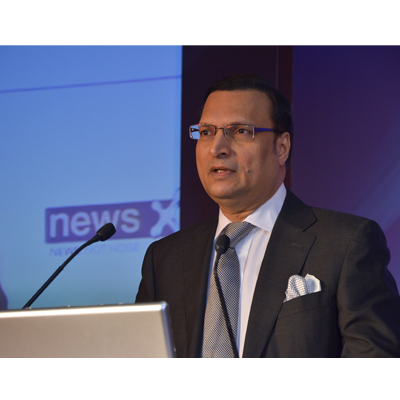
    NOIDA:  He is one of the most well known faces of the Indian media industry. Rajat Sharma, the host of popular talk show, Aap Ki Adalat, has added responsibilities on his shoulders. He is not only the chairman and editor in chief of India TV, but also represents the industry as the new president of the News Broadcasters Association as well as the vice president of strategic affairs of the Indian Broadcasting Foundation (IBF).

    Sharma, who was addressing the 7th Indian News Television Summit 2014 organised by indiantelevision.com as a keynote speaker highlighted the evolution of the news industry as well as listed the three biggest challenges that lie ahead.

    He began by saying that three years ago the news channel industry was very different from what it is today. “There has been a change in perception in the way news is seen,” Sharma said adding that news no longer is considered to be negative.

    Substantiating the evolution in terms of changing perception, Sharma gave the example of the 26/11 terror attack when reporters did 24X7 reportage and were blamed for aiding the terrorists and their handlers in Pakistan. “News channels also suffered commercial losses during the attacks as ad breaks were restricted,” he informed. According to Sharma, while news channels earlier were perceived as being a platform that telecasted frivolous events to garner eyeballs, things today have changed. “News is back,” he announced.

    He pointed out that the space has seen drastic changes.  “The society has evolved and the media has played a great role in it especially during events like the Lokpal Bill, the Delhi gang rape and the tirade against corruption,” he said.

     “Today even if Shah Rukh Khan or Salman Khan want to promote their films or emerging sports like Kabaddi wants to garner attention, news channels have a role to play in that as well,” he opined.

    Sharma while praising the social commitments of the news industry said that the space as a whole is not healthy. “The biggest problem for the industry is its revenue model,” he said while pointing out that though this year the balance sheets of the industry looks good due to elections, but, as a whole, the model is not sustainable.

    Listing the three main challenges for the genre, Sharma said that carriage fee was the biggest concern. “A few years ago, people expected news channels to be a loss making property since carriage fees were high and when broadcasters spoke to the multi system operators (MSOs) they said it was a problem of demand and supply. When digitisation kickstarted, we thought that consumers will get better quality channels and carriage fees will disappear. For the MSOs, it is the carriage fee from the news channels that helps them sustain, since they pay the GEC’s huge sums for getting their programming on their platform,” he said.

    He informed that the industry had 20-25 meetings with the previous TRAI chairman to discuss the issue of carriage fees.  While it was expected that digitisation would bring down carriage fees, something unexpected happened. Two days before the former TRAI chairman could retire he signed the ad cap. “When we were trying to improve the content and trying to solve one issue we were burdened with another one.”

    “Ad cap ensured we received 50 per cent less advertising. Death was certain now for the news channels,” he added.

    While the then Union Minister Ambika Soni said she will look into the matter, the broadcasters decided to fight the case in TDSAT. “News channels have managed to get a stay and therefore are surviving,” he said while giving the example of the newspaper industry, which has no such restriction. “We want the same for the broadcasting industry,” he opined.

    He also mentioned that the industry needs a better rating system and the TAM currency will be replaced by BARC India, which is an incorruptible agency.  “Therefore today the biggest challenge for the industry is the ad cap, the rating system and carriage fees,” he informed.

    In his closing remarks he said the whole industry including the IBF and the NBA should work together to resolve these issues. “The news industry as a whole cannot fight the MSOs as we are fighting amongst ourselves. While, we come together during a board room meeting, once we are out there will be one or two who would go against the same,” he lamented. 
  • 7th Indian News Television Summit: Innovation for higher ad revenue

    7th Indian News Television Summit: Innovation for higher ad revenue

    MUMBAI: ‘When the going gets tough, the tough get going’ is an age old adage. Operating in a cash crunch environment, this seems to be just what Indian news broadcasters will have to do  if they want to continue to beam into homes. 


    The Indian TV news business has been grappling with several issues. Close to 400 channels account for a small per cent of ad spends. High carriage fees and cutthroat competition for the ad rupee have made the going really tough for those in the news business. 


    With this as the backdrop, comes leading Indian media service Indiantelevision.com’s Seventh News Television Summit entitled ‘Monetisation in Transformational Times” on 28 October at the Radisson Blu Hotel in Noida, Uttar Pradesh.  It seeks to address how those in the news TV ecosystem can develop more robust or new business models, including new revenue streams such as digital online video, syndication, off the air ground activities, advertiser driven programming solutions, among many others. 


    The highlights of the half day premier news television industry confab  are a keynote by News Broadcasters Association president and India TV chairman and editor in chief Rajat Sharma followed by a discussion on ‘Meeting the challenge for today’s TV news networks, a one-on-one with ITV Network MD Kartikeya Sharma and then a keynote from leading media agency Group M south Asia CEO CVL Srinivas.  .


    The session ‘Content monetisation through conventional and digital platforms of news channel’ will see a reveling discussion on how business heads are meeting the challenge of low ad rates and near zero subscription revenue with rising cost through alternative options such as syndication of news, events, digital etc. Included in this session are NDTV group CEO Vikram Chandra, TV Today Network CEO Ashish Bagga, IBN18 Network CEO Avinash Kaul, Doordarshan ADG News Mayank Agarwal and Focus News Network group CEO Neeraj Sanan.


    ‘Innovation in news selling’ will explore novel ideas for media agencies and brands to increase their ROI from their investments on news networks and what innovative methods can be drawn for both to achieve a win-win business model. Opening the session is Srinivas’ keynote followed by a discussion with IPG Mediabrands India CEO Shashi Sinha, CNN-IBN and IBN7 national revenue head Vishal Bhatnagar, India TV senior VP and country head – ad sales Sudipto Chowdhuri and Zee Sangam national sales head Harsha Vardhan Dwivedi. The sessions will be moderated by Provocateur Advisory principal Paritosh Joshi.


    Editors of networks will discuss how far they will go to allow money to drive content in the session titled  ‘Monetisation for editorial independence’. ITV Network editor in chief Deepak Chaurasia, former India TV editorial director and veteran journalist QW Naqvi, Mi Marathi consultant Nikhil Wagle and moderator Aaj Tak and Headlines Today editor at large Rahul Kanwal will take the stage. In a separate discussion,  Amagi co-founder KA Srinivasan will discuss how it can offer solutions to advertisers and news networks to further ad revenue.


    Says Indiantelevision.com founder, CEO and editor in chief Anil Wanvari:So far the news television industry has not been able to harness substantial subscription revenues, even as carriage fees look set to rise with digitisation being delayed. Hence, it needs to look for solutions to hike revenues from the advertising inventory – the threat of the reduction of this has been staved off at least for now – they have, apart from working closely with advertisers and agencies to offer solutions that opens up the revenue pipeline for them further. The challenge is to increase their yields while increasing the ROI for advertisers. I believe the seventh news television summit will help give both advertisers and news channels some pointers as to how they could achieve this jointly.”


    The presented by sponsor for the event is Jia News, silver partners are Akamai, India News, NewsX, Sakshi TV, TV9, growth partner is SureWaves, Amagi is lanyard partner, support partners are CNBC Awaaz and CNBC TV18, online media partners are radioandmusic.com and tellychakkar.com. The event is executed by ITV 2.0 Productions.