Tag: Indian Digital TV Honours

  • The LMO-MSO relationship will get clarified within six months: Sameer Manchanda

    The LMO-MSO relationship will get clarified within six months: Sameer Manchanda

    NEW DELHI: Digitisation has given an opportunity for cable to compete with direct-to-home (DTH). There was a time when digital meant DTH and cable was largely analogue. But now, there is competition between digital and digital. While world over, cable is supposed to provide premium products, here in India, DTH was and is considered as a premium product. Digitisation has given cable an opportunity to show its might to DTH, compete with it, and provide customers television without interruption and with broadband internet and Value Added Services (VAS).


    We are in a highly competitive work environment. For smaller players to emerge, they will need scale, pure execution and vision of where they want to see themselves. They should be thinking big and along with that, should have the patience to wait for at least 5-10 years. There will be hiccups and ups and downs, but as long as they manage and maintain the course, they will achieve their goal. Cable has a unique proposition. It has scale, is a mass product, has mass appeal, is bigger than DTH, and every home has been watching cable since 1991. So just believe in the vision.


    Cable is a technology; we just have to leap frog from analogue to a complete different pipe, and that will happen in the next 5-10 years. As we saw in the case of mobile, even cable will go the same way as the world has gone.


    I know that there is a lot of pain, and in the beginning years, we have all faced it and will probably face it for a little longer too. But in the next 10 years, everyone will benefit. And every stakeholder, be it small Multi System Operators (MSOs), Last Mile Owners (LMO) or national MSOs, each one will gain. The industry can only be as vibrant and strong as each of its players. So, one player cannot remain vibrant while the other isn’t. The whole industry has to be vibrant and so, we all have to take a step forward in unifying the cable industry and making it vibrant.


    The LMOs and MSOs have to think that they are partners. Right now, there is a turf war of economics. But it will wear off once they realise that the customer will go wherever he/she wants to. He will go to DTH or the IPTV platform or 4G or any other platform where he/she gets better service. So, the LMOs and MSOs have to understand that they have to be together.


    If you see, the MSOs are ploughing in a lot of investment; they are dealing with broadcasters and are taking risks. They are also the ones who are making the pipe much stronger, so if you look at that, there is a role that the MSO plays and then there is a role that the LMO plays.


    Today, the turf war is on economics. But in six to nine months, each player will understand the strengths and weaknesses of each party. And if they play to the strengths, the customer will get a better product and then he/she will pay much more than what he/she earlier paid. Because if you see that from 70 channels, they will have 300-400 channels, then there will be VAS and much more. So you will see that the LMOs will be making much more than what they are making today.


    The revenue share needs to be sorted and these are things that need discussion. The MSO is also in a tight position. He has to deal with broadcasters and also ensure that the customer management is better than DTH. There are investments that need to be made. So I think that both parties need to understand each other.


    The first effect of digitisation has already been felt and that has happened from the customers’ end. The customer today has moved from some 70 channels to 300 channels and all this with no interference. He/she has been given a box for a reasonable sum and in a few minutes, with no wire and antenna, he has started getting the digital experience. This has been the real effect of digitisation, which has unfortunately gone unnoticed. And this was the reason that 21 million homes, which could have chosen DTH, chose digital cable instead. So the effect of digitisation has been felt, but now because of switch offs, the LMO issue, and under investment by some players, the impact is marred. So there will be good and bad times for cable, but then in a couple of years, it will all be sorted.


    The entire chain of media will become vibrant. The broadcaster, LMO and MSO will gain. Currently, since everybody is looking at getting the most, there are wars, but this will get resolved in six months, it can’t take longer. I want to see the industry getting stronger, more vibrant. Customers should be so happy with cable that they start moving from other players to cable. We all want cable to be strong and the whole chain to be very vibrant.


    I am an optimist. Media has a great future in the next 5-10 years. No one part can say that he will gain while others don’t. All stakeholders will benefit. Even the customers will have the option of close to 1,000 channels. Yes, they will have to pay more for that, but at least, they will have the option to pay for what they want to watch, which was not there earlier. But unfortunately, this will need them to cough up a lot of money. There will be pain, but eventually, every stakeholder will have to think about 5-10 years later.


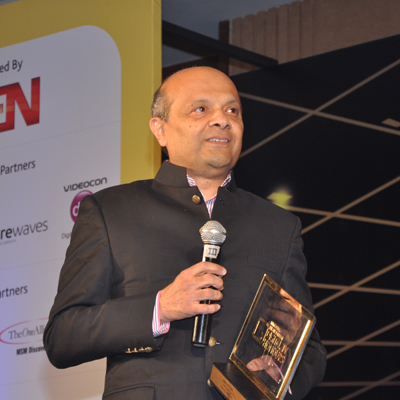
    (The remarks above are a part of the acceptance speech by DEN Networks Chairman & Managing Director Sameer Manchanda during indiantelevision.com’s The First Indian Digital TV Honours held in New Delhi on 28 January 2014)

  • First Indian Digital TV Honours celebrates digitisation’s leading practices

    First Indian Digital TV Honours celebrates digitisation’s leading practices

    NEW DELHI: It was a day when the stalwarts of the Indian cable, broadcast and direct to home television industry converged to witness the best or leading practices of the industry being recognised at indiantelevision.com’s first ever Indian Digital TV Honors (IDTH).  The event, held at the Lalit  Hotel in Delhi late last eveing saw 15 professional/initiatives/organisations getting a citation for evolving best practices during phase I and phase II of digitisation over the past 18-24 months, ever since digital addressable system (DAS) was mandated by the government.


    An advisory panel comprising 13 professionals from broadcast, cable TV, consulting and technology , along with the editorial team of indiantelevision.com, helped finalise the honoraries after a tough round of discussion for over a month on the merits and demerits of those being sought to be honoured for their great work and innovations.


    The  event was attended by close to 200 professionals from the cable, DTH and broadcast industry and the regulatory body.


    The evening was anchored by Indian Television Dot Com Founder, CEO and editor-in-chief Anil Wanvari along with TV actor Prerna Wanvari  who hosted the two hour long proceedings.


    The First Indian Digital TV Honours, which were powered by leading Indian MSO DEN Networks began with Tata Sky being honoured for its obsessive focus on consumer service and product quality. The direct to home operator (DTH) has for long being spoken of excelling in the area of customer services, and this honour  only further supported that perception.


    India’s oldest DTH operator Dish TV  was honoured for its dervish like focus on its financial health and for protecting and creating shareholder value. The citation was received by CEO RC Venkateish, who shared the fact that he has to answer to public and other shareholders regularly, making  it imperative for the company to be bottom line focused. 


    “We have been generating free cash flow for quite sometime, and probably are the only Indian DTH company to do so,” said  Venkateish. “Things could be better if we could rationalise content costs which are still way too high.”


    Videocon d2h was recognised for its technological innovations and for the use of indigenous set top boxes which the group’s sister organisation manufactures indiegenously


    Additionally MSO Hathway Cable & Datacom was honoured for its pioneering push into broadband internet services, way before anyone else in the business. “With over 400,000 users we have gained a lot of experience which will only further help us as we move forward. Consumers are demanding a lot more bandwidth as they are guzzling a lot more online content,”  said  Hathway CFO G. Subramaniam. “We will be the best company providing  the broadband internet service in the future.”


    Tata Sky was also recognised for its its Value Added Services (VAS)  which it says is helping lure subscribers to them.


    DEN Networks, which had in 2013 attracted an investment of $160 million from Goldman Sachs at a time when every other MSO was being turned away, was honoured for becoming a beacon for the cable TV sector in the area of raising capital. Elated with the honour, DEN Network CFO Rajesh Kaushal said, “This is a very cash guzzling business and so there is a lot of investment and infrastructure that is needed. We have enough capital with us to see us through Phase I, II  and III  of DAS.”


    The Indian Broadcasting Foundation (IBF) was recognised for its marketing and promotional campaign to encourage the smooth spread of digitisation.  Almost every channel aired the commercial several times a day to push the message and educate consumers about digitisation and set top boxes. The same was recognised by the Indian Digital TV Honours advisory committee.


    “We wanted to incite consumers through the ad campaign. We had aired the promos for at least eight times a day on 150 channels,” said IBF secretary Shailesh Shah while receiving the honour.  Leading broadcaster Star India was also recognised  for its strategy to invest big money in sports. Sports TV worldwide is a big driver of pay TV and Star India’s early initiative to invest big money is only going to see a similar play being played out here.  And this in turn will likely encourage the process of digitsation.


    SitiCable Network was honoured for fostering Local Cable Operator (LCO) partnerships and being the first ones to give carriage fee revenue share to the LCOs. “We believe that LCOs are an integral part of the cable TV ecosystem and that is the reason we have given them the access to our subscriber management system and also are sharing the carriage fee revenue with them,” informed SitiCable COO Anil Malhotra.


    It was in 2013 that Doordarshan owned DTH service DD Direct Plus was rechristened as Freedish. The DTH player which introduced several innovations for its consumers in the year was recognised for catering to the needs of Indian consumers through Freedish. “Freedish is the most profitable venture of Prasar Bharti. Broadcasters are changing their business model for us, which is welcome change,” said Doordarshan additional director general Ranjan Thakur while receiving the honour.


    Two industry leaders have put their shoulder to the wheel and have played a major role in promoting digitsation over the past 18-24 months and have themselves invested heavily in it: Hathway Cable’s Raheja family led by Viren Raheja and DEN Networks’ founder Sameer Manchanda. “If you have patience, scale and execution one can excel in this field which holds a lot of scope. Cable will grow exactly how mobile grew in India, but you will have to wait minimum for five years to see results,” opined Manchanda. “You have to have the passion to see your belief in cable TV come true.”


    The evening also saw Seven Star Digital Network being honoured for effectively managing digitisation as an independent operator. Honours were also given to Ministry of Information and Broadcasting and Telecom Regulatory Authority of India for their push in making India a digitised nation. Most of industry has begun hearing of the Maharashtra Cable Operators Federation (MCOF), which represents the interests of the last mile owner.  In time, if it does manage to facilitate a feasible formula on revenues and shares with MSOs, then it stands a strong chance to be honoured  in next year’s Indian Digital TV Honours.


    More power to the industry’s elbow!