Tag: Indian broadcast

  • High profile executive departures in 2016

    High profile executive departures in 2016

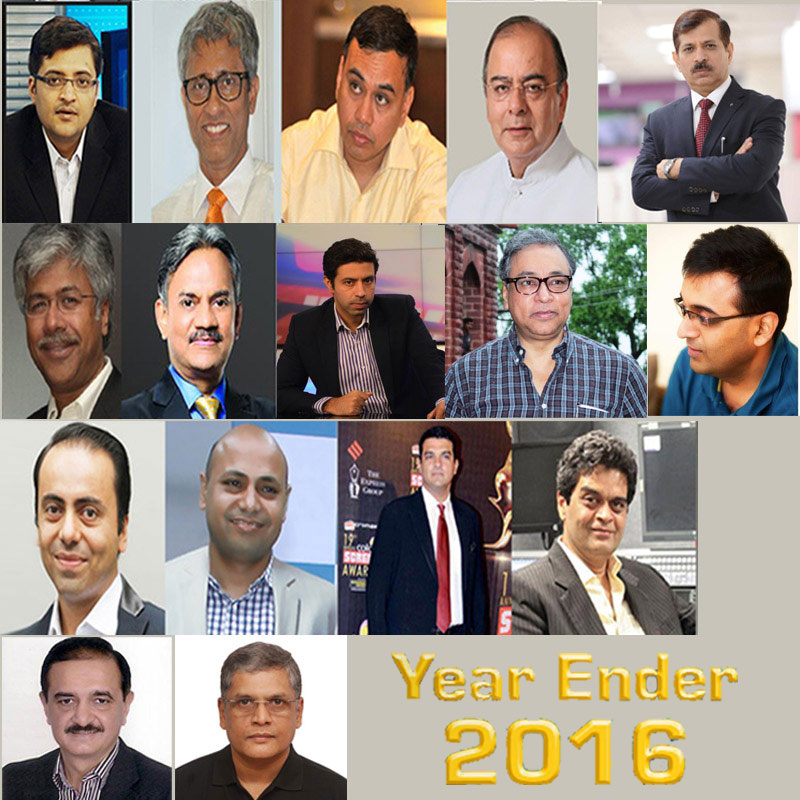
    MUMBAI/NEW DELHI: As the year comes to a close, let’s take a dekko at the major parting of ways between individuals and companies and also in companies themselves that hit the Indian broadcast, cable, satellite TV sectors. The list is definitely not comprehensive but the effort has been to try and cover what we at indiantelevision.com consider major split ups, including in the government.

    Arun Jaitley: One of the most powerful politicians in the country was entrusted by PM Modi some very important portfolios when the BJP-led government came to power mid-2014.

    In a cabinet reshuffle in November 2014, Jaitley was also handed the important ministry of information & broadcasting (MIB) and he headed three ministries at one time, including the all-powerful Ministry of Finance.

    However mid-2016, MIB was handed to M. Venkaiah Naidu. Critics said it was PM’s way of sending a message to Jaitley, but with three ministries under him, it was asking too much from the man even as brilliant as he is. Jaitley retains the portfolios of  Corporate Affairs and Finance — and, probably, could turn out to be PM Modi’s best lieutenant in the all-out war on black economy declared via  demonetisation of high-value currency notes and other proposed measures .  

    Jawhar Sircar: A senior bureaucrat-academecian, he quit the government to take up in 2012 the challenging post of CEO of India’s pubcaster Prasar Bharati, overseeing the monolithic Doordarshan and the widely-reached All India Radio.

    An outspoken person and a hard taskmaster, Sircar attempted to bring about a revolution in Prasar Bharati’s way of functioning and improve its revenue and reach.

    Partially successful, he met with lot of resistance trying to change a slothful giant. In private, he admitted that what frustrated him was that the pubcaster is manned by a bunch corrupt, no-good, job-for-life-security-seeking blokes, who wanted to retain the status quo.

    With his tenure scheduled to end in first quarter of 2017, a “tired” Sircar (as per his own admissions on social media) finally threw in the towel and sought early retirement in October 2016, which was granted by the government. Sircar returned to his home base in Kolkata to lead a  retired life and giving talks on issues related to primarily arts. 

    Arnab Goswami: The popular anchor had made shouting out his guests as the trademark of his prime time show – News Hour on Times Now. So one only expected his departure to be as noisy – though it was unfathomable by many who thought he and the channel were one – conjoined at the hip.

    And Arnab did not disappoint. The media went berserk: mainline and trade portals, social media, could not stop talking about his departure for weeks, months, and they have not stopped even as the year is coming to a close.

    Goswami’s new venture, believed to be on the cutting edge of technology — and news – is christened Republic.

    Ashok Venkatramani: The CEO of ABP News saw the news network being reinvented, rebranded and recreated from Star News to ABP News a few years ago without losing viewership and business. Venkatramani strengthened the companys financials, brough in systems and rigour making ABP News a viable business operation. He improved the company’s margins, keeping costs under control, even as he expanded ABP News Network’s portfolio to five TV channels, six mobile products, six websites and three additional revenue verticals. Venkatramani quietly resigned without any hullabaloo in November after serving out his notice period. He was replaced by Atideb Sarkar, the son of ABP editor in chief Arup Sarkar.

    Rahul Shivshankar: He left News X in November 2016 to fill the the big shoes left behind by Arnab Goswami. The Kartikeya Sharma owned NewsX flourished under his ediorial leadershup of three years during the TAM era. The journey after BARC’s evolution was not  as good, but the former Headlines Today journalist has his own following.

    Known to be an insightful, incisive journalist, Shivshankar joined Times Now on 15 December as Chief Editor, returning to the company after six years.

    Shivshankar was Senior Editor in his previous stint at the Times Now. And he seems to have done well as Arnab’s replacement. Times Television Network CEO MK Anand has come on record to state that the news network’s viewership share has stayed intact, unaffected by the larger than life news anchor’s departure.

    Sameer Ahluwalia: In one of the more controversial moves, Zee Business head Sameer Ahluwalia parted ways with Zee Media Corp Ltd (ZMCL)  Ahluwalia was associated with the Zee Network for 19 years  and was known to be a close confidante of ZMCL chairman Subhash Chandra.

    Samir’s name was embroiled in the case of the alleged extortion of Rs 100 crore along with Zee News Editor-in-chief Sudheer Chaudhary. To make matters clear, the management had immediately accepted his resignation.

    RK Arora: Zee Media has seen a lot of changes in 2016, with RK Arora being one of those who made an entry and then an exit. Known for his industry acumen and powerful contacts, RK Arora quit Zee Media as executive director and chief cxecutive officer after a stint of around 15 months.

    Arora had joined Zee in May 2015 and parted ways in August 2016. The former News Nation strategic and operational head and ITV Network senior executive has moved onto a new venture JK Media and got into the business of running television news once again.

    Zee Media Group CEO News cluster Bhaskar Das: Leadership to him means delivering outcomes and not outputs. Identifying and mitigating pain-points come naturally to him. With a career spanning over three years, he was responsible for driving up the revenue of all news channels from the cluster that includes channels such as Zee News, Zee Business, Zee 24 Taas (Marathi) and 24 Ghanta (Bengali).

    Earlier this year, he was moved to Zee Entertainment’s media sales arm, Zee Unimedia. As the president and chief growth and innovation officer, he heads the group’s news business operations, including the digital properties.

    CNBC TV18 CEO Anil Uniyal: After working with the TV18 Broadcast for more than 15 years, Uniyal decided to hop on to the Raghav Bahl-Bloomberg venture. An insight provocateur, catalyst, a leader, he  served the network in various positions such as business director for Forbes, head of TV 18 Media operations, COO for Network 18 and lastly CEO for CNBC TV 18 and CNBC Awaaz. Uniyal joined as the CEO to lead Bahl’s joint venture with  Bloomberg.

    CNBC Awaaz and CNBC Bazaar editor Sanjay Pugalia: Right after the exit of Uniyal, Pugalia called it a day at Network18. He moved on after 12 years as editor of CNBC Awaaz and CNBC Bajar. Further, under his leadership CNBC Awaaz went to the number 1 position in its segment. Pugalia played an important role in the launch of Star News in India. He went on to join as president and editorial director of both, Raghav Bahl’s The Quint and Bloomberg Quint.

    India TV  CEO Paritosh Joshi: It’s all about respect and relationships for him. Acting as a strategist at India TV since 2012, he was brought on board as CEO in November 2015. While everyone hoped that this would be a long association, it was clearly taxing for him as he continued to commute between two metros. He has completed the circle and is back to being a strategist. The primary reason behind his exit was to return to his family in Mumbai. After quitting as the CEO of Star CJ Network in 2012, Joshi planned on starting his own venture in the media and entertainment space. He founded Principal, an advisory to advise clients on corporate strategy, marketing, revenue enhancement and other issues.

    Zee Digital Debashish Ghosh: With the explosion in the OTT and VOD ecosystem, opportunities are coming a-plenty for professionals. Zee Digital Convergence CEO Debashish Ghosh put in his papers at Zee Digital and hopped on board the Chinese tech and consumer electronics major LeEco. The salt and pepper coloured hair head took over as the new COO at LeEco’s India outfit in June 2016. While at Zee, he had taken charge of all the digital businesses of the Essel Group in India as CEO and whole time board director of India.com network in February 2013. He started his career with the Times of India Group in 1990 and worked as head of technology and advertising operations to becoming Times Business Solutions CEO in 2012.

    Zee TV Business Head Pradeep Hejmadi: From a broadcasting company to an audience measurement system and back to broadcasting, Hejmadi has seen it all. With multi-dimensional understanding of the media businesses, he moved from Nickelodeon India as director for business and operations to spearhead TAM media research as senior VP. He was responsible for revenue generation, client management, new business development and new product development. In July 2014, Zee Entertainment Enterprises Ltd (Zeel) appointed him as the business head of its flagship Hindi entertainment channel Zee TV.  Hejmadi called his last at Zee in May  2016 after spending two years with the company.

    Disney India CEO Siddharth Roy Kapur:  Kapur was one of the newsmakers  of the year 2016. He is married to the beuatiful Vidya Balan and his brothrs Aditya and Kunal have made a mark for themselves in Bollywood as on-screen talent.

    Siddharth quit Disney India as managing director in October to explore his own business interests. He was replaced by Mahesh Samat, the former CEO, who returned to the position that he held between 2008 and 2012, and officially took charge on November 28.

    While working for the company, Kapur introduced the Indian Broadway version of the timeless classic ‘Beauty and the Beast’, which was a huge success, apart from launching a slate of Bollywood projects for the studio and fine tuning the network’s channel bouquet.

    He joined UTV in 2005, took over as chief executive officer of UTV Motion Pictures in 2008 and after the integration of UTV with The Walt Disney Co. (India) in 2012, held the role of managing director-studios.

    He was promoted as managing director of Disney India in 2014.


    S.N. Sharma: He left a company he helped cofound to assist Reliance Industries boss Mukesh Ambani’s Jio to roll out a national cable TV and broadband network. But earlier this year, cable vet SN Sharma quit Jio to go back to his  original home DEN Networks.

    His former boss  Sameer Manchanda gave him a call and told him he needed his help to whip the floundering national MSO into shape. SN – not one to ignore a challenge – took up the assignment. Pradeep Parmeswaran the DEN CEO stepped down,  paving  the way for Sharma to come back, and continued  as an advisor to the company.

    Sharma has his task cut out but he has been taking strong but effective  steps with the company’s national jont ventures and he is steering it strongly into broadband. He  has confessed his stint at Reliance Jio has imbibed in him a telecom rigour which should go a long way in helping steer  DEN Networks into the fast lane.


    Jagdish Kumar Pillai: The buzz was anyway gaining in strength; that Jagdish Kumar was counting his days at the national MSO – probably the most respected nationally. And that he had got the go-ahead to depart from both the Hathway Cable & Datacom management and director Viren Raheja who has been spearheading his father Rajan  Rahejas’s  cable TV venture.

    With cable TV ARPUs being restrained the company is being restructured with Jagidish quitting and being replaced by Hathway broadband president  Rajan Gupta who was named the managing director. President – video business T. Panesar was also elevated as CEO-video business.

    Jagdish who was with the MSO for around half a decade said he was taking a sabbatical before making his  next move.


  • High profile executive departures in 2016

    High profile executive departures in 2016

    MUMBAI/NEW DELHI: As the year comes to a close, let’s take a dekko at the major parting of ways between individuals and companies and also in companies themselves that hit the Indian broadcast, cable, satellite TV sectors. The list is definitely not comprehensive but the effort has been to try and cover what we at indiantelevision.com consider major split ups, including in the government.

    Arun Jaitley: One of the most powerful politicians in the country was entrusted by PM Modi some very important portfolios when the BJP-led government came to power mid-2014.

    In a cabinet reshuffle in November 2014, Jaitley was also handed the important ministry of information & broadcasting (MIB) and he headed three ministries at one time, including the all-powerful Ministry of Finance.

    However mid-2016, MIB was handed to M. Venkaiah Naidu. Critics said it was PM’s way of sending a message to Jaitley, but with three ministries under him, it was asking too much from the man even as brilliant as he is. Jaitley retains the portfolios of  Corporate Affairs and Finance — and, probably, could turn out to be PM Modi’s best lieutenant in the all-out war on black economy declared via  demonetisation of high-value currency notes and other proposed measures .  

    Jawhar Sircar: A senior bureaucrat-academecian, he quit the government to take up in 2012 the challenging post of CEO of India’s pubcaster Prasar Bharati, overseeing the monolithic Doordarshan and the widely-reached All India Radio.

    An outspoken person and a hard taskmaster, Sircar attempted to bring about a revolution in Prasar Bharati’s way of functioning and improve its revenue and reach.

    Partially successful, he met with lot of resistance trying to change a slothful giant. In private, he admitted that what frustrated him was that the pubcaster is manned by a bunch corrupt, no-good, job-for-life-security-seeking blokes, who wanted to retain the status quo.

    With his tenure scheduled to end in first quarter of 2017, a “tired” Sircar (as per his own admissions on social media) finally threw in the towel and sought early retirement in October 2016, which was granted by the government. Sircar returned to his home base in Kolkata to lead a  retired life and giving talks on issues related to primarily arts. 

    Arnab Goswami: The popular anchor had made shouting out his guests as the trademark of his prime time show – News Hour on Times Now. So one only expected his departure to be as noisy – though it was unfathomable by many who thought he and the channel were one – conjoined at the hip.

    And Arnab did not disappoint. The media went berserk: mainline and trade portals, social media, could not stop talking about his departure for weeks, months, and they have not stopped even as the year is coming to a close.

    Goswami’s new venture, believed to be on the cutting edge of technology — and news – is christened Republic.

    Ashok Venkatramani: The CEO of ABP News saw the news network being reinvented, rebranded and recreated from Star News to ABP News a few years ago without losing viewership and business. Venkatramani strengthened the companys financials, brough in systems and rigour making ABP News a viable business operation. He improved the company’s margins, keeping costs under control, even as he expanded ABP News Network’s portfolio to five TV channels, six mobile products, six websites and three additional revenue verticals. Venkatramani quietly resigned without any hullabaloo in November after serving out his notice period. He was replaced by Atideb Sarkar, the son of ABP editor in chief Arup Sarkar.

    Rahul Shivshankar: He left News X in November 2016 to fill the the big shoes left behind by Arnab Goswami. The Kartikeya Sharma owned NewsX flourished under his ediorial leadershup of three years during the TAM era. The journey after BARC’s evolution was not  as good, but the former Headlines Today journalist has his own following.

    Known to be an insightful, incisive journalist, Shivshankar joined Times Now on 15 December as Chief Editor, returning to the company after six years.

    Shivshankar was Senior Editor in his previous stint at the Times Now. And he seems to have done well as Arnab’s replacement. Times Television Network CEO MK Anand has come on record to state that the news network’s viewership share has stayed intact, unaffected by the larger than life news anchor’s departure.

    Sameer Ahluwalia: In one of the more controversial moves, Zee Business head Sameer Ahluwalia parted ways with Zee Media Corp Ltd (ZMCL)  Ahluwalia was associated with the Zee Network for 19 years  and was known to be a close confidante of ZMCL chairman Subhash Chandra.

    Samir’s name was embroiled in the case of the alleged extortion of Rs 100 crore along with Zee News Editor-in-chief Sudheer Chaudhary. To make matters clear, the management had immediately accepted his resignation.

    RK Arora: Zee Media has seen a lot of changes in 2016, with RK Arora being one of those who made an entry and then an exit. Known for his industry acumen and powerful contacts, RK Arora quit Zee Media as executive director and chief cxecutive officer after a stint of around 15 months.

    Arora had joined Zee in May 2015 and parted ways in August 2016. The former News Nation strategic and operational head and ITV Network senior executive has moved onto a new venture JK Media and got into the business of running television news once again.

    Zee Media Group CEO News cluster Bhaskar Das: Leadership to him means delivering outcomes and not outputs. Identifying and mitigating pain-points come naturally to him. With a career spanning over three years, he was responsible for driving up the revenue of all news channels from the cluster that includes channels such as Zee News, Zee Business, Zee 24 Taas (Marathi) and 24 Ghanta (Bengali).

    Earlier this year, he was moved to Zee Entertainment’s media sales arm, Zee Unimedia. As the president and chief growth and innovation officer, he heads the group’s news business operations, including the digital properties.

    CNBC TV18 CEO Anil Uniyal: After working with the TV18 Broadcast for more than 15 years, Uniyal decided to hop on to the Raghav Bahl-Bloomberg venture. An insight provocateur, catalyst, a leader, he  served the network in various positions such as business director for Forbes, head of TV 18 Media operations, COO for Network 18 and lastly CEO for CNBC TV 18 and CNBC Awaaz. Uniyal joined as the CEO to lead Bahl’s joint venture with  Bloomberg.

    CNBC Awaaz and CNBC Bazaar editor Sanjay Pugalia: Right after the exit of Uniyal, Pugalia called it a day at Network18. He moved on after 12 years as editor of CNBC Awaaz and CNBC Bajar. Further, under his leadership CNBC Awaaz went to the number 1 position in its segment. Pugalia played an important role in the launch of Star News in India. He went on to join as president and editorial director of both, Raghav Bahl’s The Quint and Bloomberg Quint.

    India TV  CEO Paritosh Joshi: It’s all about respect and relationships for him. Acting as a strategist at India TV since 2012, he was brought on board as CEO in November 2015. While everyone hoped that this would be a long association, it was clearly taxing for him as he continued to commute between two metros. He has completed the circle and is back to being a strategist. The primary reason behind his exit was to return to his family in Mumbai. After quitting as the CEO of Star CJ Network in 2012, Joshi planned on starting his own venture in the media and entertainment space. He founded Principal, an advisory to advise clients on corporate strategy, marketing, revenue enhancement and other issues.

    Zee Digital Debashish Ghosh: With the explosion in the OTT and VOD ecosystem, opportunities are coming a-plenty for professionals. Zee Digital Convergence CEO Debashish Ghosh put in his papers at Zee Digital and hopped on board the Chinese tech and consumer electronics major LeEco. The salt and pepper coloured hair head took over as the new COO at LeEco’s India outfit in June 2016. While at Zee, he had taken charge of all the digital businesses of the Essel Group in India as CEO and whole time board director of India.com network in February 2013. He started his career with the Times of India Group in 1990 and worked as head of technology and advertising operations to becoming Times Business Solutions CEO in 2012.

    Zee TV Business Head Pradeep Hejmadi: From a broadcasting company to an audience measurement system and back to broadcasting, Hejmadi has seen it all. With multi-dimensional understanding of the media businesses, he moved from Nickelodeon India as director for business and operations to spearhead TAM media research as senior VP. He was responsible for revenue generation, client management, new business development and new product development. In July 2014, Zee Entertainment Enterprises Ltd (Zeel) appointed him as the business head of its flagship Hindi entertainment channel Zee TV.  Hejmadi called his last at Zee in May  2016 after spending two years with the company.

    Disney India CEO Siddharth Roy Kapur:  Kapur was one of the newsmakers  of the year 2016. He is married to the beuatiful Vidya Balan and his brothrs Aditya and Kunal have made a mark for themselves in Bollywood as on-screen talent.

    Siddharth quit Disney India as managing director in October to explore his own business interests. He was replaced by Mahesh Samat, the former CEO, who returned to the position that he held between 2008 and 2012, and officially took charge on November 28.

    While working for the company, Kapur introduced the Indian Broadway version of the timeless classic ‘Beauty and the Beast’, which was a huge success, apart from launching a slate of Bollywood projects for the studio and fine tuning the network’s channel bouquet.

    He joined UTV in 2005, took over as chief executive officer of UTV Motion Pictures in 2008 and after the integration of UTV with The Walt Disney Co. (India) in 2012, held the role of managing director-studios.

    He was promoted as managing director of Disney India in 2014.


    S.N. Sharma: He left a company he helped cofound to assist Reliance Industries boss Mukesh Ambani’s Jio to roll out a national cable TV and broadband network. But earlier this year, cable vet SN Sharma quit Jio to go back to his  original home DEN Networks.

    His former boss  Sameer Manchanda gave him a call and told him he needed his help to whip the floundering national MSO into shape. SN – not one to ignore a challenge – took up the assignment. Pradeep Parmeswaran the DEN CEO stepped down,  paving  the way for Sharma to come back, and continued  as an advisor to the company.

    Sharma has his task cut out but he has been taking strong but effective  steps with the company’s national jont ventures and he is steering it strongly into broadband. He  has confessed his stint at Reliance Jio has imbibed in him a telecom rigour which should go a long way in helping steer  DEN Networks into the fast lane.


    Jagdish Kumar Pillai: The buzz was anyway gaining in strength; that Jagdish Kumar was counting his days at the national MSO – probably the most respected nationally. And that he had got the go-ahead to depart from both the Hathway Cable & Datacom management and director Viren Raheja who has been spearheading his father Rajan  Rahejas’s  cable TV venture.

    With cable TV ARPUs being restrained the company is being restructured with Jagidish quitting and being replaced by Hathway broadband president  Rajan Gupta who was named the managing director. President – video business T. Panesar was also elevated as CEO-video business.

    Jagdish who was with the MSO for around half a decade said he was taking a sabbatical before making his  next move.


  • ‘Why would BCCI want its biggest new property on a new channel?’ – Kunal Dasgupta

    ‘Why would BCCI want its biggest new property on a new channel?’ – Kunal Dasgupta

    For Sony Entertainment Television (Set) India CEO Kunal Dasgupta, the big wish for 2008 is to throw up that one hit narrative show that would get some momentum going for his network’s flagship channel Set. Other than the vexed issue of Set and its equally struggling Hindi GEC sibling Sab, the network is doing fine thank you, argues the long serving head honcho of the Indian broadcast operations of Sony Pictures  In conversation with Indiantelevision.com recently, Dasgupta looks back on the difficult year that was 2007 and offers some pointers to the strategic direction Set India (now renamed Multi Screen Media Private Limited) is looking to take in 2008 and beyond.Excerpts:

    Let’s start with the new name. Is this because your parent Sony Pictures Entertainment is distancing the Sony brand name from the Indian broadcast entity?
    Certainly not. The name is reflective of the company’s evolution from a pure television broadcaster to a multimedia one. We want to be on all screens that are video enabled. Going forward, we will be actively investing in mobile, movies, Internet, and out of home screens. Mobile in particular is going to be a focus area for us.

    When you say you want to be on all screens, could you elaborate on that?
    I am going to be recycling the over 30,000 hours of television content and 750+ movie titles that I have with me. We plan to repurpose a lot of it not just across the different screens, but across networks too. The realm of exclusivity is no longer the norm. To stay ahead of the game you have to be focused on how best to leverage the content that you have.

    Like the Rs 40 crore (RS 400 million) deal you did with Peter Mukerjea’s INX for 60 movie titles?
    Yes. That deal entitles INX to three airings of each film I have syndicated to them.

    Looking back to 2007, how would you rate the performance of the channels in the Sony network?
    Well, Max was fantastic; Pix became viable. On Sony and Sab we have suffered reverses on account of our fiction programming not working.

    And looking ahead into 2008?
    The business paradigm is changing and we are at the forefront of that. You could say we are the catalysts for change. Syndication, mobile; these are going to be areas that will explode. The one who reads the writing on the wall and adapts will survive.

    How has the year been in terms of revenues? The perception in the market is that Sony had a terrible year?
    If you add up ad sales, distribution and our international business, it would be Rs 1,200 crores (Rs 12 billion) overall, so you can’t say it was a terrible year.

    One reason for the perception that Sony had a lousy year, aside from its programming not working, was the ICC World Cup debacle in March. We understand you lost some RS 800 million odd due to India’s early exit. Comment?

    The ICC rights should not be looked at from the results from one tournament, but on how it delivered over four years. And it delivered on every count for us.

    Looking at the larger perspective, what have been the big challenges the broadcast sector faced and will face, going forward?
    The pathetically slow pace of digital rollout (Cas) has been the biggest challenge for existing players. Though I do believe digital distribution will come into play from 2008 onwards.Combating all these new players will be the big upcoming challenge. The (leadership) pecking order will have to be reestablished. Star is not complacent in its position of number 1. Even Zee as a challenger is not complacent. Everybody will face challenge. The whole media business will face challenge.

    The industry is seeing huge churn now. The channel explosion is going to further fragment audiences. We will soon have 9/10 channels in each of the genres – news, sports and movies.

    You say pathetically slow digital rollout on the cable front is the biggest challenge for the new players as well as the existing players. But if we look at 9X, the numbers they are drawing are not due to cannibalization, but due to new viewers?
    It’s not cannibalization of GEC but other genres like music.

    So you don’t believe that people have an inherent desire to consume entertainment content but may have been tuned off by the lack of variety presently on offer so they are trying out channels like 9X?
    It’s not just 9X. Even Bindass is getting new viewers. 9X is making a lot of noise but give me a name of one show that stands out. On NDTV Imagine also, nothing will stand out.

    What do we have in 2008? BCCI’s Indian Premier League will take off and what else?
    I don’t know on which channel it will take off. I hope it is on ours.

    But as you yourself said, there will be new sports channels launching and we should expect bids from new players?
    They can of course bid but why would BCCI want its biggest new property on a new channel? Its not just money, they (the cricket board) have to make it successful.

    We do have an example of Ten Sports, which launched with World Cup Soccer in 2002?

    There were only two channels – ESPN and Star Sports – then. Today there are seven channels (DD Sports, Ten Sports, Zee Sports, ESPN, Star Sports, Star Cricket, Neo Sports). Additionally, Max is half a sports channel.

    Each time you launch a new channel, the space will get further fragmented. There is too much out there. There is going be a blood bath.

    What about a platform proposition, like in the case of Sky in the UK? For a rights holder, could IPL potentially become as critical as EPL was to Sky?

    Firstly, in India no exclusivity is being allowed. Secondly, the new guys bidding for the rights are channels which are not yet launched. If platforms like Dish TV or Reliance were to buy the rights, then I would understand but the guys buying are unknown people. They are all startups. They are doing it for their business valuations. They are not bothered whether IPL succeeds or not. Whereas BCCI wants IPL to succeed. IPL will collapse with new players.

    Coming back to the year ahead, how do you see 2008 for your network and the industry?

    As far as the industry is concerned, we would want to see the Reliance launches happening. It’s a very big thing. Then IPL should succeed. New players should enter digital distribution in the cable front. More people are required, more funding is required.

    As for ourselves, we will take some other new initiatives and continue to build our business. We need one hit show. Saat Phere was the starting point for Zee. I need one hit show from Monday to Thursday. That is my perspective. I have no problem in any other area of my business except that. We need to build up, which is not happening.

    Each channel is doing its own thing and so are we. In the meantime, I am doing syndication and international distribution. I am doing everything right except getting that one hit show.

  • Trai’ng hard but falling way too short

    Trai’ng hard but falling way too short

    Some like it; some don’t. But there’s no denying that the Telecom Regulatory Authority of India (Trai)-mandated pay channel prices in CAS areas (Rs 5 for all pay channels) is going to stir up much more than just a storm in the proverbial cup.


    It’s like those weekly village markets that are quite popular in India where the refrain is har maal paanch rupaiya mein (every product priced uniformly at Rs 5). The actual price may differ a bit, but the concept adopted by Trai is the same. Reason: low and uniform prices attract buyers.


    Faster the adoption of a technology like CAS, sooner more transparency will come into the Indian broadcast and cable industry, which has been plagued by massive under-declaration by cable ops
    _____****_____

    A low price entry point for a new technology — about which myths abound still for the general public — is certainly a good way of incentivising its quick adoption. And, faster the adoption of a technology like CAS, sooner more transparency will come into the Indian broadcast and cable industry, which has been plagued by massive under-declaration by cable operations and other such ills in the absence of any regulation.


    But in attempting to keep cable TV as a mass service —- which it is, anyway — and having the prices of all pay channels uniform, Trai has forgotten one important aspect of regulatory process: the cost factor while deciding tariff for a service.


    The real boom in the Indian cellular phone market came when players clipped price lines and made the whole process of acquiring a mobile phone connection so cheap and attractive that even a domestic hand found it hard to resist. Who can forget a certain Indian telecom player’s offer of a mobile phone connection with unlimited talk time for a certain period of time and the handset thrown in for Rs 500 under the Monsoon Hungama or monsoon bonanza scheme some time ago?


    Trai, which also oversees the telecom sector, may actually take pride in claiming that it facilitated massive growth in cellular phones in the country. The numbers say it all. There are more cellular phone connections in the country compared to fixed line connections. But broadcast industry cannot crow like its telecom counterpart.


    Though cable TV service, unlike some others like transport (especially capital intensive railway transport), cannot be categorized as a natural monopoly, the cost of putting together that service cannot be overlooked.


    In forcing an entertainment broadcaster to sell its product at a ridiculously low cost, Trai is trying to say Indian consumers don’t appreciate high quality production values.
    _____****_____

    Not as capital intensive as power or transport sectors, cable TV nevertheless does need investments to be made by all stakeholders of the value chain. By presuming that all types of content can be acquired comparatively cheap and revenue generated through volume sales (after all, India now boasts of 68 million C&S homes with all TV homes standing at 110 million), the regulator has highlighted its partial ignorance of how the broadcast business is conducted.


    Imagine the plight of Nimbus, for example, which has bought Indian cricket rights for over $ 600 million hoping that the content would help it to price its proposed channel at a premium. But now it would have no option but to price a pay channel at Rs 5 and look at rejigging the whole business model.


    There is no denying that the programming costs in the sports, movies and entertainment segments are higher than news or infotainment channels segment. In forcing an entertainment broadcaster to sell its product at a ridiculously low cost — when compared to the input costs of aggregating content — Trai, probably, is trying to say that Indian consumers don’t appreciate high quality production values and can be served shoddy work. Class comes with a price tag and the price decided by the regulator is unlikely to encourage quality.


    Could Trai have gone in for differential pricing for some genres of channels? Yes, of course it could have, and displayed a visionary flair in the process.


    But as long as regulators like Trai remain hostage to a government’s whims and fancies, it would always open itself to the criticism of pandering to politicians’ wishes, which are mostly based on populism.


    Still, there is no gainsaying that the last word on this tale is a long way away from being written. And, if the way the currents are flowing are anything to go by, it could well be on this critical point that Trai’s efforts to usher in the CAS era could fall flat!