Tag: India TV

  • Apology for ‘India TV’s dispute with CCL’ report

    Apology for ‘India TV’s dispute with CCL’ report

    Indiantelevision.com carried a report on 15 February, 2008, under the headline ‘India TV settles CCL dues, to move to new premises by November-end.’

    The report correctly states that India TV has settled its dues to CCL, while the headline wrongly implies that it would be vacating the premises by November 2008, when in fact the news channel will be moving out by November 2009. 

    Additionally, the following inadvertent errors also crept into the report, which have been brought to our notice by India TV:

    * That the issue of dispute between CCL and India TV was one of “overdue rent when in fact the channel has regularly and unfailingly paid what was due and had repeatedly brought to CCL’s notice vide emails and all other means the equipment and services that had not been put into place despite lease rentals being paid vide cheques.”

    * That, in specific terms, the article claims that ‘more than Rs 6 crore were not paid by the channel (India TV) in terms of rent for the premises and as the hi-tech digital newsroom that CCL (Century Communications Ltd) has also rented to the channel’, when the facts, as enshrined in the MoU clearly bear out the channel’s position, including a substantial amount exceeding Rs 2 crore being deleted from CCL’s original claims, confirming thereby, that key equipment and services had indeed not been made available to India TV; and the fact that India TV had to independently acquire the above mentioned digital newsroom at a huge cost.

    * That by repeating a wild allegation made by CCL officials in a press conference claiming that the lives of the CCL owners had been threatened by India TV and that they had written to the Union Home Minister for protection, indiantelevision.com has lent credence to a preposterous claim which CCL chose not to substantiate with even a shred of evidence.

    Indiantelevision.com regrets the inadvertent errors and apologises to Independent News Service Pvt Ltd, owners of Hindi news channel India TV, and states for the record that it has no intention of dishonouring or bringing to disrepute either India TV or its founder Rajat Sharma. 


  • India TV CEO Chintamani Rao quits

    MUMBAI: Chintamani Rao has resigned from the post of CEO of Rajat Sharma’s Independent News Service (INS), which owns and operates Hindi news channel India TV.

    While confirming his resignation, Rao refused to give any indication as to where his next port of call would be. “I will reveal my plans within the next four weeks,” was all he was willing to offer.

    Rao’s exit comes close on the heels of India TV managing editor Rohit Bansal’s elevation last week to INS COO. The post is a newly created one.

    India TV chairman Rajat Sharma said , “India TV has achieved the big league in the Hindi News genre in the last one year on the back of innovative news programming and a strong distribution push. A strong team is ready andeager to achieve the next level in sales and branding.”

    Rao, an advertising veteran of more than three decades before he joined India TV said, “It will be very satisying to see India TV and brand Rajat Sharma becoming bigger.”

  • 3 ‘Cs’ lord over politics on news channels

    MUMBAI: Talk to any Hindi news channel honcho today and s/he will invariably tell you that what drives viewership are the three ‘Cs’ – cricket, cinema and crime – not politics.

    Affirmation of that can be seen in a new study by the Delhi-based Centre for Media Studies, which shows news channels have undergone a radical transformation, whereby the news has not only changed in its definition and content, but also in the manner in which it is presented. A rise in comedy and reality shows; the emergence and establishment of trivia in news; and most significantly, the end of political news dominance; this is the face of the news channels today, the study says.

    Click to see graph in full scale
    The research indicates that TV news today is no longer political, but has become more augmented, with sports, entertainment, and crime stories being an integral part of the news in bulletins. It is not surprising then that a decrease in the number of political stories has coincided with a rise in the number of sports, entertainment, crime and human interest stories.

    According to CMS Media Lab, the time spent on political news in the year 2007 has come down by more than 50 per cent, as compared to 2005 (from 23.1 per cent in 2005 to 10.09 per cent in 2007), and the sports, entertainment, crime and human interest news have more than doubled (from 27.9 per cent in 2005 to 53.1 per cent in 2007). At the same time, agriculture, education, health and environment news have not seen any net change; their coverage has been as insignificant in 2007as earlier (see graph).

    The rise of trivia in news is what has made channels like India TV and Star News market leaders today, the report argues. Their success with stories of ghost hunting, celebrity tracking, has prompted other channels to follow suite, CMS Media Lab avers. Star News also introduced another successful experiment of integrating Bollywood and cricket in the prime time slot, a move that helped end Aaj Tak’s reign at the top.

    The study also finds that locations from where news is presented have also undergone change. Instead of the field, studio discussions (graphics, dramatization, features) and live footage have become integral to news today.

    2007 has been a year of experimentation for the news channels; with respect to content (incorporating reality shows, comic programmes etc), style, presentation and some channels even experimenting with new names (like Janmat becoming Live India) and a new fleet of presenters.

    With the national news channel space already heavily competitive and cluttered, 2007 saw the entry of new city/region specific news channels in the market. For the coming year, the battleground will be the regional space, the report predicts. 

  • ‘2007: The Year of New Beginnings’

    ‘2007: The Year of New Beginnings’

    When I was asked to do a round up for the year gone by, only one word resonated in my mind – 2007 was the year of strong emergence for the Industry. It was a year when the media and entertainment Industry galloped ahead and consolidated its growth on many fronts such as animation, the kids’ space, licensing & merchandising, DTH and the ever increasing number of channels aggressively competing for a piece of the Indian TV pie.

    Kids’ television has been the catalyst for televised animation produced in India for some time now and will be one of the key drivers. Delightedly, the Indian Animation Industry seemed to have come of age in 2007 with the badshah of Indian entertainment, Bollywood discovering the potential of animation. In fact one of the greatest challenges that Cartoon Network faced when it pioneered kids’ television entertainment in India was to elevate animation to the level of general entertainment.

    Local animation talent pool is fast growing and the Industry got a further fillip with homegrown animation hits like Hanuman, Krishna movie series etc. International studios have also recognised the potential available in India and are increasingly outsourcing work, beyond the sweat shops to creative hot spots to animation studios here. In the coming years, one will surely see a huge spurt of growth in animation studios followed by an inevitable consolidation.

    Similar to Indian animation, the demand for original content in 2007 actively fueled customized content creation and production especially for kids. Reading the signs of the times to come, locally produced content in India would be created for a larger audience footprint, not restricted to India, offering a significant leverage of economies of scale to kids’ TV players here, both local and international.

    Acquisitions, whilst is a very critical part of this genre, but to be able to have a sustainable business model, there is an imperative need to owning Intellectual Properties. For e.g. the very successful original production on POGO – M.A.D is a classic example of how quality content that is well researched and creatively executed, is critical, as audience tastes are becoming increasingly sophisticated

    Television continues to be the dominant and the first medium of choice for kids. Kids spend on an average of two hours watching TV and have relatively very low preference for other media. (To be fair, they spend about the same time playing at home or outdoors as they spent watching TV). Source: New Generations TM

    So no wonder that we saw an outburst of kids’ television channels launching in the country, not very unlike what happened in the news’ television space a few years back. From a couple of channels in 1995, we now have nine kids’ channels in the country today, of which two new players joined in 2007.

    On a more professional note, 2007 really spelt “leadership” for Turner India, as our clear focus of the year was to constantly innovate and continue to rule the roost with each of our brands in India: CNN, Cartoon Network & POGO and we did succeed!

    • Even with seven kids’ channels in the country, Cartoon Network and Pogo continue to be #1 and #2, garnering almost 50% of channel shares in 2007! Cartoon Network and POGO accounted for 98 of the top 100 transmissions across all kids’ channels in 2007, up from 91 in 2006! Even the highest raters on kids’ channels – shows that rate 2+ TVRs – have exclusively been on Cartoon Network and POGO in 2007!
       
    • Ad sales for India and South Asia region achieved a new height with 32% growth, of which kids’ entertainment grew by 26%, HBO by 16%, CNN by 41% and Cartoon Network Pakistan by 73%!

    Our 2008 mission is to continue to blaze the trail and the lead the Industry from the front.

  • Hindi news channels see tough Muqabala

    Hindi news channels see tough Muqabala

    Lights flashed, cameras rolled, news was created and records made. With no sure route to success, the tussle for bragging rights in the Hindi news space aggravated, with ever more bizarre stories being thrown up. In stark contrast, investigative, true journalism could not collect much by way of worthwhile brownie points on the ratings graph-o-meter. 2007 has indeed been an active year for news channels; sting operations, saas bahu stories, khatarnak baba, Nag Nagin Ki Shaadi, and the like ruling the roast.

    IBN7 managing editor Ashutosh says that this year has clearly shown how ratings and TRPs can affect content.

    NDTV Group director Narayan Rao says, “This was a year when the question was asked as to where the advertisers were putting their money: trash channels or genuine ones. From the limited perspective of a news channel, particularly Hindi news, I can see that a large number of them have gone the tabloid way: the sex-and-violence route.”

    Indiantelevision.com’s analysis of Hindi news channels using Tam data (HSM, C&S 15+, all day parts) during the one-year period beginning January 2007 throws up some interesting insights into the genre while the battle among the players intensifies.

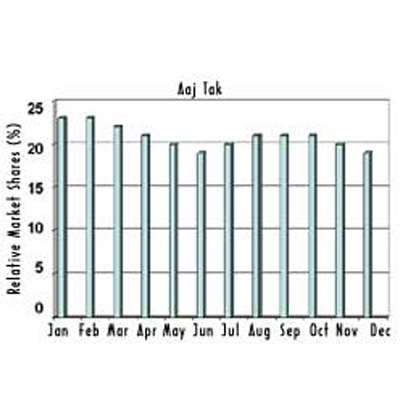
    Refusing to budge from the top position for the ‘golden’ year of Hindi News channels is India Today Group’s Aaj Tak, with an annual average of 20.83 per cent market share. Being the forerunner, it has been consistent in its performance as far as relative market share. Beginning the year with 23 per cent in January, it reached its lowest in the month of June and December with a market share of 19 per cent in both the months. In June it was neck to neck with Star News, but in the month of December it had to finally give way as Star News took over pole position.

    Aaj Tak’s sister concern Tez has also maintained its consistency with an almost constant share of 5 per cent of the market for eight months.

    Aaj Tak news director QW Naqvi says, “As for our channels, it is extremely satisfying that we have retained the number one position despite a virtual dogfight in the TV news market. We are proud to present balanced news content. Though this is a remarkable achievement for Aaj Tak, we are aware of the challenges ahead. A number of new channels coming in the fray and with a growing audience base, it will be our effort to retain our number one position – both in terms of content perfection and market share.”

    A huge attrition seen by Aaj Tak during the year however did not have any direct effect on the score card. Its top rung journalists have made tracks, either to upcoming Hindi news channels or already established ones. Aaj Tak lost its executive editor Punya Prasun Bajpai who switched sides to Samay (then Sahara Samay) as editor-in-chief. Bajpai took along with him a host of other Aaj Tak journalists including anchor and deputy editor Sanjay Bragta and crime bureau chief Nazim Naqvi.

    Aaj Tak executive editor and Mumbai bureau chief Shishir Joshi quit to join Mid Day Multimedia as group directorial editor. Aaj Tak also lost Ram Kripal and Rahul Kulshetra to Triveni Group. While Kripal joined as group editor for their upcoming news channels, Kulshetra will head technical operations.

    With an annual average of 18.08 per cent is News Corp backed Media Content and Communication Services (MCCS)’s Star News, which stands next to Aaj Tak in terms of market share. Star News began the year with 17 per cent market share in January. By mid-year it had picked up 19 per cent. It carved a share of 20 per cent each in the months of September, and October but could not surpass Aaj Tak in the numbers game. December, however, was a good month for Star News as it broke Aaj Tak’s monopoly by getting to the top place with 20 per cent of the market share in its kitty.

    Next in the rung is India TV with an annual average of 13.75 per cent. India TV had 11 per cent in January, but slipped down to 9 per cent in February. From May, India TV joined the race in high spirits with its highest grab of 16 per cent. What followed in the later months was consistence in terms of performance in market share, dabbling between 15 to 16 per cent in the last two quarters of the year.

  • Hindi news channels see tough Muqabala

    Hindi news channels see tough Muqabala

    India TV CEO Chintamani Rao says, “For India TV, it has been a good year. Two years ago we were number six or seven in the news channel category, with a five to six per cent share; today we are number three with a 17-18 per cent share. “


    In 2007, Zee News was not steady in the numbers game starting the year with 13 per cent and ended with 10 per cent. With an annual average of 11.54 per cent, Zee News had its best runs of 14 per cent in the February and April period. From May with 12 per cent.


    It reached it’s lowest ebb of 9 per cent in September. Mid-September, incidentally, was also a time when the channel was headless after Harish Doraiswamy resigned from the CEO’s position, following which MCCS executive vice-president Barun Das was roped in as CEO.


    Global Broadcast News’ IBN7 has an average annual share of 10.5 per cent, opening the account with 9 per cent in January. Though low in its numbers, IBN7 has been consistent, with the figures ranging between 9 to 12 per cent market share.


    Ashutosh says, “About my own channel, we can say that we were bold enough to stand our ground saying. Whatever rubbish is going on the other channels, let them do it, but we shall not do that. I won’t say we have been 100 per cent successful, but very, very successful and I am proud that we are probably the only Hindi news channel that can call itself a news channel.”


    He asserts, “We provoked ourselves to get news in the right perspective. We have been aggressive and this has given us excellent results, maybe not in terms of ratings, but in terms of perception. We have severely shaken up the political establishment repeatedly. “


    Among the news broadcast majors though, it is NDTV India in particular that would like to leave behind 2007 as far as market share is concerned. Its average for the year – a highly disappointing 9.5 per cent. In January it was at 13 per cent, but drastically fell from June on when it stood at 9 per cent. In an attempt to get more eyeballs, NDTV India forayed into fiction by launching its weekly series Bombay Lawyers in July. It got only 8 per cent each in July and August, managed some uplift in September to 9 per cent, but slipped back to 8 per cent again in November and December.


    In August, NDTV India saw a major change in leadership when Dibang stepped down as the managing editor. In his place, senior staffers Sanjay Ahirwal and Manish Kumar were entrusted with the responsibility of overseeing the day-to-day news operations of the channel.


    Narayan Rao says, “In terms of rating you have Aaj Tak at the top and then Star News and some others high up, but in terms of revenue we are still there right at the number two position. Ultimately, no advertiser would like to spend money beyond a point on such shows. So, if there has been an impact on viewership, there is no significant impact on revenues.”


    Punya Prasun Bajpai’s taking over the content, the channel getting a revamp with a fresh look and feel and even changing its name could hardly contribute anything to Sahara’s national Hindi news channel Samay. With an annual average market share of 5.1 per cent, the month-on-month figures have hovered around 4 to 6 per cent.


    Likewise Broadcast Initiative’s Live India re-positioning itself from a views channel to a news channel and its re-christening could not however save it from hitting rock bottom. Soon after being re-launched it was slapped a month’s ban for a sting operation gone horribly wrong. However, it can take solace from the fact that it had 1 per cent market share in January, which has gone up to 4 per cent at the close of the year.


    DD News on the other hand does not have a success story to its credit. DD News has to be satisfied with an annual average of 3.3 per cent of the market share.


    Whatever the figures say though, news broadcasters across the board agree unanimously that there has been a lot of compromise in content.


    Naqvi says, “No doubt, television news industry has grown at such a frantic pace, that it has created certain pitfalls. All out efforts in the past year were made to grab viewership. In this mad race, at times content was compromised and true journalism took a back seat. Compounding this malady, mushrooming news channels tended to water down the impact of many meaningful news reports.”


    Rao says, “If it says that on a certain night some news channel was number one, then more or less it works that way. It is another matter that that news channel was then showing a sex show. But that is for the viewer to decide. If he wants to see a sex show in news, it is his choice.”


    In the same breath news broadcasters also believe that “it is going to be hard hitting, proper investigative journalism that will have to come back to the news channels.”


    2008 would require the Hindi news channel market already flooded with more than 10 channels to accommodate a long list of channels waiting in the wings. B.A.G Films and Media News24 is the first one in the fray, with many others to follow in the year.

  • ‘Burgeoning distribution costs eating into money that should have been spent on content’

    ‘Burgeoning distribution costs eating into money that should have been spent on content’

    Much has happened this year and yet not a lot has happened.

    For India TV it has been a good year. Two years ago we were number six or seven in the news channel category, with a 5 to 6 per cent share; today we are number three with a 17-18 per cent share.

    The broadcasting industry has seen a huge amount of debate and discussion on the proposed Broadcast Bill and the Content Code. It perhaps looks to an observer like there is much heat and no movement, but I do believe such debate and discussion is essential.

    This is not something that can be done in a hurry. It has very wide implications in a country as free as India, where the media are genuinely free.

    And while the arguments for and against regulation are many, the fundamental thing is that any attempt to legislate a free media has to be done with a great deal of care. It is at the heart of Indian democracy. And as the world acknowledges, we may have a myriad problems but we are a robust democracy despite all odds: it is too valuable to risk.

    On the Content Code there has been a discussion for well over a year, and the government has been open to dialogue, which is excellent. The broadcasters have offered to create their own Code for self-regulation.

    The government has welcomed the offer of the industry to develop its own Code, as it has accepted and notified the ASCI Code for advertising. ASCI is a voluntary body, so the government has encouraged self-regulation, which is great.

    The single biggest problem in the industry today is distribution. It is getting more and more competitive, as more and more channels come into business. The cost is enormous and growing wildly, and it is hurting every broadcaster from the biggest to the smallest, FTA or pay.

    In this battle MSOs and LCOs point fingers at each other, but either way it is costing the broadcaster. And money that could and should have been spent on content is getting spent on distribution instead, and it weakens the industry.

    And as that burgeoning cost is eating into money that could and should have been spent on content, in the end it is affecting the viewer, with no medium term solution in sight.

    Digitisation is the only real answer. Digitisation is slowly coming in the non-CAS areas, but the operative word is ‘slowly’. Anything that the government can do to accelerate digitisation will be for the good of all, mostly for the good of the consumer.

    The other important thing with growing competition is the issue of audience measurement. Periodically there is heated debate, and everyone has an expert opinion on the subject. But listen to what each broadcaster says, and you know how good their ratings are: why else are yesterday’s critics silent today and why were today’s critics silent yesterday, when the system has been the same for years?

    And even as broadcasters and agencies criticize the measurement system they continue to use the data to help in buying and selling Rs 5-6,000 crore worth of advertising, on the nonsensical plea that some data is better than no data.

    There have been impassioned complaints about how the broadcasters and production houses are victims of the rating system, how every Friday when those wretched numbers come in they have to slog overnight to fix the content according to what the numbers tell them.

    It’s Aamir the actor who acts for a living versus Aamir the brand whose equity must be protected, grown and leveraged
    _____****_____

    That’s like a hypochondriac taking his temperature and blaming the thermometer. No one is forcing anyone to use the data, much less what to do about it. If you choose to be tyrannised by it, that’s your choice.

    That is not to say the current system is perfect. That it needs upgrading is beyond doubt. The industry has taken the initiative in that, with the formation of the Broadcast Audience Research Council.

    Whatever the outcome, it can only lead to a better, more robust measurement system.

    The best thing that has happened this year?

    It may sound like a strange thing to say, but to my mind the best thing that has happened is the ongoing debate about the Broadcast Bill and the Content Code. It brings many issues to the fore, many things that we need to be more aware of and many that we need to engage with the government about.

  • ‘Burgeoning distribution costs eating into money that should have been spent on content’

    ‘Burgeoning distribution costs eating into money that should have been spent on content’

    Much has happened this year and yet not a lot has happened.

    For India TV it has been a good year. Two years ago we were number six or seven in the news channel category, with a 5 to 6 per cent share; today we are number three with a 17-18 per cent share.

    The broadcasting industry has seen a huge amount of debate and discussion on the proposed Broadcast Bill and the Content Code. It perhaps looks to an observer like there is much heat and no movement, but I do believe such debate and discussion is essential.

    This is not something that can be done in a hurry. It has very wide implications in a country as free as India, where the media are genuinely free.

    And while the arguments for and against regulation are many, the fundamental thing is that any attempt to legislate a free media has to be done with a great deal of care. It is at the heart of Indian democracy. And as the world acknowledges, we may have a myriad problems but we are a robust democracy despite all odds: it is too valuable to risk.

    On the Content Code there has been a discussion for well over a year, and the government has been open to dialogue, which is excellent. The broadcasters have offered to create their own Code for self-regulation.

    The government has welcomed the offer of the industry to develop its own Code, as it has accepted and notified the ASCI Code for advertising. ASCI is a voluntary body, so the government has encouraged self-regulation, which is great.

    The single biggest problem in the industry today is distribution. It is getting more and more competitive, as more and more channels come into business. The cost is enormous and growing wildly, and it is hurting every broadcaster from the biggest to the smallest, FTA or pay.

    In this battle MSOs and LCOs point fingers at each other, but either way it is costing the broadcaster. And money that could and should have been spent on content is getting spent on distribution instead, and it weakens the industry.

    And as that burgeoning cost is eating into money that could and should have been spent on content, in the end it is affecting the viewer, with no medium term solution in sight.

    Digitisation is the only real answer. Digitisation is slowly coming in the non-CAS areas, but the operative word is ‘slowly’. Anything that the government can do to accelerate digitisation will be for the good of all, mostly for the good of the consumer.

    The other important thing with growing competition is the issue of audience measurement. Periodically there is heated debate, and everyone has an expert opinion on the subject. But listen to what each broadcaster says, and you know how good their ratings are: why else are yesterday’s critics silent today and why were today’s critics silent yesterday, when the system has been the same for years?

    And even as broadcasters and agencies criticize the measurement system they continue to use the data to help in buying and selling Rs 5-6,000 crore worth of advertising, on the nonsensical plea that some data is better than no data.

    There have been impassioned complaints about how the broadcasters and production houses are victims of the rating system, how every Friday when those wretched numbers come in they have to slog overnight to fix the content according to what the numbers tell them.

    That’s like a hypochondriac taking his temperature and blaming the thermometer. No one is forcing anyone to use the data, much less what to do about it. If you choose to be tyrannised by it, that’s your choice.

    That is not to say the current system is perfect. That it needs upgrading is beyond doubt. The industry has taken the initiative in that, with the formation of the Broadcast Audience Research Council.

    Whatever the outcome, it can only lead to a better, more robust measurement system.

    The best thing that has happened this year?

    It may sound like a strange thing to say, but to my mind the best thing that has happened is the ongoing debate about the Broadcast Bill and the Content Code. It brings many issues to the fore, many things that we need to be more aware of and many that we need to engage with the government about.

  • Big Fight in Hindi news turf

    iding high on the claim of carrying ‘exclusive’ and ‘breaking’ stories, news channels are rating their success stories. The route is not through digging a story from the rubles of Nandigram or Singur but the passing game of the pot of gold begins with high end stories on the World Cup, Shilpa Shetty winning the Big Brother title or being kissed by Richarsd Gere and the great Indian Abhi-Ash wedding.

    Indiantelevision.com’s analysis of Hindi news channels using Tam data (HSM, C&S 15 + years) during the six-month period beginning January 2007 throws up some interesting insights into the genre while the battle among the players intensifies.

    The reigning Hindi news channel in the category during this period is TV Today’s flagship channel Aaj Tak. The channel has held on to its top position. With a six month average of 21.3 per cent (Tam C&S 15 + years, HSM), it has topped the chart with a share of 23 in January. But it has yielded ground in June and has shared the top slot in this month with a 19 per cent share.

    Meanwhile, Aaj Tak’s sister concern Tez has managed to be consistent in its performance with an average of 4 per cent for the period. 

    Second in the ratings game performance is Star News which has been consistent and stable across the period. Securing the second spot in the January to May period, Star news has gripped the market with 17 per cent share. However, in the month of June, it soared to the very top, sharing position with Aaj Tak. Star News clocked a six month average of 16.8 per cent.

    But a closer look at the half-yearly score card (January -June 2007) of news channels across the Hindi speaking belt reveals grave concerns for some players.

    One that has seen the slide is NDTV India. From January to June, the relative market share has been dipping considerably. From a 13 per cent market share in January, the channel reached 9 in June, while the six-month average stood at 10.8 per cent, which does not even place the channel among the top three.

    Explains NDTV group CEO Narayan Rao, “It is a short term passing phase. In the long term for any news channel it is credibility and authencity that matters. Whatever the situation is, we never opted to go down a certain route. We still have the same philosophy as we had when we conceived the channel.” 

    The channel had the guts to stay out of sensationalism which was grabbing eyeballs. “News can be of any kind. It depends on the channel’s ideology to present the same story without sensationalising it. We strive to get the hard core stories. Dibang who was our managing editor, on his special request, is now sent on special assignment. He will travel across India and bring core issues into light,” Rao says.

    NDTV’s hope is that sensationalism would ease out in the long run. Says Rao, “Undoubtedly the differentiating factor is how we package the content. We never want to titillate the viewer but rather have a impact on him. On 14 and 15 August, when all the news channels were showing the footage of the gory fake encounter in Allahabad, we edited the video and showed it only for a limited number of times. This makes a difference in the long run.”

    As a rule, somebody’s loss is somebody’s gain. Giving tough competition to the other news channels, India TV has upped its status in the ranks. Holding 11 per cent share in January (Tam C&S 15 + years, HSM), the channel jumped up to 16 cent and 15 per cent in May and June to clutch the second position in the respective months.

    Is Hindi journalism in the electronic media going the tabloid way?

    A media observer says, “The division is like the caste system in India. When the bigger channels show anything exclusive, people say the channel deserved it. Yet, people call it ‘tabloidisation’ when a smaller channel shows anything of that sort.”

    The news is not so good for Zee News. A matter of concern is that Zee News has not been able to go beyond the third spot. In the January to June period, Zee News’ has been hovering around 13 to 11 per cent (Tam C&S 15 + years, HSM). However in the month of June, the channel lost its long held third position to IBN 7.

    IBN 7, a later entrant into the space, has been working hard to get into the top league. The channel leaped into the competition in the months of May and June with 12 per cent each, prior to which it accounted for merely 9 per cent of the market in the month of January.

    Says IBN 7 managing editor Ashutosh, “We were the first to expose the Nithari case. It was us first who brought to light the first case of cannibalism in India.”

    “These days hardcore news is disappearing from the channel. It is not that all the news channels are here to do moral lesson stories. The news stories are selected on the basis of popularity. However, we at IBN 7 have always invested in the hardcore stories. This is the USP of the channel,” he explains further.

    The other channels in the fray have not been able to stand the heat of the competition in the Hindi speaking belt. Whatever the reasons may be, the Hindi heartland fails to be satisfied by the likes of DD News, Sahara Samay Rashtriya and Janmat (now re-positioned as Live India).

    The figures of the government run DD News tells a sad story. Starting as low as three in the month of January, DD News could only manage a mere four per cent in June.

    Lagging further behind is Broadcast Initiatives’ Janmat with an average of 1.83 per cent over the six month period. Following its recent re-positioning from a ‘views’ channel to adopting the live news approach, the challenge ahead will be to make its mark in the market.

    Sahara Samay Rashtriya has also been losing its existing hold in the market with a share of 7 per cent in January, slipping down to 5 in the month of May.

    Currently obsessed with the three C’s – crime, cricket and cinema – another C (for comedy) has become the new found love of Hindi news channels.

    Meanwhile, the deadly Content Code proposed by the information and broadcasting ministry is threatening to whack news channels going astray. Facing much opposition from these channels, the restrictions of the Content Code might, in fact, turn the tables of the numbers game or even determine whether tabloidisation or credible and authentic journalism is what will rule the roost.

    Once the ‘big brother’ steps in, it will be interesting to see the strategy each news channel churns out to outdo competition and be ahead of the game.

    But that is another story we will have to wait for as the government is coming under increasing pressure to bow down on the Content Code.

    Graphs by Roshnni

  • India TV elevates Rohit Bansal to COO

    India TV elevates Rohit Bansal to COO

    MUMBAI: India TV managing editor Rohit Bansal has been elevated to the post of Chief Operating Officer of Independent News Service, the holding company of India TV. The post is a newly created one.

    He will directly report to Independent News Service managing director and co-founder Ritu Dhawan and Independent News Service chairman and co-founder Rajat Sharma.

    In his new position, Bansal will look after various new avenues that the company is looking for in 2008. Bansal said, “Independent News Service has a very tight schedule for 2008. We will be leveraging our strengths in various non-news entities in 2008.”

    In a recent development, Vinod Kapree joined India TV to replace Rohit Bansal as the managing editor. Kapree comes in from Star News where he was deputy managing editor.