Tag: India TV

  • Is BARC all set for broadcasters and media agencies in Kolkata?

    Is BARC all set for broadcasters and media agencies in Kolkata?

    KOLKATA: While Broadcast Audience Research Council (BARC) seems all set to formally launch its much-awaited television audience measurement system in phase wise manner starting April, broadcasters and media agencies have begun to pull out from TAM India. If industry sources are to be believed, broadcasters like Star, Zee, Discovery, Star Sports, India TV and NDTV have already sent their termination notices to TAM.


    Regional media broadcasters specifically in West Bengal, however, have their own viewpoints. In Kolkata, broadcasters and media agencies expect to get a fair report with the introduction of BARC’s new TV ratings measurement system.


    At a time when agencies and broadcasters in Mumbai have already sent letters to TAM informing them that they are either not extending their subscription after 31 March, 2015 (in case their current subscription is expiring on that date) or terminating their subscription with the stipulated one-month notice period (in case their subscription runs till 31 December, 2015), Kolkata-based agencies and broadcasters have not yet got any detailed report on the pricing and policies of BARC.


    “BARC authorities came to Kolkata for one road show and with the lack of interest shown from people here and the absence of proper feedback, it hasn’t taken much initiative in Kolkata,” a city-based advertising agency executive said on condition of anonymity.


    Zee Entertainment Enterprises controlled 24×7 Bengali news channel 24 Ghanta will pull out from TAM along with the network’s others channels, said an executive from 24 Ghanta, adding that almost all channels in India are likely to do that. “With the arrival of BARC, it would make an even equation for all the stakeholders,” the channel executive added.


    When queried about the expectations from BARC, the executive said, “No tampering is possible as BARC will provide a wider audience reach. We also expect scientific and more detailed findings from untapped rural areas.”


    On the other hand, Aakash Aath director Eshita Surana said, “We have yet not decided, whether we will continue with TAM or no. We have not yet got the pricing policy from BARC.”


    However, Surana went on to add that the company has high hopes from BARC.


    On the initiatives being taken to establish strong communication, BARC CEO Partho Dasgupta said, “We have been constantly communicating through our newsletters, press interactions. website, twitter, roadshows and meetings. Pricing model details are on the website and all CEOs who watermarked the channels have been written to individually.”


    BARC, in the past three weeks, has been seeing an increasing rush from smaller broadcasters, both national and regional, who are now getting watermarked.  


    Speaking about expectation from BARC, a Kolkata-based GEC executive said that BARC’s report will at least not bring Kolkata TV’s teleshopping show in the top 20 programme list.


    Moreover, the number of peoplemeters that TAM had installed was 10,000 whereas BARC will be starting with 20,000 and then plans to gradually scale up the number by 10,000. “This will ensure more representation and data from these peoplemeters that will enable a more accurate understanding of stickiness, preference and even demography of every segment of viewers. BARC will even provide zip-code wise data on ratings, which will help advertisers in choosing the right TV channels to reach out to their TG,” brand and communications expert Mahul Brahma added.


    A media buying executive said that all stakeholders, including the media agencies, have invested in the new BARC system, and it is natural that all should move to this audience measurement system. “BARC is a joint industry body, and we are part of the industry. We believe that BARC will have a more accurate and better measurement. Our preference would be to go with the measurement which is more robust, transparent and accurate,” he said.

  • “Thanks to fruitful elections, balance sheets look better in 2014”: Rajat Sharma

    “Thanks to fruitful elections, balance sheets look better in 2014”: Rajat Sharma

    The news industry has taken a full circle – from providing welfare information to entertainment to astrology to cricket to sensationalism and now almost pure news taking back the centre stage. In a recent phase, news channels were dominated by frivolous content and Hindi news channels stood as the main suspects. The industry has worked really hard get over it to regain its lost respect. I can now safely say that “NEWS IS BACK”.

    While the news channels have proved themselves as an effective platform for promoting culture, movies, sports and many other activities, at the same time they have played a pivotal and decisive role in tackling core issues like corruption, rape, terrorism and inflation. Relentless coverage of Delhi rape case, Anna Hazare’s Lokpal agitation, 26/11 etc. to name a few stand a testimony to that fact.

    Despite the fact that news channels comprise an enormously important element of the socio-economic and geo-political ecosystem of the country, most such channels are facing monetary issues – characterised by negative pressures on the revenue toplines and ever increasing costs. The current year though may prove to be an exception and the respective balance sheets may look better than explained, because the industry has seen a relatively long and fruitful election season.

    The carriage fees regime stemming out of the analogue pipeline (despite a couple of phases of digitisation already complete) still plagues the industry. However, with the recent developments over the last couple of years, we hope that the actual correction (from digitisation) will start happening in the near future.

    The increased bandwidth due to transition to the DAS regime, will not only push the carriage fee down, but also bring in the transparency that shall further help proper monetary compensation for the operators so that the pressure can further reduce on broadcasters. This will help boost the profitability and further the cause of more investments in developing quality content that will be dished out with better audio/video quality.

    What could have been another blow to the industry, which is already reeling under multiple pressures, a 12 min/hour advertising cap that was introduced by TRAI for all the channels. We are happy that after a series of discussions with TRAI and TDSAT, High Court has finally put a stay on the same.

    I think it’s time now that broadcasters should unite and work towards the growth of broadcasting industry that not only provides employment to thousands but is an important pillar of India’s democracy. In an example of this unity, IBF & NBA along with other industry stakeholders, have created BARC as an alternate to TAM which we are sure will be a transparent and incorruptible currency.

    (These are purely personal views of India TV chairman and editor in chief Rajat Sharma and indiantelevision.com does not necessarily subscribe to these views.)

  • Subhash Chandra knew I had a winning concept: Rajat Sharma

    Subhash Chandra knew I had a winning concept: Rajat Sharma

    In the 21 years of this show, nobody has been forced to reply, Rajat knows the art of extracting a reply through his sweet questioning. Another big quality of Rajat is that he uses his tongue sparingly in his show, but he uses his heart to the fullest. A clever mind works behind this,” is how Prime Minister Narendera Modi described the man who has been for 21 years making the icons of the country answerable.


    Rajat Sharma’s journey with ‘Aap ki Adalat’ began with Zee TV in 1994 and from then there has been no stopping. The talk show has seen politicians, sportspersons, celebrities and others pour out their heart as well answer some of the trickiest questions.


    Amidst the celebrations, indiantelevision.com’s Meghna Sharma in a freewheel chat with Sharma spoke about what keeps him ticking, his favourite interview and much more.


    Excerpts…


    21 years is a long time, what do you have to say about the journey? What keeps you ticking?


    It still feels that the journey has just begun; all my memories with the show are still very fresh. The type of guests we have hosted on ‘Aap Ki Adalat,’ their replies, the viewers’ response, the in-studio audiences, the ambience that makes me feel at home every time I step into the Adalat Studio, the affection showered upon me, probably the never-ending love of my viewers…all makes me feel really blessed and probably gives me the strength to keep going.


    When did you come up with the idea of starting ‘Aap ki Adalat’? Any glitches faced while launching the show?


    The idea came up in a casual conversation with Zee TV owner Subhash Chandra on a flight from Delhi to Mumbai, 21 years ago. Without much thinking I told Subhash Chandra how the interviews should be done for TV. I told him about putting politicians in the dock and making them accountable to public. After we landed I forgot about the conversation. Subhash Chandra, however, was quick to realise that I had come up with a winning concept.


    Your most memorable interview so far and why?


    Like I said, all of my interviews have been really special and still very fresh in my memory, however if you tell me to pick one, I would pick the one with the then PM candidate, Narendra Modi. The reason for my pick is not only did the show created a huge ripple in the broadcast media Industry, when almost India’s 85 per cent news audiences watched the show’s first telecast with competition reduced to negligible numbers but also because of spontaneity and ease with which Mr. Modi responded even to the trickiest questions…given the fact that he had a really bad throat after addressing six-odd election rallies during the hectic campaign spree. We weren’t expecting more than 15 minutes of shoot. We ended up shooting him for over two hours and the result was breathtaking.


    Whom/what do you attribute this success to? How do you still maintain the charm of the show?


    Talking of success, I am very sure that it wouldn’t have been the way it is now if the director of my show, who also is my wife, Ritu Dhawan wouldn’t have been around. She is the one who has been standing like a rock behind my success…taking care of everything, from my looks to the positioning of the show, she is everywhere.


    I have always believed in doing my job right and just focus on that. We have been able to create the right mix of depth, detailing and research mixed with the right amount of humour, we have ensured to keep the show relevant to the changing preferences of the audiences over the last two decades, probably that’s what you are referring to as charm.


    After 21 years, will we see any changes in the format?


    Change is inevitable, however more than planning any such change we would rather keep ourselves adaptive to what our audiences would prefer.


    From President to PM to celebs, everyone attended the celebrations. What do you have to say about the support?


    One word, I am overwhelmed. Feeling deeply humbled. While just focusing on my work, I never expected the amount of affection and respect showered upon me by all including country’s topmost icons. I am more than grateful to all and most to my viewers who have backed me all through as their advocate while I tried to amplify their voice with who mattered.

  • A blockbuster evening marks 21 years of ‘Aap Ki Adalat’

    A blockbuster evening marks 21 years of ‘Aap Ki Adalat’

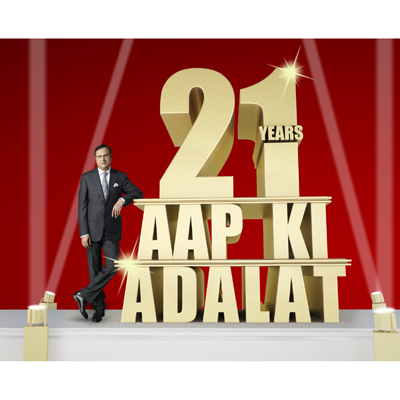
    MUMBAI: India’s longest running television show ‘Aap Ki Adalat’ saw a gathering of icons including those from politics, sports, business and spirituality who came together to celebrate the 21 years of the show, with Rajat Sharma.


    The attendee list sported names like President Pranab Mukherjee, PM Narendra Modi, Union ministers Arun Jaitley, Smriti Irani, Venkaiah Naidu, Suresh Prabhu, Ravi Shankar Prasad, Prakash Javadekar, Ram Vilas Paswan, Dharmendra Pradhan, Rajyavardhan Rathore and Najma Heptullah. BJP president Amit Shah, Lok Sabha Speaker Sumitra Mahajan and former LS Speaker P A Sangma also attended the event. Chief Ministers Shivraj Singh Chauhan, Vasundhara Raje Scindia, and Harish Rawat were also present.


    The three Khans of Bollywood, Shah Rukh, Salman and Aamir, along with others like Anil Kapoor, Ajay Devgn, Hema Malini, Anupam Kher, Sonakshi Sinha, Shatrughan Sinha, Rani Mukerji and cricketer Gautam Gambhir also attended the celebration.


    PM Narendra Modi talking on what makes Aap Ki Adalat so distinct and unfading observed, “In the 21 years of this show, nobody has been forced to reply, Rajat knows the art of extracting a reply through his sweet questioning. Another big quality of Rajat is that he uses his tongue sparingly in his show, but he uses his heart to the fullest. A clever mind works behind this.”


    Anil Ambani, Gautam Adani, Hari Bharatia and Raj Kumar Dhoot were among the business tycoons who were present at the occasion. Other personalities who attended included noted Pakistani ghazal singer Ghulam Ali, Himesh Reshmiyya, Udit Narayan, Anu Malik, advertising guru and lyricist Prasoon Joshi, Rakhi Sawant, Dr. Naresh Trehan, Daler Mehdi, Sakshi Maharaj, Yogi Adityanath, Raju Srivastav, Shashi Sinha, and social activist Kiran Bedi.


    Senior Congress leaders Kamal Nath, Sachin Pilot, Janardan Dwivedi, Salman Khurshid, Jagdish Tytler, Vijay Bahuguna, Rita Bahuguna, Renuka Chaudhary, Sushil Shinde, R K Dhawan, Dr. Karan Singh, JDU chief Sharad Yadav, RLD chief Ajit Singh, Amar Singh and Jaya Bachchan were also present at the event.


    India TV chairman and editor in chief Rajat Sharma commented, “I am short of words to express how overwhelmed and humbled I feel right now. Over the last two decades I was simply focusing on doing my job right, I never expected the amount of affection and respect showered upon me by all including country’s topmost icons.”


    “I am more than grateful to all and mostly to my viewers who have backed me all through as their advocate while I tried to amplify their voice with who mattered,” he added.


    Speaking on the success of the mega event, India TV MD and CEO Ritu Dhawan observed, “When we first thought of marking the occasion, we always knew that this is going to be an industry benchmark, however I have no doubt now that our expectations have been hugely exceeded. This has been a truly superlative success & people will remember this for a very long time.”


    Star Plus has also decided to be part of the celebrations. The event will be simulcast on both the channels – India TV and Star Plus on 7 December at 10 pm. Cineyug, a premier event management companies managed the show that was hosted by singer Sonu Nigam.

  • Aap Ki Adalat @ 21, India TV announces a celebration like never before

    Aap Ki Adalat @ 21, India TV announces a celebration like never before

    MUMBAI: From the power corridors of Delhi to the glamorous Mumbai, there is a most definite flutter over the news of a mega event being hosted by India TV to celebrate the 21 glorious years India’s longest running Television show Aap Ki Adalat with Rajat Sharma.
     
    To commemorate the legendary milestone for the show, a cult in its own, India TV is organizing a never before and dazzling event on 2nd December. Country’s topmost leaders including the President & the Prime Minister, most celebrated Bollywood Stars including the three Khans, most celebrated Sports Icons including top Cricketers, Country’s top Business leaders, top Spiritual Gurus and Country’s Apex Bureaucrats & Administrators for the first time come together under one roof.
     
    In the Indian electronic media industry, the names Rajat Sharma and Aap Ki Adalat have been synonymous since 1993, when the first show was telecast. The show in its lifetime has broken all possible records in the history of Indian news television, and still continues to dominate the rating charts.
     
    Ritu Dhawan, MD & CEO, India TV said, “Words would be redundant if we try to sum-up the glorious journey of Aap Ki Adalat, equally redundant would be an attempt to word the glory of the celebration plan.” “I am sure that every bit will be loved by both who will be present for the ceremony & those who will get to watch this on their TV sets.” She added.
     
    In the last two decades, this top show that has enviably featured almost all top names of their times till date. During the celebration most of the personalities who featured in Aap Ki Adalat in its journey are expected to grace this mega event, making it the biggest & brightest such gathering of contemporary times.
     
    India’s Premier GEC Star Plus has also decided to be part of the celebrations and the event will be simulcast on both the channels – India TV and Star Plus on a 7th December at 10 PM.  Cineyug, one of India’s premier event management companies will be managing the evening.


  • NBA president Rajat Sharma to meet Arun Jaitley, soon

    NBA president Rajat Sharma to meet Arun Jaitley, soon

    MUMBAI: A few months into the Narendra Modi government and Prakash Javadekar taking charge as the Minister of State (independent charge) of the Information and Broadcasting Ministry, a reshuffle has now put Arun Jaitley in charge of the department, in addition to Finance and Corporate Affairs with the MoS charge being given to Col Rajyavardhan Singh Rathore.


    While Jaitley is someone who has knowledge of the ministry, Rathore is yet to understand the nitty-gritty of it. News Broadcasters Association (NBA) president Rajat Sharma is optimistic about Jaitley handling the portfolio. “NBA welcomes the appointment of Arun Jaitley as I&B Minister. He has a great understanding of the challenges faced and ahead of the broadcasters and I hope that he will play a proactive role in resolving the issues,” he says.


    Jaitley has been an advisor to broadcasters in the past and is aware of issues they face such as carriage fees, ad cap, digitisation etc. “The NBA delegation will be meeting Mr Jaitley soon to discuss industry problems,” he adds.


    Sharma had earlier mentioned while speaking at indiantelevision.com’s 7th Indian News Television Summit that the NBA would be meeting the Prime Minister Narendra Modi, the I&B Minister Prakash Javadekar and the Home Minister Rajnath Singh to place before them, concerns of the news television industry.


    Sharma says that it feels good to have ‘industry’s friend’ as a minister of the department. 

  • NBA and IBF to approach govt bodies regarding broadcasting woes

    NBA and IBF to approach govt bodies regarding broadcasting woes

    MUMBAI: The broadcasting industry of India has been facing several issues right from carriage fees to the imposition of the ad cap. In order to reduce the burden on the broadcasters, the Indian Broadcasting Foundation (IBF) and the News Broadcasters Association (NBA) have now decided to unite and present their views to the highest authorities in India.  


    India TV chairman and editor in chief Rajat Sharma who is also the NBA president and the IBF vice president of strategic affairs, said that the two bodies will meet the Prime Minister Narendra Modi, the Finance Minister Arun Jaitley and the Information and Broadcasting Minister Prakash Javadekar to make them aware about the growing cancer called carriage fees. ”We will also show a revenue model that MSOs can adopt so that we don’t become dependent on carriage fees,” said Sharma.    


    Regarding ad cap he said that they will show the ministers the kind of revenue loss the channels will incur if the 10+2 minute ad cap is implemented. The case is currently being fought by the NBA in the Delhi High Court.  “We will request for the 12 minute advertising cap to be removed from the licencing conditions,” he said. The NBA president added that no channel, be it a news channel or a GEC, wants to show more than five minutes of advertising but the revenue model forces them to do so. “None of us want to compromise on programming,” he said.


    The new ratings system that will be applicable once BARC India starts its operations, should be transparent, he said. ”Till the time these issues are not addressed, the industry will keep suffering,” he opined.   


    While speaking to indiantelevision.com, Sharma said that the meeting is expected to happen in the next few days.


    Sharma was addressing a keynote at the Seventh Indian News Television Summit, organised by indiantelevision.com where he discussed the role of a news channel and the challenges and hurdles that they face.

  • “The news industry is fighting amongst itself”: Rajat Sharma

    “The news industry is fighting amongst itself”: Rajat Sharma

    NOIDA:  He is one of the most well known faces of the Indian media industry. Rajat Sharma, the host of popular talk show, Aap Ki Adalat, has added responsibilities on his shoulders. He is not only the chairman and editor in chief of India TV, but also represents the industry as the new president of the News Broadcasters Association as well as the vice president of strategic affairs of the Indian Broadcasting Foundation (IBF).

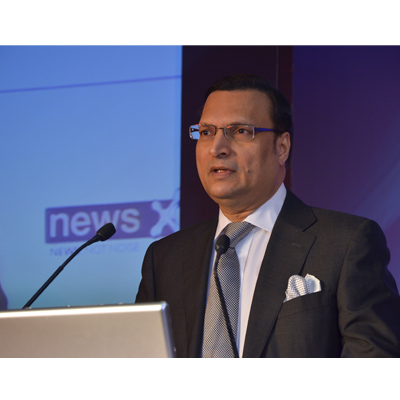
    Sharma, who was addressing the 7th Indian News Television Summit 2014 organised by indiantelevision.com as a keynote speaker highlighted the evolution of the news industry as well as listed the three biggest challenges that lie ahead.

    He began by saying that three years ago the news channel industry was very different from what it is today. “There has been a change in perception in the way news is seen,” Sharma said adding that news no longer is considered to be negative.

    Substantiating the evolution in terms of changing perception, Sharma gave the example of the 26/11 terror attack when reporters did 24X7 reportage and were blamed for aiding the terrorists and their handlers in Pakistan. “News channels also suffered commercial losses during the attacks as ad breaks were restricted,” he informed. According to Sharma, while news channels earlier were perceived as being a platform that telecasted frivolous events to garner eyeballs, things today have changed. “News is back,” he announced.

    He pointed out that the space has seen drastic changes.  “The society has evolved and the media has played a great role in it especially during events like the Lokpal Bill, the Delhi gang rape and the tirade against corruption,” he said.

     “Today even if Shah Rukh Khan or Salman Khan want to promote their films or emerging sports like Kabaddi wants to garner attention, news channels have a role to play in that as well,” he opined.

    Sharma while praising the social commitments of the news industry said that the space as a whole is not healthy. “The biggest problem for the industry is its revenue model,” he said while pointing out that though this year the balance sheets of the industry looks good due to elections, but, as a whole, the model is not sustainable.

    Listing the three main challenges for the genre, Sharma said that carriage fee was the biggest concern. “A few years ago, people expected news channels to be a loss making property since carriage fees were high and when broadcasters spoke to the multi system operators (MSOs) they said it was a problem of demand and supply. When digitisation kickstarted, we thought that consumers will get better quality channels and carriage fees will disappear. For the MSOs, it is the carriage fee from the news channels that helps them sustain, since they pay the GEC’s huge sums for getting their programming on their platform,” he said.

    He informed that the industry had 20-25 meetings with the previous TRAI chairman to discuss the issue of carriage fees.  While it was expected that digitisation would bring down carriage fees, something unexpected happened. Two days before the former TRAI chairman could retire he signed the ad cap. “When we were trying to improve the content and trying to solve one issue we were burdened with another one.”

    “Ad cap ensured we received 50 per cent less advertising. Death was certain now for the news channels,” he added.

    While the then Union Minister Ambika Soni said she will look into the matter, the broadcasters decided to fight the case in TDSAT. “News channels have managed to get a stay and therefore are surviving,” he said while giving the example of the newspaper industry, which has no such restriction. “We want the same for the broadcasting industry,” he opined.

    He also mentioned that the industry needs a better rating system and the TAM currency will be replaced by BARC India, which is an incorruptible agency.  “Therefore today the biggest challenge for the industry is the ad cap, the rating system and carriage fees,” he informed.

    In his closing remarks he said the whole industry including the IBF and the NBA should work together to resolve these issues. “The news industry as a whole cannot fight the MSOs as we are fighting amongst ourselves. While, we come together during a board room meeting, once we are out there will be one or two who would go against the same,” he lamented. 

  • 7th Indian News Television Summit: Innovation for higher ad revenue

    7th Indian News Television Summit: Innovation for higher ad revenue

    MUMBAI: ‘When the going gets tough, the tough get going’ is an age old adage. Operating in a cash crunch environment, this seems to be just what Indian news broadcasters will have to do  if they want to continue to beam into homes. 


    The Indian TV news business has been grappling with several issues. Close to 400 channels account for a small per cent of ad spends. High carriage fees and cutthroat competition for the ad rupee have made the going really tough for those in the news business. 


    With this as the backdrop, comes leading Indian media service Indiantelevision.com’s Seventh News Television Summit entitled ‘Monetisation in Transformational Times” on 28 October at the Radisson Blu Hotel in Noida, Uttar Pradesh.  It seeks to address how those in the news TV ecosystem can develop more robust or new business models, including new revenue streams such as digital online video, syndication, off the air ground activities, advertiser driven programming solutions, among many others. 


    The highlights of the half day premier news television industry confab  are a keynote by News Broadcasters Association president and India TV chairman and editor in chief Rajat Sharma followed by a discussion on ‘Meeting the challenge for today’s TV news networks, a one-on-one with ITV Network MD Kartikeya Sharma and then a keynote from leading media agency Group M south Asia CEO CVL Srinivas.  .


    The session ‘Content monetisation through conventional and digital platforms of news channel’ will see a reveling discussion on how business heads are meeting the challenge of low ad rates and near zero subscription revenue with rising cost through alternative options such as syndication of news, events, digital etc. Included in this session are NDTV group CEO Vikram Chandra, TV Today Network CEO Ashish Bagga, IBN18 Network CEO Avinash Kaul, Doordarshan ADG News Mayank Agarwal and Focus News Network group CEO Neeraj Sanan.


    ‘Innovation in news selling’ will explore novel ideas for media agencies and brands to increase their ROI from their investments on news networks and what innovative methods can be drawn for both to achieve a win-win business model. Opening the session is Srinivas’ keynote followed by a discussion with IPG Mediabrands India CEO Shashi Sinha, CNN-IBN and IBN7 national revenue head Vishal Bhatnagar, India TV senior VP and country head – ad sales Sudipto Chowdhuri and Zee Sangam national sales head Harsha Vardhan Dwivedi. The sessions will be moderated by Provocateur Advisory principal Paritosh Joshi.


    Editors of networks will discuss how far they will go to allow money to drive content in the session titled  ‘Monetisation for editorial independence’. ITV Network editor in chief Deepak Chaurasia, former India TV editorial director and veteran journalist QW Naqvi, Mi Marathi consultant Nikhil Wagle and moderator Aaj Tak and Headlines Today editor at large Rahul Kanwal will take the stage. In a separate discussion,  Amagi co-founder KA Srinivasan will discuss how it can offer solutions to advertisers and news networks to further ad revenue.


    Says Indiantelevision.com founder, CEO and editor in chief Anil Wanvari:So far the news television industry has not been able to harness substantial subscription revenues, even as carriage fees look set to rise with digitisation being delayed. Hence, it needs to look for solutions to hike revenues from the advertising inventory – the threat of the reduction of this has been staved off at least for now – they have, apart from working closely with advertisers and agencies to offer solutions that opens up the revenue pipeline for them further. The challenge is to increase their yields while increasing the ROI for advertisers. I believe the seventh news television summit will help give both advertisers and news channels some pointers as to how they could achieve this jointly.”


    The presented by sponsor for the event is Jia News, silver partners are Akamai, India News, NewsX, Sakshi TV, TV9, growth partner is SureWaves, Amagi is lanyard partner, support partners are CNBC Awaaz and CNBC TV18, online media partners are radioandmusic.com and tellychakkar.com. The event is executed by ITV 2.0 Productions.


  • Vinod Kapri quits News Express

    Vinod Kapri quits News Express

    MUMBAI: News Express CEO and editor in chief Vinod Kapri has decided to quit the organisation. Confirming the news to indiantelevision.com he said that he will concentrate on completing and releasing his upcoming film.


    He is currently serving his notice period at the news organisation till 31 October. He currently has no plans to join any other channel until his movie is completed.


    Kapri had joined the company in December last year after a six year stint at India TV as managing editor. He has been a journalist for nearly two decades and has also worked with organisations such as Star News and Zee News.