Tag: India Today

  • TV news channels, exit polls & Delhi Assembly elections

    TV news channels, exit polls & Delhi Assembly elections

    MUMBAI: When predictions become a reality, it’s champagne popping time. Or breaking into a Gangnam Style jig on live television. This is exactly what happened with the majority of news channels’ exit polls, which were done in association with various research agencies that surveyed the mood of Delhiites during the state assembly elections.

    This time, a majority of the news channels were almost bang-on as far as the final tally for the various parties in the bitterly fought battle to rule New Delhi was concerned. In the process, they possibly gained a veneer of trust from viewers, who have otherwise been possibly put off by the state of news TV and reportage recently. Indeed it should help them get more eyeballs going forward as it most likely did during the vote count and announcement of the results of the hustings on 11 June.

    Says India Today Group vice-chairperson Kalli Purie: “Every time we get a poll right the stakes get higher. This was our fifth poll bang on. The trust put in us by our viewers is a big responsibility and makes us work harder. We wear glasses with no colour when we look at data. Data is always neutral. The partnership of the best data input from Axis and serious ground reporting from our team before every election has made this incredible feat possible.”

    It was her network which predicted the most accurate outcome in partnership with pollster  Pradeep Gupta’s Axis My India. Their forecast: the Aam Aadmi Party would sweep the elections giving it between 59 and 68 seats in the 70-member Assembly, while BJP and its allies,  would get two to eleven seats and the Congress none.

    "We follow international best practices,” says Axis My India chairman & managing director Pradeep Gupta. “Our methodology is highly refined that helps us eliminate margins of error. Our sampling is the most demographically and politically representative in any given election. There's zero tolerance for any compromise on the quality. That's perhaps the reason why the Harvard Business School is doing a case study on Axis My India for the GE 2019 predictions."

    India Today Group-Axis My India exit polls have accurately predicted 33 out of the 35 elections over the past four years. And, the trend of being near to correct has been going on since last year’s general election followed by Maharashtra, Haryana and Jharkhand Assembly elections.

    APB News Network chief executive officer Avinash Pandey concurs with Purie’s view that accuracy in exit polls helps build up perceptions toward news television. Says he: “The exit polls raise the stickiness and strengthen the loyalty towards a channel; they are a significant element as they predict the outcome of the final result. The data points help news channels establish faith in the eyes of the viewers and emerge as a credible entity.”

    He adds that elections being of national importance, “there have been times when news channels have surpassed GEC viewership numbers by comfortable margins during both exit poll and counting days, especially on counting days as the numbers keep changing by the minute.”

    ABP News Network in association with Centre for Voting Opinion & Trends in Election Research (CVoter), was the second most accurate with its poll prediction. It projected Aam Aadmi Party to win 51 to 65 seats, followed by BJP with three to 17 seats, and zero to three seats for the Congress, which was quite close to the actual results.

    Cvoter sampled 11,839 voters in New Delhi after they cast their ballot on the EVMs.

    Times Now editor-in-chief Rahul Shivshankar points out that exit polls are based on actual field survey and mathematical extrapolation, and “a lot of times predictably algorithms and good fieldwork can give results in line with actual results data. Since exit polls are conducted prior to the actual results and sometimes at least two to three days prior they do help shore up eyeballs on the main day that see a spike in viewership. The maximum traction that news channels generally receive is observed when data is live and counting of votes is on. The second spike comes for the evening debates on the election day.”

    Times Now, in association with research agency Ipsos, was relatively optimistic about the BJP’s performance in its exit poll. Ipsos predicted that the BJP would snare 23 seats and AAP would pocket 47, which was quite off the mark.

    ABP News’ Pandey says the network’s flagship program Kaun Banega Mukhyamantri attracted sponsors such as Signature Pan Masala, Rakesh Masale, and Tata Altroz. “The property has had a tremendous lineage of viewers for the past 17 years and with every election, it has grown bigger and more popular amongst the viewers,” he reveals.

    “A  property such as elections turn eyeballs of viewers and advertisers to the news channels,” says media veteran Anita Nayyar.  “Exit polls set the mood and opinion of the viewers and have an important role to play as it tells in which direction the wave is going. Since viewers are glued to the events such as exit polls and counting days, the advertisers want to take the leverage this opportunity and it becomes important for them.”

    Dentsu Aegis Network India chief executive officer Anand Bhadkamkar opines that he would like news channels to be consistently on the button, not just during exit polls. Says he: “Exit polls are definitely one of the factors to increase the credibility of news channels but consistent and impartial performance helps the news broadcaster maximum to generate credibility of the channel. Election is one of the important events where spends do work. Brands and advertisers do want to leverage on the space where there are major eyeballs being glued.”

    A view echoed by Madison Media senior general manager Chirag Shah. Says he: “Exit polls’ accuracy in line with actual results does give a short term benefit of consumer buzz related to credibility. But news channel loyalty depends on overall content on the channel. News viewing and relatability is a habit that is formed over a longer period of time. Advertiser support is also a longer-term partnership.”

    In the battle for Delhi that concluded on Tuesday, the Aam Aadmi Party for the third straight time emerged victorious, gaining 62 seats in the 70-member Assembly of the national capital; it received over 50 per cent of the vote share. Delhi’s denizens rejected the Congress this election too, like in the last one. Trailing behind AAP, the Bharatiya Janata Party bagged eight seats, improving its performance compared to the 2015 elections when it won just three seats.

    But the biggest gainers of this election were the news channels and their research agencies, which predicted the results right.

  • India Today forecast — bang on, as always!

    India Today forecast — bang on, as always!

    NEW DELHI – Elections can be unpredictable for political parties. Their results aren't for the India Today Group.

    As every other media outlet faltered in its forecast of Haryana and Maharashtra elections, the India Today-Axis-My-India exit poll delivered the most accurate picture of around 11 crore voters in the two states.

    HARYANA

    Almost all other pollsters and TV stations were unanimous in predicting a sweep by the BJP in Haryana, led by Chief Minister Manohar Lal Khattar.

    But it was the India Today-Axis-My-India exit poll that hit the bull's-eye, forecasting anywhere between 32 and 44 for the ruling party. Based on face-to-face interviews with voters across 90 constituencies, with a sample size of 23,118, the India Today-Axis-My-India Today survey foresaw the Congress ranks swelling in the range of 30-42 seats, up from 15 five years ago.

    It gave the Dushyant Chautala-led Jannayak Janta Party (JJP), a breakaway faction of the Indian National Lok Dal (INLD), between and six and ten seats.

    By Thursday evening, at time of writing, actual results were much the same as India Today's predictions — the BJP led successfully in 40, the Congress in 30 and the JJP in 10 constituencies.

    Other pollsters, however, weren't really able to capture the voter pulse in Haryana accurately. In its exit poll, Republic-Jan Ki Baat had given the BJP 52-63 and the Congress between 15 and 19 seats. According to News18-IPSOS, the ruling party was poised to secure 75 and the Congress 10. ABP-CVoter charts indicated 72 for the BJP and eight for the Congress. Times Now predicted 71 for Khattar's party and 11 for the Congress led by Bhupinder Singh Hooda, the Leader of Opposition,

    MAHARASHTRA

    In Maharashtra, the actual outcome came closest to the India Today-Axis-My-India's predictions for the BJP-Shiv Sena alliance unlike several other pollsters forecasting a landslide for the ruling coalition.

    According to the India Today-Axis-My-India survey, the BJP-Sena alliance was projected to secure between 166 and 194 seats and the NCP-Congress combine from 72 to 90.

    By Thursday evening, election results at time of writing showed the ruling coalition leading successfully in 159 of the state's 288 constituencies and the NCP-Congress combine in 105.  

    Contrast this with exit polls executed by other players.

    Times Now had predicted 230 seats for the BJP-Shiv Sena and 48 for the NCP-Congress together. Republic-Jan Ki Baat had forecast 216-230 for the governing alliance and 52-59 for the opposition. The News18-IPSOS gave as high as 243 to the BJP-Shiv Sena and as less as 41 seats to the NCP-Congress alliance in Maharashtra.

    According to ABP-CVoter, the BJP-Sena were projected to win 204 and the opposition combine 69.

    "I think getting the exit poll right again, especially against popular belief, separates news channels from propaganda channels," said Kalli Purie, Vice Chairperson, India Today Group. "It's our approach on ground reporting and non-alignment that we were able to read data with a level of understanding. And doing it in Haryana elections, where the margin on so many seats was so slim, is a validation of the scientific and thorough approach of Axis," the Vice Chairperson said.

    INCREDIBLE TRACK RECORD

    Of all the elections that took place in India between 2013 and 2019, India Today-Axis My India post-poll surveys have given the most accurate predictions in 95 per cent of the cases.

    Since 2013, Axis My India has conducted 38 post-poll surveys, of which 36 have been spot on.

    Conducting the largest exit poll for the world's largest democracy the 2019 general elections, the India Today-Axis My India exit poll, for instance, predicted 339-365 seats for the BJP-led NDA and 77-108 seats for the UPA in the new Lok Sabha. The actual results weren't different — the NDA got 352 and the UPA 92 seats in the lower house of parliament.

    Axis-My-India chief Pradeep Gupta attributed his successful predictions to team work and scientific monitoring of voter behaviour. "We follow international best practices. Our methodology is highly refined that helps us eliminate margins of error," he explained. "Our sampling is the most demographically representative in any given election. We closely, and continuously, monitor voter mood and intent." 

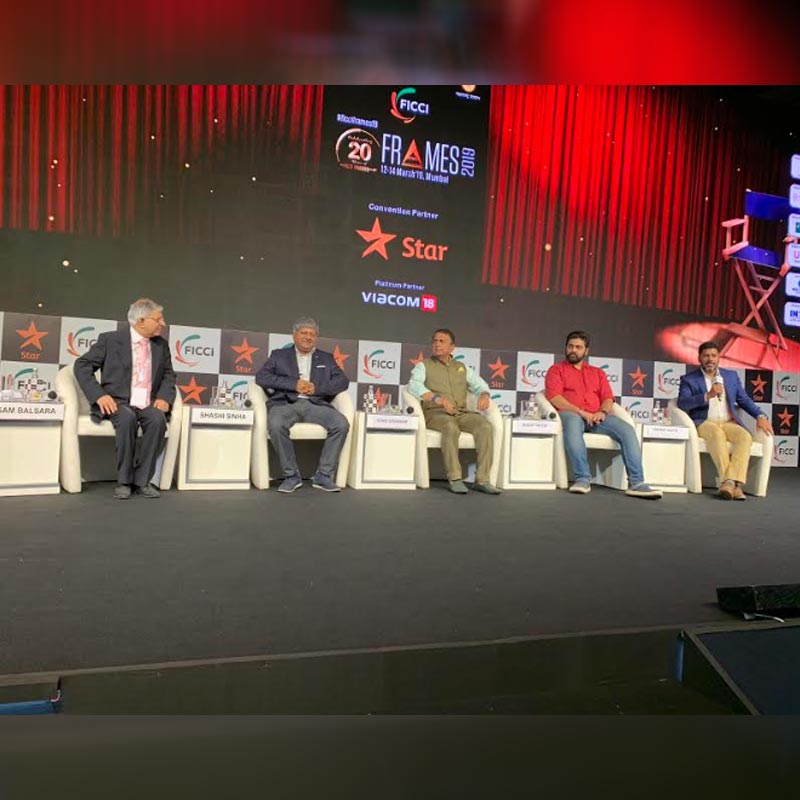
  • Mr. Sunil Gavaskar launches the So Sorry Gully Cricket app by India Today

    Mr. Sunil Gavaskar launches the So Sorry Gully Cricket app by India Today

    MUMBAI: A cricket app of India Today called So Sorry Gully Cricket was formally launched in the presence of legendary cricketer Sunil Gavaskar on day 3 of FICCI FRAMES 2019 in a session moderated by Vikrant Gupta. Apart from the Mr. Sunil Gavaskar, Present were Mr. Sam Balsara, Mr. Shashi Sinha and Mr. Jaideep Trivedi.

    Sunil Gavaskar spoke about the memories associated with Gully Cricket, “There used to be very narrow space between the two buildings and if you hit over the top of the 1st floor, you were out. We learnt only to play straight. You sort of leant to adjust your bat speed and you learnt to either play forward or back. The best part or the worst part according to the way you saw it was that the umpires were all from the building so if they liked you, they would say not out they didn’t like you, you were given out.” He said laughingly.

    Mr. Sam Balsara said, “There is nothing big in the country right now that cricket and politics. You are giving both these things to Indians in form of a game, you should hit jackpot with this.”

  • Vodafone, Idea pay Rs 72 bn to DoT for merger

    Vodafone, Idea pay Rs 72 bn to DoT for merger

    MUMBAI: Vodafone India and Idea Cellular have paid Department of Telecommunications (DoT) Rs 72 billion in cash that was the key condition for approving their merger. With the financial dues out of the way, the merger of Vodafone and Idea Cellular is likely to be approved in the next few days.

    “Idea has submitted its compliance to the DoT’s conditional approval letter dated July 9 2018, for the merger of Vodafone India Ltd and Vodafone Mobile Services Ltd with Idea Cellular Ltd, including the payment of Rs 3,926.34 crore (in cash) and bank guarantee of Rs 3,322.44 crore. With this we hope to get final approval from DoT for the merger at the earliest,” said a spokesperson from Idea as quoted by Economic Times.

    To avoid any kind of delay the two companies- Idea and Vodafone decided to pay the full amount demanded by the government. The two companies have started joint training sessions.

    Vodafone Idea will be the country’s largest telecom operator, with a revenue market share of around 37.4 per cent and more than 438 million subscribers. Headquartered in UK, Vodafone had announced the merger of its India operations with Kumar Mangalam Birla-led Idea Cellular in March last year. The companies were hoping to complete the merger by the end of June but the process got delayed by a month.

    The Vodafone – Idea merger is expected to make the country a three player universe, one of the biggest being Reliance Jio, which has captured a revenue market share of around 20 per cent in just 18 months of commercial operations. Recently, Bharti Airtel (India) CEO Gopal Vittal had said that the telecom sector was set to have just three big players holding similar market share.

    If that’s the case, then Vodafone Idea could lose some market share as Airtel and Jio are expected to continue to exert pressure on margins.

    The companies have earlier announced that Kumar Mangalam Birla will be at the helm as non-executive chairman while the Vodafone insider and current chief operating officer (India) Balesh Sharma will be CEO of the merged entity.

  • Assembly elections catapult English news genre viewership

    Assembly elections catapult English news genre viewership

    BENGALURU: The recent elections in Gujarat and Himachal Pradesh have given a fillip to the sagging viewership of the Indian English news genre.It clocked the third-highest combined viewership for the top-five channels (All India (U+R): NCCS AB: Males 22+ Individuals) in 2017 during the week election results were declared. According to Broadcast Audience Research Council (BARC) data, the combined ratings of the top-five English news channels were 3.808 million weekly impressions in the penultimateweek of 2017 (Saturday,17 December 2016 to Friday, 23 December 2016). 

    The top-five channels of the genre had earlier recorded higher combined ratings of 4.897 million weekly impressions and 4.282 million weekly impressions in weeks 11 and 19 of 2017,respectively.During week 11, assembly election results of five Indian states were announced and week 19 was the week in which the current genre leader–the ArnabGoswami-led Republic TV was launched. The fourth highest combined ratings of the top-five channels of the genre (3.781 million weekly impressions) in the year was in week 29 of 2017 when the Supreme Court gave its verdict for Indian godman Ram Rahim case.

    It may be noted that the ratings of week 21 of 2017 have not been considered in this report because in that week all the major English news channels, excluding Republic TV and a few others, had withdrawn from the BARC ratings system. Hence,BARC viewership data for week 21 of 2017 has not been considered in this paper.

    Please refer to the figure below:

    public://chart2_1.jpg

    Another yardstick that many in the industry consider more reliable are the four-week average ratings. Since data for week 52 of 2017 has still to be released, a three-week average has been calculated for weeks 49 to 51 in the figure below. Also, since data for week 21 of 2017 has not been considered in this paper, data for weeks 22 to 24 is also a three-week average.

    In case the viewership ratings of the genre fall in the last week of 2017, the four-week average ratings for the last four weeks will be lower than the three-week average viewership figure of 3.0220 million weekly impressions (the likelihood of which is quite high). The highest four-week average recorded by the genre in 2017 was in weeks 29 to 32 at 3.2695 million weekly impressions. As is obvious, the genre’s ratings were in freefall after that until the weeks leading up to and after the assembly elections in the two states. 

    public://chart_1.jpg

    The number in maroon text in the figure above for weeks 49-51 is the average of 3 weeks.

    Top-fiveEnglish news genre channels ratings in week 51 of 2017

    The combined ratings of the top-five channels of the English news genre grew by 31.81 percent in week 51 as compared with week 50. The same channels that featured in the list of week 50 remained in week 51 with a slight shuffle in the ranks.

    Republic TV has been leading the genre in terms of viewership right from the week it was launched. As the leader for week 51,it garnered 1.480 million weekly impressions, followed by Times Now with 1.203 million weekly impressions. The former’s viewership expanded by 50.71 percent in week 51 as against week 50, while Times Now’s ratings grew by 39.24 percent during the week under review. Both channels retained their previous week’s first and second ranks respectively.

    Climbing up a place to third rank in week 51 was CNN News 18–the channel had viewership of 0.443 million weekly impressions in week 51 compared with 0.329 million weekly impressions of week 50, indicating growth of 34.65 percent. At fourth place in week 51 and down a rank from week 50 was India Today Television (ITTV). ITTV recorded 0.424 million weekly impressions for week 51 of 2017, which was 8.23 percent lower than the 0.462 million weekly impressions in week 50. At fifth place was NDTV 24×7 with 0.258 million weekly impressions in week 51 of 2017 which was 2.38 percent more than the 0.252 million weekly impressions in week 50.

    Republic TV bandied some numbers on its screen just after BARC data was released claiming to have had 50 percent of the viewership of the English news channels on the day the Gujarat and Himachal Pradesh assembly election results were announced.

    Also read:

    Four Star India channels among top 10 channels across genres

    Hindi News genre versus Indian English News during festival week

    Indian English News genre facing festival blues?

  • Vivek Khanna becomes Group CEO at India Today

    Vivek Khanna becomes Group CEO at India Today

    NEW DELHI: Vivek Khanna, former chief executive officer of Hindustan Media Ventures, has come on board the India Today Group as its Group CEO. He will report to vice chairperson Kalli Purie, who recently announced the growth of the group by launching seven mobile channels.

    The news was announced to the employees by group chairman and editor-in-chief Aroon Purie in an internal communication this morning: “I am excited about Vivek joining us. With his background plus track record and our bench strength, I am confident he will bring structure, process discipline and marketing muscle to our creative genius so we can scale new heights. In all of you, I know I have the best team in the industry which makes me so proud. Now with the new leadership in place, I look forward to a year of exponential growth.”

    Purie added that “Apart from his strategic thinking and marketing expertise, I have selected Vivek because he is a ‘people’ person. He has an inclusive style of leadership, works hard and with passion, is goal oriented, pays attention to details, and builds teams. He believes that the right person in the right job is the only formula for good decisions, growth, and organisational success. Like me, Vivek leads from the trenches. He is known for personally going out to close partnerships and service clients.”

    Vivek comes with 26 years of solid experience in strategy, sales, and marketing. An alumnus of IIM Ahmedabad, Vivek began his career with Hindustan Unilever and Aviva Life Insurance. He moved to HT Media in 2008. Since 2013, he has been the CEO of Hindustan Media Ventures.

    Aroon Purie said Vivek’s most impressive accomplishments include the turnaround of HT products and brands. Last year, Hindustan Media Ventures was ranked amongst the top five fastest growing listed companies in India. He grew the advertising revenue of Hindustan by 14 per cent between 2013 and 2016; this was 4-10 per cent faster than competition.

    Operating EBITDA grew at more than 30 per cent per annum in this period. Circulation of the newspaper increased by over 30 per cent. The top line increased from Rs 6 billion to Rs 10 billion and the company’s market cap doubled to over Rs 20 billion.

    Also Read:

    India Today launches 7 mobile-specific niche channels

    India Today’s Purie says new vice chairperson Kalli has ability to straddle edit and biz functions

  • India Today launches 7 mobile-specific niche channels

    India Today launches 7 mobile-specific niche channels

    NEW DELHI: The India Today group, which recently announced the appointment of its group editorial director (Broadcast & New Media) Kalli Purie as group vice vhairperson, has now entered the new age of mobile journalism with seven customised news and other channels on different aspects of life. 

    Purie told indiantelevision.com that the channels launched today are Yoga Tak, Food Tak, Life Tak, Tech Tak, Astro Tak, Sports Tak, and News Tak which will also see the presence of veteran journalist Rajdeep Sardesai. The news channel News Tak will carry headlines every hour.The tagline for the channels is ‘Share kar’.

    Purie said that the Indian media landscape is transforming with ever changing content consumption pattern in society and the aim was to take full advantage of this.

    Although the group already had an online presence, the new channels will be more interactive with videos on demand and over 150 videos are already available from today.

    She said this had become possible because of increased bandwidth available with increase in players including Jio. Since mobile has its own limitations, she said the videos could also be seen without audio or vice versa.

    Her aim as to increase this number by at least two more channels so that the total is ten including the formerly launched Lallantop.com.

    The channels are also present on sites like Facebook, Twitter and YouTube and except for the last medium, there are no ads at present. Publicity would be done through the group channels and social media.

    Driven by broadband services at affordable rates and technology improvements, the number of internet-enabled mobile phones is growing very fast and the number is expected to touch 700 million by 2021.

    Consequently, approximately 99 per cent of Indian language internet users access online content on mobile devices and over 60 per cent of the Indian language internet users prefer to consume regional news.

    The most used content on mobile phones is video. Video is expected to represent 60 per cent of the overall mobile data traffic and is expected to grow to 78 per cent by 2021.

    The channels can be downloaded from https://www.mobiletak.in/

  • India Today’s Purie says new vice chairperson Kalli has ability to straddle edit and biz functions

    India Today’s Purie says new vice chairperson Kalli has ability to straddle edit and biz functions

    MUMBAI: India Today Group, which runs news channels — India Today and Aaj Tak and also print media magazines like india Today — on Tuesday, named Kalli Purie as the vice chairperson.

    Kalli, an Oxford University graduate in politics, philosophy and economics, is, at present, the group editorial director (broadcast and new media). Working with the group in several roles since 1996, she will now oversee the editorial and business functions of the group, according to an email from the group’s chairman and editor-in-chief Aroon Purie, Mint reported.

    Purie said he believed, like him, she had the ability to straddle both, editorial and business functions.

    Purie, who has been at the helm for over 40 years, wrote that , with the new appointment, he would be spending time on strategic steering of the group and exploring new opportunities, rather than on day-to-day operations.

    The group CEO Ashish Bagga had, in July this year, resigned and the company is yet to find a replacement.

  • India Today to honour champions of ‘Clean India’ cause

    India Today to honour champions of ‘Clean India’ cause

    MUMBAI: The India Today Group announces the third edition of the India Today Safaigiri Awards and Singathon, a platform that will showcase and felicitate the pioneering efforts of those who are leading the change in cleanliness. This is in continuation to the launch of 1st edition in 2015.

    The event will be held October 2nd, on the third anniversary of the Swachh Bharat Abhiyan launch and the birth anniversary of Mahatma Gandhi. This year the theme around which the campaign is focused on “Gandgi Dehan Safaigiri ke Sang” which aims to demolish one the major evils that our nation is facing today and honouring the clean champions of the nation.

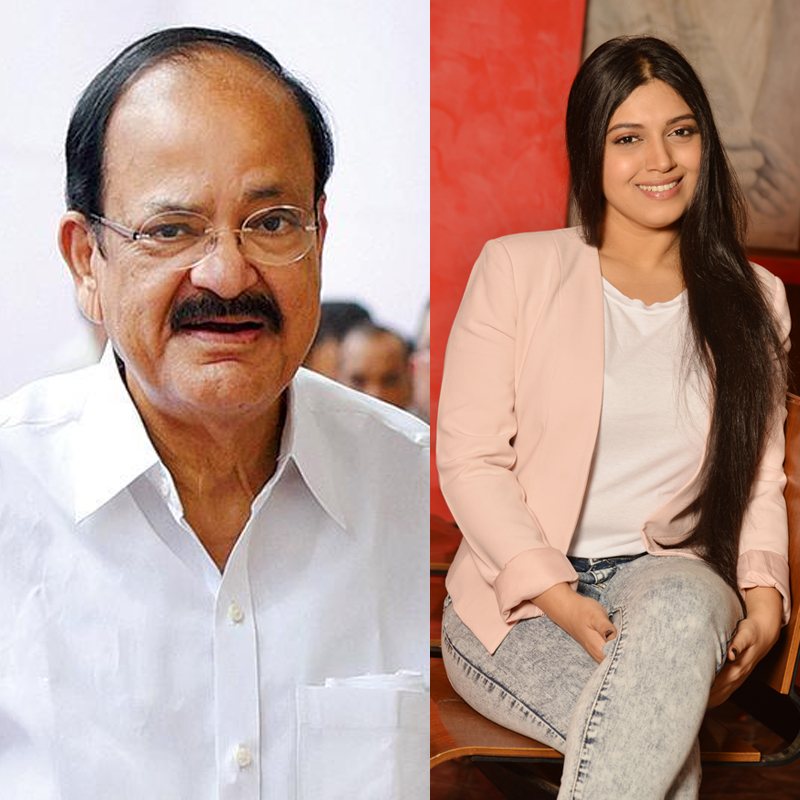
    India Today Safaigiri Awards & Singathon will be a day-long event and will get musicians together to celebrate the Safaigiri movement. The biggest names in the music fraternity will join hands to spread the message of Safaigiri. Bollywood actor Bhumi Pednekar will be presenting awards to women champions who have made Swachhata hi Seva their message. This special category of awards has been introduced this year in keeping with Prime Minister Narendra Modi’s message to observe September 15 to October 2 as Swachhata hi Seva fortnight. The focus is on women because if you teach a woman, you teach a generation.

    Vice President M Venkaiah Naidu will be presenting awards to 16 cleanliness champions selected by a process which involves shortlisting by Nielsen and selection by an eminent jury. The event will have singers performing throughout the day. The singers attending the day-long event include – Ankit Tiwari, Armaan Malik, Jasleen Royal, Amit Mishra, Shashaa Tirupati, Tulsi Kumar, Nakash Aziz and Mohit Chauhan’.

    India Today Safaigiri Awards and Singathon is a key initiative of the Group’s efforts in realising the vision of Swachh Bharat and in recognising Clean Champions across the country. The Clean Champions are selected in 16 categories through a process of fieldwork and selection by a jury of eminent citizens. The jury members are Mr. Aroon Purie, Chairman and Editor-in-Chief, India Today Group; Mr. Shashi Tharoor, MP; Ms. Neerja Birla, Founder and Chairperson, Aditya Birla Education Trust; Mr T.V Mohandas Pai, Chairman, Global Manipal Education; Mr.Vinayak Chatterjee, Chairman, Feedback Infra; Mr. Shubhagato Dasgupta, Senior Fellow, Centre for Policy Research & Bollywood actor Shilpa Shetty.

    The awards will be given in different categories such as Garbage Guru, Toilet Titan, Tech Icon, Water Saviour, Corporate Trailblazer and Cleanest Religious Place.

    The India Today Group has already started the war for cleanliness in a unique style at Ram Lila ground this year. Dirt/Filth, the major concern of the country was offered to fire in the form of Ravana this time.

  • Indiantelevision.com’s VR news journalism workshop gives fresh insights

    Indiantelevision.com’s VR news journalism workshop gives fresh insights

    MUMBAI: “Immersive Journalism.” “The Use of VR in News Journalism”

    Indian broadcast news journalists have heard these terms being used either online or in conversations. But, apart from NDTV, Republic and Times Network, not many of them have explored the innovation that is currentl engaging TV news viewers worldwide.

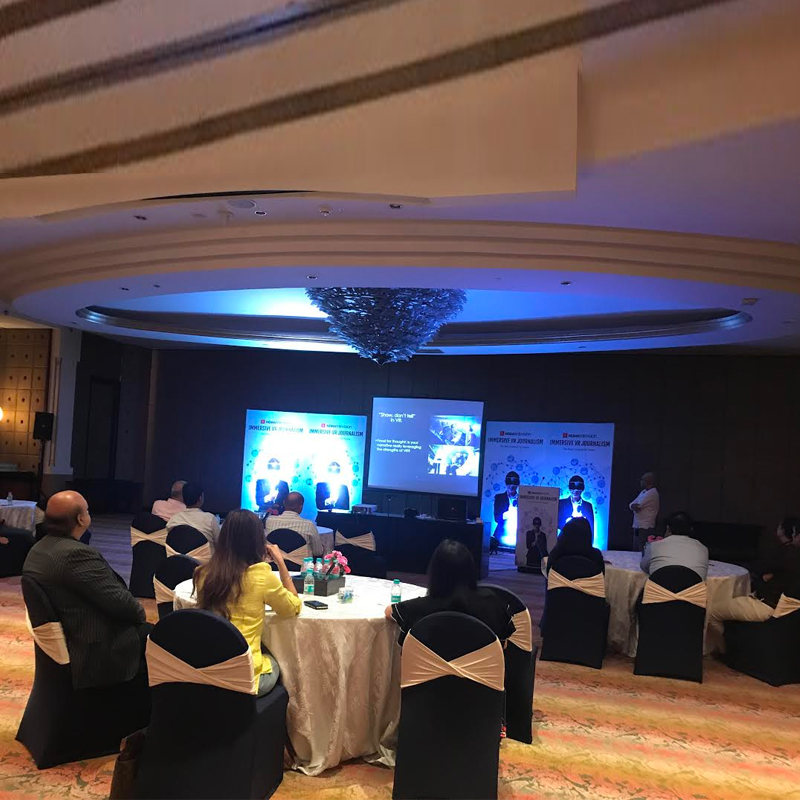
    To fill this gap, indiantelevision.com organised a half-day workshop in Noida’s Radisson Blu MBT Hotel on 26 September.

    In the house were a select group of tech professionals from news organisations such as NDTV, ABP News, India Today and News18 Television. The workshop was presented by  VR expert, the Dubai-based Clyde Desouza.

    Indiantelevision.com founder, CEO and editor-in-chief Anil Wanvari stated at the start of the workshop that VR journalism is not just in an experimental stage currently, it is a reality amongst many broadcasters worldwide. The reason for this is the falling prices of 360 VR cameras and VR headsets.

    public://Clyde DeSouza.jpg

    Clyde Desouza gives his take

    I’ve just completed a whirlwind initiative to bring awareness of Immersive Journalism to media organisations in India, thanks to the support and thrust provided by IndianTelevision.com.

    What started out as a series of discussions with the founder of IndianTelevision.com, Anil Wanvari, culminated in an exclusive, invite-only seminar on the future of factual storytelling – Virtual Reality and Mixed Reality Journalism at the Radisson Hotel, Noida, India.

    The top news and media organisations are headquartered in Noida, and CxO-level professionals from these organisations attended along with news editors and graphics teams to look into the future of news reporting and what I’d like to term as “Experiential Journalism.”

    The audience was informed and engaged. I won’t hesitate to say I’ve learned equally as much from the questions posed, as from the non-linear discussions that ensued well past the two-hour time allotted for the workshop.

    It was encouraging to see attendance from such prestigious organisations as E&Y, alongside respected NEWS and media organizations such as NDTV, ABP, and Network 18 in India.

    The seminar started with an overview of what Immersive Journalism is, with due credit given to the such luminaries as Noni De La Peña, but also the current state of the art in Virtual Reality news reporting and looking forward to Mixed Reality storytelling.

    As a tech / creative evangelist for VR, I was happy and impressed with the questions asked, and was genuinely excited to field queries ranging from Photogrammetry offer ideas on how CG “assets” could be created, and a library built for rapid Immersive Journalism pieces, with existing television CG packages and solutions such as VizRT and Wasp3D.

    There is certainly an appetite among the media and NEWS organisations in India, to take reporting beyond what’s possible on linear TV.

    While I’m currently bringing one of India’s leading news channels up to speed in VR, it was heartening to see almost all other major and emerging media organisations, aware that in order to build loyalty to their channel and brand, they need to engage their audiences on a level that goes beyond sensationalism and traditional news reporting.

    Twitter @cly3d

    Linkedin: https://www.linkedin.com/in/clydesouza

    www.realvision.ae/blog

    Many of the broadcasters are foraying into it because they want to get brand innovation credibility, apart from attaining a sense of future preparedness. Wanvari added that currently most of the players are actually producing a lot of 360 videos, rather than fully immersive ones.

    The early adopters apart, most news broadcasters are treading cautiously because the monetisation models have yet to be developed, and though prices have been heading southwards, the cost of VR gear – both at the producer end and at the consumer – still make it an elitist hobby, said Wanvari.

    He added that around three million headsets have been sold internationally.

    He urged the Indian news industry to get together under the NBA umbrella to work cohesively with tech partners, and platforms to increase awareness amongst its members as well as to negotiate on both production equipment and content standards.

    Desouza, on his part, began by explaining to the audiences what VR really seeks to achieve.

    “VR is not VR for VR’s sake,” he said. “It’s the experience that your brain feels.” 

    He explained the difference between VR and AR. “AR is when digital assets are added into the real world,” he said. “VR is when it’s entirely virtual and digital.”

    Desouza pointed out that care should be taken while filming 360-degree videos. “You have to keep the viewer in mind. You can’t pan and swish and zoom in like you would do with a normal camera. These kinds of motions give the VR viewer a headache.”

    He pointed out that many organisations are investing hundreds of thousands of dollars and producing videos that don’t really work as VR or immersive journalism.

    “The VR video has to draw the viewer into understanding that it is his point of view which he is experiencing,” he said.

    Desouza added that news brands internationally are using — and can use — VR to galvanise the audience into action.

    “For instance, a feature on haemophiliacs can be told from a victim’s point of view and the viewer should be able to feel and experience what the haemophiliac is feeling and going through and how we need to deal with them,” he explained.

    His view is that Indian news organisations would do well to keep aside budgets of about US$ 100,000 to start up their VR departments as well as a room with young, trained journalists so that costs can be kept under control.

    His talk was illustrated with the best and the worst examples of VR and immersive journalism videos from global studios.

    Desouza is currently consulting a leading Indian English news broadcaster to help steer it into VR journalism, and is in talks with a couple of others for the same.

    To read Clyde Desouza’s perspective on the workshop, click here.