Tag: Impact Communications

  • Impact Communications bags majority stake in Immersive Communication, set to disrupt market!

    Impact Communications bags majority stake in Immersive Communication, set to disrupt market!

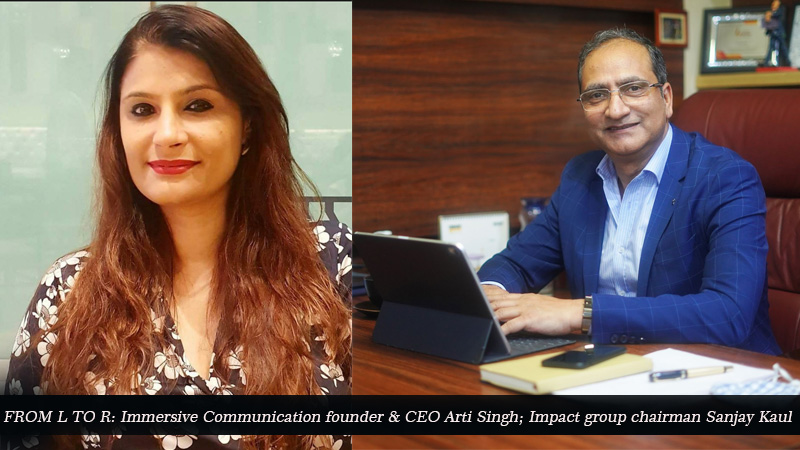
    MUMBAI: In a move set to redefine experiential marketing in India, Impact Communications has acquired a majority stake in Immersive Communication, the cutting-edge experiential and shopper marketing agency founded by industry veteran Arti Singh. This isn’t just another corporate handshake—it’s a collision of legacy wisdom and creative dynamism, promising to turn the industry on its head.

    Impact Communications, long revered for its expertise in brand strategy and execution, now has a fiery new partner in Immersive, known for its tech-driven, innovative approach to consumer engagement. Together, they are poised to craft experiences that don’t just sell products but create memories—because let’s be honest, who remembers a boring billboard?

    Singh, a retail and brand activation maestro, has built Immersive Communication into a powerhouse that thrives on agility and consumer psychology. Having honed her skills at Dentsu, Madison, and other top agencies, she brings the perfect blend of creativity and market insight to this newly forged alliance. And let’s just say, she isn’t here to play small.

    “This strategic partnership with Impact Communications marks a defining moment for Immersive,” said Immersive Communication founder & CEO, Singh. “This collaboration empowers us with the necessary scale, infrastructure, and innovation to reimagine how brands engage with consumers. With Impact’s operational strength and our creative agility infused with our abilities, we are set to deliver unparalleled experiential solutions across the country.”

    Impact group chairman Sanjay Kaul echoed the sentiment, adding, “Partnering with Immersive Communication is a pivotal step toward creating a veritable ‘powerhouse’ that seamlessly blends creativity, technology, and execution scale. With Arti’s leadership, we are confident that this collaboration will redefine the future of experiential marketing in India.”

    So, what does this mean for brands looking to dazzle their consumers? Expect next-level campaigns that blur the line between the physical and digital, fuelled by Impact’s deep-rooted industry know-how and Immersive’s future-facing approach. The collaboration will harness cutting-edge technology, expand creative talent pools, and supercharge operational capabilities—all in the name of crafting experiences that people won’t just engage with but will talk about long after they’ve happened.

    This isn’t just a merger of businesses; it’s a fusion of minds determined to take marketing from predictable to phenomenal. As the industry evolves at breakneck speed, Impact and Immersive are ready to lead the charge—one jaw-dropping campaign at a time.

  • Fintech is going to be a major disruptor for rural: Impact’s Sanjay Kaul

    Fintech is going to be a major disruptor for rural: Impact’s Sanjay Kaul

    MUMBAI: It is said that India lives in its villages. With more than 65 per cent of its population residing in rural areas, it would not be a stretch to state that Bharat represents the real India – that is, more than 800 million people. It is little wonder then that ‘Go rural’ is the marketer’s new slogan and companies, both Indian as well as multinational, have their vision firmly set on the rural markets.

    In a free-wheeling conversation with indiantelevision.com’s Anupama Sajeet, Impact Communications founder & CEO Sanjay Kaul, who also serves on the advisory board of Rural Marketing Association of India (RMAI), talked about some of these issues including the challenges, the possible disruptions in the market and the way forward for the industry when it comes to rural India. Kaul has recently stepped down from his position after leading the marketing agency for over two decades.

    Edited excerpts:

    On how rural marketing has shaped up over the last two decades.

    The transformation is tremendous. Rising incomes, the advent of new technology, and the increase in media penetration have fuelled the demands, consumption, and aspirations of rural India. Earlier, the content dissemination was slow because of the low penetration of mobile phone technology. We just had wall paintings or billboards. The reach of newspapers was limited. All this has changed now. The advent of technology, banking, ATMs, government initiatives like Jan Dhan Yojana, have changed the way a rural marketer now approaches these areas.

    On the investments witnessed by the rural market from FMCG and BFSI sectors.

    FMCG is a $1.1 trillion sector in 2020, out of which 30-35 per cent comes from rural areas. Companies like Unilever, Dabur, Colgate – up to 50 percent of their sales come from rural areas. Even Maruti, Hero MotoCorp – more than half their sales happen in rural India. So those who got on to the rural bandwagon early have an advantage. Most of the major FMCG companies see rural as their “next growth” destination.

    The rural FMCG market in India is expected to grow up to $220 billion by 2025. The opening of accounts by the government proved to be a game-changer for the BFSI sector. Next, fintech is going to be a major disruptor in the future for rural. Most of the banks, even traditional ones – whether it's HDFC or SBI – all have tie-ups with fintech companies to enhance their rural reach. Especially in these uncertain times, BFSI has a great future in rural areas with fintech collaboration.

    On consumption trends and the march of e-commerce.

    There is a misconception, that rural areas have not been able to keep up with the urban areas when it comes to e-commerce. In fact, both Amazon and Flipkart have got a majority of their sales coming from tier-2 and tier-3 cities. Consumer aspirations are shaping up and there is a demand for more and more branded products. Since most brands do not have all the range of products available in stores in small cities and towns, a lot of the transactions take place through these e-commerce channels. Experts are pegging rural as the major driver for the next fiscal.

    On the challenges faced by brands trying to expand their rural footprint.

    There are two major issues – trust deficit and logistics. The companies are trying to overcome these hurdles. Amazon has tied up with post offices for logistic support, which helps service certain inaccessible pin codes. The trust barrier still exists when it comes to online shopping. One way out would be to create hub models locally for trust fulfilment, then maybe the deficit factor can be reduced. The logistics challenges can be overcome through micro-distributors who are already supplying to village outlets. They can be used as fulfilment centers, which these big e-tailer companies can leverage. Myntra, Flipkart and Amazon have already tied up with large distributors who serve as their last-mile fulfilment centers.

    On the next big opportunity in rural and the way forward for the industry.

    Earlier, we used to do BTL activations by aggressively reaching out to people. Now, the ‘digital first’ strategy has to be leveraged along with a physical presence. We saw how the local kirana shops took off during the pandemic. There is a lot of investment the companies can do to do to build up these channels and not just be dependent on the wholesale distributors. Technology-enabled solutions will also make a difference. One can scale the communication, marketing operations, distribution in a feasible manner when it's technologically enabled. Today the challenge for brands is not just to make the product available to the rural user. Consumers are spoilt for choice in every brand category. Brands need to remain engaged with the customer constantly.

    On his future plans.

    My new journey would entail a technology-enabled rural market development company. One needs to create a demand for the brand in the rural market areas and then grow the brand with persistence. It will all be technology-based and an aggregate model for all the brands, which will be a first of its kind in rural areas.

  • Sanjay Kaul steps down as Impact Communications CEO

    Sanjay Kaul steps down as Impact Communications CEO

    NEW DELHI: Impact Communications founder & CEO Sanjay Kaul has stepped down from his current position. He is an industry veteran with more than three decades of experience in rural marketing and has been instrumental in building Impact as a rural marketing practice in India. He also serves as the chairman of National Advisory Board of Rural Marketing Association of India.

    Kaul has handed over the mantle to the new leadership team. Nidhi Singh, who has been part of the founding team will be the new CEO, while director- strategy planning Kalpana Raina will take the role of chief operating officer. Both have been part of the core team from the organisation’s formative days.

    “My journey of building Impact from scratch has been fulfilling, enriching and nothing less than a celebration,” said Kaul. “I have been fortunate to have a passionate and talented bunch of professionals in my team, who have both been part of my challenges and success, will always cherish those wonderful memories. I am leaving Impact at the helm of very creative, experienced and knowledgeable professionals and with a solid foundation. I am sure new leadership has both capacity and capability to take Impact to next level as rural is evolving and changing faster than ever before.”

    Kaul is embarking on a new entrepreneurial journey, with plans to build a technology enabled rural market development, sales and distribution company.

    “We have already plunged into this exciting new journey and will make formal announcements next month. Data driven approach and measured growth will be at the heart of the service offerings of the new venture,” he added.

  • Impact Communications madehat-trick at RMAI Flame Awards

    Impact Communications madehat-trick at RMAI Flame Awards

    MUMBAI: At the fifth Edition of The Rural Marketing Association of India Flame Awards 2013,the association acknowledged the finest campaigns in Rural marketing, branding, innovation and CSR  Campaigns in rural India in the past year.

    The RMAI Flame Awards recognizes the work of corporates & agencies successful in rural marketing every year. This year, the event was attended by 300 participants from Corporate, Media, Consultancy and Agencies. 209 entries were received and 63 won awards across 25 categories. India’s most reputed and eminent personalitiesconstituted the awards jury. These included S Sivakumar – Chief Executive (ABD) ITC Ltd, GeetuVerma, Executive Director, Unilever, Harish Bijoor, Brand – Strategy Specialist & CEO, Harish Bijoor Consults Inc. and George Angelo, Executive Director (Sales), Dabur India Ltd,Sidharth Singh Executive VP GSK &N Subramanian EVP TAFE. With over 200entries to compete with, Impact Communications won 13 awards across categories including 5 Gold, 3 Silver and 5 Bronze awards.

    This year RMAI celebrated10 years of this platform andacknowledged the best works of the past decade, under special categories of “Long Term campaign of the decade”, “Social Development campaign of the decade” and “Brand association with a traditional congregation platform, of the decade”,Impact Communications found its place in all three categories. Bagging Gold and Bronze with “PehelaEkGhanta” a campaign for pregnant women and neo natal care in the categories of “Long Term campaign of the decade” and “Social Development campaign of the decade” respectively for PATH India. Impact also grabbed Silver for “Brand association with a traditional congregation platform, of the decade” with “LuiDahhan-Sonepur Mela” a proprietary event for Reckitt Benkiser.

    Impact Communications won Gold & Silver in the following categories across domains of consumer/ B2B/ CHANNEL MARKETING/ OOH:

    •    On-ground promotion of the year for Brand Awareness: “Ceat – Monsoon Smart Campaign”.  Was activating the Target group by triggering the urgency during monsoons & addressing the procrastinating nature of the customers. The intelligent messages delivery & intercepting them at different relevant touch points & connecting them to convergence point through technology made it comprehensive awareness campaign tailored to deliver for the brand.

    •    Small Budget campaign of year “Chick Thickness Queen” won gold on its cost competitive approach to drive the core proposition of thick hair promise with thickness meter a tool made of art paper measuring thickness of hair. Creating a moment of truth & recognition for Target group in the school.

    •    Channel Marketing / Retailer Incentive of the year: “Meri Guarantee, Mazbuti Guarantee”-JK Lakshmi Cements. A brand endeavor of presenting the dealerships with personalized customized branding of outlets and message of recognising them as local ambassadors was an out of box integration of main line communication targeting the dealers for motivational purpose.

    •    OOH Campaign of the year: “Horlicks -Maha Kumbh”. In sync with brand positioning “BadhayeDoodh Ki Shakti” a spiritual message “ Kumbh Snaan Bhakti Ka, Ek cup Horlicks Shakti Ka” was integrated and casted on clutter breaking above the eye stand out mediums, eateries and ride brandings was recognized as intelligent messaging in  the largest congregative platform like Kumbh Mela.

    •    Direct Marketing campaign of the year: “Ceat-Bike Tagging”. Reducing thepath to purchase through innovative use of technology, Target group were identified by tagging bikes at parking lots. These tags linked the customers back to the dealers reducingdependence on intermediaries.

    Commenting on the win, Sanjay Kaul CEO Impact communications said,“We are really pleased that our work has been recognized across categories.RMAI awards definitely energize our teams to plan & implement differentiated & path breaking marketing initiatives for our clients. ”.