Tag: IGNOU

  • News18 Bangla concludes the 2nd edition of leadership conclave on a high note

    News18 Bangla concludes the 2nd edition of leadership conclave on a high note

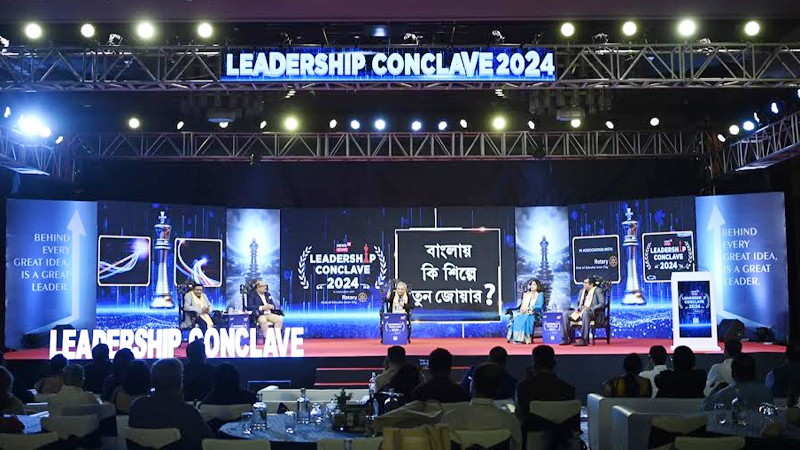
    Mumbai: News18 Bangla recently hosted the second edition of the Leadership Conclave in Kolkata on 11 March 2024. The event aimed at recognizing and celebrating the individuals and institutions who have made remarkable contributions to the growth of West Bengal. News18 Bangla honoured these individuals and institutions for creating new opportunities and strengthening the infrastructure.

    News18 Bangla Leadership Conclave was organized in association with the Rotary Club of Calcutta Inner City, which helped to shortlist the awardees by forming a jury board. The members of the jury were Mr. Pradeep Gooptu, the former editor of Business Standard; Mr. Anindya Palchowdhury, Founder and CEO of Welta Family Office; Mr. Krishna Kumar Modi, Founder Director of Phoenix Machines Pvt Ltd; Mr. Nabarun Sen, President of Century Ply Board; and Ritesh Kapoor, Director of KK Craft & Engineer Consultant Pvt Ltd

    Apart from the celebrations the ceremony also featured five panel discussions, where eminent personalities, experts, and stalwarts explored the many challenges faced by the state and the potential solutions for these hurdles. Distinguished guests who have participated in panel discussions include Mr. Bidyut Majumder, General Manager, Business Development, JIS Group; Dr. Cs Mamta Binani, President, MSME Development Forum, West Bengal; Mr. Anindya Palchowdhury, Founder and CEO Welta Family Officer; Mr. Krishna Kumar Modi, Founder & Director, Phoenix Machines Pvt Ltd; Dr. Sujata Dutta Hazarika, Senior Regional Director, IGNOU, Kolkata Regional Centre and Mr. Subir Khasnabis, Retired, CEO, Arcelor Mittal Design and Engineering. Mr. Biswa Majumdar, Editor of East at Network18, highlighted the rapid changes happening in the global landscape.

    Mentioned below are the individuals and institutions who were felicitated at the conclave – Mr. Sanjib Kr Patwari, Director, Rashmi Group – ‘Most Reliable Leader In Construction & Building Materials’; Mr. Satyam Roychowdhury, Co-Founder & Managing Director, Techno India Group & Chancellor, Sister Nivedita University – ‘Iconic Leader & Philanthropist In Eastern India’; Dr. Debashish Bhattacharya, Founder Chairman, Disha Eye Hospitals – ‘Visionary Leader In Eye Care’; Mr. Atanu Sarkar, Founder & CEO, Webskitters – IT Development & Academics – ‘Most Promising Leader in  IT Development & Academics’; Dr Pooja Shaw, Executive Director, Narayan Memorial Hospital – ‘Most Promising Women Leader In Healthcare Industry’; Mr. Supriyo Ghosh, Managing Partner, Girish Chandra Ghosh & GGS – ‘Leadership Legacy In Multidisciplinary Business Establishments’; Sardar Simarpreet Singh, Director, JIS Group – ‘Most Trusted Leader In Education’; Mrs. Bipasha Samanta, Director, Smiles Per Miles – ‘Most Promising Women Leader in Travel & Tourism Industry’; Mr. Debasish Bhattacharjee, CEO, Samata Co Operative Development Bank – ‘Leader In Fecilitating Women Empowerment’; Dr. Somnath Chatterjee, Director, Suraksha Diagnostic Pvt Ltd – ‘Most Trusted Name In Diagnosis’; Sardar Taranjit Singh, Managing Director, JIS Group – ‘Most Inspirational Business Leader In Eastern India’; Mr. Hirak Bhattacharjee, Director, Shalimar Chemical Works – ‘Most Prolific Young Leader in FMCG Sector In Eastern India’; Mr. Chitta Dipan Biswas, Managing Director, Dipan Herbal Pharmacy LLP – ‘Leader In Alternative Medicines’;  Mr Maminul Akanda, Founder, Global Institute Of Management Studies – ‘Youngest Leader In Hotel & Hospitality Education’; Mr. Sudipta Banerjee, Director, Bevel – ‘Most Versatile Leader In Diversified Ventures’; Mr. Tapabrata Mukherjee. Director, Meghbela Cable & Broadband Services (P) Ltd – ‘Dynamic Leader in Broadband Services & Entertainment’; Mr. Chiranjib Ghosh, Proprietor, Eureka Enterprise –‘Most Encouraging Leader Promoting Entrepreneurship’; Mr. Prithiijit Das, Director, Das Style Private Limited – ‘Emerging Young Entrepreneur’; Mr. Manab Paul, Founder & CEO, Sree Balaji – ‘Most Innovative Leader In Real Estate’; Dr. Jahidul Sarkar, Director, Mr Group of Colleges & Hospitals – ‘Emerging Leader In Education & Health’; Mr. Amiyo Dey (Shankar Da), Managing Director, Vivekananda Ashramik Coaching Centre (Shankar Da R Coaching) – ‘Most Consistent Leader In Competitive Studies’; Mr. Sukantilal Saha, Founder, Master Weaver & Designer, Saha Textiles – ‘Most Inspiring Leader In Textile Research & Development Of Rural Weavers’; Prof. Samit Ray, Chairman – Rice Group & Chancellor – Adamas University, Rice Group – ‘Most Celebrated Leader In Education In Eastern India’  and Balaram Mullik & Radharaman Mullik – ‘Excellence In Sweet And Confectionary’

    The second edition of the News18 Bangla Leadership Conclave was successfully concluded, honouring brilliant minds from various sectors.

  • Relaunched Gyan Darshan goes digital and mobile, also serve diaspora

    Relaunched Gyan Darshan goes digital and mobile, also serve diaspora

    MUMBAI: IGNOU has relaunched Gyan Darshan, its educational broadcast channel, which is said to be a major step in implementing education through electronic media. The channel was launched through webcasting along with Ignou’s Electronic Media Production Centre (EMPC) page on Facebook.

    IGNOU’s programmes will be available on the mobile phones too. The channel’s content will also serve the Indian diasporas globally, also enlightening them with contemporary achievements of India.

    EMPC initiatives will also help IGNOU’s study centres in West Asia (Middle-East) and African countries to enhance the learning processes of the foreign students.

    IGNOU has started Gyan Vani interactive radio counselling programmes already through both, webcasting and broadcasts.

    Gyan Darshan was operating well until June, 2014, as a significant channel for educational programmes but was closed by Indian Space Research Organisation (ISRO) to help its migration to GSAT-10.

    The Indira Gandhi National Open University (IGNOU) vice-chancellor Prof Ravindra Kumar, while launching the webcast, said that they were digital and open university — closing the chasm between Ignou and the learners.

    EMPC director Prof Kapil Kumar said the platform would be used as a promotional tool India’s cultural awareness and empowerment on a variety of issues and challenges related to societal development, environment and cultural heritage, etc.

  • Doordarshan agrees to apply for permission for four IGNOU channels

    Doordarshan agrees to apply for permission for four IGNOU channels

    NEW DELHI: Doordarshan has agreed to apply for licence to telecast four channels of the Indira Gandhi National Open University, even as the 32 channels of the Human Resource Development Minstry are still to find a place in the pubcaster’s Freedish.

    Interestingly, one Gyan Darshan channel and one one Gyani channel had been taken off DD and All India Radio respectively in 2014 for non-clearance of dues.

    Under a Memorandum of Understanding now signed between Doordarshan and IGNOU regarding the transmission of four Gyan Darshan Educational channels, DD has agreed to apply for permission to telecast four Gyan Darshan channels from IGNOU Earth Station Delhi to operate in C-band from GSAT-10. IGNOU is not eligible to apply under the Uplinking and Downlinking Guidelines as it is not a broadcaster.

    The Gyan Darshan Bouquet of Educational TV Channels is an educational media initiative of MHRD in collaboration with the Information and Broadcasting Ministry, Prasar Bharati and the Indian Space Research Organization with IGNOU as the nodal agency.

    It consists of four TV Channels: GD-I & II (by IGNOU), GD-III – Eklava (by Indian Institute of Technology, Delhi), and GD-IV – Vyas Channel (by University Grants Commission, CEC).

    Gyan Darshan had been initially launched on 26 January 2000 as a solitary 24×7 hour satellite channel under the banner of Doordarshan which provided a Transponder on INSAT 2B satellite, free of cost.

    Gyan Darshan ran successfully till 2 June 2014 as a must carry channel for educational programmes but was shut down by ISRO to facilitate its migration from INSAT 3C to GSAT-10.
    IGNOU now needs to apply for a fresh License to start the uplinking of its Channels for GSAT-10 Satellite.

    Speaking on the occasion, DD DG Supriya Sahu said, “I am happy that we have signed this MOU with IGNOU and joined hands with a premier institution like IGNOU. This partnership would ensure that the educational channels of IGNOU reach and benefit millions of students across the country. I think this is one of the most outstanding initiatives in the field of Public Broadcasting”.

    IGNOU Vice Chancellor Ravindra Kumar said, “Gyandarshan has always been a flagship programme for IGNOU and educational community. Today we (IGNOU & DD) are both happy and enormously excited that Gyandarshan has once again become a reality.”

    Earlier in October 2014, indiantelevision.con and radioandmusic.com had reported that the channels Gyan Darshan and Gyanvani had been shut down because of non-payment. While the figures were DD were not available, AIR DG Fayyaz Sheheryar had said the dues amounted to more than Rs 21.6 crore.

    He had then said that it had to be understood that Gyanvani and Gyandarshan were radio and television channels respectively run and owned by IGNOU and Prasar Bharati only provided the platform for the broadcasts.

    Later, IGNOU had launched these channels on the Internet. indiantelevision.com had learnt at the time that IGNOU had applied to WPC for a licence to run television channels, but had been refused by the Department of Telecom which had told them that only Doordarshan can apply for such a channel.

    But DD had refused to apply for the channel on behalf of IGNOU in view of the report by the Telecom Regulatory Authority of India which bars allotment of licences to government bodies to start their own channels.

    These web-based channels can be accessed by the students directly from their homes at http://www.ignouonline.ac.in/Broadcast/ without having to go to the Regional Centres or Local Study Centres.

  • Doordarshan agrees to apply for permission for four IGNOU channels

    Doordarshan agrees to apply for permission for four IGNOU channels

    NEW DELHI: Doordarshan has agreed to apply for licence to telecast four channels of the Indira Gandhi National Open University, even as the 32 channels of the Human Resource Development Minstry are still to find a place in the pubcaster’s Freedish.

    Interestingly, one Gyan Darshan channel and one one Gyani channel had been taken off DD and All India Radio respectively in 2014 for non-clearance of dues.

    Under a Memorandum of Understanding now signed between Doordarshan and IGNOU regarding the transmission of four Gyan Darshan Educational channels, DD has agreed to apply for permission to telecast four Gyan Darshan channels from IGNOU Earth Station Delhi to operate in C-band from GSAT-10. IGNOU is not eligible to apply under the Uplinking and Downlinking Guidelines as it is not a broadcaster.

    The Gyan Darshan Bouquet of Educational TV Channels is an educational media initiative of MHRD in collaboration with the Information and Broadcasting Ministry, Prasar Bharati and the Indian Space Research Organization with IGNOU as the nodal agency.

    It consists of four TV Channels: GD-I & II (by IGNOU), GD-III – Eklava (by Indian Institute of Technology, Delhi), and GD-IV – Vyas Channel (by University Grants Commission, CEC).

    Gyan Darshan had been initially launched on 26 January 2000 as a solitary 24×7 hour satellite channel under the banner of Doordarshan which provided a Transponder on INSAT 2B satellite, free of cost.

    Gyan Darshan ran successfully till 2 June 2014 as a must carry channel for educational programmes but was shut down by ISRO to facilitate its migration from INSAT 3C to GSAT-10.
    IGNOU now needs to apply for a fresh License to start the uplinking of its Channels for GSAT-10 Satellite.

    Speaking on the occasion, DD DG Supriya Sahu said, “I am happy that we have signed this MOU with IGNOU and joined hands with a premier institution like IGNOU. This partnership would ensure that the educational channels of IGNOU reach and benefit millions of students across the country. I think this is one of the most outstanding initiatives in the field of Public Broadcasting”.

    IGNOU Vice Chancellor Ravindra Kumar said, “Gyandarshan has always been a flagship programme for IGNOU and educational community. Today we (IGNOU & DD) are both happy and enormously excited that Gyandarshan has once again become a reality.”

    Earlier in October 2014, indiantelevision.con and radioandmusic.com had reported that the channels Gyan Darshan and Gyanvani had been shut down because of non-payment. While the figures were DD were not available, AIR DG Fayyaz Sheheryar had said the dues amounted to more than Rs 21.6 crore.

    He had then said that it had to be understood that Gyanvani and Gyandarshan were radio and television channels respectively run and owned by IGNOU and Prasar Bharati only provided the platform for the broadcasts.

    Later, IGNOU had launched these channels on the Internet. indiantelevision.com had learnt at the time that IGNOU had applied to WPC for a licence to run television channels, but had been refused by the Department of Telecom which had told them that only Doordarshan can apply for such a channel.

    But DD had refused to apply for the channel on behalf of IGNOU in view of the report by the Telecom Regulatory Authority of India which bars allotment of licences to government bodies to start their own channels.

    These web-based channels can be accessed by the students directly from their homes at http://www.ignouonline.ac.in/Broadcast/ without having to go to the Regional Centres or Local Study Centres.

  • DishTV adds 32 educational channels to its bouquet

    DishTV adds 32 educational channels to its bouquet

    MUMBAI: Providing better quality entertainment to its subscribers and offering value for their money is DishTV. The DTH brand has taken its total count to more than 585 channels and services. It has reportedly added 32 new educational channels launched by the Ministry of Human Resource Development.

    The content of the 32 channels is unique in order to provide maximum information through the visual medium. The educational channels are available from channel number 2001 to 2032 on DishTV and Zing.

    DishTV CEO Arun Kumar Kapoor said, “We support the Government’s initiative of driving education through TV sets, and are delighted that these educational channels from the Ministry of Human Resource Development are available to all DishTV subscribers. We feel proud and contented at the same time as we are reaching a new milestone of having more than 585 channels and services on our platform.”

    With the focus on using space technology to expand reach, these channels will offer high quality educational content to all subscribers designed by central universities such as Jamia Millia Islamia, Punjabi University, IGNOU, Kashmir University and other leading educational institutions.

    The service will also offer telecast of live classroom lectures from top-notch institutions including the prestigious IITs.

  • DishTV adds 32 educational channels to its bouquet

    DishTV adds 32 educational channels to its bouquet

    MUMBAI: Providing better quality entertainment to its subscribers and offering value for their money is DishTV. The DTH brand has taken its total count to more than 585 channels and services. It has reportedly added 32 new educational channels launched by the Ministry of Human Resource Development.

    The content of the 32 channels is unique in order to provide maximum information through the visual medium. The educational channels are available from channel number 2001 to 2032 on DishTV and Zing.

    DishTV CEO Arun Kumar Kapoor said, “We support the Government’s initiative of driving education through TV sets, and are delighted that these educational channels from the Ministry of Human Resource Development are available to all DishTV subscribers. We feel proud and contented at the same time as we are reaching a new milestone of having more than 585 channels and services on our platform.”

    With the focus on using space technology to expand reach, these channels will offer high quality educational content to all subscribers designed by central universities such as Jamia Millia Islamia, Punjabi University, IGNOU, Kashmir University and other leading educational institutions.

    The service will also offer telecast of live classroom lectures from top-notch institutions including the prestigious IITs.

  • ‘Global animation studios will set up shop in India for captive backend facilities’ : Ronald D’Mello – Maya MD and CEO

    ‘Global animation studios will set up shop in India for captive backend facilities’ : Ronald D’Mello – Maya MD and CEO

    Two years back, Maya Entertainment Ltd. was in trouble with two of its business verticals in the red. What followed was a restructuring and the education vertical since then has seen exponential growth to post over Rs 1 billion in FY‘09.

    The studio business has also grown and Maya is in the midst of releasing its first animated movie, Ramayana The Epic.

    Promoted by Bollywood filmmaker Ketan Mehta, the company went through an ownership change. Enam Securities holds 45 per cent stake, Bhukhanwala Holdings 20 per cent and Intel Capital, with three rounds of funding, around 12 per cent.

    The company faces new challenges as it scales up and plans to raise funds.

    In an interview with Indiantelevision.com, Maya MD and CEO Ronald D‘Mello, who is preparing for a new innings, reflects on how the company managed to turn around in the last two years.

    Excerpts:

    When you took over as CEO of Maya Entertainment Ltd, there was a need to restructure the company. What are the measures you took?
    There were substantial corporate hygiene issues which threatened the very structural stability of Maya as a company. In November 2007, we engineered a major restructuring exercise in our education vertical, risking almost half of our business, to eliminate conflict of interest positions of some of the key executives and employees of Maya, the group which went on to form a competing business. Thankfully, the exercise not only resulted in a clean and transparent Maya but also laid a strong foundation for substantial growth.

    On the studio side, the challenge was both on business development and internal operational disciplines which we were able to overcome.

    Did this mean that the key management of the education business changed?
    We terminated 13 educational franchise centres in north India which collectively contributed to 50 per cent of our turnover. The result was extremely satisfying. We were able to grow the education vertical billings by over 300 per cent over the last two years to make it an over Rs 1 billion activity in billing in FY‘09. In terms of number of franchise centres, we grew from 38 ( at the end of the restructuring exercise in 2007 ) to 70 by June 2009.

    We consolidated our position in animation education to become the largest player in career-oriented animation education. We created an Advisory Board comprising the stalwarts of animation industry to build a constant interaction between industry and academia so that the courses we offer are suited to industry needs. We converted the outlook of our courses from software to creativity- focussed. We also created a product ( MAAC Junior Toon Club ) for young students in the age group 7 to 14 as a creative enrichment platform to integrate with art and craft curriculum of schools across India. Association with IGNOU for degree program in animation and VFX was also a feather in our cap during this period.

    And on the studio front?
    We went on to have the most productive year in FY‘09 where the total output between international service work, own IP and domestic service work was amongst the largest in Indian animation studios.

    When you joined two years back, animation was on a high-growth curve. Did that help Maya ride the tide in any way?
    All industries go through highs and lows. Challenge is to get the best out of it when the industry is on a growth curve and to pro-actively future proof your business for industry lows. We did have the benefit of industry highs as much as everyone else in the segment did. But our growth probably outperformed industry and competition.

    are the challenges the Indian animation industry faces today as the global economy is in the midst of a downturn?
    I would rather not get too influenced by the downturn in global economy as it is the ‘uncontrollable” factor all are faced with. In isolation, I see Indian animation industry far slower than the hype it has created for itself. If we believe the global animation and VFX consumption numbers at over $60 billion, what India has managed to get in terms of service outsourcing is abysmally low even if you assume content production constitutes 10 per cent of the global animation consumption pie. Also, the demographics of India population indicate a good future for more youth friendly animation, gaming and VFX content.

    Unfortunately, most of the early entrants in Indian animation production space lack a long term strategy to sustain market penetration and growth over a longer period of time. Even the development of talent has suffered due to this short term approach. If you see the IT sector and how it grew over the years, you will find sustained long term stay over decades by some of the dominant players to make India the hub of IT services and create a large industry today.
    ‘Indian animation studios may not be in the position of strength, both creatively or in market reach, to be up on the value and risk chain on co-productions‘

    Several companies have ventured into animated movies for the domestic market as a scale up strategy. But most of them have flopped at the box office. How do you think this is going to impact the business?
    This is what I meant by short term approach. If anyone thought of producing an animation movie thinking it would be a huge success, it is a wrong base to start with. Animation movies, like any other movies, are not free from the risks familiar to film producers. Moreover, you have the task of playing in an unestablished segment of viewership. I am afraid it would take few more movies to fail and learnings from those taken, before we see the domestic industry evolving in animation. Till someone takes that risk and has a sustained agenda to create this segment, it would be hard to imagine the domestic industry to mature.

    In a period of hype, even Disney entered into a joint venture with Yash Raj Films for an animated movie Roadside Romeo when one thought they didn‘t require a local partner to aid them in what they are best at. Since the movie bombed, this may discourage international companies making animated movies for the Indian market. Are we entering a different phase of the business cycle?
    I don‘t think any international studio considers failures as end of the road. I am sure Disney and Yash Raj Films have drawn considerable learnings from their first attempt which will only help them to make it better next time, both in terms of content creation and market exploration.

    Is getting into co-production arrangements for international movies and TV series a more viable business model?
    It all depends where you place yourself in the value and risk chain. If you are the last man standing in the chain, no international co-production can change the game for you. I am afraid, Indian studios may not be in the position of strength, both creatively or in market reach, as of now to be up on the value and risk chain on co-productions. Hence, it may be a while before it happens to its spoken potential.

    What are the steps you took at Maya to prepare the company for producing an animated movie?
    Ramayana The Epic, Maya‘s first animated film, was already in its baby steps when I joined. We decided to provide a development budget to the director and team so that the idea can be taken to a script, few key character designed and a three-minute sample fully animated and composed sequence developed. At the end of this exercise, we were fully convinced that the team can deliver an astounding product and decided to move on.

    What is the budget for Ramayana and how have you de-risked the project?
    We would have loved to have some co-producer coming in through its production phase. But the overall economic slowdown and Indian film ( specifically animation films ) sector dampness did not help us. The film is now complete and being shown to potential distributors.

    How much does Maya depend on outsourced projects? How does it scale up its studio business?
    Maya is predominantly a service studio, barring the first IP we produced over the last year. I cannot really comment on the future strategy for the studio scale up as it would be now left for Maya board to drive the company.

    Are there too many animation companies fighting for too small a pie?
    The pie is big, but someone needs to take a really long term view of the potential and have sustained existence to bear the desired fruit. Meanwhile, I see international animation producers and studios setting shops in India for captive backend facilities which will open new avenues for talent.

    How tough is it for the small-sized animation companies to raise capital and survive?
    Raising capital is dependent on the industry perception, company fundamentals and overall investment market climate. I presume in the present scenario it would be difficult for an animation production player to raise funds as none of the above three are in favour. Education industry will attract investor interest for businesses which have good fundamentals and clear future focus.

    Is Maya planning to raise funds? How much, how and for what?
    Yes, we have been on it since last year. But I can‘t give you more details.

    You are quitting Maya at a time when it has still to grow. What do You think is the future of such companies?
    I suppose I cannot comment on this. I am sure Maya will be able to attract the next anchor and drive the business forward.

    You are quitting Maya at a time when it has still to grow. What do You think is the future of such companies?
    I suppose I cannot comment on this. I am sure Maya will be able to attract the next anchor and drive the business forward.

    How tough is it for the small-sized animation companies to raise capital and survive?
    Raising capital is dependent on the industry perception, company fundamentals and overall investment market climate. I presume in the present scenario it would be difficult for an animation production player to raise funds as none of the above three are in favour. Education industry will attract investor interest for businesses which have good fundamentals and clear future focus.

    Is Maya planning to raise funds? How much, how and for what?
    Yes, we have been on it since last year. But I can‘t give you more details.

    You are quitting Maya at a time when it has still to grow. What do You think is the future of such companies?
    I suppose I cannot comment on this. I am sure Maya will be able to attract the next anchor and drive the business forward.

  • ‘B’cast pros will benefit from tec choices at Expo’ : AS Guin – Engineer-in-chief at AIR and president, BES

    ‘B’cast pros will benefit from tec choices at Expo’ : AS Guin – Engineer-in-chief at AIR and president, BES

    The NGO Broadcast Engineers Society is holding its 13th Expo this year from February 1 to February 3 at Delhi’s Pragati Maidan. It is a much larger exposition this year, and with the government setting the cut-off date for digitalisation, will showcase technology options. Possibly the most socially significant technology presented will be the low-band community radio system, supported by Unesco.


    Indiantelevision.com’s Sujit Chakraborty met AS Guin, engineer-in-chief at AIR and president, BES, to find out what’s on offer this year.


    Excerpts:

    The BES Expo is just a few days away. What are the new things expected this year?

    There are many changes in respect to last year. The participation has grown manifold and instead of the earlier venue of Hotel Taj Palace, as in 2006, this year we have to shift to a much larger arena, the Pragati Maidan, which gives us 20 per cent additional space.

    In terms of revenue, what is BES’ business model?

    Here too, there will be a 20 per cent rise in receipts. There will be 16 new companies who will take part for the first time. BES depends mainly on revenue from the exhibitions and membership. We have 1,600 members across the country, and we expect the number to grow further next year. We have to cut some of the costs, but then we also plan to start an educational programme, which will be no-loss, no-profit.

    What are the major technological windows that you wish to open this time?

    The biggest is of course the community radio solutions and mobile TV and radio. These would be most important in terms of both business and community service, with local NGOs being able to broadcast on their own radio, with all the support of AIR experts. Even our retired engineering staff is willing to offer their services free to persons willing to set up local channels.


    As I told you, we have 1,600 members across the country and they give us a tremendous outreach to help spread the low-band community radio movement. We are very excited about this programme, which will be a prime exhibit this year.

    Who all are supporting this event?

    The event is supported by the Ministry of Information and Broadcasting , Government of India, and endorsed by International Association of Broadcasting Manufacturers and also by Prasar Bharati, Asian Broadcasting Union, UNESCO, IGNOU and Department of Information Technology, Government of India.


    UNESCO is going to showcase its low-cost technological innovations and is with us at BES EXPO 2007, and will push forward the community radio programme. They are going to present suitcase radio, hand-wound sets (which need no battery or electricity to run) solar-powered FM transmitters, and other radio equipment compatible with Indian conditions.


    They will also set up in their stall a community multi-media centre, including radio, internet, and content networking programme, with live content programming.

    Many private sportscasters have announced their mobile programmes and one is running already, but these show snaps only. So how is your system going to be different?

    No, ours will be a full streaming. This will not be clips. In fact, this will completely shift prime time to office time, with people seeing DD or hearing AIR news and programmes on their way to office. These will not be clips, but as you see or hear news.

    New technology will always remain in the public domain, because of the sheer scale of operational costs, which the private sector would find very difficult to match

    Is this Prasar Bharati’s own technology?

    There is technology available in Europe and the US. The latter is using the MediaFlo. technology and Europe is using DVB-H. MediaFlo is a proprietary system, while DVB-H is an open system. An expert committee constituted by the Ministry of Information and Broadcasting has recommended DVB-H .With Secretary level approval a final decision is still awaited.

    What are the technical and operational differences in the two?

    DVB-H is IP-based and an open platform, where as MediaFlo has proprietary elements MediaFlo has less channel switching time than DVB-H. Both employ battery-saving techniques. They have different encoding and modulation schemes.

    What is the delay, and how long would it take?

    The proposal has been sent to the Planning Commission, which will study it and will have to sanction money. This could take eight to 10 months.

    What will be the outcome of the event?

    Broadcast professionals will be highly benefited in enhancing their knowledge about emerging broadcast technologies and also have a look and feel of new broadcast equipment systems in the exhibition. It will help the broadcast planners to choose viable and right technologies for their digitalisation plans.

    You have said that AIR and DD will turn digital during the 11th Plan. What is the cost you are looking at?

    For AIR, we have asked for something like Rs 5,900 crore and for DD another Rs 6,000 crore. But these are very large sums of money and chances are we might not get it all during the 11th Plan itself. But even if we get something like half of this, we could go digital and AIR could have seven digital channels. The output would be almost FM quality.

    Would these channels be available on the normal radio sets we use today?

    No, that technology is not available so far and even in the west, it is very costly, about $80 for a digital radio handset.New technology will always remain in the public domain, because of the sheer scale of operational costs, which the private sector would find very difficult to match.


    This will completely take away perhaps the only joy of millions of poor Indians who are totally dependent on AIR for news and entertainment, besides the public services as on health and agricultural advice. Well, the decision to go digital, across the world, has been taken, so this will have to happen. In any case the cut-off date set by the government for transition from analogue to digital is 2015. But then, as demand goes up, the prices will come down. A normal radio handset now costs Rs 200, and these sets will cost something like Rs 500, at the most, with cheaper technology coming in. But do remember that the audience will have a choice of seven channels.

    Any other benefits on offer for this costly technology?

    Interactive broadcasts and a number of value-added services will be possible. Well, one of the most important things will be the pro-active role AIR will get to play in disaster management. We will introduce a system all across the channels on the coastal belts, which will be integrated with the early warning systems. Thus, whenever an early warning is triggered off the computer linkage with the radio stations will ensure that the channel would automatically switch over to transmitting the warning, with the ongoing programme switched off. Once the warning has been issued, the radio station would switch over to the normal ongoing programme. This will give a huge lead time for people to evacuate.

    How do you see prices coming down?

    Take the example of DTH. When it started the companies were asking for Rs 5,000 per dish, but we are now giving our DTH, DD Direct Plus at Rs 1,200. So this depends on two things, content and demand.

    Who are you looking to as technical collaborators?

    You see, the US has HD radio, and Korea uses DMB but that’s mostly for TV. China uses DRM technology for external services. We have spoken with China about DRM .It has shown a keen interest and once the two countries collaborate, the prices of receivers would dramatically come down. China would have to collaborate to set up factories in India, because if we have to import, prices would be very high.

    What are the network plans?

    The digitalisation process would start with all the studios. It would be the Short Wave transmissions that would go digital first. Each state capital would have one Short Wave transmitter and there will be three transmission complexes with five transmitters per complex for national digital radio coverage. These complexes will be suitably located., Each complex will transmit five digital channels across the country, including regional language channels. This will mean that these channels will be accessible across the country. So, a Bengali in Mumbai would not have a problem if he wishes to hear All India Radio Kolkata.

    Being a public broadcaster, how do you think the private players would match your line of thinking?

    Interestingly, I think that introduction of new technology will always remain in the public domain, due to the sheer scale of operations and costs that private enterprise would find it difficult to match. This is a Plan expenditure with government support. Only after it is introduced in the country will public private participation happen. For example, the private players have invested a huge amount in Phase 1 and 2 of FM, which is in the analogue mode. AIR is proposing digital FM in the near future, using DRM+, or DAB or HD Radio technology. But forget replacing the existing transmitters, even initial investment will not be easy for the private entrepreneurs, unless the receivers for digital broadcasting become low cost and catch the imagination of the public.