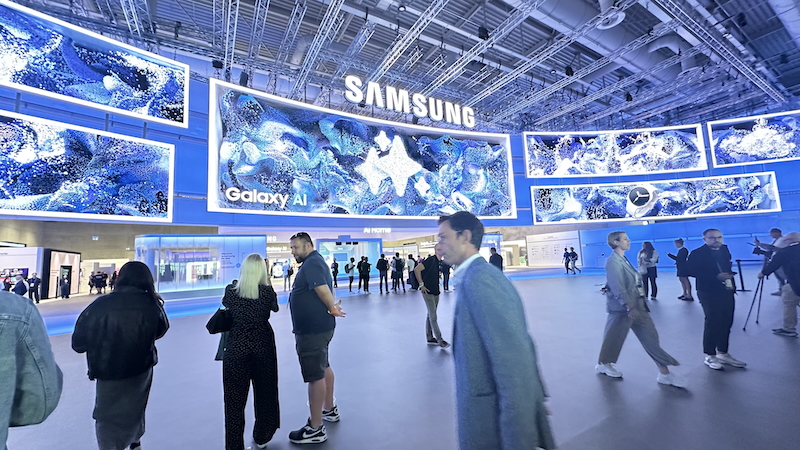
BERLIN: At Innovation For All (IFA) 2025, Samsung Electronics took centre stage with one message: artificial intelligence has moved out of the lab and into the living room. Under the banner “AI Home: Future Living, Now,” the South Korean conglomerate unveiled its vision of domestic life powered by adaptive technology — one that it claims is already attainable and accessible to millions.
Executive vice president and head of digital appliances Cheolgi Kim framed the pitch as a shift in how technology should exist within human life. “At Samsung, we’re not just imagining the future of AI; we’re building it into everyday life,” he said. “This is the beginning of a new era — where technology supports your life in the background so that you can live it more fully.”
The ambition is bold: move beyond the fragmented world of “smart” gadgets towards a seamless ecosystem that not only responds but anticipates. The stakes are equally high. With AI now the battleground for Big Tech and consumer electronics, Samsung is vying to prove that homes are where AI will have its most profound — and profitable — impact.
Samsung’s SmartThings platform lies at the heart of this proposition. Once marketed as a connected-home app, it is now evolving into what the company describes as a “home operating system.” AI routines automate lighting, temperature and shading; blinds align with the weather forecast; heating systems learn daily habits; and appliances self-optimise without prompting.
Consumer appetite, Samsung insists, is real. A global survey commissioned by the company shows two-thirds of respondents find the concept of an AI-enabled home appealing. Forty-four per cent cited streamlined chores, while 45 per cent liked the idea of controlling devices by phone or voice. More tellingly, 93 per cent described the home as a sanctuary, and 80 per cent saw it as a social hub — a place where technology should enhance human connection, not interfere with it.
Samsung’s pitch, then, is about invisibility. The AI Home is not meant to dazzle with futuristic gimmicks but to fade into the background, adjusting conditions subtly to improve comfort and efficiency.
The company knows that energy bills remain top of mind worldwide. According to its research, 66 per cent of consumers believe AI can help reduce costs. The SmartThings Energy service provides real-time monitoring, nudging households towards savings. Samsung claims it can cut washing-machine power use by up to 70 per cent — a figure it highlights repeatedly.

The emphasis on energy efficiency is strategic. Unlike voice assistants or robotic gadgets that risk being dismissed as novelties, tangible cost savings could be the lever that convinces consumers to invest in AI-enabled ecosystems. It also aligns with regulatory pressures in Europe, where energy performance standards are tightening.
With smart homes comes a perennial concern: security. Four in ten consumers surveyed by Samsung expect AI to enhance home safety. The firm has responded with Knox Vault, a hardware-level data safeguard, and Knox Matrix, which provides cross-device protection across its ecosystem. The language here is deliberate: “vaults” and “matrices” are meant to signal seriousness, reassuring customers that AI will not become a Trojan horse for hackers.
In a market where trust is fragile — particularly in Europe, where data privacy is heavily policed — Samsung’s ability to frame AI as safe as well as smart may determine adoption.
Perhaps the most visible manifestation of Samsung’s AI strategy is its Bespoke AI appliance line. This year’s models showcase a shift from novelty to genuine utility:
* Jet Bot Steam Ultra: now equipped with enhanced object recognition that can detect even transparent liquids — addressing one of the biggest challenges in robotic cleaning.
* Bespoke AI Washer: featuring AI Wash+, it analyses fabric load and dirt levels to adjust cycles. It surpasses the threshold for Grade A energy efficiency by 65 per cent.
* Bespoke AI Dishwasher: dynamically optimises cycles based on how dirty the dishes are, then pops its door open to accelerate drying.
* Extractor Induction Hob: integrates the extractor into the hob itself, maximising kitchen space — a design nod to compact European apartments.
These are not futuristic concept devices but commercial products. Samsung is betting that incremental intelligence built into everyday machines will persuade consumers to trade up.
Samsung’s push is not confined to the kitchen or laundry. The company is embedding what it calls Vision AI Companion into larger displays, positioning it as a natural, almost human-like presence that can converse, guide and entertain. Unlike voice assistants locked into narrow commands, Vision AI is pitched as a trusted “companion” — a word chosen to evoke emotional connection.
Hardware remains a showstopper. The 115-inch Micro RGB display delivers cinema-quality visuals with striking depth and vibrancy, while the Movingstyle TV, a portable touchscreen with a built-in battery, targets younger consumers with flexible living spaces. The Samsung Sound Tower, meanwhile, promises 18 hours of portable battery life, customisable lighting and app-controlled sound effects — signalling that AI is also about fun.
Samsung’s AI story extends beyond the home and into its most recognisable product line: Galaxy smartphones. Having rolled out Galaxy AI to more than 200m devices in 2024, the firm now aims to double that reach, targeting 400m devices by end-2025.
The company frames this as “democratising AI”. Features once reserved for flagships will trickle down to mid-range devices, creating a seamless experience across phones, tablets and wearables. With rivals from Apple to Huawei making similar plays, scale will be crucial.
IFA, Europe’s premier consumer electronics show, is as much about theatre as technology. Samsung embraced the spectacle with a 50-metre-wide media art installation at Berlin’s CityCube entrance. Created with French digital artist Maotik, the piece visualises “wind” as flowing data waves — an abstract metaphor for AI’s invisible yet transformative role.
The exhibition itself, running from 5–9 September, invites visitors to walk through fully staged AI Home environments. The message is clear: AI is not a far-off dream. It is a present-day reality to be touched, tested and bought.
Why such a push now? First, competition. Apple, Amazon, and Chinese firms such as Xiaomi are all racing to dominate the home AI market. Google and Microsoft are extending their reach through partnerships and cloud AI services. For Samsung, whose strength lies in hardware, the opportunity is to integrate AI deeply into devices that already sit in millions of homes.
Second, consumer economics. Global demand for white goods is relatively flat. By adding intelligence, Samsung hopes to revive upgrade cycles and command premium prices. Energy savings and convenience are framed as justifications for those higher upfront costs.
Finally, brand positioning. By declaring that “AI is here”, Samsung differentiates itself from rivals still speaking of AI in aspirational terms. It wants to own the narrative that artificial intelligence is not just about chatbots or productivity tools, but about life’s most intimate space: the home.
Samsung’s pitch is compelling but not without hurdles. Convincing sceptical consumers that AI is worth paying for will require more than glossy demos. Regulatory scrutiny around data will intensify. And rivals will not cede the living room easily.
Yet if Samsung is right, the next frontier for AI is not in boardrooms or studios but kitchens and bedrooms. The company’s IFA showcase was a declaration of intent: to weave AI so seamlessly into daily life that, eventually, people may stop noticing it at all.
For now, the AI Home is a vision Samsung insists you can live in today. The test will be whether the world believes it — and buys it.