Tag: IDOS 2017

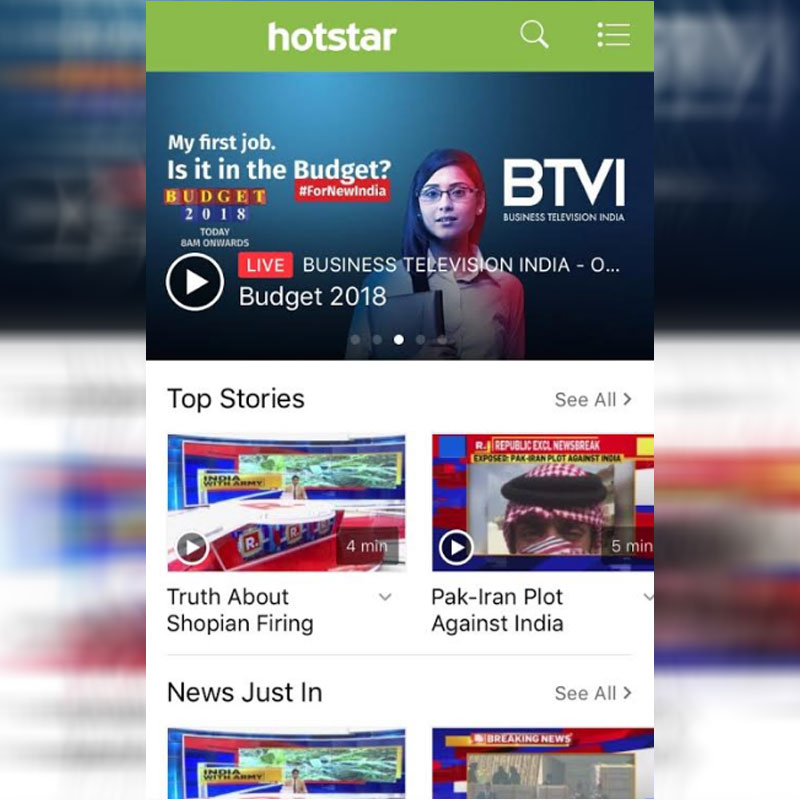
  • BTVI to now bring live budget updates on Hotstar

    BTVI to now bring live budget updates on Hotstar

    MUMBAI: At a time when OTT players are striving hard to build their content partnerships, Hotstar is adding a new pipeline of content to its news category. After Republic and ABP News, now BTVI is also live on Hotstar.

    BTVI will be giving all the Budget 2018 updates from today 8pm onwards.

    In May 2017, Republic joined hands with Hotstar to shape the future of news online. Republic TV claimed the partnership to be a stunning debut on Hotstar by crossing a million viewers within a day of its launch. Meanwhile, ABP has been live on Hotstar since October 2017.

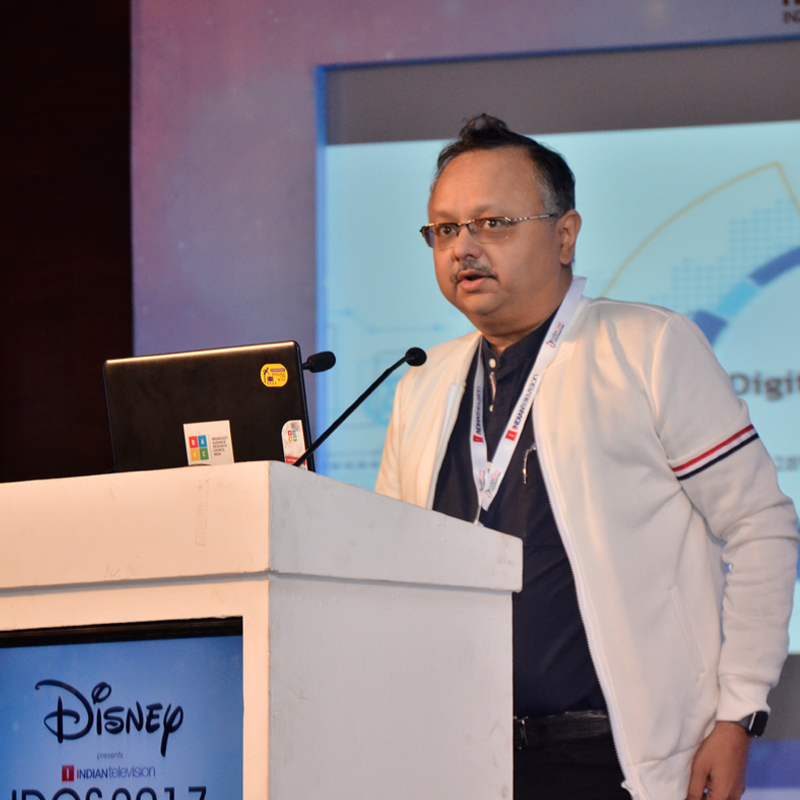
    News as a genre is continuously spreading its wings. The ratio of watching news on television is on a whopping increase. In Indiantelevision.com’s 13th Indian Digital Operators Summit (IDOS 2017), Broadcast Audience Research Council (BARC) India CEO Partho Dasgupta sounded a positive note on the growth of news as a genre. He said, “Hindi news grew by 93 per cent in 2017 over week 41 of 2015,” which means the news content is being consumed more and more on television as well as online.

    Also Read:

    Hotstar is an important platform for us: ABP’s Avinash Pandey

    Republic TV claims  ‘stunning’ debut on Hotstar

    Hotstar announces partnership with awesomeness

  • IDOS 2017: Television is growing and will continue to do so, says BARC’s Partho Dasgupta

    IDOS 2017: Television is growing and will continue to do so, says BARC’s Partho Dasgupta

    NEW DELHI: Broadcast Audience Research Council (BARC) India CEO Partho Dasgupta sounded a positive note at Indiantelevision.com’s 13th Indian Digital Operators Summit (IDOS 2017) in New Delhi’s The Lalit on 28 September 2017. Dasgupta stated that the video distribution ecosystem will have place for all types of DPOs – DTH, cable TV, OTT, terrestrial, free to air and even FTTH.

    “India’s cable TV operators have been pretty resilient over the years,” said he. “There is a lot potential for them to distribute video in India. TV has till now reached around 64 per cent of the Indian households. Thirty-six per cent is still left. A 100 million households are still not connected with TV. Even if 50 million more were to get connected, that’s a lot of potential for everyone. Multiple players and multiple digital formats will exist,” he said.

    He explained that India is one of the few countries where around 40 (television) channels are being added (as per MIB permissions) every year. “The launches are happening because there is potential in the market,” he said.

    He pointed out that TV viewership is seeing growth like never before. “It spurted by 25 per cent to 27.0 billion impressions in 2017, from 22.4 billion impressions in 2016,” he stated. “Even the daily average time spent (ATS) has grown by 16 per cent from three hours seven minutes in week 41 2015 to three hours thirty-seven minutes in week 36, 2017.”

    Dasgupta exclaimed that Doordarshan’s FreeDish is emerging as a potent force. “Free TV with 80 channels is being watched in rural areas. For them, the fact that some of the programmes are repeats does not matter because viewers are watching them for the first time.”

    He highlighted that there is a lot of excitement around flat TVs, HD TV, 4K TV, but the reality in the Indian marketplace is that 86 per cent of TVs are CRT (cathode ray tube) sets. “There is movement upwards expected in this area too,” he added.

    Dasgupta was of the view that the new millenials are watching some TV but they are also consuming video on their handheld devices. “However, OTT has some way to go because of bandwidth issues in India,” he pointed out. “Though the situation could change soon with dropping bandwidth prices and quality. And, we are getting ready with our measurement of multiscreen viewing which will include handheld devices.”

    He stated that future of television looks healthy, as almost every genre is showing growth in terms of viewership. “GEC has expanded 12 per cent since the beginning of the year,” he elaborated. “News and movies have also grown. Hindi movies grew by 60 per cent in 2017 over week 41 of 2015; Hindi news by a whopping 93 per cent in 2017 over week 41 of 2015.”

    For TV industry professionals, that should surely come as good news.

  • IDOS 2017: Cable TV sector needs more collaborative broadcasters, say MSOs

    IDOS 2017: Cable TV sector needs more collaborative broadcasters, say MSOs

    NEW DELHI: Even as the multi-system operators and cable operator are doing their bit to aid digitisation, broadcasters need to participate more in the process which officially has been completed. They need to be more transparent and supportive of the distribution platform operator — in this case the MSO and cable TV operator — and not be like a tax collector always asking for more.

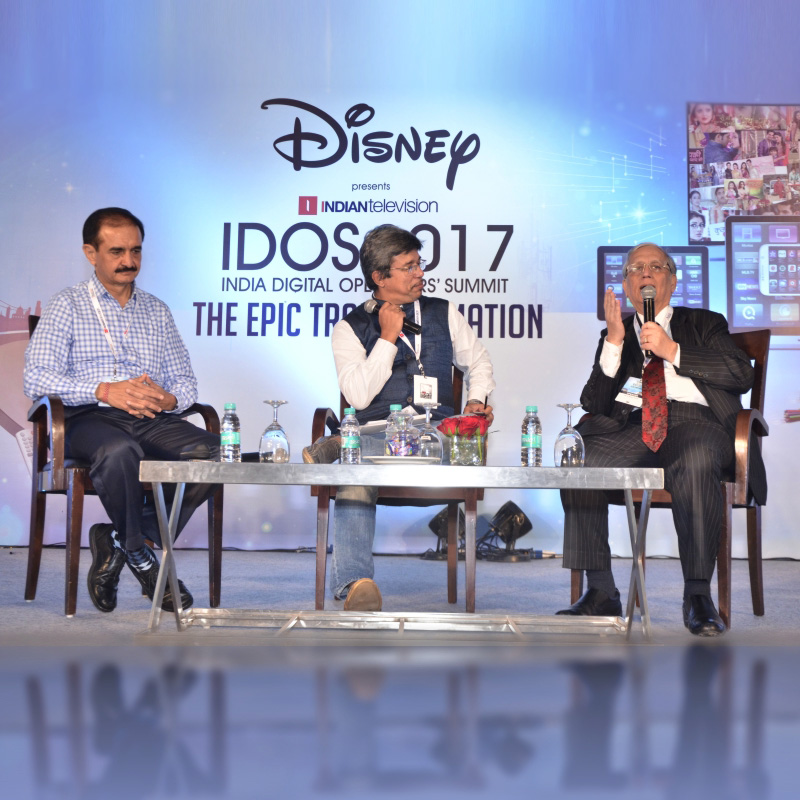
    This was the general view of both, S N Sharma of Den and Ashok Mansukhani of Incable in a discussion in ‘The Indian MSO: Redefining the raison’etre’, who also said it was only now that the MSO was beginning to monetise almost five years after digital addressable system was first launched.

    Furthermore, the broadcasters were still free to fund the business as they wanted, and, as Sharma put it, there are only two laws that control the broadcaster – the Programme and Advertising Codes and the Cable Television Networks (Regulation) Act 1995. Thus, there is virtually no regulation for the broadcaster, Sharma said.

    Both, Sharma and Mansukhani agreed that MSOs and even LCOs had put in a lot of effort to get DAS off the ground — that too in a period of four to five years, which is unprecedented globally.

    “The DAS regulation was brought in for transparency and to allow everyone to have a fair share of the huge subscription revenues that viewers were paying to watch cable TV,” said Sharma. “But, the sad part is that broadcasters are constantly asking for rate increases of 24 per cent or so without even asking if it were possible,” added Mansukhani.

    They said that it would be better if the broadcasters were to communicate rate increases to viewers and invest in promoting that, rather than expecting MSOs who are just about recovering from the hangover of the huge investments they have put into DAS as well as getting robust systems and processes in place. “Also, we are not equipped or have the creative mindset to communicate this effectively for all channels,” agreed both Sharma and Mansukhani.

    Rather than going to courts to stall the TRAI tariff order, they said, broadcasters could collaboratively work with the DPOs to take DAS on to the next level. “Neither the government nor the regulator has been able to do anything,” they said.

    “We have our own troubles, recouping our investments to bring back profitability into the cable TV sector, as well as dealing with piracy and leakages which broadcasters take time to check and stop because they have procedures to follow,” said Sharma.

    Mansukhani disagreed with Indiantelevision.com founder, CEO and editor-in-chief Anil Wanvari that the cable TV sector will not be in a position to manage complicated skinny a la carte bundles for the millions of customers that it serves. “Our backends are ready,” he said. “Our SMS, billing and KYC of the customers is in place,” he said. “We are just waiting for the (court) order to come through.”

    He opined that the industry would ultimately survive the changes, and he was also confident that the cable industry was ready to adapt to any new technology.
    To a question about monetisation, Sharma said the MSOs were not beginning to reap the monetary benefits of Phase I. Even the DTH industry was beginning to break even only now, more than a decade after it was launched.
    Mansukhani said he was happy that the Hinduja’s headend in the sky (HITS) NXTDigital was reaching 1.5 million consumers. But, the need was to break even as early as possible and “giving a dividend to my shareholders.”

    But, he stressed the need to keep the dialogue open with the LCOs who are the ones dealing with the consumer. Consumer connect has to continue. He regretted that the level playing field that he had hoped to get from the government has never came.

    Both Mansukhani and Sharma agreed that, though the government had not made a difference between the urban and rural viewers, this was necessary if there has to be penetration in rural areas. Otherwise, they would go to Doordarshan’s FreeDish.

    Sharma said his company was soon launching a device that would not be internet-based and could be used for all gadgets including mobiles, TV, tabs, and so on.

    Mansukhani said that it was clear that the MSO will have to graduate from being a TV MSO to a multi-screen MSO.