Tag: ICT

  • India has failed to move up the GCI index, despite the Digitization push and increase in broadband base

    India has failed to move up the GCI index, despite the Digitization push and increase in broadband base

    NEW DELHI: Despite the stress on Digital India, India retains its rank at the 44th position in GCI 2016 – the same as last year. India has a huge consumer base that’s connected to the globe mainly by submarine cables..

    Huawei’s 2016 Global Connectivity Index (GCI) released today.says India can focus on speeding up its optical fiber Bharat Broadband Networks to bring high-speed Internet connectivity to rural areas. Strategies for increasing mobile broadband supply will increase demand in the nation.

    Both the public and private sectors need to invest in their networks to serve the growing subscriber base, and provide universal broadband access with digital literacy programs to close the rural-urban divide. The government plans to train an additional 10 million people in ICT from towns and villages to help digitize rural communities.

    Global improvements have been seen in overall levels of national and economic digitization.

    In its third year, the report measures the progress of 50 nations in investing in and deploying Information and Communications Technology (ICT) to achieve economic digitization.

    The greatest improvements across the globe have been seen in broadband coverage and speed, but nations are also making headway with cloud, big data, and Internet of Things (IoT) technologies.

    GCI 2016, Connect where it counts, measures how nations are progressing with digital transformation based on 40 indicators that cover the supply, demand, experience, and potential of five technology enablers: broadband, data centers, cloud, big data, and IoT. Investing in these five technologies enables nations to digitize their economies.

    Average national connectivity levels are 5 percent higher than they were in 2015.

    Twelve countries improved their positions, while four experienced a drop. The top three developed economies are the United States, Singapore, and Sweden. The leading developing economies are the United Arab Emirates in 19th place, Qatar in 21st, and China in 23rd.

    Examples of countries that moved up the index include the UK in 5th, up one place from last year; Malaysia, which jumped four places to 25th; and Indonesia, which moved up two places to 41st. Malaysia and Indonesia’s gains are attributable to broadband rollout, which in turn influences data center development. These two basic technologies lay the foundation for the three advanced technology enablers: cloud, big data, and IoT.

    GCI scores continue to show a positive correlation with GDP, similar to last year’s findings. However, the extent to which GCI influences GDP varies with the stage of digital transformation in each country.

    GCI 2016 identifies three groups of nations: Starters are beginning their digital journey and score between 20 and 34. At the moment, their digital infrastructure is not developed enough to strongly influence GDP. Adopters in the middle range have a stronger digital infrastructure and score between 35 and 55. They experience the greatest GDP gains per GCI point increase. Frontrunners show the greatest digital development with scores above 55, although GDP gains per GCI point are slightly less than Adopters.  However, Frontrunners show more mature cloud, big data, and IoT in readiness for more extensive economic digitization.

    GCI 2016 finds that investing in digital infrastructure correlates to GDP gains because it increases economic dynamism, efficiency, and productivity. To drive further GDP gains, countries need to move up the technology stack by investing in new technologies and ensuring they are adopted by governments, industry, and people.

    According to the report, nations with high GCI scores are also more competitive and innovative, with a close correlation found between GCI scores and ratings in the WEF Global Competitiveness Index and the Global Innovation Index, jointly published by Cornell University, INSEAD, and the UN’s World Intellectual Property Organization.

    “A revolutionary shift is occurring in the way the world works, with economies across the planet going digital fast. Nations that are in the early stages of economic digitization should develop long-term technology plans that include broadband and data centers to reap the benefits of enhanced growth,” said Kevin Zhang, president of Huawei Corporate Marketing. “Developed economies wanting to capitalize on their frontrunner ICT status should invest more in cloud, big data, and IoT technologies and solutions to experience the full benefits of a digital economy.”

    The 50 countries assessed by GCI 2016 account for 90 percent of global GDP and 78 percent of the world’s population.
    For information about Huawei Connectivity Index, visit: www.huawei.com/gci

     

  • EU welcomes India’s decision to open telecom to FDI, concern about in-house testing

    EU welcomes India’s decision to open telecom to FDI, concern about in-house testing

    NEW DELHI: The European Union has noted with satisfaction India’s recent decision not to use security as justification for domestic manufacturing preference policies in telecom and electronic goods; and not to extend restrictive measures to private procurement (e.g. of telecom operators as licensees for radio spectrum).


    The EU has also supported India’s decision to open up the telecom sector to foreign direct investment (foreign ownership had been limited to 74 per cent).


    During a meeting of the EU-India Joint ICT Working Group met in Brussels, EU expressed concerns about mandatory ‘in country’ testing and certification of telecom network elements by Indian labs and demanded that mutual recognition for example under the Common Criteria Recognition Arrangement (CCRA) should be accepted. India has also mandated compulsory registration of 15 groups of consumer electronics products in order to comply with Indian product safety standards.


    It was decided at the meeting that two sub-groups will be established: one on Market Access and ICT Manufacturing (lead: EU) and another on internet security (lead: India) which should focus on matters of network and information security and provide input to EU-India Cyber Security Consultations.


    Both sides highlighted the crucial role ICT research and innovation can play in tackling the economic and societal challenges of our time, and agreed to deepen cooperation in this area. Interest was expressed particularly in the areas of e-Infrastructures, High Performance Computing, Cloud Computing, Wireless Broadband Communications, Internet of Things, and Electronics. Cooperation was proposed, inter alia on standardisation and interoperability matters, for which follow-up is envisaged.


    The Indian delegation was referred to the High Level Dialogue on Migration and Mobility as the “one-stop shop” where concerns regarding the ease of mobility of Indian IT professionals could be addressed.


    India’s request for “data adequacy status” under the EU data protection legislation (which is of high importance for Indian services and business process outsourcing businesses), will need to be addressed to an expert group of national data protection authorities, which is ready to meet with Indian representatives in order to advance the dialogue.


    The EU delegation was led by Gerard de Graaf, Director, DG Connect, and the Indian side by Raj Kumar Goyal, Joint Secretary for International Cooperation in the Department of Electronics and Information Technology, within the Ministry of Communications and Information Technology.


    DigitalEurope had hosted the EU-India ICT Industry Dialogue, where leading industry experts from Europe and India met with delegations of the Government of India (Department of Electronics and Information Technology) and of the EU (European Commission – DG Connect and European External Action Service). There was a unanimous call by both Indian and European participants for global approaches and global solutions.

  • ICANN & CDAC to establish Center of Excellence to thwart cyber attacks

    ICANN & CDAC to establish Center of Excellence to thwart cyber attacks

    NEW DELHI: Coordination plans for the creation of a Center of Excellence in Domain Name System Security in India are to be put together by the Internet Corporation for Assigned Names and Numbers (ICANN) in partnership with the Center for Development of Advanced Computing (CDAC).


    The Center of Excellence is expected to work alongside ICANN security staff to design research projects intended to solve critical Domain Name System (DNS) security issues, such as thwarting cyber attacks. The center is also envisioned to be home to a state-of-the-art research laboratory to evaluate and test security solutions.


    In the presence of Communications and Information Technology Minister Kapil Sibal, ICANN president and CEO Fadi Chehadé and CDAC DG Dr. Rajat Moona today signed a letter of intent regarding the building of the center during a signing ceremony at the ‘Internet, Mobile & Digital Economy Conference’ (IMDEC) organised by FICCI in association with the Ministry. The theme of the conference was ‘Internet to Equinet: Empowering A Billion Online’.


    Sibal said India is fully committed to freedom of expression to work towards creating equality of opportunity, and there is a need to create systems for encouraging free flow of information, moving away from the traditional idea that knowledge is a personal asset.


    He said that the way forward is to take the consensual approach where all the stakeholders including the government will have an equal say while deciding the institutional framework. Creating an inter-governmental group is not a solution because governments will have their differences. Besides, the industry forms the crux of cyber space and without them feasible policy cannot be conceived.


    Sibal said the spread of internet and technology is creating awareness among people; they now know of the public services that are available to them, and this was leading to the development of a transparent society.


    Speaking about the relevance of the centre, Chehadé, said, “This center will play a central role in ensuring the security and stability of the Domain Name System. The Internet has become one of the world’s most valued resources and it is deserves nothing less than full global cooperation and collaboration in developing concrete solutions to combat threats to the DNS.”


    Nehchal Sandhu, Deputy National Security Advisor to the Government, said equal, unrestricted, affordable and sustainable access to ICT are needed to give equal opportunity to the people of India. Equal opportunity means democratic, transparent, collaborative and participatory way of knowledge sharing.


    M F Farooqui, Secretary in the Department of Telecommunications, said internet and telephony are interconnected and people at the bottom of the pyramid can be empowered by granting them access to these tools. The National Optical Fibre Network tends to provide connectivity to 600 million people by 2020, which would open new choices for people.


    J Satyanarayana, Secretary, Department of Electronics & IT, Ministry of Communications & IT, Government of India, said, “We are always in doubt when accessing the internet whether whatever is being shared is visible to someone else far off. We need to dispel this fear, which is associated to the internet.”


    He said, “Last week, the Union Cabinet approved the National Policy on Universal Electronic Accessibility that recognizes the need to eliminate discrimination on the basis of disabilities as well as to facilitate equal access to electronics and Information and Communication Technologies (ICTs). It is a step towards shifting emphasis from internet to equinet.” He added that the policy will facilitate equal and unhindered access to electronics and ICT products and services by differently-abled persons (both physically and mentally challenged) and to facilitate local language support.

  • 2.7 billion will be using internet by the end of 2013: UN

    2.7 billion will be using internet by the end of 2013: UN

    NEW DELHI: The United Nations has said that 2.7 billion people will be connected on cyber space by the end of the year, making about 40 per cent of the total population of the world.


    The International Telegraphic Union also said 90 per cent of the people who are deprived of a presence on cyber space belong to the developing world.


    Mobile subscription was estimated to reach 6.8 billion equating the amount of people that live on planet earth.


    The report also said mobile broadband is now more affordable than fixed broadband.


    The report ranks 157 countries for their efforts to improve ICT access, use and skills in their countries.

  • 80% people globally have TV access

    80% people globally have TV access

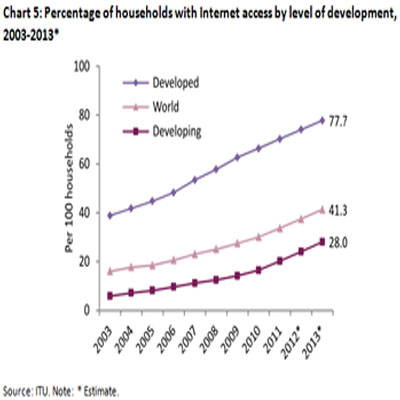
    NEW DELHI: Almost 80 per cent of households globally had access to television at the beginning of 2013, compared to 41 per cent of households with a computer and 37 per cent with internet access.


    The report shows that the number of households with internet access is increasing in all regions, but large differences persist, with penetration rates at the end of this year set to reach almost 80 per cent in the developed world, compared with 28 per cent in the developing world.


    An estimated 1.1 billion households worldwide are not yet connected to the internet, 90 per cent of which are in the developing world, according to the International Telegraphic Union’s flagship annual report Measuring the Information Society 2013.


    Internet users as a percentage of the population have been growing on average at double-digit rates over the past ten years. The percentage of the population online in the developed world will reach almost 77 per cent by end 2013, compared with 31 per cent in the developing world.


    Mobile broadband connections over 3G and 3G+ networks are growing at an average annual rate of 40 per cent, equating to 2.1 billion mobile-broadband subscriptions and a global penetration rate of almost 30 per cent.


    Almost 50 per cent of all people worldwide are now covered by a 3G network, the report said.


    By end of 2013 there will be 6.8 billion total mobile-cellular subscriptions – almost as many as there are people on the planet.


    An estimated 2.7 billion people will also be connected to the internet – though speeds and prices vary widely, both across and within regions.


    The Republic of Korea leads the world in terms of overall ICT development for the third consecutive year, followed closely by Sweden, Iceland, Denmark, Finland and Norway. The Netherlands, United Kingdom, Luxembourg and Hong Kong (China) also rank in the top 10, with the United Kingdom at the 11th position last year.


    The report identifies a group of most dynamic countries, which have recorded above-average improvements in their IDI rank or value over the past 12 months. These include (in order of most improved): United Arab Emirates, Lebanon, Barbados, Seychelles, Belarus, Costa Rica, Mongolia, Zambia, Australia, Bangladesh, Oman and Zimbabwe.


    In the four years between 2008-2012 fixed-broadband prices fell by 82 per cent from 115.1 per cent of average monthly income per capita (GNI p.c.) in 2008 to 22.1 per cent in 2012.


    The biggest drop occurred in developing countries, where fixed-broadband prices fell by 30 per cent year on year between 2008 and 2011.


    The average price per unit of speed (Mbps) also decreased significantly between 2008 and 2012, with a global median price of $19.50 per Mbps in 2012, almost a quarter of the price that was being charged in 2008.


    Austria has the world’s most affordable mobile broadband, while Sao Tomé and Principe, Zimbabwe and the Democratic Republic of the Congo have the least affordable, with service cost equal to or higher than average monthly gross national income (GNI) per capita. Other countries that rank well for mobile broadband affordability include Qatar, the United Kingdom, Germany, Kuwait and France.

  • Vserv.mobi joins forces with IAMAI for AppFest 2013 to evangelise App Developer ecosystem

    Vserv.mobi joins forces with IAMAI for AppFest 2013 to evangelise App Developer ecosystem

    MUMBAI: Vserv.mobi, a leading Global Mobile Ad network, announced its collaboration with Internet & Mobile Association of India (IAMAI) to reinforce its commitment to the growing Indian mobile app developer community. Vserv.mobi will be powering the Hackathon session at IAMAI’s AppFest 2013 event, a team based coding marathon running over 24 hours to create an innovative app, where the winners will be rewarded with handsome cash prizes. AppFest 2013, scheduled to be held from 26th to 28th July 2013 at IIM-Ahmedabad, seeks to provide an environment for developers and entrepreneurs to come together on a unique platform, and leverage the enormous opportunity to establish India as a superpower in the global Apps economy.

    Commenting on the event, Binay Tiwari, Director – Global Marketing & Product, Vserv.mobi said, “We are in an era, where the global mobile App economy is lowering the barriers to entrepreneurship. Today’s young App Entrepreneurs have an unprecedented opportunity to create products that will touch the lives of millions of mobile users across the world. Vserv is committed to fostering App Entrepreneurs across the world, and we are excited to collaborate in India with IAMAI AppFest, to further expedite the rise of India as a Superpower in the App economy.”

    India has emerged as a global leader in app downloads from stores such as Android Play store, Nokia App store and SlideMe, underpinned by factors such as the influx of affordable mobile devices, rapidly increasing mobile internet penetration and mobile-ready regional content. Vserv.mobi’s recently released report on the ‘Rise of India as an App Superpower’, corroborated this trend and also indicated that mobile games account for the most downloaded content on mobile phones. Apart from the app consumption aspect, the ‘appification’ of the Indian economy is also the result of a growing breed of app entrepreneurs from tier 1 and 2 towns of India who are leading the app development culture. Ahmedabad is one such burgeoning mobile app development location and reports state that out of the 250 (ICT) firms in the city, more than 60 companies are dedicated mobile app developers.

    Since its inception, Vserv.mobi’s developer-first approach has translated into creating powerful technology tools based on the monetization challenges of developers in emerging markets like India. Typically, developers enable ads on their apps through the traditional way of integrating an SDK, which is a tedious process that requires significant source code changes and even app layout changes. Also to enable other forms of monetisation such as paid in-app purchases, the developer has to integrate additional SDKs. Vserv.mobi’s flagship AppWrapper technology dramatically simplifies this process down to just One Click. Without any coding efforts, AppWrapper enables both – premium advertising & innovative pricing models – to create a compelling & effortless App monetization approach for developers.

    As a result, the company has empowered developers across the world to earn money from apps, across all mobile platforms. Having monetized over 20,000 Apps, developers are earning unprecedented global revenues powered by the Vserv.mobi AppWrapper.

    Organized under the aegis of IAMAI, this is the second edition of Appfest after the overwhelming response and success of last year’s event in Hyderabad. The winning team of the Hackathon challenge in 2012 included three Hyderabad-based developers – S Nithin Reddy, Paulomi Roy Choudhary and Ashish Das who received a cash prize of Rs 1 lakh from Vserv.mobi.

  • 4K technology shines at BroadcastAsia2013 exhibition

    4K technology shines at BroadcastAsia2013 exhibition

    MUMBAI: Ultra HD (or 4K) was the buzz word at BroadcastAsis2013. The show underlined various aspects of the entire 4K ecosystem, right from the cameras to production, and from post-production to content delivery technology.

    BroadcastAsia2013‘s first-time exhibitor Ericsson partnered with CommunicAsia2013‘s MEASAT to provide the encoders and receivers to facilitate the delivery of Ultra HD content from MEASAT‘s satellite feed- a perfect example convergence of technologies across information and communications technology (ICT) and broadcasting sectors.

    “BroadcastAsia2013 has been a successful experience for us. We had an extensive showcase of our technology solutions from acquisition to delivery of content on multiple devices. We are pleased with the quality of visitors to our booth,” informed Ericsson, Hong Kong head of TV, Asia Pacific Ward Hansford.

    The trade show also witnessed unveiling of Blackmagic Production Camera 4K and its latest 6G-SDI products that allow Ultra HD products to be integrated into current SDI based television systems. The highlight was Panasonic‘s Ultra Wide Angle camera that can showcase an entire football field at once and GoPro that showcased its latest camera HERO3 that is 30 per cent smaller and 25 per cent lighter, and twice more powerful than its predecessor and includes 4K video recording capability.

    Envivio‘s Muse live video encoder and transcoder for broadcast and multi-screen services was one among the exhibition highlights. Designed for 24X7 TV services over satellite, cable and managed and unmanaged IP networks, Muse compresses live SD or HD TV signals to any format and resolution while maintain an outstanding video quality.

    The tradeshow also witnessed worldwide launch of Space Bridge, which offers the ability to re-purpose existing Fibre Channel or SAS storage and ‘Bridge‘ it into the world of space. Grass Valley‘s latest LDX Flex studio camera system was also one of the attractions.

    “I was updated on the latest audio-visual trends and technologies, especially HD related technologies pertaining to projection and cameras, through the trade show. This exposure has left me thinking of investing in it,” revealed ETG Singapore Anthony Ng.

  • Global industry leaders come together at Trade Fair in Singapore

    Global industry leaders come together at Trade Fair in Singapore

    MUMBAI: Fulfilling business interactions and knowledge exchange amongst like-minded industry professionals marked CommunicAsia2013, EnterpriseIT2013 and BroadcastAsia2013, a one of its kind industry event in Asia. The four day event, starting 18 June, got global industry leaders together to showcase latest technologies and solutions for information and communications technology (ICT) and digital media industries.

    The event which was held at a uniquely spectacular venue, Marina Bay Sands, Singapore saw 51,000 attendees from 100 countries/regions. Unlike past years, CommunicAsia/ EnterpriseIT and BroadcastAsia this year was conducted under one roof. While CommunicAsia was held at basement 2 and level 1, BroadcastAsia was organised on level 3, 4 and 5. The arrangement proved advantageous to visitors as they had to only climb different levels, instead of different venues.

    This year, while CommunicAsia had 1,328 exhibitors, of which 82 per cent was from overseas, BroadcastAsia had 716 exhibitors of which the overseas exhibitors comprised 86 per cent.

    Themed ‘The Next Wave: Empowered Customer‘, CommunicAsia focused on the central information requirements and featured 8 tracks and 2 interactive workshops. The BroadCastAsia international conference was designed on the theme ‘Enhancing User Experience, Monetising Content.‘

    What marred the excellent organisation was the heavy smog, which made visibility difficult even at 100 metres.

    “The show has done extremely well this year. All the attendees, including exhibitors, conference speakers, delegates as well as members of the press, have expressed satisfaction in terms of the content of the show. For us, this is testament to our success,” said Singapore Exhibition Services (SES) Chief Executive, Stephen Tan. SES is the organiser of CommunicAsia2013, EnterpriseIT2013 and BroadcastAsia2013.

    “By holding all the shows under one roof, we could leverage the increasing convergence of technologies across both sectors, and still have each show maintain its own appeal,” he added.

    Unveiling of Panasonic Toughpad JT-B1, a 7-inch Android rugged tablet designed for Asian customers, Huawei‘s- P6 Ascend, world‘s slimmest smartphone and Thuraya‘s innovative phone sleeve, that converts ordinary iPhone into a satellite phone for mobile communications almost anywhere in the world, by connecting the phone to Thuraya‘s satellites, were among the major highlights of Enterprise and Communic Asia 2013.

    Retail Juice chief executive officer Richard Jones said, “This is our first experience with exhibiting at CommunicAsia and it has been fantastic. It has exceeded our expectations both with the number of visitors and leads we have generated, and also the quality and diversity of opportunities we have created.” Jones through the exhibition has developed new relationships with potential customers and partners in Asia, Europe and America. “We will be returning next year and also recommending the event as a great business investment,” he opined.

    CommunicAsia2013 also brought together its largest ever contingent of more than 130 satellite communications companies. Asia Broadcast Satellite, APT Satellite, Asia Satellite Telecommunications, China Satcom, Eutelsat, Intelsat, Inmarsat, MEASAT, SES, SKY Perfect JSAT and THAICOM among others showcased their latest satellite communication solutions and applications in broadband, HD content delivery and remote area connectivity for government, military and maritime sectors as well as innovations that will bridge the gap between the ICT and broadcasting industries.

    Adding to the list of many of the firsts, the tradeshow also streamed live ultra high-definition content to an Ultra HD TV screen over MEASAT‘s satellite network, using Ericsson‘s compression technology.

    “There is a good representation of international exhibitors at CommunicAsia2013 and I‘m impressed with the show. In particular, the solutions provided by the exhibitors from China attracted my attention because of their competitive pricing. I am here to find suppliers for fibre optic deployment and I have found useful contacts for future partnerships,” said PT. Ketrosden Triasmitra of Indonesia business and risk analysis manager Irene Mayarani.

  • Govt Appstore launched to bring in efficiency in e-functioning

    Govt Appstore launched to bring in efficiency in e-functioning

    NEW DELHI: The government has launched the pilot e-Gov application store to will bring functional efficiencies in the government and enable citizen to receive services in a more streamlined manner.

    This e-Gov Appstore has been designed, developed and hosted by the Department of Information Technology through the National Informatics Centre.

    Launching the Appstore, Communications and Information Technology Minister Kapil Sibal said the App Store governance aims to reduce uncertainty and improve transparency.

    The e-Gov Appstore aims to be a National level common repository of productised applications, components and web services that can be used by various of government agencies/departments at Centre and in the States. This will enable acceleration of delivery of e-services as envisaged under NeGP and optimise the ICT spending of the government.

    Core and common applications that have high demand and are replicable across the central and state levels would be available on the e-Gov Appstore, which shall be hosted on the National Cloud.

    Currently 20 Applications, 8 Components and 1 Web Services are hosted. These applications are sourced from 8 distinct States/UTs and provide a gamut of G2C/G2B services. Going ahead, the applications will be productized and made available on the e-Gov Appstore for use

    The present version of the e-Gov Appstore has the following features: (1) Sharing of applications (2) Search for applications (3) Provides basic information about an application on selection (4) Allows users to provide feedback and rate an application (5) Has two level approval process for contributing applications (6) Allows authenticated users to download application for consumption

    This e-Gov Appstore will be augmented to include applications and components developed by various departments and agencies at Centre and States and by private players; and a complete eco-system will be established (including mechanism for funding, charge back, contract management, SLAs) and will become a part of the GI Cloud initiative under government of India.