Tag: Iceland

  • Discover Iceland’s magic with Wego: Top attractions and undiscovered treasures

    Discover Iceland’s magic with Wego: Top attractions and undiscovered treasures

    Residing in the heart of the North Atlantic Ocean, Iceland is often called the Oasis of Peace, owing to its surreal landscapes. The island country is renowned for its panoramic views, massive mountains, and the elusive Aurora Borealis, also known as the Northern Lights. The land is a plateau that is home to vast ice fields, live volcanoes, and naturally occurring hot springs.

    An excursion to Iceland is an experience of a lifetime and a shared dream of many travel enthusiasts. To make the journey of these travellers more scenic and memorable, here are the top locations and hidden gems in Iceland.

    Graenihryggur Ridge

    The Graenihruggur-Green Ridge offers some of the best views of the landscapes in Iceland and leads to unique formations in the Lamdnannalaugar area, near the Central Highlands of the country. The striking emerald green-coloured ridge resembles a natural jewel and is a sight to behold. The trek of this site goes through a remarkably pristine and picturesque area. It is highly recommended to embark on the trek to this beautiful ridge and discover the extravagant beauty of Iceland.

    Strútsfoss waterfall

    The Strútsfoss is one of the tallest waterfalls in Iceland and is located along the Strutsa River. The Strútsfoss waterfall is off the beaten path and away from the crowded tourist trails. The magnificent waterfall cascades to the red strata in two levels. The first is 30 meters high, whereas the second falls from 100 meters above sea level. The flowing water, with the beautiful surrounding area, makes this site a magical experience. The best time to visit this is between April and October.

    Reykjanes Peninsula Grindavik

    The Grindavik region encapsulates dramatic surroundings, lava fields adjacent to the coast, and the renowned Blue Lagoon, offering endless possibilities to visitors. Sites such as Eldovorp, Selatangar, Gunnuhver, and the Reykjanes lighthouse add to the extraordinary beauty of the village of Grindavik. The village encounters seismic activity on a daily basis, experiencing more than ten earthquakes per day. However, the earthquakes are minor and measure only three on a Richter scale. Apart from this, the village is home to a community of 3000 residents.

    Hrossaborg

    Hrossaborg is located in Mývatnsöræfi, near the edge of the Highlands desert in Iceland. The crater looks out of this world with its distorted circular shape. It was formed 10,000 years ago due to the explosion of hot magma with cold groundwater. It was once used as a pen for horses, hence its name, Hrossaborg, which translates to Horse Castle.

    Trollaskagi

    Trollaskagi peninsula is one of the most popular towns for snow activities. It has the tallest mountain range in Iceland, exceeding 1500 metres in height, and offers a number of activities, such as skiing, snowmobiling, and snowboarding. The 200 glaciers in the peninsular region and the snow mountain cap last through May. The ski hike here begins from the mountain and ends on a black beach near the ocean. During the summers, the place becomes a paradise for hiking enthusiasts, as it has stunning hiking trails, and tourists can drive on the cliff looking over the ocean below.

    A trip to Iceland is nothing short of visiting heaven itself. The breathtaking views, surreal landscapes, and the truly mesmerising Northern Lights make this place one of a kind. While there are many great popular locations to visit in the Island country, there are several hidden gems waiting to be explored. From majestic waterfalls and hot springs to hiking glaciers, Iceland offers endless opportunities for travellers to behold its natural beauty and connect to nature in the most surreal way possible.

    The article has been authored by Wego general manager, India Bernard Corraya.

  • 80% people globally have TV access

    80% people globally have TV access

    NEW DELHI: Almost 80 per cent of households globally had access to television at the beginning of 2013, compared to 41 per cent of households with a computer and 37 per cent with internet access.


    The report shows that the number of households with internet access is increasing in all regions, but large differences persist, with penetration rates at the end of this year set to reach almost 80 per cent in the developed world, compared with 28 per cent in the developing world.


    An estimated 1.1 billion households worldwide are not yet connected to the internet, 90 per cent of which are in the developing world, according to the International Telegraphic Union’s flagship annual report Measuring the Information Society 2013.


    Internet users as a percentage of the population have been growing on average at double-digit rates over the past ten years. The percentage of the population online in the developed world will reach almost 77 per cent by end 2013, compared with 31 per cent in the developing world.


    Mobile broadband connections over 3G and 3G+ networks are growing at an average annual rate of 40 per cent, equating to 2.1 billion mobile-broadband subscriptions and a global penetration rate of almost 30 per cent.


    Almost 50 per cent of all people worldwide are now covered by a 3G network, the report said.


    By end of 2013 there will be 6.8 billion total mobile-cellular subscriptions – almost as many as there are people on the planet.


    An estimated 2.7 billion people will also be connected to the internet – though speeds and prices vary widely, both across and within regions.


    The Republic of Korea leads the world in terms of overall ICT development for the third consecutive year, followed closely by Sweden, Iceland, Denmark, Finland and Norway. The Netherlands, United Kingdom, Luxembourg and Hong Kong (China) also rank in the top 10, with the United Kingdom at the 11th position last year.


    The report identifies a group of most dynamic countries, which have recorded above-average improvements in their IDI rank or value over the past 12 months. These include (in order of most improved): United Arab Emirates, Lebanon, Barbados, Seychelles, Belarus, Costa Rica, Mongolia, Zambia, Australia, Bangladesh, Oman and Zimbabwe.


    In the four years between 2008-2012 fixed-broadband prices fell by 82 per cent from 115.1 per cent of average monthly income per capita (GNI p.c.) in 2008 to 22.1 per cent in 2012.


    The biggest drop occurred in developing countries, where fixed-broadband prices fell by 30 per cent year on year between 2008 and 2011.


    The average price per unit of speed (Mbps) also decreased significantly between 2008 and 2012, with a global median price of $19.50 per Mbps in 2012, almost a quarter of the price that was being charged in 2008.


    Austria has the world’s most affordable mobile broadband, while Sao Tomé and Principe, Zimbabwe and the Democratic Republic of the Congo have the least affordable, with service cost equal to or higher than average monthly gross national income (GNI) per capita. Other countries that rank well for mobile broadband affordability include Qatar, the United Kingdom, Germany, Kuwait and France.

  • India among partly-free countries as far as Freedom on the Net goes

    India among partly-free countries as far as Freedom on the Net goes

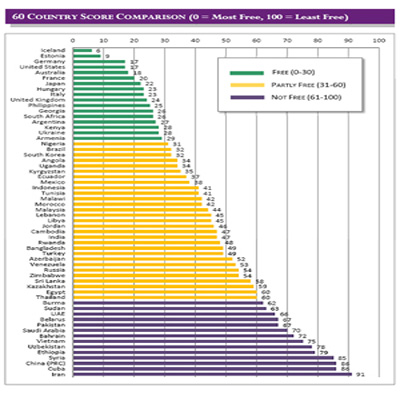
    NEW DELHI: India is 35th among sixty countries in the Freedom on the Net 2013 report.


    The annual report is carried out by Freedom House, an independent watchdog organization, and measures the level of internet and digital media freedom in 60 countries.


    In the new report, each country received a numerical score from 0 (the most free) to 100 (the least free), which serves as the basis for internet freedom status.


    India with 47 points is 18th in the list of the countries listed as partly free (31 to 60 points). There are seventeen countries in the most internet-free countries (0 to 30 points), 29 in the partly free countries, and fourteen in the ‘not free’ list (61 to 100 points).


    Iceland with six points tops the list of the free countries with the United States at the fourth place with 17 and the United Kingdom with 24 points, while Iran (91 points) is at the bottom with China (86 points) at the third place from the bottom of the countries which are not free of control. Pakistan has 67 points and is the fifth among the not-free countries.