Tag: IBN7

  • CNN-IBN, IBN7 to conduct exclusive poll on Modi government’s one year in power

    CNN-IBN, IBN7 to conduct exclusive poll on Modi government’s one year in power

    MUMBAI: As CNN-IBN and IBN7’s special programming around Modi Government’s one year in power draws to a close, the channels present a special poll for its viewers assessing the government’s performance from the common man’s / woman’s perspective.


    Marking a shift in leadership and style of governance, Modi government in the last one year undertook a series of administrative measures to achieve the vision of a better India. To evaluate the impact of these changes through the eyes of the common men and women, Axis APM conducted a comprehensive survey across 20 states and more than 200 districts with a sample size of 20,000 across all age groups and sections of society.


    With an aim of giving its viewers the sharpest and the most incisive analysis, the survey questions revolve include various facet of the government’s performance such as- the financial situation of the country, employment opportunities, reduction in inflation, corruption, etc. The channels will bring to its viewers the most detailed analysis of the findings with the finest panel of guests & experts that include Aakar Patel, R.Jagannathan, Ashok Malik, Nalin Kohli, Manini Chatterjee and Shankkar Aiyar.


    The special poll programming will be aired on IBN7 from 23 to 25 May, 8pm-10pm and on CNN-IBN on 25 May at 8 pm–10.30 pm.

  • Network18 to review Narendra Modi govt’s one year at conclave

    Network18 to review Narendra Modi govt’s one year at conclave

    MUMBAI: As the NDA Government completes a year in office, Network18 has launched an initiative called Modi Sarkar – Year One Dialogue.


    The initiative will see policy makers from the NDA government and experts from various fields discussing and assessing the series of administrative measures taken by the new regime with a vision for a better India in a day-long conclave.


    Modi Sarkar – One Year Dialogue is the third in a row of Network 18 dialogues.


    IBN Network CEO Avinash Kaul said, “Modi Sarkar – Year One Dialogue will serve as a beneficial platform to examine key areas of the reforms brought in by the Modi Government and give our audience a recap of how the world’s largest democracy sees the first year of the Modi government’s vision for India.”


    Keeping in mind the importance of the first anniversary of this NDA government Modi Sarkar – Year One Dialogue will review the key priority areas of the government and their road map to achieve the stated objectives. The day-long conclave will review the last year of Modi governance and check whether the trajectory of the stated policy framework is on the right course. Including multiple panels, keynotes, and interactions, the dialogue will see a recap of the initiatives taken in the past year.


    Modi Sarkar – Year One Dialogue will also host dignitaries from diverse backgrounds such as ministers, bureaucrats, policy consultants, diplomats and industry heads who will deliberate upon key topics ranging from Make in India, Brand India Under Modi, Maximum Governance Minimum Government and Sabka Saath Sabka Vikaas (Inclusive Growth).


    Network18 Group president, news Umesh Upadhyay said, “We at IBN Network aim to use this occasion to host the top policy makers in the NDA government to share their journey so far; record their achievements and share dispassionately the challenges and opportunities that lie ahead.”


    The conclave will be hosted on 22 May and will be broadcast across Network18 channels including CNN-IBN and IBN7.

  • CNN-IBN to air shows on Narendra Modi’s one year in office

    CNN-IBN to air shows on Narendra Modi’s one year in office

    MUMBAI: It has almost been a year since Narendra Modi – the longest serving BJP chief minister created history when he won by a landslide victory of 282 seats in the Indian General elections and formed the first single party majority Government in three decades.


    Taking charge, the Modi government undertook a series of administrative measures with a vision of better India, marking a shift in leadership and style of governance.


    CNN-IBN and IBN7 will introduce two new shows in order to  answer the curious minds on how the country has fared under Modi’s rule so far and assess the impact of the measures taken by his government.


    The two programs are an exclusive array of shows that focus on all the aspects of the key decisions and initiatives government has taken. CNN-IBN will air Modi @ 360 from 16 – 26 May, that will constitute a half-hour tete-a-tete with ministers and MPs from the ruling party along with interviews with senior opposition leaders. It also has a slot for feature stories like ‘five point something’ that showcase the top five highlights of PM Modi in various fields.


    While Modi@360 focuses on the political impact of Modi’s government and his leadership, Ek Saal Modi Sarkar on IBN7 that will run from 18 – 26 May will evaluate the work from a common man’s point of view. The extensive programming will be in the form of documentaries, surveys, discussions and interviews. It includes an eight episode long series of discussions discussion titled Modi Ke Mantri featuring key ministers of Modi government on the performance and the way forward for their respective ministries. This will be an eight episode series, which will be followed by 12 Mahine, 12 Faisle, a three hour long special that will bring the reasons, details and outcomes of 12 key decisions taken by the Modi government to the limelight.


    Apart from these programs, the channels will also conduct an exclusive nationwide survey on the performance of PM Modi and his team. Sabse Bada Survey will gauge mood of the nation from a sample size of about 20000 respondents from across 20 states and more than 400 districts.

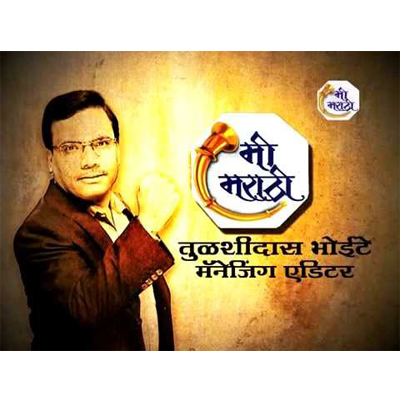
  • “Media today is suffering from ideological corruption”: Tulsidas Bhoite

    “Media today is suffering from ideological corruption”: Tulsidas Bhoite

    Mi Marathi, a Marathi news channel has been working hard to gain cognizance since its revamp from an entertainment channel to a news channel in March 2014. The channel, after a year of constant endeavour to connect with the viewers, has become the chart topper in the Marathi news space.

    At the forefront of Mi Marathi is a team of veteran journalists and among them is the channel’s managing editor Tulsidas Bhoite.  

    Bhoite started his career in 1992 in print media. It was in 2000 that he moved to electronic media with his debut stint at ETV. He has worked with leading channels like Zee Marathi, IBN7, Star Majha, Zee 24 Taas, TV 9 and Jai Maharashtra.

    Indiantelevision.com’s Seema Singh spoke to Bhoite about the transition of Mi Marathi from an entertainment channel to a news channel, the challenges and much more.

    Excerpts:

    What was the reason behind converting the entertainment channel Mi Marathi to a news channel?

    I think it was a wise decision by the management. I travel a lot with all segments of people, be it with commoners or professionals from different field. As per my analysis, there is space for more than 10 news channels in Maharashtra. The market here is quite weak in terms of both revenue and TRP, and so far, not a single channel has tapped the market fully. Currently with seven players in the region, we have only just managed to tap 50 per cent of the market.

    How did the transition take place? What happened to the GEC employees?

    We haven’t removed a single employee from any department because we didn’t want to write-off any people. Everyone has their own talent, and it was our duty to cultivate that talent for the betterment of the channel. We decided to use GEC talent for news and fortunately the management allowed us to do that. As the pace of work in a news channel differs from that of a GEC, we do face the problem of speed but our employees are coping and trying to change their functioning style.

    When the management decided to relaunch the channel as a news channel, they started hiring best professionals from the industry. The hiring process is still on and we have on board the three best faces from the industry in Kumar Ketkar, Nikhil Wagle and Bharatkumar Raut.

    We are hiring more talent from the news industry now. Even today, we do not have any technical backup like the other news channels, because of the space crunch. Plans are also afoot to shift to a new office and buy more technical equipments. With no technical support and just 60 per cent workforce as compared to the other news channels, I think we have been doing a fairly good job.

    How is the management-employee relationship in the company? Are employees involved while taking decisions?

    We ask our employees to give ideas. We may or may not accept the ideas, but we always ask people to participate in the ideation process. In fact, Jhingroo, the icon created by the channel during elections, was the idea of our creative team, which is still being appreciated by many.

    Being the seventh player in the market, what was the strategy to attract viewers? 

    Yes, we entered the market as the seventh player in the regional news space in March 2014. In order to remain relevant in the space, we had to create a new market for ourselves. As I mentioned, there is a large part of Maharashtra, which is still uncovered by news channels. So our strategy was to create a new segment for ourselves in the news market and also grab existing viewers of other news channels.

    We decided to cover news differently. For example in Mumbai, channels generally cover Mantralaya when it comes to politics, stock market for financial and a select two or three theatres or multiplexes when it comes to entertainment news. We changed this. We sent our cameras to that part of the society, where others hesitated. The news industry generally works on a myth of the up market and down market. But if you see, only 10 per cent of the news channel viewer comes from the so called up market strata.

    Even in the rural parts of Maharashtra, channels focus on the sugar belt of Pune or Nasik. We completely changed that. We always cover every news right from rural to urban, from upper to middle to lower middle class. And I’m not saying this because I’m a journalist, but this is the most practical approach. Even advertisers want to cater to the rural markets these days.

    What were the challenges you faced when you entered the market?

    The first challenge that came our way was that no one wanted to accept us as we weren’t big faces, when we launched. Traditional leaders thought we could not carry on the channel. But when we applied our strategies to run the channel, after four months they started taking cognizance of the channel.

    What did you do right to get to the number one position?

    Firstly, the selection of issues and subjects to cover. Secondly, we consider the opinion of each person in the team as important. Thirdly, when others are trying to think on an issue, we have already acted on it. We connect our channel directly to viewers, from all segments. We are always trying to give them a say in each and every programme. To understand the pulse of the audience, we never forcefully apply our views on the audience. We give the audience a chance to express their opinion.

    What’s your Target Group?

    While we don’t focus on one TG, we look at targeting the 15-45 year olds. For example, our character Jhigroo, resonates not just with politicians, but also the younger generation, who while are not too interested in politics or the news, but like the animated character. We want to catch the young audiences.

    How did you ensure that you did not lose out on your viewers from the entertainment channel, while making new ones in the transition?

    Most channels apply the ‘Hot Cut’ policy. But during the relaunch, we did not make the mistake of ‘Hot Cut.’ So while a show was on air, we did not cut the programme to go on air on something that was happening now because that could have harmed us. So we used the phase out process. We kept 50 per cent programming and 50 per cent news from September 2013 to March 2014. And from March, we relaunched fully as a news channel and we continue treating news in a different way. A lot of emphasis is being given to the presentation of the news, despite lacking on the technical front.

    How do you plan to maintain the number one position?

    When we announced the relaunch in the newsroom, I had said ‘our struggle is man vs machine.’ While content is the king, distribution plays a crucial role and we are hoping to expand our reach.

    My aim is to not just get good numbers. My ultimate goal is that the channel should be cognizable, right from the top person to someone sitting in the rural area. People should know the channel and the content. Number one, two doesn’t really matter.

    We would like to capture 50 per cent of the market to be able to do more experiments with the content.

    What are the challenges in the Marathi news space?

    In Maharashtra, people are open to other languages, and so we have to compete with Hindi news channels as well. Our strategy is to go to people, pick up their issues and give them a voice.

    Do you think advertisers should put in more money in regional channels? Is there scope?

    There is an untapped market in Maharashtra. However, when it comes to news genre, I don’t think any sales team in any of the channels has the potential to tap that huge market, and this includes my channel. There is a need to set up that team. We need to look at people with good ideas, who can tap that market.

    The logo has remained the same even after the relaunch. Any plans to change that?

    We thought on that. The creative team has created a different logo as well, but for now we will stick to the current logo. Our communication from class to mass shows that they like our current logo.

    Are you looking at revamping the channel?

    My team is currently struggling with the limited resource. But we need to move to a new space and as soon as we find that space, we will have two studios and better equipment and lighting. The revamp will be in the next six months.

    We are also working towards bringing in more graphics in the next 15 days. We will not stick to a single rule of programming. Adding more content to the channel is an unending process. We are making rules, only to break them.

    How has Nikhil Wagle’s presence helped the channel?

    If you study our viewership pattern, we are equally distributed throughout the day, from 3 pm to 11 pm. We wanted to strengthen our 9 – 10 pm time band and so when Nikhil Wagle agreed to join our channel, we offered him that time band. He has his own followers in Maharashtra, and that cannot be denied. Our mood and his is the same and that helps the channel a lot.

    How many journalists and bureaus do you currently have?

    In all over Maharashtra, we have nine bureaus and we will increase that to 12 in the next three months.

    Of the nine, seven are connected by lease lines. We will also start our studios in the next three months. We want to give our correspondents in these studios an opportunity to handle their own small shows on regional basis.

    In Mumbai, we have a team of 12 reporters and 20 camerapersons and out of Mumbai we have 60 reporters and 30 camerapersons.

    What’s your take on prime time debate?

    When deciding the strategy for the channel, I think like a viewer and not like a journalist. People are fed up of debates and that’s a fact. Fortunately, we only have one debate showPoint Blank hosted by Wagle, who is a man of content.

    We take only four people on the panel in order to give proper time to each one to represent their point of view. Media is suffering from ideological corruption. We are media, we are supposed to give equal opportunity for people to give their opinion. There should be discussion and not debate.

    Vir Sanghvi had once said, “We don’t have news channels, we have low cost entertainment channels.” But I think people are fed up of such low cost entertainment and so we are trying to deliver hard core news.

    If you check our ratings, we aren’t getting good ratings for any of our entertainment shows.

    Have you subscribed to BARC? Will you be discontinuing your TAM subscription? 

    We haven’t yet subscribed to BARC, but we will. We haven’t taken a decision on whether we will continue with TAM or not. We may continue with both TAM and BARC.
  • CNN-IBN & IBN7 score big with World Cup contests

    CNN-IBN & IBN7 score big with World Cup contests

    MUMBAI: Throughout the duration of the Cricket World Cup, CNN-IBN & IBN7 brought a delectable fare of coverage on the tournament. The channels launched a series of contests that allowed both advertisers and viewers to take centre stage. Specifically, advertisers are being offered an exclusive opportunity to dine and interact with such legends of the game as – Kris Srikanth, Ricky Ponting, Zaheer Abbas, Chris Harris and Kiran More.


    Additionally, CNN-IBN & IBN7 have also launched Cup Quiz With Cheeka and #CricfieCup Quiz With Cheeka is a cricket quiz on-air and on social media wherein participants need to answer questions related to past cricket world cups, asked by the former India captain and chairman of selectors Srikanth. 


    #Cricfie is a contest running on IBN7 wherein the channel is calling for selfies with quirky captions wishing and cheering for Team India to be shared on Facebook page or the Twitter handle of IBN7. The top Cricfies will be printed, framed and sent back to participants duly autographed by the channel’s panel of experts.


    While the extensive programming providing viewers with a 360 degree view of this mega cricketing event will continue till the end, CNN-IBN & IBN7’s special viewer and trade engagement activities will add another dimension to its coverage.

  • Budget 2015- Returning Indian economy to the path of explosive growth

    Budget 2015- Returning Indian economy to the path of explosive growth

    MUMBAI: With Budget 2015, the entire nation awaits with hope. As Railway Minister, Suresh Prabhu and Finance Minister, Arun Jaitley present the Rail and Union Budget on 26 and 28 February respectively, nearly every economic indicator is favourable – inflation is down, so are crude oil prices, foreign exchange reserves are at a peak and foreign investors are interested again in India’s stock markets.


    So, what will Prime Minister Narendra Modi and his team do to return India to the oath of exponential growth?


    To decode this much-awaited budget, CNN-IBN and IBN7 will bring rolling coverage on the Rail Budget and Union Budget 26 February (today) and on 28 February, respectively, under the aegis of the specially branded shows Modi Express & The Modi Budget on CNN-IBN and Prabhu Ki Patri & Jaitley Ki Potli on IBN7.


    These will be a culmination of a series of pre-budget shows that both channels have been running capturing the mood, expectation and suggestions from a cross-section of individuals from corporate to entrepreneurs to students. With more than 18 hours of live programming on each channel, the network is all set to be the one stop destination for viewers to know everything about the upcoming budgets.


    The finest editorial teams of both the channels including Bhupendra Chaubey, Sumit Awasthi, Karma Paljor, Shereen Bhan, Sanjay Pugalia and Anubha Bhonsle will bring budget updates, public reactions and impact assessment.


    They will be joined by the country’s most formidable economists and commentators including former member-traffic, railway board SB Ghose Dastidar, Concor/Container Corporation of India founding CMD Raghu Dayal, former additional member, planning, railway board Sumant Chak and Smartwave railway expert / CEO Sanjeeva Shivesh for Rail Budget 2015.


    For Union Budget 2015, experts such as India Foundation head Shaurya Doval, Industry and Commerce former secretary Dr. Ajay Dua, former finance secretary C M Vasudev, former chief economic adviser Dr. Arvind Virmani, Sr. Journalist / Columnists Swapandas Gupta and Ashok Malik and former chief economic adviser Dr. Shankar Aachraya will be on-board.

  • IBN7, third most watched Hindi news channel: TGI

    IBN7, third most watched Hindi news channel: TGI

    MUMBAI: Taking its rich legacy of being India’s channel of Impact forward, IBN7 has marked its position in the top three Hindi News Channels as per the latest TGI survey.


    TGI (Target Group Index) is a global market research conducted across 72 countries. In India, this study is conducted by IMRB. This study is considered as the most relevant for media agencies and advertisers for developing strategies and understanding consumer segments since it gives insights on consumption across 300 categories. The latest round of this study – Wave 2 (March-May, 2014+ Aug-Oct, 2014) had a sample size of 29,212 from Urban India, HSM (SEC ABC 15-55 years). Overall the study has a sample size of 40,000 (approx).


    IBN7 had repositioned itself with a new tag line ‘Hausla Hai’ in mid-October. A fresh and positive perspective, a committed team of reporters, new shows and pacier & cleaner graphics have ensured that IBN7 stands out in the cluttered Hindi News genre. IBN7 has been dedicated to providing coverage which no other network can match. The channel is focused on providing more and more news as opposed to views and opinions that have become the norm on most news channels.

  • Network18 announces Media Institute Initiative (MII)

    Network18 announces Media Institute Initiative (MII)

    MUMBAI: News channels CNN-IBN and IBN7 have planned to launch a Media Institute Initiative (MII) that will engage media schools in the country and abroad through a structured and collaborative approach aimed at unleashing the potential of the youth. Initiative aims to deepen the industry – academia engagement in the media space through seminars, internships, guest lectures and other interventions for sectoral capability enhancement.


    Speaking on the MII, Network18 president news Umesh Upadhyay said, “We are really happy to launch the Media Institute Initiative that will engage the industry, the youth and the sharpest academic minds on an on-going basis. The cross-pollination of ideas and talent will create unparalleled opportunities and ideas that will have the potential to define the media landscape of the future.”


    Under this initiative, the first Memorandum of Understanding (MoU) is being signed with the Kushabhau Thakre Patrakarita Avam Jansanchar Vishwavidyalaya, Raipur in the presence of Chhattisgarh chief minister Raman Singh. The MOU will be signed between Network18 president news Umesh Upadhyay, and Kushabhau Thakre Patrakarita Avam Jansanchar Vishwavidyalaya vice chancellor Sachchidanand Joshi on 30 January 2015 in Raipur. IBN7 deputy managing editor Sumit Awasthi will address the aspiring media professionals in the city.


  • CNN IBN’s & IBN7’s non-stop coverage of US President Obama’s visit to India

    CNN IBN’s & IBN7’s non-stop coverage of US President Obama’s visit to India

    MUMBAI: In the lead up to President Obama’s historic second visit to India, CNN-IBN and IBN7 bring to their viewers an exhaustive programming Namaste Obama and Phir Wahi Dil Laya Hoon respectively. The channels will provide in-depth coverage of President Obama’s tour of India, covering every facet of his visit.


    The channels’ formidable team of journalists will track President Obama’s talks with top leadership in New Delhi on ways to make progress on key issues like Defence and Civil Nuclear Agreement and his historic participation in the Republic Day celebrations as the Chief Guest. The special programming will also run updates on Modi-Obama talks on the entire gamut of bilateral ties.


    Watch Namaste Obama on CNN-IBN and Phir Wahi Dil Laya Hu on IBN7 from 25 January to 27 January 2015. 

  • CNN-IBN and IBN7 to ride World Cup fever with new series

    CNN-IBN and IBN7 to ride World Cup fever with new series

    MUMBAI: The biggest carnival of cricket, the ICC Cricket World Cup 2015, is inching closer and channels are bringing in new and detailed presentations to cater the need of cricket crazy India.


    While India fights to defend the most prestigious trophy in cricket history, CNN-IBN special programming for World Cup begins with Kings of Cricket, which is a seven episode documentary featuring the diverse history of World Cup. The show will cover the historical achievements of legends like Sir Viv Richards, Steve Wagh, Kapil Dev, Sachin Tendulkar and others. The series will also analyse performances of Yuvraj Singh in World Cup 2011 where he not only fought opponents but also had to deal with a venomous disease like cancer.


    On the other hand, IBN 7’s show is called Cup Katha. This show will analyse every edition of the World Cup since its inception in 1975 in England, which was won by West Indies.