Tag: I&B secretary

  • I&B ministry proposes guidelines for encryption of channels

    I&B ministry proposes guidelines for encryption of channels

    Mumbai: In an organised press briefing on Wednesday, the ministry of information & broadcasting introduced revised uplinking and downlinking guidelines for TV channels in India, as I&B secretary Apurva Chandra informed. The earlier guidelines were issued in 2011.

    As per the new guidelines, the encryption of channels is now mandatory for all bands other than C band.

    The following objectives are set to be achieved by the proposed guidelines:

    1. Ease of compliance for the permission holder:

    The proposed guidelines give importance to ease of compliance for the permission holder.

    a) There is no requirement to obtain prior permission for live event telecasts; only the pre-registration of events would be necessary.

    b) The requirement of prior permission for a change of language or conversion from Standard Definition (SD) to High Definition (HD), or vice versa is also not required.

    2. Ease of doing business

    a. The guidelines proposed a specific timeline for the grant of permission.

    b. Limited liability partnership (LLP) entities can also seek permission.

    c. A news agency can get permission for a period of five years instead of one year.

    d. A channel can be uplinked by using the facilities of more than one teleport/satellite, as opposed to only one teleport/satellite.

    e. The new guidelines have removed certain restrictions on the transfer of a channel from one entity to another.

    f. A teleport operator can uplink a foreign channel for being downlinked outside India, enabling earning of foreign exchange for the operator.

    3. Simplification and Rationalisation

    a. One composite set of guidelines instead of two separate guidelines;

    b. The structure of the guidelines has been systematised to avoid duplication, and common parameters, including financial requirements, etc., have been placed in appendices;

    c. The penalty clauses have been rationalised to separate the nature of penalties that have been proposed for different types of contraventions as opposed to the uniform penalty as at present.

  • I&B secretary asks union ministries to clear ad dues of media cos

    I&B secretary asks union ministries to clear ad dues of media cos

    MUMBAI: Information & broadcasting (I&B) ministry secretary Ravi Mittal has contacted his counterparts in several other ministers asking them to clear the dues they owe several media companies, media reports suggest. Mittal has cited the financial pressure that the media companies are facing because of the ongoing lockdown as one of the reasons. 

    It is being highlighted that various union ministries including telecommunications, sports, youth affairs, the departments of posts, electronics and IT, and the NITI Aayog, among others, owe at least Rs 400 crore to several media companies. 

    According to a Hindustan Times report, which cites having Mittal’s letters in its possession, he has underlined that it is of vital importance that all payments due to the private media sector are made to enable them to pay their employees, keep their businesses afloat and prevent layoffs. 

    “As you would appreciate, these media houses are also supporting the government’s efforts to communicate with its citizens during the current crisis arising due to COVID-19,” he wrote.

    Mittal’s intervention comes days after the Indian Newspaper Society (INS) communicated to Union finance minister Nirmala Sitharaman that they are in grave danger of losing monies. 

    Additionally, the Advertising Agencies Association of India has also written to the I&B ministry demanding tax relief.

  • Telangana state government sets up committees to track the television sector

    Telangana state government sets up committees to track the television sector

    MUMBAI: This is one state which is taking the central government’s order to keep a check on the content being aired satellite TV channels following the hue and cry which was raised after the Peace TV controversy. We are referring to the Telangana state government.

    Yesterday it constituted the State and District level monitoring committees whose job will be to ensure effective implementation of the Cable Television Network (Regulation) Act.

    The committees are expected to meet at least once a year and submit a detailed annual report for Telangan, including district-wise data of cable operators registered within the state and estimated number of TV homes/viewers, to the I&B ministry before 31 December 31 annually. Their job would also be to recommend action and forwarding complaints against satellite television channels that are violating the government’s orders on the programme and advertising codes to the I&B ministry, to ensure that respect, dignity and self-esteem of children and women and other sections of society are duly protected, to see whether the authorised officers are effectively performing their duties, to see how many cases are handled by them and what decisions are arrived at, to give suggestion/ guidance to district/ local level committee, to take decision on the matters referred to it by district/ local level committee, to collect data/ information from district/ local level committee and forward it to I&B secretary.

    On the state level committee would be the following: the principal secretaries of revenue and home, secretary and commissioner of I&PR department, Doordarshan Kendra Hyderabad director and commercial taxes commissioner.

    The district level committee would have the following members: district collector, superintendent of police, commercial taxes deputy commissioner or his representative and the district public relations officer.

    Observers believe that the setting up of the committees is a step in the right direction, but the state would have done well to have other representatives from society and the private sector to give a more holistic perspective.

  • Telangana state government sets up committees to track the television sector

    Telangana state government sets up committees to track the television sector

    MUMBAI: This is one state which is taking the central government’s order to keep a check on the content being aired satellite TV channels following the hue and cry which was raised after the Peace TV controversy. We are referring to the Telangana state government.

    Yesterday it constituted the State and District level monitoring committees whose job will be to ensure effective implementation of the Cable Television Network (Regulation) Act.

    The committees are expected to meet at least once a year and submit a detailed annual report for Telangan, including district-wise data of cable operators registered within the state and estimated number of TV homes/viewers, to the I&B ministry before 31 December 31 annually. Their job would also be to recommend action and forwarding complaints against satellite television channels that are violating the government’s orders on the programme and advertising codes to the I&B ministry, to ensure that respect, dignity and self-esteem of children and women and other sections of society are duly protected, to see whether the authorised officers are effectively performing their duties, to see how many cases are handled by them and what decisions are arrived at, to give suggestion/ guidance to district/ local level committee, to take decision on the matters referred to it by district/ local level committee, to collect data/ information from district/ local level committee and forward it to I&B secretary.

    On the state level committee would be the following: the principal secretaries of revenue and home, secretary and commissioner of I&PR department, Doordarshan Kendra Hyderabad director and commercial taxes commissioner.

    The district level committee would have the following members: district collector, superintendent of police, commercial taxes deputy commissioner or his representative and the district public relations officer.

    Observers believe that the setting up of the committees is a step in the right direction, but the state would have done well to have other representatives from society and the private sector to give a more holistic perspective.

  • NBA apprises new I&B secretary Sunil Arora with revenue models of news b’casters

    NBA apprises new I&B secretary Sunil Arora with revenue models of news b’casters

    NEW DELHI: The newly appointed Information and Broadcasting Ministry secretary Sunil Arora was today apprised of various issues relating to news broadcasters in a wide-ranging discussion with the News Broadcasters Association (NBA). 


    NBA president Rajat Sharma told indiantelevision.com that all issues including the ad cap were discussed with Arora.


    The meeting comes soon after the adjournment of the ad cap case to 23 September by Delhi High Court.


    This is the first meeting of the new secretary who took over on 31 August, 2015.


    Issues relating to carriage with multi system operators (MSOs) and local cable operators (LCOs) and revenue models for growth of the industry were also discussed. 


    The delegation led by Sharma comprised NDTV’s Narayan Rao, Ashok Venkatramani of ABP News, Anuradha Prasad of News 24, Ashish Bagga of India Today, A P Parigi of Network 18 and NBA secretary general Annie Joseph.


    Special secretary J.S. Mathur was also present in the meeting. 


    The delegation also apprised the secretary about the initiatives taken by the broadcasting industry in the direction of self-regulation which includes working of News Broadcasters Standards Authority (NBSA), an independent authority set up by NBA and the two tier mechanism of complaints redressal relating to news channel followed by them. 

  • Spirit of inquiry amongst media must not morph into a campaign of calumny, cautions PM

    Spirit of inquiry amongst media must not morph into a campaign of calumny, cautions PM

    NEW DELHI: Prime Minister Manmohan Singh on Saturday called for caution as mediapersons executing their responsibilities in a vibrant democracy which revels in free enquiry and quest for answers.


    He said the media industry had a special role in assessing, tackling and overcoming the challenges that two decades of socio-economic change have brought about. “But a spirit of inquiry must not morph into a campaign of calumny. A witch-hunt is no substitute for investigative journalism. And personal prejudices must not replace the public good.”


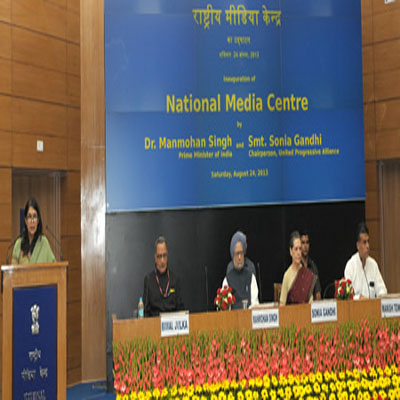
    Dr Singh was speaking after he and UPA Chairperson Sonia Gandhi inaugurated the National Media Centre in the capital this morning. Information and Broadcasting Minister Manish Tewari, I&B Secretary Bimal Julka, and Press Information Bureau Principal Director General Neelam Kapoor were also present.


    Singh said “It is a reality that journalism cannot be divorced from the business of which it is a part. The responsibilities of a media organization are not limited to the viewers and readers alone. The companies also have an obligation to their investors and shareholders. The tussle between bottom-lines and headlines is a fact of life for them. But this should not result in a situation where media organizations lose sight of their primary directive, which is to hold up a mirror to society and help provide a corrective. ”


    He said “This Centre showcases our ability to keep pace with similar state-of-the-art facilities across the world. It symbolizes the vibrant mood of the existing media landscape in our country. As a ‘Communication Hub’ and a ‘Single Window’ facility, I am sure it will fulfill the needs and requirements of our media fraternity, many of whom are present here today.”


    In her address, Gandhi said “The government and the media have the shared interest in disseminating programmes, policies, decisions and information. This is where an institution such as the National Press Centre assumes importance. I hope that it will represent a partnership in which both sides will be able to discharge their designated responsibilities.”  


    “In any society undergoing dramatic and rapid transformation there is constant need to renew and rebuild. This facility represents that evolution. I hope very much that it will become an effective nerve centre and a duct and an information bridge between the Government, the Media and the People,” she added.


    “I want to be quite clear we don’t favor propaganda or publicity campaign simply in order to score points for the government, but the people have a right to know their legal and other entitlements. They have a right to information. They have a right to be able to make informed decisions. Only an aware and conscious citizenry can be expected to make this system work well and hold governments and political parties to account.”


    Referring to the National Media Centre, Gandhi said “This beautiful building is not just brick and mortar. It is up to you media professionals, officials of Information and Broadcasting Ministry and others who will inhabit it to infuse life into it by making it an instrument to serve the people and empower them.”


    The Centre at 7E Raisina Marg in the proximity of Shastri Bhavan which presently houses the Press Information Bureau was inaugurated 21 years after it was first conceptualized during the 8th five year plan (1992-97).


    Tewari said: “We live in an era of an information overload. The media landscape has transformed exponentially over the past two decades. This transformation has brought its own set of challenges to the media industry. India today mirrors the world in global cross media consumption patterns.”


    He said a ‘very unfortunate collateral of this epoch making change’ is the print industry globally. It was distressing to learn that iconic newspapers and magazines around the world were ceasing to print. However, India appeared to have changed this trend. The Indian newspaper market will be the only one to grow at a double-digit CAGR [Compounded Annual Growth Rate] of 10 per cent and would emerge as the world’s sixth-largest newspaper market by 2017 as per industry reports on media and entertainment. The regional and vernacular print sector is growing on the back of rising literacy and low print media penetration as well as the heightened interest of advertisers wanting to leverage these markets.


    Tewari said according to industry sources, print has a combined market penetration of a ball park of 14 per cent. Thus, the print industry has the potential to expand its footprint and readership across the national canvas. This sector thus would be able to weather the shifting sands of technology at least in the Indian context.


    The Indian broadcasting sector had grown from one channel in 1991 to 852 at the last count.  After statutory rationalization the number now stood at 795 odd channels, he added. While this had brought about plurality, it had resulted in market fragmentation as well.


    “There are 15.4 crore TV households in India. Unfortunately the news and current affairs genre makes up only seven per cent of the total television viewership, according to TAM CS4+ all India weekly average for 2012. The remaining 93 per cent of this universe is occupied by general entrainment channels despite there being 395 odd news and current affairs channels.


    He said this generated hope that there is an exponential potential for growth, provided the news broadcasters and Multi System Operators (MSO’s) are prepared to re-imagine their content and carriage paradigms respectively.


    In both the print and television genres, he said the revenue model remains heavily dependent on advertising. As the advertisement cap requires a migration path synchronous with the roll out of digitization For the news broadcasting industry, Tewari hoped that the Telecom Regulatory Authority of India would re-consider its deadline.


    To give consumers the benefit of better quality of service and correct the skewed revenue models in the broadcasting sector government launched a massive digitization exercise in 2012.  With 10 million set top boxes seeded in Phase–I, another 20 million in Phase–II and yet another 80 million scheduled for Phase–III & IV, by the end of 2014 no one in the Broadcasting Sector can really say that bottom-lines and balance sheets in August 2013 are not looking better than in October, 2012.  


    The MSME sector must also endeavour to leverage this unique business opportunity and convert it into the India digitization story even in manufacturing terms.  


    India had 86.7 crore mobile phones, 12.4 crore Internet users with an expected growth up to 37 crore by 2017, eight crore people on Facebook and 1.8 crore on Twitter.


    The government had recently taken a decision to create a New Media Wing in the Ministry to have an institutional presence in this virtual civilization.


    He said the radio, till a decade back considered, was a casualty of the tectonic technological shifts but now stood poised on the threshold of a new wave. High mobile penetration and cheap call rates in our country had brought this renaissance into replay.


    The film industry had completed a century of existence. This industry had grown but still had tremendous potential. As per an industry estimate, about 14 million Indians go to the movies everyday. As per another report, the film industry is valued at Rs 112.4 billion [$1.741 billion], and is estimated to grow to about Rs 193.3 billion [$2.994 billion] by 2017, a compound annual growth rate (C.A.G.R.) of about 11.5 per cent. The regional film industry is a steady contributor to this growth process.


    The media sector had grown by a CAGR of over nine per cent between 2007-2012 and was projected to grow at 15 per cent between 2012 and 2017, Tewari added.


    But there were some paradoxes that all stakeholders in this sector must try and collectively resolve to find the elusive golden mean. These included flawed Revenue Models qua Questionable Revenue Generation practices; TRPs qua truth; Media Trials qua a Fair Judicial Trail guaranteed by article 21 of the Constitution; and anonymity masquerading as privacy in the new media space – the spectre of the ‘hidden’ people, apart from Last mile neutrality among carriage providers so that content providers get a level playing field and are able to reap the benefits of convergence.


    The National Media Centre (NMC) was initially conceptualized by the Press Information Bureau in 1989 to facilitate greater interaction between the Government and the media with a state-of- the-art equipped media centre. The Centre has been planned on the model of media centres in some of the capitals of the world such as Washington and Tokyo. It will have offices of the PIB as well as special facilities for the media to enable the Government to interact closely with the media.


    The Centre has a Press Conference Hall for 283 media persons, a briefing room for about 60 persons, 24 Work stations for the media, a library, media lounge and cafeteria. The press conference hall and media lounge are Wi-Fi enabled.


    Major Highlights:

    World Class Media Center, Ground + 4 Floors + 2 basements, Press Conference Hall with seating capacity for 283 persons, Media Lounge – Work area facilities for media personnel, Committee Room with video conferencing facilities, Library, Cafeteria, IT and AV Infrastructure in NMC.


    Facilities provided:

    Optic fibre internet backbone with redundancy, Mini Data Centre for application development and hosting, Webcast, including live webcast, Video feed to TV channels outside the building, Network with redundancy and expandability to 500 nodes, IT facilities to media persons in work area/Lounge, Internet Telephony, AV Video Wall.·        


    The NMC has been constructed by the National Buildings Construction Corporation (NBCC) over a period of three years with a total covered area of 13867 sq m. The plot size is 7787.46 sq m (1.95 acres).

  • Govt may mandate local sourcing of a percentage of STBs: I&B secretary

    Govt may mandate local sourcing of a percentage of STBs: I&B secretary

    NEW DELHI: The government could consider making it mandatory for procurement of certain percentage of locally-made set-top boxes (STBs) if domestic manufacturers priced them competitively.

    Information and Broadcasting (I&B) secretary Uday Kumar Varma said most of the STBs at present are being imported and the share of the domestic manufacturers is negligible, mainly on account of cost disadvantage.

    He said with the government embarking upon a massive drive to switch over to digital delivery of television channels to households, there is a huge demand for STBs.

    If domestic manufacturers are able to price their products competitively, I&B Ministry may even mandate a certain percentage of STBs to be procured domestically, he added.

    Varma also said the I&B Ministry has written to the finance ministry over the issue of locally manufactured STBs attracting higher rate of value-added tax (VAT), while imported STBs are subjected to a lower rate of service tax as it is considered a service offered by cable operators.

    The I&B Ministry has asked the finance ministry to remove the tax anomaly and create a level playing field for domestic STB manufacturers.

    He said the government is confident of meeting the 31 March deadline for digitisation in 38 cities (with one million plus population) across the country in the second phase of digitisation.

    Varma said, �It is estimated that 16 million STBs would be required to digitise the 38 cities, excluding the four metros. But a study conducted by the ministry has revealed that already six million TV sets in these cities are already digitised."

    Cities like Ludhiana and Amritsar are already 90 per cent digital, according to Varma. The level of digitisation is high even in Bangalore and Hyderabad.

    The four metros – Mumbai, Delhi, Kolkata and Chennai — were part of the first phase of digitisation effective 1 November.

    Varma expressed satisfaction over the implementation of the first phase of digitisation. He said the exercise was "more or less completely successful" in Mumbai and Delhi. He added that even Kolkata, which initially had reservations about digital conversion, has come on board with a conversion rate nearing 90 per cent.

    It is held up in Chennai because of a petition by cable operators in the Madras High Court challenging the digitisation notification itself.

    Varma said the I&B Ministry has been reviewing the progress on a continuous basis and nodal officers have been appointed in every state to oversee the conversion process.

    He said the first phase of digitisation was a learning and the government was working to refine the process in the second phase. The feedback from the newly-converted digital homes has been mostly favourable and added that the move is bringing in a more transparent cable TV regime in the country.

  • Decision on CAS appeal after stakeholders meeting 27 March: Arora

    Decision on CAS appeal after stakeholders meeting 27 March: Arora

    MUMBAI: The uncertainty over the implementation of conditional access system (CAS) is not over yet. The government will take a call on whether it should move the Supreme Court only after a meeting with the broadcasters, multi system operators (MSOs), cable TV operators and consumers on 27 March.

    “We have invited all the stakeholders for a meeting on 27 March. We will take into consideration their views before deciding whether we should approach the court,” I&B secretary S K Arora told Indiantelevision.com.

    Early this month, the Delhi High Court had ordered the government to enforce the rollout of addressability in cable pay television (conditional access system or CAS) in India within four weeks. After reserving the judgement for several months, the court had delivered the verdict on a writ petition filed by a bunch of MSOs.

    On being queried whether one month was too short a time to implement CAS, Arora said the government’s argument in the court was that three months would be needed.

    Was the old notification on CAS good enough? “We will discuss all this in the meeting. Only then can we take a stance on whether modifications are necessary,” Arora said.

    The scheme as it was structured in 2003 ran into rough weather with some of the stakeholders opposing it, Arora added. “We need to resolve these issues. Consumers were opposing it because they felt they were forced to buy the set-top box (STB). Broadcasters came out with a pricing that wasn’t serious in intent.”

    Arora also pointed out that the government was yet to receive the Delhi High court judgment. “We believe the implementation of CAS would come into effect one month from the date of receiving the certified judgment,” he said.