Tag: IAMAI

  • ZEE5 India CEO Tarun Katial to chair  IAMAIdigital entertainment committee

    ZEE5 India CEO Tarun Katial to chair IAMAIdigital entertainment committee

    MUMBAI: ZEE5 India CEO Tarun Katial has been appointed chairman of the Internet and Mobile Association of India (IAMAI) – digital entertainment committee. He takes over from Ajit Mohan, managing director, Facebook India. 

    Viacom 18 Digital Ventures COO Gourav Rakshit has been named the new vice chairman, succeeding Kurate Digital Consulting senior partner Uday Sodhi. The digital entertainment committee at IAMAI represents all prominent members of the video on demand and audio on-demand companies such as Netflix, Zee5, Prime Video, Hotstar, Sony Liv, Viacom18, RJio Studios, MX Player, Hungama, Discovery, Hoichoi, Arre, Hooq, Gaana, Saavn, Flickstree among others.

    IAMAI has been in communication with MEITY, MIB and MHA during the lockdown period as the liaison between the industry and government officials. The association has earlier communicated to the officials about the collective efforts taken by the sector to assuage the impact of lockdown, and suggested an industry SoP for the sector to resume operations post lockdown.

    ZEE5 India CEO Tarun Katial said, “The digital entertainment sector, similar to the rest of the economy, is going through challenging times due to Covid2019. At IAMAI, our immediate task at hand would be to seek support from the Government, policymakers, local authorities to resume production activities at the earliest. This would go a long way in supporting various supply chain linkages, citizen’s livelihood and contribution to the national exchequer.”

    IAMAI has also identified some larger issues which have emerged due to the current pandemic and the same will be raised with the MIB on priority. In addition to these, some long pending issues hindering the growth of the sector will also be discussed.

    Follow Tellychakkar for the consumer facing news & entertainment

  • Admitad India announces its partnership with India Affiliate Summit & Awards 2019, organized by IAMAI

    Admitad India announces its partnership with India Affiliate Summit & Awards 2019, organized by IAMAI

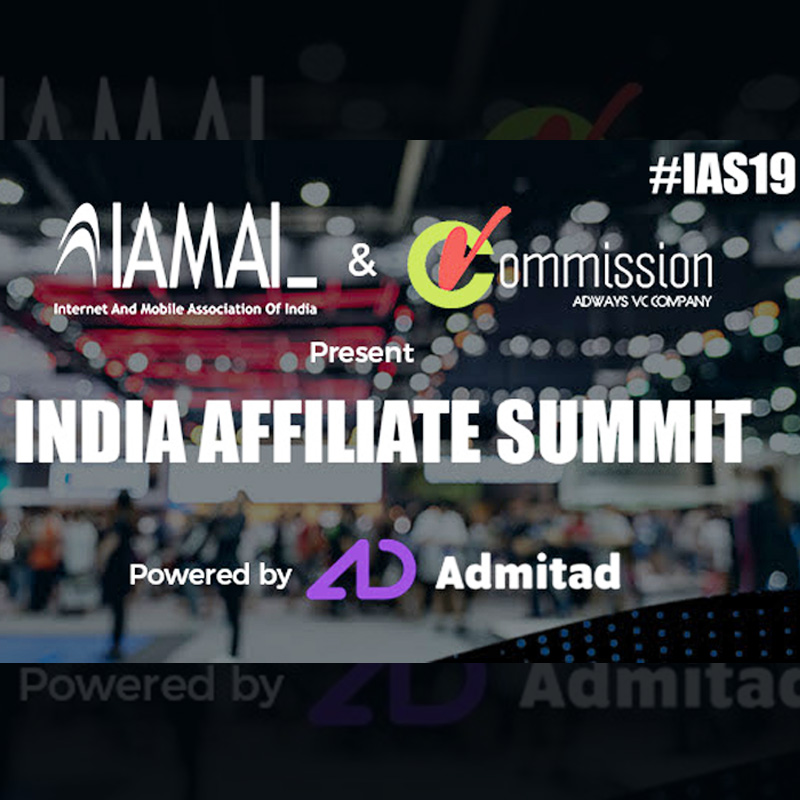
    MUMBAI: Underlining its position as a domain leader in the Indian affiliate marketing industry, Admitad India has announced its association with India Affiliate Summit & Awards 2019 (#IAS19). Organized by IAMAI, the 5th edition of the premier affiliate marketing event will be held at The Leela Ambience, Gurugram, on September 26th and 27th. 

    Themed ‘Re: Imagine’, the latest edition of the largest annual gathering of affiliate marketers will focus on charting out an innovative and lucrative future for the country’s growing affiliate marketing industry. Admitad India is honored to be the ‘Powered By’ partner of IAS 2019.

    This year’s India Affiliate Summit will witness the convergence of more than 2,700 delegates, 500 companies, and 70 exhibitors. With the overarching goal of bringing together the brightest minds of the affiliate marketing industry, the summit will spark meaningful conversations around the growth of affiliate marketing with performance-based partnerships at its core. 

    The summit will also provide the backdrop for India Affiliate Awards – a celebration of the most innovative and effective advertisers, agencies, publishers, networks, and technology solution providers in the industry. 

    At the summit, Ms. Neha Kulwal (CEO – Admitad India) will be sharing her insights on the ‘Importance of affiliate marketing in M-commerce’. Attendees will also witness several captivating keynote discussions around topics such as the changing role of brand and performance marketing in India, optimally utilizing new-age marketing channels, and visual content consumption trends. These discussions will be led by global industry doyens including Emanuel Cinca (Founder – What The Aff) and Chris Adams (CTO – eDatasource), amongst others. The summit will also feature a standalone session by Daniil Silvestrov (Country Manager – USA, Admitad) on ‘How to build strong affiliate channels based on international experience’. 

    As ever, the India Affiliate Summit will act as a platform for industry players to network with key decision-makers, explore new opportunities and collaborate with high-potential partners. Powered by Admitad India, #IAS19 is set to build on the success of previous editions and emerge as the grandest iteration of the country’s largest affiliate marketing event.

  • Amazon’s Amit Agarwal appointed as IAMAI chairman

    Amazon’s Amit Agarwal appointed as IAMAI chairman

    MUMBAI: Amit Agarwal, senior vice-president, Amazon and country manager, India, has been appointed as the new chairman of Internet and Mobile Association of India [IAMAI]. He assumes office at a time when the industry is going through a growth trajectory with more than 500 million internet users in India.

    Commenting on his appointment, Agarwal said, “This is an exciting phase in the growth story of internet in India. As the internet revolution continues to be a socio-economic leveler, offering barrier-free access to Indian customers and small businesses in the remotest areas, I am excited that we are coming together as an industry to help truly harness the potential of the internet and emerging technologies such as AI in addressing India-specific problems at scale. I look forward to IAMAI continuing to offer a thoughtful platform for the industry to collaborate with the government, academia & think-tanks and other relevant stakeholders to leverage the digital ecosystem and contribute to India's growth."

    He added, "We will continue to offer evidence-based insights to not only be trusted as thought leaders in the emerging areas of tomorrow but also in the debates today. The association remains committed therefore to bring forward non-partisan leading reports that include multiple perspectives to help lay the road map for achieving the 1 trillion dollar digital economy along with job creation, improving livelihood and contribution to the overall GDP of the country."

    Apart from Agarwal, there have been certain other key appointments at IAMAI. Yatra co-founder and CEO Dhruv Shringi has taken up the charge as vice chairman. He succeeds MakeMyTrip founder and group CEO Deep Kalra.

    Times Internet vice chairman Satyan Gajwani has been elected as the new Treasurer of the association. Dr. Subho Ray continues to be the president of the association. The tenure of the new council is for two years.

  • IAMAI requests TRAI to recognise OTT services as “digital applications”

    IAMAI requests TRAI to recognise OTT services as “digital applications”

    MUMBAI: The Internet and Mobile Association of India (IAMAI) has reiterated that the term over-the-top (OTT) does not justify the innovation in the digital applications at the application layer. In its submission on counter comments to the OTT communication services consultation paper by industry body Telecom Regulatory Authority of India (TRAI) it has asked the regulator to recognise OTT communication services as ‘digital applications’.

    “Using the terminology of OTT paints digital applications as free-riding over telecom networks, as they are accessible to all users with internet service without any arrangements / agreements with TSPs. Using the internet to offer services to consumers does not amount to free-riding, as consumers pay TSPs for the data that they use,” IAMAI said.

    The industry body has also added that digital applications provide different services with diverse functionalities that do not merely replicate legacy telecom services. It has also noted that the use of the term “over the top” tries to equate the services while differentiating the mode of their accessibility. According to IAMAI, the services provided by digital service providers in the areas of communication, e-commerce, news, social media etc., do not provide substitutable services.

    While submitting comments on the OTT consultation paper, some of the telecom operators and COAI sought to qualify the services provided by some of the digital applications to be similar or substitutes for telecom services. IAMAI is of the view that digital applications are qualitatively very different from telecom services.

    “Identifying Rich Interaction Applications (“RIAs”) as comparable to telecom services is highly reductionist and unjustified. Moreover, digital applications are not available to those telecom subscribers who do not have access to the internet. While internet penetration in India is increasing with the rapid adoption of smartphones, this number is still a very small percentage of the Indian population. On the other hand, users can access telecom services without internet access or even smartphones,” it commented.

    Some of the stakeholders also spoke about the regulatory gap between ISPs and digital application providers. In response to that, IAMAI has said that the digital applications are duly governed by the IT Act under the Ministry of Electronics and Information Technology. It added that any new regulations under a different regulatory authority will only convolute the existing regulatory regime and adversely affect the ease of doing business in the country.

    “The argument of “same services same rules” was laid to rest in previous TRAI consultations on the matter. TSPs, with access to scarce national resources like spectrum and having restrictive access over physical infrastructures cannot possibly be compared to services being provided at the application layer, and any discussion of regulatory imbalance between the two would be comparing apples with oranges,” it highlighted.

    IAMAI thinks all arguments of service or functional substitution by the telcos ultimately stem from a narrow perception of revenue substitution. In this context, it has highlighted that earlier some telcos acknowledged that the rise of digital applications has actually led to a rise in data revenues for these service providers.

    “IAMAI would like to request the authority not to encourage TSPs to cherry-pick digital applications that help raise their revenues while choose to clamp down those they perceive as a threat for their revenues. Regulations should be based on principles and using regulations as restrictive tools for protecting business interests is a myopic outlook that harms the greater interest of the nation at large,” it commented.

  • IAMAI suggests advertisers pay 0.25% of media spends to strengthen BARC measurement

    IAMAI suggests advertisers pay 0.25% of media spends to strengthen BARC measurement

    MUMBAI: Presenting counter comments to the Telecom Regulatory Authority of India (TRAI) consultation paper on BARC TV viewership measurement, the Internet and Mobile Association of India (IAMAI) has said that advertisers can pay 0.25 per cent of their media spends for TV viewership measurement every year. It will not only help them in making judicious investments but will also largely contribute to the process of increasing panel size for audience measurement.

    The association noted this in response to the question asking about methodologies and technologies to rapidly increase the panel size for television audience measurement and the related commercial challenges. It wrote, “Use of multiple technologies such as peoplemeter, RPD, channel video players, softwares measuring the consumption of OTT and data modelling should help increase the overall sample size without commensurate increase in the costs. Advertisers can pay 0.25 per cent of their media spend for measurement every year to make the currency more robust which in-turn helps them to make judicious investments.”

    IAMAI also stated that it feels Indian Society of Advertisers (ISA) and The Advertising Agencies Association of India (AAAI) members, who hold 20 per cent share each in BARC, are not much involved in the currency.

    It mentioned in its counter comments, “At present, IBF owns 60 per cent of BARC and 20 per cent each is owned by AAAI and ISA. As a result, IBF has a greater say in the functioning of BARC. However, globally, higher percentage of revenue is contributed by media owners.”

    “In past TRAI consulting papers, most contributions also came from the media owners. It seems ISA and AAAI members are not that involved with overall currency. Consultation with these constituents may help ensure equal contribution in functioning of BARC by all the three industry bodies, irrespective of the share of revenue contributed. Presently it is felt that with 60 per cent share IBF controls day-to-day functioning of BARC and future course of action,” the comment further read.

    IAMAI also vouched for introducing a competitive currency of viewership management; one based on peoplemeter and the other based on RPD.

    It noted, “We can do this for different types of data, whether from the set-top box in the home or mobile services that enable subscriber viewing on tablets or phones. This will add Digital Viewership Measurement, which is currently missing.”

    “The 2nd study of RPD can be done with Internet and Mobile Association of India (IAMAI), who represents most of the digital media and publishers, in partnership with relevant stakeholders,” its comment mentioned.

    Most of the broadcasters, in their responses to the paper, had denied the need of introducing competition in the viewership measurement domain, citing reasons like it would lead to chaos and duplication of data and skewing of results to the convenience of a few stakeholders.

    TRAI had released the said consultation paper in December last year to seek suggestions on how the existing TV viewership management system can be made more robust. It asked several important questions to various stakeholders, including if the current measuring system is apposite, should the sample size of the population be increased, and related commercial viabilities of the responses.

    The stakeholders were asked to file the comments by 2 January and counter comments by 16 January. However, the dates were further extended to 2 February and 16 February, respectively.

  • Comment: Self-regulation a positive step for OCC platforms, but…

    Comment: Self-regulation a positive step for OCC platforms, but…

    At a high profile event in Delhi last week, a section of the Indian digital industry, comprising some of the biggest global players and domestic thoroughbreds who now define themselves as online curated content (OCC) platforms, announced a self-regulatory code — distancing itself from user-generated content or UGC platforms.

    That the formal launch of the self-regulatory code, signed by nine platforms till now, was preceded by a bit of drama, backroom politics and media leaks involving the content and phrasing of the code — highlighting the proponents and critics of the self-regulatory mechanism — is another tale worthy of another time and place as the devil always lies in the fine print, though a Reuters report did bring out the divergent views. 

    The objectives of this OCC Code, drafted by an industry body Internet and Mobile Association of India (IAMAI) after consultations with the stakeholders are as follows: 

    • Empower consumers to make informed choices on age-appropriate content; 
    • Protect the interests of consumers in choosing and accessing the content they want to watch, at their own time and convenience; 
    • Safeguard and respect creative freedom of content creators and artists; 
    • Nurture creativity, create an ecosystem fostering innovation and abide by an individual’s freedom of speech and expression; and 
    • Provide a mechanism for complaints redressal in relation to content made available by respective OCC Providers. 

    Though highly laudable and praiseworthy a move, there’s no denying the fact that with curated content getting increasingly edgy in India in an hitherto unregulated environment, the government, nudged by the judiciary, has been actively toying with the idea of setting government-mandated guidelines, a fact that has been officially denied in and out of the parliament. The looming general elections in a few months time has made the government, probably, more circumspect.

    But it would be interesting to analyse the move of the fledgling OCC industry that boasts of several billions of investments in original Indian content by international and domestic players like Netflix, Amazon Prime Video, Hotstar, Zee5, Voot, Reliance Jio, etc. 

    Types of streaming services

    The online video industry primarily has two segments:

    # Curated video on demand (VoD) applications, which refer to digital applications that provision proprietary content for which application/platform concerned indulge in curating the content made available. 

    # UGC platforms/applications refer to those platforms/applications that allow users to upload content and make it available for other users to stream. In this case, the entity owning the application performs no role in curating/editorialising the content made available through its platform.

    # There’s a third category too of streaming services that are a hybrid of curated and UG content.

    As the professional video streaming applications exercise editorial control (curation) over the content made available through their platforms, they are liable for such content.

    On the other hand, UGC platforms enjoy certain protection within the Indian law framework as they can be classified as “intermediaries” under Section 79 of the IT Act, 2000. They shall not be held liable for the content distributed through their systems if they did not initiate the transmission; select the receiver of transmission and select or modify the information contained in the transmission.

    However this provision is not a blanket protection as the platform can in no situation escape the responsibility to act in conformity with law as the same section clearly states “the intermediary observes due diligence while discharging his duties under this act and also observes such other guidelines as the central government may prescribe in this behalf” and “the intermediary has [not] conspired or abetted or aided or induced, whether by threats or promise or otherwise in the commission of the unlawful act”.

    The said safe harbour continues to operate only for 36 hours, which means the intermediary has only 36 hours to acknowledge the receipt of complaints from the aggrieved user and a period of 30 days to respond to the same.

    While Section 79 of the IT Act was originally intended to provide time to intermediaries to act in alacrity with the law and get their act in order, however, in practice it has been abused by UGC and social media platforms that have used it as a protective wall to prevent any action against them.

    Existence of self-regulatory mechanisms for content industry

    Self-regulatory/co-regulatory mechanisms for content regulation have long held field for governance of editorialised or curated in content in India.

    The print media has Press Council of India (PCI); the news and current affairs broadcast has News Broadcast Standards Authority (NBSA); non-news broadcast has Broadcast Content Complaints Council (BCCC) under the Indian broadcasting Federation and advertisement sector has Advertising Standards Council of India (ASCI).

    TV content, generally, is regulated in multiple ways that range from statutory regulation to self-regulation. The content or programmes on these channels are regulated by the Cable Television Networks (Regulation) Act, 1995, which consists of a programme and the advertising codes that all content transmitted or retransmitted on television must adhere to. The programme and the advertising codes are collectively called “codes” and are mentioned in the Cable Television Networks (Rules), 1994.

    The programme code largely regulates the content that should be shown on TV. For example, the programme code prohibits airing any content that may not be suitable for public viewing that may be otherwise prohibited under the Cinematograph Act, 1952. This code also prevents the airing of content that may be in contravention of prevalent policies such as obscenity, communal disharmony, child pornography, etc.

    However, to ensure the independence of the media, a self-regulating provision has also been acknowledged by the state. To that end, IBF and NBA’s guidelines for regulating all content on TV across all forms of transmission — cable, terrestrial, DTH, IPTV, etc. — have helped, but have raised some questions too. The self regulatory codes will be applicable on NBA and IBF members who can be penalised by the self-regulatory bodies, but what about the non-members? Not all the 650-odd on-air TV channels out of the 800+ government permitted channels are members of IBF or NBA or both. 

    Still, the need and importance of self-regulatory mechanisms in India was observed by the Supreme Court of India in the case of Common Cause vs. Union of India where it affirmed and recognised the self-regulatory mechanism put in place for advertising content by ASCI. 

    Case for self-regulation by OCC platforms

    As envisioned by the Indian government’s Digital India initiative, access to digital services (government and entertainment services included) is now at the centre of India’s collective rise transcending urban/ rural, income and gender divides. 

    At present the OTT space is being regulated by the Ministry of Electronics and Information Technology (MeitY), which, as per government rules, is the ministry in charge of making policies in all matters relating to information technology, electronics and internet except licensing of Internet Service Providers. It is also in charge of matters relating to the Information Technology Act, 2000. 

    Information Technology Act, 2000 as India’s primary cyber law legislation provides for punishment for new offences such as publishing or transmitting obscene materials, materials containing sexually explicit acts and materials depicting children in sexually explicit acts.

    Moreover, intermediaries are subject to the Information Technology (Intermediary guidelines) Rules, 2011, which require intermediaries to publish rules and regulations as well as a privacy policy, and terms and conditions or user agreements that inform users not to use the platform to upload or transmit information that is grossly harmful, harassing, blasphemous, defamatory, obscene, pornographic, paedophilic, libellous, invasive of another's privacy, hateful, or racially, ethnically objectionable, disparaging, relating or encouraging money laundering or gambling.

    Well aware of any government’s leanings towards an Orwellian Big Brother-regime, Supreme Court has noted the value and importance of the internet as a medium, and has warned against excessive censorship underlining the importance of keeping the internet open and free. This is notably evidenced by the striking down of Section 66A of the Information Technology Act 2000 in a historic case few years back, which upheld the freedom of speech and expression. The court held that words like ‘offensive’, ‘annoying’, ‘menacing’, ‘insulting’ used in the section as grounds for restriction on speech on the internet were too vague and that this would have a chilling effect on speech on the internet. 

    Presently, there is no single regime regulating online content. This makes online content platforms soft targets and vulnerable in the whole scheme of things as they are subject to multiple existing criminal and civil laws. Some media reports some time back highlighted the self-censorship of content being undertaken by some OTT platforms – much before the self-regulatory code were announced and by those platforms that have not yet signed on for the last week’s announced codes. 

    Implementing a framework for self-regulation for curated VoD platforms could work as a guiding principle for OCC platforms and could ensure that the stakeholders regulate their content in a responsible and professional manner, protect users from illegal, infringing and discriminatory content (after all pirated content too cannot be allowed a free run as it results in loss of big time revenue), while being mindful of the need to nurture creativity, foster innovation and abide by the citizens’ freedom of speech and expression, and their right to receive information.

    To create an environment of responsibility in the online video space, it is necessary for the VoD industry to appreciate the genuine need of consumers for a safer viewing experience. In the Indian context, the needs of consumers get enhanced due to emphasis on family viewing as multiple-devise or solo viewing is still not a mass phenomenon.

    In the Indian scenario, the industry shall have to contend with the diverse socio-cultural and economic strata that exist within our society that bring along a complex set of different sensitivities. 
    With such a background, it is important, that the curated VoD industry agrees to a common set of principles, which reflect the following:

    # Empowering consumers to make informed choice regarding appropriate content for their families and themselves;

    # Protecting interests of consumers in making available content they want to view;

    # Safeguarding the freedom of creative community, while achieving the above two objectives. 

    The self-regulatory code for OCC platforms made public by IAMAI does address most of the aforementioned points, but also raises questions like:

    # Will the days of edgy domestic and international content for Indian consumers be soon over?

    # Will it lead the government to crack the whip via mandated guidelines if such self-regulation fails to rein in the errant ones?

    Questions that only the future can answer as we at Indiantelevision.com still haven’t laid our hands on a future-predicting crystal ball.

    However, enlisted below are some self-regulatory regimes from other parts of the globe that seem to be working? These global practices around regulations in curated VoD space indicate that many regulators and governments have refrained from imposing heavy regulatory control to avoid burdening the segment with legacy regulations and allowing it to grow optimally. Importantly, user choice and control have been prioritised over blocking of content to ensure protection of minors. Built in safe guards (like age filters and proper messaging about content type) have helped prevent access to objectionable content on an opt-in basis.
     
    Comparative Summary of OTT-Content Regulatory Frameworks

    Jurisdiction

    Regulatory Approach

    Description

    Canada

    Self-Regulation

    Canada has a strong system of self-regulatory practices which encourage industry partnerships with government as well as with each other to come up with codes of practice. The Canadian Association of Internet Providers (CAIP) became one of the first industry associations to come up with a code of conduct and this has been leveraged as a template for a number of online-industry designed codes to address various concerns like protection of personal information and protection of consumers of E-commerce.

    Japan

    Self-Regulation

    In the absence of an independent regulatory commission, Japan’s internet industry is another jurisdiction to have embraced self-regulation. Non-governmental, non-profit organisations have been formed, with the support of for profit organisations, to regulate the industry. This includes the Content Evaluation and Monitoring Association and the Internet Content Safety Association

    Australia

    Australian Communications and Media Authority (ACMA)

    Co-Regulation

    Legislative scheme requires ACMA, which is the converged regulator for broadcasting, telecom and the internet, to give the industry an opportunity to develop co-regulatory solutions before other forms of intervention are considered, with the regulator maintaining reserve powers to intervene when co-regulation has not adequately addressed issues of concern.


  • MIB may nod in favour of self-regulation code for online video streamers

    MIB may nod in favour of self-regulation code for online video streamers

    MUMBAI: An upswing in online streaming platforms in India has drawn attention of authority as well as stakeholders on regulation. As per industry sources, most of the major players have agreed to a code of self-regulation that may receive an endorsement from the Ministry of Information and Broadcasting (MIB).

    While Netflix, Star India’s Hotstar, Reliance Jio, Zee5, AltBalaji, SonyLiv and Times Internet Limited-owned MX Player are ready to follow the codes, giant international players Amazon Prime Video, Google and Facebook are not in agreement. According to sources, there are some differences over details of grievance redressal mechanisms among the players who are ready to accept the code.

    Indiantelevision.com has learnt of the existence of a document called “Code of best practices for curated online video platforms” which depicts the principles, objectives as well as the codes of the self-regulation.

    The key objectives of the code is to empower consumers to make informed choices and protect the interests of consumers. It also looks at the creative freedom of content creators and artists. Providing mechanism for grievance redressal in relation to content made available by the platforms has also been highlighted under the objectives.

    As per the said draft, the code properly defines prohibited content and age-inappropriate or sensitive content. Any content showing disrespect to the national emblem or national flag, child engaged in sexual activities, outrages religious sentiments, promotes terrorism will be prohibited.

    “The signatories to this code seek to protect the consumers’ ability to choose the content that is appropriate for themselves and their families. The objective is to use information and technological tools to equip consumers with requisite knowledge and awareness, to enable informed decisions on the consumption of content,” the draft is said to mention.

    Discussions on grievance redressal mechanism have also acquired an important place in the document. There is suggestion to internally institute as part of their operational systems an independent Standards and Practices (S&P) department to receive, objectively address any online consumer related concerns and complaints in relation to content made available.

    There are also suggestions that the signatories of the code shall establish a grievance redressal body – the Content Committee, which shall address grievances from users on violations of the code. The detailed process, functioning and powers of the Content Committee will be institutionalised in due course. However, ZEE5 and Netflix have not agreed to complaint redressal codes yet.

    Although the voluntary censorship code is aimed at maintaining creative freedom, the rules under the code highly reflect the model of TV content censorship. According to earlier reports, The Internet and Mobile Association of India (IAMAI) has supposedly drafted the code.

  • OTT platforms may soon adopt self-censorship

    OTT platforms may soon adopt self-censorship

    MUMBAI:  Leading OTT players clearly don’t want the government interfering with their content or creating rules like broadcast. So, Netflix, Hotstar, Reliance Jio and some other streaming services may soon adopt a voluntary censorship code.

    As part of the code, the platforms will remove content that has been banned by the courts and that disrespects the national flag, emblem, hurts religious sentiments or promotes violence or terrorism against the country, or even shows children in sexual acts. These are codes that even the broadcast industry follows.

    Economic Times citing sources reported on the self-censorship initiative. However, tech companies including Amazon, Facebook and Google are unlikely to sign up for the code as this move of could set an example of how to regulate internet and meddle with creative freedom.

    The code is likely to include a “redressal mechanism” allowing the users of the streaming platform to issue complain in case they think that the over-the-top (OTT) services have violated the code. Eventually, this mechanism may transform in an “adjudicatory body” that will resolve the complaints filed by the customers.

    According to the report, ZEE5, Times Internet, Eros Now and AltBalaji are in favour of the code and the Internet and Mobile Association of India (IAMAI) is facilitating the process. It also added that the players who don’t think it as a very wise step opine it would lead to an unnecessarily nervous environment and validates the government’s point of view that the internet needs regulation.

    Allegedly, the whole process has been opaque and closed-door while content creators have not been included in the discussions. The opposition group to the court also believes the process has been swayed by companies that want OTT companies to be at a more level playing field with broadcasters.

  • Moneycontrol and IAMAI conclude the 4th edition of Digital Marketers’ Awards on a high note

    Moneycontrol and IAMAI conclude the 4th edition of Digital Marketers’ Awards on a high note

    MUMBAI: moneycontrol, India’s No.1 leading financial and business media platform along with Internet and Mobile Association for India (IAMAI) hosted the fourth edition of the Digital Marketers' Awards (DMA). The awards were conceived with an aim to recognize the the spectacular ideas and brilliant minds of the brand custodians, elite marketers and creative honchos who have made outstanding contribution towards groundbreaking advancements and rose above their peers.

    Setting the wheels in motion for the evening, the event commenced with an engaging panel discussion between Gautam Shelar, Business Head, Moneycontrol, Suman Srivastava, Founder & Innovation Artist, Marketing Unplugged, Shamsuddin Jasani, Group MD, Isobar, South Asia, Adhil Shetty, CEO, BankBazaar.com moderated by Anant Rangaswami, Editor of MELT on WION, advisor to Unmetric ‘Digital transformation through new innovations: A complete road map’. This was followed by a keynote address by Himanshu Vyapak, Deputy CEO, Reliance Nippon Life Asset Management Limited (RNLAM). 

    This year, the awards honored path-breaking marketers across banking, digital business, FMCG & consumer durables, automobiles, healthcare, travel, insurance, IT, retail, personal finance & investments, real estate, Most Popular CMO of the Year as well as Best Digital Personality of the Year. The prestigious  jury panel chaired by CVL Srinivas, Country Manager, WPP India, comprising of esteemed members like Amit Sharma, Senior VP and Head – Digital & Ecommerce, Max Life Insurance, Prasun Basu, President, South Asia, The Nielsen Company, Anuradha Narasimhan, Consultant, Scripbox.com, Rohit Raj, Co-Founder, Chief Creative Officer, The Glitch, Dolly Jha, Executive Director, Nielson India, Chaaya Baradhwaj, Founder & Managing Director, BC Web Wise and Suman Srivastava, Foundation and Innovation Artist, Marketing Unplugged helped arrive at the big winners of 2018.

    The digital sphere has grown exponentially and the event payed a fitting tribute to the force behind the domain’s unprecedented expansion. Amidst the presence of other luminaries, renown actor Varun Dhawan was also awarded “Best Digital Personality of the Year” to acknowledge the widening digital influence he possesses. 

    Commenting on this edition of the awards property, Mr. Manish Maheshwari, CEO, Network18 Digital said: “Digital Marketing has become one of the most integral and effectual tools today. India is become a vital instrument in driving the world economy, and the digital industry has an undeniable role to play. As we move forward in era of the 4th industrial revolution, disruptive technology have become the way forward. With this edition we aimed to not just celebrate the medium but also those bigwigs who have utilised innovative and creative digital tools to get through to their target audience. As the leading digital platform for financial information, it is befitting for moneycontrol and IAMAI to come together and undertake such an initiative to applaud the pioneers of the industry.”

    Gautam Shelar, Business Head, moneycontrol remarked, “The Indian digital landscape houses some exceptional minds that have played a key role in its expansion. There has been an augmented growth in the digital sphere, which has fuelled the level of competition in the industry through differentiated offerings. As one of the early pioneers in the digital industry, we wanted to honour the game changers in the Digital Marketing industry by highlighting the strongest performers of the year. With time, the awards have evolved into one of the most premium platforms that brings together the ingenious minds of the industry who have achieved great heights by adopting effective digital strategies.”

  • 150 IoT start-ups in 3 cities in as many yrs: IAMAI, Napino tie up

    150 IoT start-ups in 3 cities in as many yrs: IAMAI, Napino tie up

    NEW DELHI: The Internet and Mobile Association of India (IAMAI) has teamed up with Mobile10X and Napino Auto & Electronics Limited to bring together startup entrepreneurs so that they can realise their true potential and evolve Internet of Things (IoT)-based ecosystem in the country.

    Iot.IN is one-of-its-kind initiative and will invite nominations from IoT startups based in Delhi-NCR, Bangalore and Mumbai. It will provide mentorship, investment and partnership opportunities to the select startups. The focus of this initiative is to encourage young aspiring entrepreneurs to create innovative and disruptive solutions around the IoT, which will eventually align the government’s Smart India initiative with the vision of Digital India.

    In the past two years, Napino has invested Rs 300 mllion in technology companies at different stages of business cycles. In the next two years, it will invest Rs 600 million and focus on next-generation tech companies in IoT, Blockchain, Big Data and Artificial Intelligence.

    Napino director Vaibhav Raheja said: “We want to be at the forefront of innovation and have been continuously supporting entrepreneurs by providing business expertise, engineering and manufacturing support and industry connects. Despite a high rating on innovation and entrepreneurship, India attracts a meager share of VC funding in the world because of gaps in skills, scaling and business development models that entrepreneurs follow.” He said that Napino has five facilities to begin with for this programme.

    To a question, he said that Napino was bringing in the hardware and the Cloud support in this programme.

    ‎‎Amazon Internet Services head – India Bikram Bedi who is a senior IAMAI member said the plan was to start at least 150 start-ups in the three targeted cities over the next three years.

    About the help from the government, he said the government was helping individual programmes under the “Digital India” programme. He told indiantelevision.com that the programme would be publicised through the large number of members of IAMAI apart from alternative methodologies.

    Bedi said: “We are headed to a completed connected world and this will soon be a nine billion dollar industry with shareholders among ISPs, TSPs, and others who could contribute to making India a hub for this sector.”

    Through the iot.IN programme, Bedi said, they will be publishing white papers, building proof of concepts around segments which are central to the Digital India vision. The programme will focus on healthcare, automobile, agriculture, transportation, and smart cities. Going forward, the aim is to move into blockchain technology development, artificial intelligence, and also virtual reality.

    He said consulting firm Deloitte estimates that India’s mobile data usage will grow to 1608 PB by 2020. 1 PB (or petabyte) amounts to 1,000 TB (terabyte) or 1 million GB (gigabyte).

    IAMAI Startup Foundation’s Mobile 10X programme CEO Jitender Minhas said: “The Mobile10X programme has been striving relentlessly to provide a robust support system for app developers and young startups. I believe this joint effort will be a perfect complement and give a fillip to nurture dynamic startups. With many more such initiatives, we will see great products emerging from such programmes.”

    Though he declined to give a definite figure, he told indiantelevision.com that a percentage of the Rs 600 million was being set aside for marketing.

    He said initially, the start-ups will get a grant to launch their companies. As a part of the programme, startups will be provided technical, marketing and leadership skills along with financial support to build applications and businesses. They will also network with industry leaders, thought leaders, VCs, ecosystem evangelists and funders.