Tag: I-phone

  • Pulling back the curtain on cell phone cinema

    Pulling back the curtain on cell phone cinema

    Los Angeles: Director, writer, and producer, Vineesha Arora-Sarin mixed together unusual but effective ingredients combining a family vacation, an epiphany, her iPhone, and adding a generous portion of talent to produce her debut feature “Between Mountains,” a visually whimsical but sobering thematic drama about loss, guilt, and mental health.

    Arora-Sarin grew up in New York balancing her western upbringing with her cultural Indian roots. She traveled to India post-college to reevaluate her life and reconnect with family and ended up enrolling in a drama class. It was there she was set up on a blind date with her future husband, a young, talented drama student and future Bollywood star, Amit Sarin. In 2003, Arora-Sarin made her acting debut in the film “Supari” just as Sarin began landing television roles. It turned out to be a pivotal year as she later traveled to New York where she met her idol, Al Pacino after his Broadway show. Her meeting with Pacino added clarity and inspired a shift in focus to pursue writing. Upon her return to India, Arora-Sarin began honing her skills in writing, as well as acting. In 2009, she started a production company along with her husband producing short films and media advertising, as well as organising Bollywood events.

    In 2018, after lining up projects in Los Angeles, Arora-Sarin and Sarin decided to make the leap from Bollywood to Hollywood. Early in 2020, just as their creative ventures were moving forward, the Covid-19 virus began its deadly march shutting down productions in Bollywood, Hollywood, and around the world.

    “My main mantra of life is to keep moving forward, keep creating, keep inspired. My mantra became my savior during this time. I kept an open mind and kept thinking about how do we turn this around into something positive,” Arora-Sarin stated.

    With the Covid-19 pandemic raging, their projects side-lined, and with their two children off from school, the couple decided to take a family road trip through the natural beauty and tranquility of national parks from California to Colorado and through Utah. A close family friend and Sarin’s onetime co-star Sushant Singh Rajput had committed suicide earlier that month and his sudden and tragic death was weighing heavy on them. Early one morning while on the trip, Arora-Sarin woke up with an epiphany, an idea about the effects experienced by people from a sudden loss and the mystic power of nature to heal.

    She brought out her iPhone and with no script in hand, started to shoot with her basic concept and the surrounding nature serving as her inspirations. With “Between Mountains,” Arora-Sarin became the first female director, writer, and producer to make a film entirely on an iPhone.

    “I had an iPhone in my pocket and I thought to myself, ‘What’s stopping me?’ That’s the beauty and convenience of cell phone cinema. You just need a little knowledge in terms of how to take your shot and you need a compelling story,” Arora-Sarin said.

    “Between Mountains” stars Arora-Sarin’s husband, Amit Sarin, and tells the story of a recently widowed father who reaches his breaking point after also losing his young son to an untimely sudden death. Overcome with sadness he sets out on the road with the intent of ending his life.

    His journey takes audiences on a progressive journey of self-discovery, enlightenment, and acceptance. The film features a haunting soundtrack, written and performed by Nashville musician Scott Turek, which helped create the mood of the film.

    Arora-Sarin’s advice to aspiring filmmakers: “If you have a burning desire and passion to tell a story, you don’t need to wait. Find a way to tell that story,” she stated.

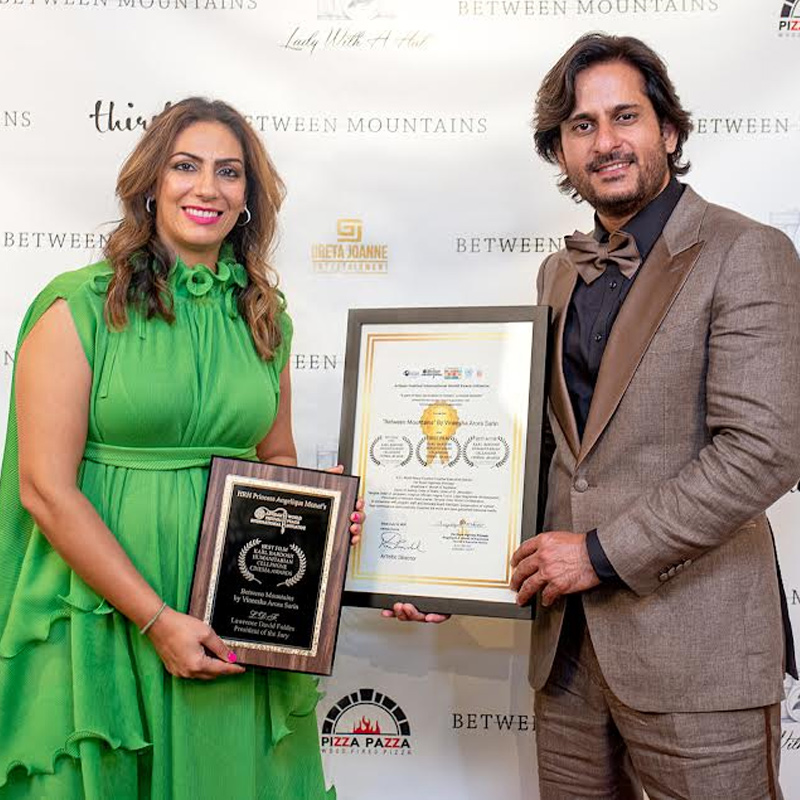
    “Between Mountains” wooed the audience at its world premiere in Los Angeles in August with its raw story and visual beauty. In addition, attendees were later astounded to learn the film was shot entirely on an iPhone. It won Best Narrative Feature with Amit Sarin taking home the Best Actor prize at the AFI Karl Bardosh Cell Phone Cinema Humanitarian Awards which take place during the Cannes Film Festival. In addition, the song, World on Fire featured in the film was released in a separate music video and won the Best Music Video award.
    With her innovative work in “Between Mountains,” Arora-Sarin is inspiring a new way of thinking and approach to filmmaking. The use of cell phone technology expands possibilities to creative filmmakers for their stories to be told. She is set to start work on her second feature, Deathbed, to be shot on an iPhone, as well. In addition, Arora-Sarin is working on a crime drama web series “End of Karma” and along with her husband, Sarin is producing “Tiger Heart,” an anti-poaching feature on tigers.

  • ‘If you don’t innovate, somebody else will take it from you’ : Sir John Hegarty – BBH chairman & worldwide creative director

    ‘If you don’t innovate, somebody else will take it from you’ : Sir John Hegarty – BBH chairman & worldwide creative director

    Sir John Hegarty stands tall in whatever he does. Starting Bartle Bogle Hegarty (BBH), of which he is chairman & worldwide creative director, four years into the run the agency was voted Campaign magazine’s Agency of the Year in 1986. Awards galore have seen been following the man who launched the famous Levis “Live Unbuttoned” campaign. In 2007, Hegarty received a knighthood in the Queen’s birthday honours for services to advertising.


    At Goafest 2009, Hegarty explained why recession is the best time to be in advertising as it induces innovation and makes change acceptable.


    In an interview with Indiantelevision.com’s Tarachand Wanvari, Hegarty talks about the current status of the advertising industry, the need to address the digital medium and the fantastic future of television as people can now watch it from anywhere.


    Excerpts:

    How different are the agencies and clients in India as opposed to those in the Western world?
    People always talk about what’s different, but there are more similarities. You really have to understand the complexities of India, the diversity of its culture. You also have to remember that advertising is about converting people, it’s about unifying people. Great ideas unify people, and that’s what you are looking to do. Music’s done it, painting’s done it, films have done it, why can’t advertising do it?

    Everyone’s speaking about the new media. But is the industry, the client ready for it?
    Yes, everyone’s speaking of the industry not being ready and responding to it. I mean, this is probably the most competitive business you can be in. I can start an agency tomorrow – we just started one. It’s not a difficult thing to start an agency. I think agencies are moving as fast their clients allow them. I think that it’s more often that I found that clients often talk a good digital story, but when it comes to actually doing it, they are rather hesitant. Certainly BBH is responding and so is the industry. We are looking at how we put these things together and how we create a roadmap for our client. I think we are doing as much as we can, but we can only be so far in front.

    Are the agencies ready for the new media – technologically and with manpower skills?
    I still think that it’s a developing market and you are looking at how far ahead are consumers. You can look at Japan, I mean they are tech-mad. They live their lives on the mobile. They are texting each other, which is not the case here in India. You have got to look at the market place and see what is it doing and how is it doing it and then respond to that. I think agencies are by and large doing that in India.

    Audio visual is one of the best forms of communication. What do you think is going to happen next – television episodes, internet access, voice communications on the mobile or a hand held device? Are we ready with the content?
    The first thing that we fundamentally believe is that the world’s going to go mobile. There’s no question. You are going to take your devices with you. You will still want to sit down in front of the television at home, you know three hours of cricket, it’s fantastic, I just love doing it. But you are also going to be taking it with you. Television has got a fantastic future if it realizes that people can now watch television anywhere. Imagine if you had a newspaper etched on stones, you couldn’t carry it with you to read. Television is going to have an ever expanding influence in my view, because people love watching it.

    But are we ready with the content?
    It’s very hard to be ready with the content when the audience is not there yet, when they haven’t got the devices. It’s going to take another five to ten years when we have fantastic devices with great screens that give us actual clarity of picture. I have watched bits of television on an i-Phone. It’s brilliant, and I think it will happen more and more, but it won’t stop me watching TV at home.

    If you just narrowcast, then you are not going to be talking to the expanding market. And in a funny way, people talk about narrowcast. The world actually is going broadcast

    People are talking of mobisodes for TV consumption on mobile devices, because one can’t capture facial expressions and fine details on the small screen. Do you think that there is an opportunity to create more mobile-centric television content with which agencies could weave in their ad strategies?
    I think I’d rubbish that. People’s eyes adjust. I have watched a bit of Star Wars on the i-Phone. Of course it’s not the same as watching it on a flat screen television, but, then, that too is not the same as watching it on cinema screen. We are incredibly adaptable and will adjust. You put the device closer to your eyes, so the ratio changes. It’s got to do with entertaining the mind, how you embellish it with sound and visual. We’ll see what people want to watch on the very very small screen and what they want to watch on the big screen.

    Where do you think the industry is headed here in India? I mean during one of panel discussions we had people saying that there is no recession in the industry, despite the fall in ad agencies revenue. Do you think that the industry needs a bigger shock to awaken and realise that they are going down economically?
    I can’t answer that. I think that people are being na?ve if they are saying that there is no recession. There is a recession, a downturn, that is a reality. If they don’t respond to it, they are going to go out of business. As I said before, this is an extremely competitive industry. You don’t need any special training to start an agency, you don’t need any licence. You don’t need a Phd, you just need courage. If you don’t innovate, if you don’t change, if you don’t move forward, somebody else will take it from you. But I think recessions are very good at getting to accept change and that’s what we should be focusing on. I think the advertising industry has a fantastic future.

    Digital has one of the best ways to measure the success of any campaign. For television advertisements, even today people depend on Tam’s peoplemeters which can never give a true reach picture. Yet, marketers are allocating a major chunk of their budgets for conventional media, rather than digital media.
    I consider digital as more than just a medium, it is a whole lifestyle change the way people communicate. I think you have got to be very careful about how you use it. I will quote a little – a very very important quote – ‘A brand isn’t just made by the people who buy it. A brand is also made by the people who know about it.’ That’s a very very important point! That is fundamental to the future. Broadcast – you define broadcast in some sense or another – you won’t convert, you won’t build a fantastic brand. If you just narrowcast, then you are not going to be talking to the expanding market. And in a funny way, people talk about narrowcast. The world actually is going broadcast.