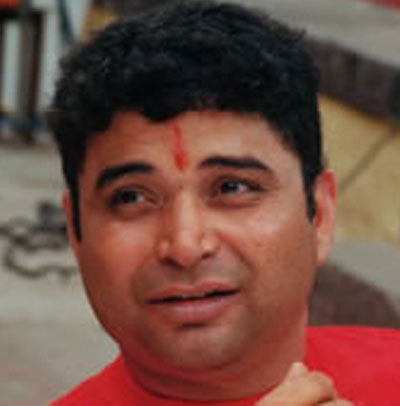
On the dot of 2 pm, I am ringing the doorbell to his apartment. It has been a hot afternoon and seems to be getting worse. Someone lets me in and beckons me to sit. Sipping cold water in his drawng room, I wait. A few minutes later, a well-built 30-something guy in shorts comes rushing in. “Hi! I am Jitendra Kumar,” he says, stretching out his hand.
Preliminary pleasantries excahanged, he shoots off, “First promise me you won’t ask about my future plans. I am sick of answering this question. Who knows his future? I will never forget the days when I constantly brooded about my tomorrow. Those were the days when I was just 21. I wanted to settle down quickly. I didn’t want to loaf around. But like most youngsters, I was very confused.” I interrupt him to put up my first question.
Excerpts of a Q & A session with Vickey Lalwani.
Did you always want to become a director?
No. It just happened. I was a 20-something son of a zamindar in Haryana, trying to settle down in some sphere. But despite my best efforts, I could not. Believe it or faint, I changed as many as 11 businesses in a span of 12 months – garage, travel agency, Maruti showroom, restaurant and what not!
I was here in Mumbai for a short holiday, when I saw Mahesh Bhatt shooting for Sadak in Film City. While most other people around me were looking at the stars, I was mesmerized by Bhatt. What command that man has when he directs! Something struck me and I decided that I wanted to be like him. I went back, packed my bags and came to Mumbai.
Was Mumbai easy to get work in?
Are you kidding? Here, talent is recognized but you need luck too. The first eight to nine months were terrible. Every director I went to said he had 20 assistants. One day, I met Raman Kumar. Pat came the reply, “I have nine assistants.” I don’t know how but I mustered up some courage to tell him, “If you have nine, you might as well have ten.” He smiled and asked me to call him up the next morning. I told him, “Sir, you are a big man. I will not be able to reach you via your phone operator. Can I directly come to the office at 11 am tomorrow?” He nodded.
The next morning, he was not in his office when I reached. An hour later, I decide to trudge back home. As I was about to get up, the phone rang. It was Raman Kumar asking for me! He directed me to the sets where he was shooting. I reached there at about 2 pm, but we did not exchange a single world till 2 am! And all he did was ask me to come over to the office the next morning! Next morning, he patted me on my back and said, “Young man, you are on. I was testing your patience yesterday.”
 |
“I do not condemn a channel’s decision to withdraw a serial. A flop serial to a channel is like a white elephant“ |
|
And then?
Within the next two months, I became his right hand. I assisted him in Tara, Rahat, Shatranj, and many other projects. Every day, I learnt something new. I was passionate, no, obsessed with my work. Even after the shoot was over and done with, I used to sit down and make plans. Unlike boys my age, I never went to a discotheque or a pub, I never dated a girl (blushes).
The golden period of my youth was spent slogging (smiles). I went back to my hometown for only two days, that is, when my younger brother expired due to brain fever! Raman Kumar taught me direction, production and almost everything he knew about TV serial making. Yes, I am Raman Kumar’s protégé.
When did you start directing independently?
Raman Kumar had shot for two – three days on Yehi Hai Zindagi (Zee TV). It was based on the famous Rajesh Khanna starrer Bawarchi. Archana Puran Singh played the protagonist. On the fourth day, he told me to handle the proceedings as he would be away in a meeting with Zee officials. He came back during the lunch hour, but refused to take the reins. I continued, and slowly he withdrew himself.
YHZ was a great experience. I was at the helm for 52 episodes. It was one of the top five grossers on television at that time. Later, Raman Kumar’s company ran into financial problems. Archana left the serial, so did I. She and I, however, became good friends during the making.
Did she help you from there?
You guessed it right! She was doing two shows for Cinevista- Jaane Bhi Do Paro and Nehle Pe Dehla. We both began co-directing the two projects. After about 26 episodes of both the serials, she delivered her first kid. From there on, I took over. Came Kati Patang, Apni Khushiyan Apne Gam, Hum Hain Dilwale, Har Mor Par, Hum Hain Aapke, Pyar Zindagi Hai and Henna (the last two are currently on air).
You had shot something with Mohnish Behl too. Right?
(smiles) Oh, so you know about that! Yes, I did shoot about eight episodes with him for a serial for Mak TV. But the channel did not come on air!
Your ‘Hum Hain Dilwale’ was a major disaster, wasn’t it?
Yes. Well, it wasn’t launched properly. There was no propaganda, it just burst out one fine day. But at the end of the day, the hype does not really count. If your content is good, even then your serial may flop. Somehow, our viewers wants to either cry or laugh. Plus they want lots of moral values all the time. They don’t want too much of intellectual stuff or something new. They don’t allow us to experiment.
HHD had lots of young and trendy culture with four youngsters Rohit Roy, Rakhee Tandon, Nilanjana and Vishal Singh; it did not stir sentiments- no stomach aches, no tears; it bombed. HHD might have worked if it had been aired in a late-night slot.
As a director, don’t you get frustrated when the channels ask you for changes when the TRPs are low?
I do. But ‘kya karen’? You can’t look at this phenomenon from only one side. You have to see the channel’s perspective also. Low TRPs indicate failure. If there is less attendance in a theatre for a particular film, will the theatre continue to run that film? At least here, we are allowed to run for sometime. I do not condemn a channel’s decision to withdraw a serial.
A flop serial to a channel is like a white elephant. Also, why do you forget the amount of competition that channels face in today’s times? Gone are the days when there was only DD, or say DD and Zee. Today, the competition is not fierce but ferocious. Try to understand that channels are in the fray to do business.
| “Today, channels have acquired such status as brand names that the viewer decides the quality of the programme by the name of the channel” |  |
You are one of the few directors who speak the channels’ language?
We have to be practical. There is no point in beating our chest on creativity. Channels are not killing a director’s creativity. They are not governing how we extract the maximum from an artiste. They don’t decide what angle the shot be taken from. They are mainly concerned about the look- the grandeur of the room, the clothes of the artistes etc.
What’s wrong in these things? What’s wrong in meeting them midway and working cohesively? Today, channels have acquired such status as brand names that the viewer decides the quality of the programme by the name of the channel! All said and done, every director who is sore about channel interference must stop sitting on his false ego and realize that the channel is bigger than his/her own self.
But do the channels really know what the people want? Or, is this a blind war of one upmanship?
Of course, they know. Today, nobody writes letters to the editors in newspapers and magazines to convey their taste about a programme. They straightaway fire an email to the channel, and before the director has an explanation or an excuse to justify his failure or error, the channel is ready with the remedy. And of course if things don’t work out even then, as I explained earlier, they have to call it off because of their business interests.
Do you have assistant directors?
Five. I keep a strict tab on all of them.
How do you select them?
I chose people who say they want to learn and not people who say they have learnt. The first thing I tell them is ‘this is not a 9-5 job, get ready for odd hours of working’. Many times, I have sacked people who just want to hang around the sets on be seen with me. I want people who bring their individual energy on my table. I shun those who want to lean on me and learn. Presently, two of my assistants are girls.
What kind of an atmosphere do you maintain on the sets?
As cool as cucumber. Even if an artiste goofs up a scene 10 times, I do not lose my temper. It will not help. If he/she is already nervous, it will only make him/her more nervous.
Have you ever reduced someone’s role if he/she failed to deliver?
I have. As I told you, channels are doing business. In other words, television programmes are business ventures. At times, I have reduced someone’s role even if he/she has loads of attitude. There are some TV artistes who behave very haughty. My policy is simple: ‘I’ll respect your work if you respect mine’. Sometimes, however, if the artiste is too integral to the script, I have to bear him/her.
Ever thought of writing scripts?
Many people have suggested this to me. They say that a director is better when he himself has written the script. He flows with the script, he knows exactly what he wants, blah, blah, blah. Somehow I like to take a fresh look at the script. At times, I tried writing, but lost my way. Script-writing is not my domain.
Some people have even said that if a director writes the script, he can take the shot from a better angle; his vision for the output is better then. But tell me, how many people who see television realise which angle the shot should have been actually taken from? The public does not understand the technicalities of the game. They want good acting.
A director has told us ‘There are no bad actors, only bad directors’. Comment.
Rubbish. Amitabh Bachchan is like a Land Cruiser. Press the accelerator and he starts to run at 200 km/hr. I think that answers your question! (smiles).
Your message to aspiring TV artistes?
Stop being conscious about how you look. Channels will take care of your looks, depending upon the character you are selected to play. Focus on getting into the skin of the character, and initially, do not take on too many assignments.
Have you been offered films?
About 15-20. But all these guys wanted someone who would only call ‘Cut’ and ‘Action’. They have ready scripts, a ready star cast. I respect the channels and meet them midway. Similarly, I would love to meet the film producers midway too. But I can’t be an absolute puppet in their hands!