Tag: Huawei

  • Maxus strengthens global board with three additions

    Maxus strengthens global board with three additions

    MUMBAI: Maxus has announced the strengthening of its global senior management team with three new appointments to its executive board.

    Benedict, Rudi Symons and Pam Sullivan are joining the ExCo. Benedict and Symons have both been promoted to new roles. Benedict becomes worldwide chief client officer, while Symons has been named worldwide chief talent officer. Sullivan, will continue in her role as managing director of Maxus Los Angeles.

    Benedict joined Maxus as a managing partner in 2014 from MEC where he was the global client lead. In his new role, Benedict will continue to help develop both the ever-expanding Maxus global Huawei relationship and GroupM’s global L’Oréal account across 19 markets, as well as spearheading the Maxus Client Leadership practice.

    Rudi Symons, newly appointed worldwide chief talent officer, joined Maxus in September 2015 as EMEA head of talent and culture. In her new role, she will be responsible for developing the global talent and culture strategy across 55 markets. Since joining, Symons has launched a number of HR initiatives at Maxus.

    Pam Sullivan joined Maxus in 2011 as the managing director for Maxus Los Angeles, leading the launch of the new office. She also heads Maxus’s largest client in North American, leading the NBCU film and television business, for which she oversees and leads strategic planning, implementation and stewardship for all products. In her five years at Maxus, Sullivan has increased the Los Angeles office’s billings fourfold.

    Lindsay Pattison, worldwide CEO, said, “Our talent delivers highly creative, award winning campaigns that grow our clients’ businesses.”

    Dan said: “With Maxus’ unique client-centric culture my new role is firmly about supporting clients through this time of peak complexity. The key is ensuring local knowledge delivers global impact.”

    Sullivan will continue to be based in Los Angeles and report into both Steve Williams, Maxus Americas CEO, and Lindsay Pattison, Maxus Worldwide CEO. Benedict and Symons will continue to be based in London and report to Pattison.

  • Maxus strengthens global board with three additions

    Maxus strengthens global board with three additions

    MUMBAI: Maxus has announced the strengthening of its global senior management team with three new appointments to its executive board.

    Benedict, Rudi Symons and Pam Sullivan are joining the ExCo. Benedict and Symons have both been promoted to new roles. Benedict becomes worldwide chief client officer, while Symons has been named worldwide chief talent officer. Sullivan, will continue in her role as managing director of Maxus Los Angeles.

    Benedict joined Maxus as a managing partner in 2014 from MEC where he was the global client lead. In his new role, Benedict will continue to help develop both the ever-expanding Maxus global Huawei relationship and GroupM’s global L’Oréal account across 19 markets, as well as spearheading the Maxus Client Leadership practice.

    Rudi Symons, newly appointed worldwide chief talent officer, joined Maxus in September 2015 as EMEA head of talent and culture. In her new role, she will be responsible for developing the global talent and culture strategy across 55 markets. Since joining, Symons has launched a number of HR initiatives at Maxus.

    Pam Sullivan joined Maxus in 2011 as the managing director for Maxus Los Angeles, leading the launch of the new office. She also heads Maxus’s largest client in North American, leading the NBCU film and television business, for which she oversees and leads strategic planning, implementation and stewardship for all products. In her five years at Maxus, Sullivan has increased the Los Angeles office’s billings fourfold.

    Lindsay Pattison, worldwide CEO, said, “Our talent delivers highly creative, award winning campaigns that grow our clients’ businesses.”

    Dan said: “With Maxus’ unique client-centric culture my new role is firmly about supporting clients through this time of peak complexity. The key is ensuring local knowledge delivers global impact.”

    Sullivan will continue to be based in Los Angeles and report into both Steve Williams, Maxus Americas CEO, and Lindsay Pattison, Maxus Worldwide CEO. Benedict and Symons will continue to be based in London and report to Pattison.

  • Deutsche Telekom pushes LTE speed to 1.2Gbps with Huawei

    Deutsche Telekom pushes LTE speed to 1.2Gbps with Huawei

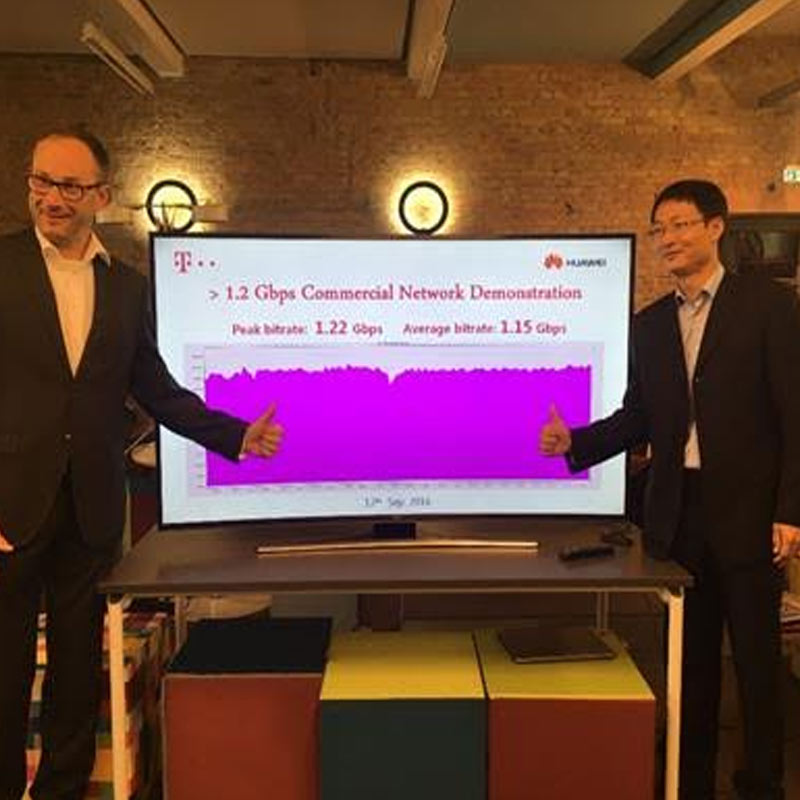
    NEW DELHI: Deutsche Telekom and Huawei have accelerated mobile data transfer in Berlin’s LTE network to more than 1.2 Gigabits per second (Gbps), achieving a technology mix of four sending and receiving channels (4×4 MIMO) and five carrier frequencies deployed live for the first time and proving LTE Advanced Pro (4.5G) gives the highest data speeds.

    Deutsche Telekom and Huawei used the latest evolutionary step of this technology – LTE Advanced Pro (4.5G) – with a conventional mobile base station which was bundled with a small cell solution; the data traffic flowed over five carrier frequencies instead of just one. This required one thing above all from both the transmitter station and the receiving devices: they have to support 4×4 MIMO (multiple input – multiple output) technology. If all these components are used, individual users can enjoy peak speeds of more than 1 Gbps. Wireless capacities in the equipped cells are also improved greatly for all users.

    The current move by Deutsche Telekom and Huawei represents the next step in a long-term innovation collaboration in the development of mobile communications technologies and the roll-out of Germany’s fastest LTE network.

    “User behavior is evolving rapidly on the way to a gigabit society.
    That’s why fast Internet access can’t be limited to just fixed lines and fiber optics – our customers also want the highest possible speeds,” said Deutsche Telekom AG Board Member for Europe and Technology Claudia Nemat.

    Huawei Deutsche Telekom executive Lin Baifeng said, “Together, we innovate for the advanced wireless technology and Huawei is happy to support Deutsche Telekom to prove the benefits of LTE Advanced Pro (4.5G), in real field application.”

  • Deutsche Telekom pushes LTE speed to 1.2Gbps with Huawei

    Deutsche Telekom pushes LTE speed to 1.2Gbps with Huawei

    NEW DELHI: Deutsche Telekom and Huawei have accelerated mobile data transfer in Berlin’s LTE network to more than 1.2 Gigabits per second (Gbps), achieving a technology mix of four sending and receiving channels (4×4 MIMO) and five carrier frequencies deployed live for the first time and proving LTE Advanced Pro (4.5G) gives the highest data speeds.

    Deutsche Telekom and Huawei used the latest evolutionary step of this technology – LTE Advanced Pro (4.5G) – with a conventional mobile base station which was bundled with a small cell solution; the data traffic flowed over five carrier frequencies instead of just one. This required one thing above all from both the transmitter station and the receiving devices: they have to support 4×4 MIMO (multiple input – multiple output) technology. If all these components are used, individual users can enjoy peak speeds of more than 1 Gbps. Wireless capacities in the equipped cells are also improved greatly for all users.

    The current move by Deutsche Telekom and Huawei represents the next step in a long-term innovation collaboration in the development of mobile communications technologies and the roll-out of Germany’s fastest LTE network.

    “User behavior is evolving rapidly on the way to a gigabit society.
    That’s why fast Internet access can’t be limited to just fixed lines and fiber optics – our customers also want the highest possible speeds,” said Deutsche Telekom AG Board Member for Europe and Technology Claudia Nemat.

    Huawei Deutsche Telekom executive Lin Baifeng said, “Together, we innovate for the advanced wireless technology and Huawei is happy to support Deutsche Telekom to prove the benefits of LTE Advanced Pro (4.5G), in real field application.”

  • How 4K video bearer networks will pan out: Huawei’s view

    How 4K video bearer networks will pan out: Huawei’s view

    NEW DELHI: Video services will account for as much as 80 per cent of network traffic in the future, and 4K video, as a leading factor in the development of video services, has already become the strategic high ground on which telecom operators and online OTT video content platforms are striving to attract customers and obtain competitive advantage.

    In a white paper called The Experience-driven 4K Bearer Network released at its 2016 Global Analysts Summit in Shenzhen, Huawei said many mainstream telecom operations and OTT content providers around the world have already released 4K service strategic plans.

    Compared with traditional video services, 4K video services require higher bandwidth, lower latency, and reduced packet loss rates. With the rapid growth of 4K video traffic, however, the expansion of telecom operators’ networks is unable to meet fast growing bandwidth requirements, and the dilemma between providing a good video experience and ensuring return on network investment is becoming more distinct. The question of how to build a video service bearer network that can monitor user experience, allow service fault identification and demarcation, guarantee service quality, and benefit all parties is now of critical importance for the development of 4K services.

    The white paper focuses on two issues that have drawn considerable attention from telecommunications operators: how to ensure a good user experience for 4K video and how to bear the service. The paper presents an end-to-end target network architecture and evolution solutions for various deployment scenarios. As the industry’s first technical document to systematically set forth 4K bearer network solutions, the white paper should be of interest to telecom operators considering deployment of online 4K services  as well as establishment of  a positive business cycle in the 4K industry.

    The White Paper is claimed to be the first to systematically introduce the User, Unified, Ubiquitous-Mean Opinion Score for Video (U-vMOS) benchmark, which objectively quantifies end-user experience. It offers a guide to build an end-to-end best-experience 4K bearer networks architecture helping operators to simplify network layers, deploy gigabit access efficiently, and improve capabilities in intelligent acceleration, network perception, as well as big data analytics. Based on this proposal, operators can effectively solve problems in commercial applications of 4K videos, such as long loading time, pixelation, stalling, and even difficulties in locating reported faults.

    Creating a best-experience 4K bearer network can alleviate user experience degradation, as well as difficulties in service fault identification and demarcation. Telecom operators can provide 4K video themselves, gaining a competitive edge by their ability to offer differentiated services, or they can work together with OTT video content providers, providing them with a video distribution network that features BoD, quantifiable user experience, and manageable quality. End-users will enjoy not only top-quality 4K video, but also smooth online playback and carrier-class troubleshooting service.

    As an advocate for experience-centric network construction, Huawei says that it has actively invested in 4K UHD video bearer networks and carried out joint innovation with industry-leading operators to create 4K bearer network solutions that provide the best user experience. Huawei has also supported operators in successfully providing 4K video services and increasing the value of their fixed broadband networks. At present, Huawei’s best-experience 4K bearer network is already widely used at China Telecom, China Mobile, China Unicom and British Telecom.


  • How 4K video bearer networks will pan out: Huawei’s view

    How 4K video bearer networks will pan out: Huawei’s view

    NEW DELHI: Video services will account for as much as 80 per cent of network traffic in the future, and 4K video, as a leading factor in the development of video services, has already become the strategic high ground on which telecom operators and online OTT video content platforms are striving to attract customers and obtain competitive advantage.

    In a white paper called The Experience-driven 4K Bearer Network released at its 2016 Global Analysts Summit in Shenzhen, Huawei said many mainstream telecom operations and OTT content providers around the world have already released 4K service strategic plans.

    Compared with traditional video services, 4K video services require higher bandwidth, lower latency, and reduced packet loss rates. With the rapid growth of 4K video traffic, however, the expansion of telecom operators’ networks is unable to meet fast growing bandwidth requirements, and the dilemma between providing a good video experience and ensuring return on network investment is becoming more distinct. The question of how to build a video service bearer network that can monitor user experience, allow service fault identification and demarcation, guarantee service quality, and benefit all parties is now of critical importance for the development of 4K services.

    The white paper focuses on two issues that have drawn considerable attention from telecommunications operators: how to ensure a good user experience for 4K video and how to bear the service. The paper presents an end-to-end target network architecture and evolution solutions for various deployment scenarios. As the industry’s first technical document to systematically set forth 4K bearer network solutions, the white paper should be of interest to telecom operators considering deployment of online 4K services  as well as establishment of  a positive business cycle in the 4K industry.

    The White Paper is claimed to be the first to systematically introduce the User, Unified, Ubiquitous-Mean Opinion Score for Video (U-vMOS) benchmark, which objectively quantifies end-user experience. It offers a guide to build an end-to-end best-experience 4K bearer networks architecture helping operators to simplify network layers, deploy gigabit access efficiently, and improve capabilities in intelligent acceleration, network perception, as well as big data analytics. Based on this proposal, operators can effectively solve problems in commercial applications of 4K videos, such as long loading time, pixelation, stalling, and even difficulties in locating reported faults.

    Creating a best-experience 4K bearer network can alleviate user experience degradation, as well as difficulties in service fault identification and demarcation. Telecom operators can provide 4K video themselves, gaining a competitive edge by their ability to offer differentiated services, or they can work together with OTT video content providers, providing them with a video distribution network that features BoD, quantifiable user experience, and manageable quality. End-users will enjoy not only top-quality 4K video, but also smooth online playback and carrier-class troubleshooting service.

    As an advocate for experience-centric network construction, Huawei says that it has actively invested in 4K UHD video bearer networks and carried out joint innovation with industry-leading operators to create 4K bearer network solutions that provide the best user experience. Huawei has also supported operators in successfully providing 4K video services and increasing the value of their fixed broadband networks. At present, Huawei’s best-experience 4K bearer network is already widely used at China Telecom, China Mobile, China Unicom and British Telecom.


  • India has failed to move up the GCI index, despite the Digitization push and increase in broadband base

    India has failed to move up the GCI index, despite the Digitization push and increase in broadband base

    NEW DELHI: Despite the stress on Digital India, India retains its rank at the 44th position in GCI 2016 – the same as last year. India has a huge consumer base that’s connected to the globe mainly by submarine cables..

    Huawei’s 2016 Global Connectivity Index (GCI) released today.says India can focus on speeding up its optical fiber Bharat Broadband Networks to bring high-speed Internet connectivity to rural areas. Strategies for increasing mobile broadband supply will increase demand in the nation.

    Both the public and private sectors need to invest in their networks to serve the growing subscriber base, and provide universal broadband access with digital literacy programs to close the rural-urban divide. The government plans to train an additional 10 million people in ICT from towns and villages to help digitize rural communities.

    Global improvements have been seen in overall levels of national and economic digitization.

    In its third year, the report measures the progress of 50 nations in investing in and deploying Information and Communications Technology (ICT) to achieve economic digitization.

    The greatest improvements across the globe have been seen in broadband coverage and speed, but nations are also making headway with cloud, big data, and Internet of Things (IoT) technologies.

    GCI 2016, Connect where it counts, measures how nations are progressing with digital transformation based on 40 indicators that cover the supply, demand, experience, and potential of five technology enablers: broadband, data centers, cloud, big data, and IoT. Investing in these five technologies enables nations to digitize their economies.

    Average national connectivity levels are 5 percent higher than they were in 2015.

    Twelve countries improved their positions, while four experienced a drop. The top three developed economies are the United States, Singapore, and Sweden. The leading developing economies are the United Arab Emirates in 19th place, Qatar in 21st, and China in 23rd.

    Examples of countries that moved up the index include the UK in 5th, up one place from last year; Malaysia, which jumped four places to 25th; and Indonesia, which moved up two places to 41st. Malaysia and Indonesia’s gains are attributable to broadband rollout, which in turn influences data center development. These two basic technologies lay the foundation for the three advanced technology enablers: cloud, big data, and IoT.

    GCI scores continue to show a positive correlation with GDP, similar to last year’s findings. However, the extent to which GCI influences GDP varies with the stage of digital transformation in each country.

    GCI 2016 identifies three groups of nations: Starters are beginning their digital journey and score between 20 and 34. At the moment, their digital infrastructure is not developed enough to strongly influence GDP. Adopters in the middle range have a stronger digital infrastructure and score between 35 and 55. They experience the greatest GDP gains per GCI point increase. Frontrunners show the greatest digital development with scores above 55, although GDP gains per GCI point are slightly less than Adopters.  However, Frontrunners show more mature cloud, big data, and IoT in readiness for more extensive economic digitization.

    GCI 2016 finds that investing in digital infrastructure correlates to GDP gains because it increases economic dynamism, efficiency, and productivity. To drive further GDP gains, countries need to move up the technology stack by investing in new technologies and ensuring they are adopted by governments, industry, and people.

    According to the report, nations with high GCI scores are also more competitive and innovative, with a close correlation found between GCI scores and ratings in the WEF Global Competitiveness Index and the Global Innovation Index, jointly published by Cornell University, INSEAD, and the UN’s World Intellectual Property Organization.

    “A revolutionary shift is occurring in the way the world works, with economies across the planet going digital fast. Nations that are in the early stages of economic digitization should develop long-term technology plans that include broadband and data centers to reap the benefits of enhanced growth,” said Kevin Zhang, president of Huawei Corporate Marketing. “Developed economies wanting to capitalize on their frontrunner ICT status should invest more in cloud, big data, and IoT technologies and solutions to experience the full benefits of a digital economy.”

    The 50 countries assessed by GCI 2016 account for 90 percent of global GDP and 78 percent of the world’s population.
    For information about Huawei Connectivity Index, visit: www.huawei.com/gci

     

  • India has failed to move up the GCI index, despite the Digitization push and increase in broadband base

    India has failed to move up the GCI index, despite the Digitization push and increase in broadband base

    NEW DELHI: Despite the stress on Digital India, India retains its rank at the 44th position in GCI 2016 – the same as last year. India has a huge consumer base that’s connected to the globe mainly by submarine cables..

    Huawei’s 2016 Global Connectivity Index (GCI) released today.says India can focus on speeding up its optical fiber Bharat Broadband Networks to bring high-speed Internet connectivity to rural areas. Strategies for increasing mobile broadband supply will increase demand in the nation.

    Both the public and private sectors need to invest in their networks to serve the growing subscriber base, and provide universal broadband access with digital literacy programs to close the rural-urban divide. The government plans to train an additional 10 million people in ICT from towns and villages to help digitize rural communities.

    Global improvements have been seen in overall levels of national and economic digitization.

    In its third year, the report measures the progress of 50 nations in investing in and deploying Information and Communications Technology (ICT) to achieve economic digitization.

    The greatest improvements across the globe have been seen in broadband coverage and speed, but nations are also making headway with cloud, big data, and Internet of Things (IoT) technologies.

    GCI 2016, Connect where it counts, measures how nations are progressing with digital transformation based on 40 indicators that cover the supply, demand, experience, and potential of five technology enablers: broadband, data centers, cloud, big data, and IoT. Investing in these five technologies enables nations to digitize their economies.

    Average national connectivity levels are 5 percent higher than they were in 2015.

    Twelve countries improved their positions, while four experienced a drop. The top three developed economies are the United States, Singapore, and Sweden. The leading developing economies are the United Arab Emirates in 19th place, Qatar in 21st, and China in 23rd.

    Examples of countries that moved up the index include the UK in 5th, up one place from last year; Malaysia, which jumped four places to 25th; and Indonesia, which moved up two places to 41st. Malaysia and Indonesia’s gains are attributable to broadband rollout, which in turn influences data center development. These two basic technologies lay the foundation for the three advanced technology enablers: cloud, big data, and IoT.

    GCI scores continue to show a positive correlation with GDP, similar to last year’s findings. However, the extent to which GCI influences GDP varies with the stage of digital transformation in each country.

    GCI 2016 identifies three groups of nations: Starters are beginning their digital journey and score between 20 and 34. At the moment, their digital infrastructure is not developed enough to strongly influence GDP. Adopters in the middle range have a stronger digital infrastructure and score between 35 and 55. They experience the greatest GDP gains per GCI point increase. Frontrunners show the greatest digital development with scores above 55, although GDP gains per GCI point are slightly less than Adopters.  However, Frontrunners show more mature cloud, big data, and IoT in readiness for more extensive economic digitization.

    GCI 2016 finds that investing in digital infrastructure correlates to GDP gains because it increases economic dynamism, efficiency, and productivity. To drive further GDP gains, countries need to move up the technology stack by investing in new technologies and ensuring they are adopted by governments, industry, and people.

    According to the report, nations with high GCI scores are also more competitive and innovative, with a close correlation found between GCI scores and ratings in the WEF Global Competitiveness Index and the Global Innovation Index, jointly published by Cornell University, INSEAD, and the UN’s World Intellectual Property Organization.

    “A revolutionary shift is occurring in the way the world works, with economies across the planet going digital fast. Nations that are in the early stages of economic digitization should develop long-term technology plans that include broadband and data centers to reap the benefits of enhanced growth,” said Kevin Zhang, president of Huawei Corporate Marketing. “Developed economies wanting to capitalize on their frontrunner ICT status should invest more in cloud, big data, and IoT technologies and solutions to experience the full benefits of a digital economy.”

    The 50 countries assessed by GCI 2016 account for 90 percent of global GDP and 78 percent of the world’s population.
    For information about Huawei Connectivity Index, visit: www.huawei.com/gci
     

  • LeEco bags the Most Promising Smartphone Brand Award by TeleAnalysis

    LeEco bags the Most Promising Smartphone Brand Award by TeleAnalysis

    MUMBAI: In less than three months LeEco formally entered into India, the company crossed another milestone in its journey to become top three mobile players in the market.  LeEco bagged the “Most Promising Smartphone Brand” award in the TeleAnalysis Customer Satisfaction Survey on 17 March in New Delhi, India.

    The award was based on an extensive nationwide survey conducted by TeleAnalysis in the last three months. Sample size was around 12,000 with 3,000 consumers from each zone -east, west, north and south.

    The results of the survey proved that consumers appreciated LeEco’s brand as well as its products. And the award is a testimony of the consumers’ faith in LeEco’s products.

    This is not just another feather in LeEco’s cap as the company has not only managed to pip ahead of other established brands in this cluttering market, but also been able to generate a loyal and a reasonably large clientele base within a short span of time. The brand recognition is a no mean feat considering that the mobile phone maker entered the Indian market only a couple of months ago.

    The “Most Promising Smartphone Brand” award was given to LeEco by Anupam Shrivastava, Chairman and Managing Director, BSNL at the TeleAnalysis Device World 2016 conference held at New Delhi on March 17.

    Around 250 people from Telecom industry including high-profile speakers from various smartphone and telecom companies like Samsung, Reliance Jio, Motorola, Micromax, huawei, and Intex as well as from government agencies participated in the TeleAnalysis Device World 2016.

    LeEco had recently offered an exchange offer for 2 days on E-commerce site, Flipkart, for buyers to grab on the exciting offers. Of late, LeEco days on E-commerce portal, Flipkart have become blockbusters in the mobile phone industry.

    LeEco has launched two phones in India – Le 1s and Le Max. Within only February, LeEco had sold more than 200,000 Le 1s, the flagship killer device in India, making several industry records concerning flash sale quantity and time.

    The company is planning to embed different types of contents to its Superphones and offer it to the phone buyers on a platter. This initial “Device+Content” strategy adopted by LeEco in the world’s second largest smartphone market has already garnered rave reviews starting from bloggers and gadgets freaks to common buyers.

  • LeEco bags the Most Promising Smartphone Brand Award by TeleAnalysis

    LeEco bags the Most Promising Smartphone Brand Award by TeleAnalysis

    MUMBAI: In less than three months LeEco formally entered into India, the company crossed another milestone in its journey to become top three mobile players in the market.  LeEco bagged the “Most Promising Smartphone Brand” award in the TeleAnalysis Customer Satisfaction Survey on 17 March in New Delhi, India.

    The award was based on an extensive nationwide survey conducted by TeleAnalysis in the last three months. Sample size was around 12,000 with 3,000 consumers from each zone -east, west, north and south.

    The results of the survey proved that consumers appreciated LeEco’s brand as well as its products. And the award is a testimony of the consumers’ faith in LeEco’s products.

    This is not just another feather in LeEco’s cap as the company has not only managed to pip ahead of other established brands in this cluttering market, but also been able to generate a loyal and a reasonably large clientele base within a short span of time. The brand recognition is a no mean feat considering that the mobile phone maker entered the Indian market only a couple of months ago.

    The “Most Promising Smartphone Brand” award was given to LeEco by Anupam Shrivastava, Chairman and Managing Director, BSNL at the TeleAnalysis Device World 2016 conference held at New Delhi on March 17.

    Around 250 people from Telecom industry including high-profile speakers from various smartphone and telecom companies like Samsung, Reliance Jio, Motorola, Micromax, huawei, and Intex as well as from government agencies participated in the TeleAnalysis Device World 2016.

    LeEco had recently offered an exchange offer for 2 days on E-commerce site, Flipkart, for buyers to grab on the exciting offers. Of late, LeEco days on E-commerce portal, Flipkart have become blockbusters in the mobile phone industry.

    LeEco has launched two phones in India – Le 1s and Le Max. Within only February, LeEco had sold more than 200,000 Le 1s, the flagship killer device in India, making several industry records concerning flash sale quantity and time.

    The company is planning to embed different types of contents to its Superphones and offer it to the phone buyers on a platter. This initial “Device+Content” strategy adopted by LeEco in the world’s second largest smartphone market has already garnered rave reviews starting from bloggers and gadgets freaks to common buyers.