Tag: HSDPA

  • BroadcastAsia to highlight digital convergence technologies

    BroadcastAsia to highlight digital convergence technologies

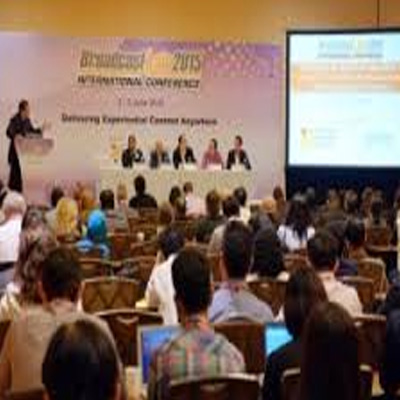
    MUMBAI: Asia’s digital multimedia and entertainment technology event, BroadcastAsia, will return to Singapore Expo from 19-22 June 2007 to showcase the latest digital technology, professional equipment and services.

    Over 800 exhibiting companies including Harris, Sennheiser, Miranda, Vizrt, Magna, Innoxius, Conax and Qualcomm will demonstrate a full spectrum of products and applications from media content creation to delivery including new technologies birthed as a result of digital convergence.

     
    Strong group participation is also expected at BroadcastAsia2007 with pavilions from Singapore , China , France , Germany , Italy , Korea , USA and UK . More than 80 per cent of the show floor has already been filled.

    This year’s BroadcastAsia will also feature a high definition (HD) studio demonstrating a full suite of high definition production workflow – from production to final content output. Industry professionals will be on hand to explain the features and processes of the studio as well as highlight the differences in quality between standard definition and HD transmissions to visitors.

     
    Over the years, BroadcastAsia has proven to be a one-stop sourcing ground for broadcasters, production and post-production companies as well as network with the industry. BroadcastAsia2007 expected to attract over 10,000 industry professionals, decision makers, vendors and buyers from 50 countries.

    Adding greater depth to event is the BroadcastAsia International Conference. In partnership with various industry organisations, the conference features a series of sessions focussing on critical industry issues and will bring greater clarity to the new technological and business opportunities within the industry.

    Addressing the “how”, “what”, “where” and “why”, the BroadcastAsia2007 International Conference will cover areas in file-based production, media production & development, digital multimedia, IPTV, content delivery to creating new opportunities.

    Calvin Koh who is the project manager for communications events with organizer Singapore Exhibition Services “This year’s conference saw over 60 representatives who responded to its call for contribution. The overwhelming response was an indication of the industry’s enthusiasm to use the conference to share and update fellow professionals”.

    Spread over a total of eight halls, BroadcastAsia, alongside with CommunicAsia, EnterpriseIT, InteractiveDME and ComputerGraphics Overdrive — will see the gathering of over 2,400 companies as they come together to demonstrate the transforming powers of digital technologies that are redefining the boundaries of traditionally-segmented telecommunications, networks, enterprise solutions and entertainment arenas.

    Reflecting the growing importance of the interactive digital media industry in Singapore , which had been identified as a key growth sector for the local economy, interactive and digitised media and entertainment content will be a highlight on the show floor.

    The convergence of media, communications and IT has dramatically changed the landscape of the media and entertainment industry, and is revolutionising the way we think, live, work and play. According to industry observers, the estimated size of the global media and entertainment industry in 2009 is expected to hit $1.78 trillion, while the Asia-Pacific market is predicted to reach $431 billion in the same period. Some ‘hot’ converged applications include digital cinema, IP TV, connected digital home devices and online gaming, amongst others.

    Some ‘hot’ converged applications that visitors can expect to see include mobile entertainment, IPTV, connected digital home devices, as well as mobile and online gaming, amongst others.

    Some of the key enabling technologies that will occupy top prominence on the show floor this year are:

    Wireless — covering 3G, HSDPA, WiMax/ WiBro, Fixed-Mobile Convergence (FMC), as well as Radio Frequency Identification (RFID) and Embedded technologies Broadcasting — covering Satellite, Digital Multimedia Broadcasting (DMB) and Digital Video Broadcasting (DVB) Digital Networks — covering Next Generation Networks (NGN), Voice over IP (VoIP) and Information Security.

    CG Overdrive will also be held alongside BroadcastAsia for the first time, to answer the growing interest in animation and demand for Asian animated content. Despite being a relatively young trade show, CG Overdrive has built a reputation as a must-see event for computer graphics and animation enthusiasts in the Asia-Pacific region.

    One of the main highlights of CG Overdrive is a knowledge-centric conference that will address topics such as character animation techniques, character modelling and production of CG cinematics for gamers. Fringe activities like digital film screenings, digital art gallery and networking parties will be staged to connect CG enthusiasts to the gurus.

  • Design and innovation unite Motorola’s announcements at 3GSM World Congress; showcasing compelling mobile experiences

    BANGALORE: Motorola, Inc. (NYSE: MOT), a global leader in wireless communications, today delivered compelling mobile experiences with a portfolio of devices and solutions that demonstrate the company’s leadership in design, music, media, high-speed performance, wireless broadband and connecting the unconnected.

    “What better place than 3GSM World Congress to show how Motorola’s latest products and services are making seamless mobility real?” said Ron Garriques, president of Motorola Mobile Devices. “This year we’ll be demonstrating wickedly cool and compelling products that are making on the go and always-on entertainment and communication a personal reality for everyone, as well as the solutions and services which enable our customers to deliver them to their consumers.”

    Goodbye low bandwidth; HELLO mobile TV

    Motorola has further defined its ‘no compromise’ commitment to quality high-speed performance with a series of new HSDPA-enabled handsets.

    The MOTORIZR™ Z8 provides quick downloads of streamed media via ultra-fast HSDPA technology. With a multimedia feature set that includes a brilliant 16 million colour 35x50mm QVGA full screen display, MOTORIZR Z8 boasts outstanding video quality playback with speeds of up to 30 frames per second.

    The unprecedented entertainment experience is brought to life via a partnership with BSkyB* which will users to access Sky’s mobile content services. As well as offering access to an on-demand library of updating news, entertainment and sports, Sky’s ‘Anytime’ application also provides an access point to Sky’s range of live mobile TV services. Anytime also allows customers to use their mobile phone to programme their Sky+ boxes remotely.?

    MOTORIZR Z8 features Motorola’s first ever “kick slider”, a graceful mechanism that achieves a “fit-to-face” profile by gliding open in a curve to match the contour of your face.

    The new MOTOKRZR™ K3** is where Motorola style meets performance. The handset features the beautiful MOTOKRZR design language, while providing a full multimedia experience through HSDPA connectivity. The MOTOKRZR K3 is a cool wireless high-speed multimedia handset, incorporating no compromise use of colour, materials and finishes.

    Goodbye Office; HELLO Liberated Lifestyle

    Motorola has expanded its award-winning MOTOQ™ platform with the new MOTO Q q9 and MOTO Q gsm — two experience-optimized QWERTYs for HSDPA and GSM/EDGE networks designed to. Delivering power, style and ease-of-use, with features and functions uniquely their own, MOTO Q q9 and MOTO Q gsm continue to evolve the mobile office experience and personalize productivity for users worldwide.

    MOTO Q q9 rounds out Motorola’s HSDPA portfolio and sets a new standard for smartphones, delivering power, richer messaging and multimedia experiences and even better basics for consumers and professionals who want it all. Operating on the new Windows Mobile 6 platform with Motorola’s Good Mobile Messaging technology, MOTO Q q9 provides easy and intuitive personal and corporate email, as well as Windows Mobile “PlaysForSure” enabling compatibility with hundreds of music and video stores worldwide. ?

    The second handset built on Motorola’s SCPL platform, MOTO Q q9 is thin, lightweight, and sophisticated with an ergonomically-optimized keyboard and five-way navigation key to enable fast, no compromises text entry. MOTO Q q9 also boasts one of the world’s smartest screen displays, automatically adjusting to produce the best visual experience, indoor or out.

    MOTO Q gsm retains all the productivity features and style of the original CDMA-based MOTOQ while adding a few new twists. MOTO Q gsm features quad-band GPRS and EDGE capabilities to deliver worldwide connectivity?, Microsoft Windows Mobile 6 software for flexibility and power, as well as a full suite of multimedia and messaging options.

    Goodbye isolation; HELLO Connectivity

    Motorola was connecting the unconnected even before we were awarded the GSM Association’s Emerging Market Handset programmes in 2005 and 2006.

    Together with the GSM Association (GSMA) and MTC Namibia, we’re announcing at 3GSM the first trial for wind and solar power systems to support the African operator’s remote GSM cell sites. Such systems provide an alternative to the main grid electricity supply or diesel driven generators in remote areas. The cell site will remain a part of MTC Namibia’s current wireless network and continue to carry the same levels of traffic.

    Goodbye four walls; Hello super-fast wireless broadband

    Motorola is delivering WIMAX today; infrastructure that delivers super-fast wireless broadband. As well as offering compelling network economics, Motorola WiMAX transforms services. And we’re showing an impressive range of engaging WiMAX experiences at 3GSM. These include: a look at the possibilities presented by advanced interactive gaming; high quality, live video conferencing between laptops and mobile devices; and true mobile WiMAX TV. Extensive multimedia and content services also promise to captivate.

    Goodbye Low Tier; HELLO MOTOMOBILE Experience

    Motorola’s mass market success is set to continue with the introduction of an expanded MOTOMOBILE portfolio. The new portfolio will bring enhanced features and a rich mobile experience to the next billion mobile users with all the style and innovation of Motorola’s higher-end devices.

    The new MOTOMOBILE portfolio now includes features such as mega-pixel camera, speakerphone, MP3 playback and video functionality, as well as Motorola’s CrystalTalk™ technology, making it easy to hold conversations in noisy environments.

    The MOTOMOBILE line up includes Motorola’s W510, offering the best in design and value with uncompromised functionality. This stylish clamshell features sleek MOTOKRZR inspired design and boasts a vibrant 262k colour TFT screen.

    Motorola also announced MOTOSLVR™ L9, merging powerful multimedia features with Motorola’s sleek MOTOSLVR form factor. MOTOSLVR L9 provides a rich visual entertainment experience via its 2.0 mega-pixel camera and full screen landscape playback as well as an integrated FM radio with a dedicated key.

    Goodbye Boredom, Hello Music for the Masses

    Motorola’s music heritage continues to bring a rich mobile music experience to consumers. As part of the portfolio, Motorola has announced MOTORIZR Z6, a multimedia masterpiece with the latest music features and a powerful digital imaging platform.

    MOTORIZR Z6 is Motorola’s first Linux-Java software based handset that incorporates Windows Media technology allowing users to sync music to their phone from over 200 music stores worldwide.?

    The handset’s dedicated music key, enhanced audio capabilities and integrated music player, with support for multiple music formats, provides a compelling music experience.

    Cutting edge Bluetooth® enabled accessories for wireless music streaming round out the music experience including the new Motorola Bluetooth Stereo Active Headphones S9, which delivers a true hands-free music experience for consumers.

    Motorola has also announced key alliances; including Warner Music Group, which will create compelling mobile scenarios on mobile devices with products such as MOTO EP (Experience Pack), a single download that contains a series of music-based products that provide a rich multimedia experience.?

    Goodbye street search; Hello mobile navigation

    Motorola has taken Bluetooth wireless technology on the road with its new Phone-based Navigation System T805 and T815 featuring MOTONAV. MOTONAV adds turn-by-turn GPS navigation to compatible Bluetooth enabled handsets4 providing exact locations, on-screen maps and turn-by-turn spoken and visual directions. The compact T805 and T815 GPS receivers fit easily in the user’s pocket and come complete with a car charger, phone holder and flexible mounting options. The T805 comes with a 12-month MOTONAV national subscription, while the T815 includes MOTONAV loaded on a memory card.

  • Global mobile content, services market to top $150 billion by 2011

    Global mobile content, services market to top $150 billion by 2011

    MUMBAI: Research firm Informa Telecoms and Media predicts that the mobile web will herald dramatic growth in revenues in the mobile content and services market.

    The global mobile content, services market is expected to top $150 billion by 2011

    Despite falling average revenues per user (Arpu) for mobile operators, the mobile content and services market will continue to grow dramatically as services and applications reach maturity and new services begin to gain traction, according to Informa Telecoms and Media. The latest edition of Informa’s Mobile Content and Services report reveals that the introduction of a whole host of new players into the value chain presents new opportunities for growth in the mobile content and services market, whilst simultaneously posing a threat to mobile operators who face losing control of the billing relationship with their customers.

    The mobile web heralds a new age: Mobile handset and network technology has now evolved to a point where true mobile web access is possible. Informa anticipates that by 2011, just under half of all mobile subscribers worldwide will use mobile browsing, a trend it sees developing with new operator offerings such as T-Mobile’s ‘Web n Walk’ service and 3’s ‘X-Series’ services. Despite this, messaging, headed by SMS will continue to dominate the overall revenues for the market, generating over half the total revenue in 2011 (from 67% in 2006).

    Informa Telecoms and Media senior analyst Daniel Winterbottom who wrote the report says, “Advanced mobile content and services have been slow to take off, but this should not be confused with the deepening relationship that we have with our mobile phones. We may not be buying as many games, full-track downloads or multimedia messages as operators would like, but we are spending a huge amount of time sending and reading text messages and organising our lives using the phone’s address book, clock, alarm and calendar functions”.

    “Over time, users will warm to other data services as well. The mobile web is a prime example: Wap failed to take off when it was first launched, but five years on, more and more users have become comfortable with accessing news or other information on their mobile phones.”

    The mobile entertainment space will also see significant innovation and development. Several technologies, such as mobile music, have been available for a number of years but the increased availability of high-speed data networks (such as 3G and HSDPA) is giving further appeal to these services. Mobile music will be a major contributor to the revenues achieved in the mobile entertainment market in the next five years, although its overall share of the market will fall from 40 per cent in 2006 to 36 per cent in 2011 as new forms of entertainment such as mobile TV and video services begin to gain consumer interest. Games, gambling, personalisation and adult content will all see significant growth, as the overall mobile entertainment market grows from US$18.84 billion in 2006 to US$38.12 billion in 2011.

    Evolving services: The report investigates a number of other areas which will see growth in the next five years:

    User-Generated Content, the big story of the Internet in 2006, will continue to extend to the mobile space as new applications begin to extend communities to users on the move, and provide further means for mobile users to contribute content whilst on the move. Informa forecasts that the user-generated and communities will be worth US$13.17 billion by 2011.

    M-Commerce faces a number of challenges and has already hit a few stumbling blocks. Whilst payments for digital content ‘on-portal’ continue to function, the growth in off-portal content and the migration to the mobile web will open up the market to other players. Google and eBay are both vying hungrily for this space. Using the mobile as a vector for physical payments, however, has proven more complex and whilst the technology, in terms of Near Field Communications chips embedded in handsets, is readily available, it has been a struggle to prove demand outside of the Far East. Informa estimates that the worldwide market for m-commerce was US$359 million in 2006, coming mostly from the Asia-Pacific region.

    Mobile TV will continue to be the focus of much excitement from mobile operators as broadcast services using a range of different technologies are rolled out across Europe. It remains to be seen if consumers will be as excited about the services, and how operators will manage the issues of advertising and pricing which will be critical to the success of the service.

    Operator strategies: The shape of the mobile content market is defining the evolution of the mobile operator as a business entity. The report investigates alternate approaches that are being taken by different operators, from those remaining ‘pure play’ mobile, diversifying into new vertical markets or business applications, to those converging into a one stop communications house. It gauges how these strategies will pan out and where each strategy is likely to take hold in different regions.

    “The arrival of the mobile web on the mobile handset over in 2007 and beyond will see users embracing the same content they take for granted on their PCs. Operators need to ensure they are firmly locked into this value chain or risk missing out on what will be an enormous market by 2011,” concluded Winterbottom.
     

  • Mobily launches 3.5G wireless technology globally

    Mobily launches 3.5G wireless technology globally

    MUMBAI: Saudi Arabia mobile operator Mobily has announced the offer of its 3G services internationally. Mobily subscribers will be able to make video calls to UAE, Italy, Hong Kong, Luxemburg and Australia using the technology of 3G or 3.5G. Mobily has just completed its own 3.5G network which covers 15 cities in Saudi Arabia, consisting more than 900 base stations.

    Subscribers will also be able to watch TV channels live on 3.5G. These include Alarabiyah channel, CNBC Arabiya channel, Saudi TV, Space Toon and others. Mobily says that it is offering a very competitive rate compared to other operators. The cost of video telephony is 0.80 halalas per minute for postpaid subscribers, whereas a minute cost one riyal when using the TV streaming. Mobily does not demand any monthly fees for all the third generation services.

    Media reports indicate that the 3.5G service will also allow for multiplayer gaming. Most of the 3.5G (HSDPA) services require 2G and 3.5G phone handsets, except for the video calling which works only on 3G handsets. One of the excellent services the 3.5G will provide is the access to the internet with 3G speed from laptop using the mobile as a modem. The setting of the internet will not be different from 2G web setting. The speed exceeds four mega per second for download.

  • KTF Korea launches nationwide Ultra-High Speed Wireless Network with LG-Norte

    KTF Korea launches nationwide Ultra-High Speed Wireless Network with LG-Norte

    MUMBAI: KTF, one of South Korea’s prominent cellular providers, has launched a next-generation ultra-high speed 3.5G wireless network in Seoul and cities across South Korea using wireless broadband technology from LG-Nortel, a joint venture of LG Electronics and Nortel.

    The network supports advanced handset capabilities including high-definition (HD) video, video chatting, messaging and remote monitoring, claims an official release.

    The new 3.5G HSDPA, handset-based service is being launched with two handset models in the initial deployment – including the first HSDPA phone from LG Electronics, the LG-KH1000. A further four to five handsets are planned later in the year. KTF’s new service is branded ‘WorldPhone View’, a name representing ‘the world at your fingertips’ through access to video and collaborative multimedia applications.

    KTF’s HSDPA mobile communications will be rolled out in 50 cities across South Korea beginning 30 June. LG-Nortel is the primary network supplier and is the exclusive vendor for 34 cities including the vast Seoul metropolitan area which alone accounts for almost 50 percent of the total population of Korea. It is estimated that 80 per cent of the country’s population will be able to access the service by the end of August 2006. A further 34 cities will be added by year-end, raising that figure to over 90 percent of the population, according to KTF estimates, the release adds.

    “The launch of our ‘WorldPhone View’ HSDPA service is a key component of KTF’s portfolio of next-generation mobile services,” says KTF EVP Won-Jin Park. “We chose LG-Nortel as the primary supplier for our UMTS/HSDPA network based on its strong technology credentials and our existing relationship. LG-Nortel has successfully implemented a world-class network which allows us to implement groundbreaking services as we enhance the mobile communications experience for all our customers.”

    “LG Nortel, with the strong support of our parent companies Nortel and LGE, has implemented a secure, reliable, high-speed network to support the innovative range of services and applications KTF is launching to its customers,” says LG-Nortel chairman on the board Peter MacKinnon. “Korea leads the world in wireless broadband and LG-Nortel plays an integral role in ensuring the continuation of that success. We will work closely with KTF on the evolution of their network to support higher uplink speeds and ever-more sophisticated service requirements in the future.”

    A key differentiator of HSDPA compared to current technologies is its ability to support high-speed, real-time HD video content. ‘WorldPhone View’ users will be able to access a variety of new services, including video SMS, video ringtone services, video chatting, video ad messaging and video remote monitoring – as well as high-quality video telephony. High-speed broadband capabilities will also enhance music downloads and high-volume multimedia collaboration and set the foundation for more sophisticated online gaming applications.

    The two HSDPA handsets being launched will also support universal integrated circuit (IC) cards, allowing access to secure transactions for transportation, membership, mobile banking and credit card services, informs the release.

  • Nortel and Qualcomm claim industry’s fastest HSDPA data call

    Nortel and Qualcomm claim industry’s fastest HSDPA data call

    MUMBAI: Nortel and Qualcomm have successfully achieved the industry’s first 7.2 Mbps HSDPA mobile data calls. The tests achieved data downloads at speeds up to four times faster than most current fixed broadband connections, companies claimed in an official release.

    According to the official communiqué, the companies completed the initial series of pre-commercial category 8 HSDPA data calls using test terminals based on Qualcomm’s Mobile Station Modem (MSM), MSM6280 solution and HSDPA network equipment from Nortel.

    The calls covered frequencies in all commercially available UMTS spectrum currently used by mobile operators throughout the world. The 2100MHz spectrum is the basis for most European 3G networks and the 850MHz spectrum is now in use for new UMTS networks in North America, the Caribbean and Latin America. As spectrum at 900MHz is expanded for UMTS services, Nortel believes this can also become an important part of European HSDPA roll out.

    “Nortel continues to be an industry leader in driving HSDPA technologies to faster, more cost-effective capabilities that will help power mobile communications to beyond 3G services such as high quality live TV and HD video on demand,” said Jean-Luc Jezouin, vice-president, GSM/UMTS product line management, Nortel. “Together with Qualcomm, Nortel is an industry pioneer in advancing the potential of HSDPA to help wireless operators maximize their existing UMTS infrastructures by offering new and faster services for subscribers.”

    HSDPA is designed to boost network capacity for data transmissions up to four times and enables twice as many wireless users per cell site compared to current UMTS networks. By making more efficient use of existing network capabilities, HSDPA helps reduce operating costs while delivering a high quality end-user experience.

    Nortel and Qualcomm will be demonstrating high-resolution video streaming enabled by HSDPA data calls at 7.2Mbps during CTIA Wireless 2006 in Las Vegas, 5 April to 7 April.