Tag: Hotstar

  • Hotstar Trends 2017: Women, small town, cross-language consumption rises

    Hotstar Trends 2017: Women, small town, cross-language consumption rises

    MUMBAI: Want to get a handle on what kind of traction that India’s answer to Amazon and Netflix –  Hotstar from Star India – is getting? Well, the OTT service has come out with an India Watch Report 2018 (IWR 2018) – just as the IPL is around the corner in a bid to pique brands’ and ad agencies’ curiosity and jiggle their memories.

    Says Novi Digital Entertainment (Hotstar)  CEO Ajit Mohan in a preface to the report: “The biggest change (between 2017 and 2016) has been how consumers are responding to the explosion in access to affordable data. Three years ago, most new data users would start with messaging, do text search, move on to social platforms and a few brave ones would watch video on the mobile network. This pyramid has been completely inverted. In a world that does not fear data charges, video is very often the first port of call for new data users. Familiar stories, whether TV shows, movies or sports, unconstrained by any language limitation, are acting as powerful triggers to light up their smartphones and their data connections.”

    The study says that Hotstar was the most downloaded video app for 2017 with a total of 325 downloads per minute totting up to an incredible 170 million downloads cumulatively. Hotstar users gobbled 3 GB data per month as compared to the average user who consumes 1.6 GB a month. Almost 90 per cent users logged on to the Hotstar app on their handsets even as there was a 6X growth in those consuming it on their connected TVs. What were they watching? 96 per cent of them gulped down videos longer than 20 minutes, thus rubbishing the long held notion that OTT users snack on short form content.

    According to IWR 2018, ViVO IPL 2017 saw a jump of 6.6 times in watch time as compared to 2016. And 70 per cent of men who consume video online were on Hotstar watching the T20 journey during its 2017 edition.

    The good news is that women are also coming online in a big way, says Hotstar. Consumption by women from smaller towns (between one and 10 lakh population) grew by three times in 2017, even as that by women in one million plus population towns and in metros doubled. The consumption growth is pretty rapid when it comes to women from places like New Barrackpore (5X), Siliguri (6.5X), Kanchipuram (5X) and Ranchi (4.7X).

    Overall watchtime is growing at an astounding clip, says the IWR in the non-metros.  In cities like Moradabad the growth was 22 times, Allahabad (13X), Hubli (12X) and Sonipat (12X).

    Hotstar notched up some other records, says  IWR 2018 – it crossed a billion minutes of watch time in a single day several times in 2017.

    Viewers cannot seem to be getting enough of the content IWR 2018 says: In 2017, cities like Delhi, Mumbai, and Pune switched off their phones at 2:37 am, 2 am and 2:35 am respectively. In Gurugram, Amritsar and Kolkata, the curfew time came out as 2:08 am, 2:15 am and 2:05 am respectively while for Bengaluru, Chennai and Hyderbad, the cutoff time was 1:59 am, 1:38 am and 1:54 am respectively. Not unexpectedly, the largest share of watchtime came from Mumbai.

    What were Hostar subs watching?

    Unsurprisingly, the nation’s most-watched genre is drama, and while West Bengal and Maharashtra can’t get enough of romance, Tamil Nadu and Delhi revel in comedy! And doing away with set notions that only women watch drama, IWR 2018 says that 50 per cent of watch time for shows such as Yeh Rishta kya Kehlata Hai was accounted for by men. Youngsters too are turning into drama with their tribe accounting for 63 per cent of watchtime of Ishqbaaaz. To add to that, Indian women accounted  for 18 per cent of watchtime of  Bahubaali 2: The Conclusion.

    The report points out that 70 per cent of premium users who watched English shows and movies also viewed other programming genres and languages. 26 per cent of Modern Family watchers tuned into cricket; 26 per cent of Game of Thrones viewers watched Hindi TV shows, and 14 per cent of premier league watchers popped up the app’s Bengali TV shows.

    The Champions Trophy final between India and Pakistan 2017 resulted in it – at 113 million views – emerging as one of the most globally watched online videos in the shortest span, that is eight hours.  That same nail-biting final saw 4.8 million simultaneous viewers making it the event with the highest concurrency seen in APAC.

    And the viewing of one day internationals saw a spurt of five times in 2017 vs 2016.

    Which sports are gaining popularity in India?

    The IWR 2018 says football is India’s second most loved sport and grew massively with watch time for the ISL rising 3.5 times and for the Premier League by 10 times. The Vivo Pro Kabaddi League saw its watch time skyrocketing nine times over 2016.

    The crown of the most watched show in 2017, according to IWR 2018, goes to the Rajan Shahi produced Yeh Rishta Kya Kehalata Hai. No surprises in the English show category with Game of Thrones emerging on top, and Big Boss Tamil and Telugu reigning in their respective languages.

    Also Read :

    Video Lighting up Data and Smartphones, Says Hotstar

    Hotstar announces partnership with awesomeness

    Leaving a Job is never easy, Hotstar gives you the best ways to #QuitInStyle
  • SonyLIV doubles MAUs to 15.6mn in Feb: App Annie report

    SonyLIV doubles MAUs to 15.6mn in Feb: App Annie report

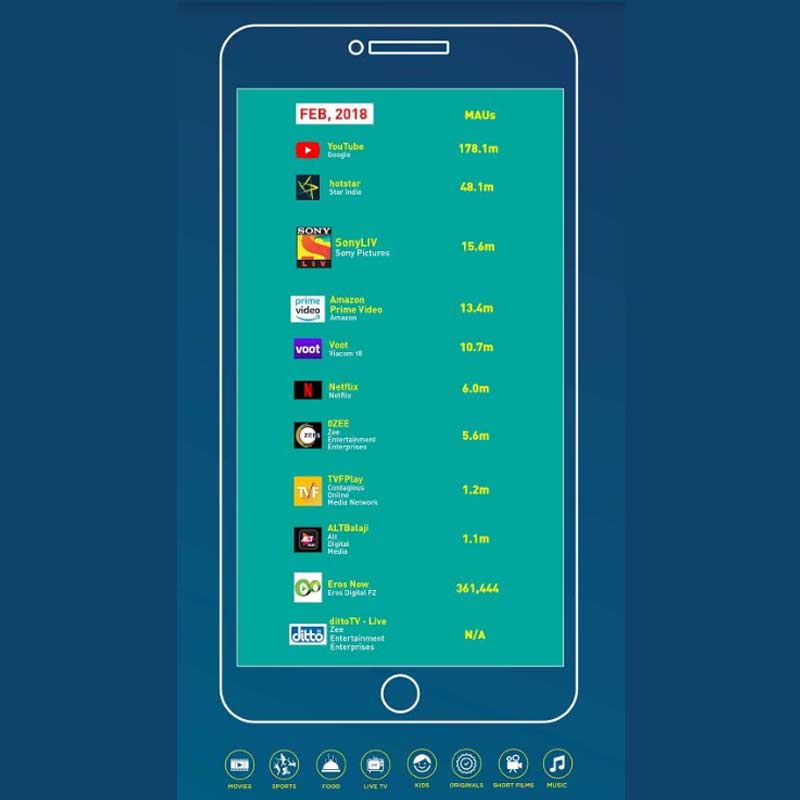
    MUMBAI: SonyLIV continued to reign the online pie by grabbing more eyeballs in the month of February. It added 7.9 million monthly active users (MAUs) in its kitty. The platform has doubled its base within a month from 7.7 million MAUs to 15.6 million MAUs and has stomped to the third position from fifth last month (January), according to App Annie data report. This ranking is a combination of iOS App Store and Google Play Store.

    According to the report, YouTube is on the top of all digital platforms with 178.1 million MAUs, followed by Hotstar at 48.1 million MAUs. Amazon Prime Video was in the fourth position with 13.4 million active users. Voot garnered the fifth position with a total of 10.7 million active users overall. The international giant Netflix had 6 million active users and stood at the sixth position. The latest OTT player, Zee5, has left a remarkable mark on the audience within a month of its launch by successfully engaging 5.6 million users on its platform.

    Though SonyLIV has an array of web series, movies, sports, catch up TV shows, music and more, the credit to increase in the viewership clearly goes to the recent India-South Africa cricket series streamed during February.

    App Annie is an app market data and insights company headquartered in San Francisco, California. App Annie focuses on the state of video streaming apps in Asia-Pacific region including emerging markets such as India, China and Thailand, among others.

    Also Read:

    Localised content the way forward for Netflix in India

    2017: The year OTTs went regional in India

    Regional OTT content more than just catch-up TV    

    Indians among top commute streamers for Netflix

  • IPL gets 34 major brands on board this season

    IPL gets 34 major brands on board this season

    MUMBAI: Vivo IPL 2018 has already attracted a phenomenal bouquet of leading brands in the run up to the 11th edition of the T20 league. So far, as many as 34 brands have come on board the Star Network.

    Brands such as Jio, AMFI, Asian Paints, Berger Paints, Blue Star, Ceat Tyres, Crompton, Dollar, Domino’s, Ford, Haier, Luminous, Pidilite, Sleep Well, Vanessa, Vimal Pan Masala and Voltas have joined existing ones like Vivo, Colgate, Amul, Coca-Cola, Dream 11, Elica, Kent, MakeMyTrip, Parle Agro, Parle Products, Polycab and Vu TV, among others, to take the roster of brands for Vivo IPL 2018 to 34.

    Star Sports EVP and head of ad sales Anil Jayaraj says, “Brands are actively choosing Vivo IPL as the marketing vehicle to deliver their business ambitions in 2018 as they have a single media property which can appeal to demographics across geographies. All brands that have come in so far have chosen to up their investments significantly over past years and this is because of their belief in the delivery of the combined power of TV as well as digital. These brands will get to leverage the power of multiple screens, multiple languages and broaden their reach and engagement like never before.”

    Out of these, the co-presenting sponsors are Vivo, Coca-Cola and Jio and the associate sponsors are Polycab, Parle Products, AMFI, Make Amy Trip, Vimal Pan Masala and Asian Paints, Dream 11.

    While IPL has grown each year since its inception, Star India promises 2018 to be an inflection point in its history with its reimagining of the tournament making it deeply local with technology at the heart of the experience.

    For the first time, Vivo IPL 2018 proposes to connect with Indians in six various language-six different languages, Hindi, English, Tamil, Telugu, Kannada, and Bengali. By leveraging the combined reach of digital and television, the tournament will be broadcast, for the first time ever, on multiple TV channels and live streamed on Hotstar with an aim to reach out to 700 million fans across TV and digital in India. 

    This will be one of the first few leagues in the world which proposes to use virtual reality and to bring live action from the stadium to fan homes. This immersive VR experience would make it possible for fans to come closer to the high-octane matches from the comfort of their homes. 

    Along with dedicated language feeds, the network also proposes to have a superfan feed available across cable, DTH and on Hotstar. This will be a curated feed for intense fans who want more than just to watch the game. It may also include features like multiple camera angle options while viewing and data layers about the teams and players during the telecast.

    Also Read:

    Dsport not in the running for BCCI’s media rights

    JSW acquires 50% stake in Delhi Daredevils

    IPL 2018: Team sponsorship deals may see an uptick

    Star unveils Re.Imagine Awards for IPL ad campaigns

  • Only 3% of Indian households paid subs of SVoD services: Global study

    Only 3% of Indian households paid subs of SVoD services: Global study

    NEW DELHI: Ground data doesn’t match the hype around streaming video services in India. Only three per cent of Indian households are paid subscribers of such services, while the corresponding figure for the US is 59 per cent, according to a new global market study released recently that was done over 2017.

    The number of households worldwide, which pay for various streaming video services such as Netflix and Amazon, has now breached the 250 million mark, research from Boston-based Strategy Analytics’ TV and Media Strategies service indicates.

    The report, Home Video and OTT Video Forecast – Global, predicts that the number of homes paying for subscriptions to streaming video services will reach nearly 300 million by the end of 2018 and more than 450 million by 2022.

    Interestingly, in China the percentage of paying households of video streaming services is not very high if the population and size of the market are taken into account. The Chinese figure is 12 per cent, while Japan (29 per cent) is the only Asian country to find a mention in the top-10 list. Smaller countries such as Norway (46 per cent) and Sweden (45 per cent) have a higher percentage of paying households.

    Some of the other key findings from the research include the following:

    ∙         Average monthly household spending on streaming video services increased by 5 per cent in 2017 to $9.46.

    ∙         The total number of streaming video subscriptions reached 345 million by the end of 2017.

    ∙         Households paying for streaming video services used on average 1.39 services.

    ∙         The US has the highest penetration of streaming video services, with 59 per cent of households using at least one service at the end of 2017.

    Percentage of Households Paying for Streaming Video Services, Dec 2017

    public://list_6.jpg

    Source: Strategy Analytics’ Media Strategies Group, Feb 2018

    “Streaming video is rapidly becoming a normal part of people’s entertainment options,” TV & Media Strategies director Michael Goodman said in a statement put out on 28 February 2018.

    According to him, “Usage is already at around half of households in the most mature markets and is likely to reach those levels in many other countries in the near future. Clearly, market leaders like Netflix and Amazon will benefit from this trend, but there are also major opportunities for media companies, which currently focus on more traditional pay TV and content development business models.”

    In this research, according to an official statement, pay-TV-like services such as NowTV and DirecTV Now were not included. Major services analysed included Netflix, Amazon Prime Video, Hotstar, IVI.ru, Hulu, Viu and iFlix.

    Though the research did not specify it, but observers of Indian media and entertainment sector explained the low percentage of paid subscribers for streaming or OTT services could be because India has always been a price sensitive market for entertainment services. And, most homegrown OTT platforms’ services are only partially or not at all behind a paywall.

    ALSO READ:

    Indian online video to grow to US 1.6 bn at 35 percent CAGR by 2022

    Indian pay-TV expanding by 10.6 pc, 77 pc to be digitised, ARPUs to rise by ’22: MPA

    MPA: India & China power APAC ad rev, ads in largest medium TV still robust

  • Localised content the way forward for Netflix in India

    Localised content the way forward for Netflix in India

    MUMBAI: Global to local seems to be the key strategy of Netflix to spread its wings in India. ‘Netflix and Chill’ is the popular term across the OTT ecosystem but the number of Indian consumers chilling with Netflix’s high-quality content dwarfs in comparison to users in other markets. However, it is adapting to Indian tastes and modifying its pure international content line-up. Will this shift drive the growth for Netflix?

    Netflix launched in India in January 2016 and has since created a niche for itself for high-quality TV series and Hollywood movie content for the English-speaking audience in the country but it is far behind other OTT players in terms of subscribers. Currently, it is the fifth largest player in India, behind players such as Hotstar, Voot and Amazon, according to the Counterpoint Technology Market Research report.

    With the rollout of 4G internet services by the top telecom providers, especially Reliance Jio, streaming in India has taken a giant leap forward. In the year 2017, Netflix acquired more subscribers than local cable connections in the US (according to data from Statista and Leichtman Research Group). However, even after spending two years in India, things aren’t quite as rosy for the company as in the US. On average, the Indian consumer would spend around $32 dollar (close to Rs 2200) per year on entertainment, whereas in the US, people spend around $2260 (close to Rs 1.5 lakh) annually, according to global entertainment and media outlook 2017-2021 report by PWC.

    How does Netflix aim to take over the minds of India when cable connections give you 100-150 channels at just Rs 1100-200? Netflix subscriptions can vary from Rs 500-800 a month. An annual plan can range from Rs 6000-9600.

    Netflix CEO Reed Hastings believes that the amount that an Indian consumer pays for cable services, on a global level, is very low, which keeps the industry smaller than it should be. Speaking at an event, he had said that Netflix’s strategy is to build up local and global content. Though he admitted that Netflix’s rates were higher than cable TV, they were significantly lower than movie tickets and other entertainment experiences. Hastings is aligning the OTT player as competition to the bigger entertainment options and not the idiot box.

    So far, Netflix has focussed on pushing its global content such as House of Cards, Orange is the New Black, Master of None, Stranger Things, Narcos and Daredevil to Indian subscribers. While it has made significant progress in adding regional content, it still has a lot of ground to make up.

    Now, Netflix sees a potential of adding a massive 100 million Indian customers. According to Hastings, Netflix has around 120 million subscribers in over 190 countries who consume over 140 million hours of TV shows and movies per day, and about 60 million are from the US. However, in the price sensitive market of India, Netflix banks on close to 1.5 million subscribers.

    How does Netflix aim to break the ice? The answer is local content. Hence, instead of price, Hasting suggested that Netflix wants to be sensitive to great local stories and content and be able to invest in them. So, the strategy will be to build up the local content that includes regional stories as well.

    But will producing local content be enough for Netflix to chill in India? Commenting on the same, PwC partner & leader, media & entertainment Frank D’Souza says, “Growing smartphone and internet penetration across the country has created a wide range of opportunities for OTT players. Focus on creating and producing regional content should be of utmost importance considering the fact that India is a multilingual country. A ‘one size fits all’ approach would not work for the country with over 22 official languages.”

    OTT platforms have realised the power that regional content has over the dissected Indian audiences. Amazon Prime was one of the first to take the plunge followed by Zee5, Hotstar, ALTBalaji, Voot, Viu etc.

    Netflix recently announced three Indian original productions Ghoul, Leila and Crocodile apart from four productions already under works which include Sacred Games, Selection Day, Again, and Bard of Blood. On Valentine’s Day, Netflix released its first India original Love Per Square Foot by Ronnie Screwvala.

    Where the platform is likely to get cold feet is in growing in tier II and III cities and the rural audiences. Commenting on the same, D’Souza says, “These are price sensitive segments of the Indian market. Considering the fact that OTT requires one to incur additional costs like that of internet subscription, it is important for players such as Netflix to have value added services or bundled services to penetrate these markets. Tying up with internet service providers and telecom operators in rural markets would give them an early mover advantage.”

    Netflix has one more interesting feature to bet on—sharing the subscription package among people. Many networks limit the number of people who can watch programming at the same time. Netflix allows two to four simultaneous streams per subscription, depending on the plan, and charges more for the higher number of streams. So, the premium plan can be shared among four people or in a family of four.

    By focussing on producing more local content from India, Netflix is betting on product over pricing when it comes to adding the next 100 million users. As a part of its future strategies, it should create movies and TV shows that Indians will be ready to die for while also keeping in mind the various languages.

    Also Read :

    2017: The year OTTs went regional in India

    Regional OTT content more than just catch-up TV    

    Indians among top commute streamers for Netflix

    Amazon strikes the balance between bingeing and episodic with ‘Breathe’

  • Video Lighting up Data and Smartphones, Says Hotstar

    Video Lighting up Data and Smartphones, Says Hotstar

    MUMBAI: Releasing the first India Watch Report 2018, Hotstar, India’s leading premium streaming platform, today shared insights on the dramatic transformation sweeping the Internet landscape in India. In a first of its kind report for any streaming platform in the world, the service has disclosed usage patterns on its platform.

    The big news? Nearly 5 times growth in video consumption in the last 12 months, with 96 percent of all usage being focused on long form video. This marks an inflexion point in India where the early years of online video were characterized by short form consumption from users deeply fearful of data charges. The last 12 months have also seen access to data and consumption of video go deeper into inner India. The report shared that growth in smaller cities, less than 10 lakh in population, outstripped that in the large metros. And, while the gender gap in access to data persists, affordability is opening up new opportunities for women, with women in smaller cities coming online faster than in the metros.

    Speaking about the report, Ajit Mohan, CEO, Hotstar said, “A new generation of users are emerging in India who take for granted round the clock access to the best stories; who know that they can watch the best shows from around the world at the same time as the world (and sometimes way ahead of most of the world); who do not worry about being forced to skip their team’s weekend football games because they are not at home in front of their television; and who have the implicit faith that all breaking news will reach them without any effort on their part.”

    Other highlights from the report:

    · Streaming video has hit critical momentum. The Champion’s Trophy Final 2017 on Hotstar hit 4.8 million simultaneous viewers, a record!

    ·Streaming habits have gone well beyond being ‘snacky’ time fillers. More and more users are treating the mobile as their first screen.

    · Streamers don’t follow stereotypes. Data reveals that consumption habits cut across stereotypes and traditional boundaries. 26% of Game of Thrones viewers also watched Hindi TV shows; 24% of Modern Family viewers watched cricket; and 50% of watch time of Star Plus’s show Yeh Rishta Kya Kehlata Hai, came from men.

    ·While cricket still rules the roost, other sports are sprouting well. VIVO IPL consumption grew nearly 7 times between 2016 and 2017. However, VIVO Pro Kabbadi and Premier League also grew nearly 10 times.

  • Amazon strikes the balance between bingeing and episodic with ‘Breathe’

    Amazon strikes the balance between bingeing and episodic with ‘Breathe’

    MUMBAI: Edgy and fresh, web content has made its mark in India, breaking free from staid television formats and rules. No time frames, no censorship issues, and women don’t turn into snakes. The west has been bingeing on shows on the internet for long, whereas India has just woken up to the concept recently, thanks to better connectivity and high-resolution video streaming. But, has launching all the episodes, together, caught on as a trend? The answer is both yes and no.

    One of the most talked about series under binge watching section is Amazon Prime Video’s first India original Inside Edge. The Bollywood-cricket web series garnered a tremendous buzz before and after its launch. The most amusing thing is the staggering figure of Rs 40 crore spent by Amazon on the show, speculated as half of it for marketing and the rest for production.

    Amazon Prime Video India director content Vijay Subramaniam said, “When we launched a little over a year ago, we realised there is a clear expectation and desire from our customers to have access to gripping storytelling, high-quality and compelling content. With the customer being at the center of everything we do, we are committed to bringing the best of content for our audiences, supported by immensely talented content creators matched by the most innovative ways to bring them to our audiences.”

    However, Amazon Prime, while releasing its second India original, Breathe, experimented with a new strategy where half the series can be binge-watched and for the rest, you have to wait a week for every new release. The first four episodes of the series were out on 26 January and the remaining four will release every Friday until 23 February. Being a thriller, the strategy is to leave viewers in suspense at a certain point.

    The marketing budget to promote Breathe is around Rs 20 crore. Amazon rolled out a robust, 360-degree campaign across India including highly engaging TVCs, print, digital, cinema, mobile, outdoor campaigns and activations for Breathe. Subramaniam called it a ‘path-breaking digital content in India’. Amazon is tight-lipped about the marketing plan for the last episode.

    Interestingly, India beats the rest of the world in binge watching a series. 71 per cent Indians in 2017 watched more entertainment in a public place than year 2016, according to the study released by Netflix. It was one of the first platforms to start the concept of releasing all episodes at one time for binge watching and others like ALTBalaji, VB on the Web, Voot, SonyLiv etc, followed suit.

    Binge watching has found popularity because Indians are alien to the idea of waiting a whole week for the next episode. They are ready to gulp their favourite series back to back, a trend that rose from the daily saas-bahu serials on TV too. Some OTT players allow paid subscribers to binge watch and unpaid ones have to wait a week. Viu released Spotlight 2 for binge watching, whereas all other series are released on weekly basis.

    SurveyMonkey found that 52 per cent Indians binge watch most at cafes and restaurants, and 37 per cent in waiting in line. Indians binge watch in parks, on the way to work, while shopping and at the gym. The study says that Indians took three days to devour an entire TV series on average, while the global average is four days.

    But the weekly episodic trend is also catching up. Since 2011, YouTube has worked with regional studios to help them get a wider distribution. In 2014, content creators from Mumbai including The Viral Fever (TVF) and AIB were making waves on YouTube and gaining traction while releasing episodes on weekly basis. TVF is said to be the pioneer of Indian web series and still release episodes on a weekly basis on their app TVF Play.

    Despite the fact that binge watching or releasing all episodes at one go attracts more audiences, Amazon took a risk with Breathe. Although, releasing shows in parts have the chances and risk to lose the viewership but weekly releases enable the audiences to keep guessing. Which side will platforms sway in the near future will be an interesting scene to look out for.

    Also Read :

    Amazon Prime Video announces a new original series, Skulls and Roses

    Regional OTT content more than just catch-up TV    

    2017: The year OTTs went regional in India


  • Airtel picks Hotstar content for its customers

    Airtel picks Hotstar content for its customers

    MUMBAI: Bharti Airtel and Hotstar have announced a strategic partnership to bring digital content from the latter’s portfolio to Airtel customers. This will further expand Airtel TV app’s wide range of offerings and expand the footprint for Hotstar’s content across Airtel’s large mobile customer base.   

    Commenting on the partnership, Hotstar CEO Ajit Mohan added, “Airtel has among the widest consumer footprints in India and with our expansive content library, comprising rich programming that can cater across age groups, geographies and interests, there are natural synergies and we are very excited about this partnership.”

    Wynk CEO Sameer Batra said, “We are delighted to have Hotstar onboard as a long term partner in our endeavour to build a world-class digital content ecosystem. Their rich content library will add immense value to our content play and add to the user experience. Airtel TV’s new version has received an extremely positive response from users and we will continue to bring exciting content and in-app innovations to delight them.”

    With the new partnership, Airtel TV now has access to one of the largest and most exciting digital content portfolios in India, with 350 plus Live TV channels and close to 10,000 popular movies and shows from India and abroad. Airtel has forged partnerships with all leading broadcasters and production houses to bring the best of content on a single platform and offer a compelling experience to customers.

    Hotstar’s library comprising over 100,000 hours of content, in nine languages will now be available to all Airtel customers for free through the Airtel TV app. This will include shows from 22 channels and over 3000 hit movies and shows.   

    All content on Airtel TV app is free for Airtel prepaid and postpaid customers on a promotional basis till June 2018.

    Also Read:

    BTVI to now bring live budget updates on Hotstar

    Airtel Digital TV revenue, PAT and EBITDA up in Q3 2018

  • VIVO IPL 2018 player auction clocks 5X viewership

    VIVO IPL 2018 player auction clocks 5X viewership

    As VIVO IPL 2018 fever gathers momentum, the player auction for the season witnessed record viewership numbers on Hotstar, India’s largest premium streaming platform.  The highly anticipated event – a potent mix of famous team owners, and bids for the world’s best loved cricketers – registered record numbers on the platform with a 5X increase in viewership compared to the previous season.

    While IPL has grown each year since its inception, 2018 promises to be an inflection point in its history as Hotstar and Star Sports reimagine it into a 6-month extravaganza, with technology at the heart of the experience.

    With the intent to be the singular destination for all things IPL, Hotstar also today announced plans to roll out the fastest cricket scorecard in the country – with load time under 0.5 seconds. The new scorecard unit will be available to all Hotstar users when they open the app.

    The seemingly simple feature packs in complex coding under the hood to provide the live score, with zero lag, to over 250 million varied devices across the country. With the fastest load time compared to any other cricket score feed, the feature is designed to minimize friction for the user, completely eliminating the need to search for the score anywhere else. The feature will be rolled out with the first Vivo IPL match on 6 April 2018.

  • IPL 2018 gets a makeover with Star India

    IPL 2018 gets a makeover with Star India

    MUMBAI: IPL 2018 not only has a new destination channel but has changes that have been requested and accepted for the first time.

    It all started in September 2017 when Star India won the global IPL media rights for Rs 16,347 crore for the span of five years (2018-22). This is the first time when both the TV and digital rights are with a single broadcaster, which will result in the simulcast of the game without the groaning five-minute delay.

    For the first time, IPL will be live on 10 channels and Hotstar. On the digital platform, VR will be a key differentiator and will possibly help Hotstar to keep the fans glued on to it.

    For the previous seasons, Sony Pictures Network was airing IPL in two languages Hindi and English on Sony Six, Sony Max and their HD feeds. But Star is planning to telecast it in six different languages English, Hindi, Tamil, Telugu, Bengali and Kannada. The Kannada channel was still in the works some weeks ago.

    Star India recently managed to convince the IPL governing council (GC) to change the timings for the games of the league being held from 7 April to 27 May 2018. The 8 pm game will now begin at 7 pm while the 4 pm game has been pushed forward to 5:30 pm.

    Mumbai Indians co-owner Akash Ambani said that the time change will impact the team. “For us it is tough. Because people of Bombay work till 6:30-7 pm. It’s going to be impossible making it to a game at 7 pm. You are impacting the revenue. You are impacting the audience coming there. So we are objecting to that,” he said to Cricbuzz.com.

    IPL chairman Rajeev Shukla told Indiantelevision.com, “We have received the letter from Mumbai Indians. We haven’t taken any decision yet and it will be confirmed shortly.” But a week ago he confirmed to Indiantelevision.com that the timings have been changed.

    IPL 2018 will see mid-season transfer after seven games. The players who were not included in the playing 11 can opt for their mid-season transfer to other franchisees.

    The IPL GC announced that each IPL franchise can retain a maximum of five players from their respective current squads. Of the five players, a franchise can retain a maximum of three players through retention in lead up to the auction, and a maximum of three players through the right-to-match card during the auction. The other restrictions on player retention are: a maximum of three capped Indian players can be retained, and only two overseas players and two uncapped Indian players can be retained. For the first time, the player retention event was aired on TV and digital. The event was watched by 8.1 million people across the country.

    The salary cap for each team for the 2018 season has been increased from Rs 66 crore to Rs 80 crore (approximately $12.4 million). A franchise will be allowed to spend only Rs 33 crore on retentions ahead of the 2018 IPL auction, leaving it with just Rs 47 crore to spend at the auction.

    The Information and Broadcasting (I&B) Ministry is working on a proposal to make IPL available on Doordarshan and has asked the Sports Ministry to weigh in on the matter.

    The move will mean that Star India will have to share the live feed of the tournament with public broadcaster Prasar Bharati under the Sports Broadcasting Signals (Mandatory Sharing with Prasar Bharati) Act, 2007. Prasar Bharati runs Doordarshan and All India Radio. For this IPL will have to be categorised as a tournament of national importance at par with events like Olympics, Commonwealth Games and Wimbledon.

    Star India, for the first time, has also thought of starting international fan parks for the IPL and cricket lovers around the globe. Fan Parks were launched in 2015, initially in 16 cities. The 2017 edition of the Fan Park was held in 36 cities in 21 states, bringing fans across the length and breadth of India closer to their beloved sport. These included 14 new cities, like Bhubaneswar, Bareilly, Kochi, Ludhiana, Tumkur and Nagercoil which hosted the Fan Park for the first time.

    For the first time, fans were given a chance to vote for their favourite players on vivoiplelection.hotstar.com as a part of the ‘Election se Selection’ campaign on the network. The campaign, according to Star India MD Sanjay Gupta, received more than one lakh votes in less than 12 hours of its launch. Ajinkya Rahane and Krunal Pandya emerged as fan favourites after the final voting count before the auctions.

    Also read:

    Star ushers in IPL’s new era with a bang

    IPL auction: Gayle to play for KXIP, Unadkat most expensive Indian player

    Star India gets IPL to change match timings for 11th edition