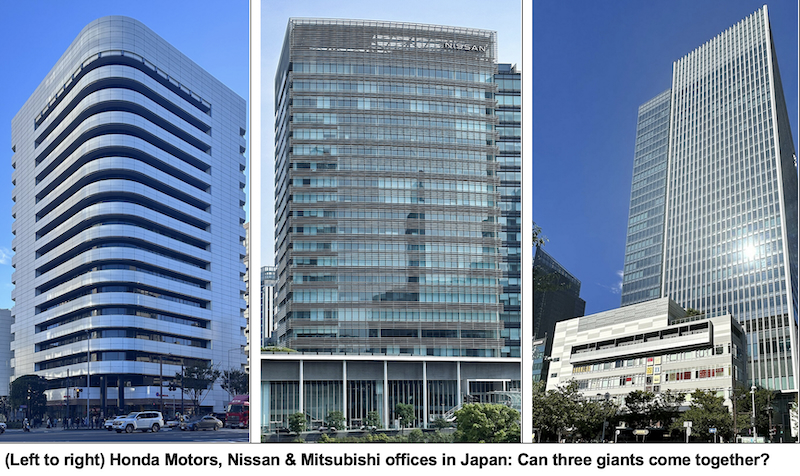
Tag: Honda Motors

  • How Japan’s Honda, Nissan & Mitsubishi are thinking big – really BIG!

    How Japan’s Honda, Nissan & Mitsubishi are thinking big – really BIG!

    MUMBAI: Can three major Japanese brands -otherwise tough competitors – integrate their business operations and operate under a single joint holding company? 

    That’s a possibility that auto makers Honda, Nissan and Mitsubishi Motors are considering.

    On 23 December Honda and Nissan announced that they were expanding their memorandum of understanding (MoU) they had signed in March  2024 and then in August 2024 into one which involved a deeper relationship. And they announced that Mitsubishi had decided to throw its hat into the ring and consider being part of the alliance. 
    .
    The 15 March MoU between Honda and Nissan related to a  strategic partnership for the era of vehicle intelligence and electrification. The 1 August agreement, was extended to include joint research in fundamental technologies in the area of platforms for next-generation software-defined vehicles (SDVs), particularly in the areas crucial for intelligence and electrification, to advance focused discussions toward more concrete collaboration. 

    The MoU between Nissan and Honda announced on 23 December  is about the two of them integrating their business operations and coming under a joint holding company aimed to serve as an option to maintain global competitiveness and for the two of them to continue to deliver more attractive products and services to customers worldwide.If the business integration can be realised, the two can aim to integrate their respective management resources such as knowledge, human resources, and technologies; create deeper synergies; enhance the ability to respond to market changes; and expect to improve mid- to long-term corporate value, said a press release.

    Japanese ccaars

    Additionally, Nissan and Honda can aim to further contribute to the development of Japan’s industrial base as a “leading global mobility company” by integrating Nissan and Honda’s four-wheel-vehicle and Honda’s motorcycle and power products businesses, enabling the brands of both companies to become more attractive and to deliver more attractive and innovative products and services to customers worldwide

    The two companies also announced that they had  signed another MoU with Mitsubishi to explore the possibility of its participation, involvement, and synergy sharing in the joint holding company. The  three companies have agreed to explore the possibility of achieving synergies at an increased level through Mitsubishi’s participation or involvement in the business integration. Mitsubishi Motors aims to reach a decision on its inclusion in the arrangement by the end of January 2025. 

    In the interim, Nissan and Honda said that they would be establishing an integration preparatory committee to facilitate a smooth integration and will conduct focused discussions. Based on the committee’s discussions, as well as the results of due diligence, the companies will examine and analyse more specific synergies. By promptly realising the synergies from the integration, Nissan and Honda can aim to become a world-class mobility company with sales revenue exceeding 30 trillion yen and operating profit of more than 3 trillion yen, said the press release. 

    The synergies they are expecting to benefit from include:

    * scale advantages by standardising vehicle platforms, 
    * enhancement of development capabilities and cost synergies through the integration of R&D functions, 
    * Optimizing manufacturing systems and facilities, 
    * Strengthening competitive advantages across the supply chain through the integration of purchasing functions,  
    * realizing cost synergies through operational efficiency improvements, 
    * Acquisition of scale advantages through integration in sales finance functions, 
    * Establishment of a talent foundation for intelligence and electrification
     

    Nissan director, president, CEO & representative executive officer Makoto Uchida said: “Honda and Nissan have begun considering a business integration, and will study the creation of significant synergies between the two companies in a wide range of fields.  It marks a pivotal moment as we begin discussions on business integration that has the potential to shape our future. If realised, I believe that by uniting the strengths of both companies, we can deliver unparalleled value to customers worldwide who appreciate our respective brands. Together, we can create a unique way for them to enjoy cars that neither company could achieve alone It is significant that Nissan’s partner, Mitsubishi Motors, is also involved in these discussions. We anticipate that if this integration comes to fruition, we will be able to deliver even greater value to a wider customer base.“
     

    Honda director & representative executive officer Toshihiro Mibe said: “Creation of new mobility value by bringing together the resources including knowledge, talents, and technologies that Honda and Nissan have been developing over the long years is essential to overcome challenging environmental shifts that the auto industry is facing. Honda and Nissan are two companies with distinctive strengths. We are still at the stage of starting our review, and we have not decided on a business integration yet, but in order to find a direction for the possibility of business integration by the end of January 2025, we strive to be the one and only leading company that creates new mobility value through chemical reaction that can only be driven through synthesis of the two teams At this time of change in the automobile industry, which is said to occur once every 100 years, we hope that Mitsubishi Motors’ participation in the business integration discussions of Nissan and Honda will lead to further social change, and that we will be able to become a leading company in creating new value in mobility through business integration. Nissan and Honda will start the discussion from today onwards with an aim to clarify the possibility of business integration by around the end of January in line with the consideration of Mitsubishi Motors.”

    Mitsubishi Motors director, representative executive officer & president and CEO Takao Kato said: “In an era of change in the automotive industry, the study between Nissan and Honda about a business integration will accelerate synergy maximization effects, bringing high value also to the collaborative businesses with Mitsubishi Motors. In order to realize synergies and to make the best use of each company’s strengths, we will also study the best form of cooperation.”

    Even if Mitsubishi decides to opt out of the mega plan, Nissan and Honda, said that they  intend  to establish, through a joint share transfer, a joint holding company that will be the parent company of both companies. This will be subject to approval at each company’s general meeting of shareholders and obtaining necessary approvals from relevant authorities for this business integration, based on the premise that Nissan’s turnaround actions are steadily executed. Both Nissan and Honda will be fully owned subsidiaries of the joint holding company.  Additionally, the companies plan to continue coexisting and developing the brands held by Honda and Nissan equally.

    schedule for biz integration

    This is broadly what the MoU between Nissan and Honda entails:
    * Shares of the newly established joint holding company under consideration are planned to be newly listed (technical listing) on the prime market of the Tokyo stock exchange (“TSE”). The listing is scheduled for August 2026.
    * With the listing of the joint holding company, both Nissan and Honda will become wholly owned subsidiaries of the joint holding company and will be scheduled to be delisted from the TSE. However, shareholders of both companies will continue to be able to trade shares of the joint holding company issued during this share transfer on the TSE.
    * The listing date of the joint holding company and the delisting date of both Nissan and Honda will be determined in accordance with the regulations of the TSE.
    * Regarding the organisational structure of the joint holding company, and both companies which will become wholly-owned subsidiaries of the joint holding company after the business integration, the optimal structure for realising synergies, including the integration of R&D functions, purchasing functions, and manufacturing functions, will be discussed and considered within the integration preparatory committee, with the aim of establishing an organisational structure that enables efficient and highly competitive business operations after the business integration.

  • HUL made to withdraw Pepsodent, Dove Hair ads

    MUMBAI: Advertising watchdog Advertising Standards Council of India (ASCI) has made FMCG major Hindustan Unilever to pull out two advertisements — Pepsodent Expert Protection Toothpaste and Dove Hair Fall Rescue Treatment – for breaching ASCI code.

    The withdrawal of the advertisements was done after ASCI‘s Consumer complaints Council upheld complaints against them. The complainant had pointed out that the Pepsodent TVC claimed “for effective cleaning in between teeth, we should use dental floss”. The TVC further claimed that Pepsodent Expert Protection toothpaste “contains germi-paste, floss-like inter dental action and long lasting freshening mouthwash”.

    These claims with regard to dental floss imply that instead of using dental floss consumers should use Pepsodent Expert Protection toothpaste. Also, this goes contrary to dentists‘ advice that one should use dental floss for effective cleaning in between teeth. The advertisement contravened Chapter I.1 of the Code.

    In the ad of Dove Hair Fall Rescue Treatment, the TVC claimed that, unlike other shampoos, Dove‘s rescue treatment nourishes hair and makes the roots strong in just two weeks. The council considered the technical data provided by the advertiser and concluded that the claims were not substantiated and it again contravened Chapter I.1 of the Code.

    The council also upheld complaints against 15 out of the 22 advertisements which were objected to during September 2012.

    In August too, the council had upheld complaints against two of HUL‘s ads promoting Rin detergent powder and Pepsodent Germicheck Magnet.

    Most of the ads found to be contravening the ASCI code continue to be from education, healthcare and FMCG sectors.

    In September, the council rejected complaints against seven advertisements.

    The other complaint upheld was against Panasonic India‘s print ads claiming that the Panasonic inverter saved up to 40 per cent energy, Panasonic Econavi saved up to 10 per cent energy and Panasonic Refrigerators have International safety standards, that they are Vitamin-safe (preserve vitamins) and Ag clean (non-stop air purification, kills 99.9 per cent bacteria). The complainant said the advertiser needed to provide all necessary data to prove these claims. In the absence of scientific studies from the advertiser, the council concluded that the claims made in the advertisement and cited in the complaint were not substantiated. The advertisement contravened chapter I.1 of the code, the council ruled and upheld the complaint.

    The complaint against Ultratech India‘s 18 Again Vaginal & Rejuvenating Gel too was upheld. As per the complaint, the print advertisement claims that, “it removes dry cells from vagina and replaces them with new cells”, “improves blood circulation”, “makes the vagina less vulnerable to infections”. The council concluded that whilst the advertiser provided the license approval given by the state FDA, in the absence of clinical studies, the claims made in the ad and cited in the complaint were not substantiated.

    Kimberly-Clark Lever‘s Huggies Total Protection Diapers‘ TVC claimed that, “The New diaper from Huggies is clinically proven”. The pack claims, “Clinically proven to help prevent diaper rash”. According to the complainant, the TVC claim and the pack claim misleads the consumers into believing that a proper clinical test has been conducted on Huggies Total Protection diaper whereas in reality there is no clinical data on Huggies to support the claims. The claim, “Huggies clinically proven” is a very broad claim and covers all the variants of Huggies. The super in the TVC did not comply with the guidelines laid down by ASCI. Also the super is blurred and illegible from a consumer point of view. The advertisement contravened Chapter I.4 of the ASCI Code as the “clinically proven” claim was neither representative nor adequately relevant given that testing was carried out in a different country with different climatic conditions and for a different product variant of the brand. This complaint was thus upheld. The supers that appeared in the TVC were also not clearly legible thus contravening the regulations of ASCI‘s minimum lettering size of supers. This complaint was also upheld.

    Among educational institutions, there were complaints against AIHM Institute of Hotel Management, Speedwings Aviation Academy, G-NET Business School Computer Education and Poddar Group of Institutions and all these were upheld.

    Jaypee Infratech‘s TVC shows “a Tata Safari car driven by a ruffian looking actor who is drinking while driving and who later gets hauled up by the police.” As per the complainant, in the TVC, Tata Safari brand is shown in wrong light and the logo is visible throughout the advertisement. The council concluded that the “use of Tata Safari logo” violated Chapter IV.2 of the ASCI Code as the advertisement made unjustifiable use of the logo of the complainant. The advertisement was also in contravention of Ch.IV.1 (e) of the Code where it discredits another product directly or by implication. The complaint was upheld. The council noted the advertiser‘s assurance that the TVC was being modified appropriately by “removing the Tata Safari logo”.

    In the case of Rejuvenation Centre, there was a complaint its print advertisement where it claimed that it “gives relief from knee pain without any surgery, 100 per cent cure, no side effect, no need to get admitted in hospital, it gives remarkable results, which is not seen in any other treatment and also effective in curing stiffness in shoulders, cervical, back pain and wrist pain. The complainant mentioned that the advertiser needs to substantiate these claims with supporting clinical information and with details of reports of tests/trials conducted by an independent recognised testing institution. In the absence of clinical data from the advertiser, the claims made in the advertisement and cited in the complaint were not substantiated. The advertisement contravened Chapter I.1 of the Code. The complaint was upheld.

    Glaxosmithkline Pharmaceuticals‘s Rota Virus Vaccine TVC said “the vaccine is the only way to reduce the incidence of infection and the fact that techniques like hand washing do not help”. This is a misrepresentation of facts. Rota virus is spread by ingestion of the virus from contaminated food and water. Hygiene helps reduce the spread of infection. The vaccine causes a fivefold increase in intussusceptions, a serious surgical condition that can result in death if not treated urgently. This is not explained in the advertisement. The council concluded that, the claim “the vaccine is the only way to reduce the incidence of infection”, was inadequately substantiated. And the statement, “Rota virus vaccine is the only way to treat Rota Virus” was misleading. The advertisement contravened Chapters I.1 and I.4 of the Code and the council upheld the complaint.

    Madhuraj Hospital‘s print advertisement claimed, “More than 10,000 couples have benefited with children and complete treatment and diagnosis is provided for infertility in males and females”. The council concluded that the claims were inadequately substantiated.

    The advertisement contravened Chapter I.1 of the Code. The complaint was upheld. The council noted the advertiser‘s assurance that the advertisement would not appear again in its present form.

    Regency Hospital‘s print ad claimed that it promotes treatment for growing hair naturally in one day. The complainant said this claim needs to be substantiated with statistical and other necessary data. The council concluded that the claims mentioned in the advertisement were inadequately substantiated and contravened Chapter I.1 of the Code. The complaint was upheld.

    During September, the council received complaints against another three print and four TV advertisements. The complaints received were against — Agron India‘s Intimaxx, Allergan Health Care India‘s Juvederm Injectable Gel Filler, Sri Manakula Vinayagar Engineering College, “Sharda University”, “Heinz India‘s Complan”, “Britannia‘s Milk Bikis”, “Hero Honda Motors‘ Hero Maestro”. However, as these advertisements did not contravene ASCI‘s codes or guidelines, the complaints were rejected.