Tag: Home Broadband

  • Bharti Airtel launches new broadband plans for connected TV homes

    Bharti Airtel launches new broadband plans for connected TV homes

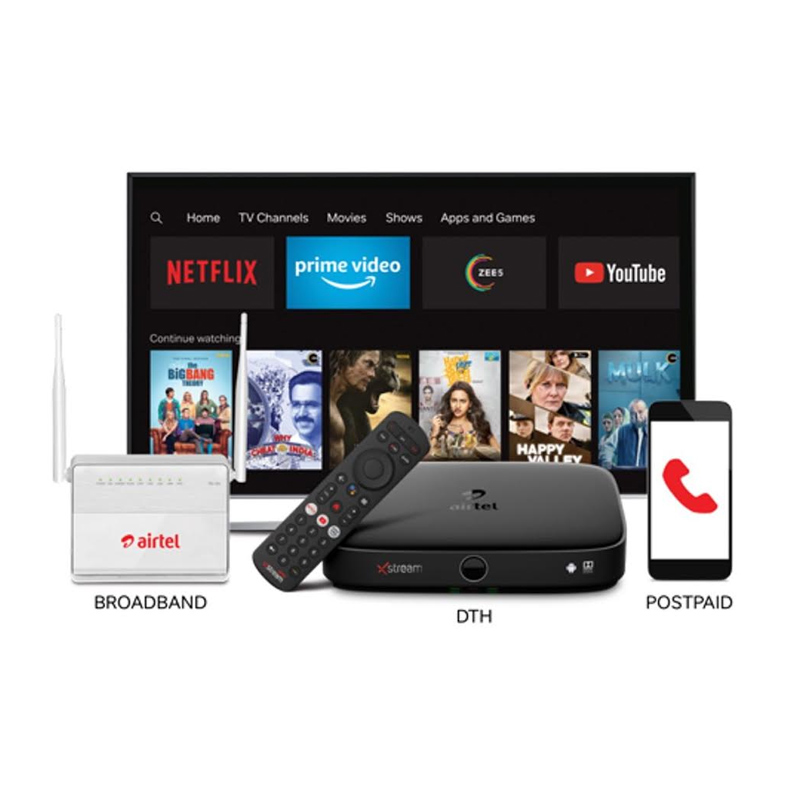
    Mumbai: Bharti Airtel on Monday announced the launch of new bundled plans for its home broadband customers. The highest tier plan at Rs 1,599 includes subscriptions to Netflix, Amazon Prime and Disney+ Hotstar. All the plans include subscriptions to 14 OTT (over-the-top) platforms and 350 TV channels and speeds up to 300 mbps.

    The new Airtel Xstream fiber broadband plans include single-login access to the OTT platforms SonyLIV, Eros Now, Lionsgate Play, Hoichoi, ManoramaMax, ShemarooMe, Ultra, Hungama Play, EpicOn, DivoTV, Klikk, Nammaflix, Dollywood and Shorts TV for customers who purchase the Airtel 4K Hybrid TV Box.

    The home broadband market has grown by 2X while the number of OTT has jumped from 9 in 2012 to 40+ in 2021. Bharti Airtel has launched the new bundle plans keeping in mind the entertainment needs of connected TV homes.  

    Bharti Airtel CEO – homes Vir Inder Nath said, “Our new plans are built for India’s emerging entertainment needs. Through these bundle offers we plan to offer our discerning customers great value, convenience and unlock a multi-faceted digital experience.”

    “Increased broadband consumption in Indian homes has given rise to the phenomena of hybrid viewing, where families are looking to consume OTT content on the TV screen along with linear TV without the hassle of managing multiple subscriptions and devices,” he said in a statement.

  • Jio Fiber acquires 2 mn new premises despite pandemic’s blows

    KOLKATA: The last year has played a crucial role in the surge of fixed-line broadband consumption, thanks to work from home and school from home routine followed by millions. After years of tepid growth, the industry got the much-needed push and one of the largest players, Jio Fiber seems to have cashed in on the trend.

    Jio Fiber has acquired more than two million new premises over the past year, said the Reliance Industries chairman Mukesh Ambani at the company’s 44th annual general meeting on Thursday.

    “Across the world, the past 15 months have been challenging for on-the-ground physical work. Jio Fiber, Jio’s optical fiber-based, gigabit speed, fixed broadband services has also faced similar challenges. The pace of Optical fiber deployment, building connectivity, and home installations have all been slower than expected because of lockdowns and other restrictions across our country,” said Ambani.

    With more than two million new premises over the past year, Jio Fiber now has a cumulative base of three million active home and business users. “JioFiber has become the largest and the fastest-growing fixed broadband operator in India,” said the Reliance Industries chairman, “I continue to be confident of a rapid uptake of Jio Fiber services and revenue growth for Jio as India recovers from Covid.”

    Data consumption on Jio Fiber has grown to more than 3.5 times compared to a year ago. Jio entered the home broadband market in 2016. At the moment, Jio’s optical fiber network is physically present outside more than 12 million homes and business premises, with a deep fiber footprint in the top 100 cities.

    Ambani added that Jio is uniquely positioned to quickly and seamlessly upgrade to 5G. To develop a 5G ecosystem, he said, the company is working with global partners to develop a range of 5G devices. “Jio is not just working to make India 2G-mukt, but also 5G-yukt,” he said.

    Jio Fiber recently launched new post-paid plans and announced that it will not charge Jio Fiber postpaid users for installation or a security deposit of the internet setup. It is offering six and twelve months post-paid plans. The plans have been introduced at a starting price of Rs 399 per month. For customer retention, it offers free Netflix, Amazon Prime Video subscription along with others for its high-end plans.

  • TRAI seeks suggestions to prevent misuse of fixed broadband licence fee exemption

    TRAI seeks suggestions to prevent misuse of fixed broadband licence fee exemption

    KOLKATA: One of the sectors that received a rapid boost last year amid the work from home scenario was fixed-line broadband. After years of tepid growth, deep-pocketed players, as well as smaller cable operators began increasing focus on the segment as the demand escalated.

    On Wednesday, the Telecom Regulatory Authority (TRAI) issued a supplementary consultation paper in this regard. The paper titled ‘Roadmap to promote broadband connectivity and enhanced broadband’ sought feedback from stakeholders on issues such as incentivisation, licence fee exemption, how to prevent licence misuse and verify revenue from the segment.

    Back in March, the Department of Telecommunications (DoT) wrote a letter seeking consolidated and updated recommendations from TRAI on the proliferation of fixed-line broadband in the country.

    “DoT has raised certain new issues like exemption of the licence fee on the revenues earned from fixed-line broadband keeping in view the current factual matrix and relevant issues, the likelihood of misuse by the licensees through misappropriation of revenues due to the proposed exemption,” TRAI said in an official statement.

    TRAI in 2015 had recommended that the licence fee on the revenues earned on fixed-line broadband should be exempted for at least five years. Apart from misuse of exemption, DoT has asked TRAI to give a reference on if the proliferation of fixed-line broadband services can be better promoted by providing direct benefit to consumers for usage of fixed-line broadband services.

    Although TRAI released two consultation papers on broadband-related issues in 2015, 2020, none of them discussed these issues. Hence, it started the supplementary consultation.

    The latest paper has also invited suggestions on how to permit the use of public places and street furniture for the effective rollout of 5G networks as it would play a significant role in offering good quality services by expanding the network coverage and going closer to the consumers.

    “It is also pertinent to understand the process which can be used by local bodies to grant permissions for use of street furniture and the associated policy and regulatory interventions,” it added.

  • Airtel reports growth for DTH, home broadband segment in Q4

    Airtel reports growth for DTH, home broadband segment in Q4

    KOLKATA: Airtel Digital TV, Bharti Airtel’s direct-to-home (DTH) segment has reported Rs 767.3 crore revenue in q4 FY21 compared to Rs 603.5 crore in the corresponding quarter of the previous financial year, clocking a 27 per cent year-on-year growth.

    The DTH segment has raked in Rs 248.3 crore profit in the quarter, up from Rs 152.8 crore in the same quarter a year ago. However, both profit and revenue have declined compared to the third quarter of FY21. The company deployed Rs 369 core capex for the quarter compared to 251.4 crore in Q4 FY20.

    Airtel Digital TV witnessed a decline in customer base by 156 K during the quarter from 17.9 million in Q3 to 17.7 million in Q4, despite a growth of 6.6 per cent from 16.6 million in the corresponding quarter last year. ARPU for the quarter was at Rs 144 as compared, down from Rs 154 in the corresponding quarter last year.

    Homes business segment witnessed revenue growth of five per cent year-on-year to reach 128.8 crore. The company’s focus on re-calibrated offerings and launch of Xstream bundles, with content and unlimited internet, to accelerate penetration has resulted in the highest ever net addition of 274K to reach a total base of 3.07 million, it stated. On a year-on-year basis, the customer base increased by 27 per cent.

    For the quarter, revenues from Homes operations were Rs 600.9 core as compared to Rs 572.5crore in the corresponding quarter last year and Rs 567.4 in the previous quarter.

    Overall, Airtel’s consolidated revenue stood at Rs 25,747 core, with India revenues at Rs 18,338 crore.

    “It is this relentless focus on customer obsession that has allowed us to deliver another consistent quarter in terms of performance. Our mobile revenues grew at 19.1% YoY backed by 13.7 Mn 4G customer additions. We are seeing strong momentum in our home business with 274k net adds. The Enterprise segment delivered double-digit growth. Our digital assets continue to scale and we are beginning to see strong traction in monetisation of these assets,” said Airtel India and South Asia MD & CEO Gopal Vittal

  • Fixed broadband demand peaks again as offices switch to work from home

    Fixed broadband demand peaks again as offices switch to work from home

    KOLKATA: India has exemplified its excellence in democratising internet through mobile data. But the growth of fixed broadband was at a much tepid rate until the country had to turn to work from home and school from home due to the raging Covid2019 pandemic. While more and more people needed high speed and stable internet and opted for home broadband connections last year, the demand for new connections is again on the rise as many parts of the country descend into lockdown.

    UCN Cable Network director Jagdish Paliya said that demand for connections has again picked up in last one month or so but not as much as last year. The company has witnessed a ten per cent growth in demand. In addition to that, data consumption of existing consumers has surged drastically, up 25 per cent, he added.

    Compared to the last quarter, broadband customer addition has gone up for GTPL Hathway too, one of the leading players in the segment. GTPL Hathway cable TV head & chief strategy officer Piyush Pankaj said the requirement for new connections has increased somewhere around 15-20 per cent month-on-month. However, this trend has been on an upward trajectory since March 2020 itself. As a large part of the workforce switches to WFH mode for the next few months, the incremental demand will remain for the next quarter at least, he noted.

    Kerala based Asianet is witnessing the same trend with 25 per cent surge in demand, Asianet Satellite Communications vice president & technology head Salil Thomas shared. “We saw a surge in demand when lockdown started last year because lot of employees started working from home. There was a surge in demand during first quarter of lockdown. That trend was evident throughout the year but when people started moving back to their respective workplaces at the end of the year, there was slow decrease in demand. Now, it has picked up again,” he detailed.

    Siti Networks CEO Anil Malhotra had a different take. According to him, the trend is not similar this year because the impact of the pandemic is much severe. Even the workers who do installations are at risk right now, people both in-office and on the field are getting infected. Consumers are also affected as the virus is permeating almost every household.

    Everybody is focused more on providing seamless service to existing customers rather than improving numbers, Malhotra stated. However, if the situation again culminates into a prolonged work from home culture, and more people start staying at home, there will be surge in demand in the long run, he added.

    Considerably, even the players who are seeing a surge in demand are facing on-ground issues. With a Covid positive case in almost every household, it is becoming increasingly difficult for operators to install new connections in these homes. Societies have barred entry to resist rapid spread of the deadly virus. But the situation is not dire like last year, as the service providers have learnt how to tackle the issues. On the backend of the services, broadband players are facing fewer issues with advance planning. In terms of inventories, these firms have stocked enough equipment – although a longer lockdown may create difficulties again.

    According to the Telecom Regulatory Authority of India’s report, there were 22.67 million wired broadband subscribers in the country as of 31 January 2021. The top five wired Broadband service providers were BSNL (7.69 million), Bharti Airtel (2. 90 million), Reliance Jio Infocomm Ltd (2.25 million), Atria Convergence Technologies ( 1.80 million) and Hathway Cable & Datacom ( 1. 06 million).

    “Penetration of home broadband in India is very low compared to advanced countries. We have a long way to go to reach ideal penetration,” Win Broadband MD & CEO K V Seshasayee noted. “It is cheaper to consume data through fibre than wireless. Customers can get a much better deal at a lower price. Fibre-based wired broadband is beneficial for small businesses as well.  Couple with these factors, the work from home culture will accelerate the demand for home broadband in India. Moreover, the bandwidth requirement will also go up with more users in rural areas.”

  • Epic On now streaming on Airtel Xstream platform

    Epic On now streaming on Airtel Xstream platform

    KOLKATA: Premium OTT platform Epic On has tied up with Airtel Xstream to offer its users the Epic On subscription at a special price.

    The partnership would allow Xstream users to access the comprehensive library of thousands of hours of titles ranging from movies, TV shows, and documentaries.

    There is a constant rise in demand for OTT from not just the urban and tier-1 cities, but also within the tier-2 and tier-3 cities across India. The upsurge continued through the year 2020 as outdoor entertainment venues remained under an extended lockdown. Amid this, streaming platforms have grown phenomenally and consumers have re-calibrated their expenses from outdoor entertainment to OTT subscriptions. 

    IN10 Media Network managing director Aditya Pittie said, "IN10 Media Network is committed to engaging with its audience across varied geographies and demographics through its outstanding content. With handpicked TV shows, documentaries, and movies we have witnessed the franchise of Epic On grow, and Airtel’s reach and distribution will further bolster its growth.”

    Epic On chief operating officer Sourjya Mohanty said, “We are elated to collaborate with Airtel Xstream and offer our content on their platform. This partnership will allow us to cater to a larger segment of entertainment seekers across India by augmenting our reach in tier II and III markets. Through the discounted subscription model on the Airtel Xstream platform, we will be able to provide our premium content to a new set of the digital audience.”

    Airtel Xstream customers can now avail of the Epic On subscriptions at a discounted price. A one-month Epic On subscription will cost the Airtel Xstream customers Rs 29 whereas and annual subscriptions are available at Rs 249.

  • Wired broadband sector adds 3.9 lakh users in October

    Wired broadband sector adds 3.9 lakh users in October

    KOLKATA: As the number of internet users in India is reaching new levels gradually, having crossed 700 million in 2020, the home broadband sector also continues to grow. The sector has reached 21.51 million subscribers in October, albeit accounting for a meagre share of the overall base yet. According to the Telecom Regulatory Authority of India (TRAI) report, the wired broadband segment has added 3.9 lakh new users in the month. But overall the  total number of broadband users has gone up from 726.32 million to 734.82 million subscribers in October; with mobile device users totting up  to 712.67 million, registering  1.15 per cent growth.

    The top five wired broadband service providers were BSNL, Bharti Airtel, Atria Convergence Technologies (ACT), Jio , Hathway. The state- run broadband service provider BSNL has lost 5 lakhs users.

    (Source: TRAI) 

    Among other services, Jio has added highest users in the month to reach 1.70 million by adding 1.8 lakh users. Jio Fiber added most wired broadband subscribers in September too. Bharti Airtel’s home broadband service also expanded its market share by adding 70,000 subscribers. While the deep-pocketedplayers keep expanding their footprints, other players like ACT, Hathway have not been able to add significant users in the month. However, ACT has witnessed decent growth in 2020.

    A recent report from Motilal Oswal highlighted that the  home broadband subscriber growth has been modest in the past five years, with annual CAGR of just five per cent. But the financial firm  added that the segment has a minuscule $2 billion market size, accounting for only nine per cent share of the country’s Rs 1.7 trillion wireless market.

    “It has largely been an urban product, with low penetration of seven per cent – due to limited network connectivity with just 80–100m estimated home passes – which has restricted subscriber growth. This has given way to increased wireless consumption in India, which has a far easier and convenient installation/activation,” it added.

  • What is hindering the fixed broadband growth in India?

    What is hindering the fixed broadband growth in India?

    KOLKATA: The last few years have seen a major explosion in internet usage, especially post Covid2019 crisis with the boom of digital payments, e-commerce, online video consumption, e-learning. Despite the huge scope, fixed broadband sector has seen a tepid growth in India, unlike mobile broadband. Issues like poor optical fibre infrastructure, high capex cost for ground networks, hardship in obtaining Right to Way (RoW) permission are deterring the expansion of the sector, as major players have commented in response to the Telecom Regulatory Authority of India’s (TRAI) consultation paper.

    GTPL Hathway pointed out three main reasons for the poor subscription of fixed broadband service – lack of availability, affordability, accessibility. The MSO has pointed out that more and more optical fibre infrastructure in the access network needs to be rolled out across the country. Along with the high capex cost involved in rolling out of last-mile access network, obtaining NoC and RoW permissions at several levels of authority for laying cable also prevents the development, as per the MSO.

     “Fixed-line services are capex intensive as the provider needs to invest a lot of funds in providing the services in the ground networking and also at the subscriber end so availability is very limited so is the subscription,” Siti Networks said.

    However, one of the largest Internet Service Providers in India, Atria Convergence Technologies (ACT) has denied that the subscription rate of fixed broadband is low. But the reach of the optical fibre cable network needs to be greatly improved upon, ACT said.

    The telecom service provider Bharti Airtel echoed the same sentiment. Lack of single window clearance and the complicated and time-consuming process for obtaining RoW permissions coupled with exorbitant fees result in unviable commercial fibre deployments, it said.

    “Another hindrance to creating a viable fixed-line network is the cost TSPs incur in installing and maintaining the infrastructure of a fixed network. Also, the additional burden of license fees of 8 per cent on AGR further reduces the commercial viability of such networks,” Airtel added. Moreover, several government and private projects for road widening, laying of electrical cables, maintenance of water and sewer pipelines result in damage to the laid fibre, it mentioned.

    GTPL Hathway mentioned that less than 15 per cent of wireline broadband connections are working on FTTH technology. Commenting about the slower growth of fibre-to-the-home (FTTH) in the country, Siti Networks said the absence of local supply chain is a major issue. The ISP added that the government should take the initiative in developing a robust supply chain in the country in order to facilitate local production to ensure sufficient inventory.

    “The wired broadband penetration is capital intensive and it’s difficult to lure financial investors to this industry due to slow reachability, fees, and taxes applicable on the sector,” ACT added. The ISP also noted that ease in the policy framework for promoting FTTH connectivity will result in-service providers providing an affordable and better quality of services which in turn, will enable the public at large to subscribe to these services.

    While the local cable operators in the country could play significant role in fixed broadband growth, there are several factors like non-lucrative business model, the burden of AGR issues, high cost for obtaining ISP license, requirement of high capex for upgrading to new technology that is holding them back from providing broadband services. 

  • Airtel has perfected the LCO model for home broadband, says Gopal Vittal

    Airtel has perfected the LCO model for home broadband, says Gopal Vittal

    KOLKATA: Bharti Airtel (Airtel) is going head-to-head with archrival Jio in the home broadband segment by putting pedal to the metal on its expansion plans. While the company has seen record subscriber addition in September, it will keep focusing on LCO partnership model.

    In an earnings call after Q2 results, Bharti Airtel India and South Asia MD & CEO Gopal Vittal declared the company has “perfected” the LCO model. Vittal said that the model has done well after being tested for seven-eight months using several different approaches in a handful of different cities. Hence, the company is scaling up the model now and has rolled it out in 29 more towns in Q2.

    Under this model, the company has a standard toolkit where it is able to go out and actually work with the local cable operator in a particular town. Airtel gives them a revenue share for laying the last mile fibre and maintaining it. On the other hand, the router, the billing system, the plan and customer relationship is managed by Airtel.

    Read more news on Airtel

    Vittal has credited work from home, surge in streaming and online education for spurring growth in  the home broadband sector. He also mentioned that the price reduction in wired broadband sector would also help in overall growth. However, the impact of the price correction would be noticeable in the next quarter.

    In the quarter ended September 30, Airtel has added 129,000 new consumers along with a million homes passes, which is amongst the highest that it has seen in any quarter.

    Other than its core telecom business, Airtel has registered a gradual growth in the DTH business as well. “We are pleased with the progress that we have made on DTH – adding more than half a million customers. Primarily that is because we are able to synergise our distribution systems of mobility and DTH. Mobility has a distribution system that’s almost 25 times that of DTH. In places like Bihar, UP, Rajasthan, we are getting significant synergistic effort by eventually finding the right model to synergise but yet keeping enough focus on DTH business,” Vittal commented.

    Bharti Airtel India and South Asia chief financial officer Badal Bagri added that most of the acquisition in the DTH segment has come in the later part of July. While July, August are softer months in terms of recharges and addition, the company has seen the traction picking up in September. Bagri is optimistic that the trend will hold.

    A recent Crisil report stated that DTH broadcasting, which accounts for 37 per cent of total television (TV) subscribers in India, is set to buck the economic downturn and log a revenue growth of 400-600 basis points (bps) to Rs 22,000 crore this fiscal, because of healthy subscriber additions.

    Airtel has struck content partnerships with all major OTT platforms lately. Vittal acknowledged that content can be a differentiator for telecom players, while also mentioning that he has not seen any compelling evidence to suggest that general entertainment content is a strong differentiator. However, he added that topical events like sports work quite well.

  • Jio Fiber service to launch on 5 Sept 2019

    Jio Fiber service to launch on 5 Sept 2019

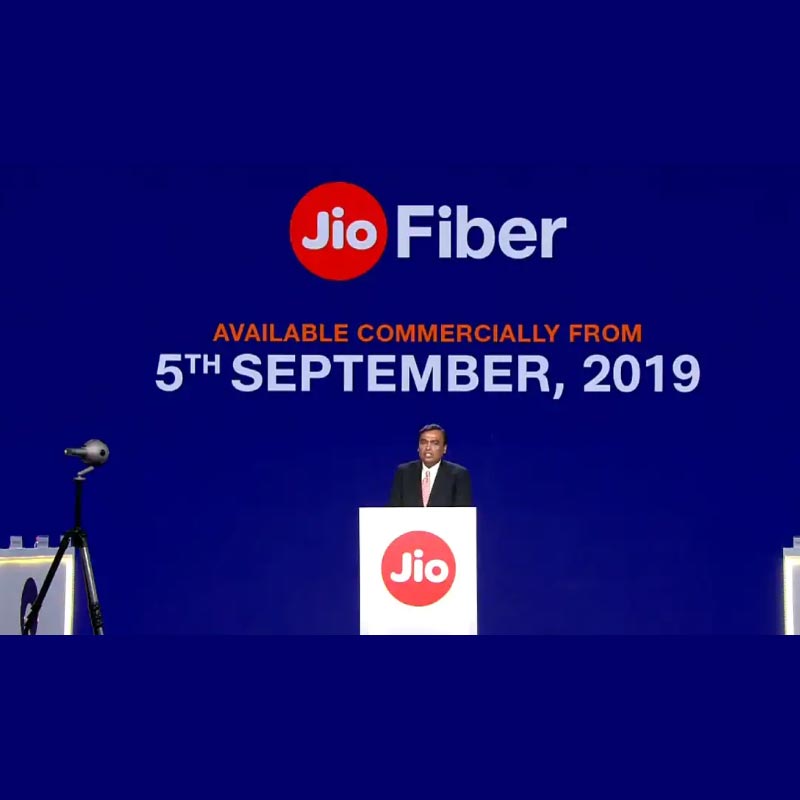
    MUMBAI: At the 42nd annual general meeting (AGM) of Reliance Industries Ltd (RIL), chairman and managing director Mukesh Ambani announced the much-awaited launch date for its fibre-to-the-home service. Jio Fiber will be launched on a commercial basis on 5 September on the third anniversary of the telecom giant’s launch.

    “Jio Fiber Services to be launched on commercial basis on 5 September 2019 – on the third anniversary of Jio’s launch. (We have) plan to reach 20 million residences and 15 million business establishments in 1,600 towns,” the business tycoon announced.

    In the last AGM of RIL, Ambani announced the high-speed fixed-line broadband services for retail customers. At the time of announced, Ambani revealed that it already invested more than $250 million in the industry. While the upcoming service has been on trial run since last year, he added that trial homes are, on average, consuming more than 100 GBs every month indicating the ever-increasing usage of internet in India.

    For a smooth rollout of the fibre service, Jio also made significant investments in two large multi system operators (MSOs) of India – Hathway and Den Networks. “Over the past months, we have upgraded our MSOs’ infrastructure to world-class standards. Now LCO partners can offer the largest bouquet of high-definition channels to customers with better features, reliability and customer experience than even DTH,” Ambani commented.

    Keeping the mixed economy structure of Indian internet users, Jio Fiber’s plans have been fixed from 100 mbps speed to all the way up to 1 Gbps. The pricing will range between Rs 700 per month to Rs 10,000 per month.

    To increase user engagement, Jio Fiber is set to offer various other entertainment opportunities to its consumers. Ambani also stated that Jio Fiber consumers will have access to premium over-the-top services. Moreover, Jio Fiber will launch a premium service where customers can watch movies at home on the release day itself, which will be launched in the middle of 2020.