Tag: HLL

  • HUL marketing spends up in third quarter

    HUL marketing spends up in third quarter

    BENGALURU: Indian FMCG giant Hindustan Unilever Ltd (HUL) is one of the biggest advertisers in India. On Indian television, the company releases the highest number of advertisements by far according to Broadcast Audience Research Council of India (BARC) weekly data for top 10 advertisers across genre. According to BARC’s weekly data for calendar year 2017 (week 1 starting Saturday, 31 December 2016 to week 52 ending on Friday, 29 December 2017), the FMCG behemoth released a staggering 68,12,298 ad insertions. This number does not include the television insertions by Brooke Bond Lipton India Ltd (Lipton), Lakme Lever Ltd (Lakme) and Ponds India Ltd (Ponds).

    Industry sources said that HUL had promoted its products quite aggressively in Q3 2018 by way of sops to the players across the sales and distribution chain as well as to consumers for some of its brands. In the current fiscal that started on 1 April 2017 (FY 2018) and will end on 31 March 2018, the company spent the highest amount as yet in the quarter ended 31 December 2017 (Q3 2018, quarter under review) towards advertisement and sales promotions at Rs 1,107 crore. In terms of percentage of total revenue also, HUL’s Q3 2018 ad and sales promotion spend works out to 12.66 percent, another peak for this year. HUL’s year-over-year (y-o-y) and quarter-on-quarter (q-o-q) spends towards advertisement and sales promotion in Q3 2018 increased 29.47 percent and 8.21 percent respectively.Please refer to the graph below for HUL’s ad and sales promotion spends during the last eight quarters.

    public://g1.jpg

    HUL was the top advertiser during all the 52 weeks of 2017 according to BARC data.Please refer to the graph below:

    public://g2.jpg

    It must be noted that BARC provides weekly data – BARC’s week commences on a Saturday and ends on the next Friday. Hence the quarterly TV insertions numbers mentioned above are approximate.

    HUL’s Tea and beverages company Lipton was present among BARC’s top 10 advertisers across genre lists during 50 of the 52 weeks. In week 52 of 2017, Lipton had 32,049 ad insertions, the highest by it in the year, while in week 19 of 2017 it had 15,719 TV ad insertions, the lowest while it was present in BARC’s list of top 10 advertisers across genre. Lakme was present in BARC’s weekly lists for 3 weeks of 2017, while Ponds was present in the lists for 15 of the 52 weeks of 2017. Assuming that these three advertisers released 20 percent additional television advertisements during the year, the total number of TV insertions by HUL during the year works out to almost 82 lakhs.

    HUL chairman Harish Manwani said: “We have delivered another strong performance in the quarter, with broad based growthacross categories and further improvement in margins. We remain positive about the mid-term outlook of the industry and willcontinue to invest strongly in our core brands and developing categories of the future. There are early signs of commodity costinflation and we will further sharpen our focus on cost effectiveness programs and manage our business dynamically forcompetitiveness and sustained profitability.”
     

  • Interactive Television: Throwing light at cinema advertising

    Interactive Television: Throwing light at cinema advertising

    MUMBAI: In the country where cricket and movies are more than a pastime, for Ajay Mehta films meant more than just a family business.

    Brought up in a household of film distributors, Mehta decided to do much more than that for the same industry. “I wanted to do something related but not join the family business and working with advertisers sounded exciting and fun,” he recalls.

    Founded in 1996 in New Delhi, Interactive Television, was set up as a marketing agency which provides cinema advertising and marketing services in multiplexes, malls, and shopping chains.

    However, the journey wasn’t a smooth one even though he belonged to the film fraternity. “The biggest challenge was to convince people of the medium without any data and in fact the cinema industry still does not offer enough data to advertisers,” says Mehta while adding that in the digital age that is simply unacceptable.

    Even though everyone knows that cinema is like a religion in India but without viewership data and demographics, advertisers are investing in the dark, highlights Mehta. To counter this, Cinema Audit Monitoring (CAM) was launched, which according to him was the first step in making the medium transparent and accountable.

    Today, working across 9000 screens in India, the company is country’s only integrated entertainment and retail marketing company, releasing CAM report each month, which gives comparative analysis of cinema advertising and movie marketing throughout the country.

    Satisfied with the journey so far, Mehta feels that the process of establishing a medium which was not in any major advertisers plans to one which is included in every major plan has been tremendous. “High point have been many, every conversion of a client is a high point especially the non believers, every innovation is a high point as it feels special to create an idea which has not been thought off before, advertising for Indian clients in international markets like the USA, UK and the UAE has been a high point as Indian movies now have a global reach and can offer a platform for clients trying to reach out to the Indian diaspora.”

    Seeing the potential, WPP had acquired the company, but it remains an independent company. “They have been fantastic shareholders and we have learnt a lot from them, apart from access to clients, we have learnt a lot on systems, processes, accountability   to clients.  The business has benefited from the insights which they have brought and we have managed to scale up the business post them coming on board,” informs Mehta.

    Started with just three people, the company now employees more than 70 in six cities which helps it to create exclusive packages for its clients. “Our people are our biggest strength and come from diverse backgrounds like cinema chains, media agencies, logistic companies, research agencies and ad sale houses. This is unmatched in the industry and gives us deep understanding of what clients want from their media investments and also gives us insights into how the cinema channel thinks. This ability to understand the entire landscape of cinema advertising is our biggest advantage.” The  company  has  been  responsible  for  immense  value  adds  to  promotions  for corporates like Samsung, HLL, ITC Foods, Reckitt Benckiser, Vodafone, Star Network, and many more.

    On the current market trend, Mehta believes that single screens have a lot of potential for advertisers trying to reach out to the mass market and categories such as FMCG, telecom, BFSI etc can leverage the reach and impact offered by the largest screen in the world i.e. the movie screen. “Digital cinema is an enabler for it and today new content reaches smaller cities on the same day as the Delhis and Mumbais of the world, this means piracy is controlled and newer audiences are embracing cinema. Till today, advertisers found advertising on single screens in small cities logistically difficult but this has changed completely with digital cinema. We think digital cinema will be the growth driver for the whole cinema advertising industry and we at Interactive want to lead this transition,” he pinpoints.

    As for the future plans, the agency wants to lead the process of making this medium more transparent and accountable through newer tools and Big Data. “We also think cinema is more than just the screen and is the only medium where one can have a live engagement with the audiences, off screen advertising is still pretty much a virgin territory and we want to ensure that gets its value,” concludes Mehta.


  • Film Farm revitalises its advertising division

    Film Farm revitalises its advertising division

    MUMBAI: Film Farm, best known for its television series Uttaran on Viacom 18‘ Colors is now shifting all its focus on its advertising division. Under the business and creative acumen of Kalyan and Rupali Guha, they have been producing advertising and television content for over a decade. They have recently ventured into the feature films arena with its maiden venture in Marathi slated to hit the big screen soon.

    With the addition of Anirudh Bagchi who comes in as producer partner – advertising, Shekhar Kamble and Tassaduq Hussain, Film Farm who has in the past worked with brands like HLL, Pepsi, Hero Motors, L‘Oreal to name a few, plans to push its advertising division to greater heights.

    Film Farm was a pioneer in presenting the production house as a hub of talent by tying up with multiple directors both from Bollywood as well as internationally, offering clients a broader base with which to make the best possible choice for a film. The company is building on its existing policy by making itself a farm or hub where talented directors and producers come in to the fold to make world-class advertisements, shows and films.

    Film Farm founder and CEO Kalyan Guha says, “I am happy to have on board Anirudh, Shekhar and Tassaduq.”

    “While I will be able to draw from this inherent strength of Film Farm, with my bandwidth of creative and marketing network and the proven creative acumen of my colleagues Shekhar and Tassaduq, I am sure to further bridge the gap in Film Farm‘s ability to serve its clients the best,” Bagchi added.

  • ”Economically sensible model is a combination of CPT and correction of income growth’ : Paritosh Joshi- Star India President

    ”Economically sensible model is a combination of CPT and correction of income growth’ : Paritosh Joshi- Star India President

    It’s now a known fact that HLL has pulled its advertising off the Star India Network, but whether a non co-existence and exchange between the biggest advertiser on television and the top rated television network in the country is a healthy proposition for either of the two parties, is the moot point?


    Even though TRP rates have declined across the network by 1-1.5 per cent after the implementation of Cas, it is also true that the television universe has grown drastically. And the truth is, Star has been singled out, leading one to question if there is a larger issue at stake here between the two mammoth corporations in this face-off that kicked off in March this year.


    Star president advertising sales and distribution Paritosh Joshi says that it is more than just an individual client issue but part of a larger debate for which the industry cannot behave like a cartel because that is unethical.


    Presented here are comments made to Indiantelevision.com on the matter by Star India president Paritosh Joshi. Additonally, relevant comments made in earlier interactions with Indiantelevision.com by HLL GM – Media Services Rahul Welde and Zee Network executive V-P Joy Chakraborthy have been provided in an attempt to offer a more rounded overview of the issue.

    Excerpts:

    How do you propose to address the issue that HLL has put the forth through its boycott of the network and rejection of Star’s advertising rate card?
    A solution to this will emerge as a fallout of the understanding of two dramatic developments in television. First the growth in television homes in the Hindi speaking markets of the East, West and North but not the South that is already saturated.

    Secondly, the GDP, which is estimated to grow by 8.9 per cent year on year. However, there is a disproportionate income increase in which the top 60 per cent of the population absorbs this growth. Out of the 120 million TV homes, 70 million are C&S, therefore with the kind of growth in disposable incomes that the country is seeing, the number of C&S homes will grow by twice that rate.

    The aggregate value of television ad sales is likely to see 20-22 per cent Y-O-Y growth. If this is not reflected as an industry then we are under monetized.

    Is CPT is the answer?
    I believe an economically sensible model is a combination of CPT and correction of income growth.

    Should broadcasters be united on this front?
    The industry cannot behave like a cartel because that is unethical. We have to, as individual broadcasters, explain this to the client in a sensible manner and get them to recognize and find merit in the argument.

    But how then do you fill up the bulk of your inventory?
    The Cricket World Cup has in some ways contributed to clients looking for a more reliable, robust and stable inventory. With April to June being a buoyant period with new category launches and the new financial year, there are enough interested clients. We are seeing high activity from the skin care sector, bottled beverages, refrigerated foods and air conditioner brands.

    XXXXXXXXXXXXXXXXXXXXXXXXXXXXXXXXXXXX

    Money is shifting from the big to the small or from the leaders to the challengers

    With HLL always known to be television heavy, what happens in the case of mass channels and niche channels, what strategy would you follow in that case?

    Well, we do spend on niche and mass channels, but with the whole area of fragmentation of audiences with multiple channels emerging, where stickiness is a challenge and competition is high. Now what it really means for us is that segmentation and multiplication of channels provides the opportunity to peg note and talk to the consumer.

    Unfortunately, the costs have increased and given that the overall advertising pie is fixed. The ad pie doesn’t grow because there are more channels, but what is happening is money is shifting from the big to the small or from the leaders to the challengers.

    The growth of channels, we will see an increase in the number seconds, but what is often interpreted is that spends are also increasing in the same proportion. It is of course a big challenge as fragmentation makes the task of planning even more difficult, where agencies will produce software and optimizers making the process more sophisticated. This scenario is good for segmentation, bad for costs. Thus I don’t know whether to call it a ‘happy situation’ because after a point of time your returns become sub-optimal when costs are high. Then that becomes a worry.

    XXXXXXXXXXXXXXXXXXXXXXXXXXXXXXXXXXXX

    The big news currently seems to be around how Hindustan Lever is significantly increasing spends on your network. You have even been on record as saying you are looking at a growth of at least 100% on Lever spend in FY08 over FY07? How do you justify that optimism?
    Levers is the biggest client in the television space and we have channels across all genres, Levers is a good client for consumption also because they are perennial clients. There has been rate correction but we have also given them big properties. At the same time, Levers buying process over the last two years has changed, initially they used to buy slots that appeared at a particular time band but now they have started buying quality as well so they would necessarily have to pay for that. Therefore, there has been a jump in ad sales rates this year over the previous year.

    When you say ‘rate correction’ – what do you mean?
    The Zee network itself is very under-priced, so we are continuously correcting our rates. I have over my tenure here (which is two years) revised my rates three times, but no rate correction is very drastic, it’s really a gradual correction.

    After all we are still in a World Cup year and although India is out of the tournament, we will see loads of other cricket action as well?
    As a network, we haven’t suffered at the hands of cricket. However a lot of money is diverted there. But thanks to cricket and sport, I believe that the overall PUT (people utilizing television) will also increase, because of World Cup TV sales will also increase, so the whole space is only going to expand.

    It will eventually benefit us also, but my only concern and what I see as a challenge this year is that the unofficial currency is cost per rating point (CPRP), which has to move cost per thousand (CPT). CPT is more important and with Tam’s expanded panel the absolute number of people watching has increased by 50 per cent and we as an industry should be paid for that. Even more, if you are a listed body you also should subscribe to the CPT model, which will happen sooner or later.

    But how soon do you think the transition from a CPRP model to CPT model will take to materialize?
    The IBF and AAAI have already met on two occasions, the next one is in April. But at the end of the day this shift will benefit all of us. It’s not that it is unfortunate for the client alone, as the television medium continues to grow the cost of programming, distribution, marketing and manpower is increasing every day. With the CPT model the ad rates will go up, infact most agencies buy on CPRP and give it to the client on CPT, but after expansion the minimum rate has increased. The recommendations of these two industry body’s should materialize within a month’s time.

    It has been previously stated that Cas impact only accounts for a 1- 1.5% drop in C&S 4+ level across TV. However, with moves to extend Cas to cover the full metros and then possibly go into other cities and towns this argument cannot be sustained for much longer. How does Zee view this situation and how do you plan to use it to your advantage?
    Cas is here to stay but the thing is that Cas growth was marginal, across the Zee network the drop accounted for 2.5 per cent, which is very less in comparison to the kind of growth that we are experiencing.

    With Cas rolling out further, the pressure from media buyers on rates is only going to go up? Do you see the possibility of many channels, including entertainment channels, going FTA to protect advertising revenues? For instance, Peter Mukerjea’s Hindi entertainment channels will be FTA when it launches…?
    Sometime we really wonder whom the media buyers really work for, the channel or the client. They will always pressurize us. Do you think they deal with rate hikes easily? They will fight for each rupee just as we fight for the same. But that is what makes our relationship so lasting.

  • ”Absolute number watching TV has increased 50%, we should be paid for that’ : Joy Chakraborthy – Zee Entertainment Enterprises Ltd. executive vice president, head network

    ”Absolute number watching TV has increased 50%, we should be paid for that’ : Joy Chakraborthy – Zee Entertainment Enterprises Ltd. executive vice president, head network

    The biggest bouquet of channels on Indian television and the second largest player in the GEC space, the Zee Network has been in the limelight recently, whether it be on the receiving end of HLL’s ad spends or with big ticket events like the Zee Cine Awards.

    Joy Chakraborthy, the man spearheading ad sales for the broadcaster, agreed to offer his opinions on the current television scenario, highlighting its drawbacks of under pricing, ad revenues that exceed distribution monies and the constant debate over cricket. At the same time he lends a word of caution to new players pacing ahead to enter the broadcast space. All this and more in a free-wheeling conversation with Indiantelevision.com’s Renelle Snelleksz.

    Excerpts:

    The big news currently seems to be around how Hindustan Lever is significantly increasing spends on your network. You have even been on record as saying you are looking at a growth of at least 100% on Lever spend in FY08 over FY07? How do you justify that optimism?
    Levers is the biggest client in the television space and we have channels across all genres, Levers is a good client for consumption also because they are perennial clients. There has been rate correction but we have also given them big properties. At the same time, Levers buying process over the last two years has changed, initially they used to buy slots that appeared at a particular time band but now they have started buying quality as well so they would necessarily have to pay for that. Therefore, there has been a jump in ad sales rates this year over the previous year.

    When you say ‘rate correction’ – what do you mean?
    The Zee network itself is very under-priced, so we are continuously correcting our rates. I have over my tenure here (which is two years) revised my rates three times, but no rate correction is very drastic, it’s really a gradual correction.

    After all we are still in a World Cup year and although India is out of the tournament, we will see loads of other cricket action as well?
    As a network, we haven’t suffered at the hands of cricket. However a lot of money is diverted there. But thanks to cricket and sport, I believe that the overall PUT (people utilizing television) will also increase, because of World Cup TV sales will also increase, so the whole space is only going to expand.

    It will eventually benefit us also, but my only concern and what I see as a challenge this year is that the unofficial currency is cost per rating point (CPRP), which has to move cost per thousand (CPT). CPT is more important and with Tam’s expanded panel the absolute number of people watching has increased by 50 per cent and we as an industry should be paid for that. Even more, if you are a listed body you also should subscribe to the CPT model, which will happen sooner or later.

    But how soon do you think the transition from a CPRP model to CPT model will take to materialize?
    The IBF and AAAI have already met on two occasions, the next one is in April. But at the end of the day this shift will benefit all of us. It’s not that it is unfortunate for the client alone, as the television medium continues to grow the cost of programming, distribution, marketing and manpower is increasing every day. With the CPT model the ad rates will go up, infact most agencies buy on CPRP and give it to the client on CPT, but after expansion the minimum rate has increased. The recommendations of these two industry body’s should materialize within a month’s time.

    It has been previously stated that Cas impact only accounts for a 1- 1.5% drop in C&S 4+ level across TV. However, with moves to extend Cas to cover the full metros and then possibly go into other cities and towns this argument cannot be sustained for much longer. How does Zee view this situation and how do you plan to use it to your advantage?
    Cas is here to stay but the thing is that Cas growth was marginal, across the Zee network the drop accounted for 2.5 per cent, which is very less in comparison to the kind of growth that we are experiencing.

    With Cas rolling out further, the pressure from media buyers on rates is only going to go up? Do you see the possibility of many channels, including entertainment channels, going FTA to protect advertising revenues? For instance, Peter Mukerjea’s Hindi entertainment channels will be FTA when it launches…?
    Sometime we really wonder whom the media buyers really work for, the channel or the client. They will always pressurize us. Do you think they deal with rate hikes easily? They will fight for each rupee just as we fight for the same. But that is what makes our relationship so lasting.

    India is the only market where ad revenues are more than distribution revenues, ideally it should be the other way round. It will be better for the industry if distribution revenue picks up. Worldwide the distribution versus ad revenue model is 70:30, but in India it’s about 35:65.

    What’s the viewership growth that Zee network has seen in 2006 over 2005?
    It’s not only about Zee TV, but all our channels across the network have done well. In Marathi and Bangla we are number one, even Zee TV from Monday to Friday is delivering for us, as it is not just about one show alone. We have such a spread across our network and as a sales head I would rather have a couple of shows delivering 4 – 5 per cent ratings rather than one show delivering 10 per cent, as it helps my inventory giving us a properly defined FPC (fix point chart), because all our shows deliver within numbers in this region providing a complete media plan.

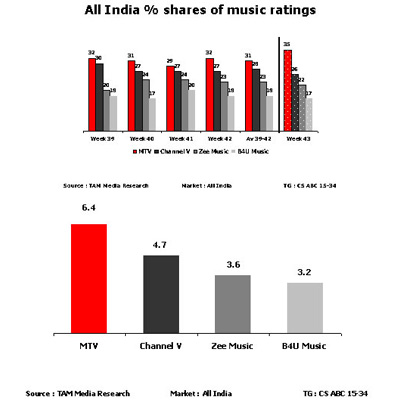
    Sa Re Ga Ma Pa has been the mantra for the network, not only did Zee TV come back with the show but also Marathi and Bangla. I believe Zee Café is number one right now and with Zee Studio we are getting back to where we belong, which means we are getting close to HBO and Star Movies. Etc and Zee Music combined gives us better numbers than even MTV and Channel [V]. Therefore, we are trying to find ways of selling together.

    In Zee TV you now have a strong number two position sewn up? Which are the channels that you have achieved a clear leadership position with?
    Percentage wise all the channels have seen growth, but in the cinema genre there has been a significant correction in GRP’s with the number of people watching cinema drastically increasing. Today 155 -160 GRP’s is equivalent to 210 GRP’s in the past, which is an absolute number of people. Movies generally give an average of 0.8 – 1.3 ratings, which points to the number of people sampling the channel.

    What’s the current order of importance of channels on the Zee network in terms of ad sales and how does it stack up percentage wise?
    Zee TV is operating on GEC where the maximum revenue lies, it will always remain the top most from an ad sales point, followed by Cinema, Marathi, Bangla, then Café, Studio, Music and Etc will stack up accordingly. But value-wise and outlay-wise these four are the ones that deliver the maximum.

    For example percentage wise Zee TV would range between 50 – 60 per cent, Cinema would be roughly around 25 per cent, while the others will corner the remaining share of the pie.

    Our differentiator is that we don’t compromise on the big channels just to accommodate weaker ones

    How is the selling done across the network? Is it broken up into Hindi entertainment, news, cinema, English entertainment and regional channels? Or is there some other formula you apply?
    We work on a matrix, for which we have all India heads and branch heads. The obvious thing is to present one face of the network to the media buyer without losing the immediate focus. The differentiation in the way we work is that we don’t compromise on the big channels just to accommodate weaker channels. As part of our strategy we also do network deals with clients like HLL, Pepsi, Coke, Nestle, L’Oreal for which we provide a bouquet offer. In fact, we can replace a lot of other networks because we have a range of channel genres to offer from GEC, music, cinema, regional etc. Each of the channels within the bouquet has its own respective teams which go out and meet the market and keep updating media agencies and through SMS we inform the trade of current GRP’s.

    From a programming perspective, Zee TV has gained a strong foothold between the 8 and 10:30 prime time, and even with the arrival of KBC you have managed to hold your ground to an extent. Are there any strategies in place to really get into programming overdrive once KBC completes its run?
    If you see, we did not panic at all when KBC was launching and didn’t resort to doing anything drastically different. We have a very close knit team for programming and marketing that evaluates the market and competition. Infact our primetime is not just 8-10.30 pm, we start at 7 pm and 7 – 11.30 pm is what we like to call primetime. All our properties are Monday – Friday that gives us a weekday skew of scheduling spots, which has been consistent in delivering an average rating between 2.5 – 8 per cent. Besides we also do plug repeats of Sa Re Ga Ma Pa, Shabash India and Johhny Aala Re.

    But what about the afternoon prime time? That is a band that Sony is actively looking at as well we’re told?
    This is a place we are not currently at, but would like to be in the future depending on the decisions taken by the programming team. With KBC and cricket we noticed that suddenly the afternoon was doing well for us, causing the time band to grow big time across all out channels. We have plans that will be unveiled once budgets are approved by the management for the financial year April – March.

    As for Sony, there seems to be confusion as to whether to go with reality or not. I strongly feel that soaps are the most important thing for a GEC because it gives you consistent viewers. I enter the fiscal in April with 60 per cent of my deals done in advance, on an assumption of X, that only soaps can deliver. As reality picks up only towards the end, you should have an ideal mix of soaps and reality, which as a network we currently have. This ultimately helps me sell well as I have more properties to offer to a client.

    Any significant weaknesses? And how do you propose to get it sorted out?
    As a network the year has been very good but we still have miles to go. For Zee TV alone, its just been a year since we started doing well, besides there is so much to be done within this genre.
    Also, the type of selling methodology is changing and we have to understand the move from CPRP to CPT. Going forward we would also like to focus on training people with skill sets because until now it was just fire fighting to grab the money that was lying in the market.

    What has been the growth like over FY06 and has it been in line with the targets you set? What are the revenues you are expecting to close this fiscal at?
    I can’t reveal growth figures but the growth has exceeded my predictions.

    We have infact exceed our revenue target by 30 per cent. However, we keep revising our targets depending upon demand and supply, channel performance which are fixed standards for us. But usually these floating targets usually go up.

    And what about Zee Next? There was talk that it would launch by mid-year. Is that plan still on track or is the current view that another channel might be a distraction as far as Zee TV’s focus on getting further ahead is concerned?
    It is still in the planning stage as there are various factors to be considered before launching a channel and we want to be fully prepared. But it is on our radar for this year. To say we are ‘on track’ largely depends on the market conditions and with KBC and so many channels actually coming in, it depends on how and when to launch.

    Yes, currently the focus is on Zee TV because our FPC has changed slightly. We also have programme launches, Sa Re Ga Ma Pa will return at the end of April and a few more strategies that will help sales.

    The Zee Cine Awards in Malaysia are obviously a headline event for you. Could you offer a picture as to the big properties Zee will have in the coming months?
    We are probably the only broadcasters that can say we own an award. In fact, the client gets lots of exposure by tying up with it across the network, that’s why there is a demand for it. It was within four days from the day we started selling, that we were sold out.

    How do you view the coming onslaught of channel launches? Wouldn’t the increased clutter only lead to further pressure on price points?
    It will affect the TV space causing further fragmentation but with so many channels coming in the number of people watching TV will increase. The only bad side to this is that new entrants will spoil the market, causing marketing and distribution costs to go up. Additionally, discounting rates will also get affected. But please note, it’s not easy to launch a channel as after launch it is difficult to maintain, because how long can you bleed? You’re basically into business and not into charity, so lets see how many will last?

    Yes, there will be pressure on price points. A situation will arise where there will be a lot of buying out of people as well as offering different credit periods to suppliers and this will ultimately spoil the market.

    If you were asked to offer a view on how the broadcast landscape will look over the coming year, what would that be?
    My only request would be that people should be very careful and do their homework before launching a channel. We have a big bouquet of channels and we know what it’s like.

    Just because somebody says GEC has got so much money and if I launch I will eat some of that pie, but at the end of the day it must make business sense.

    Competition will always keep you on your toes, you can’t be complacent and you can’t take people for granted. Even if the channel is performing, you have to be there out in the market.

  • ‘Size of ready to eat market Rs 700 m.’ : Ravi Naware – ITC Foods Division CEO

    ‘Size of ready to eat market Rs 700 m.’ : Ravi Naware – ITC Foods Division CEO

    ITC Foods, the foods division of ITC Limited has built many brands and sub brands through aggressive advertising and marketing moves. This year the foods division is expected to add about Rs 10 billion to ITC’s annual turnover. ITC has recently announced the launch of their sub brand of biscuits – Sunfeast Sachin’s Fit Kit under their flagship and umbrella brand Sunfeast to coincide with the World Cup that will be played over the next few weeks in the West Indies.

    ITC Foods Division CEO Ravi Naware shared some insights into the various aspects of the business with Indian Television Dot Com’s Tarachand Wanvari. Excerpts from the interview.

    Excerpts:

    The promotion spends in the World Cup, what would be the proportion for them vis-?-vis your annual spends? You must have a separate budget for the World Cup. Could you share the figures?

    Of course, we have budgeted a specific amount for the World Cup. The World Cup is expensive so it’s a fairly decent percentage.

    You have said that a major portion of the World Cup spends budget will be towards promotion of Sachin’s Fit Kit, could you speak some more on this?

    I think if we don’t put money behind this brand, we’ll be doing a disservice to ourselves. We have launched the brand with Sachin’s name associated with it. On its own it’s going to be high profile from the reception point of view. I don’t mean that we are doing a razzmatazz kind of a launch. Sachin’s Fit Kit and the World Cup, the whole thing matches.

    How big is the ready to eat market?

    I really don’t have a number, because I find that the ready to eat market is not very well defined. You get tinned rasgollas. Will you include them in ready to eat? Some people do, because that is ready to eat, processed, cooked and packed. The definition is not very clear on that segment. If we stick to ‘so to say’ dinner table items, but then rasgollas can also be a part of the dinner table item, we’re talking primarily about vegetable curries, paneer, chicken, birayanis, dals, this is the kind of market we construct, then we have close to 48 per cent market share. But then you go and ask someone else, they are very likely to say that claim is too high.

    By your definition, who would be number two and three in the ready to eat market?

    No 2 would be MTR Foods, next would be Kohinoor. But then there could be disputes too, because I also make halwas like gajjar ka halwa, moong dal ka halwa, we include those. Comparatively, biscuits or soft drinks have become well defined markets. So you won’t include potato chips in the biscuit segment. You don’t include fruit juices with soft drinks. Its undefined, but not a huge category.

    What about your Kitchens of India brand of ready to eat? How does it compare with Aashirvaad ready to eat?

    Both would be about equal in size. Plus, we have a fairly large export market, which add a fairly large proportion to our sales. Only Kitchens of India are exported.

    So what is the size of the ready to eat market?
    It’s approximately Rs 600-700 million, the way we look at it.

    If you are building a branded business, the brand must acquire power, stature and then you can generate the consumer pool from that

    How are your Pastas doing?

    We’ve got some very, very loyal customers who are quite happy with the performance. We’ve launched Benne Vita. Many people know how to make good pasta sauce, but the pasta is difficult to make. Earlier one had to buy imported pasta, now they can buy our Benne Vita 400 gm pack.

    You are competing with Nestle’s Maggi in terms of noodles with your pasta? Has it reached anywhere near that stage?

    Well I suppose in terms of the mental space we are competing with Maggi. But we are small and Maggi is large. It is a different product, which by now is a fairly standard one. There are lots of unbranded noodles also available in the market, maybe a similar genre, because that’s become a very popular item. Others are also getting into it.

    Compared to the existing players, you are new, just four or five years into foods Aren’t you spreading yourself with so many products?

    In 2002, when we entered the food business, if you wanted to enter almost any food product you would have competition that had already established itself. Nestle had a fairly large range of products, they have been in India about 60 years, Parle is about 60-70 years old, Britannia has been around for almost a 100 years. Then take tea or coffee, you had Tata, HLL or instant mixes, there was MTR and Gitz.


    Pasta has been introduced by us for the first time in India. If you say that we compete with noodles, then noodles have been around for 25 years or more. We are late entrants which is a fact of life. And as a late entrant you don’t want to get into chocolates. Cadbury and Nestle are already there in that space. You name any category, dairy products – you have Amul and several others already there. In that sense, there was hardly any totally new “New category” where we could enter.


    We decided to enter into those categories where we felt that we had some inherent competitive advantage. For example, when we entered atta (wheat flour), we said that we’d leverage our entire e-choupal connection. Having entered into atta and this area, we thought that we would enter into the wheat vertical space. So we got into biscuits, we got into pastas, and there are other products ideas based on wheat which would be relevant.


    Through e-choupal we buy larger and larger quantities of wheat, and at that stage, there are scale economies which give us benefits, selectivity, we can choose the right kind of wheat for the right kind of product and so on. Secondly we got into confectionaries because India has 3 million cigarette selling shops. ITC was present in those shops for the last several decades. Most of these cigarette selling shops also sell candy. So we thought that we’d have that advantage in distribution.


    This is how we chose the broad categories that we would enter where we felt that we had some competence, some in-house capabilities.


    For Kitchens of India, we had all the great recipes from our hotels. So we could make a Dal Bukhara, we could make a Chicken Chettinad, we could make a Paneer dish and so on. That was how we selected the products, otherwise, for me it was impossible to find a completely new line that we could get into.

    Do you have advantages because of your e-choupal initiative?

    We do have some advantages, we are able to source wheat through e-choupal for our atta (wheat four). We are market leaders with 15 per cent market share in the branded atta segment, which is upwards of Rs 30 billion in India. The market size `is across all brands, not just the ones that advertise. This means regional brands too.

    So what about bread, that too is a wheat vertical, isn’t it?

    Bread is a very, very difficult industry. It also requires specialized distribution. Just having a distribution network is not enough. You need to have trucks that need to got out at 3 in the morning, then you go distribute the bread, on the return you collect money. There are spoilages in bread, maybe 10-12 per cent of the bread gets spoilt, the manufacturer has to take it back. It requires a completely different distribution channel and method.


    Pepsi and Coke were already into handling bottles and liquids, they have given out coolers to their retailers, for them it was a natural entry into drinking water. Their distribution and the storage at the retail end fitted in well with their existing setup so they could launch the Aqua Fina and the Kinleys drinking waters. We didn’t find that kind of synergy with what we had for bread. I think it’s a multi local industry or a national brand industry. Each locality has its own famous bakery.

    Over the five years that you have been here, are you satisfied with all genre’s of products, or do you feel that you could have done better somewhere?

    I am very happy and very satisfied with the progress. Of course some things move much faster, some move slower. I think in Sunfeast we have had a very good run so far. Today we’re clearly the number 3 player and there is a very apparent and a visible gap between no. 3 and no. 4. A year ago that gap wasn’t so very visible. Apart from a size of 8 per cent, I think Sunfeast as a brand has acquired a good standing, a good stature in the market and in the consumers mind. And that to me is a prerequisite for building a business. If you are building a branded business, the brand must acquire power, stature and then you can generate the consumer pool from that.

  • ‘TV will continue to be important, but its importance will decline’ : Rahul Welde – HLL general manager – media services

    ‘TV will continue to be important, but its importance will decline’ : Rahul Welde – HLL general manager – media services

    For over 50 years FMCG major Hindustan Lever has dominated the Indian market with brands that have become a household name for many. Now it is about to turn over a new leaf to welcome its mother company Unilever. After having hogged the media space, especially television and now opening its doors to new media like internet and radio, the time seems right to question its experts on their outlook to the fast developing media landscape.


    In conversation with Sujatha Shreedharan and Renelle Snelleksz, HLL general manager – media services Rahul Welde, who is most uncomfortable in front of a camera, puts aside all his inhibitions once he begins speaking on his area of proficiency – media and advertising.


    Excerpts:

    With the HLL name change announced, the next question is how would this pan out in terms of a branding and marketing strategy?

    Since it’s just been announced, we haven’t really planned that out as yet. It will be put to vote in the AGM in May, after which it will get adopted and implemented.

    One of the biggest advertisers on television, HLL is now looking beyond the medium. What kind of media mix does HLL now look at? You have also maintained that TV is bound to decline?

    Television will continue to be important. However it will also continue to decline in importance. The reason for this primarily has to do with the way consumers are reacting to television messages. Studies indicate that there is a greater degree of ad avoidance, greater degree of clutter on television and that has resulted in lesser interest in television by consumers.


    Simultaneously people are spending more time outdoors, doing other things than just watching television. As a result television is facing a lot of competition from the other media.


    There was a time when there was no television and print had all the advertising – but that lasted only until television made an appearance. It ate big time into print advertising. Something similar will happen to television with the advent of radio, internet, mobile communication and other types of new media. Eventually they will fight for the same share of the rupee.


    I don’t think anything as drastic as the death of television is bound to happen anytime soon but it is staring into the face of a huge challenge even while other media grow at an exceptionally fast pace. The same applies to our understanding of media buying as well. Our focus has shifted to alternate media and is much higher than what it used to be two years ago.


    Also, I must say that there is also nothing like an HLL mix, as it depends on our brands. Some will focus on TV and spend nothing on print and vice versa, so the strategic thinking as to what to use comes from the brand and consumer lens. We are thus excited about the internet when it comes to youth brands, while outdoor and DD are key for brands like Wheel. From an industry perspective, I think radio will experience growth.

    With HLL always known to be television heavy, what happens in the case of mass channels and niche channels, what strategy would you follow in that case?

    Well, we do spend on niche and mass channels, but with the whole area of fragmentation of audiences with multiple channels emerging, where stickiness is a challenge and competition is high. Now what it really means for us is that segmentation and multiplication of channels provides the opportunity to peg note and talk to the consumer.


    Unfortunately, the costs have increased and given that the overall advertising pie is fixed. The ad pie doesn’t grow because there are more channels, but what is happening is money is shifting from the big to the small or from the leaders to the challengers.


    The growth of channels, we will see an increase in the number seconds, but what is often interpreted is that spends are also increasing in the same proportion. It is of course a big challenge as fragmentation makes the task of planning even more difficult, where agencies will produce software and optimizers making the process more sophisticated. This scenario is good for segmentation, bad for costs. Thus I don’t know whether to call it a ‘happy situation’ because after a point of time your returns become sub-optimal when costs are high. Then that becomes a worry.

    Given that you are the biggest advertiser on kid’s channels, what is the potential that you see in this space and how do you (as an advertiser) think it will shape up in the coming years?

    For us it is important, but the degree of importance it would be very low because you have to look at it from the brand and consumer fitment perspective. There are a few of our brands that actually talk directly to kids while a larger percentage of our brands look at the older demographic.


    Even then we are the largest advertisers. So you can imagine if kid’s were to become important then we would really have to up our spends. But the interesting part is that kid’s involvement in influencing the purchase decision is growing. Now does that mean that they participate in the decision to buy a laundry powder? My guess is that they don’t.


    Thus, it’s not really a major part of our media thinking but it’s interesting because there is a lot of stuff happening in the kid’s space.

    You’ve shown a lot of enthusiasm about radio. But it seems HLL mostly uses AIR and not private station. How do you view private FM?

    I see private FM as a very exciting space for us because suddenly with the addition of newer towns, viewers will have more choice in media. This viewer engagement will attract more advertising, so from our perspective which brand will resort to using radio will depend on the brand and consumer fit. Right now we are in the process of taking stock of radio advertising and as we see it increasing to about 300 stations, but more importantly the excitement is about the increase in towns.


    Now whom we are in partnership with has to be strategically thought out, but we are in talks with several partners. The good part is that there are new and established players coming into the fray. Even now we are the largest advertisers on AIR and FM, this will only mean that our footprint will become broader within the radio space.

    Media planners are hesitant about radio due to the lack of key differentiators, what are your views on that?

    Somewhere a woman/man is being wooed and while people begin to analyze this space I think we will get on to the bus much faster. We have in the past invested in the medium and will continue to do so. We will not wait to see who emerges as different, as differentiators are what you create. You don’t view TV the way you used to therefore, radio will also be consumed differently. I don’t know what media agencies generally view this space, for us what is important is what we can do to it. Currently, we are holding our excitement.

    Following Wheel Smart Shreemati and Rin Mera Star Super Star will AFP’s be given greater importance going forward?

    All our AFP’s played out very well for us, Wheel was the top rated show on Doordarshan. Although, it may appear like something we mounted and happened to do well for us, but the truth is we were working on it for three years. In 2004, the germ of the idea began, 2005 we tested it on a smaller channel and 2006 we took it to DD. Our planning and research helped us get to where it is as the top rated show.


    The challenge is that you have to combine the arithmetic of the brand, communication and commercial and get the trio to work. However, the effort required for AFP’s is disproportionate. It calls for a genuine collaborated effort with the channel, the clients and the production house. It gives a new lens to the planning effort and it’s the next practice.


    We have been cautious with in-films as we don’t really know how it pays back. It is one step higher than AFP in terms of collaborative effort, in fact it ends up being more of a ‘punt’ than TV.

    Talking about the online space could you highlight what is currently being done with online marketing after Sunsilk Gang of Girls and Axe land?

    We have got stuff in progress but not in the development stage yet. The Gang of Girls gave us better results that what we expected both from the returns and consumer engagement we got. The sheer numbers were amazing, we tracked all the measures and it appears the time spent by these girls was almost 11 to 14 minutes. We did it to get engagement rather than exposure and it was a collaborated effort with partners like Monster.com, Elle and Cosmopolitan. It went beyond just talking about hair to discussing everyday issues among friends, to have an extended conversation with the consumer. So both thematically and in terms of engagement it played out very well.


    Also with Axe we did Axe Unlimited Academy and will roll out something along the lines shortly. So will we have all brands participate aggressively on the net? Probably no. But definitely our youth brands will, because it’s really about redefining the role of engagement. Therefore for us the whole space of internet is going to grow very fast and it will grow through a combination of such websites and simultaneously through traditional web based advertising. The net allows a huge amount of interaction but it depends on how you exploit it.

    How does this translate into sales?

    This was a brand building effort, but of course everything that goes towards building a brand must translate into sales. But it is about driving brand preference and an alternate way of communication.


    A big change is likely to be seen which is currently under the surface, but the in the coming years the numbers in terms of advertising will show that.


    The only thing that we consider is the brand and the consumer, the media needs to fit into that, so if online would largely be urban, but this is also applied to the rural I-Shakti programme, however, net penetration is still restricted to urban India, but progressively it will spread.


    Even the outdoor space is very interesting, however it’s not being exploited sufficiently. Every time people travel, it’s an opportunity for advertisers. In fact, among different forms of media there are definitely some that are really likely to rock!

    Could you name three different media that you think will rock in 2007?

    I think for the next two-three years radio will rock, maybe not in 2007 because lets not forget that print is some 1,000 crores (Rs 10 billion) and radio only some 100 crores. If I were to have a prognosis I believe that radio will really double, because it’s just the sheer scale that cannot be ignored. But within this space there are also so many players, coupled with the lack of measurement at the moment will make it even more difficult, so who do you back, how do you know it works? Thus a half baked science gets applied. But the minute you put measurement, predictability and science behind it that will cause inflection, otherwise people will be cautious.


    What will also make a big shift, whether it will rock financially I cannot say, but the whole business of in-store on-screen advertising, suddenly you will find them all over the place and therefore it will peel off mainstream advertising and then get evaluated analytically by agencies.


    Even in the TV space, the whole area of Cas and DTH will keep the excitement alive. DTH is getting into rural space so that will be interesting. There is great action happening there as well, KBC 3 and others.


    Another thing is that regional media is also getting more and more important across all genres, whether it has been Marathi, Bengali, Oriya and traditionally Telugu, Tamil and Kannada have been strong anyways.

    We’ve talked conventional media and new media but HLL has always been a strong advocate of rural marketing? But the focus keeps shifting and after some time all talks of rural marketing die out. Can you give us an update on what has been happening on this front?

    The biggest challenge for us is that a large part of India is still media dark. What that means is that television or print does not really reach there. Then there is the problem of infrastructure and literacy. Therefore from our perspective we’ve really tried to concentrate on on ground activation- demonstration, sampling and events.


    While the problem of infrastructure, non motorable roads, etc. remains there is also a challenge of scalability. We’ve been active in the rural areas for a long time and progressively have increased our thrust in this area. The big change is of course in the scale. We have upped the scale in these initiatives.


    We’ve got two-three programmes which we have been looking at for the last few years. One of them is Lifebuoy Swasthya Chetana- a rural communication programme around Lifebuoy that has touched over 130 million consumers across Bihar, UP and Rajasthan. Similarly, there is Project Shakti. The Shakti Vani is a programme that we started keeping in mind communication with rural consumers.


    While Lifebuoy Swasthya Chetana is a brand specific programme, Shakti Vani cuts across all the brands to speak to the consumer. The action in rural India is all about being ‘their type.’

    Is there also a challenge of making these initiatives profitable? You have talked to us about scaling it up? Since you do talk about the challenges, how do you go about building your capabilities and expanding it?

    The issue is not so much about profit although there is a worry of cost effectiveness. So when you know that there is a cost involved in physically being there which cannot always be done. When I say scalability, the challenge is to do with two things – one is to do with researches on ground.


    If you want Western class communication to reach rural India, you need a full stream of resources which works down the line, is well trained and which understands what is being spoken about. The fact remains that the scope of the country is so vast and immense that no matter how much you do, it’s never going to be enough. Despite this, I don’t know any other company which does as much in rural marketing as we do.


    We work with one agency on our rural initiatives – Ogilvy Outreach and have built a strong network through our vendors. I think over time we have built our capabilities in this segment. As for expanding this further, yes we would look into that as well. We are expanding in almost every sphere and rural marketing will come under that focus too.

    Big monies are being pumped into cricket on TV, but I don’t see the same quantum of returns

    If we could just talk about HLL brand and brand categories. You have largely spoken about brands in the health and personal care segment, in this respect has the push in the food division been milder?

    We do have firm positions in beverages. In fact, we just re-launched Taj across a multimedia campaign. There is excitement in foods but the scale and salience is very different. It is largely to do with the category and not so much to with the brand itself. Our tea brands are the largest in the category but if you look at these brands in advertising terms they are not as active as the personal care. Inevitably you would see Lux, Lifebouy, Sunsilk, Surf, Rin as large media and advertising brands.

    As opposed to the parent company, which has a strong presence in the food category, therefore would the recent global alignment following the inclusion of Unilever into the companies name, mean that there expertise in foods would be brought to India?

    It’s outside my remit to comment on that because that’s a matter of corporate strategy and how the food units would grow and I can only comment on advertising. But in totality the investments in this space are as hot as personal care and it’s growing as much. It is smaller in scale but as active.

    Finally, with the World Cup Cricket right around the corner, any new initiatives or plans for the season?

    (Laughs) You know every year there is great excitement over World Cup Cricket among advertisers and also channels. We share that excitement too, but we don’t want to be carried away by it. We will have certain things in place for cricket, some of our brands will have World Cup Cricket branding. But the fact of the matter is that a lot of money is pumped into cricket on television. The question to ask is where does this extra resource come from? It is but obvious that it is either pulled out from some other kitty or companies start following a cost cutting plan. So while I may be excited about it, I don’t see the same quantum of returns in World Cup, so I am cautious.


    So it is great that the advertisers are looking at World Cup. For us the larger worry is the movement of eyeballs from the general entertainment channels to the sports and news channels. Finally it’s a question of checks and balances. Is this rupee spent worth it? Any advertiser would ask himself that before putting up his money. Otherwise it becomes like a punter’s game.