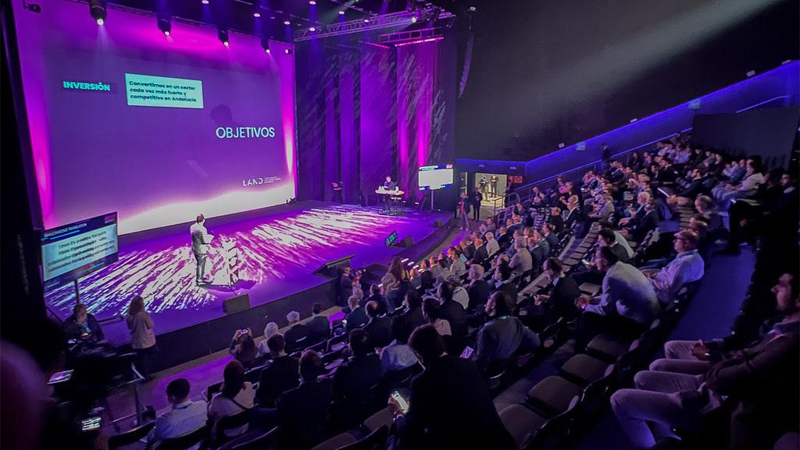
MUMBAI: Seville is once again in ultra high focus and it’s not just the camera lenses doing the zooming. The 4K HDR Summit is back for its 11th edition, transforming the Andalusian capital into a global hotspot for Ultra High Definition (UHD), cutting-edge streaming, and the future of AI-driven audiovisual production. Running from 10 to 13 November 2025, the event will blend two days of in-person action at the Cartuja Auditorium (10–11 Nov) with two days of virtual sessions (12–13 Nov), syncing with the 22nd Seville European Film Festival for a blockbuster audiovisual week.
With over 500 professionals and 240 companies attending in 2024, this year’s edition builds on its reputation as the world’s premier forum for all things 4K and HDR, boasting participation from nearly 30 countries across Europe, Asia, and the Americas. From RTVE’s pioneering UHD DTT broadcasts to global giants prepping for LA 2028, the Summit promises to capture every pixel of innovation.
Expect participation from heavyweights like Dolby, Fraunhofer IIS, EVS, Hispasat, and broadcasters across FORTA, along with UHD Spain’s General Assembly, and top-notch tech, OTT, AI, and immersive audio panels.
2024’s edition drew 150 million media impressions, with an estimated media value of over 1 million euro, setting a formidable benchmark for the Summit’s hybrid format. Spain’s leadership in UHD content on DTT, underscored by La1’s regular UHD broadcast since Feb 2024, only heightens the stakes.
As the world gears up for AI-enhanced production and immersive streaming, the 4K HDR Summit remains the place “where technology and content have time to talk.” Bonus: all sessions will be available year-round on Medina Media’s El Observatorio platform because UHD conversations don’t fade to black.
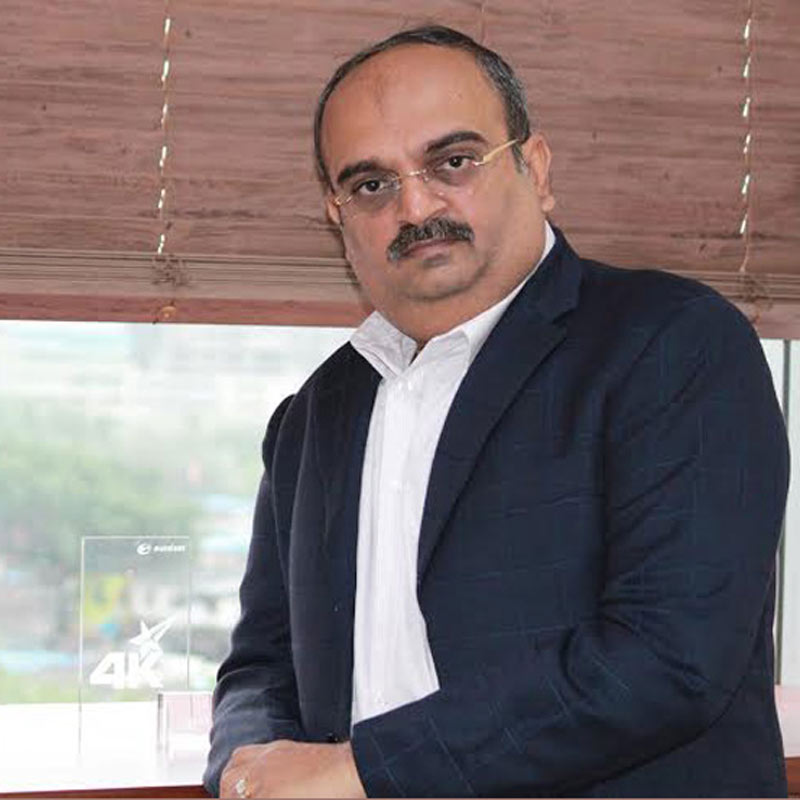
MUMBAI: Prashant Chothani is a man on a mission. The veteran cable TV professional-turned-Zee TV-associate-turned TV broadcaster has marked two dates in his calendar – October 2016 and February 2017. The founder and CEO of Travelxp- the Indian travel lifestyle channel – has set his sights on launching his channel in 4K globally in order to engage even international viewers by one of those two dates.
Says Chothani: “We have shot 100 hours of UHD (Ultra High Definition) 4K content and need another 50 hours of content to launch a full fledged 4K channel.”
It’s almost as if a race is on. And it’s a race he has ventured into by himself. Ever since he started dabbling in filming travel and lifestyle shows in 4K and got pole-vaulted into an elite group of 4K content pioneers thanks to MipTV and Mipcom in Cannes, the format has been coursing through his veins and keeping him awake night and day.
So much so that he has invested around $2 million in producing his shows in 4K over the past year or so. That kind of investment – when the entire channel Travelxp is turning over an estimated $3 million in revenues (both advertising and subscription) – shows his commitment and optimism about the future of UHD content and to be a pioneer.
“The process of 4K is long and time consuming and one needs a lot of investment and patience for this transition. We were amongst the first to begin the shift from Standard Definition to High Definition. And now we are all up for new age of 4k. As an Indian production company, we are setting the standards for 4K. We are very proud of that,” says Chothani excitedly.
He and his Travelxp team have shot in about 10 countries including a series in India with a plan to produce more indigenous content. 4K TV productions cost about four times more than a HD shoot. Travel shows take about six to eight months to complete with a crew of six to eight once again.
Chothani has invested a few million dollars in the 4K production pipeline. Travelxp owns Sony F5S cameras with Canon lenses. Colour grading is done on DaVinci Resolve machines. 4K requires terabytes of storage and processing the content requires high speed machines for rendering. The in-house production team at Travelxp is using Apple Pro modified machines to process the heavy raw footage.
He reveals that he challenge lay in selecting the right equipment which would allow him to maintain image and video quality in natural light. He and his team have done what Indians are known for “juggad” or innovating to get things working in the Indian ecosystem.
“We are the first ones to attempt this, so the learning was on the job. We made our mistakes, but learned as we went along,” says Chothani “The HD to 4K transformation is not easy for anyone. It will take undoing what is done and unlearning what production houses already know. Old infrastructure is not compatible for such a change.”
The advantage of 4K is the color quality, picture depth and image sharpness it offers to viewers. The viewer feels like he is experiencing each frame live with his naked eyes. One can see every inch of detail from blossoming flowers to morning dew and each merging shade of rainbow on one’s screen. Sports and travel and lifestyle content come out best when viewed in 4K.
Chothani has been filming keeping in mind the evolution of UHD standards set by the UHD Alliance recently. These state that for a production to be labeled as High Dynamic Range (HDR) 4K, it has to be shot at a 10 bit rate at 50 frames per second (fps) and 2100 REC with the pixel set at 3,840 X 2,160 and 16:9 format. But he and his team have filmed their 100 hours of content at 4K SDR (standard dynamic range) with the bitrate at 16 and at 50 fps. This Chothani states will allow all the content to be upgraded to 4K HDR rather easily. Says he: “We have kept the shooting quality with both the SDR and HDR options being open to us.”
It’s not as if the 4K HDR road is going to be easy and paved with gold. An estimated 30 million 4K TV sets or receivers have been purchased by TV viewers globally. But these are SDR sets and most will have to be replaced or use Hybrid Log Gamma tech to allow viewers to enjoy the better picture quality that HDR yields. And brands like Sony and Videocon have started manufacturing TVs matching the new 4K HDR standards.
Then there is the question of distribution via satellite. Each 4K channel requires 25 Mbps of bandwidth on a transponder. That means expenses. Chothani is in talks with satellite capacity providers such as with SES, Eutelsat, Measat and Hispasat. He says 20 distribution platforms worldwide have already agreed to carry Travel Xp 4K once it begins telecasting.
According to Chothani, it took some time and tedium for the industry and viewers to shift from standard definition to high definition viewing. Around 50 channels in India out of the 800 odd are beaming in HD, making it an eight to 10 per cent ratio. Chothani predicts that 8-10 per cent of HD channels will also likely transition to 4K in the short run. “The challenge is truly big, but change indeed is the only constant,” he says with a shrug of his shoulders. “And I indeed want to be ahead of the curve.”
MUMBAI: Prashant Chothani is a man on a mission. The veteran cable TV professional-turned-Zee TV-associate-turned TV broadcaster has marked two dates in his calendar – October 2016 and February 2017. The founder and CEO of Travelxp- the Indian travel lifestyle channel – has set his sights on launching his channel in 4K globally in order to engage even international viewers by one of those two dates.
Says Chothani: “We have shot 100 hours of UHD (Ultra High Definition) 4K content and need another 50 hours of content to launch a full fledged 4K channel.”
It’s almost as if a race is on. And it’s a race he has ventured into by himself. Ever since he started dabbling in filming travel and lifestyle shows in 4K and got pole-vaulted into an elite group of 4K content pioneers thanks to MipTV and Mipcom in Cannes, the format has been coursing through his veins and keeping him awake night and day.
So much so that he has invested around $2 million in producing his shows in 4K over the past year or so. That kind of investment – when the entire channel Travelxp is turning over an estimated $3 million in revenues (both advertising and subscription) – shows his commitment and optimism about the future of UHD content and to be a pioneer.
“The process of 4K is long and time consuming and one needs a lot of investment and patience for this transition. We were amongst the first to begin the shift from Standard Definition to High Definition. And now we are all up for new age of 4k. As an Indian production company, we are setting the standards for 4K. We are very proud of that,” says Chothani excitedly.
He and his Travelxp team have shot in about 10 countries including a series in India with a plan to produce more indigenous content. 4K TV productions cost about four times more than a HD shoot. Travel shows take about six to eight months to complete with a crew of six to eight once again.
Chothani has invested a few million dollars in the 4K production pipeline. Travelxp owns Sony F5S cameras with Canon lenses. Colour grading is done on DaVinci Resolve machines. 4K requires terabytes of storage and processing the content requires high speed machines for rendering. The in-house production team at Travelxp is using Apple Pro modified machines to process the heavy raw footage.
He reveals that he challenge lay in selecting the right equipment which would allow him to maintain image and video quality in natural light. He and his team have done what Indians are known for “juggad” or innovating to get things working in the Indian ecosystem.
“We are the first ones to attempt this, so the learning was on the job. We made our mistakes, but learned as we went along,” says Chothani “The HD to 4K transformation is not easy for anyone. It will take undoing what is done and unlearning what production houses already know. Old infrastructure is not compatible for such a change.”
The advantage of 4K is the color quality, picture depth and image sharpness it offers to viewers. The viewer feels like he is experiencing each frame live with his naked eyes. One can see every inch of detail from blossoming flowers to morning dew and each merging shade of rainbow on one’s screen. Sports and travel and lifestyle content come out best when viewed in 4K.
Chothani has been filming keeping in mind the evolution of UHD standards set by the UHD Alliance recently. These state that for a production to be labeled as High Dynamic Range (HDR) 4K, it has to be shot at a 10 bit rate at 50 frames per second (fps) and 2100 REC with the pixel set at 3,840 X 2,160 and 16:9 format. But he and his team have filmed their 100 hours of content at 4K SDR (standard dynamic range) with the bitrate at 16 and at 50 fps. This Chothani states will allow all the content to be upgraded to 4K HDR rather easily. Says he: “We have kept the shooting quality with both the SDR and HDR options being open to us.”
It’s not as if the 4K HDR road is going to be easy and paved with gold. An estimated 30 million 4K TV sets or receivers have been purchased by TV viewers globally. But these are SDR sets and most will have to be replaced or use Hybrid Log Gamma tech to allow viewers to enjoy the better picture quality that HDR yields. And brands like Sony and Videocon have started manufacturing TVs matching the new 4K HDR standards.
Then there is the question of distribution via satellite. Each 4K channel requires 25 Mbps of bandwidth on a transponder. That means expenses. Chothani is in talks with satellite capacity providers such as with SES, Eutelsat, Measat and Hispasat. He says 20 distribution platforms worldwide have already agreed to carry Travel Xp 4K once it begins telecasting.
According to Chothani, it took some time and tedium for the industry and viewers to shift from standard definition to high definition viewing. Around 50 channels in India out of the 800 odd are beaming in HD, making it an eight to 10 per cent ratio. Chothani predicts that 8-10 per cent of HD channels will also likely transition to 4K in the short run. “The challenge is truly big, but change indeed is the only constant,” he says with a shrug of his shoulders. “And I indeed want to be ahead of the curve.”
MUMBAI: Thomson Video Networks has announced that HISPASAT has launched a trial demonstration of Ultra HD content delivery using the High Efficiency Video Coding (HEVC) compression capabilities of the ViBE™ VS7000 multi-screen encoding platform. HISPASAT, a leading satellite transmission operator with a strong presence in Europe and South America, is deploying the VS7000 to deliver HEVC-encoded Ultra HD content to air via its HISPASAT 1E satellite platform. At IBC 2013 this month, HISPASAT will demonstrate live Ultra HD video streams using the Thomson Video Networks technology.
“This demonstration plays an important role in our plans to promote the deployment of the most cutting-edge compression and delivery formats – giving our customers the ability to offer their viewers the absolute highest-quality viewing experience,” said HISPASAT chief commercial officer Ignacio Sanchis. “With the Thomson Video Networks technology, we are hoping to create awareness within our customer base and deliver live Ultra HD streams that can be used in many different ways, such as demonstrating interoperability among manufacturers of TV sets and set-top boxes.”
Thomson Video Networks has been participating in a proof-of-concept trial with HISPASAT that ends this summer to demonstrate how its technologies can form an ecosystem to drive future commercial Ultra HD service offerings based on HEVC compression. The ViBE VS7000 will provide 4K file transcoding in HEVC, and Thomson Video Networks’ Sapphire transport stream server will play out the Ultra HD HEVC-encoded content. The open-source GPAC or VLC HEVC-enabled media players will decode the HEVC content for display on TV sets.
This trial demonstration is also one of the first steps in the H2B2VS and UltraHD4U Eureka research projects where partners set up a satellite 4K HEVC transmission, paving the way for HEVC-based broadband and broadcast services.
“By adding our own implementation of the new HEVC compression standard to the ViBE VS7000, Thomson Video Networks is paving the way for HD and Ultra HD content on any kind of device and any kind of network. HISPASAT is providing an important service to the media industry by proving that the technology exists today through the ViBE VS7000, and that it can be harnessed to encode 4K content in HEVC for actual Ultra HD delivery,” said Thomson Video Networks president Christophe Delahousse.
In addition to this HEVC trial demonstration, Thomson Video Networks and HISPASAT have signed a wider cooperation agreement to jointly promote Ultra HD TV. As part of this agreement, Thomson Video Networks will be a partner to the HISPASAT 4K channel, which will be launched at IBC this year.