Tag: Hindi cinema

  • Sanjay Dutt sparks digital push with Getepay’s Vega

    Sanjay Dutt sparks digital push with Getepay’s Vega

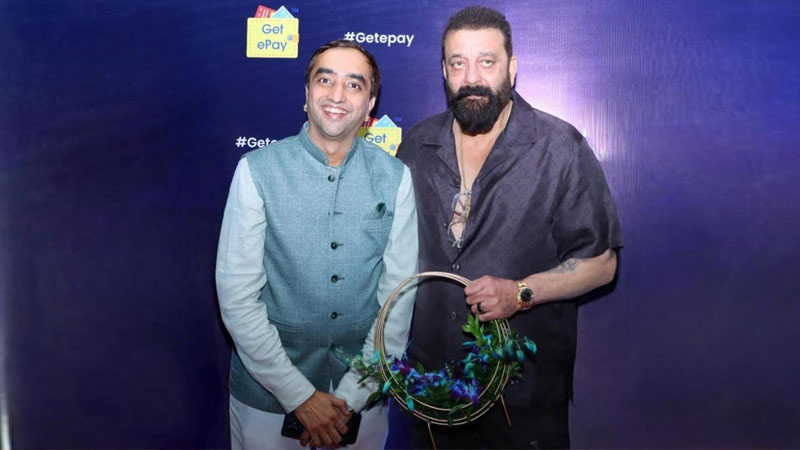
    MUMBAI: He’s known for power-packed performances, now Sanjay Dutt is helping power Digital Bharat. The Hindi cinema icon unveiled Vega, an indigenously built payment switch by Getepay, at an event in Mumbai, joining forces with Getepay founder and managing director Pravin Sharma, to celebrate a major stride in India’s fintech innovation.

    Headquartered in Jaipur, Getepay is a payment aggregator on a mission to make digital transactions simpler, faster, and more inclusive. Its latest creation, Vega, is a certified next-generation payment switch designed to serve banks, fintechs, and merchants with seamless scalability and security. Built on a microservices-based architecture, Vega promises lightning-fast processing, real-time settlements, automated reconciliation, and intelligent merchant management, all crafted in India, for India.

    Speaking at the launch, Sanjay Dutt said, “I’ve always believed in backing things that are real, solid, and made with heart, and that’s exactly what Vega is. This is about more than technology; it’s about giving every entrepreneur, from a street vendor to a shop owner, the confidence to go digital. That’s the Bharat I want to cheer for.”

    Pravin Sharma added, “Vega is not just a technological leap, it’s a bridge for millions of small entrepreneurs powering India’s economy. With Vega, we’re simplifying digital payments while enabling every corner of India to participate confidently in the digital revolution.”

    With its regulatory-compliant, future-ready design, Vega ensures secure, uninterrupted payment processing even during high-traffic periods. Its scalable framework allows banks and merchants to modernise swiftly without disrupting business operations.

    Following an 8 million dollars funding round led by Virender Sehwag, alongside Hyderabad Angels, ITI Growth Fund, and DBR Ventures, Getepay continues to strengthen its digital infrastructure, driving financial inclusion and accessibility for businesses of all sizes.

  • Dandiya dazzle as Hindi cinema joins Falguni Pathak fun

    Dandiya dazzle as Hindi cinema joins Falguni Pathak fun

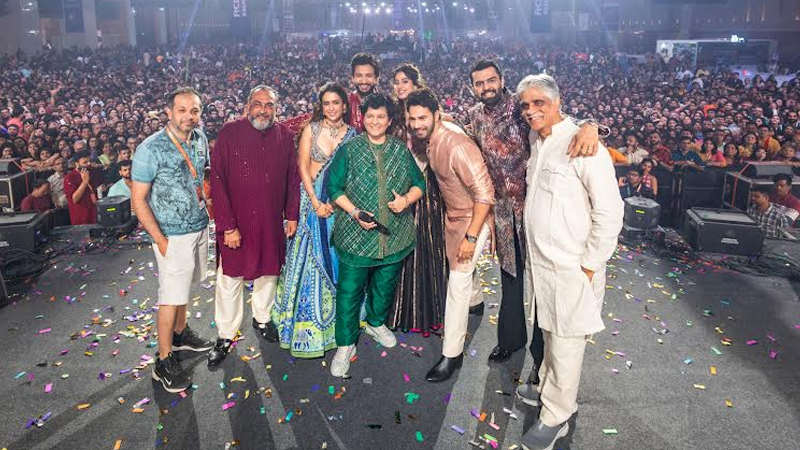
    MUMBAI: Talk about a Hindi cinema beat! The Radiance Dandiya Navratri Utsav 2025 with Falguni Pathak turned Mumbai into a whirlwind of music, colour, and star-studded glamour as the cast of Sunny sanskari ki tulsi kumari: Varun Dhawan, Janhvi Kapoor, Rohit Saraf, Sanya Malhotra and Maniesh Paul, took to the stage on Sunday night.

    Thousands of fans in vibrant festive attire cheered as the stars grooved alongside Falguni Pathak to the chartbuster anthem ‘Bijuria’, breaking into the hook step and creating a magical fusion of Hindi cinema sparkle and Dandiya tradition. The cast also performed a high-energy dance to the peppy track ‘Panwadi’ from their upcoming film, with fans singing along and waving to the rhythm.

    Falguni Pathak’s evergreen hits and signature Garba beats kept the crowd dancing through the night, while a wave of patriotic cheer swept the arena as Team India clinched the Asia Cup 2025. Over seven nights, the festival transformed the Jio World Convention Centre into a hub of devotion, music, and celebration, with special private pods adding a touch of exclusive fun for close groups.

    The event also drew celebrity guests including Dilip Joshi, Divyanka Tripathi, Rupali Ganguly, Orry and Viraj Ghelani, soaking in the festive spirit. Produced by Tribevibe Entertainment, a Bookmyshow company, and Purple Blue Events & Ideas, the Utsav showcased a seamless blend of tradition and modernity, setting a new benchmark for Navratri celebrations in Mumbai.

    With more energetic performances and timeless music to come, Falguni Pathak’s Navratri nights promise to keep the city dancing and celebrating long into the festival season.

  • Aamir Khan slams Hindi cinema’s bad scripts, says good films can’t be stopped

    Aamir Khan slams Hindi cinema’s bad scripts, says good films can’t be stopped

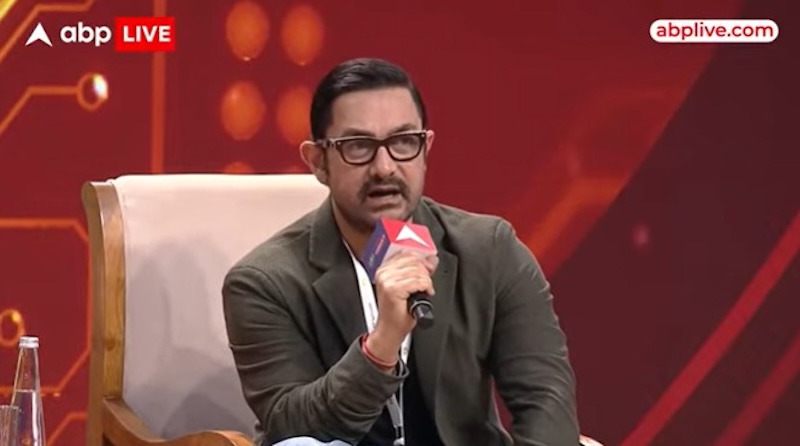
    MUMBAI: Hindi cinema needs to raise its game—and fast. That was the clear message from celebrated actor and filmmaker Aamir Khan at ABP Network’s high-octane India @ 2047 Summit, a national thinkfest charting India’s journey to becoming a fully Viksit Bharat by its centenary year.

    “India has no shortage of stories. The problem is the way we’re telling them,” Khan quipped in a sharp takedown of the Hindi film industry’s recent flops. “Hindi cinema is making bad films. You can’t stop a good film, and you can’t force a bad one to be a hit.”

    He didn’t hold back in comparing the current business model unfavourably to the booming south Indian industry. “We release films theatrically, and in eight weeks they’re available at home. Why would anyone go to a theatre?” he asked, pointing to a post-pandemic shift in viewing habits and a shrinking window between theatrical and satellite premieres.

    Speaking in the session The Attention Industry: Telling the Best Stories, Khan struck a nuanced note. “Box office numbers matter, but they’re not the only yardstick. We also need better stories, better policy support, and frankly, more screens.”

    Taking a macro view, Khan welcomed initiatives like Waves that support the creative industries, urging deeper government collaboration. “India has only 10,000 screens. For Hindi films, we get just 5,000. Compare that with China’s 90,000 or the US’s 35,000. We need more theatres, faster licensing, and incentives to build supporting infrastructure,” he said.

    Khan also teased his upcoming film Sitare Zameen Par, calling it a spiritual successor to his 2007 classic Taare Zameen Par. 

    “It carries the inclusion theme ten steps forward, but this time through comedy. My character Gulshan is a hot-headed basketball coach—the opposite of the gentle Nikumbh,” he smiled. “It’s about how we each define what ‘normal’ means.”

    In true method-actor style, Khan recounted not bathing for days while filming Raakh and Ghulam, laughing, “I had to look like I lived on the streets!”

    On his long-cherished dream of adapting the Mahabharat, Khan said, “That’s a sacred story. It won’t let you down—but you could let it down.” While coy about which character he’d play, he admitted, “Krishna inspires me a lot.”

    He also reflected on missing the re-release of cult comedy Andaz Apna Apna due to the Pahalgam terror attack. “We were devastated. I couldn’t bring myself to attend the premiere. But I trust the government will bring the perpetrators to justice.”

    Recounting a post-Article 370 visit to Srinagar, Khan noted, “There was peace and calm. The lockdown had just ended, but it felt like normalcy was returning.”

    On his unusual compensation model, Khan revealed he doesn’t charge fees upfront. “If the film profits, I earn. If it flops, I don’t. I didn’t take a rupee for Laal Singh Chaddha. I believe in putting my money where my mouth is.”

    At 58, Khan may be selective in his projects, but his voice still packs punch. Hindi cinema makers consider yourself warned.

  • Hindi Diwali blockbusters propel November box office to Rs 914 crore

    Hindi Diwali blockbusters propel November box office to Rs 914 crore

    MUMBAI: Diwali brought more than just lights and festivities this year—it ignited the Indian box office with a dazzling display of cinematic magic.

    According to Ormax Media’s The India Box Office Report: November 2024 the month turned into a blockbuster bonanza, with the box office cash registers ringing up a jaw-dropping Rs 914 crore in gross collections. In a nation where movies are worshipped and stars are idolised, two powerhouse releases—”Bhool Bhulaiyaa 3” and “Singham Again”—emerged as the true torchbearers of unity and entertainment, raking in Rs 664 crore and capturing a whopping 73 per cent of the month’s collections.

    Despite a year marked by a 4 per cent dip compared to 2023, the silver screen proved its resilience, delivering joy, drama, and record-breaking numbers like never before. The numbers don’t just speak—they roar!

    The Hindi film industry delivered a commanding performance in November. “Bhool Bhulaiyaa 3” emerged as the highest-grossing film of the month, amassing Rs 15 crore more than “Singham Again”. Both films now rank among the year’s top Hindi theatrical releases, trailing only “Stree 2” in total collections.

    While “Bhool Bhulaiyaa 3” capitalised on nostalgia and engaging storytelling, “Singham Again” thrived on its action-packed narrative and star power. Together, they bolstered Hindi cinema’s contribution to the cumulative box office for January to November 2024, which stands at Rs 9,862 crore.

    In contrast, non-Hindi films struggled to make a significant impact. The Tamil film “Kanguva”, despite a promising start, faltered due to poor audience reception, barely crossing the Rs 50 crore mark. Hollywood, regional Indian films, and dubbed releases collectively failed to breach the Rs 100 crore benchmark for November.

    Hindi’s market share climbed to 38 per cent  in 2024 from 34 per cent  earlier this year, signaling a recovery. However, it remains below the 44 per cent  dominance recorded in 2023, highlighting room for growth. With “Bhool Bhulaiyaa 3” & “Singham Again” being the latest additions, “Kalki 2898 AD” saw 45 per cent of its box office collection coming from its hindi version, further underscoring the language’s significant contribution to the year’s cinematic landscape.

    The cumulative gross box office collections for 2024 have already surpassed the Rs 10,000 crore threshold, thanks to the enduring appeal of major releases like “Pushpa 2: The Rule”. Industry insiders are optimistic about December’s high-profile films, including “Baby John” (Hindi) and “Mufasa: The Lion King” (Hollywood). With the right audience response, 2024 could challenge the record Rs 12,226 crore gross achieved in 2023.

    The industry’s resilience amidst a 4 per cent  decline is commendable, yet the reliance on a handful of blockbusters underscores vulnerabilities in market diversification. For regional and non-Hindi films, capturing broader audience segments will be crucial.

    As December’s releases roll in, the Indian box office’s final figures for 2024 remain a subject of keen anticipation. The industry’s ability to adapt and innovate will determine whether it can reclaim the highs of previous years or chart new territory in its post-pandemic resurgence.

    Key takeaways:

    1. “Bhool Bhulaiyaa 3” leads November 2024 with record-breaking collections.
    2. Hindi films dominate, contributing 73 per cent of monthly revenue.
    3. Regional and Hollywood films underperform, highlighting disparities.
    4. The annual box office’s success hinges on December’s releases.

    (The main picture for this story was generated usingfreepic ai image generator.. No copyright infringement is intended)

  • MovieMe reveals shift from love stories to societal issues in Hindi cinema

    MovieMe reveals shift from love stories to societal issues in Hindi cinema

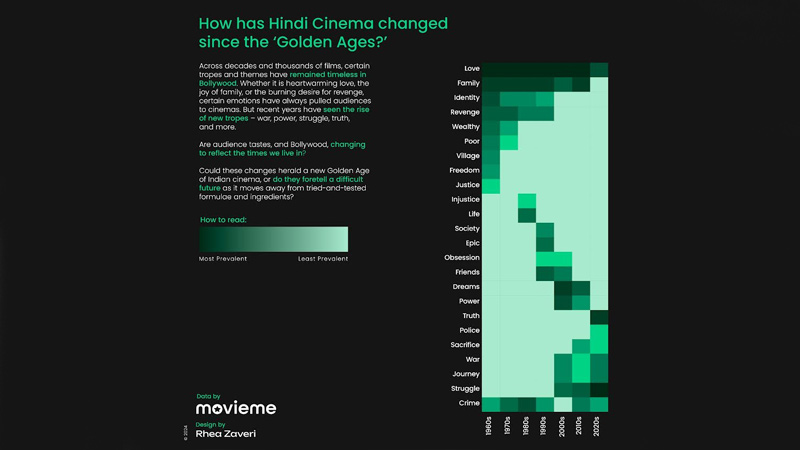
    Mumbai: The evolution of Hindi cinema over the decades reflects both changing societal values and audience tastes. In the aftermath of the golden age of Indian cinema, certain themes came to dominate narratives and audience expectations. MovieMe, an entertainment tech and content discovery platform has done a detailed study to understand the evolutions of the different themes.

    In the 1960s and 1970s, themes like love, family, and identity dominated, while more recent narratives have begun to explore themes of struggle, war, truth, and justice, a study by MovieMe reveals. While some classic tropes, such as revenge and familial bonds, remain timeless, contemporary cinema increasingly focuses on deeper societal issues like inequality, freedom, and power.

    As the world has changed and Indian society evolved alongside, so too has the content of Hindi films, reflecting the times and concerns of the present day. The new themes we see prevalent today represent a shift in Bollywood’s storytelling approach, moving away from formulaic plots to more diverse, complex narratives.

    Could this thematic evolution herald a new golden age of cinema, or does it signal a move toward uncharted territory? Clearly, Indian cinema has come a long way over the decades – and continues to evolve in its role as a mirror to Indian society.

  • UFO Moviez posts Rs 265 mn consolidated revenue for Q2FY22

    UFO Moviez posts Rs 265 mn consolidated revenue for Q2FY22

    Mumbai: In-cinema advertising platform UFO Moviez on Thursday announced its financial results for the quarter and half year ended on 30 September.

    Consolidated revenue stood for at Rs 265 million (Q2FY21 – Rs 128 million), and EBITDA at minus (-) Rs 152 million (Q2FY21 – minus (-) Rs 218 million).

    Consolidated revenue for H1FY22 was Rs 546 million (H1FY21 – Rs 306 million) and EBITDA stood at minus (-) Rs 332 million (H1FY21 – minus (-) Rs 450 million).

    In the quarter under review, theatres reopened from July in a staggered manner, except for Maharashtra, which resulted in Hindi films delaying their release dates. However, in the South and other regional markets, films were released despite restrictions on seating capacity. This led to a gradual revival in the company’s revenue and a reduction in cash losses.

    Maharashtra and Kerala allowed the reopening of theatres beginning on  22 October and 25 October, respectively. Karnataka, Telangana, Rajasthan, Odisha, and Andhra Pradesh are operating at 100 per cent occupancy, while most other states are permitted to operate at 50-60 per cent.

    “During the quarter, there were no Hindi movie releases as theatres in major markets like Maharashtra were not permitted to reopen. However, regional movies performed well at the box office,” said UFO Moviez joint managing director Kapil Agarwal. 

    “With the opening of Cinemas in Maharashtra and Kerala, Hindi and Non-Hindi markets are now fully operational. Recently, Sooryavanshi was released on more than 1600 UFO screens and the much-awaited Rajnikanth movie, Annaatthe, distributed by UFO in the Hindi circuit, was released in more than 700 UFO screens in all languages. Despite the occupancy restrictions, both the movies had a blockbuster opening weekend, collecting 100 plus crores each worldwide. This reaffirms the importance of cinemas. Also, the movie pipeline for the next six to eight months is extremely strong. We expect the film exhibition industry to recover at a rapid pace and are confident that UFO’s business and financial performance will be restored very soon,” he added.

    Further, the board of directors, in its meeting held on 3 November, approved the preferential allotment of 93,99,933 equity shares aggregating to Rs 96.82 crore to Nepean Focused Investment Fund, a scheme of investment of Nepean Investment Trust II, a category II alternative investment fund registered with Securities and Exchange Board of India at a price of Rs 103.01 per equity share, as per applicable rules and regulations. This preferential issue is subject to necessary approvals.

  • Make Film Museum interactive to ensure involvement of visitors, says Arora

    Make Film Museum interactive to ensure involvement of visitors, says Arora

    New Delhi: Information & Broadcasting Secretary Sunil Arora has said every effort is being made to make the second phase of the Film Musuem in Mumbai interactive, giving visitors a very unique viewing experience.

    He said, the museum should highlight the cultural and social impact of cinema on people.

    The remarks came during a review meeting of the National Museum of Indian Cinema at the Films Division in Mumbai on 22 March.

    The focus was on Phase II of the museum that will be housed in a state-of-the-art new building being specially built for the purpose. The progress of civil construction was reviewed and museum plans were discussed.

    The museum, spread over five levels, would showcase various facets of Indian cinema from its early years to present period. It will also have interactive exhibitions on all verticals of film making covering cinematography, editing, sound, script writing, screenplay among others.

    There will also be special sections on regional cinema, Hindi cinema, documentaries and Indian film music.

    The new bulding housed in the Films Division complex on Pedder Road in South Mumbai, will also have two mid-size auditoriums, viewing galleries, cafeteria among others. The building is being built by the public sector National Building Construction Company. The National Council of Science Museums, Kolkata under the Culture Ministry has been tasked with setting up of the museum.

  • Make Film Museum interactive to ensure involvement of visitors, says Arora

    Make Film Museum interactive to ensure involvement of visitors, says Arora

    New Delhi: Information & Broadcasting Secretary Sunil Arora has said every effort is being made to make the second phase of the Film Musuem in Mumbai interactive, giving visitors a very unique viewing experience.

    He said, the museum should highlight the cultural and social impact of cinema on people.

    The remarks came during a review meeting of the National Museum of Indian Cinema at the Films Division in Mumbai on 22 March.

    The focus was on Phase II of the museum that will be housed in a state-of-the-art new building being specially built for the purpose. The progress of civil construction was reviewed and museum plans were discussed.

    The museum, spread over five levels, would showcase various facets of Indian cinema from its early years to present period. It will also have interactive exhibitions on all verticals of film making covering cinematography, editing, sound, script writing, screenplay among others.

    There will also be special sections on regional cinema, Hindi cinema, documentaries and Indian film music.

    The new bulding housed in the Films Division complex on Pedder Road in South Mumbai, will also have two mid-size auditoriums, viewing galleries, cafeteria among others. The building is being built by the public sector National Building Construction Company. The National Council of Science Museums, Kolkata under the Culture Ministry has been tasked with setting up of the museum.

  • This Holi Max2 spreads the colours of Hindi Cinema

    This Holi Max2 spreads the colours of Hindi Cinema

    MUMBAI:The iconic movie channel, Sony Max 2 presents its viewers with some of the most colorful Bollywood movies for Holi. The channel has carefully handpicked films that represent the spirit of joy and celebration that is synonymous with the festival of colors.

    With Holi falling on 6th March, MAX 2 will showcase movies that celebrate different colours of cinema throughout the day. The festival comprises of 4 movies – Silsila, Yaarana, Satte pe Satta and Kishen Kanhaiya representing different shades of life. Silsila the iconic love triangle featuring Amitabh Bachchan, Jaya Bachchan and Rekha represents the beautiful colours of love especially with its timeless Holi song sequence, Yaarana a story of Amitabh and Amjad Khan’s friendship represents the colours of friendship, Satte pe Satta featuring the bond between 7 brothers represents the colours of family bonds and Kishen Kanhaiya a story of twins with contrasting qualities both played by Anil Kapoor represents the contrasting colours of separation and reunion that is prevalent through the film.

    Commenting on the film festival Neeraj Vyas, Sr. EVP & Business Head, MAX & MAX 2 said, “MAX 2 has always entertained its viewers with best movies from Hindi cinema with genres ranging from romance and family dramas to thrillers and social dramas. For those who wish to stay in the comfort of their homes on this festive day, we have created a special line up comprising of some of the best loved films that would enable families to catch up on quality time together”.

  • 10 Indian films in Berlinale, Bimal Julka meets stakeholders to promote India as film destination

    10 Indian films in Berlinale, Bimal Julka meets stakeholders to promote India as film destination

    NEW DELHI: The Information and Broadcasting (I&B) Ministry is to enter into negotiations with countries for promoting the platform of Co-production Audio Visual Agreements in an effort to ensure that India emerges as a viable Filming Destination.


    While a number of agreements had been signed, the broad framework of outlining such agreements had been shared with a number of countries, I&B Secretary Bimal Julka said in his deliberations with key stakeholders representing different film platforms at the Berlin Film Festival. 


    In his interaction with various film bodies and makers, Julka gave an overview of the Single Window Clearance mechanism drawn up in view of constraints faced by agencies for obtaining permission for film shooting in India. Julka said this platform had been created with the objective to establish a single window for film makers seeking permission for filming of feature films, short films and TV programmes. A Standard Operating Procedure had been put in place to facilitate the process and discussions were on to establish a dedicated web portal for this mechanism. 


    Julka said India’s co-production agreements were unique as they offered multiple benefits to foreign film producers. Any agreement to this effect enabled foreign producers to harness the strengths of India’s film prowess namely its technically qualified manpower, pool of talented actors and a multitude of shooting locations.


    Co-production agreements also enabled the films to be treated as National Films and thereby be eligible for National Film Awards and the Indian Panorama Section of the International Film Festival of India. The release of such films through Indian distribution network enabled coproduction to open up to Indian consumer market to the foreign producers. The Indian films industry also benefited by the profiling of shooting locations, generation of direct employment and encouragement to film tourism. 


    On the objective of participation and showcasing the industry at the India pavilion, Julka said it was to promote Indian films across linguistic cultural and regional diversity so as to forge an increasing number of international partnerships in the realms of distribution, production, filming in India, script development and technology, thereby accelerating the growth of film sector in India. Several networking sessions keeping in mind the future roadmap of the film industry had been planned. These included coproduction, single window clearance for filming in India, animation, gaming and visual effects, role of film schools in development of cinema and documentary movement in India. 


    Regarding the India Film Guide released during the Festival, he said the publication was an effort to brand the identity of the Indian film industry and commemorate the celebration of 100 years of Indian Cinema. It provided an opportunity for various stakeholders to understand the nuances of the Indian film industry and international players at the European film market. This publication was an effort to reiterate the role of the Ministry as a facilitator keeping in mind the liberal policies in the media and entertainment industry. The publication also outlined the key policy initiatives and processes under the ambit of the film sector. 


    Ten Indian films will be screened in the 64th Berlin International Film Festival. Indian films screened officially at Berlinale include Imtiaz Ali`s Highway (Panorama), Jayan Cherian`s Papilio Buddha (Panorama), Pushpenra Singh`s Lajwanti (Forum), Jessica Sadana and Samarth Dixit`s Prabhat Pheri (Forum), Avinash Arun`s Killa (Generation), Gaurav Saxena`s Rangrez (Native), and two films Mount Song, Blood Earth (Forum Expanded) among others. The iconic Satyajit Ray`s Nayak (Berlinale Classics) and Mani Kaul`s Ghasiram Kotwal (Forum) will be screened at Berlin in restored prints. In addition, Overdose is in the Co-Production Market and three people in the Berlinale Talent section.