Tag: headend in the sky

  • TRAI advises TV distribution platforms to use e-CAF to increase efficiency

    TRAI advises TV distribution platforms to use e-CAF to increase efficiency

    MUMBAI: As a proactive measure for enabling the use of digital technologies towards bringing efficiencies in providing and managing services to the subscribers, the Telecom Regulatory Authority of India (TRAI) has asked distribution platform operators (DPOs) like direct to home (DTH), multi-system operators (MSOs), Headend-In-The-Sky (HITS) and IPTV companies providing TV broadcast services to use Electronic Customer Application Form (e-CAF). 

    The CAF is required to be filled up by customers mandatorily before subscribing to TV services. The information captured in the CAF is then transferred to the Subscriber Management System (SMS) of the DPO for managing the services availed by the subscriber.

    The authority said that presently, use of CAF in paper format is prevalent and manual process is followed for updating information in the SMS, which involves processing millions of physical CAFs and their storage creates operational difficulties.

    “The e-CAF can be easily accessed and integrated with the SMS of the DPO eliminating the manual feeding of information and also provides customers a simpler method for subscribing to services; improve customer relationship, and management of their subscription and services. The e-CAF will bring efficiencies in the process of providing and managing services to the subscribers,” TRAI said in an advisory. 

    It went on to add that the adoption of e-CAF is an environment friendly measure and is likely to benefit all stakeholders.

  • TRAI advises TV distribution platforms to use e-CAF to increase efficiency

    TRAI advises TV distribution platforms to use e-CAF to increase efficiency

    MUMBAI: As a proactive measure for enabling the use of digital technologies towards bringing efficiencies in providing and managing services to the subscribers, the Telecom Regulatory Authority of India (TRAI) has asked distribution platform operators (DPOs) like direct to home (DTH), multi-system operators (MSOs), Headend-In-The-Sky (HITS) and IPTV companies providing TV broadcast services to use Electronic Customer Application Form (e-CAF). 

    The CAF is required to be filled up by customers mandatorily before subscribing to TV services. The information captured in the CAF is then transferred to the Subscriber Management System (SMS) of the DPO for managing the services availed by the subscriber.

    The authority said that presently, use of CAF in paper format is prevalent and manual process is followed for updating information in the SMS, which involves processing millions of physical CAFs and their storage creates operational difficulties.

    “The e-CAF can be easily accessed and integrated with the SMS of the DPO eliminating the manual feeding of information and also provides customers a simpler method for subscribing to services; improve customer relationship, and management of their subscription and services. The e-CAF will bring efficiencies in the process of providing and managing services to the subscribers,” TRAI said in an advisory. 

    It went on to add that the adoption of e-CAF is an environment friendly measure and is likely to benefit all stakeholders.

  • MSOs, LCOs upbeat about Hinduja’s NXT Digital HITS platform

    MSOs, LCOs upbeat about Hinduja’s NXT Digital HITS platform

    MUMBAI: The Indian television industry is bracing itself for the third phase of digitisation as the deadline for Digital Addressable System (DAS) ends on 31 December, 2015.

    Phase III deadline of digitisation is what the broadcast ecosystem has been talking for a year now. While on the one hand, the government of India has time and again made it clear that there will be no extension of deadline, which is 31 December, 2015, on the other, stakeholders are pointing fingers at the system as the teething issues like inter-connect agreement (ICA), CPS deals et al are yet to be taken care of. In a recent notice the Ministry of Information and Broadcasting (MIB) headed by Arun Jaitley and MoS RajyavardhanSingh Rathore, has asked broadcasters to stop beaming analogue signals to all MSOs. Now with only days to go, people are still unclear as to what’s ahead.

    Amidst the chaos of litigations between stakeholders and various pot-shots being fired, Hinduja’s Headend In The Sky (HITS) platform NXT Digital found its calm in doing actual ground work before launch.

    Harvard Business School professor Rosabeth Moss Kanter once said, “Leaders must pick causes they won’t abandon easily, remain committed despite setbacks, and communicate their big ideas over and over again in every encounter.” And that’s exactly what the team helming NXT Digital did. Prior to its launch on 16 September, the HITS platform carried out road shows involving Last Mile Operators (LMOs) in over 19 cities spread across the length and breadth of the country to communicate the new idea.

    While the initial reactions from the operators weren’t that encouraging, the lack of collaboration on-ground between existing MSOs and LCOs turned out to be a blessing in disguise for NXT Digital, which in turn fuelled its penetration into the hinterland. Now, MSOs and LCOs that Indiantelevision.com spoke to are upbeat about the new platform.

    An independent MSO from the North Eastern Province tells Indiantelevision.com, “I recently invested Rs 50 lakh to establish a cable head-end but as of now I don’t know how much I will be charging the consumers. The Cost Per Subscriber (CPS) model is not even talked about yet. Broadcasters are giving out different deals to different MSOs. If anybody asks me for a suggestion, I would tell them to go for HITS as it is a much more transparent platform.”

    Another impeding problem that the industry will soon face is a serious crisis of Set-Top-Boxes (STBs). While the boxes are assembled in India, the components are still being shipped from China. “The components have not yet been ordered. While a few have placed the first round of orders, there are many who are yet to do that. It takes three months for the components to be delivered from China and then an additional one month to assemble them. So it is certain that the boxes will not reach on time. The STB crisis will be there for NXT Digital too,” said a senior official of an established MSO.

    However, NXT Digital is unperturbed. A senior official of the company says, “There was going to be a set-top box crisis and we always knew about it. Hence we placed an order for four million boxes and there are close to 1.1 million boxes available for us at this stage. So NXT Digital is pretty sorted from the STB point of view.”

    If sources are to be believed, Star is charging Rs 38 for its bouquet in DAS Phase III areas, whereas the Zee bouquet costs close to Rs 30. Sony Pictures Networks India (erstwhile Multi Screen Media) is pricing its bouquet at Rs 24, while India Cast is charging Rs 20.

    On the other hand, NXT Digital is charging Rs 71 per box. “It’s a good deal. It’s just that they don’t have Zee in their package yet. But I don’t think it will take long for them to get them in,” says a reputed member of a Southern cable federation. “They are giving a total of over 300 channels and if there is a spike in demand, they have the infrastructure to meet it too. So it’s a good long term investment.”

    NXT Digital follows a prepaid model, which the Indian ecosystem is not yet used to. “That’s not really a big issue; people usually get used to it. I am getting a lot of positive feedback from the industry about the HITS platform. However, there’s one thing that I will request Mr Tony to look at and that is the exchange of STBs. People are not ready to forget the STB investment that they have already made to have one. If they give an exchange offer, it would be great for us,” opines an LMO.

    Now it remains to be seen how NXT Digital proceeds further and to what extend they succeed in capitalising the hinterlands.

  • MIB reminds broadcasters & MSOs of DAS Phase III signal transmission laws

    MIB reminds broadcasters & MSOs of DAS Phase III signal transmission laws

    NEW DELHI: After the Telecom Regulatory Authority of India (TRAI) firmly ruled out any extension of Phase III of digital addressable systems (DAS), the Information and Broadcasting Ministry today told broadcasters that “it is obligatory to stop TV signals to multi system operators (MSOs) and local cable operators (LCOs) who are not registered with the Ministry for operation in DAS notified areas.”


    In a letter sent to all broadcasters and MSOs, Ministry joint secretary (broadcasting) R Jaya said, “All the broadcasters are requested to ensure to stop TV signals to those MSOs who are not registered with this Ministry for operation in DAS notified areas under Phase Ill and/or those who are not transmitting digitally encrypted TV signals in phase Ill areas after the cut-off date of 31 December, 2015.”


    The letter aimed at drawing the attention of all broadcasters is drawn to certain rules, regulations and guidelines related to transmission of television signals in connection with approaching cut-off date for Phase Ill of cable digitisation in the country.


    The letter said under Section 4A of the Cable Television Network (Regulation) Act 1995, it is obligatory for every cable operator to transmit or re-transmit programmes of any channel in an encrypted form through a digital addressable system with effect from the date as may be specified in the notification.


    Under para 5.6 of the Policy Guidelines for downlinking of Television Channels, the company will provide satellite TV channel signal reception decoders only to MSOs/cable operators registered under the Act or to a direct-to-home operator registered under the DTH guidelines issued by the Government or to an Internet Protocol Television Service (IPTV) provider duly permitted under their existing Telecom license or authorised by the Telecommunications Department or to Headend In The Sky (HITS) operator duly permitted under the policy guidelines for HITS operators issued by I&B Ministry to provide such service.


    Furthermore, the letter said under sub-regulation 3(2) (Chapter II- Interconnection) of Interconnect (Digital Addressable System) Regulations 2012, every broadcaster will provide signals of its TV channels to MSOs registered under rule 11 of the Cable Television Networks Rules 1994, making request for the same.

  • Pay channel’s a la carte rate to not exceed two times its RIO rate: TRAI

    Pay channel’s a la carte rate to not exceed two times its RIO rate: TRAI

    NEW DELHI: The Telecom Regulatory Authority of India (TRAI) today said that the a la carte rate of a pay channel forming part of a bouquet offered by any digital platform should not exceed two times its RIO order rate offered by the broadcaster for addressable systems.


    TRAI also said that the sum of a la carte rates of all channels in the bouquet should not exceed three times the bouquet rate. 


    This applies to all multi-system operators (MSOs), direct to home (DTH) operators, internet protocol service (ISP) providers and Headend in the Sky (HITS) operators providing broadcasting services or cable service to its subscribers using a digital addressable system (DAS) and offers pay channels or pay and free-to-air (FTA) channels as part of a bouquet.


    These provisions are contained in the draft Telecommunication (Broadcasting and Cable) Services (fourth) (Addressable Systems) Tariff (Amendment order), 2015 that TRAI has prepared consequent to an order of the Telecom Disputes Settlement and Arbitration Tribunal (TDSAT) of 13 July.


    TRAI has also given the definitions of RIO and RIO rates in the draft, to which comments can be filed by 14 October with counter-comments if any, by 21 October.


    TRAI defines “RIO” as Reference Interconnect Offer published by a service provider specifying terms and conditions on which other service providers may seek interconnection from the service provider making the offer. On the other hand, “RIO rate” is the rate specified by the service provider in its Reference Interconnect Offer.


    The a-la-carte rates of all the channels offered by the service provider should be same for all the bouquet of channels formed by the service provider.


    The matter had gone to TDSAT as some platforms had objected to the “twin conditions” that were prescribed at retail level pricing of TV broadcasting services in order to link the a-la carte rates of channels to the bouquet rates in the Tariff order of 20 September, 2013.


    TDSAT, while disposing off the appeal vide its order of 13 July, stated that the Authority will consider the concerns of the appellants and take a final decision on the matter within four months from the date of the order.

  • NXT Digital ‘hits’ Indian market with total outlay of Rs 5000 crore

    NXT Digital ‘hits’ Indian market with total outlay of Rs 5000 crore

    NEW DELHI : After three and half years of struggle, Hinduja’s Headend In The Sky (HITS) platform NXT Digital finally got rolling with a total project outlay of approximately Rs 5000 crore. The mammoth investment will be utilised as the business continues to design and develop new products and services for a growing customer base as well as strive to enhance its own standards.


    Information and Broadcasting Minister Arun Jaitley officially launched the venture in the presence of Hinduja Group chairmanAshok Hinduja and Grant Investrade MD Tony D’Silva.


    Launching the platform, Jaitley said, “Multiple carriage technologies will provide customers more choice as to which technology platform to choose.”


    While Hinduja Ventures has set an initial budget of Rs 5000 crore for the project, the chairman is open to investing more if necessary. “We are here to aggressively back this initiative and if necessary we will invest double or triple the allocated budget. Last mile operators (LMOs) are the one who started the business by laying the first cable and this venture is for them,” Hinduja said.


    The HITS project will not only facilitate over 100 million homes go digital in Phase III & IV digitisation markets but will also raise the standards of quality of service. 


    To acquire the base model of a Cable Operators Premises Equipment (COPE), one has to pay Rs 10.60 lakh while the premium one can be acquired after a payment of Rs 14 lakh. The amount appears high for the LMOs but Hinduja said that the Group also has a finance group, which would help the LMOs. “The project has a lot of securities and the investment is certain to provide returns so it is a safe investment. We have insurance schemes for the operators so their investment is safe,” he added.


    According to D’Silva, the consumer will have to pay a maximum of Rs 50 per month. NXT Digital is presently equipped to beam up to 500 channels and this capacity can be raised to 1000. The earth station is in Sector 62 in Noida in the National Capital Region (NCR) of Delhi. NXT Digital has six transponders at present.


    D’Silva also noted that it was interesting that the last two phases of Digital Addressable Cable TV System (DAS) provided for only 32 per cent of the revenue though they would cover a much larger area.


    The DAS Phase III and IV areas, which are estimated to have more than 120 million home, are the prime focus of NXT Digital. To succeed in occupying 15 per cent of the market, the company will have to provide set top boxes (STBs) to 20 million home, which is a huge demand to supply. However, Hinduja is bullish about meeting the demand on time and optimistic that the platform will not face a situation where there will be shortage of boxes.


    NXT Digital is also positioning itself as a adopter of the government’s Make in India, Digital India and Skill India initiatives, which according to Hinduja was the byword for the Group. The LMOs in the DAS III and IV areas have to be skilfully equipped with modern technologies that NXT Digital will be bringing in.


    Asked about how his system was different from the already existing – NSTPL’s JainHits – Hinduja said that the aim of the Hinduja Group was to protect the LCOs because it was they who had built this industry in the late eighties. “Therefore, the LMO will not lose out in any way, will be fully in charge of his own company, and will have full freedom to operate in his own way,” he said.


    When queried as to why it had taken the Group three years to get a licence when there was no cap on HITS, Hinduja said, “Formalities take time.”


    He also said that wherever someone tries to bring in transparency in any system, there are objections. He was also conscious that there was competition in the field and this may even lead to some legal hassles, but his Group was prepared for everything.


    Hinduja said that he was conscious of the matter relating to NSTPL pending in TDSAT, which sought that broadcasters treat HITS players at par with multi system operators (MSOs). He said the NXT Digital viewpoint had been presented at the hearings.


    Senior Hinduja executive Aubin Das said that the NXT Digital platform also took efforts to curb the issue of piracy and if LMOs attempt to put on the channel of a broadcaster in the slots meant for local channels, it could be immediately traced and stopped.


    Commenting on the training and development initiatives Castlemedia director Vynsley Fernandes said, “We are travelling to every nook and corner of the country to skilfully equip and train people about our technological upliftment and it is a chain system. Around 200 people have been trained under a ‘Train the Trainer’ programme and they will train others. And we are not equipping them only about NXT Digital we are introducing them to the next generation.”


    D’Silva said that under NXT Digital, the LMO gets to continue their ownership, enter into broadcasting deals, do packaging and pricing according to market demands, acquire STBs at cheaper rates, run up to 16 local channels, and compete with direct-to-home (DTH) operators.


    He added that DTH was on Ku-Band, which got disturbed in rainy or inclement weather, but HITS being on C-Band will not be disturbed. Furthermore, the HITS headend was on ground while DTH had to depend on satellites. Furthermore, NXT Digital will be able to service both DAS and non-DAS areas.


    NXT Digital focused marketing and subscription drive in the Phase III & IV markets. The company has so far travelled across 400 districts in 20 states to contact and inform the cable fraternity there about its offerings. As of now it has 14 vans touring various parts of the country to give live demonstrations to LMOs and LCOs. 


    Welcoming the move, Maharashtra Cable Operators Federation president and task force member Arvind Prabhu said, “I would like to congratulate AP Hinduja, with this initiative he actually kickstarts the process of digitisation. Mr Hinduja thought about the last mile operators and came up with NXT Digital, which will help LCOs getting their due. The other HITS platform is providing the COPE at a cheaper price and that will be a challenge. The pricing that we got from them are really good but considering the fact that DAS III and DAS IV areas do not come under ratings I believe there can be further negotiation with the broadcaster. Overall I believe it’s a move for the LCOs.”


    LCO from Assam and Task Force member Md Iquebal Ahmed also welcomed the HITS venture. “Operators cannot afford headends and MSOs take total advantage of it and in that context, it’s a great initiative. But the content pricing needs to come out transparently. Affordable pricing is what we are looking forward to.”
     

  • Decks cleared for JAINHITS to get TV signals of MSM Discovery, ESPN and SUN channels

    Decks cleared for JAINHITS to get TV signals of MSM Discovery, ESPN and SUN channels

    NEW DELHI: In less than two months since Media Pro Enterprises India was given directions to supply the channels it distributes to JAINHITS, the country’s only headend-in-the-sky (HITS) platform, the Telecom Disputes Settlement and Appellate Tribunal (TDSAT) today directed Sun, Sony (MSMD) and ESPN to provide their television channel signals to the platform by this evening.

    The three channel aggregators between them provide more than fifty prominent channels, but had been delaying giving their channels to Noida Software Technology Park Ltd (NSTPL) – which manages JAINHITS – which had approached the authorised content aggregator for these channels owned by Sony, Sun and ESPN.

    TDSAT Chairman Justice Aftab Alam and member Kuldip Singh were not impressed by the argument that all operators had created fresh Reference Interconnect Offer for HITS which was yet to get the clearance of the Telecom Regulatory Authority of India (TRAI). They asked the counsel for respondents whether this did not amount to breach of violation of section 3.2 of the Digital Access System (DAS) regulations of the cable interconnect agreement.

    With this, JAINHITS will now be able to transmit over 250 channels to consumers all over the country. The 12 September order relating to Media Pro had brought a total of around 75 channels into the JAINHITS fold.

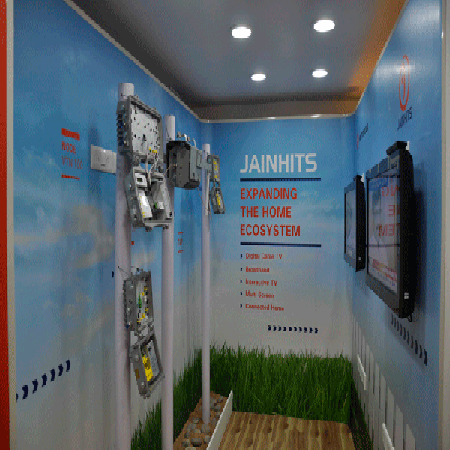
    The only satellite-based platform for the distribution of digital TV channels, NSTPL is currently the only distribution platform of TV channels that is providing advanced HITS services to consumers through local cable operators.

    NSTPL founder and chairman of Jain TV Group Dr. J.K. Jain said, “The mission of JAINHITS is to build and operate digital highways in collaboration with cable network owners. We thank TDSAT for the ruling as this is an important announcement not only for the 60,000 cable operators across the country but also to the consumers. Without proper digitisation, government is losing huge revenue.”

    Senior counsel for NSTPL Vivek Chib told indiantelevision.com that this order would not only be in the larger interest of the government’s digitisation policy, but would ultimately benefit the end-user with greater choice and better quality.

    NSTPL had filed the petition under sections 14 and 14A of the TRAI Act 1997 seeking directions to enter into the Interconnect Agreement on mutually agreed terms or in case the two sides are unable to come to any mutually agreed terms, as per the respondent’s Reference Interconnect Offer (RIO) and to provide to it the content/TV channels under the latter’s control.

    NSTPL obtained from the Information and Broadcasting Ministry in 2003 the licence to establish, install, operate and maintain “headends in the sky” system to provide digital cable services in India. Apparently, the licence was granted even before provisions were made for accommodation of the HITS operator in the regulatory framework. Suitable provisions were made in the regulations to accommodate the HITS operators.

    NSTPL claimed that it had even got its system checked by the Broadcast Engineering Consultants (India) Ltd.