Tag: headend in the sky

  • TRAI orders monthly, quarterly compliance reports from TV distributors

    TRAI orders monthly, quarterly compliance reports from TV distributors

    NEW DELHI: India’s broadcast regulator has ordered all distribution platform operators (DPOs) — including DTH, cable (MSOs), headend in the sky (Hits)  and IPTV players — to file performance monitoring reports every month and quarter, in a bid to sharpen oversight of the sector.

    The Telecom Regulatory Authority of India (TRAI), acting under section 12 of its 1997 Act, said the move was aimed at ensuring compliance, protecting consumer interests and fostering orderly growth of the TV distribution industry.

    Until now, only DTH firms were required to furnish quarterly reports, a rule dating back to 2008 and expanded in 2019 to cover MSOs and Hits)  operators. The new order updates formats to reflect changes in tariff, interconnection and quality-of-service rules.

    From now, operators must file monthly reports within ten days of month-end, and quarterly reports within 15 days of each quarter’s close. Smaller DPOs with fewer than 30,000 subscribers may skip the quarterly filing.
    The order marks another tightening of regulatory screws on a sector under pressure from both rising consumer expectations and surging competition from streaming platforms.

  • GTPL Hathway announces fiscal year 2025 results; recommends dividend

    GTPL Hathway announces fiscal year 2025 results; recommends dividend

    MUMBAI: Cable TV MSO and broadband major GTPL Hathway Ltd  has released its audited financial results for the fourth quarter and the entire financial year, ended 31 March 2025. The board of directors, at its recent meeting, approved these results and recommended a dividend of Rs. 2.00 per equity share of Rs. 10 each, subject to shareholder approval.

    Here’s a snapshot of the company’s standalone financial performance, with comparisons to the previous year:

    finanials
    For the quarter ended 31 March 2025, GTPL Hathway reported revenue from operations of Rs. 5,621.91 million, a 10.44 per cent increase compared to the same period last year, and a net profit after tax of Rs. 81.50 million, a decrease of 18.10 per cent.

    For the year ended 31 March 2025, revenue from operations reached Rs. 21,933.81 million, an 8.13 per cent increase year-over-year, and net profit after tax was Rs. 478.03 million, a 37.30 per cent decrease compared to the previous year.

    The company’s board has proposed a dividend of Rs. 2.00 per share.

    segment results

    The old stager, cable TV, remains a significant contributor to GTPL Hathway’s coffers, raking in Rs 28,620.85 million for the year. However, the segment’s profitability has taken a hit, dropping to  Rs 268.48 million, compared to a far healthier Rs 859.68 million in the previous year. The fourth quarter, in particular, saw a loss of Rs 6.68 million. The internet service segment continues its race, pulling in Rs 5,485.09 million for the year, and a profit of Rs 218.31 million.

    Meanwhile GTPL Hathway  has paid a one-time application fee of Rs 100 million and has obtained approval from the ministry of information & broadcasting to establish, maintain, and operate a headend-in-the- sky (HITS) broadcasting services platform for a 10-year period, in compliance with the HITS guidelines. As at 31 March 2025, the company  is in the process of setting up the associated network and also obtaining other necessary licences.

    A media release issued by the company had the following to say: 

    Q4 FY25 Total revenue stood at Rs 8,989 million a growth of 10 per cent  Y-o-Y
    * FY25 revenue stood at Rs  35,072 million a growth of 8 per cent  annually and broadband revenue grew by four per cent  annually
    * EBITDA for Q4 FY25 stood at Rs   1,144 million  with an EBITDA Margin of 12.7 per cent  and an operating EBITDA margin of 22 per cent. For the full year, EBITDA stands at Rs   4,625 million with EBITDA Margin of 13.2 per cent  with an operating margin of 22 per cent 
    * Q4 FY25 Profit After Tax stood at Rs   105 million  and the same for FY25 is Rs   479 million

    Digital Cable TV
    • Active subscribers were 9.60  million as of March 31, 2025, achieving an increase by 100K Y-o-Y
    • Paying subscribers stood at 8.90 million, increasing by 100K Y-o-Y
    • Subscription revenue from cable TV stood at Rs   2,982 million for Q4FY25 & Rs  12,327 million for FY25
    • Company signed grant of permission agreement (GOPA) with ministry of information and broadcasting for
    providing headend-in-the-sky (HITS) services for a period of 10 years

    Broadband
    • Increase in broadband subscribers by 25K Y-o-Y thus standing at 1045K
    • Broadband revenue increased by 4% to Rs   1,358 million  for Q4 Y-o-Y &Rs   5,456 million  for FY25
    • Homepass as on 31 March  2025, stood at Rs 5.95 million – an addition of 150K Y-o-Y. Of the 5.95Mn, 75 per cent available for FTTX conversion
    • Broadband average revenue per user (ARPU) stood at Rs  465 per month per sub, increased Rs 5 Y-o-Y.
    • Average data consumption per user per month was 396 GB, an increase of 11 per cent  Y-o-Y.

    GTPL Hathway Ltd  managing director Anirudhsinh Jadeja said:  “It pleases me to report that the company has sustained its subscriber base across both business divisions reflecting the resilience within operations in an overall challenging industry environment. We continue to remain optimistic about our long-term strategies and our initiatives to capitalize on the evolving consumer trends.The upcoming financial year will be pivotal as we look to enhance our capabilities for distribution of TV services with material benefits expected to accrue over the medium term. We are constantly enhancing the ambit of our offerings, upgrading and implementing technological innovations and focusing on providing consumer centric services. We will continue to evaluate opportunities for growth across our businesses.”

  • GTPL Hathway signs grant of permission agreement with MIB for HITS

    GTPL Hathway signs grant of permission agreement with MIB for HITS

    MUMBAI: In a bold move, GTPL Hathway is preparing to colonise India’s broadcast wilderness. The Reliance Industries-owned cable TV and broadband maverick secured ministry of information & broadcasting (MIB)  approval in July 2024 to launch its Headend-In-The-Sky (HITS) project, with Rs 100 crore earmarked to execute it, subject to it being able to fulfill the laid-down guidelines.

    Having met them successfully, the company inked a grant of permission agreement (GOPA) with the ministry  on 27 March, securing a decade-long broadcast channel distribution mandate. The nerve centre? Ahmedabad for what could be a nationwide entertainment revolution. The company informed the Bombay stock exchange about the development through a regulatory filing. 

    Piyush Pankaj, the company’s chief strategy officer, had revealed during an analysts’ call in January 2025 that the project was 80 per cent complete. The idea was  to target satellite-dark regions, particularly the infrastructure-starved northern territories through the HITS service..

    The strategic thrust: by marrying cable TV and DTH technologies, GTPL aims to beam entertainment into the digital hinterlands where traditional infrastructure fears to lay its cables. It is believed that GTPL has leased twelve Telkomsat C-band transponders to broadcast the company’s digital dreams.

  • GTPL Hathway aims high with headend-in-the-sky launch in FY26

    GTPL Hathway aims high with headend-in-the-sky launch in FY26

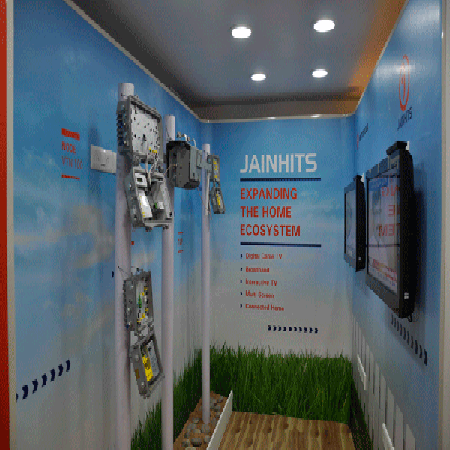
    MUMBAI: Two companies have tried to deliver TV signals via this mode. One of them- Jain headend in the sky (Hits)  was too early – and had to be put to rest. The second -Nxt Digital from the Hinduja group – has only been able to take it a certain distance.  Now a third player is getting into the Hits game: the  Anirudhsinh Jadeja-headed  cable TV and broadband MSO GTPL Hathway.

    Speaking at the investor call after the declaration of its third quarter FY25  financials last week, GTPL Hathway business head B2B &  chief strategy officer Piyush Pankaj  admitted this while responding to a question from an analyst.

    Said he: “..we  are going to change the delivery technology which we are going on. I will talk about that in Q4, much in the Q4 as we are changing it from the fiber to satellite which we are doing right now going on to the Hits, but I will talk about the Hits in the next quarter and how it is going to give us the company the access to all over India, what are going to be main targets on that, how we are going to increase our subscriber base, how it is going to affect our costing and what the positive impact is going to happen on that. That is what we are going to give you in Q4. We are trying to launch that in FY26 this Hits and it is going to be very positive for the company.”

    Pankaj added that government clearances from some of its departments are pending  and the company was in the process of fulfilling  some of the licence obligations from the ministry of information and broadcasting.

    The company has already taken loans for the Hits project  and it is almost 80 per cent complete on the capex side, Pankaj  revealed. “We are just looking forward that by next quarter the whole project will be completed and we will be ready to launch,” he said. 

    Going by the fact that it has emerged as the largest active subscriber cable TV company  in the country, it is in the realms of possibility that its Hits project could well go on to be a major hit with customers. 

  • HITS combines flexibility of DTH and reliability of cable: NXT Digital CEO Vynsley Fernandes

    HITS combines flexibility of DTH and reliability of cable: NXT Digital CEO Vynsley Fernandes

    Mumbai: Headend-in-the-sky (HITS) combined the flexibility and quality of direct-to-home (DTH) services and the reliability and pricing of cable television, said NXT Digital managing director and chief executive officer Vynsley Fernandes on Wednesday. NXT Digital is the only HITS operator in India and Fernandes is bullish on the prospects of video and broadband aggregation using HITS technology.

    In a conversation with Media Partners Asia co-founder and senior partner Vivek Couto at the Apos India summit on Wednesday, Fernandes spoke about structural developments in the TV distribution ecosystem, pricing parity for consumers, satellite broadband policy and more.

    Cable TV has been around since 1995 and the Hinduja Group introduced HITS to India in 2015. The way HITS technology works is that channels are aggregated at an Earth Station, uplinked to a satellite and instead of being downlinked directly to the customers, like DTH, they are received by cable operators via a refrigerator-sized unit and redistributed to customers, explained Fernandes. HITS allows local cable operators to digitise overnight in remote markets such as Lakshadweep, Andaman and Kargil.

    HITS is a capex light model. Post pandemic, there were last mile owners who wanted to be relevant and grow. The challenge was investing in the back-end and connecting to consumers. Fernandes said, “We already have access to 4400 pin codes and we’ve launched 40 NXT Hubs across the country. These NXT Hubs are owned and operated by us and are future-ready. Any last mile owner within 150 square feet can approach a NXT Hub and offer 650 TV channels and broadband speeds of 100 mbps overnight. It empowers the last mile owner to become a digital services provider. By the end of this financial year (March 2022) we will have 100 such NXT Hubs across the country.”

    “Last year, cyclones hit India and MSO fibre got damaged. They had the option to lay fibre but that would take a couple of months or move to another platform. We thought, what if they used our infrastructure to go digital? So, we approached the ministry and shared this idea. Credit to the ministry of information and broadcasting, literally in a few months by November 2020 it was promulgating infrastructure sharing for HITS with MSOs,” he added.

    Speaking about structural developments in the content distribution ecosystem, Fernandes said, “There are two things happening that are changing the structural makeup of distribution in terms of consumption – NTO 1.0 which is bringing parity and transparency and the pandemic.”

    “Post-pandemic, OTT platforms have realised that they can be more relevant to customers as part of an aggregated offering rather than as a standalone service,” observed Fernandes. “In metros where broadband speeds are 100 mbps and above, in towns and smaller markets, people want the same product but in smaller bundles or what we call ‘skinny bundles’. These customers have broadband speeds of 10mbps and their main consumption is not entertainment but access to e-medicine or e-education.”

    In terms of how much a consumer is willing to pay for content, Vynsley noted, “The actual prices differ widely across the country. There are markets where consumers average revenue per user (ARPU) is under $3, content cost is $2-3. In these markets, there’s not much offtake in terms of paid OTT services, instead consumers access YouTube and other freemium platforms. If you move to cities, the pricing is $300 (Rs 28,000-30,000) for an annual subscription. This is a significant opportunity for multi-system operators for flexi-play.”

    Fernandes is of the view that HITS will increase revenues for the entire ecosystem. “Today, a lot of MSOs look at certain markets as not viable because the cost of connectivity is still significant,” he said. “That’s why infrastructure sharing will benefit MSOs and broadcasters. MSO will share capacity and be able to deliver value to customers and better quality of service, while broadcasters will improve their bottom lines.”

    In Q1, NXT Digital reported five million video subscribers and one million broadband users growing at 7-10 per cent year-on-year. “There is a 30 per cent overlap between our video and broadband user base,” said Fernandes. “That means a quarter of a million customers are consuming both linear/digital products. There is a runway to grow that base to a healthy 50-60 per cent and that’s our target vision for the business. We’ve just launched our OTT product and are looking at bundled ARPUs. Linear TV ARPUs are currently at Rs 300 and OTT delivers higher ARPUs for us. It doesn’t concern me too much which part of revenue delivers but our offering should reach every demographic in the country.”

    During the pandemic, the government couldn’t reach out of several million people who resided in areas where connectivity was patchy. It was prompted to launch e-agriculture and e-medicine services and Telecom Regulatory Authority of India (Trai) has released recommendations on satellite-based connectivity for low bit rate applications. “The government is working on a clear plan and sees the tremendous need for broadband over satellite,” noted Fernandes.

    “Satellite broadband is a clear parallel to HITS which was needed to deliver video in markets that could not be serviced by terrestrial networks,” said Fernandes. “Broadband serves the same void by catering to markets that cannot be serviced by terrestrial fibre. Today, a broadband over satellite provider needs four things – reach and footprint, a company with experience working with satellite, regulatory knowledge and ability to work with industry stakeholders.”

  • Hinduja Ventures board okays amalgamation with Grant Investrade

    Hinduja Ventures board okays amalgamation with Grant Investrade

    MUMBAI: Hinduja Ventures Ltd’s (HVL) the board of directors  has approved the amalgamation of Grant Investrade Ltd (GIL), a wholly owned subsidiary, into the company. 

    The appointed date for the scheme of amalgamation is 1 October 2017.

    The approval has been granted subject to the approval of the National Company Law Tribunal (NCLT) at Mumbai, the approval of the shareholders and other such approvals as may be required.

    HVL has business interests in media, real estate and treasury while GIL is in the business of running channels on cable TV and treasury.

    Earlier, GIL housed the headend in the sky (HITS) business of HVL. The HITS business has now been merged with the cable TV business under IndusInd Media and Communications Ltd (IMCL), which is also a subsidiary company.

    HVL’s revenue from operations in financial year 2017 was Rs 201.7 crore while the paid-up capital is Rs 20.55 crore. GIL, whose paid-up capital is Rs 6.78 crore, had earned revenue of Rs 22.7 crore during the year.

    Since the transaction falls within the related party transaction no shares will be issued to GIL.

    Also Read:

    HVL reports lower loss for fiscal ’17, media & communications segment revenue up

    HVL receives NCLT nod for GIL’s HITS to de-merge into Indusind Media

  • Q1-17: HVL revenue up 129%; to invest Rs 271 crore for carriage subsidiary stake

    Q1-17: HVL revenue up 129%; to invest Rs 271 crore for carriage subsidiary stake

    BENGALURU/MUMBAI: Hinduja Ventures Limited (HVL) reported more than doubling (up 129 percent) of its revenue for the quarter ended June 30, 2016 (Q1-17, current quarter) vis-à-vis revenue for the corresponding year ago quarter.

    HVL revenue for Q1-17 was Rs 60.95 crore, while it was Rs 26.63 crore for the corresponding period previous year.
    However, quarter-over-quarter (q-o-q), revenue for the current quarter declined 35 percent from Rs 93.75 crore in Q4-16. The company attributes the increase in revenue to sale of setup boxes/ broking income/ income from trading of securities.

    The company reported a year-over-year (y-o-y) growth in profit of 1.3 percent for the current quarter at Rs 24.21 crore as compared to Rs 23.90 crore and a 70.8 percent q-o-q growth as compared to Rs 14.18 crore.

    HVL operates across three segments of media and communication, real estate, and investment and treasury. HVL is the holding company of integrated media companies IndusInd Media and Communications Limited (IMCL) and Grant Investrade Limited (GIL), which has launched the headend-in-the-sky (HITS) digital platform under brand name NXT DIGITAL.

    HVL’s media and communications segment

    Revenue from its media and communications segment declined q-o-q to less than a fourth (down 76.6 percent). HVL reported revenue of Rs 14.40 crore in Q1-17 and Rs 61.69 crore in Q4-16. The segment reported an operating loss of Rs 5.61 crore in the current quarter as compared to an operating loss of Rs 0.37 crore in Q1-16 and an operating profit of Rs 2.71 crore in Q4-16. For the year ended March 31, 2016 (FY-16), the segment reported an operating profit of Rs 10.09 crore.

    HVL to invest Rs 271 crore for stake in IMCL

    HVL proposes to purchase 43,03,000 equity shares of Rs 10 each for a premium of Rs 456 per share of its subsidiary IMCL.
    This stake purchase, which constitutes 5.82 percent of IMCL’s paid up equity capital, will cost HVL Rs 200.52 crore. HVL also proposes to buy 7,03,60,0000 IMCL preference shares of Rs 10 each at par from its wholly owned subsidiary shares of GIL. The IMCL stake purchase from GIL constitutes 26.02 percent of paid up preference capital of IMCL and will cost HVL Rs 70.36 crore.

    GIL to de-merge HITS to IMCL

    GIL will de-merge its HITS business undertaking to IMCL, the HVL board has decided. The scheme is subject to consent(s), approval(s) permission(s) of statutory authorities(s) if any, including, in particular, the approval from the Ministry of Information and Broadcasting (MIB), Government of India for transfer and vesting of HITS License held by GIL in favour of IMCL.

    HVL says that India is yet to witness a genuine and significant revolution in the digital delivery in true sense, especially in tier 3 and 4 cities and rural hinterland.

    The digitalization with many upcoming value added services of over 160 million (16 crore) TV homes is still far from over. It is envisaged that the combined strength of fibre based digital cable delivery and the satellite based digital signals for cable industry will enhance and create a new paradigm in the digital content delivery platform in terms of reach, value for money, state of the art technology, quality of services and significant value added digital services.

    The company also feels that this will further enhance shareholders value by consolidating the digital media distribution businesses and will help to rationalize the group structure by optimizing the resources and integrating operational synergies both in revenue and costs.

    The combined entity will also be able to venture and grow in the newer areas and many digital technology-linked value-added services that would be relevant for this business and same set of customers.
    According to HVL, its broadband business has also been restructured for a direct focus and is planned for a manifold technology-based growth.

    The synergy will be able to consolidate HVL’s media investments and would  enhance and maximize the shareholders value, avers the company.

    GIL’s (HITS business) merger into IMCL will be a unique first in the country in digital cable and has a long term positive financial implication by increasing competitive strength, technology synergies, customer service efficiency and high productivity with a genuine all-India reach. HVL says adding that similar models in developed countries have witnessed a prime leadership position in mid to long term.

    The company states that this arrangement will also strengthen HVL’s investment in media business, which will, in turn, unlock the value of HVL’s shareholders.

    Note: (1) The unit of currency in this report is Indian rupee – Rs (also conventionally represented by INR). The Indian numbering system or the Vedic numbering system has been used to denote money values. The basic conversion to the international norm would be:

    (a) 100,00,000 = 100 lakh = 10,000,000 = 10 million = 1 crore.
    (b) 10,000 lakh = 100 crore = 1 arab = 1 billion.

    (2) The numbers in this report are standalone unless stated otherwise

    (3)  1 USD= INR 67


  • Q1-17: HVL revenue up 129%; to invest Rs 271 crore for carriage subsidiary stake

    Q1-17: HVL revenue up 129%; to invest Rs 271 crore for carriage subsidiary stake

    BENGALURU/MUMBAI: Hinduja Ventures Limited (HVL) reported more than doubling (up 129 percent) of its revenue for the quarter ended June 30, 2016 (Q1-17, current quarter) vis-à-vis revenue for the corresponding year ago quarter.

    HVL revenue for Q1-17 was Rs 60.95 crore, while it was Rs 26.63 crore for the corresponding period previous year.
    However, quarter-over-quarter (q-o-q), revenue for the current quarter declined 35 percent from Rs 93.75 crore in Q4-16. The company attributes the increase in revenue to sale of setup boxes/ broking income/ income from trading of securities.

    The company reported a year-over-year (y-o-y) growth in profit of 1.3 percent for the current quarter at Rs 24.21 crore as compared to Rs 23.90 crore and a 70.8 percent q-o-q growth as compared to Rs 14.18 crore.

    HVL operates across three segments of media and communication, real estate, and investment and treasury. HVL is the holding company of integrated media companies IndusInd Media and Communications Limited (IMCL) and Grant Investrade Limited (GIL), which has launched the headend-in-the-sky (HITS) digital platform under brand name NXT DIGITAL.

    HVL’s media and communications segment

    Revenue from its media and communications segment declined q-o-q to less than a fourth (down 76.6 percent). HVL reported revenue of Rs 14.40 crore in Q1-17 and Rs 61.69 crore in Q4-16. The segment reported an operating loss of Rs 5.61 crore in the current quarter as compared to an operating loss of Rs 0.37 crore in Q1-16 and an operating profit of Rs 2.71 crore in Q4-16. For the year ended March 31, 2016 (FY-16), the segment reported an operating profit of Rs 10.09 crore.

    HVL to invest Rs 271 crore for stake in IMCL

    HVL proposes to purchase 43,03,000 equity shares of Rs 10 each for a premium of Rs 456 per share of its subsidiary IMCL.
    This stake purchase, which constitutes 5.82 percent of IMCL’s paid up equity capital, will cost HVL Rs 200.52 crore. HVL also proposes to buy 7,03,60,0000 IMCL preference shares of Rs 10 each at par from its wholly owned subsidiary shares of GIL. The IMCL stake purchase from GIL constitutes 26.02 percent of paid up preference capital of IMCL and will cost HVL Rs 70.36 crore.

    GIL to de-merge HITS to IMCL

    GIL will de-merge its HITS business undertaking to IMCL, the HVL board has decided. The scheme is subject to consent(s), approval(s) permission(s) of statutory authorities(s) if any, including, in particular, the approval from the Ministry of Information and Broadcasting (MIB), Government of India for transfer and vesting of HITS License held by GIL in favour of IMCL.

    HVL says that India is yet to witness a genuine and significant revolution in the digital delivery in true sense, especially in tier 3 and 4 cities and rural hinterland.

    The digitalization with many upcoming value added services of over 160 million (16 crore) TV homes is still far from over. It is envisaged that the combined strength of fibre based digital cable delivery and the satellite based digital signals for cable industry will enhance and create a new paradigm in the digital content delivery platform in terms of reach, value for money, state of the art technology, quality of services and significant value added digital services.

    The company also feels that this will further enhance shareholders value by consolidating the digital media distribution businesses and will help to rationalize the group structure by optimizing the resources and integrating operational synergies both in revenue and costs.

    The combined entity will also be able to venture and grow in the newer areas and many digital technology-linked value-added services that would be relevant for this business and same set of customers.
    According to HVL, its broadband business has also been restructured for a direct focus and is planned for a manifold technology-based growth.

    The synergy will be able to consolidate HVL’s media investments and would  enhance and maximize the shareholders value, avers the company.

    GIL’s (HITS business) merger into IMCL will be a unique first in the country in digital cable and has a long term positive financial implication by increasing competitive strength, technology synergies, customer service efficiency and high productivity with a genuine all-India reach. HVL says adding that similar models in developed countries have witnessed a prime leadership position in mid to long term.

    The company states that this arrangement will also strengthen HVL’s investment in media business, which will, in turn, unlock the value of HVL’s shareholders.

    Note: (1) The unit of currency in this report is Indian rupee – Rs (also conventionally represented by INR). The Indian numbering system or the Vedic numbering system has been used to denote money values. The basic conversion to the international norm would be:

    (a) 100,00,000 = 100 lakh = 10,000,000 = 10 million = 1 crore.
    (b) 10,000 lakh = 100 crore = 1 arab = 1 billion.

    (2) The numbers in this report are standalone unless stated otherwise

    (3)  1 USD= INR 67


  • Stakeholders welcome easing of FDI norms for broadcasting; want DAS to move faster

    Stakeholders welcome easing of FDI norms for broadcasting; want DAS to move faster

    NEW DELHI: The broadcasting sector and particularly the cable sector welcomed the government’s announcement bringing almost the entire broadcasting sector under the automatic route for foreign direct investment.

    Stakeholders said the step was very timely as the country was on the verge of completing the transformation to digital addressable systems for cable television.

    The government had this morning announced opening up setting up of teleports, direct-to-home, cable networks, headend-in-the-sky and mobile television to 100 per cent foreign direct investment through the automatic route.

    The announcement from the Prime Minister’s office said this had been done with the objective of providing major impetus to employment and job creation in India.

    However with regard to the broadcasting sector, it was made clear that infusion of fresh foreign investment beyond 49 percent in a company not seeking license/permission from sectoral Ministry, resulting in change in the ownership pattern or transfer of stake by existing investor to new foreign investor, will require approval of the Foreign Investments Promotion Board.

    However, Hinduja Ventures Ltd whole-time director and former president of the MSO Alliance Ashok Mansukhani told indiantelevision.com that these changes would have real meaning only if the government is able to bring back DAS ‘on the rails.’

    He said that just around six months were left for the final Phase of DAS and Phase III was already mired in several cases all over the country. Although the Supreme Court had directed that these be transferred to Delhi High Court, this process had not been completed with the result that the High Court could not proceed to hear the matter.

    Phase III was to cover 7,700 cities and Phase four is to cover 61 million (6.1 crore) television households, but all this will be derailed unless the government is able to implement the different phases.

    In a general reaction to the liberalization in FDI, FICCI Secretary-General Didar Singh said“There is no doubt that India today is the most preferred investment destination in the world. While the attraction of our market is known to all, there is now even more reason for global investors to commit themselves for making and doing business in India. Our government is translating words into action and after having made a strongest pitch ever to global investors, it if following up with a major overhaul of the FDI framework so that the interest generated is captured in the form of higher investment flows which are on a rise since the last two years”.

    National Cable and Telecommunication Association President Vikki Choudhuri, while welcoming the move, said the government should also immediately re-look at the regulations which are not favourable for BPOs and the last mile operator.

    Cable Operators Federation of India president Roop Sharma said that while the relaxation for cable and multi system sector going through automatic route was welcome, it would not serve any purpose unless the last mile operator is educated about this.

    As a result, she said it would only lead to creation of monopolies in the hands of a few large cable and MSO operators. This was because cable operators in smaller towns never even came to know about the changes since no effort was made by the government to educate them.

  • Stakeholders welcome easing of FDI norms for broadcasting; want DAS to move faster

    Stakeholders welcome easing of FDI norms for broadcasting; want DAS to move faster

    NEW DELHI: The broadcasting sector and particularly the cable sector welcomed the government’s announcement bringing almost the entire broadcasting sector under the automatic route for foreign direct investment.

    Stakeholders said the step was very timely as the country was on the verge of completing the transformation to digital addressable systems for cable television.

    The government had this morning announced opening up setting up of teleports, direct-to-home, cable networks, headend-in-the-sky and mobile television to 100 per cent foreign direct investment through the automatic route.

    The announcement from the Prime Minister’s office said this had been done with the objective of providing major impetus to employment and job creation in India.

    However with regard to the broadcasting sector, it was made clear that infusion of fresh foreign investment beyond 49 percent in a company not seeking license/permission from sectoral Ministry, resulting in change in the ownership pattern or transfer of stake by existing investor to new foreign investor, will require approval of the Foreign Investments Promotion Board.

    However, Hinduja Ventures Ltd whole-time director and former president of the MSO Alliance Ashok Mansukhani told indiantelevision.com that these changes would have real meaning only if the government is able to bring back DAS ‘on the rails.’

    He said that just around six months were left for the final Phase of DAS and Phase III was already mired in several cases all over the country. Although the Supreme Court had directed that these be transferred to Delhi High Court, this process had not been completed with the result that the High Court could not proceed to hear the matter.

    Phase III was to cover 7,700 cities and Phase four is to cover 61 million (6.1 crore) television households, but all this will be derailed unless the government is able to implement the different phases.

    In a general reaction to the liberalization in FDI, FICCI Secretary-General Didar Singh said“There is no doubt that India today is the most preferred investment destination in the world. While the attraction of our market is known to all, there is now even more reason for global investors to commit themselves for making and doing business in India. Our government is translating words into action and after having made a strongest pitch ever to global investors, it if following up with a major overhaul of the FDI framework so that the interest generated is captured in the form of higher investment flows which are on a rise since the last two years”.

    National Cable and Telecommunication Association President Vikki Choudhuri, while welcoming the move, said the government should also immediately re-look at the regulations which are not favourable for BPOs and the last mile operator.

    Cable Operators Federation of India president Roop Sharma said that while the relaxation for cable and multi system sector going through automatic route was welcome, it would not serve any purpose unless the last mile operator is educated about this.

    As a result, she said it would only lead to creation of monopolies in the hands of a few large cable and MSO operators. This was because cable operators in smaller towns never even came to know about the changes since no effort was made by the government to educate them.