Tag: HD TV

  • Aastha, Swami Ramdev’s HD TV plans

    Aastha, Swami Ramdev’s HD TV plans

    MUMBAI: Most spiritual and devotional channels operating in India have a bagful of problems: limited revenues, low production budgets, which have led to very poor production values for their shows. Programmes and shows are shot with standard definition cameras with cheap sets as backdrops.

    This, at a time, when most of television land is moving to high definition and a select few towards 4k high dynamic range productions – both of which give better quality video – which can play out better on HD and 4K sets, making for a near realistic viewing experience.

    Swami Ramdev and Acharaya Balkrishna’s Patanjali Ayurveda has been giving FMCG multinationals in India a bit of a headache by eating away at their market shares in several product categories.

    Now the yoga guru-turned-entrepreneur is hoping to capture global audiences with his brand of yoga keeping in mind prime minister Narendra Modi’s penchant for it.

    Aastha – as is known to many – is among the leaders in the spiritual television space in India. And it is a channel that is part of Swami Ramdev’s empire.

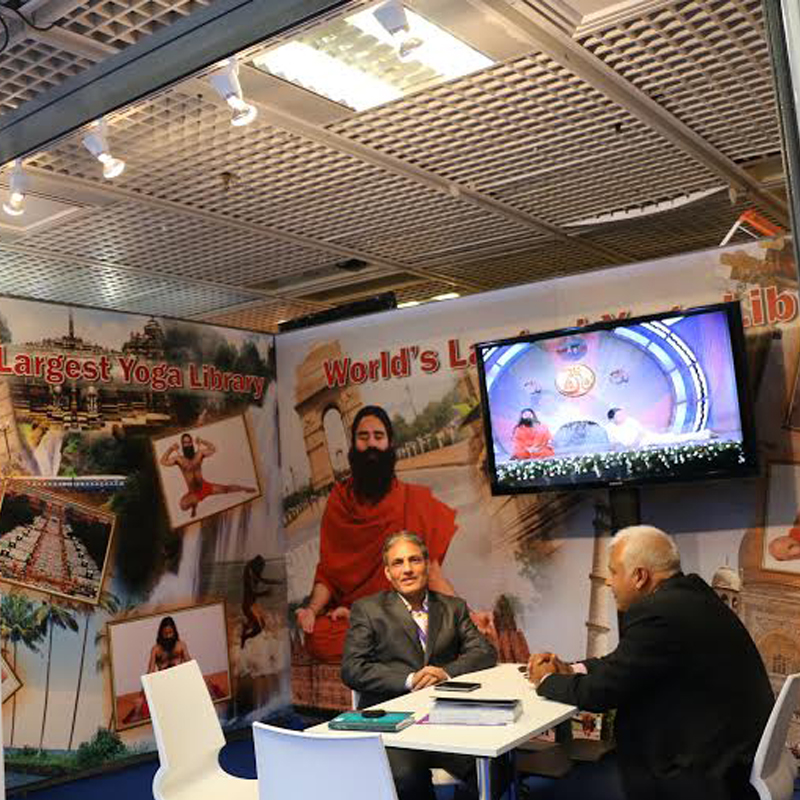
    Over the past year or so, an HD revolution has been taking place silently in Noida where Aastha TV’s studios, playout and uplinking hub are located. Swami Ramdev has pumped in more than Rs 50 lakh into infrastructure – including 10-12 Sony PMW 200 cameras and post production facilities – which has helped facilitate production of programmes featuring him in high definition.

    Two multi-camera teams have been trailing the yoga guru filming him at gatherings, camps and seminars where he has led his disciples in asanas. Almost 700 hours of Yoga have been filmed in HD so far.

    “We wanted to upgrade and keep pace with technology,” says Aastha Broadcasting Network CEO Pramod Joshi. “We were producing and transmitting in SD which has limited demand in international markets.”

    Joshi acknowledges that the shift to HD came at the urging of Reed Midem’s India, Pakistan, Bangladesh and Sri Lanka representative Anil Wanvari (also the founder of the indiantelevision.com group) when the company exhibited at annual trade show MipCom in Cannes, France.

    He points out that there here are no plans to roll out a HD channel for now, since the focus is on building a library first with Swami Ramdev’s yoga practice. Simultaneously, the channel’s programmers have been giving a nudge to other prime gurus who have taken slots on Aastha to upgrade their productions.

    “We know there is a lot of demand for Indian spirituality and yoga worldwide,” points out Joshi. “With this step up in quality, we believe many more networks will want our programming. We are also open to dubbing the content in other local languages.”

    Currently, Zee International airs programmes featuring Swami Ramdev practising and teaching yoga at his camps. Enquiries from other overseas networks have been coming in.

    In addition to yogic exercise and spiritual TV shows, Joshi says that Aastha is also looking at filming spiritual tourism documentaries by partnering with different state tourism boards. “There is a lot of India interest and these documentaries will go a long way in helping both Indian and international visitors understand India’s diverse belief systems and places of spiritual worship better and from a regional perspective.”

    Finally, Aastha, like other Indian networks which are looking at licensing and syndication revenues, is hopeful that its HD production will find cachet with international buyers. “Swamiji is known worldwide,” he says. “That’s to our advantage. We hope in the next year or so, licensing and syndication of our content will scale up. “

    When it does, Astha’s investment in HD will start paying off.

  • Aastha, Swami Ramdev’s HD TV plans

    Aastha, Swami Ramdev’s HD TV plans

    MUMBAI: Most spiritual and devotional channels operating in India have a bagful of problems: limited revenues, low production budgets, which have led to very poor production values for their shows. Programmes and shows are shot with standard definition cameras with cheap sets as backdrops.

    This, at a time, when most of television land is moving to high definition and a select few towards 4k high dynamic range productions – both of which give better quality video – which can play out better on HD and 4K sets, making for a near realistic viewing experience.

    Swami Ramdev and Acharaya Balkrishna’s Patanjali Ayurveda has been giving FMCG multinationals in India a bit of a headache by eating away at their market shares in several product categories.

    Now the yoga guru-turned-entrepreneur is hoping to capture global audiences with his brand of yoga keeping in mind prime minister Narendra Modi’s penchant for it.

    Aastha – as is known to many – is among the leaders in the spiritual television space in India. And it is a channel that is part of Swami Ramdev’s empire.

    Over the past year or so, an HD revolution has been taking place silently in Noida where Aastha TV’s studios, playout and uplinking hub are located. Swami Ramdev has pumped in more than Rs 50 lakh into infrastructure – including 10-12 Sony PMW 200 cameras and post production facilities – which has helped facilitate production of programmes featuring him in high definition.

    Two multi-camera teams have been trailing the yoga guru filming him at gatherings, camps and seminars where he has led his disciples in asanas. Almost 700 hours of Yoga have been filmed in HD so far.

    “We wanted to upgrade and keep pace with technology,” says Aastha Broadcasting Network CEO Pramod Joshi. “We were producing and transmitting in SD which has limited demand in international markets.”

    Joshi acknowledges that the shift to HD came at the urging of Reed Midem’s India, Pakistan, Bangladesh and Sri Lanka representative Anil Wanvari (also the founder of the indiantelevision.com group) when the company exhibited at annual trade show MipCom in Cannes, France.

    He points out that there here are no plans to roll out a HD channel for now, since the focus is on building a library first with Swami Ramdev’s yoga practice. Simultaneously, the channel’s programmers have been giving a nudge to other prime gurus who have taken slots on Aastha to upgrade their productions.

    “We know there is a lot of demand for Indian spirituality and yoga worldwide,” points out Joshi. “With this step up in quality, we believe many more networks will want our programming. We are also open to dubbing the content in other local languages.”

    Currently, Zee International airs programmes featuring Swami Ramdev practising and teaching yoga at his camps. Enquiries from other overseas networks have been coming in.

    In addition to yogic exercise and spiritual TV shows, Joshi says that Aastha is also looking at filming spiritual tourism documentaries by partnering with different state tourism boards. “There is a lot of India interest and these documentaries will go a long way in helping both Indian and international visitors understand India’s diverse belief systems and places of spiritual worship better and from a regional perspective.”

    Finally, Aastha, like other Indian networks which are looking at licensing and syndication revenues, is hopeful that its HD production will find cachet with international buyers. “Swamiji is known worldwide,” he says. “That’s to our advantage. We hope in the next year or so, licensing and syndication of our content will scale up. “

    When it does, Astha’s investment in HD will start paying off.

  • April Broadcast launches Choice HD

    April Broadcast launches Choice HD

    MUMBAI: Mumbai based, April Broadcast Pvt. Ltd., a privately owned company in the Technology and Media space, announced the launch of CHOICE HDTM, a new video Switcher/Mixer application, developed in-house, especially for the Indian Wedding Video editing market. Watch the video here: www.youtube.com/abChoiceHai  


    This was demonstrated at the All India Photographic Trade and Industry Association’s (AIPTIA) Consumer Electronics and Imaging Fair 2014. The event, popularly known as Photofair, is India’s largest expo for Photography and Videography products, and was held in Mumbai from 9-12 January.


    “This segment has been growing steadily over the past few years and we noticed that wedding videographers did not have too many options when it came to producing these typical wedding videos. With CHOICE HDTM, we have, literally, given them the freedom of choice to unleash their creativity and make something really beautiful for the bridal couple.” said Sandeep N Ohri, Founder, April Broadcast Pvt. Ltd.


    CHOICE HDTM leverages industry-standard video I/O cards to give the professional video editor a simple-to-use, yet powerful solution, that runs on Windows-based PCs.


    CHOICE HDTM is extremely versatile and simultaneously switch/mix 4 digital HD/SD or analog video inputs, 2 recorded media inputs, 2 graphics and 2 tickers (both in different languages). In addition, CHOICE HDTM has a variety of special transition effects, handles audio I/O and allows simultaneous recording in HD and web-streaming of the output.


    According to industry estimates, the Indian wedding market as a whole is around US$ 25 billion, (approx. Rs 1.5 lakh crores), and growing at 25 to 30 per cent a year. In India, no wedding is complete without the production of a wedding video to capture and preserve this all-important life event.


    Today, Indian wedding videos are increasingly inspired by Bollywood (the largely popular Indian Hindi film industry) and bridal couples aspire to have their videos shot to the tune of the latest popular film songs! This involves complex editing of videos captured from various cameras and angles, application of special effects and finally, expert editing to synchronize this to the background. With HD TVs and Blu-ray DVD players becoming cheaper, all of this is now required in full HD resolution.


    “In addition to handling existing legacy analog and digital SD video, CHOICE HDTM handles full HD digital video and is also upgradeable to handle 2K and 4K resolutions as well, making this a safe investment for videographers in this fast changing technology landscape.” said Salim Shaikh, co-founder, April Broadcast Pvt. Ltd.


    CHOICE HDTM will ship to customers in February 2014 and is the third application developed by April Broadcast in less than 9 months, since its inception. Other solutions are an entry-level HDMI-based virtual studio solution for Education and a high-end virtual studio solution for television broadcast.

  • Broadcasters want Trai to reinitiate dialogue on ad regulation

    NEW DELHI: Worried about the implications of the Telecom Regulatory Authority of India‘s (Trai) ad regulation policy on their business models, television industry‘s apex body Indian Broadcasting Foundation (IBF) has urged the government to engage in discussion with the stakeholders of the broadcast industry and roll back the regulation for the time being.

    The IBF suggested that like content the government should encourage self-regulation that is in line with global standards rather than pushing the regulation down the throats of broadcasters who are already reeling due to ad slowdown.

    “IBF calls for withdrawal of the notification and re-initiation of a participatory dialogue that helps make self-regulation of advertising minuteage in line with global standards a reality,” the IBF said in a statement.

    It added, “The IBF has been working with Trai over the last several months to arrive at a way forward on the quantum of advertising duration. Its fundamental stance has always been to self-regulate, aligned with globally practiced standards.”

    The IBF said that the industry is in agreement with the objective of the regulation that is better viewing experience for consumers without being frequently disrupted by advertisements, but the regulation must take into account the economic sustenance of the broadcast business.

    “The staging of doing this has to be in line with economic sustenance of the broadcasting business and is best aligned to the full value of digitisation becoming a reality.”

    The broadcast industry is still dependent on ad revenue as the primary source of income and the trickle down benefits of the much-hyped cable digitisation has not yet been realised even as carriage fees continue to be a burden.

    “The trickle back effect from the first stage of digitisation is yet to begin. Carriage fees introduced in 2008 remain a burden, especially for the more than 500 smaller channel operators. Cable TV tariffs remain frozen at 2005 rates. HD TV and pay channel revenues are just about beginning to happen and will take time to start providing economic value.

    Unless these issues are dealt with by the government it would be unfair on part of the government to bring ad regulation as the business model of broadcasters would go haywire.

    “These factors need concomitant addressing. Regulation on just advertising minuteage will have a severe impact on the survival of the broadcasting industry from amputation of a critical arm of the fourth estate,” the IBF averred.

    It opined that the broadcasting industry is yet to fully recover from the shocks of 2008 recession that had slowed down ad growth.

    “Like several industries that continue to reel from the after effects of the global economic recession, India‘s television broadcasting industry has been suffering too. The industry is largely dependent on advertising revenues for its economic sustenance,” the IBF contended.

    The Trai had on 22 March notified the Standards of Quality of Service (Duration of Advertisement in Television Channels) that caps the ad duration at 12 minutes per hour. The authority had even amended the main regulation that was issued on 14 May last year.

    The amended version of the regulation was watered down by doing away with clauses but that has still not helped in pacifying the broadcasters who have united to pressure the Trai to halt the implementation of the ad regulation.