Tag: Hathway

  • Bengaluru MSOs to start gross billing, packaging from April

    Bengaluru MSOs to start gross billing, packaging from April

    MUMBAI: The multi-system operators (MSOs) in Bengaluru are determined to do all that is needed to be in the good books of the Telecom Regulatory Authority of India (TRAI). The latest is that 12 MSOs met today in Bengaluru to discuss the status of consumer application forms (CAFs), gross billing, local cable operators (LCO) agreements and packaging to ensure compliance with TRAI regulations on digitisation.


    “This was a coordination meeting where we discussed about gross billing and also packaging,” informs a highly placed MSO who was present at the meeting.


    The group of 12 MSO will soon come out with a joint advertisement that will be published in Bengaluru newspapers and will inform the consumers about gross billing and packaging.


    The same was done in Delhi when the MSO Alliance jointly came out with an advertisement in local newspapers on the issue of gross billing.


    “We are looking at forming a joint committee in order to ensure that the guidelines set by TRAI can be followed,” informs the source.


    The timeline to start gross billing was also discussed in the meeting. “Gross billing in Bengaluru will start not later than April 2014,” informs Hathway Cable & Datacom MD & CEO Jagdish Kumar Pillai. Another important issue raised was that of the LCO-MSO agreement. “There were discussions on the revenue share for LCOs, the package rates etc,” adds Pillai.


    A Bengaluru-based MSO on the condition of anonymity informs, “The MSOs discussed on getting into a truce so that none of the MSOs infringe on each other’s subscribers. No decision has been taken on this though. The MSOs have asked for a couple of days to come to a final decision.”


    Another point discussed was that each LCO has to pay Rs 90 per subscriber per month to the MSO for using its services. “Discussions on packaging took place, which should be in place by April,” adds the Bengaluru based MSO.


    Earlier this week, Hathway, which has around eight lakh subscribers in the city, had switched off set top boxes of close to two lakh subscribers as they had not filled CAFs. “We had switched off 2.5 lakh STBs. This was to ensure that we comply with the TRAI guidelines,” concludes Pillai. 

  • TRAI: Phase I and II CAF collection nearing completion

    TRAI: Phase I and II CAF collection nearing completion

    MUMBAI: When the entire process of digitisation started in the country, nobody would have thought it would be such a tough nut to crack and there would be a slippage of so many deadlines. Recently, the Telecom Regulatory Authority of India (TRAI) warned the multi-system operators (MSOs) and subscribers in the digital addressable system (DAS) Phase I and II towns that enough was enough and that they had better get going on finishing the task of submitting the Customer Application Forms (CAFs) with two deadlines – on 27 January for 23 cities and on 31 January for eight cities – once again proving elusive.

    The caning seems to have worked well as everything is getting back on track now. A TRAI official informs that the work in the Phase I and II of Digital Addressable System (DAS) is near completion. Cities with 27 January as the deadline – Rajkot, Surat, Vadodara, Faridabad, Mysore, Aurangabad, Nasik, Pimpri-Chinchwad, Pune, Sholapur, Amritsar, Ludhiana, Jaipur, Jodhpur, Agra, Allahabad, Ghaziabad, Kanpur, Lucknow, Meerut, Varanasi, Chandigarh and Howrah – have almost been  100 per cent  penetrated with active set top boxes (STBs). Almost 85 per cent work has been done (as of 29 January) in areas with 31 January as the deadline that includes cities such as Patna, Ahmedabad, Ranchi, Bengaluru, Kalyan-Dombivali, Nagpur, Navi Mumbai and Thane.

    MSOs have been given two to three additional days post the deadline to submit their compliance reports to TRAI.


    “We are in touch with the MSOs on a daily basis and nearly 99.7 per cent has been completed as per the deadlines. If subscribers have failed to fill the forms, MSOs have cut off connections, saving TRAI’s time and also saving themselves from any action against them,” informs a TRAI official.

    However, Maharashtra Cable Operators Federation (MCOF) president Arvind Prabhoo says that only 70 to 75 per cent work has been completed in the second deadline areas, while in Navi Mumbai hardly 30- 40 per cent work is done.

    A cable operator from Airoli says, “We had got CAF forms in the beginning till about June last year. After that it stopped coming to us.”


    But Siti Cable COO Anil Malhotra says that almost 90 per cent work has been completed and the subscribers who fail to fill the forms by tonight will have to face a TV blackout. “Scrolls have already been running to make them aware about it and thus we are sure that we will reach 100 per cent compliance soon,” he remarks.


    Hathway Cable and Datacom CEO Jagdish Kumar claims that in these areas Hathway has reached near about 100 per cent. “By 27 December, almost 90 per cent work was done, while the rest had to face a disconnection. Few customers came back to fill the forms and others switched to DTH,” he says. In the next eight cities, about 80 per cent of forms have been collected and fed into the system.


    Another leading MSO, Den Networks is also claiming to have achieved 100 per cent compliance for the two dates. Says Den Networks CEO S N Sharma, “In these cities we have complied fully and sent the report to TRAI. We have data of all subscribers and for those who haven’t sent them, their cable connections have been cut off.”


    A bright day for digitisation doesn’t look far if the above numbers are to be believed. While few exceptions are always there, most of the stakeholders are taking it seriously. And if the MSOs continue at the same pace and work towards achieving the goal diligently, by February, the work for phase III and IV will kick off.

  • First Indian Digital TV Honours celebrates digitisation’s leading practices

    First Indian Digital TV Honours celebrates digitisation’s leading practices

    NEW DELHI: It was a day when the stalwarts of the Indian cable, broadcast and direct to home television industry converged to witness the best or leading practices of the industry being recognised at indiantelevision.com’s first ever Indian Digital TV Honors (IDTH).  The event, held at the Lalit  Hotel in Delhi late last eveing saw 15 professional/initiatives/organisations getting a citation for evolving best practices during phase I and phase II of digitisation over the past 18-24 months, ever since digital addressable system (DAS) was mandated by the government.


    An advisory panel comprising 13 professionals from broadcast, cable TV, consulting and technology , along with the editorial team of indiantelevision.com, helped finalise the honoraries after a tough round of discussion for over a month on the merits and demerits of those being sought to be honoured for their great work and innovations.


    The  event was attended by close to 200 professionals from the cable, DTH and broadcast industry and the regulatory body.


    The evening was anchored by Indian Television Dot Com Founder, CEO and editor-in-chief Anil Wanvari along with TV actor Prerna Wanvari  who hosted the two hour long proceedings.


    The First Indian Digital TV Honours, which were powered by leading Indian MSO DEN Networks began with Tata Sky being honoured for its obsessive focus on consumer service and product quality. The direct to home operator (DTH) has for long being spoken of excelling in the area of customer services, and this honour  only further supported that perception.


    India’s oldest DTH operator Dish TV  was honoured for its dervish like focus on its financial health and for protecting and creating shareholder value. The citation was received by CEO RC Venkateish, who shared the fact that he has to answer to public and other shareholders regularly, making  it imperative for the company to be bottom line focused. 


    “We have been generating free cash flow for quite sometime, and probably are the only Indian DTH company to do so,” said  Venkateish. “Things could be better if we could rationalise content costs which are still way too high.”


    Videocon d2h was recognised for its technological innovations and for the use of indigenous set top boxes which the group’s sister organisation manufactures indiegenously


    Additionally MSO Hathway Cable & Datacom was honoured for its pioneering push into broadband internet services, way before anyone else in the business. “With over 400,000 users we have gained a lot of experience which will only further help us as we move forward. Consumers are demanding a lot more bandwidth as they are guzzling a lot more online content,”  said  Hathway CFO G. Subramaniam. “We will be the best company providing  the broadband internet service in the future.”


    Tata Sky was also recognised for its its Value Added Services (VAS)  which it says is helping lure subscribers to them.


    DEN Networks, which had in 2013 attracted an investment of $160 million from Goldman Sachs at a time when every other MSO was being turned away, was honoured for becoming a beacon for the cable TV sector in the area of raising capital. Elated with the honour, DEN Network CFO Rajesh Kaushal said, “This is a very cash guzzling business and so there is a lot of investment and infrastructure that is needed. We have enough capital with us to see us through Phase I, II  and III  of DAS.”


    The Indian Broadcasting Foundation (IBF) was recognised for its marketing and promotional campaign to encourage the smooth spread of digitisation.  Almost every channel aired the commercial several times a day to push the message and educate consumers about digitisation and set top boxes. The same was recognised by the Indian Digital TV Honours advisory committee.


    “We wanted to incite consumers through the ad campaign. We had aired the promos for at least eight times a day on 150 channels,” said IBF secretary Shailesh Shah while receiving the honour.  Leading broadcaster Star India was also recognised  for its strategy to invest big money in sports. Sports TV worldwide is a big driver of pay TV and Star India’s early initiative to invest big money is only going to see a similar play being played out here.  And this in turn will likely encourage the process of digitsation.


    SitiCable Network was honoured for fostering Local Cable Operator (LCO) partnerships and being the first ones to give carriage fee revenue share to the LCOs. “We believe that LCOs are an integral part of the cable TV ecosystem and that is the reason we have given them the access to our subscriber management system and also are sharing the carriage fee revenue with them,” informed SitiCable COO Anil Malhotra.


    It was in 2013 that Doordarshan owned DTH service DD Direct Plus was rechristened as Freedish. The DTH player which introduced several innovations for its consumers in the year was recognised for catering to the needs of Indian consumers through Freedish. “Freedish is the most profitable venture of Prasar Bharti. Broadcasters are changing their business model for us, which is welcome change,” said Doordarshan additional director general Ranjan Thakur while receiving the honour.


    Two industry leaders have put their shoulder to the wheel and have played a major role in promoting digitsation over the past 18-24 months and have themselves invested heavily in it: Hathway Cable’s Raheja family led by Viren Raheja and DEN Networks’ founder Sameer Manchanda. “If you have patience, scale and execution one can excel in this field which holds a lot of scope. Cable will grow exactly how mobile grew in India, but you will have to wait minimum for five years to see results,” opined Manchanda. “You have to have the passion to see your belief in cable TV come true.”


    The evening also saw Seven Star Digital Network being honoured for effectively managing digitisation as an independent operator. Honours were also given to Ministry of Information and Broadcasting and Telecom Regulatory Authority of India for their push in making India a digitised nation. Most of industry has begun hearing of the Maharashtra Cable Operators Federation (MCOF), which represents the interests of the last mile owner.  In time, if it does manage to facilitate a feasible formula on revenues and shares with MSOs, then it stands a strong chance to be honoured  in next year’s Indian Digital TV Honours.


    More power to the industry’s elbow!  

  • National MSOs to meet in Mumbai on gross billing issue

    National MSOs to meet in Mumbai on gross billing issue

    MUMBAI: The national multi-system operators (MSOs) are meeting on 3 January in Mumbai to discuss the smooth rollout of gross billing in Maharashtra. While the deadline set by the Telecom Regulatory Authority of India (TRAI) to achieve 100 per cent customer application forms (CAFs) for phase II cities and submitting compliance report for gross billing for phase I cities came to an end on 31 December 2013, the MSOs have been unable to start gross billing in Maharashtra. The meeting has been called to discuss on the matter and come up with ways to ensure that gross billing begins in the state.

    “Since the issue of entertainment tax, which is supposed to be included in the bills generated to the consumer, is in the Bombay High Court, we cannot start gross billing in the state. We will be meeting on Friday to discuss issues at hand,” informs a MSO who will be attending the meeting.

     The MSOs are claiming to have achieved 90-95 per cent CAF and also submitted the compliance report for Delhi and Kolkata to TRAI. “But, the situation is a little different in Maharashtra,” admits the MSO.

    While no independent MSO will be a part of the meeting, the national players operating in Maharashtra: Hathway Cable & Datacom, DEN Networks, SitiCable and InCable will meet tomorrow.

    But, the last mile operators (LMOs) have decided to not allow gross billing in Maharashtra. “The case is anyways in the Bombay High Court and so the MSOs cannot start gross billing in the state. Though Hathway has verbally agreed to give partial access to its subscriber management system (SMS) to the LMOs and said that while it will bill the LMOs, the latter can bill the subscriber, thus being the owner of its subscriber, there has been no response from DEN and IMCL on the same,” informs Maharashtra Cable Operators Federation (MCOF) president Arvind Prabhoo.

    “We will not allow gross billing to start in Maharashtra till all the issues are resolved,” adds Prabhoo.

  • Kolkata to miss the 31 Dec TRAI deadline for gross billing?

    Kolkata to miss the 31 Dec TRAI deadline for gross billing?


    KOLKATA: The Kolkata multi-system operators (MSOs) are likely to miss the 31 December deadline given by the Telecom Regulatory of India (TRAI) to start gross billing.


    The cable TV sources in Kolkata feel that the MSOs will not be able to meet the deadline. “They are likely to start the gross billing for the month of December from 7 January,” say the sources.


    It should be noted that the 31 December deadline was granted, as the MSOs missed the earlier 15 December deadline to start gross billing in phase I areas. Says Kolkata based cable TV analyst Mrinal Chatterjee, “Kolkata missed the deadline since neither the MSO nor the last mile owner (LMO) are prepared for the process.”


    Kolkata has around 30 lakh cable television homes. “The MSOs updated the minister on the total process of digitisation and billing.  As of now we have ad-hoc billing, but soon billing as per package will start. Though customers are happy, the operators do not want the billing to be in place,” opines Siticable Kolkata director Suresh Sethia.


    Siticable has around 10-11 lakh STBs in Kolkata DAS I area.


    Explaining the nitty-gritty’s of bill payment, a MSO says, “If a customer has chosen a package of Rs 180, he will have to pay Rs 180, plus Rs 10 (amusement tax) and12.36 per cent service tax.”

       
    A LMO affiliated to Hathway Cable & Datacom informs that the MSO has sent the bills to him in a compact disk (CD) and expects him to take a print out and give it to customers.


    The way things are progressing, it seems like another deadline is on its way to be missed.

  • Santa, are you listening?

    Santa, are you listening?

    It’s the season to be jolly. It’s that time of the year when children are told to be on their best behaviour so that Santa Claus showers them with candy, toys and gifts the night before Christmas. However, it isn’t just kids who are busy making merry and wishing that the portly old man with the white beard brings them a sack full of goodies. Grown-ups across ages continue to believe in the sanctity of Father Christmas. A day before Christmas eve, indiantelevision.com asked people associated with the film, television and cable industry what they would most wish for from Santa. Read on to know what they said…

    This Christmas, I would like Santa to gift me a regulation, which will ensure that all government – both state and central – levies are removed. Also, I would like that post digitisation, the revenue share for broadcasters, multi-system operators and local cable operators should be 1/3rd each.

    Shaji Mathews, COO, GTPL, Hathway


    I would like carriage fees to be wiped out, subscription revenues to be as per world norms and till such time as that doesn’t happen, for there to be no ad cap.

    Narayan Rao, executive vice chairperson NDTV and president NBA


    We want Santa to bring reduction of taxes by the government which currently range between 35 and 40 per cent (note: exemption of Entertainment Tax).

    Anil Khera, CEO, Videocon D2H


    This Christmas, I would like clients to use a lot more of video conferencing facilities to enable less travel, more productivity and less fuel usage. As an industry, we need to look at options which not only help us but the world as a whole too.

    Nandini Dias, CEO, Lodestar UM


    I want Santa to come with a magic wand this Christmas with a click of which, the marketing of my films is taken care of! I want to concentrate on making good content and don’t want to bother about how the content will reach its buyers/target audience. Santa sir, we are creative souls and not bankers/financiers who have to keep bothering about marketing cost more than telling our stories – please kuchh karo.

    Yusuf Shaikh, head – distribution, acquisition and IPR management, Percept Picture Company, Percept Limited


    Rajinikanth once said, ‘If I say it once, I have said it a million times’. So, if I take care of one wish, it will take care of million wishes. I want Santa to be there with me every single day and not once a year. If he will be with me 365 days, he will give me gifts every single day.

    Divya Radhakrishnan, managing director, Helios Media


    Christmas is a time to party. I have two wishes from Santa this year, one on a professional level which is that Santa should give some sanity to the Telecom Regulatory Authority of India (TRAI), so that they can force the multi-system operators to introduce packaging and complete the process of digital addressability. Also, I would want Santa to gift me tickets to Disneyland, so that I can take my five-year-old daughter there.

    Sudhish Kumar, executive director , Sagar E Tachnologies


    I would like better rates from advertisers and inventory from TRAI.

    Ashok Venkatramani, CEO, MCCS


    Too many cases of people in the industry engaging in unfair means. Those who indulge in piracy are not nice. Santa should take them to the North Pole and bury them in ice! So be Good and may Santa visit everyone with good fortune, health and happiness…!

    Pankaj Krishna, founder and CEO, Chrome Data Analytics & Media


    I wish Santa could give me some professionals at the top level to help upgrade Doordarshan.

    Jawhar Sircar, CEO, Prasar Bharati

  • Hathway-MCOF show way forward on digitisation

    Hathway-MCOF show way forward on digitisation

    MUMBAI: The government-mandated DAS has been in limbo for a few months now. Even as set top boxes have rolled out in phase I and phase II towns, the issue of Consumer Application Forms (CAFs), despite claims by all, has yet to be resolved completely with the collections of these falling short of the mark. Then multisystem operators (MSOs) and last mile operators (LMOs) have been having a faceoff with the latter claiming ownership of their subscribers, while the MSOs have been insisting that they are pouring in investments hence they have the right to the cable TV viewer.

    But now a ray of hope seems to be emerging from behind the dark clouds with at least a couple of MSO working on what could be a model which could provide a solution to the vexatious problem of who owns the cable TV consumer: the MSO or the LMO? And in the process it would most likely give a real impetus to the realisation of the financial benefits of digitisation, and encourage its acceptance and spread nationally.

    Indiantelevision.com gives you an exclusive peep at what is being planned by one of the MSOs – the Viren Raheja-led Hathway Cable & Datacom – with the Arivnd Prabhoo-led Maharashtra Cable Operators’ Federation (MCOF).

    The two met on 5 December and agreedin principle that the MSO will share its subscriber management system (SMS) with its last mile operators – albeit in a limited capacity. Hathway, through this initiative, has taken a step forward in allowing the LMOs to bill the end consumers.

    “It is a great and welcoming move by Hathway,” says MCOF president Arvind PrabhooThe meeting between the duo was a result of the letter sent by MCOF to all MSOs, as a move to ensure smooth rollout of digitisation. It should be noted that MCOF had written to all MSOs after the Telecom Regulatory Authority of India (TRAI) gave MSOs the final deadline for starting gross billing by 15 December and submitting CAFs by 31 December.

    Calls to Hathway officials did not get a response. But sources close to India’s most evolved cable TV MSO admitted to indiantelevision.com that “yes, we have given the LMOs the right to bill and become the owners of their consumers. They are our trade partners and we want their rights to be maintained. And yes we want them to conduct their business using our SMS.”

    Hathway, apparently, has suggested two options to take things forward.

    The first is for smaller LMOs who who have a few 100 subscribers. The MSO says it could handle the billing for them. The LMO will function as the collection agent, earning a commission in the process for the subscribers who are part of his network. Hathway will be responsible for taxes in this case – including entertainment tax and service tax, wherever applicable.

    The second option is for larger LMOs with subscribers running into thousands and tens of thousands. These LMOs will be permitted to log online into the Hathway SMS with a unique ID and password and manage their subscribers, and even generate bills for them. If they choose this option, then they will be responsible for all the taxes and paperwork.

    Says the source close to Hathway.: “This system not only maintains the rights of the LMO over their consumers, but also makes the operation simpler for us. If we have to bill, activate, deactivate or change plans for all subscribers, we will have to set up those many call centres and infrastructure. It is easier for the customer as well, since for them the LMO is the touch point.”

    Hathway has been holding road shows all over Maharashtra to educate LMOs about its process and explaining to them that each of them can activate or deactivate boxes assigned only to them. Sessions have been held in Mumbai, Pune, Pimpri, Aurangabad, among other cities.

    However, there are still a couple of issues which have to be clarified and agreed upon between MCOF and Hathway. The first is in the area of revenue shares between the MSO and the LMOs. While Hathway has proposed a graded 60:40 to 57:43 split between MSO and LMOs, the latter would like it to be higher – say in the region of 45 per cent- in favour of the cable operators.

    The second issue that needs finalisation is: in whose name should the bill be raised – the LMO or Hathway?

    MCOF and Hathway are expected to meet this week to resolve these and any other issues that could crop up as well.

    “Hathway is the only MSO that has taken a step forward and has shown interest in resolving issues. Other MSOs have yet not approached us for any meeting,” says Prabhoo.
    Prabhoo need not worry. The floodgates may open sooner than he expects.

  • Marginal growth in broadband connectivity between August and September 2013

    Marginal growth in broadband connectivity between August and September 2013

    NEW DELHI: The total broadband subscriber base increased from 15.28 million at the end of August to 15.36 million at the end of September 2013, thus showing a monthly growth of 0.52 per cent.

    The yearly growth in broadband subscribers is 1.90 per cent during the last one year (September 2012 to September 2013).

    As on 30 September, there are 158 internet service providers (ISPs) which are providing broadband services in the country. 

    Out of these, 95 ISPs have provided broadband subscription data for the month of September 2013, for the rest of the ISPs data from previous month has been retained.

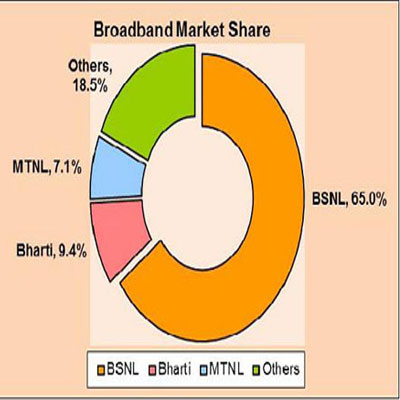
    The top five ISPs in terms of market share (based on subscriber base) are: BSNL (9.98 million), Bharti Airtel (1.44 million), MTNL (1.10 million), Hathway (0.37 million) and You Broadband (0.33 million).

  • Marginal growth in broadband connectivity between August and September 2013

    Marginal growth in broadband connectivity between August and September 2013

    NEW DELHI: The total broadband subscriber base increased from 15.28 million at the end of August to 15.36 million at the end of September 2013, thus showing a monthly growth of 0.52 per cent.

    The yearly growth in broadband subscribers is 1.90 per cent during the last one year (September 2012 to September 2013).

    As on 30 September, there are 158 internet service providers (ISPs) which are providing broadband services in the country. 

    Out of these, 95 ISPs have provided broadband subscription data for the month of September 2013, for the rest of the ISPs data from previous month has been retained.

    The top five ISPs in terms of market share (based on subscriber base) are: BSNL (9.98 million), Bharti Airtel (1.44 million), MTNL (1.10 million), Hathway (0.37 million) and You Broadband (0.33 million).

  • Cable TV DAS and the head end factor

    Cable TV DAS and the head end factor

    MUMBAI: Digitisation is meant to bring about transparency and order to what has for long been talked about as an unorganized business. The pressure of scaling up in order to deliver digital cable TV has also had an expected fallout: consolidation. Smaller cable ops, independent operators have been forced to join hands with existing national MSOs like Hathway or DEN or amongst themselves. And this fusing has resulted in the reduction of the number of headends in the major metros – especially in Delhi and Mumbai where there has been a shrinkage from 110 to 15 and from 50 to seven respectively.

    “Consolidation of headends is taking place in the transition from analogue to digital phase. Also the trend now is that the MSOs set up headends only in areas where they cannot get access to a fiber line or a digital line. Also they are looking for solutions like getting a line from say Delhi or Mumbai to the nearby areas,” informs an industry expert.

    Industry experts attribute this change to factors such as rising costs of digital headends, billing procedure and administrative control.

    Explains Hathway Cable & Datacom MD & CEO Jagdish Kumar: “With digitisation has come the convergence of technologies and features like high definition content, VAS and broadband accessibility. All this in turn requires large amount of investment to manage economies of scale, thus ushering consolidation.”

    While Hathway currently has 23 headends and seven backup headends, including GTPL, several independent operators, informs Kumar, have evinced a keen interest in aligning with its ongoing digital plans, largely due to its success in Phase I and II.

    “We’ve drawn up ambitious expansion plans for Phase III and IV. We will soon make announcements on a few strategic acquisitions,” he exults.

    IndiaCast Media Distribution executive vice president Amit Arora agrees that a number of Delhi and Mumbai-based independent operators have started taking their digital feeds from bigger MSOs.

    “This arrangement is gaining popularity since it isn’t easy for every independent operator to make the huge capital investment needed for digital headends. And consolidation of headends has led to central warehousing of data and SMS,” he says.
    According to Ortel Communications CEO BP Rath, with a 200 channel headend costing nearly Rs one crore, it is not worth investing that kind of money for an independent operator who caters to say 10,000 customers in a small town.

    “So, they are joining bigger players in order to take feeds from them. While smaller operators merged with bigger players even during the analogue phase, it is now happening on a larger scale. And one will see further consolidation during phase III of digitisation,” he says.

    Apart from independent operators joining forces with bigger MSOs, the other reason for consolidation is the advent of the conditional access system (CAS) and the subscriber management system (SMS), as well as the prerequisite for getting these systems audited and approved by broadcasters.

    “When the bigger MSOs are taking so long to adjust to the new system and maintain quality as per the regulation, how will the small players be able to do it?” questions InCable managing director Ravi Mansukhani. “With consolidation, the big MSOs will take care of all the back office problems and the on-ground activity will be done by the independent operators.”

    “All this has led to a whole lot of process issues, which the smaller MSOs find difficult to manage and that is why independent operators are joining bigger players,” adds Rath.

    Ortel, which has 31 analogue headends, two digital headends and four analogue plus digital headends, is waiting for phase III. “It is only after that, we will see consolidation happening in Orissa and Chhattisgarh. Though we have our own headends, we are also talking about intercity connectivity,” informs Rath.

    Kumar too feels that “the trend will continue even in phase III and IV. The demand for digitisation will impact local independent operators, who will find it difficult to manage independently. Hence, the independent operator would continue to look to aligning with the bigger MSOs.”

    However, Arora thinks otherwise. “The consolidation process has already come to a phase where I do not see any further consolidation happening in phase III. The big wave has already happened in phase II,” he says.

    So when a smaller operator takes digital feed from a bigger MSO, how do they share revenue? “The revenue share worked out between bigger MSOs and independent MSOs is purely on mutually beneficial terms based on investments and services being provided in the market,” says Kumar.

    Arora elaborates: “Everybody has worked a different revenue model. Someone has opted for a 49:51 split, some have a 50:50, while some will have a 51:49 split. The revenue share depends on the strength and the need for funds.”

    Coming to another metro, Kolkata, unlike Delhi and Mumbai, its five big players: GTPL, Hathway, Manthan, IMCL and Digicable Network have not seen an urge to merge.

    Meanwhile, Arora sounds a cautionary note. “A takeover of one MSO by the other in Kolkata would only be possible if there is a national degree of consolidation.”

    According to Mansukhani, the biggest consolidation will take place nationally. “Right now only the small and middle level players are going to the big players and then ultimately few major players will have control.”

    Mansukhani feels that even international players will show interest in India once they see healthy cash flows of the MSOs in DAS I and II areas. “This is when the maximum consolidation will take place and this will happen once the entire phase I and II is complete.”

    Talking about the evolution of cable TV on the ground in Kolkata Manthan Broadband Services director Sudip Ghosh says, “Players with a subscriber base of more than five lakh might not consolidate headends. But Kolkata can see the consolidation of players with others having a subscriber base of around three to four lakh.”