Tag: Hathway

  • Regional Units  set up  to implement DAS; broadcasters ask MSOs for analogue rates till Dec

    Regional Units set up to implement DAS; broadcasters ask MSOs for analogue rates till Dec

    NEW DELHI: Twelve Regional Units (RUs) are being set up for implementation of Digital Addressable System (DAS) in Phase Ill areas.


    At the ninth meeting of the DAS Task Force earlier this month, Information and Broadcasting (I&B) Ministry joint secretary (broadcasting) R Jaya said these RUs will hold workshops on digitisation where all issues shall be discussed with the District Nodal officers nominated by State Governments.


    The remark came when a representative of local cable operators (LCO) from Assam said multi-system operators (MSO) are stopping signals to LCOs without any reason and the local authorised officers do not take cognisance of any violation of the provisions of the Cable TV Act. He added that there is no redressal mechanism for violations of Cable Act at State level and the cable operators do not have the means to file cases in Telecom Disputes Settlement and Arbitration Tribunal (TDSAT).


    Additional secretary J S Mathur, who chaired the meeting on 7 July, said time was fast running out and impressed on all stakeholders to ensure progress and timely completion of digitisation by the cutoff date.


    The Telecom Regulatory Authority of India’s (TRAI) GS Kesarwani was given the task to ask broadcasters to get details of MSOs who were intending to wait till September 2015 before sending requests to broadcasters for agreements in Phase III areas.


    On the other hand, Mathur said that the endeavour on the MSOs’ part should be to start using indigenously manufactured set-top-boxes (STBs) in their network.


    Kesarwani informed of a review meeting that was held by TRAI on the progress of signing inter-connect agreements for Phase Ill areas with broadcasters and MSOs. He said that three broadcasters namely Star India, Multi Screen Media (MSM) and TV18 – informed TRAI that they had received 55 requests from MSOs so far out of which they have signed commercial deals with two MSOs, whereas deals with 11 MSOs were in advance stages of negotiation.


    Kesarwani also urged MSOs who had not received any response to their requests from broadcasters, to inform TRAI.


    Saying that the Headend-in-the-Sky (HITS) operations were also covered under DAS regulations, Kesarwani asked HITS operators to apprise TRAI if no response was received from broadcasters to their requests for interconnect agreements.


    Apprehending that there may be some gap areas or MSO deficient areas, Jaya asked Indian Broadcasting Foundation (IBF) representatives to get details of these areas from broadcasters and intimate the same to the Ministry.


    Meanwhile even as they admitted some progress, representatives of national MSOs said  that broadcasters were asking for seeding plans and other data. However, MSOs were not in a position to provide this at this stage. They said channel pricing in Phase III areas was the main hurdle in signing of interconnect agreements. Some of them said that a few broadcasters had proposed agreements on analogue rates till December 2015 and others on reference inter-connect order rates.


    Even according to the TRAI, pricing can be different for different markets, they said.


    A representative of Siticable Networks said, “According to an analysis of urban areas carried out by us, it may not be feasible for any operator to carry out digitisation in urban areas having only a few hundred TV households. Even broadcasters are insisting on analogue agreements at present.”


    According to an IBF representative, broadcasters had entered into agreements with five regional MSOs. He said, “Broadcasters have filed an appeal in the Supreme Court challenging the TDSAT judgment on the tariff orders issued by TRAI.”


    On the issue of STBs, a representative of Consumer Electronics and Appliances Manufacturers Association (CEAMA ) said that no major orders were received by the industry so far from MSOs. On the other hand, while Siticable and Hathway officials said they were in talks with indigenous STB manufacturers, officials of direct-to-home (DTH) companies said that they had procured about three million STBs from Videocon.


    The meeting was attended by around 35 persons including some senior Ministry officials and some representatives from state governments.

  • TDSAT directs Hathway to not disconnect signals of Siddhi Vinayak Cable Ops Association members

    TDSAT directs Hathway to not disconnect signals of Siddhi Vinayak Cable Ops Association members

    NEW DELHI: The Telecom Disputes Settlement and Arbitration Tribunal (TDSAT) has directed Hathway Cable & Datacom to not disconnect the supply of signals to any of the 16 cable operators who are part of the Siddhi Vinayak Cable Operators Association.


    Chairman Justice Aftab Alam and members Kuldip Singh and B B Srivastava also directed the MSO and the Association to resolve their problems through mediation and asked them to appear before the Mediation Centre.


    Hathway counsel J K Mehta told the Tribunal that his client was equally aggrieved by non-payment of regular monthly subscription fees by the members of the petitioner association. Mehta also stated that the cable operators are liable to make payment @ Rs 115 per STB (exclusive of taxes) prior to packaging.


    The Tribunal said the cable operators in turn will continue to make payment of the monthly subscription fees on the basis of the last payment made by them respectively.


    The Mediation Centre will try to resolve the disputes between the parties expeditiously and without any unnecessary loss of time, the bench said.

  • Hathway ropes in Sania Mirza as brand ambassador for broadband service

    Hathway ropes in Sania Mirza as brand ambassador for broadband service

    MUMBAI: It was in October 2013, when multi system operator (MSO) Hathway Cable & Datacom rolled out its Docsis 3.0 service, with ultra high speed internet connectivity of 50mbps. Now, in order to promote it, the MSO has roped in sports personality Sania Mirza as its brand ambassador.


    Hathway MD & CEO Jagdish Kumar said, “We are extremely proud to associate with Sania Mirza, the Indian sports icon as she perfectly illustrates the attributes of the new Docsis 3.0 platform–speed, consistency and high- performance. Hathway has aligned with one of the major visions of the Indian government to develop digital infrastructure in the country that will boost productivity in all sectors. In a way to contribute towards this big vision and to provide better user experience, we at Hathway have launched the Docsis 3.0 service that will provide users – fast internet up to 50 mbps speed.”


    “With the impending data consumption explosion in India, Hathway’s high-speed internet service is a game changer in India. It is vital to have a disruption free service at affordable prices. Docsis 3.0 will create a revolution in the market. We shall continue to invest in expanding the high speed broadband network and deliver plans with lightning fast speeds that is crucial for superior consumer experiences,” he added.


    Speaking on the fast exploding internet consumption in the country, Hathway president Rajan Gupta said, “The digital change is not only sweeping across gen-next but also among the older generation. Today the internet has come a long way, to become a household product that is synonymous with utility, functionality, fun, entertainment, knowledge and much more. With multiple high-tech gadgets being connected to the internet, the time spent on the medium is increasing at a galloping rate. The bustling e-commerce phenomenon, online shopping, social networking, online surfing, audio & video streaming, gaming, cloud computing, all go on to emphasize the momentum and traffic internet has gathered in the recent years in India.”


    According to Gupta, the phenomenon of internet adoption is expected to leapfrog in the next five years. “In such a scenario speed and cost plan has always been the constant benchmarks for choosing broadband connection. With Hathway Docsis 3.0, that provides 10 times the internet speed, we aim to democratize broadband making it accessible to all at affordable price points. The benchmark we have set in terms of our 50 mbps speed is much comparable with the advanced broadband markets across the world. While we introduce the new network plan, we think this is the right time to establish our footprint in the internet broadband industry,” he concluded.

  • IBF, NBA, MSO Alliance get more representation in DAS Task Force

    IBF, NBA, MSO Alliance get more representation in DAS Task Force

    NEW DELHI: New members have been taken on board of the Task Force for Digital Addressable System (DAS) Phases III and IV headed by the Additional Secretary in the Information and Broadcasting Ministry.


    These include one additional member each from Indian Broadcasting Foundation (IBF), and News Broadcasters Association (NBA).


    In addition, the new members include Noida Technology Software Park as members representing HITS operator; Ortel Communications; and a representative each from four national MSOs – Den, Siticable, Hathway and IMCL – who were also members of the MSO Alliance; and the All India Digital Cable Federation.


    The Government on 12 September last year had reconstituted the Task Force. This followed a revision of deadlines for the two final phases of DAS.


    The other members of the Task Force are Telecom Regulatory Authority of India (TRAI) principal advisor for broadcast and cable satellite, I&B Ministry joint secretary (Broadcasting), one other representative from the MSO Alliance, five independent MSOs one each from north, south, east, west and north east regions, five registered LCO associations one each from north, south, east, west and north east regions, representatives from the Indian Broadcasting Foundation, News Broadcasters Association, Association of Regional Television Broadcasters of India, DTH Association, FICCI, CII, ASSOCHAM, CEAMA, Department of Telecommunications, Department of Electronics and Information Technology, DG: Doordarshan, DG: All India Radio, BECIL, BIS, five prominent consumer organisations one each from north, south, east, west and north east regions and 33 state level nodal officers one each from the states/union territories governments.


    The task force is aimed to act as an interface between the government and the industry in matters related to implementation of DAS in the cable TV sector and monitor the implementation of DAS. It also will have to analyze the roadblocks that may come in the way of digitization and suggest measures. 

  • M&E cos plead government for rationality in taxation

    M&E cos plead government for rationality in taxation

    MUMBAI: The Media and Entertainment (M&E) sector is one of the most highly taxed sectors in India. The rollout of the proposed GST (Goods and Service Tax) is expected to be a major game changer as it will simplify the tax regime by combining a multitude of national, state and local taxes. However, whether it will ease the M&E sector’s tax burden or not, remains to be seen.


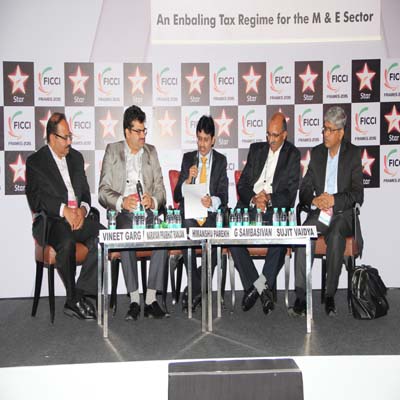
    A detailed panel discussion on the same was held in FICCI Frames moderated by KPMG executive director Himanshu Parekh with Viacom 18 CFO Narayan Prabhat Ranjan, Disney UTV CFO Sujit Vaidya, Tata Sky CFO G Sambasivan and Hathway Datacom deputy CFO Vineet Garg on the panel.


    The financial officers put up the issue of multiple taxation policy in India and inconsistency of the government, which makes scenario less business friendly. Other major issues bothering industry is lack of clarification and the biggest sufferer of that is consumer. Speaking on what the government should do, Ranjan said, “Whenever an amalgamation takes place and there is a loss, the carry forward of losses is allowed and that is something that the government should address with immediate effect. Moreover the issue of service tax VAT and excise duties should also be paid attention at. Why should one product be taxed numerous occasions with various nomenclatures?”


    Echoing Ranjan’s point of view, Vaidya added, “In other countries, if a consumer pays 100, 50 is devoted to the content. Whereas in India, due to the multiple taxation system, only 30 per cent is devoted to content. Service tax has been another pain point and entertainment tax, which varies from state to state and ranged anywhere between 10 to 40 per cent approximately is something government should look after.”


    The government in numerous occasions came on record and accepted the irregularities when it comes to taxation and GST has been portrayed as a solution. But again GST is also in experimentation stage and concrete figures are yet to be displayed in public forum. Sambasivan asserted, “Things which we expected to change did not change and there is no reason to be buoyed by GST. There is no clarity on whether entertainment tax will be subsumed or not. There is a cap of 16 – 27 per cent between which the tax will fluctuate and hence no matter how much ever we plead for a rational uniform policy, nothing of that sort comes out. Now we get 30 when someone spends 100 and if this phenomenon keeps sustaining then share holders will stop putting money as all expect high return.”


    “With digitization phase III and IV to follow, the opportunity of growth increases but at the same time there is a huge requirement of a consistent regulatory body, which has the intention to make scenarios business friendly. All the time we are suppose to devote on improvising and innovating our business model we are devoting on managing tax complacencies. AOP is an unnecessary hassle and hugely unwanted, my request to the government is to come to a consensus and make rational policy which is a win win for both the parties” concluded Garg.

  • Cisco Video Technologies India bullish on growth in phase III & IV of cable TV digitisation

    Cisco Video Technologies India bullish on growth in phase III & IV of cable TV digitisation

    KOLKATA: Cisco Video Technologies India, an information technology (IT) company, which had garnered a market share of around 51 per cent in the first two phases where more than 40 million cable TV homes were digitised in India, is looking at achieving the same market share in the remaining phases of digitisation, i.e. phase III and IV, which is mandated to be completed by end of December 2016.


    The company is bullish on growth from the Indian cable TV digitisation market, said a company official in Kolkata.


    Talking about the trends of digitisation taking place in phase III and IV, which includes rural places and non-metro locations, an official from the US-based technology major said that there are certain pockets in the country, which are looking for high end services and are not just eager to install set top boxes (STBs).


    Speaking on the sidelines of the Cable TV Show 2015 in Kolkata, Cisco senior product manager Aunindo Ghosh said, “In the next two phases there is a requirement of 75 million homes to be digitised and if not more, we will aim to maintain the same market share of around 51 per cent.”


    Also, with the demand of digitisation coming from municipal and rural areas in the phase III and IV across the country, the headend market is redefining itself in India. Cisco, in order to cater to these two phases, has done several innovations to enhance the consumer experience.


    Cisco Videoscape transforms the video technologies around the world by providing high-impact video experiences. “With Cisco Videoscape customers can not only compete, but have the potential to lead the market as it will help them to grow their business by attracting more revenue per user with spectacular video experiences. Cisco recognises that each market and subscriber base calls for different subscriber experiences and therefore, includes a range of end-to-end solutions,” said Ghosh.


    Highlighting the challenges in phase III and IV, Ghosh said that it would be a bit difficult for the company to spread awareness, while stressing on the fact that these phases are low ARPU markets.


    Talking about the phase I and II of digitisation of cable TV, he said those two phases were implemented in the right frame of mind. “The players adhered to the MIB rules. Phase I and II were well coordinated,” Ghosh said.


    Some of the clients of Cisco are Siticable, Hathway, Den, KCBPL-GTPL, and Patna-based Darsh among others. Cisco is also looking at offering its “Videoscape Express” – integrated services to cable TV operators by upgrading its existing networks.

  • Reliance Jio Media applies for pan-India license, over 200 others in queue for phase III of DAS

    Reliance Jio Media applies for pan-India license, over 200 others in queue for phase III of DAS

    NEW DELHI: Reliance Jio Media, a subsidiary of Reliance Jio Infocomm, has applied for a pan India cable television multi system operator (MSO) license as part of its step to enter the broadcast distribution sector.
     

    Confirming this to indiantelevision.com, an Information and Broadcasting Ministry official said that around 200 MSOs are in the queue for phase III of digital addressable system (DAS) license at present. Following the recent extension in date for registration of MSOs for phase III, the official said it was expected that this number may go up by another 70-80 MSO applicants.
     

    At least 50 per cent of these applicants including Reliance Jio are expected to get clearances by March 2015.
     

    Reliance Jio, the telecom arm of Mukesh Ambani led Reliance Industries, is the only company to have pan-India Broadband Wireless Access spectrum that can be used for 4G services. Reliance Jio has plans to start 4G services across most of the telecom circles by March 2015.
     

    Reliance Industries has already announced that it will launch commercial 4G telecom service of Reliance Jio in 2015 entailing investment of Rs 70,000 crore. It will initially cover about 5,000 towns and cities accounting for over 90 per cent of urban India, as well as over 215,000 villages in India.
     

    The company is focusing on convergence space and has bagged Broadband Wireless Access spectrum in 2010 and Internet Service Provider license was bagged through acquisition of Infotel Broadband Services in 2010.
     

    The company has also showcased a ‘Jio Television’ that can be delivered through 4G network.
     

    All these services will help Reliance Jio to offer broadband services through wireless media, wireline media and cable TV media thereby focusing on all types of broadband services pan-India.
     

    Reliance Jio in February 2014 acquired airwaves in 1800 MHz band across 14 out of 22 service area in the country. The spectrum in this band can also be used for providing 4G services. The company already holds Unified Licence (UL), which allows it to use any technology to provide telecom services.

    Under UL, sources said, Reliance Jio can offer Fiber-To-The-Home services and high speed broadband services to home and enterprise users.

    An MSO license will help Reliance Jio to offer cable TV services through optical fiber thereby providing triple play service as done by large MSOs in the country say Hathway, Siti Cable, IN cable, DEN and others.

  • Hathway launches HD personal video recorder

    Hathway launches HD personal video recorder

    MUMBAI:   The cable and broadband service provider, Hathway, has launched a high definition personal video recorder. Hathway is the first national MSO to launch a HD PVR.


    The Hathway HD PVR has several features that will enhance the TV viewing experience of Hathway customers:

    •     Dedicated Search button on the remote to search content by keying in search words, like actors name, sporting events etc. A first in the country.

    •     Pause LIVE TV

    •     Rewind LIVE TV

    •     Planned Recording

    –    Schedule recording of your favourite programs

    –    Series recording possible

    –    Record upto two different programs while watching the third.

    •     1080i Resolution HD video out supported

    •     7.1 Dolby Digital Plus supported

    •     500 GB disk storage to record upto 625 hours of content


    The HD PVR is being launched at a special introductory price of Rs 7999 with one month complimentary viewing for all SD and HD package channels.  Options with six months and one year packages are also available at attractive prices.


    Hathway Cable & Datacom MD and CEO Jagdish Kumar said, “The launch of the HD PVR is yet another milestone for the cable industry. The TV viewing habits of customers are continuously evolving. Given the hectic lifestyle of consumers today our HD PVR gives them total control over their TV viewing experience through features like ‘Search’, ‘Pause and Rewind LIVE TV’ and ‘Record program or Series’. Hathway’s mission is to provide an incomparable world class TV viewing experience to every Indian customer.”


    Marketing and business development EVP Kunal Ramteke added, “With the advent of the holiday season the “Record” feature will ensure  customers don’t miss out on their favourite TV programs even when they are off on vacation. The Hathway HD PVR is the first in the country with the powerful Cisco Evo 12 EPG, not deployed by any MSO or DTH player and showcases our commitment to provide cutting edge global features for digital television in India.”

  • Chrome Data: A reality check for Star’s RIO?

    Chrome Data: A reality check for Star’s RIO?

    MUMBAI: In a move that was bound to give birth to a whole new module of distribution, Star India, after deciding to enter only into Reference Interconnect Offer (RIO) deals, in late October this year, decided to give incentives to the multi system operators (MSOs) for carrying its channels.

    With a promise to empower the viewer and platforms, usher in a new era of transparency, and boost the entire digitisation eco-system, the broadcaster decided to incentivise platform operators, if they meet the three criteria: firstly, provide more Star channels on its platform; secondly, give it to as many subscribers as it can; and thirdly, give easy access by placing the channels in the top LCN on its platform.

    However, the shift didn’t go down well with the multi system operators (MSOs). Voices were raised; only to go down with a pinch of salt as slowly they agreed to put all Star channels on a la carte. With IndusInd Media and Communications Limited (IMCL) being the first one to agree to the demands of Maharashtra Cable Operators Federation (MCOF), the others including Den Networks, Digicable and Siti Cable also agreed to give the Star network channels only on viewer’s choice.

    Hathway Cable & Datacom joined the bandwagon after almost a month, by coming out with its new pricing and packaging system.

    And now with everyone toeing the same lines, one would expect things getting in place, if not perfect. However, a look at the opportunity to see (OTS) collated week-on-week by Chrome Data Media & Analytics tells another story.
    If numbers are to be believed, the OTS of channels from the network have seen a setback after the announcement of RIO. There has been a certain percentage difference between the pre and the post RIO era. And suffering the most are the niche and sports channels from the network’s stable.

    Sports channel s across India saw a drop of 9.5 per cent OTS. Channels impacted by this drop are Star Sports 1, 2, 3 & 4. Similarly, English entertainment and movie channels too have felt the heat. With 27.7 per cent OTS drop and 11.7 per cent OTS loss, channels like Star Movies and Star Movies Action and Star World and Fox Crime are losing out in their respective genres.

    The only channels which haven’t seen much impact from the RIO deal belong to the general entertainment category. It has seen a marginal drop of 0.5 per cent OTS from 81.76 per cent to 81.39 per cent, thanks to high demand of channels like Channel V, Star Utsav and Star Plus.

    To fix the damage done, the network will have to work hand-in-hand with the MSOs and advertise as much as possible to let consumers want to avail all its channels.


  • HSBC raises Hathway’s target price to Rs 432

    HSBC raises Hathway’s target price to Rs 432

    MUMBAI: HSBC Securities and Capital Markets’ latest report on multi system operator (MSO) Hathway Cable & Datacom has improved its rating from ‘normal’ to ‘overweight’.


    While it continues to value Hathway using a DCF based approach, it has raised the target price from Rs 276 to Rs 432. This is on the assumption of 12.5 per cent WACC, cost of equity of 13.5 per cent and cost of debt of 11 per cent.


    One of the main reasons for this is the expectation of increase in Average Revenue Per User (ARPU). HSBC expects gross billing to increase in phase I markets by around 15 per cent and phase II by around 10 per cent over the next two quarters. Gross ARPU is estimated to grow at 16 per cent CAGR from its earlier 8 per cent.


    Increase in ARPU would mean a near 10 to 20 per cent rise in cost, despite the incentives that are being offered by Star’s new RIO deals. The report also says that moving to prepaid would be necessary, even if it is restricted to Star  channels for now as in the long run it would allow MSOs to scale up to full prepaid gradually over the next 18-24 months.


    “LMOs will need to move to a prepay backend. Both these factors are positive for the sector and in our view build a long-term case for ARPU improvement, fewer bad debts, reducing friction between MSO and LMO relations, improving the industry structure and allowing the industry to benefit from sector consolidation,” it states.


    The report also highlights that if Star is successful in reaping benefits out of its new RIO policy, other big networks may follow suit, though not in the immediate 12 months.


    This apart, HSBC also sees broadband ARPUs increasing with a more robust DOCSIS 3.0 platform but with a slight concern on the slow pace of subscriber net addition. The delay in digitisation is positive for cable TV industry to consolidate market share in the first two phases. Side by side, issues such as revenue share and prepaid billing can be sorted and easily applied in phases III and IV.


    HSBC has raised its medium- term EBITDA estimates by 11 per cent (FY16e-21e CAGR of 13.5 per cent), cable TV ARPU assumptions by 12 per cent (FY16e-21e CAGR of 11 per cent) and broadband ARPU by 8 per cent for the same period.