Tag: Hathway Cable & Datacom

  • Four MSOs levied penalty for non-payment of entertainment tax

    Four MSOs levied penalty for non-payment of entertainment tax

    NEW DELHI: Even as Siti Cable ‘vehemently’ denied any allegation of tax evasion as alleged by the Delhi Government, similar notices were issued to three other major multi-system operators (MSOs) for paying Rs 243.77 crore as dues, due to a default in payment of entertainment tax.


    While there was no official word from either IndusInd Media and Communications or Hathway Cable and Datacom, a source from Den Networks informed Indiantelevision.com that the action by the Delhi Government was a violation of a commitment given by it to the Delhi High Court that no coercive action would be taken during the pendency of a case challenging the levy of entertainment tax and vires of the Delhi Entertainment and Betting Tax Act 1996.


    The source also added that an appropriate reply would be given both to the Delhi Government and in the High Court, but said no notice had been received so far and the MSO had learnt about it only from a newspaper report.


    Siti Cable, which had received a similar notice for Rs 33.12 crore, had said in an official statement, that it had been depositing the entertainment tax regularly on the basis of collections. The MSO had “vehemently’ denied the allegation of tax evasion.


    The matter is pending vide its Writ Petition of 2014, Siti Cable had earlier said.


    According to reports, the charges levied on the four MSOs include a 100 per cent penalty and an interest on dues.


    The levy is for 2013-14 and 2014-15. Den Networks has to pay just over Rs 88.81 crore, while Hathway Cable and Datacom need to pay around Rs 59 crore, IndusInd Media and Communications has been asked to pay just under Rs 52 crore for two years.


    While noting that these MSOs need to file their tax every month, a Delhi Government source said that Den, Hathway and IndudsInd had between them around 2.6 million subscribers in the capital. 

  • DEN Networks hikes foreign investment limit to 74 per cent

    DEN Networks hikes foreign investment limit to 74 per cent

    MUMBAI: Close on the heels of multi system operator (MSO)  Hathway Cable and Datacom’s decision to increase the foreign investment limit in its company, DEN Networks has now followed suit.


    It may be recalled that in January this year Hathway decided to increase the foreign investment limit from 49 per cent to 74 per cent. 


    DEN Networks, which is currently building its broadband base and also working towards digitisation in phase III and IV, is looking at attracting overseas capital into the company.


    DEN Networks has got the approval from the board of directors to increase the foreign investment limit in the company by Foreign Institutional Investors (FII) and Foreign Portfolio Investors etc. from the current 49 per cent to 74 per cent. This, subject to approval of the shareholders, Foreign Investment Promotion Board of India, Ministry of Finance (FIPB) among others.


    In an announcement to the BSE, DEN Networks said, “The board of directors of the company has approved through circulation, increase in foreign investment limit in the company by Foreign Institutional Investors, Foreign Portfolio Investors etc., under the Portfolio Investment Scheme in accordance with Schedules 2 and 2A of Foreign Exchange Management Act (Transfer or Issue of Security by a person Resident Outside India) Regulations, 2000 (FEMA 20) from existing 49 per cent to 74 per cent of the issued and fully paid-up share capital of the company, subject to the approval of the Shareholders, Foreign Investment Promotion Board of India, Ministry of Finance (FIPB) and all other applicable acts, laws, rules, regulations, circulars, directions, notifications, press notes guidelines and statutory approvals, if any.”

    The approval of shareholders for aforesaid resolution will be taken through Postal Ballot in accordance with section 110 of the Companies Act, 2013 read with Rule 22 of the Companies (Management and Administration) Rules, 2014, the release further added.

  • Ortel IPO opens amidst buoyant stock market conditions

    Ortel IPO opens amidst buoyant stock market conditions

    MUMBAI: The Ortel Communications issue opened on 3 March. At  the price band of Rs 181-200, the cable TV last mile operator (LMO) is offering 9.5 million shares to the public. National Stock Exchange data showed that the issue had been subscribed 0.15 times by end of day one of the offer. The company plans to use the money  raised through the issue to deepen the penetration of its cable TV and broadband offering in the geographical regions it is present i.e. Odisha, Chhattisgarh, Andhra Pradesh and West Bengal ; increasing digitisation of its cable TV subscriber base (currently 20 per cent of its analogue universe has been digitised), upgrading technology for its broadband service; buying out of local cable operators and networks, and leasing fibre infrastructure to corporates.

    At the time of writing, the IPO had received a mixed response from the investing community and research analysts. While one group says the price band is too high, another bunch has expressed that the Ortel stock has long legs and could go far. 

    Says a bullish observer: “The Ortel IPO offer is at 10 times EBIDTA for FY 2015. That’s pretty fair compared to 17 times EBIDTA for Hathway Cable & Datacom and seven times EBIDTA for DEN Networks,” says a research analyst. “We see the share appreciating after listing.”

    However, a bear stated that Hathway was quoting in the Rs 60-65 range, while DEN was in the Rs 120 band. “The Ortel price is too high when you compare it to what these stocks have notched up,” she said. “We expect to pick up Ortel after listing when we believe the overpricing will get corrected.”

    An ICICI Direct IPO review pointed out that Ortel’s low subscriber base of 0.5 million cable TV homes puts it at a competitive disadvantage against national MSOs such as DEN and Hathway which have 12 million subscribers each. 

    But another industry expert  points out that Ortel owns most of its subscriber base, aka as the last mile, which means it will reap the digital dividend and the moolah will straightaway accrue to its top line, and bottom line as it digitally connects more of them.

    He also points out to the low floating stock of Ortel that is on offer, which is likely to keep the price buoyant.

    At the time of writing, a positive sentiment had been ruling on the stock market with the National Stock Exchange Nifty  crossing an important threshold that of the 9,000 barrier which it did during intraday trading only to fall back to 8996 by close.

    The anchor investors for the IPO are Axis Mutual Fund (900,000 shares) and ICICI Prudential Life Insurance (1.657 million shares), while Kotak Mahindra Capital is managing the issue.

    The next two days (the issue is slated to close on 5 March) will throw clarity on which sentiment will hold its sway on investors during Ortel’s offering. 

  • Hathway launches campaign for new channel packages

    Hathway launches campaign for new channel packages

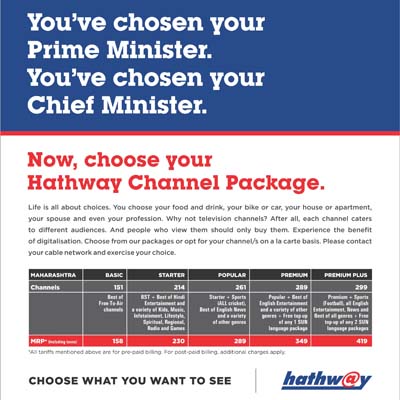
    MUMBAI: Multi system operator (MSO) Hathway Cable & Datacom is out on a mission: to educate cable TV subscribers about their new power – ‘The power to choose.’ And to spread this message the MSO has come out with three TVCs, print ads and radio jingles. 


    The campaign will use multiple media to inform and educate consumers about the different packages that the MSO has created. The move comes in the wake of broadcaster Star India’s decision to enter into only Reference Interconnect Offer (RIO) deals with MSOs. 


    The five packages for Maharashtra that have been rolled out by Hathway include: 


    · Basic Pack priced at Rs 158: This will have the best of all the free to air channels.


    · Starter priced at Rs 230: This will have best of Hindi entertainment and a variety of kids, music, infotainment, lifestyle, spiritual, regional, radio and games. 


    · Popular priced at Rs 289: This will have channels from Starter pack + sports (all cricket, best of English news and a variety of other genres).


    · Premium priced at Rs 349: This will have channels from Popular pack + bets of English entertainment and a variety of other genres + free top up of any one Sun language package.


    · Premium Plus priced at Rs 419: This will have channels from Premium pack + sports (football, all English Entertainment, news, best of all genres + free top up of any two Sun language package. 


    Conceptualised and created by Gasoline, while one of the TVCs has life reference, the other two are animated. Speaking to Indiantelevision.com, Gasoline founder and chief creative officer Anil Kakar says, “The brief given to us was that the MSO wanted the power of choice to be in the hands of consumers.” 


    The campaign highlights the five different packages as well as the a la carte prices being offered by Hathway. 


    Incidentally, the work on the campaign started in October, which is the same time when Star announced its plan to enter into RIO deals. “While the client wanted life reference, we wanted to bring in animated characters. The reason being that while the message is hard selling, animation makes it light,” informs Kakar. 


    The ad film draws an analogy from contexts wherein a consumer makes a choice. For instance, the first film opens on a lady buying a soap in a soap store. The salesman is seen pushing various soap brands on offer. The lady quips, ‘You aren’t trying to sell the whole store, are you?’ and smiles. Cut to a CG section wherein we see a host of channel logos and a voiceover, which says, ‘We choose everything in life, why not television channels?’  


    The strategy is to communicate the cost-effectiveness of a Hathway package subscription. The campaign extends with a couple of animation films, which demonstrate how a subscription is reasonably priced vis-a-vis other things in life. In the first film, we see a young character in a cafe going through his mobile bills, only to find his café bill more expensive, thus communicating the fact that a monthly subscription to a Hathway channel package is still cheaper than two cups of coffee and a sandwich.


    The radio spot extends the idea further with a groom who is choosing a bride and in another, a waiter rattling off the menu in a rapid-fire sequence. The radio jingles have been co-produced by 94.3 Radio One. 


    The print ad is topical and captivating. It reads: ‘You have chosen your Prime Minister. You have chosen your Chief Minister. Now choose your Hathway channel package.’


    While the TVC will be aired on the Hathway channels, radio ads will be played in Kolkata, South Indian states (except Chennai), Mumbai and Delhi and the print ad will also be published all over India in the mainline newspapers. 


    “The campaign has been designed to ease the life of cable operators, who are facing issues in informing consumers about the packages and its pricing,” concludes Kakar.

  • Dish TV, Hathway move to ‘overweight’: Morgan Stanley

    Dish TV, Hathway move to ‘overweight’: Morgan Stanley

    MUMBAI: Brokerage firm Morgan Stanley has some good news in store for direct to home (DTH) player Dish TV and multi system operator (MSO) Hathway Cable & Datacom. The firm has upgraded both Hathway and Dish TV to ‘overweight’, while also raising their target price, that represents an upside of 37 per cent and 20 per cent respectively, over the next 12 months.


    As per an Economic Times report, Morgan Stanley has downgraded Zee Entertainment to ‘equal weight’ with downside of 10 per cent. “Zee outperformed Hathway and Dish by 12 per cent and 24 per cent, respectively, in 2014 as they believe that a large part of the potential improvement in subscriptions for Zee is in the price,” said the report. 


    While upgrading Dish TV from ‘underweight’ to ‘overweight’, the target price of the DTH platform has been raised from Rs 49 to Rs 82. Not only this, Hathway has been upgraded from ‘equalweight’ to ‘overweight’, with a current target price of Rs 91 from Rs 59.   


    According to the brokerage firm, there is a sense of urgency on monetisation by the MSOs, which can push up realisations for both Hathway and Dish TV.


    “MSOs were unable to effect any sizeable improvements in realisations in 2014. However, the push from broadcasters to improve their subscription share has forced MSOs’ hands,” added the media report.


    As per Morgan Stanley channel checks, MSOs are responding by introducing higher value packs, raising prices and moving to a prepaid model.


    The firm expects these efforts to boost realisations for MSOs and create headroom for Average Revenue Per User (ARPU) expansion for DTH. 


    While an improving macro-economic outlook can help lift TV ad spending, margins could remain muted in F2016 for Zee due to new launches. Hence, Morgan Stanley prefers Hathway Cable followed by Dish TV and then Zee Entertainment Ltd.


  • Hathway Cable gets board nod to hike FII limit to 74 per cent

    Hathway Cable gets board nod to hike FII limit to 74 per cent

    MUMBAI: It was in 2012, when the government had relaxed foreign direct investment (FDI) limit in direct to home (DTH), cable TV industry and teleports from 49 per cent to 74 per cent. In keeping with this, Hathway Cable & Datacom which early this week became the first multi system operator (MSO) to have crossed the $1 billion mark in terms of enterprise valuation, is now probably looking at attracting overseas capital into the company.

    The MSO has in an announcement to the BSE informed that its Board of Directors have approved and passed the resolution to increase the foreign investment limit from the current 49 per cent to 74 per cent, this subject to approval from the Foreign Investment Promotion Board of India, Ministry of Finance and/or the Reserve Bank of India.

    “Subject to receipt of approval of the Foreign Investment Promotion Board of India, Ministry of Finance (FIPB) and / or the Reserve Bank of India (RBI) and all other applicable authorities, increasing the foreign investment limit only by Foreign Institutional Investors, Foreign Portfolio Investors, etc. under the Portfolio Investment Scheme in accordance with Schedules 2 and 2A of the Foreign Exchange Management Act (Transfer or Issue of Security by a Person Resident Outside India) Regulations, 2000 in the Company from 49 per cent to 74 per cent of the issued arid fully paid-up share capital of the Company,” reads the announcement.

    The Hathway Board has also passed the resolution of a postal ballot notice along with the explanatory statement and calendar of events for seeking approval of the shareholders of the Company by postal ballot for its foreign investment proposal.

    According to Hathway Cable & Datacom CEO and MD Jagdish Kumar Pillai, the cable TV sector is becoming lucrative for foreign investors. Pillai had earlier told Indiantelevision.com, “With broadband and cable TV getting more transparent, the market is viewing this as a great industry to invest in the next five years, and that’s reflected in the balance sheet. It is a promise of a good potential.”

    With the industry getting more organised courtesy its digitsation drive, Pillai expects more foreign investors to pump in funds into the cable TV sector.


  • Hathway Cable becomes India’s first $1bn enterprise valuation MSO

    Hathway Cable becomes India’s first $1bn enterprise valuation MSO

    MUMBAI: New year celebrations don’t seem to have ended at the Raheja group company and multi system operator Hathway Cable & Datacom. The MSO has become the first company from the cable TV industry to have crossed the $1 billion mark in terms of enterprise valuation.

    At the time of filing the report, as on 6 January 2015, (1 USD= 63.4286 INR mid- market rate), the total valuation of the company including market cap (Rs 5581 crore) and debt (Rs 806 crore) and excluding cash and cash equivalents  was close to $ 1 billion (Rs 6387 crore).  

    Hathway Cable & Datacom MD and CEO Jagdish Kumar Pillai is over the moon with this feat.  Says he, “This achievement has got more to do with the potential of the Indian cable TV market, and not just with what Hathway does.”

     For Pillai, digitisation has opened up the potential of unlocking the value that Indian cable TV industry holds. “With broadband and cable TV getting more transparent, the market is viewing this as a great industry to invest in the next five years, and that’s reflected in the balance sheet. It is a promise of a good potential,” he opines.

    With the industry getting more organised, Pillai expects more foreign investors to pump in funds into cable TV. “And that is what Hathway is doing. We are corporatising the whole industry and bringing the professionals to run our business. We have invested heavily in computer software and automation. It has become more like a telecom company. We expect a lot of investment interest in the industry now,” he adds.

    Pillai feels that it is Hathway’s broadband service which differentiates the company from the other players. “Our broadband service is strong and that has, along with our strong CATV, helped us reach at this level,” he says.  

    The plan for Hathway from here is clear: monetisation of the investments made in the phase I and II markets. “We have deployed 7 million set top boxes in the first two phases of DAS and we would like to monetise that. Also as we get closer to phase III and IV deadlines, we will look at opportunities which will enable us to expand further,” he informs.

    As for broadband, Hathway which has already upgraded its platform to DOCSIS 3.0, is looking at expanding to all the cities in which it has a presence.  “The investment will be two-fold, both in broadband and in cable TV,” concludes Pillai.

    Coming on the back of the announcement that the Videocon group has signed an agreement with US-based Silver Eagle Acquisition Corp to sell 33.5 per cent of its shares in its DTH venture Videocon d2h for $300 million, the Hathway landmark shows that confidence amongst investors for TV distribution initiatives seems to be reviving. And that’s good news for the entire TV ecosystem which has been struggling to digitise its TV viewer base.


  • 2014: A year of de-aggregation

    2014: A year of de-aggregation

    2014 was a year when the Telecom Regulatory Authority of India (TRAI) issued, as many said, the ‘death warrant’ for the powerful aggregators. The year started with the regulator throwing the ‘big bomb’ on the channel aggregators by introducing the ‘de-aggregation paper’. The paper clearly stated that the broadcaster appointed content aggregators could not mix and bundle channels from different networks before signing deals with the distribution platforms.

    With the regulation, the once content aggregators were given a new name, that of ‘agents’ who would carry out the deals ‘on behalf of’ the broadcaster. TRAI gave the aggregators six months to dismantle operations, or realign as agents. As part of the regulation, it was the broadcasters who could now sign deals with the distribution platforms either directly or through agents, who could only work on behalf of the broadcaster and not bundle channels from different networks. The regulation came as a shock as it curbed the power of aggregators Media Pro, IndiaCast UTV Media Distribution and TheOneAlliance.

    Soon after, aggregators started disintegrating. MediaPro, the JV between Star Den and Zee Turner was the first to announce its separation. Thereafter, both of them began distributing on their own. Zee Network created a separate distribution entity called Taj Television which would also act as agents for Turner channels. MediaPro CEO Gurjeev Singh Kapoor headed off to handle Star India’s international business while COO Arun Kapoor became CEO of Taj. Soon after this, MediaPro terminated its alliance with NDTV, MGM and MCCS.

    The next in line to break up was IndiaCast UTV, the JV between Network 18 (TV18) and UTV. The last to do so was TheOneAlliance (a JV between MSM and Discovery) which has already announced its decision to break away but will formally happen only on 1 January 2015. Meanwhile IndiaCast will act as an agent for UTV as well as Epic TV channel, while MSM and Discovery will be setting up their own operations.

    While on one hand broadcasters were figuring out how they could deal with the new clause from TRAI, on the other hand distribution issues were being fought in the Telecom Disputes Settlement Appellate Tribunal (TDSAT). The fiercest of them was between Hathway Cable & Datacom and Star India/Taj Television that lasted for nearly seven months.

    The first accusation was from Star when it stated that Hathway had removed its sports channels and placed them as a separate pack. Zee Network was nearing the end of its deal with Hathway and wanted to re-negotiate it with the MSO. Hathway failed to reply on time, leading to disconnection of signals from the broadcaster. Thereby, the MSO took Zee to court.

    After long hearings between the three parties, the two cases got combined and it was settled that till the time the case does not come to an end, Hathway would pay Star and Zee at the rate of Rs 23 and Rs 21.5 cost per subscriber (CPS) basis for their entertainment channels and Rs 4 CPS for Star’s sports channels. The last verdict of the hearing came as the TDSAT directed Hathway to enter into RIO agreements with Taj Television and Star India for the DAS markets.

    When everyone thought that the case would come to an end, Hathway went to TDSAT once again claiming that there would be partiality in providing RIO rates to various platform operators. The case came to an end with Star India coming forth and stating that it would only be executing RIO deals for DAS markets with all distribution platforms from 10 November. Though Taj Television had also been ordered to get into a RIO deal with Hathway, the broadcaster later on signed a CPS (carriage) deal.

    The year’s ending saw much discussion on Star’s incentives that were being provided on the basis of channel penetration, reach and channel placement. While most MSOs vehemently protested against the new RIO at first, in the end they took up the channels on incentive basis and created new packs. Most MSOs decided to put the popular channels on the base pack and give the remaining as separate packs, in higher packs or as a-la-carte.

    The year also saw a rise in the carriage fees, which according to many has risen by 20-25 per cent for niche and news channels.

  • IMCL has agreed to give Star channels on a la carte, says Arvind Prabhoo

    IMCL has agreed to give Star channels on a la carte, says Arvind Prabhoo

    MUMBAI: When Maharashtra Cable Operators Federation (MCOF) stepped into the office of IndusInd Media & Communications Limited (IMCL) today the agenda was clear: to get the Star network channels on a la carte and to get them to sign the interconnect agreement. 


    “We had a very positive and fruitful meeting with IMCL,” informs MCOF president Arvind Prabhoo.  The multi system operator (MSO) has not only agreed to give Star channels on a la carte, but has decided to even let go of its share on the channel’s pricing. “The MSO has said that until the consumers take the channels, the a la carte price of Star channels will be as per the price mentioned by the broadcaster in its RIO,” says Prabhoo adding that the last mile owner is free to either add his 33 per cent share to the channel pricing or give it to subscribers at subsidized rates.


    The a la carte availability of the Star channels to IMCL subscribers will start immediately. “Since InCable has decided to forego its share, subscribers can get Star Plus at around Rs 15-18, which otherwise could have gone up to Rs 27,” he informs.


    Starting 1 December, MCOF will come up with the exact pricing for the channel. “We will be meeting Siti Cable and Den Networks on 26 November and based on the meeting with them, we will work out a strategy to come up with the exact pricing of the channel,” he says, adding that only 15-16 Star channels are viewed by 75 per cent of the cable TV subscribers in Mumbai.


    “Each LMO is surveying their customers to know the channels of their choice,” informs Prabhoo who has done the same for his 300 customers. The result shows that while 80 per cent of those surveyed want Star Plus, 75 per cent want Star Pravah and 60 per cent want Life OK.


    Not only this, IMCL has also agreed to sign the interconnect agreement. “They could sign it as early as next week,” says Prabhoo. 


    MCOF also met Hathway Cable and Datacom and submitted its charter of demands. “They haven’t revealed their strategy as yet,” he says adding that Hathway will sign the interconnect agreement towards January.  


  • LMOs demand Star channels on a la carte, or face switch off, non-payment of monthly charges

    LMOs demand Star channels on a la carte, or face switch off, non-payment of monthly charges

    MUMBAI: The multi system operators (MSOs) and broadcaster Star India could have moved into the no-war zone, after Star declared that it would give its channels only on the basis of Reference Interconnect Offer (RIO). While this led to MSOs going ahead and declaring that the network’s channels will now be given to consumers only on a la carte, the incentives given by Star, melted most.  Unhappy now are the last mile owners (LMOs), who fear losing their subscribers.


    Leading the way is Maharashtra Cable Operators Federation (MCOF) president Arvind Prabhoo, who today called for a meeting, which was attended by close to 400-500 LMOs. The agenda of the meeting was simple: Getting Star channels only on a la carte.


    “While the MSOs had earlier said that the Star channels will be available on a la carte, suddenly everyone is switching on the Star channels and including it in the existing packs,” informs Prabhoo.


    The LMOs in the meeting took two resolutions. “The first one is that we will meet at least two MSOs tomorrow (25 November) and tell them that they should remove the Star channels from the packages and sell it only on a la carte,” he says.


    MCOF will meet InCable and Hathway Cable and Datacom first and then move on to meeting Siti Cable and Den Networks. “We don’t want any of the Star channels in any of the packs. We will go to our customers and ask them for the channels they want to watch and bill them only for those as per the published a la carte rate,” he adds.


    The LMOs will first request the MSOs to put the channels on a la carte, on immediate basis. “But if this doesn’t happen, we will start switching off the STBs on our own and also will not pay the MSOs the monthly charges,” informs Prabhoo, who says whatever they are demanding is as per the Telecom Regulatory Authority of India (TRAI) regulation.


    The second resolution passed is on the interconnect agreement which was drafted months ago by MCOF as per the suggestion given to TRAI and also accepted by both InCable and Hathway. “Though they had agreed to the interconnect agreement drafted, they have still have not signed it. We are going to ask them to sign it or else have decided not to pay them the monthly charges,” he says.


    According to Prabhoo, the move has been taken as the LMOs are losing their subscribers to the direct to home (DTH) players. “It is getting difficult to manage the business,” concludes Prabhoo.