Tag: Hathway

  • GTPL Hathway is gearing up to make a major HIT

    GTPL Hathway is gearing up to make a major HIT

    MUMBAI: In India’s noisy and fragmented cable TV business, where margins are wafer-thin and infrastructure is patchy, a quiet revolution is taking place above our heads. Quite literally. India’s largest cable and broadband heavyweight ) GTPL Hathway is choosing to break free from the grid by betting Rs 100 crore on a satellite-led future—launching a full-scale headend-in-the-sky (HITS) operation designed to reach the parts of India that cable lines and fibre have long ignored.

    This isn’t just an upgrade—it’s a strategic reinvention. One that could upend the rules of TV distribution across Bharat.

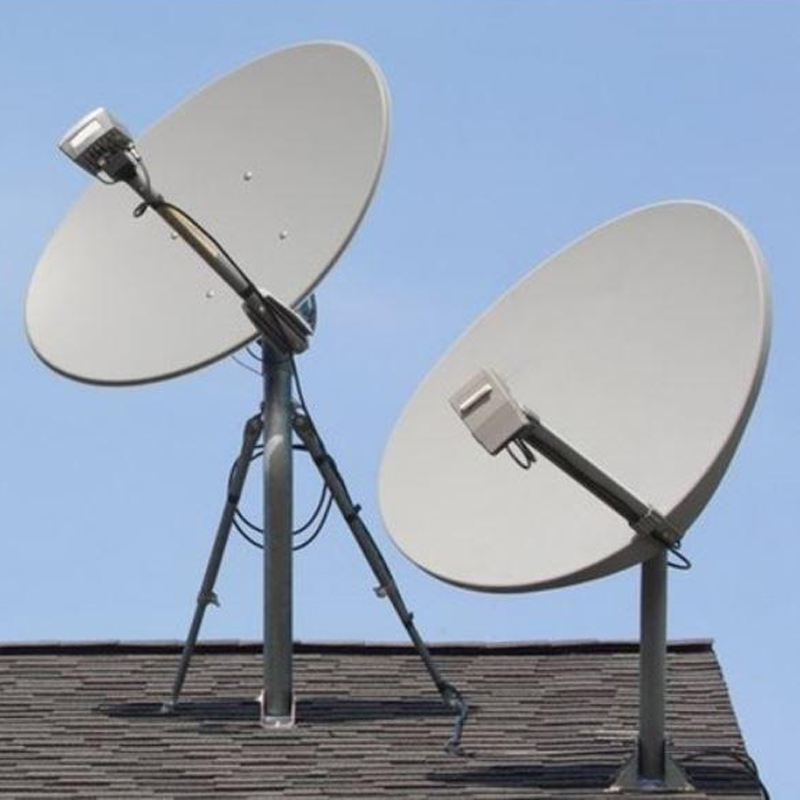
    From a sleek new uplink facility in Ahmedabad, GTPL is readying to transmit up to 900 encrypted, multiplexed channels using 12 leased C-band transponders from Indonesian satellite operator Telkomsat. The satellite signal is then beamed directly to local cable operators (LCOs), who deliver the final mile using existing coaxial or fibre lines.

    It’s a model that minimises capital investment on the ground while maximising reach—especially in India’s 130–135 million “TV-dark” homes, a figure larger than the total households of Japan and the UK combined.

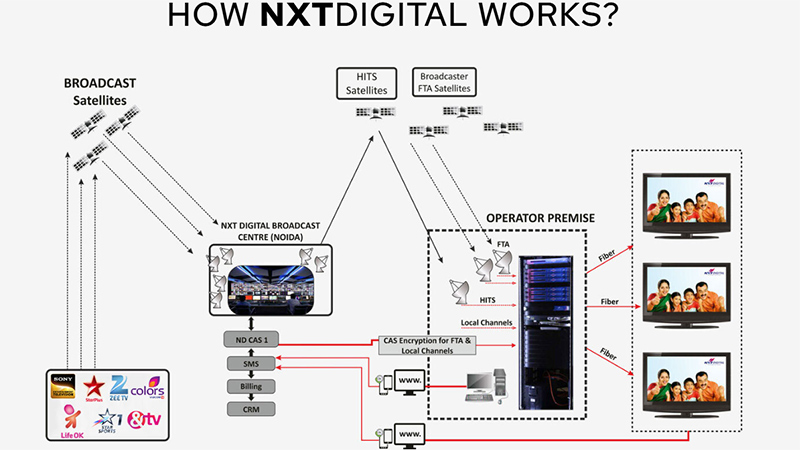
    GTPL’s move brings it squarely into competition with the Hinduja-owned Nxt Digital, India’s sole HITS player until now, with a subscriber base of 2.4 million. Nxt has played a steady game—providing shared uplink infrastructure, cost-effective Cope (cable operator premises equipment) units priced between Rs 10.6–14 lakh, and STBs from Chinese OEMs like Changhong and Telesystems.

    Its model helped reduce per-subscriber costs dramatically—from Rs 17 to just Rs 7 in some cases—offering a lifeline to smaller MSOs (multi-system operators) struggling to comply with the regulatory shift to digital. But Nxt’s footprint, while impactful, has remained modest.

    GTPL is playing a different hand: scale. With 9.6 million cable TV subscribers already on its rolls and strongholds in Gujarat, Maharashtra, West Bengal and Bihar, the company intends to transition its entire base to HITS delivery over the next 24–36 months.

    The vision? To be India’s largest HITS network—leapfrogging not only NXT, but also traditional satellite and cable architectures in one swoop.

    This pivot is part of GTPL’s broader Rs 350 crore capex outlay for FY25, which also includes new broadband infrastructure and set-top boxes. The numbers make a compelling case: annual bandwidth costs, currently pegged at Rs 85–90 crore, are expected to drop by half.

    Projected revenues from the satellite platform are equally promising. At 750,000 subscribers, GTPL expects to generate Rs 99 crore annually. That rises to Rs 132 crore with 1 million users. Add Rs 12 crore more from leasing infra services to 50 smaller MSOs (each paying Rs 2 lakh per month), and the business case becomes hard to ignore. Even under conservative adoption rates, the Rs 100 crore investment could be recouped within 12 months.

    GTPL’s HITS play isn’t just about broadcast—it’s also about backend tech. The company is deploying a hybrid business model: retailing bundled TV channel packs to consumers via LCOs while offering platform-as-a-service tools to smaller MSOs. These include uplinking, encryption, conditional access system (CAS) and subscriber management system (SMS) solutions—effectively turning GTPL into a SaaS player for the cable industry.

    In a sector plagued by fragmentation, opaque billing, and outdated infrastructure, this modular model could be just the reset smaller operators need to stay compliant, competitive, and cost-efficient.

    India’s content delivery puzzle has long had three flawed pieces. OTT remains hobbled by poor last-mile broadband in rural areas, with even state-run BharatNet struggling to scale. DTH, while more pervasive, has long suffered from weather interference, installation costs, and churn. Cable TV, once the lifeline of urban India, is now chafing under regulatory pressure and infrastructure bottlenecks.

    Enter HITS—a model that combines the robustness of satellite delivery with the flexibility of LCO-based distribution. It’s weather-resistant, quick to deploy, and doesn’t require laying new wires in hard-to-reach zones.

    As a middle path, HITS may well become the delivery standard for Bharat—the vast, value-driven, and still under-connected expanse of Indian television.

    Surprisingly, GTPL’s skyward expansion has not been met with resistance. The All India Digital Cable Federation (AIDCF) has raised concerns around broader issues like OTT content regulation and fair play by broadcasters—but not specifically about the HITS model. Major networks such as Zee, Sony, and Disney Star have voiced concerns over the pricing dynamics introduced under TRAI’s NTO 3.0 framework, but formal objections to GTPL’s satellite platform are absent.

    The company, for its part, holds a valid grant of permission agreement (GOPA) from the ministry of information & broadcasting (MIB) and has participated in various TRAI and MIB consultations, signalling alignment with the regulatory ecosystem.

    GTPL’s pricing strategy will be region-specific, with affordability and adaptability built in. Final LCO-facing Cope and channel package rates will be finalised once broadcasters declare new pay channel prices. While margins may initially be tight, the long-term play is rooted in volume, retention, and backend monetisation.

    This isn’t a short-term stunt—it’s a structural realignment of India’s content delivery infrastructure.

    GTPL’s satellite push is more than just a tech upgrade—it’s a masterstroke of timing, vision, and market understanding. With one eye on underserved consumers and the other on the backend tech stack, the company is positioning itself as both a broadcaster and a platform.

    As India’s media future heads skyward, GTPL’s HITS move may well become the blueprint for digital inclusion across Bharat.

    (If you are an Anime fan and love Anime like Demon Slayer, Spy X Family, Hunter X Hunter, Tokyo Revengers, Dan Da Dan and Slime, Buy your favourite Anime merchandise on AnimeOriginals.com.)

  • From Couch Potatoes to Content Creators: Hathway & Den reel it in

    From Couch Potatoes to Content Creators: Hathway & Den reel it in

    MUMBAI—Move over, television executives. The inmates are about to take over the asylum—or at least, the broadcast.

    Cable television multiservice operators Hathway and Den have launched an experiment that could rewrite the rulebook of broadcast media. Their new platform, Hathway/DEN Reels, is turning content creation and  its broadcast on its head – viewers are creating content which is being packaged and shown on a specialised service on Hathway channel no 99 and on  Den channel no 100. 

    Launched on 18 March, Hathway Reels and Den Reels  have already captured the imagination of wannabe performers nationwide. In just five days, over 1,000 user-generated reels have flooded in—a deluge that suggests a deep hunger for democratised stardom.

    “This isn’t television as we know it,” says an industry observer. “It’s television as people have always dreamed it could be”.

    The concept is disarmingly simple. Aspiring performers—be they singers, dancers, comedians, or pure eccentrics—need only a smartphone and a dash of courage. No casting calls, no industry connections, no prohibitive barriers to entry.
    Hathway reels
    Social media has long promised such democratisation, but often delivered only algorithmic mirages of fame. Hathway/DEN Reels promises something more tangible: actual broadcast airtime.

    What sets this initiative apart is its radical inclusivity. It’s not about polished performances but raw, unfiltered talent. A call centre executive in Bengaluru, a farmer in Punjab, or a student in Mumbai can now find themselves beamed into living rooms across India.

    The platform represents more than entertainment—it’s a social leveller. For every frustrated creative soul shelving dreams due to practical constraints, this is a lifeline. No need to quit the day job. No need to move to Mumbai or Delhi. The stage has come to them.

    Initial response suggests the concept has struck a nerve. In an era of algorithmic content and manufactured viral moments, Hathway/DEN Reels offers something revolutionary: genuine human connection.

    As television wrestles with relevance in the streaming age, this could be a blueprint for survival. Not by competing with slick productions, but by becoming a mirror—reflecting the vibrant, diverse, utterly unpredictable talent that pulses through India’s veins.

    For those who’ve ever mumbled “I could do that” at their television, the time has come. The spotlight awaits.

  • Hathway’s Q3 FY25: A drama of numbers, some cheers, and a few tears

    Hathway’s Q3 FY25: A drama of numbers, some cheers, and a few tears

    MUMBAI: Numbers don’t lie, but boy, do they tell a rollercoaster of a story!

    Hathway Cable and Datacom’s Q3 FY25 financial results are in, and while there’s some sizzle, there’s also some fizzle.

    Let’s dive in, shall we?

    For the quarter ending 31 December 2024, Hathway flexed a total income of Rs 532.13 crore. It’s a whisker down from last quarter’s Rs 543.25 crore but ekes out a win compared to last year’s Rs 535.33 crore.

    Revenue from operations? Rs 511.15 crore. Not too shabby, but hey, it’s no jackpot either. Meanwhile, other income decided to take a nap, dropping to Rs 20.98 crore from Rs 30.52 crore in the previous quarter.

    For the nine-month stretch, Hathway managed to pull in a total of Rs 1,599.75 crore, a teeny-tiny uptick from last year’s Rs 1,585.32 crore.

    Here’s where things get interesting.

    Consolidated profit before tax (PBT) took a nosedive to Rs 19.07 crore. Compare that to Q2’s Rs 39.88 crore and last year’s Rs 30.75 crore, and you’ll understand why we’re clutching our calculators in dismay. Rising pay channel costs (Rs 249.29 crore, up from Rs 244.47 crore) and higher depreciation expenses (Rs 86.98 crore, up from Rs 80.79 crore) clearly didn’t help.

    Net profit for Q3 landed at Rs 13.54 crore, a far cry from the prior quarter’s Rs 25.78 crore and even last year’s Rs 22.35 crore. For the nine months, net profit dropped to Rs 57.74 crore from Rs 64.72 crore. Ouch.

    Broadband vs Cable

    1    Broadband Business: Revenue dipped to Rs 149.99 crore, down from Rs 151.59 crore last quarter and Rs 155.60 crore last year. Let’s just say the internet’s not as hot as we’d like it to be.

    2    Cable Television: Revenue held its ground at Rs 345.79 crore, a hair better than last quarter’s Rs 344.01 crore. But losses in this segment widened to Rs 16.55 crore. Maybe it’s time for some reruns of “How to Cut Costs 101”?

    The numbers tell us Hathway is juggling rising costs and a competitive market. Yet, the story isn’t all doom and gloom. Total income is up year-on-year, proving the brand has staying power. Now it just needs to flex those operational muscles a bit more.

    Hathway’s next episodes will need to feature a blend of strategic moves and bold actions to maintain its plot as a major player in India’s digital landscape.

    Can they level up their game while keeping the balance sheet in check? Stay tuned and watch how the story unfolds!

  • Hathway and Den bring Invidi Tech’s addressable ad tech to digital cable TV

    Hathway and Den bring Invidi Tech’s addressable ad tech to digital cable TV

    MUMBAI: Invidi Technologies, a pioneer in addressable advertising technology, has announced a ground-breaking partnership with Hathway Digital Ltd. (Hathway Digital), a wholly owned subsidiary of Hathway Cable & Datacom Limited (Hathway)  and Den Networks Ltd. (Den), India’s leading multi-system operators (MSOs). This collaboration marks a significant step in transforming the digital cable TV advertising landscape by introducing, for the first time, digital cable TV markets advanced targeted ad solutions to Hathway Digital  and Den’s extensive distribution network. This partnership will help in addressing the pressing need of the current day and age of reaching the right audience in the right markets in the most economical way. 

    Both Hathway Digital and Den will leverage Invidi Technologies’ cutting-edge ad tech through this strategic alliance to deliver highly targeted and personalised advertisements to diverse audiences. This solution will ensure anomalies of linear TV ads is addressed and they  are delivered with the required advertiser’s customer profile cohorts. This innovative approach will open new avenues, improve media buying efficiencies and allow brands to reach specific viewer segments with tailored messages, enhancing the relevance and effectiveness of their money spent on ad campaigns.

    Says Invidi Technologies chief operating officer Prasad Sanagavarapu: “Our collaboration with both Hathway and Den represents a major advancement for content owners, viewers, and advertisers alike. By deploying Invidi’s  addressable TV solutions, Hathway and Den will enable brands to optimise their marketing spend by delivering relevant ads directly to their target audiences. This partnership underscores our commitment to enhancing the Indian advertising ecosystem with state-of-the-art technology.”

    Adds a Den representative:  “We’re excited to integrate Invidi’s technology into our operations. This partnership is a game-changer for our advertising partners, giving them the ability to target their audiences with unprecedented precision. For our subscribers, it means receiving more relevant and engaging content, which enhances their overall viewing experience. By bringing Invidi’s  advanced solutions to the Indian market, we’re not just improving our ad offerings but also providing our subscribers with more relevant content and less ad clutter.”

    “We are delighted to bring first time in digital cable TV, targeted ad solutions and partnering with Invidi Technologies represents a major milestone in our commitment to delivering cutting-edge solutions to our advertisers,” points out a Hathway representative. “This partnership will redefine the ads on digital cable TV and enable us to offer a new level of precision in linear TV advertising. With this, brands can connect with their audiences more meaningfully.”

    Addressable TV advertising represents a departure from traditional broad-spectrum TV ads. Unlike conventional methods, which cast a wide net, addressable ads allow for precise targeting based on viewer demographics, interests, and behaviours. This tailored approach not only improves the relevance of the advertising content but also boosts engagement and maximises the return on investment for advertisers by minimising wasted impressions.

    Combining Hathway Digital and Den’s extensive distribution network and reach with Invidi’s advanced targeting capabilities, this partnership will deliver a robust ad solution that bridges the gap between linear digital cable TV’s wide audience and digital precision targeting, providing brands with a powerful tool to connect more effectively with their ideal customers.

    (Pix: courtesy Barc)


  • “We have penetrated globally, and that shows the strength of our content”: Travelxp’s co-founder & CEO Prashant Chothani

    “We have penetrated globally, and that shows the strength of our content”: Travelxp’s co-founder & CEO Prashant Chothani

    Mumbai: Having endured two difficult years due to Covid-19, travel channel Travelxp is now looking at strong growth. Travelxp co-founder & CEO Prashant Chothani said that the broadcaster, which recently launched in Portugal, will also expand its presence in 10 more countries in future. It will also triple the content output compared to pre-Covid. He mentioned that the broadcaster is profitable while noting that content costs have more than doubled, in part due to sharply rising airfares.

    In an interaction with Indiantelevision.com, he said, “We have just launched in Portugal, which is our 81st country and 21st language. We will launch in 10 more countries in the upcoming months. We will soon be introducing a dedicated feed for Latin America. The aim is to enter more markets. We will ramp up our content & production initiatives to make up for the time that we lost due to Covid-19. As you know, we are a travel channel and nobody could travel. So, producing travel content was impossible. That was the biggest drawback. Now we are ramping up content production like never before. The aim is to cater to the accelerated market growth and demand.” 

    Growing during Covid-19: In India, the channel is produced in English and then dubbed into Hindi, Bengali, and Tamil. More Indian languages will come by the end of the year or the beginning of next year. “We will launch at least three to four new languages in India.” He maintains that the channel is profitable. 

    He added, “Even during Covid-19, our subscription revenues almost doubled worldwide. 95 per cent of our revenues come from subscriptions. During Covid-19 we did several distribution deals. People were sitting at home and viewing the world. We have almost grown two times. India was stagnant. 95 per cent of our revenues come from subscriptions. We are largely a subscription-driven business globally. Advertising is something that we introduced recently.”

    “Audiences’ minds are open when they watch us, and they are in a great mood to receive advertiser messages. The communication impact is much higher. People are in a happy state of mind when they watch us. We have very high-end advertisers who value the kind of audience that we bring. The plan going forward is to ramp up marketing initiatives, affiliate marketing initiatives, and work with platforms around the world. Viewers will be updated on the content being produced,” Chothani said.

    Content costs: He noted that the content production costs have at least doubled and, in some cases, have tripled. The cost of travel has shot up. “The flight that earlier cost Rs 40,000 now costs Rs 1,20,000. Also, content production costs are at an all-time high. But at the same time, we will produce three times the amount of content compared to pre-Covid. We have to do justice to the platforms that we are present on. We have to showcase not only good but the best quality content.”

    Distribution: He maintains that not being part of a distribution network is not an issue. Today, he said, with the NTO (new tariff order), Trai wants to de-bundle. Success, he maintains, is about a channel’s USP and not being part of a network. “Nobody produces the kind of content that we do. We have penetrated globally, and that shows the strength of our content. We talk to mainstream audiences in various countries. In India too, there is an advantage. It all does not boil down to the network. That is irrelevant if the content is bad. If the content is good, anybody can sell it.” He added that NTO will keep on evolving. “People have different views on it. It is confusing. Where it will go, there is no clarity. It is caught between regulation and litigation. There is also no clarity between linear and non-linear as the latter is not regulated.”

    “The distribution platforms have been impacted more. People work around it, which means that you adjust your business plans. There is both a B2B2C and D2C business. It depends on where you are and how you are being impacted. I think that DD Freedish may be a bigger issue for some broadcasters and platforms than the NTO. With changing times, channels have to change. If viewership is falling for a channel, then the programming strategy for that channel may not be correct. Or in the case of a platform, maybe the platform does not have the channel that subscribers want. It is not that viewership per se is falling. It is just that viewers have gone elsewhere. For us, we are happy with the viewership.”

    At the same time, he also noted that distribution platforms have to make an effort to educate consumers about the content available on various channels. In a B2B2C, the B in the middle has to properly market to the C at the end. “There has to be the proper focus between both the Bs to reach out to the C.”

    Content strategy: In terms of shows on Travelxp, he said that they are about the destination, food, culture, history, and heritage. The aim is to have the travel experience percolate into the viewer’s mind. “It is about having travel content that is informative, well researched, and produced with the highest production quality. This makes the difference. It is not a fiction show where you have to think of new stories. We have to ideate new ways of experiential travel that can be introduced and what new destinations in the content line-up can be showcased. Till now, we have filmed in 65 odd countries. There are always new ways of presenting content and presenting a destination. Each piece of content is unique. It is completely different.”

    Shedding light on the amount of time it takes to produce a show, he said, “It takes nine to 10 months to create a show of two to three hours. Research takes two months at least. One month is spent on pre-production, getting the required permissions, etc. One to 1.5 months is spent on production. Then two months are devoted to post-production in terms of things like colouring, grading, etc. It is like making a movie. We will make a movie about that destination. You cannot go wrong when it comes to research. It is not like filming for a social media platform. You cannot take away from what they are doing, but the audience there consumes it for fun.”

    “People consume us for information, knowledge, entertainment, and infotainment. People come to us. On social media, travel content comes to you. It is content that comes by the way. People, on the other hand, watch Travelxp by appointment,” he explained.

    The travel scenario: He noted that right now there is a huge boom in travel and it is about revenge travel. But he also explains that things will be moderated in a few months. He does not think that Covid-19 and monkeypox will be a challenge. People, he noted today, do not care about it. “I don’t think people are even bothered about them. Nobody is withdrawing from travel due to any threat. Unless something dramatic happens, there will be no impact,” he said.

    The potential inflation impact: He does, however, concede that inflation is a challenge. The challenge will be seen months down the line. That is because people plan their travels slightly in advance. So the inflation impact on travel will come up pretty late. There is a time lag. He noted, “The cause and effect time lag will be there, and at the same time, revenge travel will settle down. Between 3-6 months, you will see revenge travel moderately. Things will become real.”

    “Inflationary pressures will add to the travel impact. There will be a scale down from the travel levels that are being seen now. This is a temporary travel boom being seen now. My hope, though, is that more and more people will want to travel now, which will be very good for us and other travel stakeholders. Earlier, travel was a luxury. Now people view travel as a necessity.”

    Travelxp, he added, also plays the role of a memory re-collector for viewers who have visited a destination that is being showcased. “It is also a great infotainment entertainer. You want informational content that gives you relief from the pressure of the inflationary times that we live in. Viewers get refreshed and inspired by our content. Viewers relive memories with us. People remember our content for a long, long time.”

    The challenge: Right now, the challenge for the travel industry is that the stakeholders, like airports, are struggling to cope with the huge demand. “Fares are exorbitantly high; airports and hotels are facing financial pressure. Revenge travel is happening. People just want to travel. We are exploring new destinations. We are also revisiting destinations that we have covered in the past, and we aim to show viewers how they can explore the same destination in a new way. Our job is to excite travellers,” he said.

    Being about the big screen: On digital, Travelxp has an app which was launched in the previous quarter. But he stressed that content created is meant to be watched on the television set, not on the mobile. That is why features like augmented reality will not play a role in Travelxp.

    “Travelxp is a big-screen television experience. We are not producing content for mobile phones. There you fight with the likes of Youtube and Instagram, where user-generated content comes into play. Television cannot work for augmented reality. Even on non-linear apps, everything has shifted to the television set.”

    He also noted that it is a false statement that content viewership is migrating from TV to OTT. People are also taking OTT and are also watching linear TV. It remains to be seen if OTT growth remains high. The base was low, he explains. In the long run, the current distribution platforms like Tata Play and Hathway will offer an aggregated offering of linear and non-linear. The aggregator model also has a role in Travelxp’s distribution plans, he explains. “The future will see everything available. You can buy an app on a standalone basis and also through the aggregator route, where both TV channels and OTT apps are available in one place.”

  • FY 2022-23 will be a transformational year for the company: Hathway Cable & Datacom MD Rajan Gupta

    FY 2022-23 will be a transformational year for the company: Hathway Cable & Datacom MD Rajan Gupta

    Mumbai: On building a profitable business, Hathway Cable and Datacom managing director Rajan Gupta stated that he believes FY 2022–23 will be a transformational year for the company.

    The provider of Cable and Internet services in its annual report mentioned the annual gross revenue up by 4 per cent to Rs 1,793 crore in FY 2022 as compared to FY 2021. After this, Gupta seems confident in increasing the company’s market share.

    Gupta said that with the worst of the pandemic effect seemingly behind us, and sports & other live entertainment events fully back in action, the environment looks favourable for the revival of the cable TV business currently.

    The company is confident that the efforts being made to prepare the platform for making deeper inroads into the market will significantly yield benefits in the increasing market share in the cable TV segment, going forward. It is focussed, committed and motivated to play a pivotal role in helping India’s media and entertainment industry bounce back, stronger than ever.

    Simultaneously, he also mentioned that the company acknowledged the current business environment has changed dramatically in the post-Covid world. In this difficult year, the company invested in building organisational competencies to align them with the evolving market and consumer demands & aspirations. “We have focussed on developing our capabilities in crisis management, enterprise agility, cost management, workforce resilience and innovation, which we believe to be the pillars of our growth-centric business model. Initiatives are also underway to leverage digital platforms to enhance the competencies of our partners in the cable TV business, as more than 90 per cent of our consumers in this segment are being serviced through our local cable operators,” Gupta added.

    He further noted that with the pandemic catalysing a new surge in demand, the FTTH (fiber to the home) segment of the business saw a healthy 20 per cent growth in revenue earning customers in these challenging times. “However, our cable TV business health was challenged due to a multitude of extraneous consumer and environmental factors. Limited original content, financial stress experienced by consumers in the Covid world, and multiple lockdowns led to many of them moving from metros to their home towns in this period. This, in turn, caused the bottom of the pyramid consumers to shift to value offerings, thereby limiting our ability to monetise this business,” Gupta said.

    Armed with in-depth industry knowledge and consumer understanding, Hathway responded to the situations with a powerful thrust on cable TV network expansion and transformation. Coupled with digital innovation, customer delight and workforce agility, the company is able to navigate successfully these unprecedented times.

    In line with this strategy, the company rolled out more than 140 new towns and added more than 3,000 kms of fibre network during the year under the community antenna television (CATV) business. With innovative next-generation high-definition (HD), high-efficiency video coding (HEVC) and over the top media service (OTT) set-top boxes delighting customers, Hathway scaled its consumer proposition for millions of new TV consumers. “These boxes host many new exciting industry-first features, such as time-shift – enabling users to watch a programme on one channel while recording a programme on another, radio channels, among others. We have also initiated a cable TV network transformation project, aimed at ensuring that our network is benchmarked to telco standards in terms of uptime, redundancies, resiliency and proactive monitoring,” he said.

    In the annual report, the company said that at the heart of its strategic thrust on continuous innovation lies a strong ambition to empower customers. “We invest in modern technologies, including artificial intelligence (AI) and machine learning (ML) applications and tools, to stay connected with our customers at all times. This helps us foster meaningful interactions with our customers,” he quoted.

    Taking its local cable operators (LCO) partnerships to the next level, the company also noted that amid the challenges of the year, Hathway’s marketing team pushed its efforts to improve communication with its LCO partners and assist them in growing the business. As part of these efforts, it identified the pain points of its LCOs, devised exciting ideas to pique their interest, and launched initiatives to raise awareness of its products and services.

    As part of these efforts, it identified the pain points of its LCOs, innovated exciting ideas to grab their attention, and took initiatives that helped create awareness about its products and services. According to the report, this triggered a new level of LCO activation and re-energisation of the stalled engagement.

    On the content front, the company plans to launch Kflicks, a dedicated channel for Korean content with dubbing in Kannada and Telugu languages for Karnataka, Andhra Pradesh, and Telangana markets. There will be English subtitles for the rest of the markets.

    The move is aimed at catering to the high demand from the new generation and the millennials. It also plans to launch an app, LCO LightHouse, to raise awareness about the LCO portal’s underutilised features, provide the necessary information, promote new or existing schemes & increase engagement.

  • Sony welcomes NCLT order to start Manthan’s liquidation process

    Sony welcomes NCLT order to start Manthan’s liquidation process

    MUMBAI : The television distribution landscape is getting treacherous day by day with the rapid evolution of video consumption and the yo-yoing of pricing regulations by the Telecom Regulatory Authority of India (Trai). Carcasses of the leaders in the Cable TV distribution are lining the streets of India’s television land. A leader in Kolkata for many years, Manthan has been facing challenges with its mounting debts and dues that have forced its managers to give up the ghost as well as a nudge from the regulators.

    The corporate debtor, Manthan Broadband Services has been facing a financial crunch, bankruptcy, and challenges in repaying its debts to the creditors. Therefore, the liquidation of the Manthan is becoming a growing concern currently. Since the financial year 2019, there have been no business operations of the corporate debtor and no regular employees are working in the firm.

    Sony Pictures Networks India moves high court

    Sony Pictures Networks moved to the Kolkata high court and in January, it obtained an order directing National Company Law Tribunal (NCLT) to hear Manthan’s corporate insolvency resolution matter and pass an appropriate order within three months. An attempt to submit a resolution plan to revive Manthan was persistently opposed by Sony along with Alliance Broadband (another creditor of Manthan) and Kuldeep Verma (the appointed liquidator of Manthan currently). The long-pending Manthan matter finally was put to rest with NCLT passing an order on 6 April 2022 directing the liquidation of Manthan.

    Further, Sony Pictures is the only broadcaster that got the title deeds of three acres of land as collateral from Manthan under a watertight memorandum of understanding (MoU). It is the first time that any broadcaster used such a method to secure their dues. Incidentally, it is probably the first time that an Indian broadcaster had thought of such an idea of using real estate as collateral for securing outstanding financial dues.

    This could be described as a positive development for the broadcaster since it can now deal with the said portion of Manthan’s land parcel under the relevant provisions of the Insolvency and Bankruptcy Code (IBC).

    The collateral will help the broadcaster to gain the ‘Secured Operational Creditor’ status which was granted by the NCLT in January 2021. The first of its kind judgement in the entire broadcasting industry. The operational creditors are not given secured creditor status due to lack of collateral; no other broadcaster has ever taken any collateral in this industry.

    The Manthan case chronology

    On 8 March 2021, an order was first passed by the NCLT that Manthan should be liquidated. The decision to liquidate the Distribution Platform Operator (DPO) was taken by NCTL after various opportunities given to the company for producing a resolution plan. Manthan has undergone the insolvency proceedings on 18 September 2019 and the corporate insolvency resolution process (CIRP) was initiated after the financial creditor, Alliance Broadband Services had filed a petition in the court for claiming a defaulted loan amount of more than Rs 10.20 crore.

    In addition, there were two parties Atria Convergence Technologies Ltd (ACTL) and India Cable Network Company Ltd (ICNCL) who expressed their interest in submitting the resolution plan for the corporate debtor. However, both the bidders withdrew from CIRP after submitting a resolution plan.

    The committee of creditors (CoC) passed a resolution for winding up Manthan and Kuldeep Verma, the resolution professional had accordingly filed appropriate applications before the NCLT. The issue was further discussed during the 10th CoC meeting in March 2021 and ultimately, in the 11th CoC meeting, the decision to liquidate Manthan was approved after casting 100 per cent votes from the creditors.

    The industry spokesperson said that they have waited for a long time for the smooth running of the CIRP of Manthan. However, even after best efforts, the revival plan for Manthan could not happen within the timelines, including seeking extension and exclusion.

    So now, with the passing of the order by the tribunal for Manthan’s liquidation process, the creditors expect that it will streamline everything and facilitate recovering the pending dues from the corporate debtor.

  • Broadcasters promoting pay-TV on Free Dish are shooting themselves in the foot – Saurabh Sancheti

    Broadcasters promoting pay-TV on Free Dish are shooting themselves in the foot – Saurabh Sancheti

    Mumbai: With a 40 million base, which is constantly growing at the cost of Pay-TV, Prasar Bharati’s DD Free Dish is not just another competing platform, but considered by many as a precursor to the success of Free Ad-Supported Television (FAST) model in India. The implementation of NTO 2.0 is going to further intensify this cannibalisation. While broadcasters are riding the FTA wave, some fairly and some in an unfair manner, distribution platform owners are pushing for regulatory intervention and new ways to tackle the challenge.

    Saurabh Sancheti – Business Head | Hathway GTPL,   has long been advocating and working towards building a ‘rupee-a-day’ product that can take on Free Dish. At the Video & Broadband Summit organised by Indiantelevision.com on 19 January, he outlined the approach that is needed to arrive at this solution.

    “Out of the country’s 280-300 million households, nearly 200 million own a television set, and of this, only about 120 million have Pay TV. MSOs and broadcasters have to work together on wooing the remaining 80 mn base with a customised product. LCOs too need to reinvent themselves by adopting digital technology that serves their customers better,” he said. Sancheti is confident that if all players can collaborate on it, not only can the economics be worked out, but the pay-TV basket can be grown by at least 30-40 million in the next couple of years.

    Cog in the wheel

    In the current scenario, (short-term) gains and survival concerns are driving the top and bottom of the pyramid. Elaborating on what he terms as “death by annual plan”, Sancheti remarked, “Broadcasters promoting Pay-TV on Free Dish are shooting themselves in the foot. No matter how big you become on Free Dish, the platform cannot be monetised.”

    “They need to understand the possibilities of working with the DPOs. As people’s income levels increase, they will spend more on subscriptions. Those who join at a Free Dish equivalent pricing today, can become our regular and even premium customers tomorrow. But instead of thinking about taking customers up the funnel, and about the long-term growth of pay-TV, they are worried about their annual and quarterly targets,” he rued.

    Further, he noted that with infrastructure sharing and cheaper bandwidths making it possible to achieve last-mile delivery to the level of a gram panchayat at very low costs, distribution networks will also have to re-engineer themselves to align with the broadband revolution that’s underway.

    It’s obvious that the postulated rupee-a-day product cannot run in the same high-touch manner as the current base is running and hence the requirement of “lot more digital, lot more long-term packs and lot more of DIY”.

    Would that mean LCOs losing control of the last mile and eventually dropping out of the value chain? Commenting on the long-standing issue, Sancehti stated, “The primary models have failed, and MSOs realise that they cannot reach out to consumers directly, but only through the LCOs. That being said, today, consumers want more control. This is the reason why DTH, which has declined globally, is still surviving in India. It is the only medium that allows you to do everything yourself; from channel selection to bill payments. So, the risk of being eliminated is clearly there, however, it’s not because of the large players but the LCOs’ unwillingness to reinvent.”

     The next big opportunity

    Sancheti believes that the linear TV model still has a lot of scope left. Out of the 200 million TV-owning households in India, the top tier of 20-25 mn has both pay-TV and fixed-line connectivity. Their number is growing, and so is their OTT consumption.

    The second set of 100 mn households, which is 70 per cent urban, consumes linear TV on the large screen and OTT on private/mobile screen. It will gradually go the 25 mn way.

    The remaining 80 million (TG for the rupee-a-day product) are the ‘cord nevers’ who are subscribed to either analogue or Free Dish today. As their income levels increase and more content and services suitable for them are made available, they will move up the ladder into the pay-TV base.

    Sancheti, however, finds the 100 million ‘TV nevers’ equally if not more promising than the 80 mn cord nevers. “At Den, Hathway, and GTPL, we believe this is where the opportunity lies to as much as double our base. As the economy progresses, spends on services will increase exponentially, and we are reinventing ourselves for the change; whether it is by way of working on connectivity/network or by value engineering the set-top boxes that begin at an 800 Rupees price point today.”

    Pinpointing the 100 mn challenge and opportunity, he added, “It’s not like the cable hasn’t reached the ‘villages’. The problem is that it has found only 500-odd homes/subscribers there. The art is in doubling this number by offering the right product and pricing.”

    Impact of NTO 2.0

    Winding up the discussion with a word on the present state of regulation and the impact of NTO 2.0, Sancheti observed that “whatever rationalisation had to happen in terms of channel selection at the customer end has already happened with NTO (2019). Beyond a point, more à la carte will only do more harm. With NTO 2.0 we are looking at a 25-30 per cent increase in prices as per published broadcaster RIOs. India being a price-sensitive and value-seeking market, this will further pressurise the PayTV base, leading to more people opting out of it.”


    Please Note : “The views expressed are personal and do not represent the views of Reliance Industries Limited or any of group companies”

  • DTH segment expands its subscriber base by 1.01 mn in 2020

    DTH segment expands its subscriber base by 1.01 mn in 2020

    KOLKATA: The direct-to-home (DTH) subscriber base in India has reached a base of around 70.99 million in 2020, according to the Indian Telecom Services Performance Indicator Report October-December 2020 published by the Telecom Regulatory Authority of India (TRAI). This points to an addition of around one million subscribers in the year.

    While the total active DTH subscriber base stands at 70.99 million as of 31 December 2020, the segment had reported a base of 69.98 million for the last quarter of 2019.

    Tata Sky is leading the DTH segment with 33.03 per cent market share. It has marginally increased its market share of 32.58 per cent from July-September (2020) quarter. Airtel’s DTH arm has almost closed its gap with Dish TV with the former holding 25.17 per cent market share, and the latter gaining 25.45 per cent market share. Sun TV’s DTH arm has also improved its position with 16.35 per cent market share compared to 15.83 per cent in the previous quarter.

    As on 31 December 2020, there are 1,704 MSOs registered with the ministry of information and broadcasting (MIB), as against 1,613 multi-system operators (MSO) at the end of 2019. There were 1,697 MSOs including two provisional MSOs at the end of the previous quarter. Further, TRAI data indicates that there are 12 MSOs and one HITS operator who have subscriber bases greater than one million. Siti Networks, GTPL Hathway and Hathway are the top three players in this category.

    A total of 907 private satellite TV channels have been permitted by MIB for uplinking, downlinking, as on 31 December 2020. There are 326 pay TV channels including 233 SD channels and 93 HD channels and 581 free-to-air channels.

  • Reliance to sell 11.61 per cent stake in Hathway

    Reliance to sell 11.61 per cent stake in Hathway

    NEW DELHI: Reliance Industries is preparing to sell 11.61 per cent of its stake in Hathway Cable & Datacom to comply with SEBI’s minimum public holding norms.

    Through offers for sale (OFS), Reliance plans to offload Hathway shares worth Rs 442 crore, bringing down its holding in the cable company to 75 per cent from 86.6 per cent earlier.

    According to exchange filings, Hathway promoters Jio Content Distribution Holdings, Jio Internet Distribution Holdings and Jio Cable and Broadband Holdings will sell 205.44 million shares with a floor price of Rs 21.50 aggregating to Rs 441.61 crore.

    This comes barely a month after the above mentioned Jio subsidiaries sold 338 million shares, or a 19.1 per cent stake in Hathway, aggregating to Rs 853.45 crore.

    The share sales by promoter firms are aimed at achieving minimum public holding in the companies in accordance with the guidelines set by market regulator SEBI.

    The OFS will open for non-retail investors on Monday and for retail buyers on Tuesday.