Tag: Harsh Mariwala

  • ET NOW lights up Diwali with mega market specials

    ET NOW lights up Diwali with mega market specials

    MUMBAI: This Diwali, ET NOW is making markets sparkle! India’s leading English business news channel has launched its Mega Diwali programming special, “Samvat 2082: Save, Invest, Prosper”, bringing investors closer to the festive action while decoding the country’s economic pulse.

    Presented by SBI Bank and co-powered by SBI Life Insurance and Polycab, the week-long coverage runs until 20 October and culminates in the Grand Muhurat Trading special on 21 October. With GST rate cuts and policy reforms shaping the economic backdrop, ET NOW aims to empower viewers with insights into investment strategies, consumption trends, and market opportunities.

    Highlights include Investment Gurus, featuring experts like Ramesh Damani, Rajeev Thakkar, Atul Suri, and others, who decode their outlooks for Samvat 2082. Consumption Pulse explores festive spending across automobiles, FMCG, retail, jewellery, and real estate, with insights from industry leaders including Harsh Mariwala and Santosh Iyer.

    Live interaction formats like deal or no deal answer viewers’ stock queries, while Fund’tastic Managers presents strategies from top mutual fund leaders such as Radhika Gupta and Prashant Jain. Commodity trends are tracked in Commodity Central, and investment opportunities are identified in Cracker Stocks, ranging from “Safe sparklers” to “High-risk rockets.”

    Primetime specials include ET NOW Realty Reckoner on 15 October, deep-diving into real estate across metros and emerging cities, and The Ultimate Snakes & Ladders on 17 October, reflecting India’s market highs and lows. The grand finale on 21 October features Muhurat Trading, with market stalwarts Vijay Kedia, Nilesh Shah, and Sunil Singhania leading live coverage and sharing wealth insights.

    With this festive line-up, ET NOW is combining expert analysis, interactive shows, and cultural relevance to help viewers navigate Samvat 2082 with confidence, ensuring Diwali celebrations are as bright financially as they are culturally.
     

  • Rashmi Bansal pens India’s givers’ guide

    Rashmi Bansal pens India’s givers’ guide

    MUMBAI: Give and let live. That’s the mantra driving Live to Give, author and entrepreneur Rashmi Bansal’s latest book that celebrates India’s new-age philanthropists turning prosperity into purpose.

    Launched in Delhi in partnership with Accelerate Indian Philanthropy (AIP), the book captures the journeys of 16 visionaries who are redefining giving, from business magnates to healthcare pioneers and family foundations. Among those featured are Ajit Issac, Binny Bansal, Harsh Mariwala, Dr Sunita Maheshwari, Kumari and SD Shibulal, and Rekha Jhunjhunwala, each embodying a unique philosophy of generosity.

    Divided into three thoughtful sections: Prana (heart-led giving), Gyaan (strategic philanthropy), and Daan (trust-based giving), the book reveals not just how these leaders give, but why they do. Together, their stories form a powerful narrative of how India’s wealth creators are moving from success to significance.

    “Live to Give is not about wealth itself, but what wealth can achieve when guided by purpose,” said Rashmi Bansal at the launch. “True legacy begins when success is shared.”

    The book arrives at a time when India’s giving culture is evolving rapidly. With over 350 billionaires and a fast-growing pool of ultra-wealthy individuals, philanthropy is stepping out of the shadows of charity to become a catalyst for change.

    The Convergence Foundation founder-CEO and AIP core founder Ashish Dhawan said, “Giving has always been part of India’s DNA. What’s new is the opportunity to make it transformative.”

    Backed by Bushfair Publications, Live to Give will see follow-up launches in Mumbai and Bangalore this month, inviting readers to see wealth not as an end, but as a beginning.


  • Lather rinse profit as Marico cleans up with Rs 1658 crore in FY25

    Lather rinse profit as Marico cleans up with Rs 1658 crore in FY25

    MUMBAI: When it comes to FMCG bigwigs, Marico isn’t just oiling the wheels, it’s flying on full throttle. Marico has closed FY25 with a consolidated net profit of Rs 1,658 crore, marking a 10 per cent rise over last year’s Rs 1,502 crore. The standalone numbers weren’t far behind either, with net profit at Rs 1,541 crore, reflecting a hefty 43 per cent jump from Rs 1,078 crore in FY24.

    Revenue from operations touched Rs 10,831 crore, up from Rs 9,653 crore a year earlier, while other income surged to Rs 208 crore from Rs 142 crore. That’s a total income of Rs 11,039 crore, served up with a generous side of operational efficiency.

    The Board, clearly in a generous mood, has recommended a final dividend of Rs 7 per share, bringing the total payout for the year to Rs 10.5 per equity share, including the interim Rs 3.5 disbursed in January.

    A major ingredient in this profitable recipe? Cost control. Despite global macro headwinds and raw material volatility, Marico kept total annual expenses at Rs 8,923 crore, managing margins smartly. Advertisement and promotion spends stood at Rs 1,128 crore, a modest increase from Rs 952 crore last year, showing the brand is still playing to win.

    Its international business, now contributing about 25 per cent to overall revenue, continues to ride strong tailwinds from Asia and Africa. On the domestic front, flagship brands like Parachute and Saffola, along with digital-first acquisitions like Just Herbs and Plix, helped widen the consumer base and deepen wallet share.

    The company also saw major movement on the investment and acquisition front completing the buyout of Apcos Naturals and increasing its stake in Satiya Nutraceuticals (Plix) to 51.38 per cent, transforming it into a majority-owned unit. Marico closed the year with Rs 321 crore in cash and equivalents, up from Rs 228 crore.

    Meanwhile, FMCG patriarch Harsh Mariwala, who turns 75 next year, will continue as a Non-Executive Director, with the board approving his continuation under SEBI’s age-related norms. Also onboard for the long haul is Dr K.R. Chandratre, appointed Secretarial Auditor for the next five years.

    With strong financials, smart acquisitions and a dividend that’s clearly keeping shareholders happy, Marico seems to have struck the perfect balance between tradition and transformation. In a market often running on fumes, this coconut oil kingpin is proving it’s still very much in its prime.

  • BT Mindrush 2025 honours top CEOs and business icons in Mumbai

    BT Mindrush 2025 honours top CEOs and business icons in Mumbai

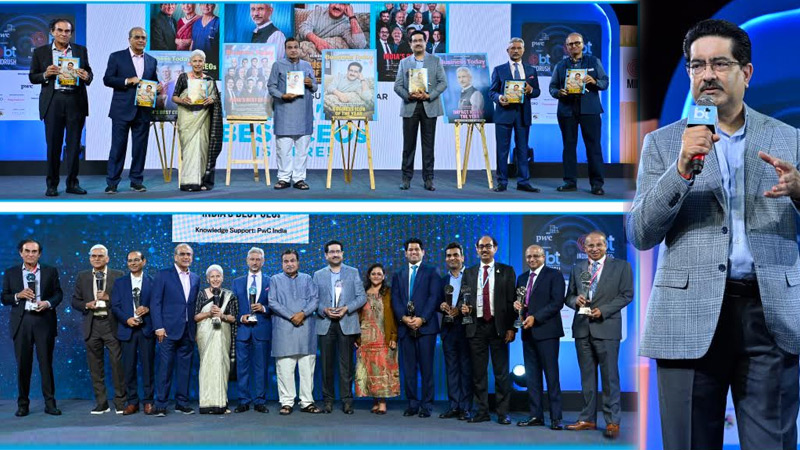
    MUMBAI: India’s top executives and business pioneers gathered at BT Mindrush 2025 on 22 March in Mumbai, where Business Today unveiled its prestigious India’s Best CEOs Awards 2025. The event honoured remarkable figures shaping the corporate landscape while offering insights into strategies for navigating global economic shifts.

    Aditya Birla Group chairman Kumar Mangalam Birla, was named Business Icon of the Year, while minister of external affairs S. Jaishankar, received the Impact Icon of the Year award. The Lifetime Achievement Awards were presented to Marico Ltd. chairman Harsh Mariwala and Thermax former chairperson Anu Aga for their enduring contributions.

    Among the other honourees, Narayana health chairman Devi Prasad Shetty was recognised as the Most Trusted Leader, while Eternal founder & CEO Deepinder Goyal received the Resilient CEO award. Tata Power CEO & MD Praveer Sinha was honoured as the Green Growth Visionary, and Physics Wallah founder & CEO Alakh Pandey earned the Startup of the Year title. Sun Pharma CMD Dilip Shanghvi was acknowledged for Services Vanguard, whereas TVS Motor MD Sudarshan Venu won for Manufacturing & Retail Excellence. MOFSL group MD & CEO Motilal Oswal was named among The Wealth Makers, while Mankind Pharma chairman Ramesh Juneja was recognised as The Deal Maker. Interglobe Aviation CEO Pieter Elbers was awarded the Glocal CEO title, and Jindal Stainless MD Abhyuday Jindal was honoured as an Urban Visionary. Solar Industries MD & CEO Manish Satyanarayan Nuwal was named among the Pillars of Progress, while KPIT Technologies’ Kishor Patil and Persistent Systems’ Sandeep Kalra received Tech Titans awards. Additionally, Mazagon Dock Shipbuilders former CMD Sanjeev Singhal was recognised as the Bharat PSU Icon.

    The theme, Vucanomics 2025: Thriving in Turmoil – Turning Global Disruptions into Growth, steered discussions on leveraging technology and capital to transform uncertainties into opportunities.

    Birla, said, “Each overseas acquisition must be driven by clear strategic rationale securing raw materials, strengthening value chain resilience, or accessing higher-margin markets with lower volatility.” He added, “India is firmly on course to achieve developed-country status by 2047.”

    Union minister Nitin Gadkari, the event’s chief guest, announced that a national tolling policy would be introduced before 1 April, ensuring “reasonable concessions to commuters” and unveiling 36 new green express highways. Jaishankar, awarded Impact Icon of the Year, highlighted India’s balanced approach in global diplomacy, remarking, “From Russia and Ukraine to Israel and Iran and from the BRICS to the QUAD India engages across divides with the mantra of ‘Sabka Saath, Sabka Vikas.’”

    Financial markets and policy stability were also key discussion points. Motilal Oswal urged cautious optimism in equities, while SEBI chair Tuhin Kanta Pandey assured, “Taxation has been rationalised; let’s not unsettle that certainty.” NSE MD Ashish Chauhan noted a shift in market dynamics, saying, “Domestic investors are increasingly becoming a stabilising force even as foreign flows ebb and flow.”

    The event culminated in the unveiling of Business Today’s special annual issue, honouring India’s finest executives. The issue was launched by Union ministers Gadkari and Jaishankar, Birla, and India Today group chairman Aroon Purie.

    With 18 eminent speakers across 13 sessions, BT Mindrush 2025 hosted over 200 CXOs from corporate India. The event was supported by Pwc (Presenting Partner), Diageo (Celebration Partner), Polymatech (Semiconductor Partner), Becquer Solar Studio (New Energy Partner), Logitech (Collaboration Partner), GAIL (Energy Partner), Sofitel Mumbai BKC (Hospitality Partner), and Laqshya Media Group and Omark Media Around Life (Outdoor Partners).

  • Business Today MindRush returns with top leaders decoding disruption at Vucanomics 2025 in Mumbai

    Business Today MindRush returns with top leaders decoding disruption at Vucanomics 2025 in Mumbai

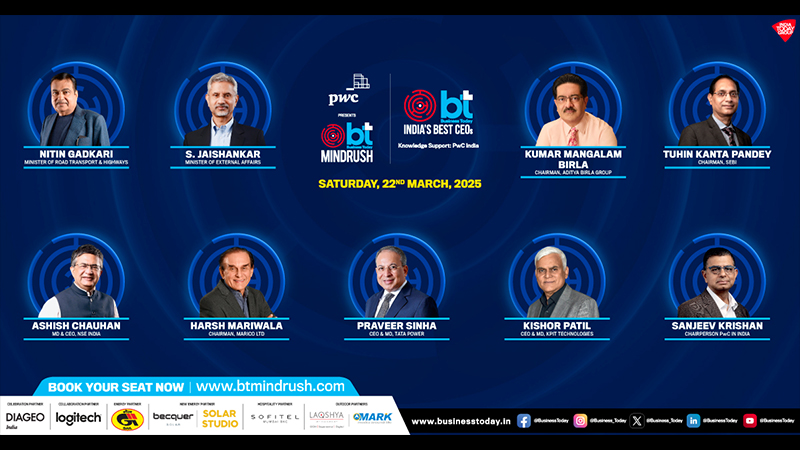
    MUMBAI: Global disruptions, economic turbulence, and CEOs dancing through chaos—sounds like the perfect storm waiting to hit Mumbai! Hold onto your hats because Business Today’s MindRush 2025 is about to turbocharge the narrative. Gathering the sharpest minds and slickest suits, BT MindRush will speed into Mumbai on 22 March, transforming global upheaval into growth opportunities faster than you can say ‘Vucanomics’.

    Taking place at the swanky Sofitel in BKC, the 13 edition of this flagship event will see India’s corporate titans swapping survival tips and secret sauces for thriving amidst turmoil. “Vucanomics 2025: Thriving in Turmoil – Turning Global Disruptions into Growth” isn’t just catchy; it’s an entire blueprint for business brilliance.

    Headlining this leadership carnival will be luminaries like India’s road transport czar Nitin Gadkari; diplomatic heavyweight S. Jaishankar; and NSE India boss Ashish Chauhan. Throw in Kumar Mangalam Birla, Harsh Mariwala, Praveer Sinha, Kishor Patil, and PwC India’s Sanjeev Krishan, and you’ve got more star power than a Hindi cinema blockbuster.

    From fiery keynote speeches to razor-sharp panel discussions, BT MindRush will dish out lessons in leadership, innovation, and grabbing disruption by the horns. This year’s edition won’t be for the faint-hearted, promising ‘ample networking opportunities’—corporate speak for ‘bring your best elevator pitch or stay home.’

    The crème de la crème will also get their moment in the spotlight with the prestigious BT India’s Best CEOs Awards. These won’t be your run-of-the-mill trophies—winners will be selected through the intense BT-PwC India’s Best CEOs survey, honouring those who have turned volatility into victory.

  • “Creating a culture that fosters new ideas and constant innovation is a key to building a successful business”: Marico’s founder H Mariwala

    “Creating a culture that fosters new ideas and constant innovation is a key to building a successful business”: Marico’s founder H Mariwala

    Mumbai: Indian multinational consumer goods company Marico’s founder and Chairman Harsh Mariwala reckons that companies should place a greater emphasis on innovation when conducting business. Harsh Mariwala, speaking at the FICCI-FLO seminar ‘Right to Win,’ revealed that Marico’s three D2C brands have grown to a Rs 500 crore business.

    “If we look at Marico’s brands, in every segment they are market leaders, and this is because the company has innovated or pioneered the segment,” said Mariwala. Marico now has operations in 25 countries across Asia and Africa. Since then, the company and its products have become a part of every Indian household.

    While giving an example of Marico’s brand Parachute, Mariwala explained how its packaging was innovative. Mariwala said, “In a product like the Parachute, Marico constantly innovated in its packaging, Saffola was a pioneer in healthy edible oil, and so on. My belief in innovation is very high, and that’s why we started the Marico Innovation Foundation. I think if India has to succeed, innovation has to play a very important role.”

    Mariwala believes that it is difficult to create a culture of innovation in businesses and it is the leadership to ensure that people in the organisation experiment and take risks and remove the fear of failure. “Constant innovation and creating a culture that encourages new ideas are key to building a successful business,” he said.

    He further added, “I realised the importance of innovation 20 years back, when I look back at our brands, they all have something different that has succeeded in the market. So, if you want to succeed in the marketplace, you have to innovate, not just to launch a product but also on a perpetual basis, because it is only a matter of time before others will start copying you.”

    He also stressed how technology has influenced every business, even defensive sectors like FMCG. He gave the example of Mamaearth, which has emerged in the FMCG space. Before the advent of e-commerce and digital market initiatives, companies required a budget of Rs 20–30 crore just to launch a product with an all-India distribution network. According to Mariwala with the right approach, the industry should prioritise its digital initiatives and capitalise on this business growth opportunity.

    While speaking on high standards of governance, Mariwala advised not to take shortcuts on compliance. “This is my advice to entrepreneurs of any size. Get the highest thrust on governance,” he said.

    He believes once a promoter begins to compromise on compliance, the organisation’s culture is destroyed. He believes it is critical for society and potential employees who are interested in governance. Furthermore, good governance and compliance pay off when a company is listed and commands a much higher price, he added.

    Mariwala also emphasised the significance of identifying and cultivating talent. He believes that as India advances, talent will be scarce.

    “Marico, which also owns brands such as Hair and Care, Nihar, and Livon, will continue to maintain a sharp focus on driving penetration and market share gains across its portfolios aided by distribution expansion, cost controls, and investment in market development and brand building,”  Mariwala concluded.

  • Innovation and pioneering helped Marico grow: Harsh Mariwala

    Innovation and pioneering helped Marico grow: Harsh Mariwala

    MUMBAI: Harsh Mariwala transformed his family's trading business in spices and edible oils into Rs 7,300-crore FMCG giant Marico, led by flagship brands such as Saffola and Parachute which sell in 25 countries. The company recently launched Saffola FITTIFY, a range of healthy soups and shakes. Mariwala's other businesses include Kaya, a chain of skin care clinics.

    The company also scouts for young Indian entrepreneurs and facilitates the start-up ecosystem through the mentoring platform Ascent Foundation.

    Mariwala is someone who walks the talk and lives by example – a catalyst of positive change, said Raj Nayak during a tete-a-tete with the affable Marico founder.

    “We started in phases, earlier the name of the company was Bombay Oil Industries. It's an edible oil business where we were selling coconut oil, refined oils to trade as well as some industries. That business was not doing too well, lots of businesses depend on how well you cover your raw material or how the raw material prices behaved, so it was very erratic in terms of margin and performance,” shared Mariwala.

    So he thought of converting the oils business from unbranded to branded in order to make it more profitable and sustainable, a bold move which paid off. And that’s how it all started. He started travelling to internal markets, appointed distributors, talent managers, advertising agencies in the interiors of Maharashtra and Gujarat. The consumer product is highly de-licensed, which helped Mariwala to gain profit. Apart from licensing, one clear no for him was entering the high-tech business.

    Mariwala mentioned that while his iconic Parachute brand was a success, it was mainly selling in 50 litre tins. Initially, the retailers would buy it and sell it in bottles which were later purchased by consumers. Back then, the market of packed coconut oil was much smaller than what it is today. Later, the idea struck him to create a packaged product which was sold in various parts of Maharashtra. Mariwala’s initial foray was to scale up the existing business across India.

    Another well-known brand, Saffola was neglected for a very long period of time, he revealed. After starting the business, his focus was to identify further opportunities. He added, “I wanted to be in the number one position, to be a market leader, as it helps you to get more margin. We grew by innovating in the coconut oil market, during that time the whole market worked on tin containers, then we converted it to plastic. It was not an easy journey; it was a tough conversion. However, it ensured that our growth rate jumped up multiple times. We applied the same innovation in Bangladesh, and now we are the leading coconut player in the Bangladesh market.”

    Another key innovation was the lice-killing hair product Mediker, a must-have in Indian households with young kids.

    “We acquired Mediker from Proctor & Gamble and introduced it in oil format, the sales just doubled. So, innovation and pioneering helped us to grow,” the business tycoon remarked.

    Relating an interesting anecdote behind how the Revive detergent was launched in the early ‘90s and creating a market for a product where none existed, Mariwala said, “We came up with our product Revive out of a personal necessity. I liked crisp clothes, that is how we made Revive which helps to starch clothes without any hassles.”

    According to him, for any product, there must be a consumer need which is big enough to build a brand. Moreover, to become a market leader, advertising is very important and once a certain mass is created, one can go back to devising effective cost structures and improving margins.

    Everybody still wonders, from where the name Parachute emerged. Mariwala jokingly said that is the question that the nation wants to know. He shared that Bombay Oil Industries was formed in 1947, shortly after the second World War when a lot of Indians got to know about parachutes – and that’s how Mariwala’s uncle thought of creating a brand by this name, which is now a huge success.

    On the subject of world wars, Mariwala opined that there is an ongoing war for talent, and one has to treat hiring like marketing. “When there is a shortage of good talent, you have to market yourself first,” he quipped. “That means you have to identify what is unique about you, you arrive at what we call employee value proposition, which is unique in the job market. In our case, unlike big MNC corporations where decisions are taken in closed headquarters, we empower our employees.”

    Spoken like an entrepreneur who knows how to make a difference.