Tag: Harit Nagpal

  • “Subscribers stick to us because of our services and choice of packs”

    “Subscribers stick to us because of our services and choice of packs”

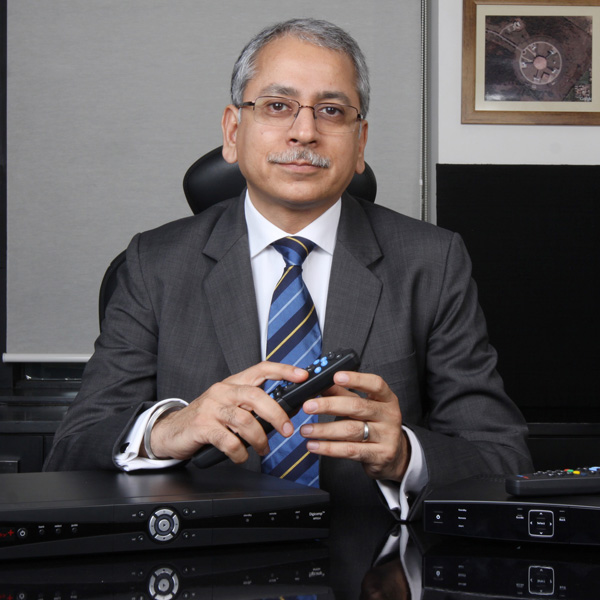
    When you first meet him, what strikes you most about him is his candour. Indeed, Tata Sky managing director & CEO Harit Nagpal has got a reputation of speaking his mind. He was not afraid to come out in the media and make an appeal to ISRO when it delayed delivering him his transponders on GSAT-10 which would have allowed him to ramp up the offerings the Tata group, News Corp and Temasek joint venture could deliver to its customers. When the appeal got no response, he did not let it dampen him. Instead he chose to upgrade Tata Sky’s set top boxes from MPEG-2 to MPEG-4 at no cost to them.


    He was also quite open at the Indian Digital Operators Summit organised by Indiantelevision.com and Media Partners Asia when he invited his rivals and other players from the cable TV ecosystem to come in and study the best practices that Tata Sky has put in place. “The time has come for all of us to collaborate and grow the digital ecosystem,” he had said. “And my doors are open to anyone who wants to see how we do what we do.”


    That offer still stands, says Nagpal, who believes that Tata Sky has some processes which compare with the finest practices globally. Especially its single-minded focus on the customer and the experiences it provides them. Nagpal strongly believes in delighting the customer and his supplier-partners as well. “In this way, we will all grow together,” he says.

    Nagpal presides over the DTH Operators Association of India and has a CV which explains his dervish like focus on the consumer. A chemical engineering graduate with an MBA from FMS, Delhi, he has nearly 28 years of work experience with stints at Shoppers Stop, Pepsi, Marico and Lakme in various leadership positions in fields like Sales, Exports, Operations and Marketing. Before joining Tata Sky in August 2010 he was the group marketing director of Vodafone plc, working out of London.


    In a conversation with indiantelevision.com’s Seema Singh and Vishaka Chakrapani, Nagpal talks about the efforts which are needed to keep Tata Sky’s 11 million subscribers happy, the company’s decade-long journey and how it’s dealing with the national digitisation rollout.


    Excerpts:


    How was the year 2013 for Tata Sky and for the DTH industry? What will year 2014 bring for Tata Sky and the industry?

    2013 was what we had been waiting for years. It was strange that in a country like India where everything is regulated, there was one full unregulated industry that required government intervention. People developed cold feet when the process of digitisation began but after the first round took place both the industry and government were confident that it has to be and can be done.


    DTH gained hugely in the process. We don’t create a new customer; instead, we convert an analogue customer to DTH. Very rarely we have fresh customers coming to DTH. On a steady basis, this industry picks approximately three million customers every year. Also, every year DTH converts around four per cent of the 100 million cable TV viewers into DTH homes. In the cities that got digitised in 2013, DTH gained nearly 30-35 per cent of cable converts.


    So while we were converting around four per cent cable TV customers into DTH subscribers per year, with digitisation, we have moved it up to 35 per cent in a month. Now did we gain or lose, it’s for you to decide. The biggest advantage of DTH is that consumers can choose their pack and pay for it.


    At Tata Sky, we’ve had a very good year, in terms of total turnover, profits, growth rate, churn, average revenue per user (ARPU) etc. In every aspect, we are leading.


    The new year will have newer services and technology being introduced.


    What differentiates Tata Sky from other DTH players?


    There’s hardly any scope for differentiation here. With content being common and everyone having access to similar technology, there is no exclusivity. The only differentiation is through the service we offer. Stakeholders are judged on: a) how they manage customers without causing much trouble for them and (b) how they help customers recover as soon as possible, in case of any issue. 

    I have always believed that there is room for innovation. We started with standard definition (SD), high definition (HD), DVR, video on demand (VOD), ‘Catch up TV’ and now have moved to ‘Everywhere TV’. We believe in introducing one service every year. The service initially starts with being accepted by leading edge customers, which then percolates to others.

    How do you decide on the new services? Also, how do you ensure that it is accepted by the consumer?

    Customers tell us what they are seeking. We just have to go back to them and seek their pain points and then find solutions for that. We don’t start with technology and find customers. We try to seek their needs and then tailor services.

    The television sets in Indian homes are getting better, and so we have to ensure that we match the screens at home. Giving digital signals to cable TV homes was the first step, the second was HD. Even for this transformation, it was the customer that gave us the cue, since they were looking for better quality. 

    The recorder was introduced when we saw that people were expected to be in front of the TV when the show was being broadcast, it was becoming impossible for them to plan their day around the show. The answer to this was the recorder.

    When we saw it was causing inconvenience for customers to physically get a DVD from market and watch it, we launched VOD and followed it up with ‘Do it yourself’ films.

    Catch up TV came in response to customers wanting to watch something that had already been aired. Our latest addition was ‘Everywhere TV’. We found out that more and more people were spending time outside and were consuming videos on mobile screens. So we thought of connecting Tata Sky to the handsets. Through this, a decent broadband or 3G connection could help people consume content through ‘Everywhere TV.’

    How much a does a consumer pay for subscribing to ‘Everywhere TV’? How do you divide the revenue share? Do you think people would want to subscribe to ‘Everywhere TV’?

    If a consumer can buy a Rs 50,000 phone, he would not mind paying Rs 60 per month for ‘Everywhere TV’. The Rs 60 is divided equally among all stakeholders. So while one-third goes as taxes, the broadcasters take one third and we keep the rest. So, we would make around Rs 20 for the infrastructure we’ve invested.

    The need on which the product is based tells me it will do well. The first launch is restricted to iOS, but we will be launching soon on Android as well. We are happy with the numbers we got in the first three weeks of the launch of the service.

    Everyone is consuming videos today. And with the video consumption going up, prices are coming down. Even mobile phone operators want people to consume videos on phone. Everywhere TV is one way of increasing consumption and as networks start getting filled it is possible for mobile operators to drop prices. Our job is to create the product and make it affordable.

    How are the multiple services helping the company?

    The services are helping us increase the ARPUs without any price rise. When you are penetrating deeper into a market, your next customer is bound to give you less. The only way you can increase it is by making him consume more of what he wants to and make him pay for it.

    By offering more services and choice of packs, we have been able to ensure that our subscribers stick to us. The fact that we have growing ARPUs, we must be doing something right, by launching multiple services. 

    Have you been able to fulfill the need for more capacity with MPEG4 boxes? By when will the seeding of the MPEG4 boxes be complete?

    MPEG4 boxes have ensured that there is no real content shortage now. We started seeding MPEG 4 boxes this year and with that we have been able to fill the gaps. We had to leave Kerala and Tamil Nadu, because of capacity constraint. With the MPEG4 boxes, we have been able to go back to Kerala with 19 channels.

    It will take close to two years for us to complete the whole replacement process. We have 12 transponders and with these MPEG4 boxes, we are fine in the short to medium term.

    Recently the aggregator IndiaCast had a face-off with Dish TV over ‘on-request channels’. How does Tata Sky manage the relationships with the stakeholders involved?

    We have great relations with our content providers. We have long and protracted negotiations with them. However, that rarely leads to a breakdown of relations and we reach a reasonable and reasoned out number to renew our contracts. If we make more money we would like to share it with the partners.

    2014 may see disappearance of aggregators? Do you think it will affect the DTH players?

    No, it will not. I have been hearing news on these lines, but it doesn’t affect us much. If it comes into force, instead of negotiating with one player, we will have to negotiate with several players. But that is easy. These negotiations do not happen every day, these are contracts signed for three to four years.


    Apprehension is that if all this will result in cost hike. But I don’t see any cost issue. In fact, with aggregation we are forced to buy certain channels, which our customers don’t want. If TRAI decides to remove the role of aggregators then I may not take all the channels. I can save that bandwidth for products that my customer wants. Currently, what is happening is more and more bandwidth is getting clogged because of the channels that broadcasters wants to push and not what customers want to watch.

    In the long run, it is all about what the customer wants.


    Are the DTH players pinching customers from each other?

    At this stage there are no such plans. With 70 per cent still being analogue cable TV homes, we have enough scope from the analogue cable TV homes. We can tap that.

    Do you think India is still far away from US standards? Can we think of a time when DTH will totally replace cable TV? 

    I think we are already there. Any technology launched in the US is also available here. There are some services that are slightly better there but that’s dependent on quality of broadband. The day that gets better, the service experience will get better. There are infrastructural constraints that keep us from providing certain services that are present in the US. But, one has to start somewhere.

    Cable is getting digitised and so it’ll be there in the industry. I don’t think India will be an only DTH country. The industry improves only when more operators try to do new things. Life starts with fragmentation and moves to consolidation. I don’t think there’ll be consolidation in this business. Yes, the number of subscribers moving from cable to DTH is larger than reverse. But that doesn’t mean the cable will disappear.

    How has the response of interior towns been to DTH penetration?

    More than 60 per cent of our new customers are not from the top 20 cities. Once a service reaches them, they respond more positively than a person in the city. Most places we are going today are places with the presence of cable. There is certainly a kind of saturation we are reaching in top cities. Not like we are not getting numbers but there are certain limitations.


    More customers are available in the interiors. A good amount of growth is coming from basic services in interiors and high end in top cities. A customer, who came to us seven years ago, picked up our innovations each year. We are hopeful that someone in the interiors will also get onto our recording facility in a few years.

    To what extent has packaging been explored in India? How do you package channels for your consumers? Is it easy for consumers to add or remove channels from their pack?

    There was a time we were creating packs that customer didn’t even understand. In India, people don’t watch metals (bronze, silver, gold packs), they watch genres. Hindi news and Hindi soaps is something that everyone watches. What we do is that we put these in the base pack and then top it with a bit of music and other genres. We, then give two language channels because in most homes two languages are spoken apart from Hindi and English. Customers have a choice of adding other genres like English movies, kids, music, knowledge, etc on top of the base pack.

    We have services by which if a person who is not getting a channel he needs, can just SMS it to us and instantly the channel will be switched on. It’s instantaneous. Customers take a pack and then add on a la carte. So they take a base pack and then add channels to it. That’s where our revenues are growing. Our ARPUs are growing because we are making it easy for our consumers to buy more content.
  • Recharge Tata Sky connections through Yes Bank ATM

    Recharge Tata Sky connections through Yes Bank ATM

    MUMBAI: Recharging your Tata Sky connection couldn’t get easier. The direct-to-home service provider and Yes Bank have come together to provide its respective customers an easy medium to recharge the DTH connection. The Yes Bank customers can simply walk into any Yes Bank ATM to recharge their Tata Sky account.

    “The purpose is to make recharging of Tata Sky connections easier for customers,” says Tata Sky CEO Harit Nagpal. The ATM recharge method is the newest addition to Tata Sky’s already existing options of recharging through retailers, debit/credit cards, call center, mobile app, WAP and SMS recharge. “We have taken a step towards making recharges available to customers in a convenient way,” adds Nagpal.

    Yes Bank is the first of the lot from the banks that Tata Sky has approached for activating this facility. “We are in touch with many other banks. There will be many more such activations that will take place in the time to come. Yes Bank is a start,” says he.

    Commenting on the tie up with Yes Bank, Tata Sky chief commercial officer Vikram Mehra says, “We are proud to be associated with Yes Bank, known for its customer service centricity for this offering. Tata Sky has constantly endeavored to customise its bouquet of product and services for its evolving subscriber base. With the advancement of technology; the option of instant ATM based recharge facility will help reach out to subscribers spread across the country. Using the wide spread network of the bank along with other touch points, Tata Sky looks forward to increasing convenient modes of payments in the future.”

    Yes Bank with its 1100+ ATMs pan India is hoping to better its services with this addition. “This is a result of our ever endearing efforts to offer superlative ‘consumer convenience’ across the board. And it gives us immense pleasure to find like minded partners, to work closely towards jointly achieving a platform aimed at ‘Customer Delight’,” adds Yes Bank senior president & country head, liabilities, cards & direct banking Chitra Pandeya.

  • Tata Sky ushers Ganesh Chaturthi with 10 day-long celebrations

    MUMBAI: Tata Sky, one of the leading Direct-to-home service provider in the country, has announced a range of celebrations on the occasion of Ganesh Chaturthi for its subscribers. These festive offerings will be spread over 10 days of Ganesh Utsav, for its customers delight with some quality digital entertainment.


    To add to the festive spirit, Tata Sky has created attractive content for every member of the family.


    As part of the Ganesha specials, one can start the day with Actve Music listening to Sthapna Vidhi, welcoming the deity at home or listen to aartis in praise of Ganpati.
    Young minds can get a sneak peek into the life of the mischievous Bal Ganesha through fun-filled and interactive stories, art sessions and craft videos on Actve Fun Learn.


    And there is Actve Cooking which is for the women who would love to cook up a delicacy for the family and invite guests over for a scrumptious meal this festive season.

  • Why Tata Sky’s Harit Nagpal is pained about the MPEG-4 STB rollout

    Why Tata Sky’s Harit Nagpal is pained about the MPEG-4 STB rollout

    MUMBAI: A press release hit indiantelevision.com yesterday disclosing how US chip company Broadcom had got a massive order to supply standard definition MPEG-4 set top boxes (STBs) to Tata Sky. A simple release right. But it surely got the goose of Tata Sky managing director Harit Nagpal.

    Tata Sky MD Harit Nagpal is still awaiting a response from ISRO officials
    “This entire exercise is costing Tata Sky about Rs 1000 crore,” was Nagpal’s admission, when indiantelevision.com called him up. “We are replacing close to 5-6 million MPEG-2 SD STBs at no cost to consumers over the next year. All of this is coming in from internal accruals.” Nagpal says the DTH operator normally supplies about three million STBs a year for new acquisitions and churn. “This year we will be doing about 9-10 million STBs,” says he.


    The volumes have forced him to bring in emergency teams to make sure they install 500,000 STBs a month (made by Huawei and Humax apart from other international STB makers). This is apart from the regular service teams, which handle regular installation and problems.

    “For us even at Tata Sky it is a massive exercise and we have been working on it for the past three months and have just started the rollout,” he reveals.

    But isn’t that good? “Upgrading the boxes will give me more capacity for 12-14 channels,” he admits. “But I am being forced to do this because Indian Space Research Organisation’s (ISRO) has yet to give me my transponders. I could have put this money elsewhere on expanding my digitisation plans.”

    Tata Sky’s signals are being beamed off Insat 4A; but it had signed a contract to lease 12 transponders on ISRO’s GSAT-10 satellite around five years ago which have not been delivered to Tata Sky yet, even after the satellite launched in to space in September 2012.

    “It is sad that after national publications and a medium such as yours have carried my complaint against ISRO, I have not got a single revert from it about our transponders. We intend to take legal action since all our attempts to reach ISRO have failed. The courts are on vacation now, when they open again, we will move them,” added Nagpal.

    The transponders would have allowed Tata Sky to increase its channel offerings to consumers. However, now the new STBs will allow Tata Sky to add more channels to its bouquet. “We have been adding channels in a phased manner; the process will now be accelerated with the MPEG-4 STB. By June-July next year we should be able to revise our channel offerings to consumers,” said Nagpal.

  • Satellite woes bog down Tata Sky’s Harit Nagpal

    Satellite woes bog down Tata Sky’s Harit Nagpal

    MUMBAI: Tata Sky Managing director Harit Nagpal is extremely irate. The reason: he has not been able to expand his DTH service’s offerings for sometime now. And for no fault of his or his company’s, he says.

    Eight years ago, his company had contracted to use the government owned Indian Space Research Organisation’s (ISRO) satellite Insat 4A, with a proviso thrown in that if he needed more capacity, the satellite organisation would make the transponders available to him within two years of his request.

    In 2007, his organisation wrote in asking for more capacity. By then, Tata Sky was having about two million subscribers with dishes pointing in the sky towards where the Insat 4A satellite is located in orbit.

    Isro was slated to launch its Gsat-10 satellite with communications capabilities and Tata Sky had booked 12 transponders on it. The launch was delayed on account of something or the other. It finally, got into space in September 2012 off an Arianespace launch vehicle from Kourou in French Guiana.

    The launch gave him some relief, but what has dumbfounded him, is the fact that the transponders have not been made available to him almost eight months since launch.

    Since then, it has been a constant to and fro for his company. “We have been in touch with ISRO for a long time. We have written 100 emails to the ISRO chairman, met at least three to four times in the past six months. I know he wants to move things,” says Nagpal. “But despite his wanting nothing is.”

    Nagpal has been told Tata Sky’s allocation is stuck with the Space Commission currently. Prior to that, it was held up with the Insat Coordination Committee for a few months. He has even written to the Prime Minister’s Office which has then forwarded his request to ISRO. And the yo-yoing has been going on since.

    “It’s extremely frustrating,” says Nagpal. “I am a customer with a contract that entails me to pay Rs 50-60 lakh a month per transponder to the government as a rental. And I don’t have the government sticking to its contractual obligations.”

    But why is this happening? “I guess it is inertia,” says Nagpal. “Like everything has been stuck in bureaucracy. Even on this front no one is taking a decision as yet. Our contract is stuck in bureaucratic limbo.”

    Each of the 12 Ku-band transponders on GSat-10 have 36 MHz usable bandwidth with a footprint covering the Indian mainland with a power of 51.5 dBW. It is located at 83.0 degrees east in the same orbital location as Insat 4A and another Isro satellite GSAT-12.

    “I am open to other options. If officials are worried, then let them throw Insat GSAT-10 open for tender,” highlights Nagpal. “There will be no takers for it. Tata Sky is the only DTH provider, which has 10 million dishes nationally pointing towards the same zone in the sky that GSat-10 is at currently. Imagine you have an expensive bird in the sky costing $300-400 million and it is not being used productively.”

    Nagpal says he is days away from approaching the law of the land to force the government to stick to its commitments. “It’s not the ideal way,” he says. “I have been waiting for six years for my satellite transponders to be given to me. It has gone on long enough. There are no problems with my application; everything is sorted out. I am one of their main customers; so why such an extended delay?” he asks.

    Is somebody in government listening? Or in Isro?

    Indiantelevision.com called Isro chairman K. Radhakrishnan. And at that the time of writing was still awaiting a response from him. Keep watching this space for updates!

  • Goafest’13: How to make client-agency relationships work

    VARCA,GOA: When Arvind Sharma was asked to kick off the Advertising Conclave at Goafest 2012, he said one line, which turned out to be more prophetic than he would have imagined. He started his speech saying “Some of the most meaningful conversations one has, are the ones he avoids the most.” He was referring to this year’s theme at the Advertising Conclave which was ‘Time to Listen’.

    The first day of the annual ad fest in Goa on 4 April witnessed advertisers across categories address an audience filled with the cr?me de la cr?me of the advertising world. They frankly shared their perceptions of the shortcoming of ad and media agencies and where the latter were not living up to their expectations.

    HUL MD Nitin Paranjpe delivered an insightful narration where he pointed out what in his experience are the kinks in the client and agency relationship. He started off admitting that it is not just the agency that should be held responsible; the entire marketing environment that needs to be looked at hard to find some answers.

    According to him, the biggest challenge today is the abundance of choice. There is an abundance of options for each product in the market and brands are vying for the TG’s attention in a heated environment. On the other hand, media itself is facing the tyranny of abundant choice where the audience is becoming increasingly fragmented and engaging it is very tough. “What we have is scenario where choice is abundant, but there is very little to choose between each,” Paranjpe explained.

    This has led to an urgent need for brands to differentiate themselves which in turn possibly leads to desperate measures. Tata Sky MD and CEO Harit Nagpal‘s view in this regard was that “in order to be different, it is necessary to actually be different rather than just standing different.” He supported this this statement with a picture of five zebras where the one in the middle had its rear facing the camera.

    Another point that was unanimously pointed out by all the advertisers was that the 30 second television commercial is becoming redundant and agencies need to strategise innovatively to factor in this change. The rise of social media also needs to be accounted for when planning in today’s environment.Amul MD RS Sodhi spoke from his experience with agencies – DaCunha Communications (outdoor), Draftfcb Ulka (creative) and Lodestar (media). He expressed that for any marketing strategy to work, there needs to be a long-standing relationship between the agency and the client. This builds the basis for trust and understanding that is required in any marketing relationship. It also offers consistency, which is paramount to maintaining a brand’s identity among the TG.

    “According to me, what agencies need to remember today, is that the goal of advertising is to sell the product and not the creator of the campaign. What the product stands for, what the audiences relate to with the product and the brand should be the first consideration,” he elucidated. “Accolades for the creator should not be the reason behind creating any campaign.”

    He also added that the whole concept of advertising awards should either be discontinued or be revisited and reworked upon. “These awards look at and honour work that is created by the industry and judge by the industry. What is the point? Either discontinue them or ask the clients and the audience to rate the ads,” he suggested. His suggestion was met with a thunderous applause fom the audience.

    SBI Capital Markets MD & CEO Arundhati Bhattacharya spoke about the importance of research. “It is important to understand both the brand personality and the TG profile in order to come up with a relevant campaign,” she said. She also feels that advertising should be done in order to further the business and it should be kept simple and short. It is the consumer whose minsdset has to be appealed to,she further said.

    Arunabh Das Gupta of BCCL feels that the death of planning as a practice in the industry has led to a lot of complications. Today one sees a gap in the marketing research done by agencies and this leads to a shortfall of breakthrough creatives. He also offered that creative agencies need to look at talent retention seriously since their employess are the touch points that the clients deal with and form the basis of building a relationship between the two.
    Tata Sky‘s Nagpal begged to differ from the rest on a couple of points. While most of the speakers felt that the fragmentation of the advertising agency into media, creative and account planning has led to a decrease in efficiency of client servicing, Nagpal feels that hiring specialised personnel for specialized work is the order of the day and if need be, this talent should be imported.

    He added that there should be clarity regarding wha the agency and the client expect from each other in order to have an efficient and fulfiiling working rapport. Suresh Bandi from Panasonic pointed out that what matters to a clients is the value that an agency gives them for a given price. “The way I see it, when an agency increases its fees, the value the agency brings to me decreases,” he said.

    Nagpal on the contrary feels that clients should not look at cost-cutting every time. Specialized work comes at a certain cost and while agencies in a bid to compete and win clients may lower their rates, it may lead to a lowering of quality. It is the basic princliple of “Itne mein sirf itna hi milega.”

    Another grievance recorded by each advertiser was that while the pitch process is spearheaded by a known senior agency executive/professional, once the pitch is won, the clients end up dealing with newbies who are not trained enough to handle the account or have no clue of the pitch in the first place. This creates a disjunct and gap in the dynamics and is often the reason why most client-agency relationships fail.

    In conclusion, the panel agreed that while agencies and clients needs to introsopect and make some changes, the key takeaway was that the relationship between the agency and the client is what decides the effecniency of a campaign. An integrated team will function much better than a fragemented one and a team that knows each other is the one that will take the brand all the way.

  • All roads lead to Goafest

    MUMBAI: It’s that time of the year again when the who’s who of the advertising and marketing industry ditch their suits and don their sunhats to attend the annual Indian advertising extravaganza Goafest.

    Going with the theme ‘Just what you unexpected’, this year’s Goafest promises to be different and exciting. The focus is on listening to advertisers as to where they think media and creative agencies are falling short and what they expect from them.

    The knowledge seminars will see global experts discussing issues like maximising the potential of social media, democratisation of creativity, and what great work looks like in the present scenario.

    Perhaps for the first time, the festival also has speakers from walks of life different than marketing, advertising and media.

    This year attendees at the Goafest will get a chance to hear Prasanna Trust founder and chairman Swami Sukhabodhananda talk about “Uncertainty is also part of life’ and film maker Abhishek Kapoor (high on the recent success of Kai Po Che) narrates his views on ‘Do What Your Heart Says’.

    This is a year of firsts as the Abbys have introduced a new category named Branded Content. In the media category too, the committee has made a significant change by introducing sub categories in the digital segment. Explaining the move, Media Abby Jury chairman Ashish Bhasin said, “By having a broad category for digital, we ended up comparing apples to oranges. The digital medium has evolved rapidly to have a diverse range from website design to mobile campaigns to online activations. Introducing new sub-categories does justice to this variety of innovations that can happen on the medium.”

    Indiantelevision.com caught up with some of the delegates and speakers headed for the Goafest to know what they expect from this year’s edition.

    GCMMF (Amul) MD RS Sodhi who is one of the speakers at the Advertising Conclave on 3 April will be attending the festival for the first time. “I have heard so much about the Goafest and am really glad I’ll be attending this year. To be able to mix and mingle with the various stakeholders of the industry from India and abroad is what I am looking forward to. I’m honoured to have been invited to speak,” he says enthusiastically.

    For Tata Sky MD and CEO Harit Nagpal, the annual ad fest is the perfect setting to meet the ad industry’s creative professionals and media planners and buyers and discuss matters in a relaxed atmosphere. He feels that more than a networking hub, the Goafest is a platform that allows the members of the industry to interact, debate and take discussions to the next level.

    The delegates coming to Goafest look forward to not only the seminars and networking opportunities, but also the various activities lined by the festival partners. Last year saw Disney UTV’s youth entertainment channel bindass line up some activities like water zorbing and the Hindustan Times had a photo booth where you could have your photo printed on the front page of a newspaper! This year too, delegates can look forward to a Rain Dance and many on the spot activities/games.

    Publicis Capital CEO Hemant Misra looks at Goafest as the time to take a break, meet old friends and see some stimulating work. He explains, “Goafest is a great opportunity for young talent. While we add value to our client‘s business we hardly spend time adding value to our own people, Goafest is an opportunity for them to open their minds, observe, discuss, argue…learn. Importantly unlearn the old and partake of the new.”

    On a lighter note, Misra adds, “Hope there‘s no free drinks this time so the kids spend more time listening than getting drunk!” Publicis Capital will be sending upwards of 50 delegates to the Goafest this year.

    Madison media’s Lara Balsara, who will be there at the Goafest with nearly 100 other Madisons, hopes there will be “some learning, lot of winning and lots of fun” this year. She agrees that the festival is a great opportunity to see some of the best work in the sub-continent at one shot. She has just one suggestion to make, that the venue be changed next year so that the ad industry can explore some new venues and beaches in Goa.

    Carat Media Senior vice-president Himanka Das will be giving the festival a skip this year, but is confident that the work portrayed is getting better every year. Having been on the jury for the Media Abbys, he has seen some of the projects submitted by the agencies and he is mighty impressed.

    Scarecrow Communications co-founder and director Manish Bhatt has a special bond with Goafest. He was part of the designing team at Goafest 2008 (he was at Contract Advertising back then). “The Goafest is fast becoming the Mecca of India’s advertising industry. It’s a great opportunity for everyone to meet and listen to the who’s who of the industry. The Abbys are the awards to look out for and this year, we are thrilled since of the 62 entries we sent, 33 have been shortlisted across categories,” says an excited Bhatt.

    The Abby Awards have seen their fair run of controversy and this year was no different. The recent sacking of top creative executive Bobby Pawar by the JWT India management over the Ford Figo ads raised a lot of questions. While on the one hand the industry debated the evil of scam ads, many also questioned why the creative department is made the scapegoat in such cases all the time? The controversy though does not seem to have dampened the spirit of the Goafest goers as they are looking forward to the festival excitedly.

    So it’s time for the ad industry to slap on the sunscreen, put on the shorts and head to Zuri White Sands in Varca Goa and have an educational, exciting and fun-filled time at Goafest 2013.

  • DTH Assn’s Harit Nagpal: “We can plug the shortfall in STBs in Phase II”

    DTH Assn’s Harit Nagpal: “We can plug the shortfall in STBs in Phase II”

    MUMBAI: They are being pretty direct. DTH TV operators have categorically stated that they can definitely fill the gap should there be any shortage of set top boxes in any city under phase II of the government mandated digitsation of cable TV.

    “Digitisation does not need to be postponed,” says DTH Association of India president Harit Nagpal emphatically “ We have been digitizing the TV industry for the past seven years. We have national contracts with the broadcasters, which we keep working on with them. We have adequate stocks of STBs and trained manpower to meet any demand which crops up in any city should cable TV operators not be in a position to deliver the set top boxes to their customers.”
    He is pretty confident that this can be done overnight. “At Tata Sky we have about 1.5 million set top boxes in stock,” he reveals. “I am speaking for all DTH operators: If there is a colony or a ward or a pincode which is feeling the shortage, we can rush boxes there overnight to plug the shortage.”

    Nagpal believes that media reports claiming that 50 per cent of homes in some cities are facing a TV blackout could be attributable to independent cable TV operators in these cities not clearly reporting the number of STBs they have installed. “I think it is a reporting problem,” he says. “The number of TV homes not receiving signals is much lower. Some anomalies like this are bound to occur on an exercise of this scale.”

    DTH today accounts for about 27-28 per cent of the entire pay TV base in this country with about 40 million active subscribers according to the DTH association.

    Also, according to MIB reports almost 40 per cent of the digitization that has been achieved in the 38 cities has been done by DTH players, among which figure Tata Sky, Airtel, Videocon d2H, DishTV, Sun, DDDirect, Big TV.

  • Goafest Ad Conclave theme announced

    MUMBAI: The theme of this year‘s Goafest Advertising Conclave is ‘Time to Listen‘ and it will highlight the shortcomings of media and creative agencies, as perceived by major advertisers.

    The conclave is being sponsored by Discovery Channel and will see 200 industry leaders drawn from marketing, advertising and media. The Advertising Conclave will be held on 4 April at Zuri White Sands, Goa from 3.30 pm to7.30 pm.

    Goafest Advertising Conclave chairman Srinivasan Swamy said, “Our Conclaves always focus on issues of relevance to us. In the past we have talked about how to grow the advertising industry, or on the changing agency structure or how advertising is more than creative and media etc. In the same vein, this year we will get advertisers to tell us how we can be more relevant to their needs. The theme ‘Time to Listen‘ captures this essence.”

    Goafest Advertising Conclave will have some of India‘s biggest marketers identify the areas that agencies, both creative and media, need to focus on and make suggestions to get served better.

    Hindustan Unilever MD and CEO Nitin Paranjpe will deliver the keynote address at the conclave. The other industry experts that have confirmed their presence at the conclave include Tata Sky MD and CEO Harit Nagpal, SBI Capital Marketers MD Arundhati Bhattacharya, and Bennett Coleman president Arunabh Das Sharma.

    SKA Advisors founder and chairman Sunil Alagh will moderate a lively panel discussion with the distinguished speakers.

    Goafest 2013chairman Nakul Chopra said, “The original idea of the conclave as distinct from Goafest was a forum where industry leaders could contemplate the future of our industry and come together to cooperate in improving it. True to this spirit this year it is our endeavour to make the conclave a much more potent learning experience for the industry. There is no better way to improve our future than by listening to our own customers. With a stellar cast of speakers and a potent theme this year‘s Conclave promises to be thought provoking at the very least.”

    For the record, Goafest 2013 will be in its 8th edition and for the 6th consecutive year AAAI and The Advertising Club will come together to deliver India‘s premier awards that celebrate creativity.

  • Tata Sky extends STB contract with Technicolor

    Tata Sky extends STB contract with Technicolor

    MUMBAI: Technicolor, a technology leader in the media and entertainment sector, said it has won two extension contracts from Tata Sky, India‘s leading satellite operator with over eight million subscribers, for supply of set-top boxes (STBs).

    Deliveries of new STBs are scheduled from the third quarter of 2013 to second quarter of 2015, while Technicolor will continue providing locally-based after-sales support to Tata Sky.

    Tata Sky has granted Technicolor, until mid-2015, extension of the initial contracts for the STBs already delivered over the past years which includes the HD-enabled zapper (MediaPlay DSI715) and the SD satellite zapper (MediaPlay DSI309).
    “Technicolor‘s solutions have met our expectations in terms of reliability because we want to guarantee a trouble free experience for our customers. They also help meet our Total Cost of Ownership requirement, which is key for an operator with a large subscriber base like ours. The latest agreements mark the continuation of our trusted relationship with Technicolor,” said Tata Sky MD and CEO Harit Nagpal.

    Technicolor‘s Connected Home division President Michel Rahier added, “We are very proud to support the commercial success of Tata Sky in its digital television services. As a long standing partner of Tata Sky, the renewal of the previous contracts awarded up to two years ago proves us that we have been able to build a strong relationship thanks to the high quality of our products.”