Tag: Hansa Research

  • SureWaves & Hansa Research to audit Spot TV Network

    SureWaves & Hansa Research to audit Spot TV Network

    KOLKATA: SureWaves MediaTech, a Bengaluru-based digital media-technology company, has joined hands with Hansa Research, to carry out third party audit and validation of the entire SureWaves Spot TV Network.


    SureWaves MediaTech aggregates television audiences on diverse and fragmented cable and satellite channels in the country.


    The association of Hansa Research with SureWaves Spot TV Network, brings an additional seal of accountability to a revolutionary, new age media platform, fulfilling a long felt industry need and is likely to cause a major shift in media buying on television. 


    New age technology led media platforms are fast emerging as the biggest trend in the media industry. Advertisers are tapping into the vast potential these mediums offer in terms of reach and diversity of audiences.


    SureWaves assists brands to reach out to a vast, diverse and hitherto untapped audience in a cost efficient manner with its flagship solution – SureWaves Spot TV Network. With the help of its patented technology, SureWaves has aggregated more than 450 television channels on its digital platform offering around 90 million households across 29 states in India.


    “The third party audit and validation of the SureWaves Spot TV Network by Hansa Research will cover random physical verification of technology deployment at channel studios and online audit and validation of SureWaves ADEX Logs with LIVE monitoring of channels. To further increase the trust and confidence levels we felt that opening of the technology behind SureWaves Spot TV Network to third party audit and validation by a reputed research agency like Hansa is a logical step forward,” said SureWaves chairman and managing director Rajendra Kumar Khare.

  • Women portrayal: Better days are emerging

    Women portrayal: Better days are emerging

    MUMBAI: The debate over portrayal of women in our advertisements and soaps is ever going. Remember the recent Airtel advertisement which created a furor as people debated if a working woman should cook or not? Or even the last year’s Ford Figo advertisement, which saw people from creative agency JWT being asked to leave and not to forget the deodorant ads.
    Many blame that the sexist or regressive portrayal of women in advertisements, soaps and movies is the reason behind the way they are treated in real life. While others say it just reflects the changing morals and values of the generation that consumes it. The advertising industry has been faced with a piquant situation, for many years now.
    However, over time, steps have been taken to apply a healthy amalgam of scientific temper and good intentions to pursue the goal of gender equality.
    Advertising is known to reflect societal norms and should be a torch bearer of change. Does advertising showcase the changes in women’s roles? The question is answered in a survey, of key personnel in advertising and marketing in the report titled, Changing Gender Frames.
    In today’s connected and networked times, the role of media in shaping and forming public opinion and perceptions has been well documented. One such area is that of gender stereotyping.  So, one of the ways to change the attitude towards women could be through the change in portrayal of women in media and advertising.
    The research, included marketing and advertising professionals spread across Delhi, Mumbai and Chennai, to assess and understand the status of gender stereotypes, the perceptions of the portrayal of women in advertising and an understanding of the effect of communication that challenges gender stereotypes.
    In the research, professionals resoundingly endorsed that it is education and financial independence that is empowering women, giving them more decision making power and helping them enter public spaces and conversations.

    There was almost unanimous agreement that gender roles are less clearly defined these days, and stereotyping and accompanying social pressures are on the wane, especially for aspects like women working out of the house and men doing housework, both of which have become acceptable.  But women still feel that children are more their responsibility than that of the father.
    However, there is some ambiguity on the whole sexuality or body image aspect. Women still report that men normally judge them on the basis of beauty and sex appeal.
    Professionals are of the opinion that in advertising today women are being portrayed more as energetic, confident and modern multi-taskers than as ‘homely’. This then leads to the question of whether a new stereotype of supermom has arrived.
    While most professionals feel that the changing trend is sustainable, it rests on the fact that marketers now look at women as a potential segment which will facilitate growth; thereby making it important to tap the potential of this segment which is now experiencing independence on the financial as well as decision making front.
    Using women ‘provocatively’, in advertising is seen as a sure shot way to grab attention even today by both men and women.
    The research also flagged advertising that has been noticed for its challenging of gender stereotypes.   Airtel with the wife as boss, the remarriage story of Tanishq and the mother who trains her child in the Bournvita commercial, have emerged as examples of moving to the new gender conversation with style.
    However, there is still a majority feeling that advertising has not been able to portray the actual status of women in society.   While there seems to be a change in the portrayal of women in advertising due to her newer roles, there still seems to be a lot of opportunity to explore various facets of women and showcase them in advertising.

    Click here to read the full report


  • IRS’ Q4 media reach findings

    IRS’ Q4 media reach findings

    MUMBAI: Is the rollout of DAS having an impact on cable & satellite TV’s reach? Prima facie it seems to be if one goes by the numbers thrown up the Indian Readership Survey for Q4 2012. Conducted by Media Research Users’ Council (MRUC) and Hansa Research, it showed that the C&S reach generated a growth of 8.9 per cent (Q2-Q4) as against 10.5 per cent for (Q1-Q3).

    Overall, television’s reach also slowed down from 6.1 per cent CAGR in Q1-Q3 to 5.2 per cent CAGR Q2-Q4.

    The fastest growing medium was the internet which grew at a slower 24.2 per cent CAGR in Q2-Q4 as against 27.5 per cent in Q1-Q3 of the IRS.

    Radio’s reach saw a CAGR of 1.9 per cent in Q2-Q4 as against a growth of 6.4 per cent. Newspaper readership grew by a more pleasing 0.8 per cent CAGR in Q2-Q4 as against 0.7 per cent in Q1-Q3 of the IRS.

    On a quarter on quarter basis, the reach of the following mediums grew as follows:

    • Cable & Satellite TV from 499.437 million (Q3) to 509.821 million (Q4)
    • Television overall from 571.426 million (Q3) to 578.011 million
    • Internet from 42.322 million (Q3) to 44.521 million (Q4)
    • Print from 353.338 million (Q3) to 353.409 million (Q4).
  • IRS Q4 2012: Press continues to lose

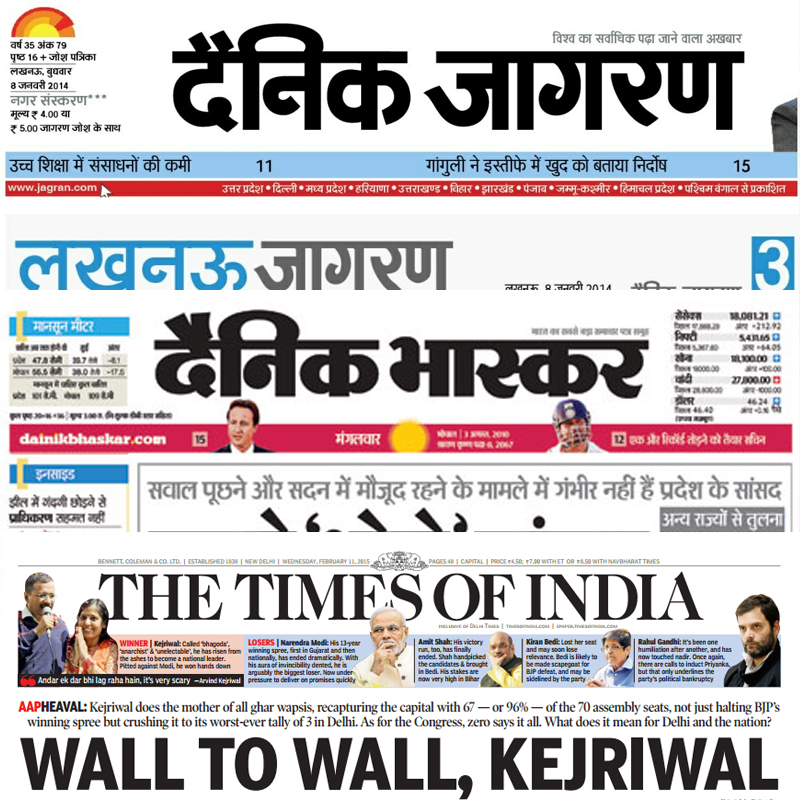
    MUMBAI: According to the Indian Readership Survey for Q4 2012 conducted by Media Research Users Council (MRUC) and Hansa Research, seven out of the top ten dailies (across languages) have lost readership. These include Dainik Jagran, Dainik Bhaskar, Amar Ujala, The Times of India, Daily Thanthi, Lokmat and Matrubhumi.

    The pecking order of the top ten dailies remains unchanged with Hindi daily Dainik Jagran continuing its reign at the number one spot. The publication saw a reduction in its readership as compared to the third quarter from average issue readership (AIR) number falling from 164.74 million in Q3 to 163.70 million in Q4. Second spot holder Dainik Bhaskar saw a similar fate as its AIR decreased from 144.91 million in Q3 to 144.16 million in Q4.

    English dailies seem to be holding ground. In their case, just five of the Top 10 dailies lost readership. The Times of India, The Hindu, Deccan Chronicle, The Economic Times and The New Indian Express. While The Times of India continued to take the top spot, its readership fell from 7.653 million in Q3 to 7.615 million in Q4. The only change in the pecking order of English dailies happened with The Tribune taking ninth place (previously tenth; AIR 671000 for Q4) to replace The New Indian Express (previously ninth; AIR 652000 for Q4).

    For the language dailies, the pecking order remained unchanged with Malayalam Manorama retaining the top position and saw an increase in readership from 9.752 million in Q3 to 9.76 million in Q4. Six of the top ten language dailies lost readership with the biggest loser being Dinakaran that lost 96000 AIR (4.912 million in Q3; 4.816 million in Q4).

  • IRS Q3 2012: 3 of top 10 Hindi as well as English newspapers lose readership

    MUMBAI: Three of the top ten Hindi daily newspapers and an equal number out of the top ten English dailies saw a fall in readership in the third quarter of 2012. The Hindi newspapers which lost readership in the third quarter are Amar Ujala, Patrika and Nai Duniya), while the English dailies are The Telegraph, The Economic Times, and The New Indian Express.

    These are the findings of the Indian Readership Survey (IRS) Q3 2012, released by the Media Research Users Council (MRUC) and Hansa Research.

    Dainik Jagran continues to be the leader with all India readership (AIR) of 16.47 million in Q3 compared with 16.42 million in the preceding quarter. Dainik Bhaskar is in the second position with AIR of 14.5 million in the third quarter of calendar year 2012, up from 14.45 million in the preceding quarter.

    The newspaper with the third largest all India readership is Hindustan. Its AIR increased to 12.24 million in Q3 from 12.20 million in the preceding quarter.

    The pecking order of the publications has remained unchanged in the third quarter of 2012.

    Malayala Manorama was the fourth most read publication with AIR of 9.75 million in Q3, up from 9.71 million in the preceding quarter.

    Meanwhile, the AIR of Amar Ujala fell to 8.53 million in Q3 from 8.6 million in Q2 2012. The publication, however, remains the fifth most read.

    Amongst Hindi language publication, Dainik Jagran, Dainik Bhaskar, Hindustan and Amar Ujala take the top four positions, respectively. They are followed by Rajasthan Patrika, AIR of which grew from 6.75 million in Q2 2012 to 6.8 million in Q3 2012.

    In case of the English dailies, the Times of India maintained its position at the top of the list with AIR of 7.65 million in Q3 as compared to 7.64 in Q2 2012. It is followed by Hindustan Times (AIR: 3.768 million) and the Hindu (AIR 2.258 million). The pecking order here too remains the same as last quarter‘s.

    The regional dailies saw some changes in the ranking order. Though Malayala Manorama continues to lead, Daily Thanthi with AIR of 7.41 million replaces Lokmat that witnessed AIR of 7.40 in the third quarter of 2012. Next in the ranking order is Mathrubhumi with AIR of 6.41 million. Seven out of the top ten Indian language dailies (Daily Thanthi, Lokmat, Mathrubhumi, Ananda Bazar Patrika, Gujarat Samachar, Dinakaran and Daily Sakal) lost readership.

  • Calcutta High Court rules in favour of MRUC

    MUMBAI: The Calcutta High Court has ruled in favour of the Media Research Users Council, dismissing the petition filed by ABP Pvt Ltd challenging the findings of the Indian Readership Survey in 2008 conducted by MRUC.

    According to a statement released by the MRUC “The Calcutta High Court has in a significant judgment delivered on 25 September 2012 held that the arbitration clause embedded in software of the Indian Readership Survey, which is part of the terms and conditions a user must accept before accessing data, is binding. Disposing of a petition filed by ABP Private Limited and vacating an injunction earlier granted by the Court, the Hon. Justice Nadira Patherya referred the dispute relating to IRS 2008 to arbitration.”

    Responding to ABP‘s petition challenging IRS findings, MRUC had contended that the dispute had to be referred to arbitration, as this clause was a part of the terms accepted by users. This was contested by ABP.

    The Hon. High Court held, “The issue sought to be raised by the plaintiff in C.S. No.242 of 2008 is covered by the arbitration agreement as the same has been couched in the widest term and encompasses the issue raised, and the same be referred to arbitration.”

    MRUC is a body constituted of media research users by media research users for media research users. “MRUC recognises that there will be situations in which users may disagree with some aspect of the conduct of various researches that it conducts. It is precisely to handle such disputes in a spirit of collaborative resolution that MRUC places so much emphasis on Arbitration,” the body informed in its statement.

    The clause in question is as follows:

    • All differences and disputes of whatsoever nature, arising between the parties including those that are in connection with, concerned with or relative to any aspect of the IRS Report inclusive of this Agreement between the parties and also any dispute or difference in regard to the interpretation of any provision or term or the meaning thereof, whether during the currency/sustenance of this Agreement or after the determination thereof, including any dispute, difference or controversy in regard to the interpretation / meaning / application of this clause, shall be referred to arbitration by sole arbitrator to be nominated by the MRUC Board of Governors and the said arbitration shall be governed by the Arbitration and Conciliation Act 1996. The place of arbitration shall be Mumbai only.
    • In all cases where “Court” has jurisdiction to entertain, try and dispose of matters governed by and/arising under or taken under any provision of the said Act, the party/ies (MRUC, Hansa Research and/or the user/s concerned) shall take such proceedings in an appropriate Court in Mumbai alone to the exclusion of all other Courts in the rest of India.
    • All disputes, differences and controversies between the parties, if any, not covered under Clauses XII.1 & XII.2 hereinabove shall be filed in and settled exclusively by the Courts in Mumbai alone.
  • Nielsen replaces Hansa Research to handle IRS

    Nielsen replaces Hansa Research to handle IRS

    MUMBAI: The Media Research Users‘ Council (MRUC) has decided to award the Indian Readership Survey (IRS) contract to the Nielsen Company.

    The decision was made on the recommendation of Readership Studies Council of India (RSCI). Earlier, the IRS contract rested with Hansa Research.

    The formal award of contract will follow a process of legal due diligence. A comprehensive nine month process that began in November 2011, with the formation of the RSCI by its sponsors, the MRUC (Media Research Users‘ Council), and ABC (Audit Bureau of Circulation) preceded the decision.

    The process involved the active participation of 20 senior representatives of advertisers, agencies and publishers who served on the RSCI managing committee, as well some of the sub committees formed to vet every aspect of the submissions – from technical superiority to fieldwork integrity, research cost, organisation strength and stability. Another 24 senior industry professionals contributed to the technical deliberations, under the chairmanship of the technical committee Paritosh Joshi.

    Joshi said, “Proposals were received from the most hallowed names in the media measurement universe and the quality of submissions was uniformly high. The knowledge and skill on display drew upon the very finest professional capability available globally. Developing an RFP award recommendation was an unusually challenging task. The Nielsen Company proposal, that has won the approval of the Council, was exceptional in its methodological rigour, comprehensiveness and future readiness. The design recommendation and resources committed to the project should enable the Indian Readership Survey to reassert its position of preeminence in Indian media measurement.”

    RSCI chairman Lynn de Souza said, “Our objective through the process was twofold – one, to achieve the construct of a study that would be the gold standard all over the world in readership measurement. And two, to involve all industry stakeholders in the decision making process with a spirit of collaboration and teamwork. The months and years ahead will present several challenges as we introduce a first ever data capture system – the Dual Screen CAPI (Computer Aided Personal Interview) – a system that will reduce interview time, respondent fatigue and confusion, and interviewer bias of any kind.”

    She added, “I am overwhelmed by the seriousness and commitment of the many industry seniors who gave freely of their time on weekends, and holidays as well, to help the RSCI arrive at a decision. Thank you would not be enough. Ravi Kiran, our marketing chairman, was also very helpful in enabling us to identify new revenue sources given that the new IRS will be captured, stored, disseminated and analysed digitally.”

    Nielsen India MD – media Prashant Singh said, “The MRUC‘s belief in the innovative techniques and technology proposed for the forthcoming Indian Readership Survey will certainly transform market research in India, improving quality and the effectiveness of gathering and applying consumer insights for businesses and marketers. Nielsen is honoured to have been chosen as its partner in this landmark study that will no doubt shape all future research across India.”

  • Hansa Research, Ipsos sign MoU to jointly bid for IRS

    Hansa Research, Ipsos sign MoU to jointly bid for IRS

    MUMBAI: Hansa Research and Ipsos have entered into a Memorandum of Understanding (MoU) to jointly bid for the new Indian Readership Survey (IRS) contract that starts with IRS 2013.

    Hansa Research has been conducting the IRS since 2003. So far, Hansa has been doing it with Media research Users Council (MRUC).

    The Indian Readership Survey (IRS) has been owned and administered by Media Research Users’ Council (MRUC), an Industry body set up in 1994. Earlier in 2011, MRUC and ABC (Audit Bureau of Circulation) decided to merge their parallel readership studies by entering into an alliance to form the RSCI, which is now taking charge of administering the IRS.

    Hansa Research Group MD Ashok Das said, “We are happy and excited to work with Ipsos on this prestigious project, and hope to bring in a number of new ideas into the IRS.”

    This joint bid will combine Hansa’s experience of readership measurement in the Indian context with Ipsos’ global expertise of conducting readership surveys in 60 countries.

    Ipsos-India CEO Mick Gordon said, “We are delighted to be working with Hansa on this very exciting project and we hope we can persuade RSCI (Readership Studies Council of India) that our combination will be a very big plus for the industry. Ipsos measures readership in more than 60 countries around the world and has made a name for itself in introducing many innovations into this specialist area of market research – we were the first to use CAPI and DS-CAPI in readership measurement, for example. We believe we can add significant value to Hansa‘s proven expertise and experience on the ground in India.”

    Through the joint participation of these two entities, the two companies expect to make a very strong and forward looking pitch for the new IRS contract.

    The current sample size of the IRS is 262,000.

    Hansa Research is a global full service market research agency headquartered in India, conducting market research in 77 countries with offices in India and US. Over the last few years, Hansa has developed sound mechanisms to reduce fieldwork related issues that has been widely acclaimed by research users for its ability to minimise some long standing industry weaknesses.

    The Pulitzers are given out annually by Columbia University on the recommendation of a board of journalists and others. Each award carries a $10,000 prize except for the public service award, which is a gold medal.

    Matt Wuerker of Politico, Massoud Hossaini of Agence France-Presse, and Craig F. Walker of The Denver Post bagged the prize in Editorial Cartooning, Breaking News Photography and Feature Photography respectively.

  • IRS Q4: C&S, Internet continue growth momentum

    IRS Q4: C&S, Internet continue growth momentum

    MUMBAI: The cable and satellite (C&S) sector continued its growth momentum, posting a CAGR of 13.9 per cent as its reach rose to 462.38 million, according to the Indian Readership Survey (IRS) 2011 Q4 report, released today by the Media Research Users Council (MRUC) and Hansa Research. This, however, is lower than the 15.8 per cent CAGR the medium had recorded in the trailing quarter.

    TV sector’s reach recorded a CAGR of 6.9 per cent, increasing from 539.87 million in Q3 to 549.86 million in Q4.

    However, the reach of radio and cinema continued to record a decline with a negative CAGR of 5.8 per cent and 5.2 per cent respectively. While radio recorded a reach of 156.70 million in Q4 from 158.28 million in Q3, cinema’s reach grew from 76.83 million in Q3 to 75.77 million in Q4.

    The press’s reach showed a positive CAGR of 1.5 per cent at 350.35 million in Q4 compared to 349.89 million in Q3.

    Continuing to expand its reach, the Internet sector recorded a positive CAGR of 46.7 per cent. The medium grew 11.4 per cent from a reach of 634.88 million in Q3 2011 to 639.71 million in Q4.


  • IRS Q4: Dainik Jagran, TOI continue to dominate

    IRS Q4: Dainik Jagran, TOI continue to dominate

    MUMBAI: Dainik Jagran and The Times of India continue to be the most read Hindi and English dailies, according to the Indian Readership Survey (IRS) Q4 report, released by the Media Research Users Council (MRUC) and Hansa Research.

    However, breaking the trend from Q3, Dainik Jagran recorded a decrease in its average issue readership (AIR) from 16.46 million in Q3 to 16.41 million in Q4. It saw a negative of 0.3 per cent.

    Dainik Bhaskar, meanwhile, continued to be second and recorded an AIR of 14.60 million, down 1.84 per cent, compared to 14.88 million in Q3.

    While the top five places did not see any major changes, the top two recorded decrease in AIR while Hindustan, Malayala Manorama and Amar Ujala (third, fourth and fifth position respectively) gained readership.

    Maharashtrian daily Lokmat and Tamil publication Daily Thanthi swapped places to land up at No. 7 and 8 respectively. The Tamil daily’s AIR was recorded at 7.5 million while the Marathi publication’s AIR was 7.5 million

    Among the English dailies, The Times of India leads with a readership of 7.62 million, an increase of 2 per cent over previous quarter’s AIR of 7.47 million.

    While the top six dailies maintain the pecking order from the last quarter, the last four positions have seen some shuffle with The Economic times (AIR 790,000) slipping to No. 8 and Mumbai Mirror (AIR 803,000) climbing to No. 7.

    The ninth and tenth positions also saw a change as The Tribune (AIR 585,000) slipped to No. 10 while The New Indian Express (AIR 637,000) settled at No. 9.

    The regional dailies also experienced changes in the top ten order. While Lokmat went up a notch to No. 2 with AIR of 7.56 million, Daily Thanthi replaced it at the No. 3 spot with a readership of 7.5 million. Eenadu slipped down the ladder to sixth position with AIR of 5.99 million, propelling Anand Bazar Patrika to fifth spot with a readership of 6.05 million. Tamil daily Dinakaran dropped down to No. 8 at an AIR of 5.22 million while Telugu daily Sakshi bumped up to No. 7 with AIR of 5.3 million.