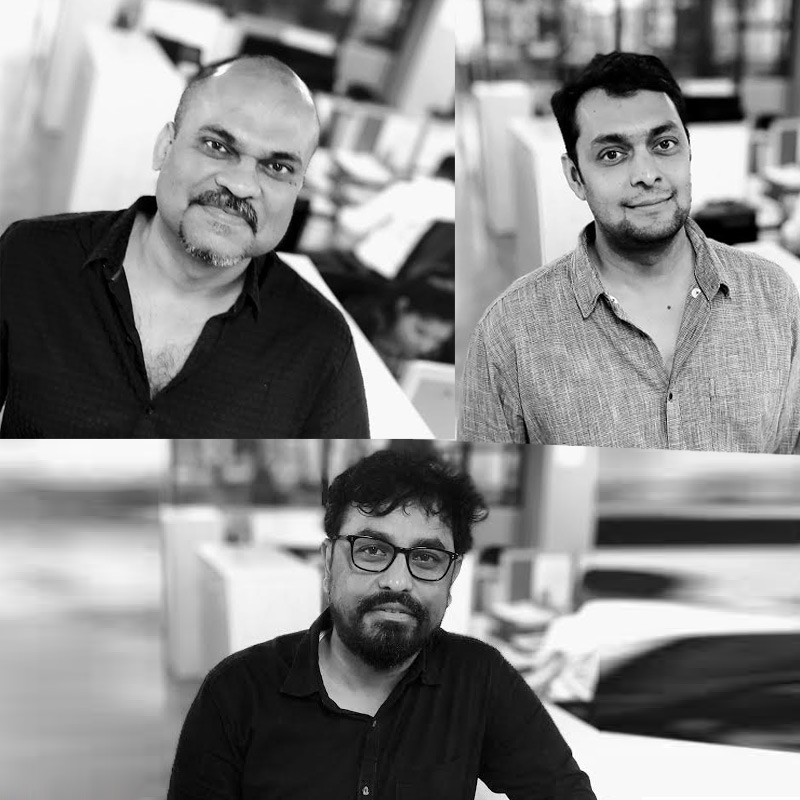
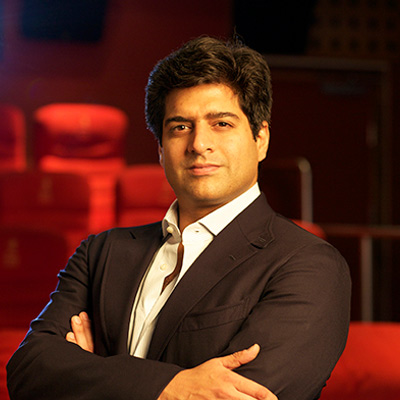
“Anything is possible” is the powerful thought that Prime Focus co-founder & chief creative director Merzin Tavaria lives by. His colorful career, which spans over almost two decades took a different turn when he partnered with Prime Focus founder and CEO Namit Malhotra, and co-founders Prakash Kurup and Hufeza Lokhandwala to set up the digital solutions provider that brought about a creative revolution within Bollywood and the entertainment industry in India before moving on to become an international success.
Tavaria has donned several roles through his journey with Prime Focus, though his biggest contribution to the company and to the world of entertainment remains as a creative leader. His ability to think out of the box allowed him to experiment with the technology was available two decades ago to push the boundaries of special effects on screen. He was instrumental in guiding Prime Focus through its many phases — starting from editing TVCs in a small garage in Mumbai to packaging for channels like MTV and Channel [V], to making India cinema more familiar with motion control technology… the list goes on. Today Prime Focus is a key provider of visual effects and digital conversion solutions globally.
Their work on film projects like Gravity, Guzarish, Ghajini, Avatar and Blue speak highly of the quality and handwork that Prime Focus puts in them, and there is no question about Tavaria’s role as a creative genius in their success.
In a free wheeling conversation with Indiantelevision.com’s Papri Das, Tavaria speaks on recent projects, the ever changing landscape of technology as well as on the emerging trends in VFX in India and Hollywood.
Excerpts:
Take us through Prime Focus’ journey and how the company became an international name?
The big change that happened in the usage of visual effects in Indian cinema was in 2006. From 50 to 100 shots per film, we jumped to 1500 shots. VFX became a part of the entire film making process rather than coming in only during post production. However when recession hit in 2008, the entire progress that we had made till then, came to a stand still. With budget cuts, visual effects dropped low on filmmakers’ priority list. That’s when we started our foray into the international market and things started looking bright for us as a digital solutions provider. We were proud to be part of Avatar in 2008, and by 2010, we had established our market abroad.
The year 2010 saw us introducing the concept of conversion, from 2D to 3D and that opened up a myriad of new opportunities for us. Before that movies were shot in 3D but after Avatar, filmmakers in Hollywood wanted to explore conversions.
What are the current international trends in visual effects?
3D is pretty big internationally and it is going hand in hand with virtual reality. That would be the next big thing. Augmented reality too is picking up pace, not just in movies but in many other different arenas. Augmented reality combined with virtual reality can work wonders for films. It was a phase that came in a few years back and quietened down but I think augmented reality is going to make a huge come back as we have seen it emerging in a big way this year.
Virtual reality will push the budget of the films up by quite a few notches as well as it’s a new medium that needs to be explored. That said, augmented reality will become a big part of the film marketing and promotions, and bring it into your house, in malls or just outside theatres. It will add another way to engage the consumers and so the entire landscape needs to be changed to prepare for its wide range of applications.
What new is happening with 3D in Indian cinema?
Unfortunately, emerging trends in 3D are mostly global. Nothing interesting is really happening in the Indian landscape. I feel bad about that because there is so much we can explore with 3D and filmmakers must realise that it’s not just about releasing movies in the 3D format. 3D is a very immersive experience and some of our action films can greatly benefit from it wherein viewers can become part of the whole experience. I don’t see that happening in India soon but I hope the situation changes.
What is the current demand for VFX in Indian cinema?
India has always been a try and test market, before going forward. We have seen a big change in the last two years when it comes to demand, specially in mainstream blockbusters like Bang Bang, Kick and even recently released films like Bajrangi Bhaijaan and Phantom. All these movies have started using technology in a big way. Brothers is another big example where without the use of visual effects, the movie would not have been what it is. Technology played a huge part in the production and narrative process. The crowd that is seen in the film was not just about crowd multiplication but crowd stimulation, which was done through Computer Graphics (CG). It was a big project for us to use VFX at that scale and volume.
How far behind is Indian cinema from its international counterparts? Are you happy with the kind of budgets Indian films set aside for VFX?
It is unfair to compare the two because one is an Indian audience and the other is global. When you are making films for a global audience, your opportunity and footprint is much wider so the final revenue cannot be compared to that of India.
However, I feel that we need to do a bit of rationalisation and work on how producers locate their resources including VFX within their available budget. We are working with certain filmmakers and producers to create awareness for visual effects and the many ways that they can use it to enhance their films. They also need to budget for visual effects upfront rather than at the end, so there are no hidden surprises as far as cost is concerned.
On the brighter side, filmmakers are starting to acknowledge the role VFX that plays in a film’s success. For example, scenes that were supposed to be shot in Shimla in Bang Bang, were actually shot in Delhi. It would have taken a huge hit on the film’s budget to shoot the entire thing in Shimla. The complete landscape had to be changed to make Delhi look like Shimla. We had to place mountains and rivers and the entire terrain needed to be changed. There was definitely a monetary benefit in it for the film’s producers.
What are types of VFX that are popularly being used in India now?
Right now whats popular is embedding VFX in scenes, specially to enhance action sequences. We are also seeing demand for the type of technology that we used for Brothers.
In general, there are two primary ways in which VFX is used in films. One would be the ‘in your face’ visual effects that we are so used to seeing in sci-fi and superhero movies. The other, which is increasingly becoming more popular in India, is visual effects blended in the narrative to enhance the entire look and feel of the film.
The reason why we don’t see the other type more often is simply because we are not making too many films like Avengers, Iron Man, or Gravity here. Of course, when films like Ra.One or Krrish are made, we do use in-your-face VFX. But those films are rare and come out after long intervals unlike in Hollywood. If you take their summer line-up for 2015, there were multiple VFX and CG heavy films like Ant Man, Jurrasic World, Avengers and Transformers amongst many others. India is more into action and dramas.
Why do you think India shies away from producing movies like Ant Man or Jurassic World? Do you think India picking up?
It’s an evolution that needs to happen. Hats off to Rakesh Roshan, who reinvented himself to do projects like that. We need more pioneering people like him in the industry to actually attempt that type of filmmaking. We also need the right kind of script that supports such visual effects. It can’t be forced into a script, which has no room for such effects.
We have enough super hero characters in our mythology, which haven’t really used to their potential. Baahubali would be a good example, and those films need to be taken seriously going forward. We haven’t been able to cash in on that yet but there is scope for sure. It takes investment of money and time, and the minute you short circuit that, the outcome isn’t that good. Filmmakers immediate knee jerk into thinking that those type of films don’t work, when in reality you need more patience for the formula to work. It just takes someone to do that.
Why do you think Indian cinema are obsessed with mythology? Why don’t we make enough sci-fi films?
Writers need to think big and make a story that is fit for sci-fi like visual effects. It starts with storytelling without which you can’t move forward in that direction. With mythology, they have a ready script and a story, which has worked for ages and their characters are ready as well. Our filmmakers like the tried and tested formula route and shy away from experimenting. We often hear people saying that India doesn’t have the technology to do so, which is wrong. If we had a ready script that allowed us to use special effects in a more futuristic way, we would absolutely love to do that for India. If we can do it for the rest of the world, why can’t we do it for India?
Can you see VFX playing a role in Indian television?
Visual effects plays a big role in television globally. I am not happy with its use in India though. There is so much more that producers can do with it. It requires the same seriousness, which they give to producing a show in general. Once we get used to a certain quality and see that it has worked, we often don’t want to put in an effort to upgrade.
Visual effects and CG on international television has grown by leaps and bounds as compared to India. There are so many TV shows that cater to the super hero genre and sci-fi, like Star Trek. India isn’t looking at those kind of projects and therefore there is no opportunity to bring in such technologies to television here. Additionally, the narrative of technology is also limited because of the kind of stories we consume on television, if you consider just fiction.
Tell us about Prime Focus’ new production facility in Mumbai?
That is the part of our whole expansion measure. Through out last year we have been consolidating our visual effects team with Double Negative in London, which is one the leading studios in the world. Everything from Terminator to Avengers have done by Double Negative. The idea has always been to do some of that high end work and bring that to India. The merger deal we did with film city also brought up this property that we aim on redoing for launching this studio. We will be using Double Negatives technology and experience of years on the bigger Hollywood projects
Which movies according to you have made good use of visual effects?
There are quite a few that have caught my eye and it is always a learning experience to see our others use VFX. Transformers, for example, is a beautiful movie and use of CGs is completely mind blowing. Michael Bay is a an amazing story teller and he has done a good job with VFX too. Then there’s the new Star Trek that comes out as well as the new Avengers. They just keep surprising you with new ways to use visual effects. The icing on the cake was Dawn Of The Planet of Apes, which brings reality so close to you that you forget after five minutes into the movie that the characters are all created in CG.
What are the upcoming projects that Prime Focus is working on?
We are working on quite a few projects both here and internationally. However, I can’t name some of them due to non disclosure agreements.
We completed working on Mission Impossible 5 and we should be working on Snow White and the Hunstmen Part II as well as on Inferno, which is the part three of The Da Vinci Code.
In India, we have a whole line up of releases, one of them being the Shahid Kapur and Alia Bhatt starrer Shandaar. We also worked on the recently released Katti Batti and Hero. There are many more to come.