Tag: Gurpreet Tathgur

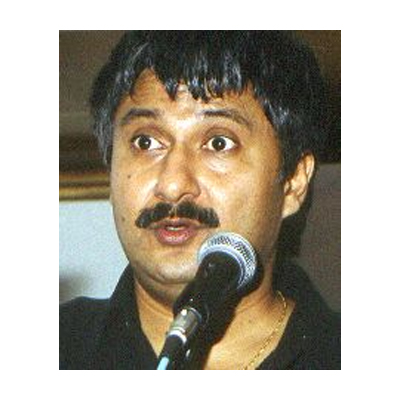
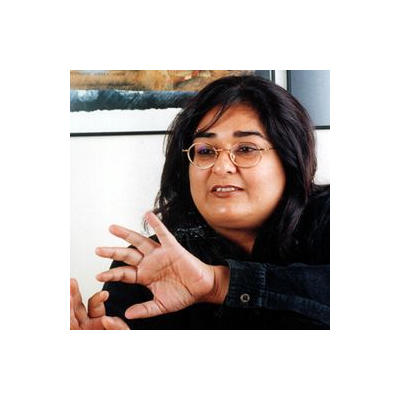
  • “I was fighting against the tide the minute I joined Zee” : writer, director, producer Vinta Nanda

    “I was fighting against the tide the minute I joined Zee” : writer, director, producer Vinta Nanda

    She started as an assistant director, grew to be the director of the first and one of the most successful satellite soaps and has not looked back since. Writer, director, producer Vinta Nanda’s association with Zee has been deeper than just that of a maker of hit serials like Tara. As the ideation head of Zee TV, she was the brain behind the most recent and revived version of Zee TV.

    Nanda, in a chat with Gurpreet Tathgur, talks about her short lived stint as Zee’s creative head and her new avatar as a commercial filmmaker.

    Excerpts –

    Could we start from your earliest associations with Zee TV?
    In 1992, I and Raman Kumar made this series called Tara for Zee. It was one of the first few big programmes for me as well as for the television scene. Tara was such a big rage, I guess thereafter my name got associated with Zee. But I have done a lot of work for other channels too. As a freelance creative person, I am open to working with any channel. It’s just perchance that I took up a job at Zee at the beginning of this year.

    How did that happen?
    Last year around November-December, Zee was trying to compete with the number one channel and was trying to put together different ways for a better strategy. There was definitely, at that stage, a need for a creative person. They came up to me and told me that they were looking for a creative head for Ideation. As a concept, it sounded very exciting and being the kind of person I am, I like to take on something that I have never done before.

    One of the biggest attractions was in knowing how a channel runs, its perception and way of thinking, which ultimately has an effect on us when we are on the other side of the fence. So I took it up as a great opportunity. I thought it was a great way of getting to know what really works in the minds of the people who are going to actually back the programmes that we make. So I impulsively said yes to the job and within two weeks I was on.

    When you took over as the creative head, Zee was not going through a very good phase. Did you find it very challenging and difficult to do what you were brought to do?

    “We tried to break through the entire saas-bahu thing. And I think that was my greatest achievement at Zee”

    It was a huge challenge. To me it was like, can I make a dent here or not? And I was sure with my experience and my past; with the number of hours of television that I had done, the amount of work I had done traveling across the length and breadth of the country, I knew through instinct that I would definitely be able to shake it up if not make a difference.

    And I think I did it, because that was the ultimate challenge. I knew we were rock bottom. I knew I was walking into a scenario where the eyes were going to turn towards me and say, “Ok let’s see what this babe does now?” The pressure and the stress were of various kinds. It wasn’t just about the work I was doing. It was about the inter-personal relationships. So in all those aspects it was a Shakespearean experience. Which eventually became more or less like a farce.

    I didn’t expect it to be like that but once I walked in I felt that I had walked into a Shakespearean play. I was literally in the concept of ‘the world is a stage’ and I am one of the players. And now I had to make my moves and I was one of the chessmen on the chessboard. I knew I was not permanent here.

    So before you joined you had it clear in your mind that you were not there to stay?
    I always knew that I was not permanent and that I had to leave the place because a corporate scenario was never my kind of scenario. I never had corporate aspirations or ambitions, but I had a corporate curiosity.

    And that had brought me into this trap. I knew I had to get out of here and I had to get out safe, sound and successful. I’m a filmmaker, I’m a director, I’m a writer, I’m a producer, there was no place for me in a permanent corporate scenario. Once I was there I knew I had to do something and it was a challenge. I also knew that I had to make it happen. So I forgot everything that I was and just concentrated on the work.

    “Creativity, innovation, experimentation, new wave thinking, contemporary approach is completely wasted as far as the Indian mindset goes”

    What was the first thing that you did when you joined Zee?
    The first thing that I did was to get into the act with my colleagues who briefed me about the present situation; where we were coming from and where we were going. And that’s when I found that I had to make some contribution because according to me the direction in which we were perceptionally going, wasn’t in my mind exactly the right way to go. I was now going to push what I thought was right. I was fighting against the tide the minute I joined Zee. But fortunately for me the chairman shared the same point of view and I will always cherish the experience of working with him.

    And if at all I do this kind of job again, it would probably be for the experience itself. Developing strategies towards our future, developing methods of achieving those strategies, implementing them, and understanding what our creative pool was all about at this present time in the industry, was my main aim with my brief stint with Zee as a creative head. We tried to find out what the available resources were and how to gain the best out of those resources. We tried to break through the entire saas-bahu thing. And I think that was my greatest achievement at Zee.

    But typical saas- bahu dramas are continuing to rule Indian television.
    One side of me is facing the market reality and it is happy to have saas bahu dramas. We are targeting the middle class and their values are quite similar to what they watch on television. Unfortunately the market perception can’t widen as easily as the creative perception does. And what has happened is the English channels are targeted at the up market audiences. And all the English software comes from abroad. Whatever Hindi programmes are, they are done and targeted for the down market audience.

    And these viewers enjoy watching middle class traditions like sindoor, mangalsutra, rona stuff. What I find the most unfortunate aspect of this is that creativity, innovation, experimentation, new wave thinking, contemporary approach is completely wasted as far as the Indian mindset goes.

    The Indian mind is not able to do all this and secondly, the foreign market has already provided all this here at cheaper rates. By the time the market realises that some change should be brought and that the middle class is ready for the changes, a whole generation of creative minds would be wasted.

    The market operates on statistics and it is the market that is presuming that our middle class is not ready for contemporary Indian programming. There is a need of huge amount of changes in the industry and until that happens nobody will really know what really going to work.

    So do you think the audience enjoys the programmes through which they can learn something?
    I don’t think so. All these are just time pass programmes. They don’t make you think. As a creative TV writer, no matter how crazy I get and how mad I get, I know I can’t write worse than what is being written nowadays. I also think we don’t have to sell family values to our audience because Indian people have more family values then any other nation. And they don’t need to learn anything from television.

    As a creative director of Zee, what changes did you make?
    I just brought in some very good new talents into the production arena and that was the biggest thing. Bringing in a new wave, a new generation of television makers. That was one important aspect of what I wanted to do and I managed to and had the full support of the channel also.

    Besides that, the innovative programming which everyone can see. New programmes like Jeena Isi Ka Naam Hai, Kittie Party, Love Marriage, Aati Rahengi Bahareinand many more, and even the lottery game shows. It was not just me, it was the entire team and the way the network was flowing. I was fortunate the way everything was happening. I really enjoyed the eight months I spent there.

    The market operates on statistics and it is the market that is presuming that our middle class is not ready for contemporary Indian programming

    Talking about the programmes you just mentioned like ‘Kittie Party’, ‘Love Marriage’ are not that high on the TRPs. Do you think only the metro viewers can relate to it and are watching it?
    No, nothing like that.Tara was like these programmes. People thought metro ke liye hai but it became a rage. The thing is that when you target a programme for a particular audience that doesn’t’ mean that other people are not going to see it. A film like Life is Beautiful was made in Italy but the whole world went gaga over it. So, when you target something at metros and say it is a city programme, the viewer in rural or small parts would still like to see what kind of lifestyle people staying in metros have and vice versa.

    You can’t really generalize. It is the story that makes the difference, it is the emotion which universalizes everything. And to me it was very important at that point when I was working at Zee to bring in serials, even though they run for three to four months but are different from what everybody are watching nowadays, and to make people turn around and start watching Zee TV.

    For me, it is important that whatever you are watching on Zee is different and none of them are like clones running on other channels.

    Why were these programmes allotted these time slots?
    I was just creating the programmes. I was not strategizing as to where they should be placed. Someone else handled it.

    Are you working on any film project as of now?
    I am working on two films called White Noise and Kali. I intend to make White Noise first, essentially because it is the expression of something that I have been through. And I don’t seem to be getting very far unless I work on it. I need to make the film. It is more my need then a business proposition. And Mahesh Bhatt has co-written the story with me.

    Kali is based on a true story, which I encountered while I was working on a documentary last year. It is a story of a girl who became a widow at the age of eight and the dramatics, which took place after that. The scripts are ready. I have got partial funds for White Noise, just waiting for more finances. The day I get them, I will start the movie.

    Are there any other projects you are working on?
    Yes, I am working on a documentary on street children. It’s a film called Seen but Not Heard. It’s about children on the streets of Mumbai and Delhi. I am doing this film for a friend of mine – Nutan Bajaj Sahani. She is heading a campaign called Sirf ek muskan which raises funds for street children. I even run an NGO called Project Smita that I started with Raman Kumar in 1988. ‘Smita’ stands for Social Mobilization in Information for Timely Action. We have done television serials, we’ve made national and international documentaries. In a year, I devote two to three months to Project Smita. I feel much more a complete person because I am able to see life from both ends. Project Smita is my research way and Tracinema is my commercial outlet.

    You have spent almost two decades in this Industry are you completely satisfied?
    To be very honest, I am completely dissatisfied. I feel zero at every stage of my life. And I feel like a beginner every single minute of the day. With White Noise and Kali staring me in my face and being unfulfilled so far…everything fulfilled in the past is a forgotten case for me. And when these projects are completed, there will be something else so….

    At the end of it were you totally satisfied with your tenure at Zee and would you wish to go back?
    I would go back anytime. I would love to go back again and again. I would love to do a six-month stint every year in Zee TV. Not just in Zee TV but some channel. Every year, I would like to make a film for six months and sit in a channel for the next six months. I think that’s life. I think these are the two ends of a spectrum I would like to visit every year of my life. And I would be able to understand and relate to the life much better. And I am completely fulfilled with what I did at Zee and I still feel I can do a lot more.
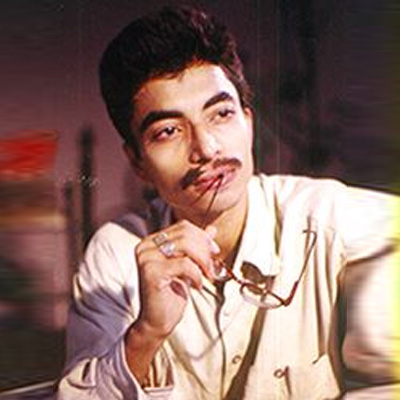
  • “I believe in inspiration but not in adaptation” : Kaushik Ghatak

    “I believe in inspiration but not in adaptation” : Kaushik Ghatak

    Just 29, Kaushik Ghatak is already a veteran director on Indian television. A hundred episodes of Kyunkii Saas Bhi Kabhi Bahu Thi, a few of Sanskriti and Sshhh.Koi Hai under his belt, Ghatak has now taken on Sanjivani, the new hospital series on Star Plus.

    Hailing from a small town in West Bengal, Ghatak honed his directorial skills under several veterans in the field after migrating to Mumbai in the 1990s. For the last four years, he has tried his hand at ad films as well, a fact that probably helps him add the element of gloss and sophistication to his assignments as a director of TV serials. Ghatak spoke to Gurpreet Tathgur and Hetal Adesera about his initial days and talks about Sanjivani, his latest and most prized assignment till date. Excerpts from the interview.

    What drew you towards direction?
    I used to write, do photography and visualize a lot of things – but was yet hunting for a means of expression. Filmmaking, I believe, is the art of all arts. With a background in photography, I started out as a cameraman. At the Noida institute where I enrolled for a course in photography, the dean himself recommended that I should take the one on direction instead. He nearly brainwashed me into taking up the direction course.

    How did you come to Mumbai?
    I came to Mumbai after finishing my course. Mumbai was as foreign to me as New York, but I have had very pleasant experiences here although I did struggle a lot initially. Anurag Basu, whom I assisted initially, is almost like a godfather to me. I assisted him on Raahat for Zee. Later, I assisted Partho Mitra for Coffee House, Gautam Mukherjee on ads like Dettol, Casper, Complan, Oscar, and Khaitan. I assisted Gaurav Pande for Star Bestsellers and even made small ads for Raj Travel and Tours.


    Ghatak with the cast and crew of Sanjivani

    What was your directorial debut?
    It was a Bengali serial for Alpha Bengali called Amra Povashi. For Hindi television, it was Kyunki, which I took over from the 35th episode and went on till the 155th episode.

    Do you believe in sticking to certain genres or do you believe in experimenting?
    Kyunki was a family drama and so was Sanskruti. After that, I got an offer to do Sshh…Koi Hai. I took up the offer not because of money or excitement but because of the experience and experimenting it asked for. After doing two family dramas, I didn’t want to be stuck with that label, so I took up Shhh Koi Hai as a challenge. Directing a thriller was not a new thing to me as I had assisted Anurag in X-Zone. Yes, I do believe in experimenting.

    What kind of themes generally interest you?
    Presently Sanjivani is my main project. I believe direction is not only about story telling, but is full of moments. Thrillers and horrors are ok but they are not my kind. I shouldn’t be saying this because I have done those genres before, but my inclination is more towards human relations and the moments they are made of.

    Thrillers and horrors are ok but they are not my kind

    ______________

    Has Sanjivani been inspired by any soaps or movies?
    Many series have inspired me, like ER, Chicago Hope and Dhoop Kinare. Also, movies like Anand have motivated me. But I have not copied or adapted from these. There are similarities but nothing has been lifted. I believe in inspiration but not in adaptation.

    What kind of research do you do before commencing any venture? Research is very important. A common man knows very little about the subject of your serial so you can’t mislead him with wrong information. My aim is firstly to entertain, then inform and lastly to educate. I agree that while making serials, there is a slight lack of authenticity as it is very difficult to be accurate but I try to be as genuine as possible. For Sanjivani, we read 800 case studies, visited several hospitals to see how the doctors work, how patients react on various occasions, and interviewed a few doctors before making a rough outline for the serial.

    Are you satisfied with your work?
    No, I’m never satisfied with my work. At the end of the day, I always feel that there is something lacking and that I probably am in the wrong profession. I feel like running away and doing something else, but when I sit down to think about it, I realise that if I leave this field there is nothing else I can do or rather, nothing else that I want to do.

    Direction is not only about story telling, but full of the moments in between.

    Who are your favourite actors?
    There are many. I have learnt a lot from many actors, so I don’t want to name all of them.

    What work schedule do you follow?
    We are currently shooting daily till 6 pm and sometimes have a night shift too if we have to complete the episodes and there’s nothing to bank on. But after we can a couple of episodes, we will shoot 16 days a month as each episode takes around four days to complete. I need my time; the maximum I do is one shift. I believe in the quality of the work and I don’t mind doing just two scenes in a day. I want perfection in whatever I do.

    What do you think makes for a good director?
    A director literally breathes his work. There has to be involvement, hard work and an ability to convey something to an audience. You have to work with a premise that your audience does not know anything about the subject you are dealing with, and that you are solely responsible to inform them. Once you have this in mind the rest just flows.

    Who is your favourite director?
    It is very difficult to answer this. But a few names that come to my mind are Satyajit Ray, Raj Kapoor, Guru Dutt, Sooraj Barjatya, Yash Chopra and Shyam Benegal.

    Do you want to direct movies?
    I plan to get into mainstream films but not into art films.

    You have to work with a premise that your audience does not know anything about the subject you are dealing with, and you are solely responsible to inform them.

    A still from Sanjivani

    What has been your happiest moment?
    My happiest moment was on 14 February 1998, the day Anurag Basu allowed me to stand on the sets and assist him. Then of course the day I got the offer to direct Kyunkiwas also a very important day and I could not believe that I was being offered to direct the current number one serial in the country.

    Where do you see yourself ten years down the line?
    When I was a kid, I used to spend Rs 3.75 to watch a film and then dream of myself directing that kind of film. And now, here I am, directing television serials! Ten years hence I see myself at the same place, directing television serials or maybe even films.

    Which are your favourite Indian serials?
    There are lots but to name a few there’s Malgudi days, Hum Log, Neem Ka Ped and Ajeeb Dastan.

    How would you define Kaushik Ghatak – the person?
    Ohh. a very fun loving person, who loves music, computers and prefers sitting with his wife after a long day of work rather than watching TV.

  • ‘I wouldn’t mind writing a funny love story’ : Shridhar Raghavan

    ‘I wouldn’t mind writing a funny love story’ : Shridhar Raghavan

    At 32, Shridhar Raghavan already has a wealth of experience tucked away.

    A computer science graduate turned journalist, he started off early in life – contributing intermittently to Science Today, Mirror, Debonairand Mid-Day while still in college. After a two-year stint in advertising, Raghavan joined Gentleman magazine, where he worked for close to five years, writing mainly on crime, health and entertainment. After a brief spell with UTV in its Inflight department, he branched out as an independent writer.

    To Hetal Adesara and Gurpreet Tathgur, Raghavan speaks of the market driven phenomenon called television and his own experiences with the medium. Apart from C.I.D. and Aahat, for which he has written over 500 episodes, he talks about other assignments and the practical aspects of writing for television. Excerpts:

    How did you get into TV scriptwriting?
    I always liked writing. I have been writing fiction since I was 14 and started freelancing for newspapers when I turned 16. After working for a few years with different newspapers and magazines, I joined UTV, doing production and trying to work out concepts to write. I was simultaneously working on a film project with Kundan Shah and on a TV serial pilot. Anjum Rajabali of Business India Television asked me to work on Aahat and introduced me to its director B P Singh and Neo Films producer Pradeep Uppoor. I started working on Aahat, an episodic series of mystery, thriller and supernatural stories and have been writing for it ever since. Around four years ago, I started to write C.I.D., again an episodic police procedural series for Sony.

    What are the natural instincts required of an effective writer?
    You need discipline because TV is a monster that is always eating and there are deadlines to meet. You need talent, hard work and a sprinkle of luck.

    Do you limit yourself to writing for certain genres?
    I think my forte is humour but I have never tried my hand at it. Thrillers interest me and of late, I have been working on dramas too. I am not good at love stories at all but if it is a funny love story, I wouldn’t mind writing one.

    Do you go by an idealistic perspective or a practical perspective while sketching your characters? Do you identify with any of the characters you have created?
    My strength is story telling and I see myself as a structural specialist. The more real a character is, the more fun it is. I even make up my own characters. No, I have never identified with any of the characters I have created until now.

    Have you been inspired by western movies/soaps in your writing?
    You are a writer because you’ve got hundreds of ideas, so there is no inspiration as such.

    Do you write in English or in Hindi?
    I write 70 per cent in English and 30 per cent in Hindi and wherever I need to use Hindi to express myself, I use it.


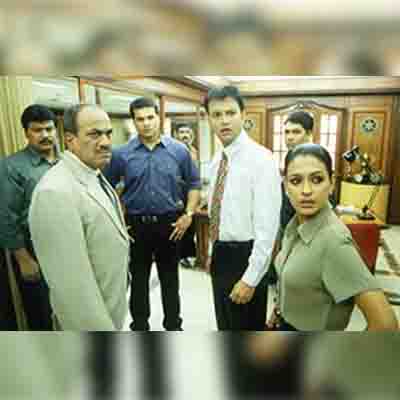
    A still from C.I.D. on Sony TV
    TV is a demand and supply situation. Presently everything is revolving around family dramas and prior to this it was thrillers. What the audience is seeking is being catered to.

    Does writing require isolation from people for long hours in order to concentrate?
    I like to be alone when I’m writing. I can’t write with people around me, as writing needs a lot of thinking. People distract me and it hampers the flow of ideas.

    Many writers feel that the authenticity of what they have visualized gets eroded at times if the director has different ideas. Have you ever felt the same?
    If the director or the channel has a different opinion on my story and if the change is for the better, I don’t have any problems. But the director has never changed the story without my knowledge. I often have to change my script when a particular location is not available or the scene is going well above budget or for other technical reasons. But I am not complaining. It is a very interactive process and I feel that one should be always open to changes. And ultimately, it’s me who is going to get paid!!

    Aren’t you ever tempted to don the mantle of a director yourself?
    No, never. I am happy with what I am doing and I am not a control freak. I don’t think I can deal with too many people and coordinate their activities and I’m sure that I don’t even want to do that. I like the process of writing, it’s fun….

    Which has been the happiest moment of your career?
    There has never been anything like the happiest or the saddest moment in my life. My life is pretty much balanced. I am happy when I am working and writing and it feels good to see your work recognized, liked and seen on TV. I am happy that I am surviving, my serials are on air.

    Where do you see yourself ten years down the line?
    In the same profession. I would still be writing; maybe dabbling in a little bit of journalism too, because it allows you to meet and talk to people. I would be doing as well as I am doing right now; maybe a little better!

    Other than a bit of talent & a complete command on the craft, what a writer really needs is discipline and the ability to rewrite endlessly.

    Shridhar with the C.I.D. team

    Where do you draw your inspiration?
    I work at least 10 hours a day and TV has deadlines, so I just can’t sit and wait for inspiration. I always have a notepad with me, I write whatever comes to my mind or whatever I see around me, that is the first stage and after that I develop the storyline.

    Could you outline the whole process from the stage you conceive a project to the stage when the final script is ready?
    If I have an idea, I put it down immediately. I work in a very structured manner. My story always has three basic stages – a beginning, middle and end. I tend to make notes – good beginnings, a nice scene, an interesting idea, a good climax, an interesting piece of research around which you can create a story, a line of dialogue or an interesting visual, a good location to set a story. Then I put them together on the computer. Once you’re sitting at the computer, it’s mainly slog work. You write, rewrite, rewrite, rewrite.. On and on. I usually present my fourth or fifth draft to the director and channel and incorporate relevant changes and suggestions, if any. Usually by this draft, the script is fine so I rarely have to make changes.

    Does a script need to be re-worked while shooting? Are you present on certain shoots?
    I am open to changes and if the situation demands it, I do rework my script. I try to be present for at least the first couple of shoots because what you write on paper may be different from what you see being enacted. The writer should be there for shoots because this is the time when the practical aspect of his story comes forth.

    Do you prefer to work on commissioned projects or to work on your own?
    I have worked on commissioned projects, but I prefer to create my own projects. I work on them and get a concept note, the entire storyline, a few scripts in place, stories for 13-20 episodes, and then present them to the channel or the producer. The process can thus take many months and even a year or two, but you know you have a solid project in hand and not just a tentative idea which you are going ahead with. It’s like insurance.

    Is narration important in Indian scriptwriting? And how important is research to a script?
    Narration is totally important. You are trying to pitch yourself. Time is one of the least things we have, so if you are able to convey your idea in a nutshell, it is beneficial. People don’t have time, so everything has to be specific. If I’m not able to tell the story, how will the director direct it? Narration helps you instantly find out what is working and what is not. With narration, the story grows in front of you and you get to know your flaws there and then.

    Research is the most important aspect of script writing. If the situation demands that you write a story that deals with medicine and doctors, it is very important that you know the minutest details such as what is forensic science, post mortems and the procedure it involves. If you don’t know the basics, you can’t progress with your story. It is very necessary to know the background.

    What kind of a writing schedule do you normally follow? How long do you need to write one episode?
    I mostly work alone though, of late, I have started working in tandem with another writer. I work daily, including Sundays, put in normally at least 10 hours of work at the computer! Frankly, writing is a 24-hour profession as you are constantly trying to crack a story in the back of your mind. Sometimes from idea to screenplay, on a great day — writing an episode takes as little as a few hours! But on an average, it takes at least four days to a week.

    Tell us something about your new serial – Achanak and other projects you are working on?
    I am currently working on Achanak, which I started writing four years ago. It is a weekly drama-thriller with an element of the paranormal, scheduled to air on Sony in the first quarter of 2002. The set is worth nearly Rs three million and the serial has been shot in various Indian cities like Kolkata, Chennai and Delhi. It has a massive cast, one of the biggest star cast on TV.

    Yes, I am developing shows for Star, Zee, Vijay TV etc. I am also working on some film projects but they are at too early a stage to even talk about.

    I try to be present for at least the first couple of shoots because what you write on paper may be different from what you see being enacted.

    Do you have any mental blocks? How do you overcome them?
    Sometimes, when the infamous writer’s block settles, ideas don’t turn into stories, stories don’t turn into screenplays and so on. I have a few dozen ideas that are still waiting for the eggshell to crack and the idea to germinate. Basically, other than a bit of talent, a complete command on the craft, what a writer really needs is discipline and the ability to rewrite endlessly.

    Are there any Indian serials that you like watching on television?
    I hardly get time to watch any soaps. I am either sitting at my computer working on the story or I am at meetings, or at shoots.

    Does TV writing pay well?
    There is good pay once you start doing well. TV is much more paying than journalism, and luck too plays a major factor. I don’t make as much as Shilpa Shetty makes, but its okay.

  • “Terrorism interests and fascinates me”:Vivek Agnihotri

    “Terrorism interests and fascinates me”:Vivek Agnihotri

    Vivek Agnihotri is one of the most modern minds in the Indian entertainment industry today.

    An advertising and Harvard background have laid the foundation for a repertoire that is both futuristic and experimental. It was during a year’s break after graduation that Vivek did a course at the Indian Institute of Mass Communication. After a stint at Harvard came jobs with O&M and McCann and then his own communication-consulting firm Offbeat. A number of ads later, he ventured into television programming, an exercise that has won him several awards.

    Gurpreet Tathgur and Hetal Adesara met Vivek Agnihotri to hear him speak about his work and his enthrallment with global terrorism at a time when it is at its peak.

    Excerpts:

    What drew you to filmmaking?
    I did my mass communication from Delhi IIMC. Advertising just happened to me. I look the entrance to IIMC as filler till I could go to the US for further studies, topped it and did the course. But it changed all my perceptions of the field.


    On the set of Irshaad, the crane hovers in the background.
    I don’t believe in icons, so I’m not inspired by very big people. I have learnt everything from people around me.

    Where do you draw your inspiration?
    People and stories around me are my inspiration. I don’t believe in icons, so I’m not inspired by very big people. I have learnt everything from people around me.

    What are the natural instincts required of an effective writer, editor and director?
    I can’t speak from what is written in the textbooks. The most important instinct required of an effective writer, editor and director is to be aware. Awareness is the single most important aspect of a good communicator. One must always keep one’s eyes open, interact with people and not look at things but look into things! Direction is a highly glorified field. To be effective as a director, it depends on how creatively you manage everything, just like an interior decorator manages his work.

    Do you always edit your own work, and if so, why?
    Yes, I always edit my own work, I prefer doing that. It gives me more satisfaction.

    What kind of themes generally interest you?
    Themes that interest me are usually true stories and human life dramas, but that’s not what I actually make. It’s a mere coincidence that most of my stories revolve around terrorism be it Sikander, Chocolate or Yeh Kahan Aa Gaye Hum. Urban terrorism has always been present in my mind and leaves a very strong impact.
    Robbery, murders, rapes and lootings don’t impress me but terrorism is what I always enjoy – it interests and fascinates me.

    Only because we don’t yet do it that way in India, people think that I am inspired by the West.

    Have you been inspired by western movies/soaps in your work?
    I never watched soaps on television when I was in the US for two years. I somehow was never interested in them at all. I work in the same manner the whole world does. Only because we don’t yet do it that way in India, people think that I am inspired by the West. All my producers think that I make something well ahead of the times, but in the near future my work does hold true. When I made YKAGH the producer wanted more emphasis on the love story angle, I wanted to focus on terrorism, which was not a big thing then, but it is now.

    Why was your much-awaited directorial venture, Prisoners of War (POW), scrapped?
    Zee would be the best to answer this question. They called me and asked me to do POW. I was only the creative designer for the show, not the producer.

    In an earlier interview with indiantelevision.com, you spoke of your excitement about the forthcoming POW. How did you feel when you were told it would not take off?
    Yes, I was really excited about the series. It was depressing to hear that it was not on as I was too emotionally involved in it. It was one of my unhappiest moments, but perhaps it was a blessing in disguise. If I had done POW, I would have been doing only that currently. So, I am glad that I have some breathing space now.

    Do you believe in sticking to certain genres or do you believe in experimenting?
    I am working in a medium where I’m not the sole decision maker. Most of my films are highly technical thrillers but I do believe in experimenting and I keep doing so.

    What prompted you to start your own film production unit?
    Vivek Agnihotri Creates was founded in 1995 as an alternative to the mainstream entertainment industry. The company serves as a source of the current trends in Indian TV, film, and advertising, and create independently of conventional thought.

    To be effective as a director, it depends on how creatively you manage everything, just like an interior decorator manages his work.
    _________

    At the Asha Bhosle music video shoot

    What of the two films Baarish and Friday Chicken, which your company is presently working on?
    Baarish is presently undergoing a name change. It is a mob film about very high society boys and girls who get wrongly influenced. It is a true story. Friday Chicken is a joint venture between America and India. It is about an American woman who comes to India and helps an Indian soldier find justice.

    How different is working on a music video from serials and ads?
    Personally, I don’t enjoy doing music videos because I feel there is nothing to tell in them. It is a cakewalk for me, so I don’t enjoy it. It is just an edit, copy and paste job for me. I was asked to do this music video for Asha Bhosle and Ustad Amjad Ali Khan, and I did it only because of the names involved. And secondly, because I like experimenting.

    What was your film Chocolate about?
    Chocolate was about the art of lying. There was no research done, it is solely a matter of fiction. It was shot in New York and was about global terrorism.

    How important is it to know your characters and what kind of research do you do before taking a plunge into your ventures?
    Research should be very extensive, but it does not mean that you are going to use everything that you know. You should get to know your character very well so that as a writer you have a complete picture and you start growing and flowing with the character. All my films are thoroughly researched.

    What are the different aspects you keep in mind before starting a project?
    Firstly you should know whom you are catering to, and secondly whether I would like to watch it or not. I haven’t done too much, but whatever I do has to match my sensibility.

    Most of my films are highly technical thrillers but I do believe in experimenting and I keep doing so.

    How paying is this field?
    You get paid in cash and kind. You get to interact and know so many people and build your contacts. And yes, there is a lot to be earned in cash too.

    What do you feel is your best work?
    Yeh Kahan Aa Gaye Hum has been my favourite production so far. Apart from that I liked my work for Gillette and Coke.

    Are you always content with your work?
    Nobody is ever satisfied in this world, the more they have, the more they crave for. But yes, I am more content than I initially was.

    Who are your favourite actors?
    I like Rohini Hattangadi, Kitu Gidwani, Pallavi Joshi, Om Puri and R Madhavan. Among the foreign films, I like Anthony Hopkins, Jack Nicholson and Jeffery Rush.

    If you had the opportunity to remake one film, which one would it be and who would be your star cast?
    The film would certainly be Deewar and I would remake it with my own style. I think it had the most perfect scripts ever written in the Indian film industry. I would cast Amitabh Bachchan and Shashi Kapoor to play the main lead.