Tag: GUEST COLUMN

  • Guest column: Looking back at 20 to look ahead at 21

    Guest column: Looking back at 20 to look ahead at 21

    MUMBAI: Many media and entertainment industry professionals would have already activated their “OOO” messages, while the others would be counting down to call time on what would have been the craziest year yet in their careers. However, before we do that, a little bit of looking back and some amount of looking ahead to 2021 is par for the course.

    For many of us (including me), the dominant sentiment is: did you ever imagine?

    For no one predicted the onset of the pandemic, and even when we started accepting the new “strange”- it continued to surprise us basis how it played out. What mattered was the vantage point and the ability to be both adaptively agile and resilient at the same time.

    Here is a bit of crystal ball gazing even at the risk of falling flat on my face, given how unpredictable and unchartered the waters seem to be. These observations are based on conversations with marketers and experts, and my personal experiences of the last nine months of seeing media and brands in various stages of lockdown and unlock phase. 

    1. Resilient television (linear – let us call it LTV) will continue to be the highest reach, most brand-safe medium in the near term. However, LTV’s babies – connected TVs, streaming and OTT – will start to make their impact felt with advertisers demanding “video neutral” planning that drives incremental reach. With media owners offering viewership, optimisation and brand lift measurement (a la Star’s Sirius); this may become a reality sooner than later. Also, with programmatic and addressable options eventually opening up, measurement and DSP integration will be the key.

    2. Fickle subscription behaviour will finally begin to change, thanks to the fillip provided by Covid2019’s last few months, with urban audiences willing to pay for content behind the paywall. It will be visible on video as well as be heard on audio and consumed on digital avatars of erstwhile print and upcoming digital offerings. So Disney+ Hotstar will continue to dominate the space that Amazon Prime Video and Netflix are increasingly winning with deep pockets of locally produced content. Spotify playlists and substack subscriptions will start showing signs of choice overload and the role of the algorithm (no prediction can be complete without mentioning these and AI) to make better quality recommendations will become critical. 

    3. Enter retailer and e-commerce media  will become key lines on media plans thanks to increased online shopping which saw 25 to 30 million new shoppers giving the addressable size a lift to 150 million. With large numbers (>70 per cent) of e-consumers willing to continue during the unlocking, this growth and behaviour seem irreversible. The opportunities for social commerce (Meesho, Instagram/Facebook shops) and D2C brand investments will further open up opportunities for consumer experiences and conversations with voice, local/vernacular content and video becoming key components.

    4. Doctors and healthcare professionals will be a video call away, giving telehealth/telemedicine a huge shot in its arm. While this part of the advertising landscape is regulated and is unlikely to change, given the sheer magnitude of the opportunity and its big data/ technology ramifications- this may lead to a transformation in pharma/wellness/healthcare communications and demand generation.

    5. News as a genre will continue to find consumption and advertising growth. Given the uncertainty and unpredictability of the environment, consumers will gravitate towards established news platforms and the tussle between social media and legacy news giants will lead to an “infomedic” with fake news and ways to counter toxic, harmful, misleading content gaining more urgency.

    (The author is CCO, Zenith. Indiantelevision.com may not subscribe to his views.)

  • Guest Column: Combatting sophisticated streaming piracy, from the dark web to Lazada

    Guest Column: Combatting sophisticated streaming piracy, from the dark web to Lazada

    GURUGRAM: Synamedia’s piracy investigators have verified a disturbing trend in India and South East Asia. Research both on the dark web and open internet by the company’s anti-piracy experts shows that illegal streaming of over-the-top (OTT) services using stolen subscriber credentials is now well established, with both local and international OTT video services being targeted.  And the growing popularity of premium streaming services, such as those of live sports, makes this an increasingly lucrative business for pirates.

    Fortunately, there are a number of ways that legitimate OTT providers can combat content theft without impacting genuine subscribers.

    Hacking tools are rife on the dark web

    Synamedia’s expert team found that pirates are using the dark web and Telegram to exchange and sell software that allow OTT accounts to be hacked, as well as selling subscribers’ stolen credentials to each other. Both generic credential cracking tools and configuration files tailored to specific OTT platform offerings are available.

    Investigation also revealed that dealers are selling thousands of illegally obtained credentials for the most popular Indian OTT platforms in bulk, on closed e-commerce sites popular with pirates.

    Pirates can also buy leaked credentials that have been taken from well-publicised, large-scale account breaches such as those suffered by major airlines, content providers and hotel chains. The re-use of these credentials for OTT piracy relies on poor security awareness, where people use the same username and password across multiple accounts, even after data breaches have been made public.

    Validated login credentials may then be sold in bulk to other dealers or offered free of charge to pirates to establish credibility. For example, we found that thousands of one South East Asian OTT platform’s credentials were being sold in bulk for approximately $1 per credential.

    Pirates are posing as legitimate businesses

    Pirates are increasingly posing as legitimate businesses as their levels of sophistication increase. Blatant examples of pirates selling illegal subscriptions to consumers on social media platforms such as Facebook, Telegram, and WhatsApp are rife. Pirates are also posing as legitimate platforms on popular Asian e-commerce sites such as Lazada, Shopee and my24hrshop.com, where some even use the real OTT providers’ logos and branding to confuse consumers.  

    These pirates are typically charging consumers between a half to one fifth of legitimate subscription fees, with premium services that include live sports packages and new movies attracting the highest rates.

    They are also offering a wide range of payment options including bank transfer, credit card and online payment. Dealers on some platforms accept PayPal and crypto-currency payments to hide their identities.

    Some credentials are being used to feed long-established illegal re-distribution from piracy networks. In this case, the pirate operator typically takes out legitimate OTT subscriptions, and takes advantage of credentials sharing to repackage and offer this content for sale as an illicit subscription service.

    Combatting streaming piracy

    These illegal streaming services compete head-on with legitimate OTT services, stealing revenues and devaluing content. There is an urgent need to disrupt these pirates’ ecosystems with a more forensic, inference-based approach designed to help drive up legitimate revenues and reduce consumers’ reliance on illegal streams.

    Legitimate providers don’t just have to contend with the lower subscription fees charged by pirate services. Pirate operators also often offer a greater choice of channels, more flexible packaging options, and contract free subscriptions – things that many consumers find more convenient, even if morally they know it is wrong.

    This point was discussed in a research report on global sports piracy recently published by Synamedia. The report concluded that an important element in the fight-back is for legitimate streaming providers to adopt more flexible solutions and services that offer sports fans more appealing themes, mixes of access and payment models. This would make it easier for sports fans to choose legitimate services over pirate streams.

    Adopting technologies and approaches that can demonstrably move the anti-piracy needle are vital. For example, Synamedia’s new intelligence-first security model makes it possible to measure the efficacy and Return on Investment of anti-piracy initiatives. Using these advanced technologies, solutions and services that draw on a blend of human and digital intelligence, a detailed picture can be built of the pirate ecosystem, crack the criminal mind-set and – working closely with law enforcement agencies – ultimately shut down pirates’ businesses. This hard data can help Synamedia customers not only protect revenues, but also negotiate fair content licence terms such as sports rights and ensure compliance.

    With streaming piracy an increasingly existential threat to the industry, there is no time to lose.

    The writer is head of sales – India at Synamedia. The opinions expressed here are his own and Indiantelevision.com may not subscribe to them.

  • Guest column: BARC is ‘Measure For Measure’, not ‘As You Like It’ (Sorry, Shakespeare)

    Guest column: BARC is ‘Measure For Measure’, not ‘As You Like It’ (Sorry, Shakespeare)

    MUMBAI: Nashik of the 1970s wasn’t the energetic city which you may have visited in recent years. It was a bucolic backwater to which retirees from Bombay’s (it was Bombay back then) Parsi and Bohri communities would gravitate. The pervasive pastoral stillness would be punctuated, infrequently, by the ponderous report of field guns from the Regiment of Artillery, still headquartered there, or the whiplash crack of the MiG-21s, test flying from the HAL Ozar plant, as they broke the sound barrier.

    A schoolboy, this schoolboy, in such a town had little fodder to satiate his keen appetite for the novel and interesting. What you, growing up in Delhi, Bombay or Bangalore, would have shrugged off with a dismissive wave, was a source of wonder and delight for him.

    Every once in a while, there would be a clutch of no more than three or four people walking purposefully along one of the main thoroughfares, one of them bearing a sturdy wooden tripod, topped off with rather elaborate apparatus. They would stop; the tripod unfolded and placed carefully, with a bloke checking a spirit level for the horizontal; caps taken off a little telescope which was the business end of the wondrous thing; and even as one of the team members scurried off into the distance with a pennant, the senior chap would begin to peer intently through the eyepiece of the telescope and start recording – I had no idea what – in his little notebook.

    If you still haven’t figured out what I allude to, it’s called a theodolite. Used by surveyors for creating detailed maps over large areas. In effect, the theodolite is really an instrument to measure length, which in this special case should correctly be labelled distance.

    Even as these wonders unfolded in the wide open spaces, our science teacher was instructing us about the centrality of measurement in the Physics lab. We were introduced to the metric and imperial systems and got a chance to use various instruments which enabled precise measurements, even of really small units. While everyone had a pocket ruler marked off in millimetres, any smaller length or width was beyond its abilities. The micrometre screw gauge was a near miraculous tool for a schoolboy. Who would have thought that one could measure the thickness of a sheet of paper? Or aluminium foil? And there it was, doing exactly that.

    I had learned, that quiet morning in a Deolali laboratory, that it was as important to measure the minuscule as it was to measure the colossal. A theodolite could measure the height of Mt Everest but it would be of little use if the task was to measure the diameter of a needle or a shirt length from a bolt of fine cotton. That measurement was not a one-size-fits-all activity.

    Sadly, four decades later, we are attempting to use a metre rule to measure a hair’s breadth.

    The BARC audience measurement system is designed to measure “What India Watches.” In an accurate analogy, the task involves measuring both the gargantuan (top Hindi entertainment channel with 1.3 billion impressions) and the minuscule (English news channel with 600,000 impressions). If the English news channel was the thickness of a typical sheet of paper, the Hindi entertainment channel would be thicker than four reams of 500 sheets each. Indeed, the entire English news genre with 2.7 million impressions would amount to just over four sheets, against over 2,000 for the single Hindi entertainment channel.

    Read more news on BARC

    You should be able to see, now, that BARC’s measurement is already able to span the range of measurements from a virtual micrometre gauge to a virtual metre rule. People who complain that BARC is unequal to its assigned task should know that this is quite unlike anything that similar systems in other jurisdictions are designed to do.

    Consider a tiny market like Serbia, population seven million, which Nielsen Audience Measurement (Serbia) tracks with 880 metered homes. For comparison, Hyderabad, India’s fourth most populous urban agglomeration, is about seven million too. Serbia has 120 metered homes per million population. At a similar metering density, BARC would have to metre over 56,000 metered homes only for urban India (population 471 million).

    Unfortunately, this would not be terribly helpful. Here’s why. Indians currently watch about 250 minutes of TV per day, with a standard deviation of 15 minutes. The standard error of this number, at 160,000 respondents in the panel, is two seconds. If the sample was to double, this would shrink to 1.7 seconds.

    The non-intuitive thing about statistical sampling is this. A doubling of the sample, from its current level, would yield a mere 15 per cent improvement in accuracy. On a number which is already incredibly accurate.

    Ask yourself. Are you a citizen of 185 Serbias? Or ONE INDIA?

    The author is principal at Provocateur Advisory. The opinions expressed here are his own and Indiantelevision.com may not subscribe to them.

  • Guest Column: Streamline Set-top-box, CAS specifications and save subscribers hundreds of crores

    Guest Column: Streamline Set-top-box, CAS specifications and save subscribers hundreds of crores

    Broadcast pay-TV in India is based on globally developed standards that enabled the fast and affordable deployment of innovative services, and intense competition. During the Covid2019 crisis, broadcast pay-TV cable and DTH platforms continued to provide consistent quality of service to all subscribers.

    In contrast, over-the-top (OTT) video streaming services required concerted interventions by broadcasters and mobile network operators to reduce video quality, bitrates, and reduce congestion. While Indian regulation of OTT video services has been very light touch, Indian broadcast pay-TV regulation has grown in complexity and cost since DTH services began in 2003. Not only are DTH and cable operators expected to divert time and resources into jumping through ever more convoluted regulatory hoops, but these additional costs would ultimately be borne by subscribers.

    Beyond India, the costs of over-regulation in various sectors have increasingly been recognised and challenged. In India, the rise of broadband internet penetration has provided direct access to new, large, well-funded foreign and local OTT players that are lightly regulated. The result is increased competition, which better serves subscribers and viewers than over-regulation.

    Read more news on TRAI

    Particularly effective measures taken elsewhere to reduce regulatory burdens have been to mandate:

    overall cost-benefit analysis for justification of all new regulations and changes, and

    sunset dates before which all regulations must be reviewed to ensure they are still justified, otherwise they automatically expire.

    Indian regulators would do well to adopt similar measures, both in policy and in practice, and save Indian subscribers hundreds of crores. The capex alone spent to support existing interoperability measures on DTH STBs have exceeded Rs 600 crore.

    TRAI’s bundling and pricing controls on content – both distribution and retail – have been widely critiqued. Also pernicious are its technology regulations – most recently its recommendations on set-top-box interoperability measures (10 April 2020) and mooted changes to the technical compliance framework for Conditional Access Systems (CAS) and Subscriber Management Systems (SMS) (Consultation Paper of 22 April 2020). Both are rooted in decades-old competition concerns, predating the internet age and massive advances in basic and digital literacy.

    The set-top-box (STB) regulations in particular fail to recognise that pay-TV operators are not in the business of providing devices, but of services. To the extent they are not prevented by regulation, broadcast pay-TV operators differentiate their service offerings with unique combinations of content

    and user experience, also VAS, and customer support.

    Read our coverage on set-top boxes

    The level of “interoperability” TRAI’s measures would enable – video and audio from one pay-TV platform to be able to be seen and heard via an STB owned by a competitor – were questionable in 2003, when STBs were relatively costly compared to dishes and installation, and the content and user experiences almost unknown without a service subscription. 

    In 2020, almost anyone can preview videos on the pay-TV providers’ websites, via search engines, or online review sites and make well-informed choices. Pay-TV operators must meet a plethora of regulated quality of service criteria in addition to bundling and pricing criteria. And for those who remain too cautious to commit, STB rental is available from all pay-TV operators.

    Unfortunately, TRAI has not performed a cost-benefit analysis on STB interoperability recently, if at all. Costs of interoperability to be borne by all subscribers are quantifiable in terms of capex and opex for each pay-TV operator platform and delays to other road-mapped innovations, which could bring greater benefit to more subscribers. If there is any benefit of TRAI’s recommended interoperability measures, it has never been quantified, nor even systematically estimated, at least not publicly. The capex alone spent to support existing interoperability measures on DTH STBs has exceeded Rs 600 crores, just for the common interface sockets. The benefit to subscribers and viewers has been zero for this white elephant, that all have paid for and none have benefited from. And at the end-of-life, the extra plastic and metal from these STBs are destined for reprocessing or landfill.

    The choice of USB port-based interoperability makes the TRAI recommendation appear simple. The simplicity of “plug and play” devices to the user hides huge amounts of standardisation and pre-integration work between USB hosts (STBs) and clients (USB dongles). Content and revenue security and subscriber privacy requirements, plus a history of USB malware exploits targeting embedded systems, make for a large development overhead to support TRAI’s recommended measures without compromising security.

    India-unique security requirements also need India-specific standardisation and pre-integration. Costs will again be borne by all existing and future Indian broadcast pay-TV subscribers, for no obvious benefit to any. The existing technical compliance framework for CAS and SMS was meant to ensure minimum content security performance, functionality, and features across platforms and maximum real choice for subscribers, as more content would be made available to each platform complying with this framework.

    Although it has not entirely met its objectives, specific incremental changes to the existing framework are preferable to establishing a new framework. Increased auditing capability is needed – especially more technical expertise – to minimise delays and reduce the number of spurious compliances reported. There is also the need to augment, revise and tighten the security parameters within the framework in line with global developments, to schedule future periodic revisions, and to provide a mechanism for urgent out-of-schedule revisions to address exceptional situations. But there is no need to constitute a brand-new framework from scratch.

    In summary, TRAI’s recently recommended set-top-box interoperability measures and mooted changes to the technical compliance framework for CAS and SMS threaten to disrupt a sector facing increasing external competition from lightly regulated OTT video and fierce internal competition. Costly, resource-diverting, and time-consuming changes to broadcast pay-TV now, due to redundant early 2000’s concerns, should be avoided. In regulating the most dependable, differentiated, and diversely available pay-TV services, take great care, and first, do no harm!

    For further details, please refer to Synamedia’s responses to the relevant TRAI consultations:

    https://www.trai.gov.in/sites/default/files/Synamedia_19122019.pdf and here:

    https://www.trai.gov.in/sites/default/files/Synamedia_04062020.pdf.

    (The author is Synamedia India Sales head Deepak Bhatia. The views are personal and Indiantelevision.com may not subscribe to them.)

  • Guest column: Winning over audience in post lockdown world

    Guest column: Winning over audience in post lockdown world

    My neighbour is an ardent Ronit Roy fan. Having not seen him for a while in any Indian serial or film, top that with a glum lockdown mood made her grumpy. One should have seen the look on her face when I told her about him featuring in ALTBalaji’s Kehne Ko Humsafar Hain. And behold, the platform had its latest subscriber. 

    Like her, millions of us have been hooked to Indian OTT platforms over the past few months. With more time in hand, they’re now open to consuming content digitally, and watching shows that they wouldn’t have watched pre-lockdown. OTT platforms have increased their subscription base by offering diverse shows with relatable characters and topics. Hence, making their service a value-for-money proposition to the viewers. 

    Today, viewers have access to more content than they ever could consume. The continued increase in the range and breadth of content libraries has created a paradox of choice — too many content choices often paralyze viewers’ decision of what to watch. A consumer’s subscription journey starts with an intent to experiment, a platform to explore, and concludes with a demand for premium content. Making quality, ease in operation, affordability, and accessibility a key factor in driving subscription plans.

    The Post Lockdown Plan

    The lockdown phase has acted as a catalyst in transforming the content consumption habit of the audience and bringing the Indian viewer to their screens like never before. The KPMG report titled ‘COVID-19: The many shades of a crisis’, reveals that the penetration of subscription-based digital models is set to accelerate. 

    There has been a significant rise in the viewers’ appetite for online content. Moreover, streaming platforms are giving viewers fresh and new content, thereby increasing the amount of time spent on the service. Add to that, the growing apprehension that exists amongst viewers will see them embrace entertainment experiences in the ease of their home.

    Nailing Nuances

    In recent times, the Indian streaming industry has grown from strength to strength giving rise to an unprecedented transformation in content creation and consumption. This has seen leading content providers take deep dive into the viewer's preferences and demand to curate engaging content and enticing subscription packages. What leading platforms have got absolutely spot-on is their increased focus towards personalization and adapting seamless technology.

    In the race to drive subscriptions, content creators and providers are presenting stories filled with local flavour and global relevance spanning genres and languages. Most are deploying and experimenting with technology-driven services. This allows them to offer a more personalized catalogue of content, in a manner that sees the viewers coming back for more. 

    Taking Your Content to the Users 

    There will never be a dearth of content in the Indian OTT space. In such a scenario, relevance makes the biggest difference between these leading players. The platform that delivers a host of offerings to the right audience makes for a leader in the industry, while the rest follow. 

    Owing to the large viewership from Tier II and Tier III markets, OTT players like us are tapping into the Bharat audience by associating with micro-influencers. This word-of-mouth advertising has worked its charm across the country. With renowned faces endorsing the content offered by the platforms, there has been an incremental growth towards roping in new audiences. 

    The shows and their diversity have paved the way towards consumer segmentation as well as streaming players catering to different demographics in their own way. Partnerships with leading telecom providers have also seen the content being amplified to a wider audience who are at the receiving end of clutter-breaking content for the same price. 

    This is a trend that’s going to stay as it's a win-win situation for both the provider as well as the consumer. 

    Ease of Consumption

    The rise of digital content consumption has made the delivery of enhanced user experience take primacy as one of the key objectives of the streaming platforms. Through adopting innovative and data-driven design approaches – the quality of the user experience has become a deciding factor for a user to choose among the various available services in the market. 

    Understanding the target group and their challenges have seen streaming platforms today offer a host of payment options and subscription packages that align to their consumption patterns. Going down the platform-agnostic route has paid dividends as they provide users a customized experience leading to an increased level of engagement, thereby resulting in more subscriptions. 

    From a content segmentation and a garnering subscription point of view, one needs to start looking at expanding, acquiring, and retaining audiences. Rest assured that there will be a content library, that like always will regale audiences, along with subscription models, that assure the viewer a service that is value for money.

    The author is SVP marketing, analytics, and direct revenue, ALTBalaji. The views are personal and indiantelevision.com may not subscribe to them.

    Follow Tellychakkar for the consumer facing news & entertainment

  • Guest Column: Content is king, but is distribution still God?

    Guest Column: Content is king, but is distribution still God?

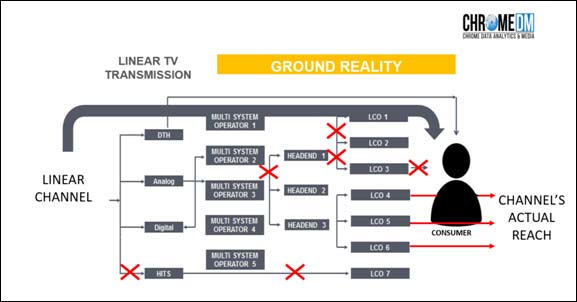
    A linear channel goes through multiple layers of distribution intermediaries on ground. 

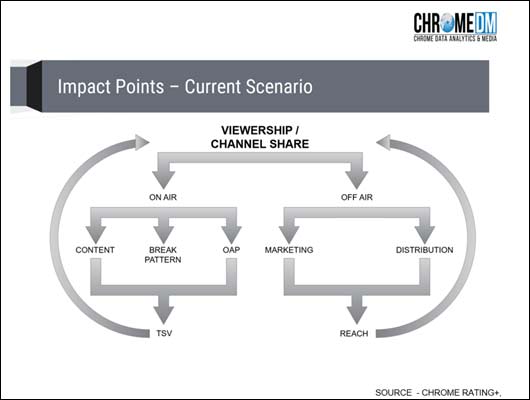
    The resulting viewership entirely depends on the on-air and off-air status of the channel. The on-air includes the content, break pattern and on-air presentation, whereas the off-air hinges on the marketing and distribution ground connectivity of the channel. With the former being constant much of the linear channel’s performance depends on the latter.

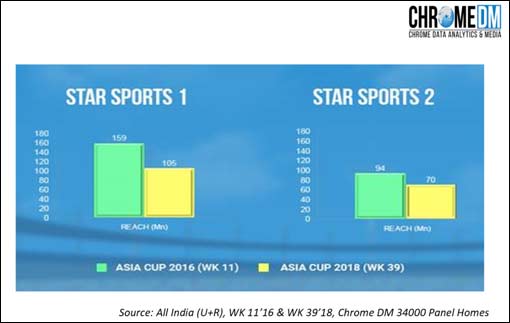
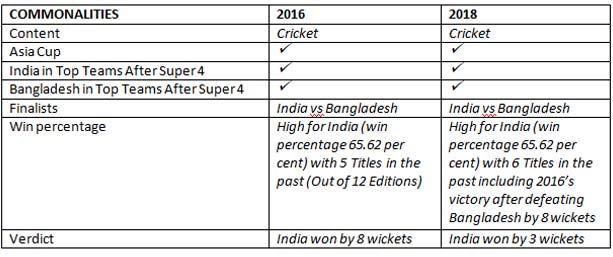
    The recent dip in the performance of the Asia Cup 2018 on Star Sports, great content coupled with the non-availability of Star channels across a major chunk of C&S homes (~52.6 million) in India, is a case in point.  The Asia Cup 2108 was a great king (content) but governed by a poor God (distribution). 

    • 10 per cent drop vis a vis 2016 and an overall drop in audience of 54 million on Star Sports1 
    • 5 per cent drop vis a vis 2016 and an overall drop in audience of 24 million on Star Sports 2 

    The Asia Cup 2018 saw an overall drop of ~45 per cent in viewership compared to Asia Cup 2016, despite seeing a TV universe growth from 168 million to 195million according to Chrome DM’s recently concluded SES survey (Sep 2018). 

    To simply compare the last two tournaments (2016 vis-à-vis 2018) for on-air, there will be ticks for all the factors (table below), indicating that the Asia Cup 2018 was no less a king than it was in 2016 from a content perspective.

    Striking the right balance between content curation and distribution can be a real challenge for broadcasters. Though decisions can be made basis the verdict of the selected barometered homes, however, in-depth studies of ground realities are much required to facilitate strategic decision making.

    Good content, whether in the form of print or TV will always inspire viewers to engage. The audience will always pause to consume, understand and perhaps even comment, like or share provided it reaches the right audience at the right time.

    The author is CEO, Chrome DM. The opinions expressed hereare his own and Indiantelevision.com may not subscribe to them.

  • Guest column: Perception sales key to news channels’ revenue

    Guest column: Perception sales key to news channels’ revenue

    A question often crosses most aware minds……where exactly do the viewer’s consume news? A large part of news viewership comes from out-of-home venues-offices, stock broking firms, airports, railway stations, retail shops-which are not measured by audience-measurement BARC that we refer to for viewership.

    Therefore, if you ask me, it is perception all the way.

    Having said that, India is a news-hungry nation, which is why it is also the most cluttered in terms of number of active players but the beauty is that there is place for everyone and even more. News is a continuously evolving and growing sector that strives for innovation all the time.

    The impact caused by news channels is immense as news amplifies the happenings and events. While all other genres may be facing a threat or slightly negative implications with digital gaining strength, news channels have benefitted from it. I believe all media websites clubbed with all social media apps/sites, etc. help to lead traffic to News channels. While all news breaks on digital platforms, immediately, to get more information, one turns to news channels and the channels that provide more credible and correct information win in the pecking order.

    Demand and supply is the simplest, age-old model that holds true even today and will remain. This is the fundamental law on which the industry works and news channels, too, are not an exception to this.

    Last but not the least, for a news channel, it’s the brand ambassadors that are the face of channels/networks and they are the ones who help sustain their perception. It is this sales force from the head to the executive that makes numbers happen.

    public://joy_1.jpgThe author is the CEO of Forbes India and president – revenue, Network18. The views expressed here are his own and Indiantelevision.com may not subscribe to them.

  • Guest Column: How 2018 could become a landmark year for OTT entertainment in India

    Guest Column: How 2018 could become a landmark year for OTT entertainment in India

    Art imitates life–this oft-repeated saying is particularly suited for the global entertainment landscape at present. The growing penetration of technology in our lives has led to widespread transformation in the way that we consume entertainment and has led to the establishment of over-the-top or OTT entertainment as a distinctive segment in its own right. The last couple of years, in particular, have seen rapid development in both OTT technologies as well as their end-user adoption.

    India, as the fastest growing large economy in the world, has been at the forefront of this tech-led renaissance. A recent KPMG report highlighted how OTT video content consumption in India has exploded, accounting for nearly half of the overall data usage within the country. This dominance is expected to grow to 75 per cent by the year 2020, as data tariffs fall and smartphones become more affordable. With the OTT entertainment landscape registering massive growth in 2017, could 2018 become a landmark year for this high-potential space? The following trends indicate that this could indeed be the case:

    The rise of regional content

    With Indian viewers consuming more online content, OTT has moved beyond metropolitan and tier-1 cities. The increased internet penetration across the country means that more and more consumers from rural and semi-urban geographies are consuming online content. This is driving the demand for entertainment that these users can relate to, that speaks to them in a language that they are familiar with.

    Regional content, as a result, is on the rise; studies indicate that 45 per cent of OTT users in India access content in regional languages. Hindi-based content remains popular, but with leading OTT players actively looking to tap into nascent regional markets across the country, regional content is expected to assume an important role in the overall OTT landscape.

    Cross-platform OTT viewing will grow

    The linear and scheduled content delivery model that traditional TV follows does not suit the evolved entertainment sensibilities and preferences of the new-age, digital-first consumers. They want their choice of entertainment delivered to them at the touch of the button, to be consumed on a device of their choice, at the time that they want to. This is driving the growing adoption of OTT entertainment in India.

    But 5-inch smartphone screens can hardly deliver the immersive experience that television enables, which is why some leading OTT platforms are also focussing on enabling a seamless, holistic, and completely native viewing experience across multiple platforms. The increased penetration of smart TVs is marrying the flexibility of OTT content with the richness of wide-screen entertainment. This will allow viewers across the county to get the best of both worlds, and will further entrench OTT’s proposition as the dominant entertainment paradigm in India.

    More AR/VR-based content to drive immersive entertainment

    There is perhaps no other medium which can deliver the immersion and engagement that virtual reality and augmented reality do. But despite the proliferation of cutting-edge VR-based devices such as Oculus Rift, Microsoft HoloLens, Vive, and PlayStation VR in the market, there is a significant lack of content that can be delivered through it. Most VR/AR solutions are, as a result, restricted to gaming at present. This is set to change in the near future; as more and more content developers and OTT platforms develop the capabilities to deliver content that is tailored for enabling an immersive, engaging, and highly interactive video entertainment experience. This will lead to the evolution in the way the entertainment is delivered and consumed and could end up transforming the global OTT landscape.

    l High demand of OTT video advertising

    Cutting-edge tech such as precision segmentation, interactivity, data, and analytics enable OTT video platforms to deliver superior ad performances in an immersive and engaging environment. This technological differentiation will drive the popularity of OTT video ads amongst digital marketers in 2018. Recent industry reports corroborate this sentiment. It is expected that OTT video advertisements will continue to play a major role in driving the overall digital advertising landscape, helping it reach revenues to the tune of Rs 15,000 crore by 2020.

    Live events streaming

    Recent technological advancements have redefined the live entertainment landscape by making it possible to deliver immersive, seamless, and glitch-free online streaming experiences in real-time. Popular sports tournaments are now being streamed live across the world by leading OTT platforms, while other prominent live events such as music concerts are also finding enhanced viewership through the OTT medium. With more and more users looking to catch their preferred live entertainment on the move, we can expect collaborations between IP owners, OTT players, and traditional broadcasters to enable live streaming of major events in 2018.

    public://ABHESH_1.jpgThe author is the chief operating officer at nexGTV. The views expressed are personal and Indiantelevision.com need not necessarily subscribe to them.
  • Guest Column: Race to the bottom(line) – From consumption to subscription

    Guest Column: Race to the bottom(line) – From consumption to subscription

    It’s been a quick and busy 36 months since the advent of the very first OTT services and between all of the media-owning majors, the flush-with-money global players and the battling aggregators and the ever-growing flock of Indie hot-shops, it’s a whole load of original and aggregated content that has been unloaded on the Indian consumer. Complemented by falling data costs, average consumption (data) has shot up 6 times with video being the clear driver.

    One thing is for sure. 100 million+ video consumers on OTT (predominantly the phone) within the year is a certainty and a target of 200 Mn+ in the coming 24 months seems a very realistic possibility. And to get to that goal, almost everyone is working to make the consumption process from app download to sign-ups to browse and watch to recommend and return an almost frictionless experience. The question of payment and monetization is a reality for everyone with the only variable being ‘when is the right time to bring it up?’

    With all the tentative attempts so far, and piecing together a lot of disparate data, and depending on how optimistic a view you would like to take, it looks like we may have anywhere between two to three million viewers paying something for their OTT video. And these payments range from Rs.500/- at the highest end (admittedly an exception) to Rs.20/- at its friendliest, and with an average possibly in the early triple figures. Now, admittedly this is small change compared to the investments in content that is being witnessed.

    From the wildly astronomical figures witnessed in recent sporting acquisitions to the scarily exuberant movie acquisitions by global majors to even the more measured investments from the original content creators, it all adds up to a serious amount of investment that is all being gussied up to make these 100 million and the next 100 million users default to their connected devices for video. Everyone realizes the habit has to come before the money. And, the majors opening that tap in full force and running it mostly for free makes it pretty difficult for the others to push the monetisation button on the subscription front.

    Having said that, the move towards subscription has begun in earnest over the last year with all major services. The likes of Netflix and Amazon Prime have always been pay. And, arguably while Hotstar’s conversion of free to pay was pretty low, this has to be seen in the light of the monstrous funnel of free users that they have been able to create. From hereon, one could assume that the subscription push will begin to intensify, already in evidence through the live cricket feed versus delayed cricket feed as a strategy to push conversions. Bolder new launches like ALTBalaji and SunNxt have started off with a paid model. 

    So, is there still a question about whether a subscription model will work in India where content has famously been sold cheap historically? There is no data that shouts an emphatic NO to that question but emerging models are clearly making it less of an unknown. 

    To my mind, among all the things happening, two aspects that pretty much decide the issue of subscription success are:

    a. Distinctive content – without a doubt, this seems to be the most crucial factor in your ability to find a core audience that will evangelise your stories. Youtube is crawling with a lot of me-toos with a phone-cam, hastily pulling together half-baked stories of clichéd youth issues presented sensationally with a liberal dash of promiscuity and abuse. As a way to make people sit up and take notice, promiscuity and abuse did show promise but as a means to create a distinctive and engaging story-telling equity, they don’t take you much past the gate. And that’s where a lot of the focus will need to be, if you hope to ever get even a part of your audience to pay. A frequently asked question is how many apps/ services is a user going to have on their devices. Well, everyone cannot and will not have everything. It’s a country of a billion different people with demographic, ethnographic and psychographic variations. 

    Finding a meaningful core audience will probably become the most critical skillset for survival. A case in point is the south-focussed offering of a SunNxt. 

    b. Charging (payments) – for a long time since the advent of e-commerce we have bemoaned the low credit card penetration and how cash on delivery is still a reality of our market. Neither helps the small-ticket digital products business. However, the one tsunami of payment enablement rapidly bubbling up is the rise of wallets. From telcos to transporters and banks to Google, everyone will have one and a significant part of their customer base can be expected to adopt. Pricing, for almost all the Indian services, is at a very realistic level. It was charging where a bulk of the problem lay. And the wallets in this context can only be good news. This can and will change the charging and subscription scenario. Examples like the Vodafone Play service with a single gate-pass for a wide ranging content offering will showcase the difference that frictionless charging can make. Thus also making the case for more charging platforms/ wallets to offer aggregated media services. 

    As this drama unfolds over the next 24 months and as the majors, minors and everyone in between tries out various strategies to bring you into their subscription net, sit back (or stand), pop the screen of your choice, choose your poison and hit Play. 

    public://vamsi.jpgThe writer is the founder and CEO of Apalya Technologies. The views expressed here are of the writer’s, and Indiantelevision.com may not subscribe to  them.

     

  • Guest Column: How interesting is real estate marketing

    Guest Column: How interesting is real estate marketing

    Fifty-three per cent of real estate transactions were influenced by the internet, according to a Google Zinnov study in 2013.

    Four years later, this figure can only have become larger. There is a shift to greater research on the internet before engaging on the ground. I wouldn’t say that Indians are buying homes online as of now, but with the right builders and price point I would expect that investors could soon start to try that route as well.

    The reason for the shift in one word is convenience. And this convenience is sought because there is an increasing demand on a person’s time. Rapid urbanisation has meant that real estate consumers are literally thrown into a new city and have to generate their own research to navigate through the complex world of real estate buying or renting. And this is where the internet real estate portals have added a whole lot of value for the home seeker.

    1. Online real estate portals provide detailed information and some of them offer verified information so that it is real.

    2. There is the visualisation of properties to give a sense of the property and the project/locality. In fact, in the case of recently launched properties, I would go as far to say that now there are views offered which are as superior and real as going and seeing the site. The 3-D tour is one such feature with which one can zoom out and get a slice view of the project and towers.  In fact, one can even zoom further out and get an area wiki. Such tools help and enable a home seeker to visualise and even interact with the available real estate. This, further saves the time of the home seeker by helping him or her in shortlisting the properties.

    3. The next logical step to visualisation is interaction and one can do so by transporting its avatar virtually and interacting with the partner, while being at work or even at different locations. Facebook Spaces is a pioneering effort towards this kind of interaction.

    4. And finally the quality of information, the trust which the seeker has in the portal and the builder as the visualisation will lead to transactions happening online.

    It is true that the real estate sector can be tough to navigate and it is also correct that it has been opaque as there is an information asymmetry which exists. But, this is factual for a lot of other sectors in India too. The opaqueness in the real estate sector sticks out because unlike a packet of chips, this is the most expensive purchase a person will make in his or her life. The first time you buy your house I can assure you, for most people it is a stretch and you do bet the farm.

    The internet and real estate portals as part of it work towards reducing this information asymmetry and thus empowering the customer. And the way to do this is by ensuring that data, information and analysis are presented accurately. Today, portals take extra care to verify the data so that there is a bond of trust which is developed between the home seeker and the portal. Then there is the content which portals publish to keep their consumers abreast with what is happening. Some portals undertake drip marketing and serve content as per a home seeker’s requirement in the various stages of home buying journey he or she is in. 

    Thus, the broad mantra followed is that, less the information asymmetry more the empowerment.

    Additionally, online real estate portals offer a suite of closely associated property services which also help empower the home seeker by providing help in legal services, home loans, property management and maintenance, furniture rentals, moving services and documentation services. These again help the home seeker close the deal.  In the west there are portals which even help with valuation and are becoming more and more accurate to +/-5 per cent of the deal value. Price discovery is in fact one of the most difficult things to do and consumers have the benefit and support of advanced modelling done by the algorithms to give a good estimate of both buying and selling.

    And, finally online real estate portals are doing a great job capturing the actual location of the properties and providing a map view which is accurate. Some portals also have a team of field experts to accurately map the property so that a consumer can check the distance and time to office or airport or anywhere and also see the average travel time during different phases of the day. This, again, is based on real data and thus a seeker is empowered by this knowledge to make a choice basis the location of the property.

    So, in conclusion the real estate portals are doing exactly what is expected of any netizen, reduce information asymmetry, give more data and analysis and empower people to make their home buying dreams come true and not become a nightmare.

    public://Neeraj Chaturvedi, Group CMO,  Housing.com, PropTiger.com and Makaan.com_.jpgThe writer is the group chief marketing officer, Housing.com, PropTiger.com and Makaan.com. Views expressed here are of the writer’s and Indiantelevision.com may not subscribe to them.