Tag: GTO

  • India’s GSAT-17 communication satellite launched successfully

    India’s GSAT-17 communication satellite launched successfully

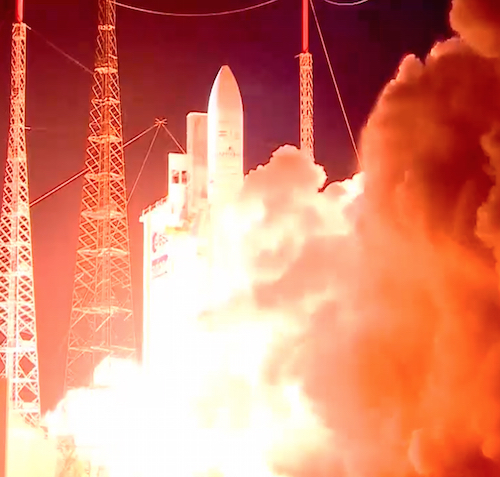
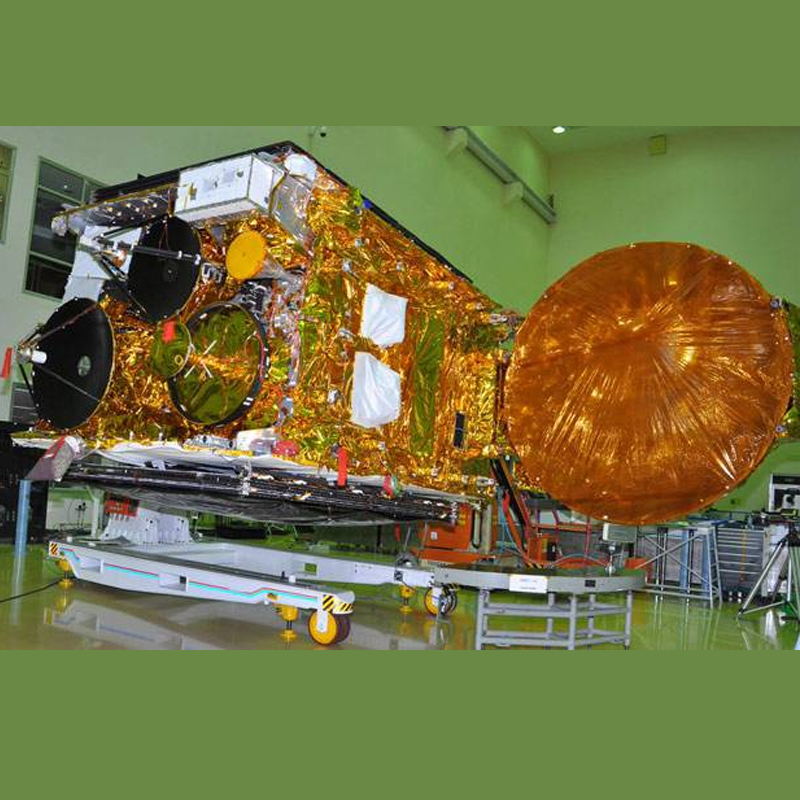
    MUMBAI: GSAT-17 became India’s third communication satellite to successfully reach orbit in the past two months. GSAT-17 was launched in the early morning hours using the European Ariane 5 Launch Vehicle from Kourou, French Guiana. The 3477 kg GSAT-17 carries communication payloads in C-band, Extended C-band and S-band for providing various services to the country.

    The satellite also carries equipment for meteorological data relay and satellite based search and rescue services. After its lift-off at 0245 hrs (2:45 am) IST and a flight lasting about 39 minutes, GSAT-17 separated from the Ariane 5 upper stage in an elliptical Geosynchronous Transfer Orbit (GTO) with a perigee (nearest point to Earth) of 249 km and an apogee (farthest point to Earth) of 35,920 km, inclined at an angle of 3 degrees to the equator.

    ISRO’s Master Control Facility (MCF) at Hassan in Karnataka took over the command and control of GSAT-17 immediately after its separation from the launch vehicle. Preliminary health checks of the satellite revealed its normal functioning.

    In the coming days, orbit raising manoeuvres will be performed to place GSAT-17 satellite in the Geostationary Orbit (36,000 km above the equator) by using the satellite’s propulsion system in steps.

    During the final stages of its orbit raising operations, the two solar arrays and both the antenna reflectors of GSAT-17 will be deployed. Following this, the satellite will be put in its final orbital configuration. GSAT-17 will be positioned at its designated orbital slot in the geostationary orbit and will be co-located with some of the Indian operational geostationary satellites. Later, it is planned to turn on the communication payloads of the satellite. After the successful completion of all the in-orbit tests, GSAT-17 will be ready for operational use.

  • Arianespace to launch ISRO-built DTH & telecom satellites

    MUMBAI: Preparations are afoot to launch two satellites aboard Arianespace’s workhorse Ariane 5 rocket for delivery to GTO (geosynchronous transfer orbit). Hellas Sat 3 / Inmarsat S EAN and GSAT-17 have been scheduled to lift off from the spaceport in Kourou, French Guiana, on 28 June (Wednesday), during a 77-minute window opening at 20:59 GMT (4:59 p.m. EDT).

    Encased in the 17-meter (55.8-foot) tall RUAG-manufactured fairing are the GSAT-17 and Hellas Sat 3 / Inmarsat S EAN satellites. GSAT-17, a 3,477-kg (7,665-pound) telecommunications satellite built by and for India, will launch in the lower position of the SYLDA payload adapter, Space Flight Insider reported.

    One of the aims of the Ariane 5 mission is the launch of two satellites on a single vehicle. On the top of the around 54.8-meter (180-foot) rocket is a pair of satellites destined to provide telecommunications and direct-to-home (DTH) television services to their respective markets.

    Sharing a single ride to orbit offers cost saving opportunities to the customers and is something at which Arianespace has become very adept. The France-based MNC has indeed been a leader in launching two large satellites to GTO for around 20 years.

    GSAT-17, which has been built by the Indian Space Research Organization (ISRO), is constructed on the indigenous I-3K satellite bus. The chassis is outfitted with twin solar panels, capable of producing up to a total of 6,500 watts of DC power, tapering to 5,200 watts at the end of its 15-year design life. The satellite will provide telecommunications services, as well as support data relay and government functions, from its position at 93.5 degrees East via multiple C-band transponders.

    The first, Hellas Sat 3, was built for and will be operated by Hellas Sat. It will provide telecommunications and DTH television services to customers in Europe, the Middle East, and Sub-Saharan African countries.

  • ISRO ready for nexGen vehicle, GSLV can launch 2.2 tonne satellites to GTO

    NEW DELHI: India, which already has the capacity to launch 1700 kg to Sun Synchronous Polar Orbit (600 km) with its Polar Satellite Launch Vehicle (PSLV), is all set to launch the next generation launch vehicle Geosynchronous Satellite Launch Vehicle (GSLV MkIII) with indigenous high thrust cryogenic stage to launch 4 tonne class of communication satellites to GTO.

    The Indian Space Research Organization is all set to make the first developmental flight in the second quarter of 2017, the space minister Jitendra Singh told the Parliament. The development of Semicryogenic engine has also been undertaken to further enhance the GTO payload capability of GSLV MkIII to 6 tonnes.

    The PSLV has proven its versatility in launching multi-satellite/multi-orbit missions as well as lunar (Chandrayaan-1) and interplanetary missions (Mars Orbiter Mission).

    Until now, PSLV has completed 38 consecutive successful missions, during which it has launched 46 Indian satellites (weighing ~ 43.2 tonnes) and 180 foreign satellites (weighing ~ 6.3 tonnes). It has already established itself as a preferred launch vehicle, in its class, in the global market for launch services, especially for smaller satellites.

    The GSLV, with indigenous cryogenic upper stage, has the capability to launch satellites up to 2.2 tonnes to Geosynchronous Transfer Orbit (GTO). GSLV has demonstrated its reliability through three consecutive successful missions in the past three years.

    The maximum GTO capability of other space launch agencies to launch satellites are: European Space Agency (ESA): 10.5 tonnes, US: 13.8 tonnes, Russia: 6.5 tonnes, China: 14 tonnes, and Japan: 8 tonnes.

    ISRO has proved the level of efficiency in the area of space science through – (i) planning, development & execution of Lunar mission ‘Chandrayaan-1’ and High resolution imaging & Systematic topographic mapping of the Moon; (ii) successful insertion of Mars Orbiter Mission (MOM) around the planet Mars in very first attempt, achieving all planned objectives and continuing the operations of MOM beyond its designed mission life of 6 months; (iii) placing India’s first observatory in space ‘Astrosat’, which enables simultaneous multi-wavelength observations (Ultraviolet to X-Ray) to study Stars and Galaxies; (iv) indigenous development & validation of several new technologies viz. autonomy, deep space communication, scientific instruments in space science missions.

    Future missions in space science include second mission to Moon ‘Chandrayaan-2’, consisting of an indigenous Orbiter, Lander & Rover and mission for solar studies ‘Aditya-L1’ to study the solar corona in different wavebands.

    The capability to set up a space station needs capability of lifting heavy payloads into space. While there is no specific plan for space station, ISRO is working towards this capability through launch vehicles using cryogenic and semi-cryogenic engines.

  • Arianespace launches GSAT-15 successfully

    Arianespace launches GSAT-15 successfully

    MUMBAI: At 3:04 this morning, Arianespace’s A5 rocket blasted off from its launch pad in Kouru, French Guiana with its payload of two satellites Arabsat 6B (BADR7) and GSAT-15. The former found its slot in space 27 minutes later, while the latter attained its Geosynchronous Transfer Orbit (GTO) 43 minutes after launch.  It was a flawless launch on a perfect evening, said officials from ISRO and Arianespace.


    India’s satellite control centre at Hasan in Karnataka is in control of the satellite  at the time of writing and maneuvres over the next three days will see it attaining its geo-stationary orbit at 93.5 degrees East. It will be replacing two ageing satellites Insat3A and Insat 4B.


    GSAT-15 has 24 Ku-band transponders to serve the needs of DTH and satellite TV operators over India as well as  VSAT operators who provide DSNG operations to news channels. It  also carries the  GPS-Aided GEO Augmented Navigation (GAGAN) payload operating in L1 and L5 bands,  to enable communications for civil aviation and other location-based services.


    Speaking from Kouru ISRO Satellite Centre (ISAC) Director M Annadurai said two other  communication satellites GSAT-17 and GSAT-18 are getting ready for launch by an Ariane vehicle in the next year. “The realisation of both the satellites is in a very advanced stage,” he said.


  • Insat-3B lofted successfully

    Insat-3B lofted successfully

    Arianespace and the Indian Space Research Organisation successfuly lifted the first in the third generation of Insat satellites on 22 March at 04:58 Indian time. The Arianespace-505 launcher had an additional payload in the Asiastar satellite which was launched for digital radio service, WorldSpace.

    Asia Star was first injected into orbit 28 minutes after lift-off, and seven minutes later, INSAT-3B was injected (in a three-axis stabilised mode into a Geo-synchronous Transfer Orbit – GTO) with a perigee of 560 km and an apogee of 35,770 km and an inclination of 7 degree with respect to the equator.

    The satellite is at present orbiting around the earth with a period of 10.64 hours. The Insat Master Control Control Facility (MCF) at Hassan in Karnataka acquired the telemetry signal from Insat-3B at 5.30 (IST) three minutes prior to its separation from the launcher.

    On separation of the satellite from the composite adopter, satellite health checks were conducted and a series of commands issued from the MCF so as to orient its earth-viewing face towards earth. The outermost panel of the stowed solar array on the south side was also oriented towards the sun to start generating the electrical power required by the satellite during its transfer orbit phase.

    The calibration of the gyros on board the satellite has also been carried out. The operations were completed in about (100 minutes). Insat-3B is being tracked, apart from MCF, Hassan, by INTELSAT Organisation’s ground stations at Perth (Australia), Fucino (Italy) and Lake Cowichan (Canada).

    The satellite will go out of the visibility of MCF, Hassan at about 03:36 pm (IST) this afternoon and will come within the radio visibility of MCF, Hassan at 02:36 am tomorrow.

    The satellite’s orbit is being precisely determined by continuous ranging from the participating TTC stations. The orbit raising operations on INSAT-3B will be carried out by firing the 440 Newton liquid apogee motor on board in stages till the satellite attains its final geostationary orbit, about 36,000 km above the equator.

    The first Apogee Motor Firing (AMF-1) is planned during the third transfer orbit tomorrow (March 23, 2000) at about 07:30 am IST. The satellite has about 1,100 kg of propellant (Mono-Methyl Hydrazine – MMH and Mixed Oxides of Nitrogen – MON-3) for orbit raising operations as well as for station keeping and in-orbit attitude control for the duration of its designed life of 10 years.

    When the satellite reaches near geo-stationary orbit, deployment of two solar panels and the two antennas will be carried out and the satellite put in its final three-axis stabilised mode. The payloads will be checked out before commissioning the satellite. The deployment of the solar array and the two antennas will be carried out after the satellite attains near geo-synchronous orbit.

    Insat-3B will be collocated with INSAT-2E at 83 deg East longitude. It may be noted that Insat satellites now occupy four slots — Insat-2B and Insat-2C are collocated at 93.5 deg (E) longitude, INSAT-1D and INSAT-2A are collocated at 74 E longitude and Insat-2DT is located at 55 E longitude besides Insat-2E at 83 deg East longitude.

    Insat-3B is primarily intended for business communication, developmental communication and mobile communication. The communication payload provides 12 extended C-band channels, each having a bandwidth of 36 MHz. The Ku-band payload provides three channels, having a bandwidth of 77/72 MHz. The Mobile Satellite Service transponders operate in C/S band frequencies. Compared to INSAT-2C/2D, the power of extended C-band transponders on board INSAT-3B has been increased from 10 W to 15 W and that of Ku-band from 20 W to 55 W.

    Once commissioned, INSAT-3B is expected to further boost the Very Small Aperture Terminal (VSAT) services. The major VSAT users include banking and financial institutions, stock markets, white goods sector, fast moving consumer goods sector and medium to heavy engineering companies. Several public and private sector units have established dedicated closed-user group networks for their in-house applications. At present seven transponders from INSAT-2B and INSAT-2C are being used for these applications and INSAT-3B will almost double the transponder capacity for these services. For the first-time Ku-band frequencies will also be used for VSAT services, which enables use of smaller ground terminals.

    INSAT-3B will provide the first set of transponders for Swaran Jayanti Vidya Vikas Antariksh Upagraha Yojana (Vidya Vahini) which had been announced by the Prime Minister on 15 August 15 1998. These transponders will be used exclusively for interactive training and developmental communication and will be a further extension of the present Training and Developmental Communication Channel of Insat that is being used by several agencies.

    Tele-medicine is also expected to be introduced that will help in remote iagnostics and extension of super special hospital treatment to the rural population. INSAT-3B Mobile Satellite Service (MSS) has forward link channel in C X S band and return link in S X C band. MSS can support portable terminals and carry voice, fax or data. It also supports messaging service using reporting terminals.