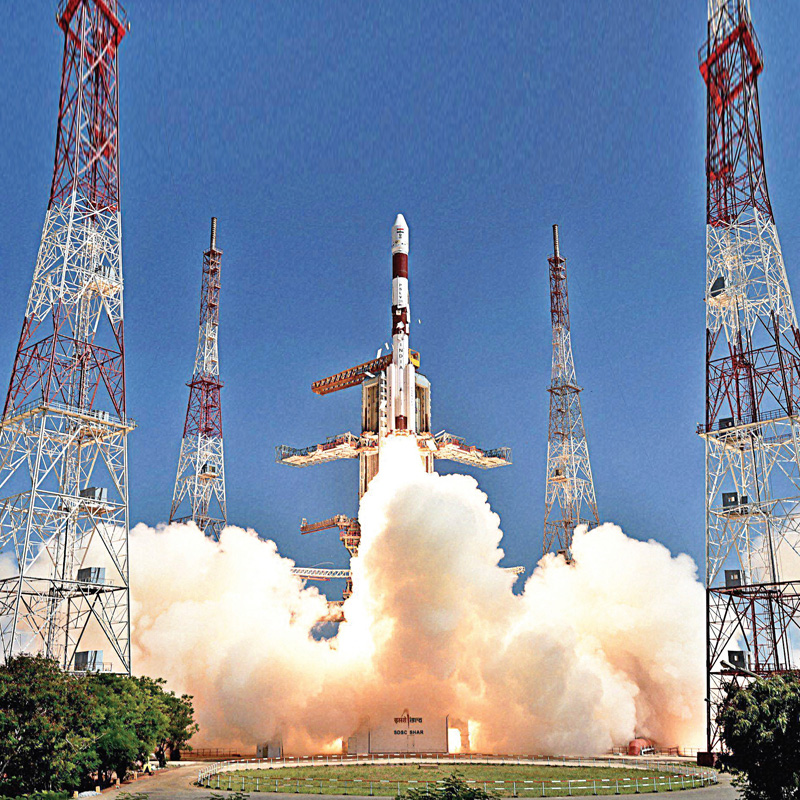
Tag: GSAT-9

  • ISRO launches into space GSAT-9 & India’s S. Asian space diplomacy

    MUMBAI: Prime Minister Modi’s Rs 450 crore (Rs. 4,500 million) Asian space diplomacy took flight today with the launch of South Asia Satellite GSAT-9 by Indian Space and Research Organization (ISRO) on Friday. Pakistan is not participating in this initiative.

    The satellite, when it finally gets commissioned, would provide services specific to individual countries as per their own needs and priorities as also common services. Each country would be allocated one transponder each. The South Asian nations that would benefit from this Indian initiative include Afghanistan, Bangladesh, Bhutan, Maldives and Nepal.     

    The South Asia Satellite has 12-KU band transponders, which India’s neighbors can utilize to increase communications. However, the on-ground infrastructure for the usage of satellite capacity will have to be built by each respective country, though, according to an official government statement, India is willing to help them do that too.   

    According to a report in the Economic Times newspaper, each of the participating South Asian nation could benefit up to USD 1.5 billion over the 12-year lifespan of GSAT-9.

    The satellite will facilitate DTH television, VSAT links, tele-education, telemedicine and disaster management support. It will provide critical communication links in times of disasters such as earthquakes, cyclones, floods, and tsunamis.

    Congratulating ISRO for the development and launch of the satellite, PM Modi, while conferring with the heads of participating nations via video conference, said, “As governments, our most important task is to secure growth, development and peace for our people and communities. And, I am convinced that when we join hands and mutually share the fruits of knowledge, technology and growth, we can speed up our development and prosperity.” 

    The vehicle is designed to inject 2- 2.5 ton class of satellites into space. The overall length of GSLV-F09 is 49.1 m. GSLV-F09 was launched on May 5, 2017 from the Second Launch Pad (SLP) at Satish Dhawan Space Centre SHAR (SDSC SHAR), Sriharikota, the space port of India.

    GSLV-F09 vehicle configuration, including the CUS, is similar to the ones successfully flown during the previous three missions — GSLV-D5, D6 and F05 — in January 2014, August 2015 and September 2016, respectively. GSLV-D5 and D6 successfully placed two communication satellites, GSAT-14 and GSAT-6, while GSLV-F05 placed India’s weather satellite INSAT-3DR in the intended GTOs.
    Also Read:

    ISRO’s ‘South Asia Satellite’ to carry 12 ku-band transponders

    ISRO world record in 104-satellite launches on a single flight


  • DTH satellite GSAT 9 (South Asia Sat) blasts off today

    MUMBAI: The countdown clock is ticking away. Come 5:30 pm IST, the evening of 5 May, and the Indian Space Research Organisation (ISRO) will have added another feather to its cap as  its indigenously developed satellite GSAT-9 lifts off from the second launch pad at the Satish Dhawan Space Center in Sriharikota  for its journey into geosynchronous orbit  as a payload on the Geosynchronous Satellite Launch Vehicle Mk II (GSLV-F09).

    The cost of the launch is estimated at around Rs 450 crore (USD 70 million)

    Labeled South Asia Sat, the 2,230 kg weighing satellite boasts 12 Ku-band transponders that will result in a swelling of capacity for India’s DTH television operators  and facilitate TV signal distribution  for its neighbors Nepal, Bhutan, Maldives, Sri Lanka, Bangladesh and Nepal (members of the South Asian Association for Regional Cooperation – SAARC).  

    The satellite also carries India’s fourth GPS aided GEO Augmented Navigation (GAGAN) payload that delivers correction signals for aircraft navigation systems to increase navigation accuracy to three meters, assisting in air traffic management and landing in tough weather and challenging terrain.

    GSAT 9 will be located at 48 degrees east and has a scheduled mission life of around 12  years.

    Also Read :

    ISRO’s ‘South Asia Satellite’ to carry 12 ku-band transponders

    MIB: No DPO request for infra sharing, DTH ops’ transponder demand up

    Could India blocking ABS’ FTA TV signals lead to breach of ITU norms?


  • ISRO to launch 103 satellites early Feb

    ISRO to launch 103 satellites early Feb

    NEW DELHI: Indian Space and Research Organisation (ISRO) will launch a record 103 satellites in one go using its workhorse PSLV-C37 in the first week of February, while the prime minister Narendra Modi’s pet South Asian satellite project will take off in March. Majority of the satellites (almost 100) set for launch in February are for foreign nations, including the U.S. and Germany.

    “We are making a century by launching over 100 satellites at one go,” a PTI report quoted S Somnath, Director of the Liquid Propulsion Systems Centre of the ISRO, as saying yesterday. The space agency had earlier planned a launch of 83 satellites in the last week of January, of which 80 were foreign. But with the addition of 20 more foreign satellites, the launch was delayed by a week and will now take place in first week of February, Somnath said.

    He, however, did not specify the number of countries that would launch its satellites in this mission, but said the list includes countries like the US and Germany. “These will be 100 micro-small satellites, which will be launched using a PSLV (Polar Satellite Launch Vehicle) – C37. The weight of the payload will be 1350 kgs, of which 500-600 kgs will be the satellite’s weight,” Somnath added in the PTI report.

    The launch will be a major feat in country’s space history as no exercise on this scale has been attempted before. Last year, ISRO launched 22 satellites at a go and this launch will have almost five times the number of crafts. The South Asian satellite will be a part of GSAT-9, which will be launched in March this year, said ISRO Associate Director M Nageshwara Rao.

    The communication satellite was to be launched in December 2016, but was slightly delayed as some other satellites are to be launched before that. PTI quoted unnamed sources saying talks with Afghanistan to have the country on-board for the project is in its final stages.

    Envisaged as a gift to its neighbours, the project, earlier known as SAARC satellite, faced stiff resistance from Pakistan. The neighbouring country wanted it to be launched under the aegis of the South Asian regional forum. It later backed out of the project. Apart from India, the satellite will benefit Sri Lanka, Maldives, Bangladesh, Nepal and Bhutan.

  • ISRO to launch 103 satellites early Feb

    ISRO to launch 103 satellites early Feb

    NEW DELHI: Indian Space and Research Organisation (ISRO) will launch a record 103 satellites in one go using its workhorse PSLV-C37 in the first week of February, while the prime minister Narendra Modi’s pet South Asian satellite project will take off in March. Majority of the satellites (almost 100) set for launch in February are for foreign nations, including the U.S. and Germany.

    “We are making a century by launching over 100 satellites at one go,” a PTI report quoted S Somnath, Director of the Liquid Propulsion Systems Centre of the ISRO, as saying yesterday. The space agency had earlier planned a launch of 83 satellites in the last week of January, of which 80 were foreign. But with the addition of 20 more foreign satellites, the launch was delayed by a week and will now take place in first week of February, Somnath said.

    He, however, did not specify the number of countries that would launch its satellites in this mission, but said the list includes countries like the US and Germany. “These will be 100 micro-small satellites, which will be launched using a PSLV (Polar Satellite Launch Vehicle) – C37. The weight of the payload will be 1350 kgs, of which 500-600 kgs will be the satellite’s weight,” Somnath added in the PTI report.

    The launch will be a major feat in country’s space history as no exercise on this scale has been attempted before. Last year, ISRO launched 22 satellites at a go and this launch will have almost five times the number of crafts. The South Asian satellite will be a part of GSAT-9, which will be launched in March this year, said ISRO Associate Director M Nageshwara Rao.

    The communication satellite was to be launched in December 2016, but was slightly delayed as some other satellites are to be launched before that. PTI quoted unnamed sources saying talks with Afghanistan to have the country on-board for the project is in its final stages.

    Envisaged as a gift to its neighbours, the project, earlier known as SAARC satellite, faced stiff resistance from Pakistan. The neighbouring country wanted it to be launched under the aegis of the South Asian regional forum. It later backed out of the project. Apart from India, the satellite will benefit Sri Lanka, Maldives, Bangladesh, Nepal and Bhutan.