Tag: GSAT-12

  • Over eighty tele-education networks established using Edusat between 2004 and 2010

    Over eighty tele-education networks established using Edusat between 2004 and 2010

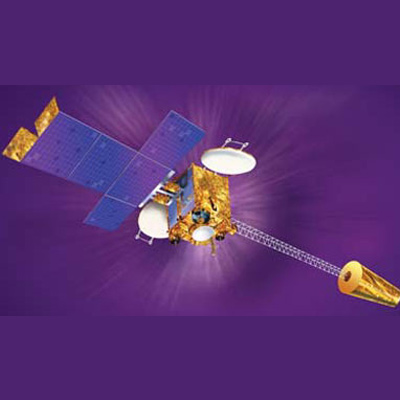
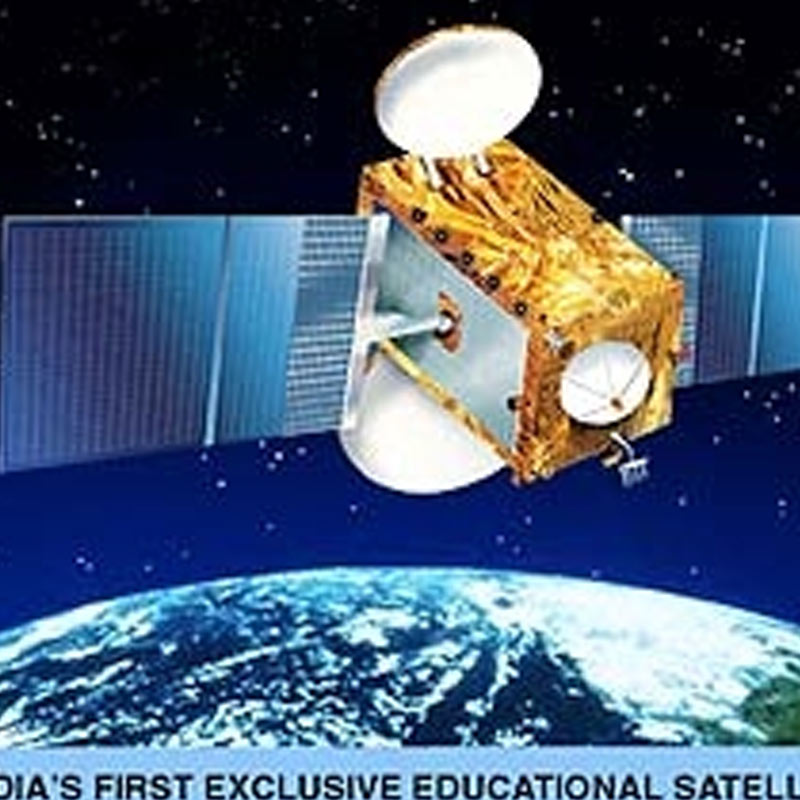
    NEW DELHI: A total of 83 tele-education networks connecting about 5000 interactive and about 55000 receive only terminals were established with the help of the Edusat satellite between September 2004 and October 2010.

    Parliament was told today by Space Minister Jitendra Singh said the satellite had been planned for demonstrating the capabilities of satellite communication technology for education sector.

    It was launched in September 2004 and supported the educational services till October 2010.
    During this period, many educational transmission experiments were demonstrated using satellite communication networks.

    After October 2010, the tele-education networks are migrated to other communication satellites like INSAT-3C, INSAT-4CR and GSAT-12.

  • Over eighty tele-education networks established using Edusat between 2004 and 2010

    Over eighty tele-education networks established using Edusat between 2004 and 2010

    NEW DELHI: A total of 83 tele-education networks connecting about 5000 interactive and about 55000 receive only terminals were established with the help of the Edusat satellite between September 2004 and October 2010.

    Parliament was told today by Space Minister Jitendra Singh said the satellite had been planned for demonstrating the capabilities of satellite communication technology for education sector.

    It was launched in September 2004 and supported the educational services till October 2010.
    During this period, many educational transmission experiments were demonstrated using satellite communication networks.

    After October 2010, the tele-education networks are migrated to other communication satellites like INSAT-3C, INSAT-4CR and GSAT-12.

  • 13 indigenous communication satellites over Indian skies

    13 indigenous communication satellites over Indian skies

    New Delhi: Thirteen of the 34 Indian satellites operational in the country are communication satellites.  

    These sare: INSAT-3A, INSAT-3C, INSAT-4A, INSAT-4B, INSAT-4CR, GSAT-6, GSAT-7, GSAT-8, GSAT-10, GSAT-12, GSAT-14, GSAT-15 and GSAT-16.  The others include 12 Earth Observation Satellites; seven Navigational Satellites;and two Space science Satellites. 
    About 30 service providers are utilising Ku-band (a part of K band) transponders onboard indigenous communication satellites for various communication applications, which include direct-to-home television, digital satellite news gathering, telecommunication, VSAT services for banking, tele-education, business communication. The government is not seeking any foreign assistance/collaboration for satellite operations, Space Department minister Jitendra Singh has told Parliament. 

    The Indian Space Research Organization has an action plan in place for developing indigenous satellites, with the participation of Indian industries, for earth observation, communication, navigation and space science and planetary exploration. 

    Meanwhile, ISRO has signed MoU/ cooperative agreements for exploration and use of outer space with 37 countries viz. Argentina, Australia, Brazil, Brunei Darussalam, Bulgaria, Canada, Chile, China, Egypt, France, Germany, Hungary, Indonesia, Israel, Italy, Japan, Kazakhstan, Kuwait, Mauritius, Mexico, Mongolia, Myanmar, Norway, Peru, Republic of Korea, Russian Federation, Saudi Arabia, Spain, Sweden, Syria, Thailand, The Netherlands, Ukraine, United Kingdom, United Arab Emirates, United States of America and Venezuela. 

    The fields to explore newer research activities addressed in these MoUs include Joint development of advanced scientific instruments to observe earth and universe; joint realization of satellite missions; jointly carrying out calibration and validation experiments; conducting airborne campaign with advanced instruments; deep space navigation and communication support for space science missions; development of advanced technologies for building and launching of spacecrafts for earth observation and space science exploration. 

    Application possibilities in the field of remote sensing addressed in these MoUs include – natural resource management; vegetation biomass estimation; meteorological & oceanographic applications; atmospheric parameter retrieval & modelling; climate monitoring and weather forecasting; disaster management support.

  • 13 indigenous communication satellites over Indian skies

    13 indigenous communication satellites over Indian skies

    New Delhi: Thirteen of the 34 Indian satellites operational in the country are communication satellites.  

    These sare: INSAT-3A, INSAT-3C, INSAT-4A, INSAT-4B, INSAT-4CR, GSAT-6, GSAT-7, GSAT-8, GSAT-10, GSAT-12, GSAT-14, GSAT-15 and GSAT-16.  The others include 12 Earth Observation Satellites; seven Navigational Satellites;and two Space science Satellites. 
    About 30 service providers are utilising Ku-band (a part of K band) transponders onboard indigenous communication satellites for various communication applications, which include direct-to-home television, digital satellite news gathering, telecommunication, VSAT services for banking, tele-education, business communication. The government is not seeking any foreign assistance/collaboration for satellite operations, Space Department minister Jitendra Singh has told Parliament. 

    The Indian Space Research Organization has an action plan in place for developing indigenous satellites, with the participation of Indian industries, for earth observation, communication, navigation and space science and planetary exploration. 

    Meanwhile, ISRO has signed MoU/ cooperative agreements for exploration and use of outer space with 37 countries viz. Argentina, Australia, Brazil, Brunei Darussalam, Bulgaria, Canada, Chile, China, Egypt, France, Germany, Hungary, Indonesia, Israel, Italy, Japan, Kazakhstan, Kuwait, Mauritius, Mexico, Mongolia, Myanmar, Norway, Peru, Republic of Korea, Russian Federation, Saudi Arabia, Spain, Sweden, Syria, Thailand, The Netherlands, Ukraine, United Kingdom, United Arab Emirates, United States of America and Venezuela. 

    The fields to explore newer research activities addressed in these MoUs include Joint development of advanced scientific instruments to observe earth and universe; joint realization of satellite missions; jointly carrying out calibration and validation experiments; conducting airborne campaign with advanced instruments; deep space navigation and communication support for space science missions; development of advanced technologies for building and launching of spacecrafts for earth observation and space science exploration. 

    Application possibilities in the field of remote sensing addressed in these MoUs include – natural resource management; vegetation biomass estimation; meteorological & oceanographic applications; atmospheric parameter retrieval & modelling; climate monitoring and weather forecasting; disaster management support.

  • Satellite requirements for next decade being analysed: Jitendra Singh

    Satellite requirements for next decade being analysed: Jitendra Singh

    NEW DELHI: An expert committee has been constituted by the Government to carry out detailed analysis considering the launch requirements of the Indian Space Research Organisation (ISRO) for the next decade, keeping in view that a number of countries have requested India to launch their satellites.


    The committee will also study the azimuth corridor for flight path, impact points of spent stages, safety zones and mission requirements. The report of the committee is expected to be finalised by October this year. 


    ISRO has two satellite launch pads at Satish Dhawan Space Centre, Sriharikota, which is the main spaceport of the country. These launch pads have been built with state-of-the-art technology and also are designed and built to withstand cyclones. 


    Meanwhile in reply to another question in Parliament today, Department of Space Minister Jitendra Singh said the GSAT-12 satellite launched on 15 July 2011 is providing linkage for the telemedicine network to the extent of supporting 384 telemedicine centers in the country. 


    It is thus carrying out a part of the work that had been assigned for a communication satellite GSAT-5P carrying 24 C-band and 12 Extended C-band transponders which was launched on 25 December 2010 on-board GSLV-F06 but could not accomplish the mission due to launch failure.


    The transponder capacity on GSAT-5P was planned to augment the INSAT/GSAT capacity for supporting ongoing satellite communication services including telemedicine. 


  • PSLV-C24 launches IRNSS-1B

    PSLV-C24 launches IRNSS-1B

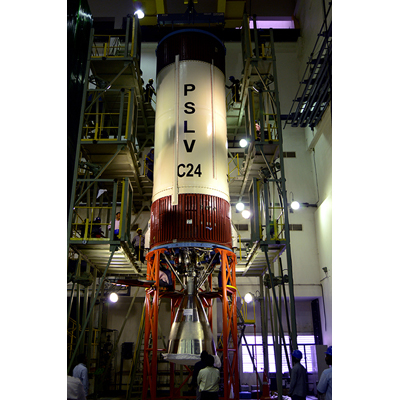
    BENGALURU: ISRO’s Polar Satellite Launch Vehicle, PSLV-C24 has successfully launched IRNSS-1B, the second satellite in the Indian Regional Navigation Satellite System (IRNSS) on 4 April at 1714 hours IST from Satish Dhawan Space Centre SHAR, Sriharikota.


    This is the twenty fifth consecutively successful mission of PSLV. The ‘XL’ configuration of PSLV was used for this mission. Previously, the same configuration of the vehicle was used five times to launch Chandrayaan-1, GSAT-12, RISAT-1, IRNSS-1A and Mars Orbiter Spacecraft.

            .                     .
    After the lift-off with the ignition of the first stage, the important flight events, namely, stage and strap-on ignitions, heat-shield separation, stage and strap-on separations and satellite injection took place exactly as planned. After a flight of about 19 minutes, IRNSS-1B Satellite, weighing 1432 kg, was injected to an elliptical orbit of 283 km X 20,630 km, which is very close to the intended orbit.

    After injection, the solar panels of IRNSS-1B were deployed automatically. ISRO’s Master Control Facility (at Hassan, Karnataka) assumed the control of the satellite. In the coming days, five orbit maneuvers will be conducted from Master Control Facility to position the satellite in its Geosynchronous Circular Orbit at 55 degree east longitude.

    IRNSS-1B is the second of the seven satellites constituting the space segment of the Indian Regional Navigation Satellite System. IRNSS-1A, the first satellite of the constellation, was successfully launched by PSLV on July 02, 2013.     IRNSS-1A is functioning satisfactorily from its designated geosynchronous orbital position.

    Being an independent regional navigation satellite system, it is designed to provide position information in the Indian region and 1500 km around the Indian mainland. IRNSS would provide two types of services, namely, Standard Positioning Services (SPS) – provided to all users – and Restricted Services (RS), provided only to authorised users.
     

    A number of ground stations responsible for the generation and transmission of navigation parameters, satellite control, satellite ranging and monitoring, etc., have been established in as many as 15 locations across the country.

    Two more satellites of this constellation, namely, IRNSS-1C and IRNSS-1D, are planned to be launched in the second half of 2014.  The entire IRNSS constellation of seven satellites is planned to be completed by 2015-16.

  • Rs 800 crore earmarked for two communication satellites in current year

    Rs 800 crore earmarked for two communication satellites in current year

    NEW DELHI: A budget of Rs 800 crore has been set aside for the launch of the GSAT 15 and GSAT 16 communication satellites during 2013-14.

    However, the total budget for GSAT-15 is Rs 859.5 crore and the figure for GSAT-16 is Rs 865.5 crore.

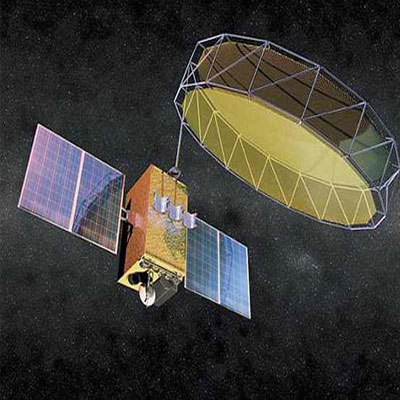
    GSAT-15 is a geostationary communication satellite which will carry 24 Ku-band transponders and one GAGAN (GPS Aided Geo Augmented Navigation) payload. GSAT-15 satellite will support the existing Direct-To-Home (DTH) and Very Small Aperture Terminal (VSAT) services in the country and the GAGAN payload will be a part of GAGAN space segment to provide better air traffic management over Indian Air Space.

    GSAT-16 is a geostationary communication satellite which will carry 24 C-band, 12 Ku-band and 12 Upper Extended C-band transponders. GSAT-16 satellite will support satellite based telecommunication, television, VSAT and other services in the country.

    GSAT-15 and GSAT-16 satellites are targeted for launch during the 2014-16 timeframe. The two satellites were approved in July this year, Minister of State in Prime Minister’s Office V Narayansamy told Parliament.

    The revenue earned by ANTRIX Corporation, the commercial arm of the department, through leasing of INSAT/GSAT transponders during the year 2012-13 is approximately Rs 482.67 crore.

    This revenue accrues from service providers of Direct-To-Home (DTH) services, TV Uplink services, Digital Satellite News Gathering (DSNG) services and Very Small Aperture Terminal (VSAT) services. This revenue does not include the capacities provided to various societal applications such a tele-education, tele-medicine, Village Resource Center, Disaster Management and part of public broadcasting services, which are not of the nature of revenue-earning services.

    At present, there are nine operational INSAT/GSAT communication satellites: INSAT-3A, INSAT-3C, INSAT-3E, INSAT-4A, INSAT-4B, INSAT-4CR, GSAT-8, GSAT-10 and GSAT-12. The total number of transponders available at present from these satellites is 195 operating in C, Extended C, Ku, and S-bands.

    Transponders on communication satellites are leased to users after the launch and operationalisation of the satellite. The Department of Space leases the transponders on INSAT/GSAT satellites through ANTRIX.