Tag: GroupM

  • Quasar consolidates under GroupM

    Quasar consolidates under GroupM

    MUMBAI: GroupM has joined hands with Quasar to build an integrated digital media agency network.

    As per the deal, Quasar will align its media units, Quasar BMS and Blazar, under GroupM Interactions management.

    The consolidated agency network will now include the existing brands of both the businesses – Mindshare, Motivator, Maxus, MEC, Quasar BMS and Blazar.

    There will not be any change of leadership for Quasar and Blazar. The two agency brands will continue to run independently, but will report to GroupM Interactions head Tushar Vyas.

    They will also report to an operating board constituting senior leadership from both Quasar & GroupM.

    The alignment will control a major share of India’s digital marketing spends with capability in Social, Creative, Search and Mobile.

    Quasar BMS and Blazar are the digital media business units within Quasar. Recently, Quasar TWS, which is the Technology and web solutions unit, was aligned to Possible Worldwide.

    The International Business Group (IBG), which is the global digital production unit, has been re-christened as Quasar Primo and will continue to focus on creative and technology development for international clients in partnership with different networks of WPP and direct clients.

    GroupM CEO South Asia Vikram Sakhuja said, “For GroupM consolidation and leverage are our two mantras. We have been successfully managing several independent media agencies for some years. As the world goes more digital we see tremendous synergies by now aligning Quasar BMS and Blazar into the rest of our digital business. Together we will bring best of class end to end capability in Paid, Owned and Earned parts of Digital Media.”

  • GroupM forecasts global ad spending to surpass $500 bn in 2011

    GroupM forecasts global ad spending to surpass $500 bn in 2011

    MUMBAI: Global ad spending in measured media is expected to exceed $500 billion for the first time ever next year following an economic recovery that also sparked significant ad spending increases in 2010, according to a revised report from GroupM.

    The report also revealed that digital media outlets are challenging newspapers as the world’s number-two preferred medium (behind television) in measured advertising investment.

    The 70-country forecast predicted that worldwide ad spending in 2011 will reach almost $502 billion, a 5.8 per cent increase over 2010 spending of $474 billion. In the U.S. 2011 spending is expected to hit $147.7 billion, a 3.7 per cent increase over the $142.5 billion invested in 2010.

    The study, This Year, Next Year also forecasted that ad spending in 2010 is expected to increase by 5.9 per cent over the $448 billion spent in 2009; in the US, 2010 spending increased 1.2 per cent over 2009, when almost $141 billion in ad expenditures was reported.

    The study is part of GroupM’s media and marketing forecasting series drawn from data supplied by parent company WPP’s worldwide resources in advertising, public relations, market research, and specialist communications. It was released by GroupM Futures Director Adam Smith and GroupM Chief Investment Officer Rino Scanzoni at the UBS Global Media and Communications Conference.

    Scanzoni said, “We’ve seen a significant rebound in advertising spending in the U.S over the last six months. Television and online media have been the primary beneficiaries of the rebound in spending. In television, the growth is driven by local TV as political advertising—coupled with the resurgence in growth from the retail and auto categories—has risen from the historically depressed levels of 2009.”

    Scanzoni added that moderately accelerated growth is anticipated in 2011 as corporations with significant cash reserves deploy investment in marketing and advertising to drive top-line growth.

    Measured global advertising has recovered nearly all the dollars lost in 2009, according to the report, which also said the recovery has been broad-based with spending increases reported in categories including toiletries and cosmetics, automotive, beverages, retail, financial services, entertainment, and food among others.

    Significantly, the report said measured internet advertising is expected to contribute 37 percent of global ad growth in 2011 and is likely to reach $82 billion, a growth rate that suggests it will overtake newspaper spending (forecast at $90 billion in 2011) at some point in 2012.

    “Internet spending may indeed already have eclipsed newspapers if one allows that measured internet ad investment does not include substantial advertiser investment in content creation, search-engine optimization and analysis,” commented Smith.

    Nations expected to contribute the largest dollar amounts in 2011 ad spending growth are the U.S. and China, each with at least $5 billion, followed by Canada, Russia, Indonesia, India, Brazil and Japan, each expected to add $1 billion-plus in spending growth.

  • ‘Break even will take five to six years for new franchises’ : GroupM ESP managing partner Hiren Pandit

    ‘Break even will take five to six years for new franchises’ : GroupM ESP managing partner Hiren Pandit

    Bigger, better, richer. That is what the franchises hope the Indian Premier League (IPL) will grow into year after year.


    In an interview with Indiantelevision.com’s Ashwin Pinto, GroupM ESP managing partner Hiren Pandit talks about the vast revenue opportunities that are waiting to be tapped as the IPL grows into a sporting spectacle.


    Excerpts:

    How is GroupM ESP involved with the IPL this time around?
    We do deals with franchises on behalf of our clients. There are logos on T-shirts and also innovations that have not been done before. We create revenue opportunities for the client as well as the franchise. This is in the form of licensing and merchandising.

    Are franchises able to fetch better rates this year with the economic situation somewhat improving?
    Keep in mind that last year local activation could not take place due to the shift to South Africa. This year, some amount of rationalisation has taken place. There is measurement in place. You know whether you should pay Rs100 or Rs 150. Most team sponsorships have been sold.

    In terms of local revenue, how will franchises fare this year as per your calculations?
    It will increase by around 20 per cent for each franchise. Revenues on T-shirts are anywhere from zero for Bangalore (The UB Group uses its own brands) to Rs 400 million for Kolkata. Delhi and Chennai will each earn Rs 330 million. Mumbai, Rajasthan and Punjab will individually earn Rs 300 million. Hyderabad will earn around Rs 200 million. The big difference is the logo on the right chest which will add Rs 30-50 million in revenue. Licensing and merchandising is just starting to happen. So this will take time to grow.


    Kolkata will get hit in terms of gate receipts as the two large stands that seat the most number of people is being reconstructed. Mumbai’s matches will happen in the CCI and DY Patil. Ahmedabad should boost Jaipur’s gate receipts. I, however, do not know the extent to which Dharamshala as a venue will help Punjab. The question that remains is Hyderabad. There needs to be some clarity on where the matches will be played.

    If you include the central pool, how much revenue will franchises earn?
    It will be a 25 per cent growth overall. Each franchise will earn $12-14 million from the central pool. The local pool will contribute around $8-10 million. Revenues from theatres, YouTube and Colors will also kick in. This will add a certain amount but it will not be dramatically different.

    Will Hyderabad’s revenues be hit due to the venue being shifted?
    I am not so sure that Hyderabad sponsorships will get hit as it depends on TV exposure. On the back of that, activation will be done. In-stadia activity, though, will be hit. But licensing and merchandising may stay unharmed. It depends on the kind of deals that they will do. It remains to be seen how much revenues come from ticketing.

    Franchises will see a 25 per cent growth overall. Each franchise will earn $12-14 million from the central pool. The local pool will contribute around $8-10 million. Revenues from theatres, YouTube and Colors will also kick in

    Is there a danger of sponsorship getting cluttered?
    From what we gather, the number of brands on IPL was 40 in the first season and 68 in the second. We expect the number to touch 80 in the third season. It is clutter but since it is at home, clients can do more activation. There needs to be innovation done by companies in terms of their campaigns. You cannot do what was done earlier unless you are sure that it will stay fresh. It needs to be different. Just keeping a logo on the T-shirt is not enough.

    Could you give me a couple of examples where team sponsors have successfully leveraged the IPL?
    Idea Cellular did something different with the Mumbai Indians in the second season. Their users could have conversation with players. Wrigleys did something different by associating with all teams. Vodafone did the Zoozoo campaign which was a wake up call to competition. Sprite did the unique ‘Seedhi Baat, No Bakwaas‘ campaign with Kolkata.

    What is the key to a successful licensing and merchandising campaign?
    Both parties have to make money. The distribution platform has to be solid and give access to all potential buyers. Under licensing and merchandising, the franchisee gets a flat amount and then a share on revenues – depending on sales. It will be a slow burner, though. And it will not kick in from day one. A substantial amount of promotions will be needed.


    Licensing and merchandising is different from having a logo on a T-shirt. People are still struggling to figure out what is the difference between advertising and licensing and merchandising. These two categories are separate but are getting mixed up. That actually helped Wrigleys who did a smart number on franchises. They did a partnership at a low cost and signed up most franchises for three years. From what I understand, Wrigleys can now milk the value of its deals to such an extent that franchises feel that they did not get the value that they were looking for. I don’t think that Wrigleys shares revenues of its products. Franchises now realise that the deal might have been a mistake for them.

    Have the franchises got it right on ticket pricing?
    I assume that they would have learnt from the first season. They will know what works and what does not. You need to analyse in detail what was done in the first season – what was right and what was wrong. If they have not done that the same mistakes will be made again. You also need to do activities to make fans come to the stadiums. The in-stadia experience will be far better this time. Catering is centrally managed. There are now turnstiles and so the number of people entering and leaving can be checked.

    Will the break even period elongate for the new franchises as the IPL has set a fourfold increase in base price?
    The revenue opportunities have grown. The break even position, however, depends on how one manages costs and the revenue generation potential of a city. Some cities will perform better than others. But generally, it will take five to six years for the new franchises to break even. The time taken to break even is also a question of how innovative can the new owners be in generating revenues. Local revenues should rule over the earnings from the central pool. Anybody who can do this will have a model that will set themselves up to making money that would justify the price tag.

    Who has fared the best in this area so far?
    The closest that anybody has come to achieving a great model is Kolkata. The fact that Shah Rukh Khan has lent himself to his sponsors like Nokia and Sprite has worked. He has extracted more revenues as a result. So instead of charging Rs 40 million, this franchise can charge Rs 70 million. Other teams also have values but I am not so sure that they are using it to their maximum potential. No franchise is optimising local sponsorship the way that they should.


    Also, keep in mind that with more teams coming in, costs and revenues will go up. The impact will be felt across the board. Player costs, travel and stadium maintenance costs will rise. Sponsorship revenues will also go up. All this has to be taken into account by whoever is bidding.

    Another issue is that current franchises will be allowed to retain some key players even after the third season. This could limit the pool of payers who are available to the new franchises. How do you see things panning out?
    A middle ground will have to be found. This is a sticky issue. On one hand, you have India Cement saying that since they have invested in Dhoni and have built their team around him, he must be retained. Otherwise the team’s value will be affected. On the other hand, the new franchises need to have a solid pool of players to pick from or else they might decide not to play. A balancing act will have to be performed by the IPL Governing Council.

    Rajasthan Royals has tied up with other cricket clubs globally. Is this the trend for the other franchises as well?
    If you have world class players who can play in different countries and fill a stadia, then it forms another revenue stream. The IPL guidelines state that Rajasthan Royals cannot play against Kolkata in, for instance, England. So by doing this kind of a tie up, they avoid that situation. Events can take place all over and more money flows in. There is an opportunity here.
    Do you see the IPL playing out well in cinema theatres?
    This year it will be a tried and tested concept. The concept looks very impressive. You will have high definition which makes a big difference. The 16:9 screen size will allow you to see more ground. This is the summer and people might want to go to an air conditioned place and enjoy it together. It is about the quality of experience. If it is good, then word of mouth will spread.

    How important is the YouTube deal in spreading the IPL brand globally?
    It is fantastic on two levels. In India, you can sit in the office and watch matches. It is a question of bandwidth. I would expect people to avail of the highlights package for matches that happen between 4-7 pm the next day. Then there is the Indian diaspora who want to watch the IPL but have no access.


    The question is how YouTube is going to monetise the IPL property. Will YouTube become pay for international markets? Today they have said no. They can continue to say no if there is enough ad support.

    The Champions T20 League got off to a slow start. Where do you see it going from here?
    I was surprised that it got off to such a slow start. But if people thought that the Champions Twenty20 League would do as well as the IPL, then they were wrong. The IPL and Champions League are about clubs. The club culture has not yet come in the country. It will take time. The second reason is that the three Indian teams did poorly in the Champions League. The interest among audiences fizzled out.


    The franchises and the IPL need to start developing a club culture. Nobody says that they want to go for an IPL match to see a particular franchise play. They simply go for great cricket. That has to change. You need to create a fan base that is passionate about the team per se, even if it comes last. Franchisees need to invest money in creating a club culture.

  • ‘All IPL teams should be able to break even by 2011’ : Hiren Pandit – GroupM ESP managing partner

    ‘All IPL teams should be able to break even by 2011’ : Hiren Pandit – GroupM ESP managing partner

    The Indian Premier League (IPL) promises huge space for revenue growth. The team franchises will have to focus on building the brand consistently, project a healthy personality and take the sponsorship value to a different level.


    It is not wise to draw sponsors just on the back of winning and losing. Performance is a factor, but it is not the only thing.


    In an interview with Indiantelevision.com’s Ashwin Pinto, GroupM ESP managing partner Hiren Pandit says there is value in T20, but warns that it should not be at the cost of the other formats.


    Excerpts:

    How have the franchises fared financially in the second edition of the IPL?
    Our assumption is that there are two who have not made a profit – Deccan Chargers (Hyderabad) and Royal Challengers (Bangalore). They had their own brands on their T-shirts, which could be looked at as an investment rather than a loss. The others have broken even at the operational level. This was due to the rise in television rights fees. The question is whether they have wiped out the losses of last year. I expect everybody to break even by 2011.


    In terms of sponsorship revenues between the team and central revenues, the IPL got Rs 3 billion. Last year it would not have been more than Rs 2.5 billion. Kolkata Knight Riders (KKR), Chennai Super Kings (CSK) and Delhi Daredevils have got the most in terms of local sponsorships, followed by Mumbai Indians, Kings XI Punjab Rajasthan Royals (RR).

    And what about sponsorships?
    CSK and KKR did a particularly good job. But you would have a team like Royal Challengers (RC) which is not interested in outside sponsorships. That franchisee put its own brands on display.

    How about defending champions Rajasthan Royals?

    RR has broken even because their payout to the BCCI is much less as compared to the others. They only shell out $6.5 million each year. Having said that, I am not so sure that finishing number one necessarily translates into higher sponsorship revenue.

    Then what matters?
    You need to look at what a team stands for. Is its branding consistent? Does it show on the ground? Does the team overall project a strong and a healthy personality? Are there characteristics in the team that can take sponsorship value to a different level?


    If an IPL team draws sponsors on the back of winning and losing, then you have a problem. Performance is a factor, but it can’t be the only thing.


    While KKR did well in terms of getting in sponsors, somewhere down the line they or the brands associated with it made the mistake of going down the performance route. That is a dangerous platform to walk on. The amount of bad press it got did not help the franchisee nor the brands that were associated with it.


    On the other side, Idea did an outstanding job with the Mumbai Indians. Their activation platform was brilliant and had nothing to do with winning or losing. It gave fans the opportunity to aspire to talk with their favourite players. Even though Mumbai Indians lost on the field, the aspirational value is still there.

    What was Group M’s role in this IPL?
    We did a few deals with some clients for having their logos appear on T-shirts. We lost out big time, though, as the IPL moved out of India. We had a smaller role to play compared with last year. We are now not involved with the Deccan Chargers.

    Revenue growth will come from local sponsorships. If you are heavily relying on the central pool, then the franchise has not built itself properly. Building up local sponsorships and fan base will be key

    Do you see yourself playing a bigger role going forward?
    Yes! We have knowledge on brand activation around the IPL. We have got a good understanding of this space and the valuation process. We can give clients a fair idea of what they should pay for a logo, depending on the position they take. We are also open to associating with teams.

    The IPL is looking at doing another event each year abroad, possibly a smaller one. Is this the best way forward?
    The aim appears to be to develop cricket in smaller, non cricket markets. Is there a window available? Are players available? These issues have to be addressed.

    Where does KKR go from here?
    They have to relook at what they have got. They are not a bad team per se. They have a high profile owner and they need to look at the relationship between owner and team.


    Secondly, they had too many people like Buchanan and Ganguly trying to become high profile. The bigger you are, the harder you fall and that is what has happened.


    Kolkata’s sponsorship is on the back of Shah Rukh Khan and not because of the team. They could rejig what their brand stands for – and then sponsors will come in for the team’s values. That is a call that they will have to take. What you will find is that franchisees will move away from performance as a platform for brand activation.


    Going forward, the growth of revenues will come from local sponsorships – and not so much from the central pool. If you are heavily relying on the central pool, then the franchise has not built itself properly. Building up local sponsorships and fan base will be key.

    How would this happen?
    The IPL will move away from being just a 45-day event. Franchisees will do activities over a longer period of time to build a fan base. They would do things like promotions, interactions and meets.

    There is talk that with the IPL the focus is shifting away from individual player sponsors and more towards team sponsorship. Are players like Dhoni going to lose out on lucrative deals going forward?
    When a team association is done, three to four players are used. Even if you are associated with CSK, you can only use Dhoni as far as IPL is concerned. This makes sense when the IPL is on or just about to start. But in December if the team endorses a brand, what will a viewer take out of it? The viewers are not stupid. If people believe that they are getting a Dhoni for free by associating with his IPL franchise, then they have a short term approach to the business.


    You could associate with a team to get national reach. If you associate with a player, it would be due to his characteristics. It is not necessary that the characteristics of the franchisees will be the same.

    When the IPL adds more teams in 2011, what would be the likely cities?
    Gujarat and UP have opportunities. You could see another team from Maharasthra – perhaps Pune or Nagpur. Kerala also has a chance if some NRI is interested. The payout could cross $200 million. But the interested party will have to work his maths out properly. Otherwise, it will be difficult to recoup your investments. The parties that shelled out the most for a franchisee the last time around are just about making it. The lower end of the payout table are more comfortable.


    Also keep in mind the fact that after 2010 all player contracts are up for grabs. The whole scenario will be reworked and changed. There should again be a cap on money that can be spent or there will be teams that will be far stronger than the rest. The IPL could then turn into a two or a three horse race which will take away from its appeal. Some deals, though, might be done outside the bidding. We will see more performance-related deals. Player loyalties and disloyalties will also come into the equation.

    Next year England starts P20. In 2011 South Africa, Australia and New Zealand start a joint league along the lines of the IPL. How do you see this affecting international cricket?
    The question is with so many leagues happening, what happens to Tests and one-dayers. Is there enough of a window for this to happen? There was a league that started in the West Indies, which subsequently got killed.


    Can the other leagues generate the kind of money that the IPL gets? I don’t know if Kevin Pietersen will get $1.5 million a year in those leagues.


    Then you must look at it from a player’s perspective. He plays around 35 ODIs, 15 Tests, 20 T20 games a year. Does he have time to play anything else? Remember also that T20 is successful in India as it is a country sport first. Then it is a club sport.

    Could we see players bypassing the international grind and just focusing on league cricket which is lucrative?
    The question is whether a player wants to play cricket for a living or does he want to represent his country and make money. You cannot have somebody only focus on the T20 format. This is something that this edition of the IPL brilliantly showed.


    The players who did well like Kumble, Gilchrist and Hayden are seasoned campaigners who have excelled in the other formats as well. T20 is not a wham bam affair. It is about playing proper cricket. If a cricketer chooses league cricket over his country, then he might be asking for trouble. Most of the IPL players got there as they made a statement by playing for their country. Then there are youngsters who did well in the IPL and are now playing for their country. I do not think that it is a choice of one versus the other.

    What impact will India’s exit in the T20 World Cup have on ESPN Star Sports?
    Ratings will take a hit. Already we are seeing that clients are not getting enough of a return when India does not play.
    How do you see the Champions T20 League faring?
    You need to let it happen once. Some players play for two teams and so will have to decide where their loyalties lie when this event starts.
    Would playing at night help Test cricket?
    This is not a bad idea. What has happened is that T20 has had a positive impact on the other formats. The run scoring in Test matches is quicker which is forcing results. This is desirable. Each format lives off the other in some form or the other.
    There will be lots of T20 cricket happening. Are you concerned that the overdose might kill the format?
    It could lose its flavour. You cannot have too much of one format. There is value in T20, but it should not be at the cost of the other formats.
    What challenges does the economic downturn pose for Group M ESP?
    We need to work harder. We need to give more value to clients. It is a partnership in good times and bad. We need to find better opportunities for clients but it is not as though we need to think differently.
    What progress has Group M ESP made in the celebrity endorsement and management space?
    We have moved away from this. Keeping in mind the Indian mindset towards celebrities, we did not believe that it was a scalable model. We focus, among other areas, on branded content in film and television. The strike affected us but hopefully the films have only been shifted and not cancelled. We have done regional tie ups with brands.
  • ‘Course correction will happen from a commercial, team management, and player angle’ : Hiren Pandit – GroupM ESP managing partner

    ‘Course correction will happen from a commercial, team management, and player angle’ : Hiren Pandit – GroupM ESP managing partner

    For franchisees the inaugural edition of the IPL has been a learning experience. The Hyderabad franchise is no different. While Deccan Chargers finished at the bottom of the table, the franchisee is confident that the investment will pay of in the long term. At the same time, the event was more difficult logistically and also physically than anybody imagined.


    GroupM ESP acts as a consultant for the Deccan Chronicle, which owns the Deccan chargers. Ashwin Pinto caught up with GroupM ESP managing partner Hiren Pandit to find out his views on the event


    Excerpts:

    How has the IPL experience been for Deccan Chargers?
    It has been a big learning curve. At the same time companies that did not get in will be furious at having missed out. The franchisees have all seen the potential of this event. We now know that this can be built up over the years. The IPL will be of the biggest benefit for those who want long-term gains.

    Overall what have the learnings been?
    There have been many. Sponsorship needs to be approached in a more effective manner. We were not able to do this earlier due to time constraints. Most of these deals have been for one year and so plans can be revised depending on what the team’s standing is. It is still early days. The way television has taken to it has been big. Next year, sponsorship rates will go through the roof.


    I believe that the IPL is looking for $ 7 to 8 million for ground co-sponsorship rights. Pepsi will go in for associate sponsorship as they want to block out Coca Cola. Each franchise and sponsor has had more than his fair share of learnings that will have to be put in place.


    A lot of course correction will happen. This will be from a commercial angle, team management angle, player angle.


    For the next three weeks people will lie low and detox from the IPL frenzy. Then they will start addressing issues. There will be a session with the IPL governing body to do a Swot analysis. Teams will look at their overall structure and check to see if all is right or if it needs to be re-looked at. Some problems may be common.

    What were the logistical challenges?
    The travel schedule was awful. I had no idea about the days. There was no concept of weekdays and weekends. It was just one haze of cricket matches and cities.


    Hats off to the players for performing. We played a match against Chandigarh. The next day we reached Hyderabad at 9:30 at night. The next day there was a match. Where is the time for player recovery? Players luggage also became an issue. It has to be at the airport. These logistics were more complex than had been first imagined.


    Then there is media pressure. Several people want to interview a certain set of players at any given point of time. This needs to be scheduled better.

    The trading window will be key but the guidelines are not clear

    For Hyderabad what have the learnings been?
    There have been many. Right from stadium management, which we managed well. The ticketing part was an experience. We were not sure initially as to whether we would have 46,000 seats or 38,000. The stadium was under construction. We had to keep in mind media sessions.

    Not just us, but everybody will handle this differently next time. We sold out tickets for many matches but we have to still understand the pattern in which ticket sales happen. With sponsors there was confusion due to outfits not being ready on time. For the first week we struggled to get a comprehensive photo of the team. Clothes designs and delivery were a challenge. It took us 15 days to do this. If we had time this would have been planned better.

    Is it fair to say that the ones who did well did not have big stars?
    I don’t think so. The ones who did well played as team. They looked up to one individual. Rajasthan looked up to Shane Warne. The passion with which they played as a unit was terrific. Dhoni inspired Chennai. If a team came together it struck.

    Did attitude play a role?
    Yes! There were some players who acted as though the IPL was a holiday. So the franchise had a problem. Some players who were in a high profile position prior to the event were stripped clean. The trading window will be key but the guidelines are not clear. Franchisees can get rid of some players and acquire others. The support staff structure will also be looked at in terms of coaches, physios etc.

    Why did Hyderabad not fare better?
    We had a weak bowling attack. We went on past performance. Some players let us down here. This put additional pressure on the batsmen to add 20 more runs. A team like Rajasthan had the perfect batting and bowling balance. With Delhi we always felt that if the top three batsmen failed we were in with a chance. However they constantly fired until the semi final. Sehwag and Gambhir got out cheaply and they collapsed against Rajasthan.

  • ‘We look at the IPL as a business and a media investment’ : Hiren Pandit- GroupM ESP managing partner

    ‘We look at the IPL as a business and a media investment’ : Hiren Pandit- GroupM ESP managing partner

    Being a regional player in the media business, Deccan Chronicle saw an opportunity in IPL to grab the national platform in line with the company’s strategy to step into new markets. It bought the Hyderabad team franchise which was named as Deccan Chargers while GroupM ESP played the consultancy role.


    Indiantelevision.com’s Ashwin Pinto caught up with GroupM ESP managing partner Hiren Pandit to find out about the plans for IPL, its usefulness as a brand-building exercise and the progress that has been made so far.


    Excerpts:

    What progress has GroupM ESP made since launch?
    We work in the areas of entertainment, sports and partnerships. We have broken the entertainment business into two spaces – film and TV content. We have done over 250 hours of branded content programming on TV. One of them was for NGC’s Genius where we got in Lufthansa as a partner for that show.


    In the film space, we help with in-film placements and also with partnerships. We do 25-30 in-film placements and partnerships a year. We got Reebok involved with Goal. Reebok launched a range of Goal products in their stores.


    Another innovation was helping Virgin Mobile partner with Channel (V) for the first live movie shot. Richard Branson actually danced on stage. We also worked with the Johnny Walker Golf tournament. Now we are working on the IPL with our partner Deccan Chronicle. We act as a consultancy for them.

    What is the aim when you are providing solutions to clients?
    We look for long-term strategic solutions. It is about creating a consumer connect in an increasingly fragmented market. Consumers spend time on different things at the same time. The effectiveness of the 30-second spot is reducing. Spends are going towards non-traditional media. We need to be present in this space. We give clients solutions that are out of the box and go beyond conventional media buying. Media is anything that consumers relate with and our aim is to provide solutions to clients that consumers can relate to. The Goal deal was one such example.


    In the partnership space we have deals for content creation, sales. We partner companies with implementation capabilities. The thinking, planning is what we do. The implementation is sourced. We are looking at a partnership for the marketing of sporting events and sports products. We also work with production houses. We worked with Miditech for the NGC show. The client requirement is our priority. A partnership is driven by a client need.

    What role does the IPL play in the overall scheme of
    things?

    We look at the IPL as a business opportunity. The intention was to see if we could do something substantial in that space with a partner. Deccan Chronicle loved the idea. We helped them bid for the team, players, seating, corporate boxes. We believe that it is a team that we also own.


    There are two poles of thinking. Some feel that it will not work. We feel that it will work. It is already a $2 billion industry straight away. The industry has been created overnight. The way the top players come in shows that the boards back it strongly. IPL is about cricket first and then entertainment. You cannot let the two merge. If it does, then the event will not do well. The cricket element should not be touched. As long as the quality of that is high, everything will fall into place.

    How does IPL help Deccan Chronicle from a brand
    building perspective?

    It gives Deccan Chronicle a platform on the national stage. It has two editions – in Andhra Pradesh and Tamil Nadu. They are looking to launch in other markets. They are also looking at a business daily. The IPL gives them visibility across the nation.


    While Deccan Chargers is a separate business, it can be used as a platform to build awareness for Deccan Chronicle. Markets like Delhi and Jaipur will get to know of Deccan Chronicle through the IPL which otherwise would not have been possible. It makes it easier for them to enter new markets.


    At the same time they have put in a lot of money to get the team and we have to make sure they get their money back.

    What was the strategy you followed in bidding for
    Hyderabad and the players?

    Initially we wanted to launch two to three teams. However the IPL rules did not allow that. So we decided to have a franchise in either Hyderabad or Bangalore or Chennai. Hyderabad was our first priority. We did a lot of homework in terms of different revenue streams. We predicted the kind of revenue television would bring in. We also predicted local revenues.


    We were, thus, able to figure out the bidding range we should be at. There were other players like GMR who are Hyderabad-based and so we needed to ensure that we came out on top to keep them out of Hyderabad. We got what we wanted. As far as the team is concerned, it took us two weeks of work to form a strategy. We gave ourselves five options of teams each of which were unique by themselves. They took into account the IPL rules as well as the local talent available in Orissa, Hyderabad and Andhra Pradesh.


    There was $5 million available. $17 million was the total base bid price of all players. Since the total purse that could be spent was $40 million, $23 million was the possible variation. We listed what we believed players would be bought at. Some players were given at 25 per cent or 50 per cent or 80 per cent depending on their availability to play. So you had more money to play with. VVS Laxman was graceful enough not to take icon status so that we would have more money. We followed a batting order process to select players we wanted. Some players were got reasonably but we did not overprice ourselves with any player.


    We looked at it from a T20 perspective. We wanted players who can bat up and down the order like Afridi. Gibbs can also do the same. Gilchrist has a dual role of a batsman and wicketkeeper. Symonds is also a match winner.


    Ladbrokes has rated us as one of the top teams to win the IPL. The onus is for the players to make sure it happens. The job of delivering a good side has been done. It is now a question of on-field delivery.

    Could you talk about the team’s positioning?
    The name of the team is Deccan chargers. We are not a team of stars. We are a unit and this needs to come across. We are there to play hard and win. We do not want superstars. We want players who will operate as a team. We are a bunch of individuals playing as a team. Deccan Chargers are all about Deccan. Hyderabad Deccan is associated with royalty. The charging bull, red eye, gold colour all stand for certain attributes.

    What plans are there to attract women and children?
    We have certain plans. One of them is a school programme. In the stadium, we are looking to create a family enclosure so that women can come. We had thought about having a women’s only enclosure but that may be some time way. We are trying to create a family entertainment atmosphere. You need to make it pleasurable outing for the family. The venue has to be comfortable.


    We started communicating with people from the day that we got the Hyderabad franchise. We ran an ad asking what people would want the team to comprise of. The build up started from there. We are doing activities in malls and multiplexes in Hyderabad. We have made a huge bat so that people can sign wishing the team good luck.

    What about creating a fan base? How long will it take
    to create one like say a Manchester United following?

    It will take at least two to three years. This is our second task. We need to make sure that fans know that it is a privilege for us to be associated with them. This year time has been too short to start the process of building a fan base. The only fan following we have as of now is on our website where half the hits come from the US.


    They already want a T-Shirt and so build up is happening. We are looking at privileged dinners, special ticketing offers, T-shirts, player interaction as time goes by. People at the moment are not used to a city-based team that has players from different loyalties. That connection has to be built up by the franchisees. Today fans relate to cricket with the country but over time people will root for their city. They will believe that an Andrew Symonds can play with VVS Laxman in the same time. This is when fans will start to bond with teams.

    IPL gives Deccan Chronicle a platform on the national stage. It makes it easier for them to enter new markets

    How is the team doing in terms of sponsorships?
    We have structured our deals differently from other franchises. Everybody is selling logos on T-shirts – front and back.


    We will have a team partner. That partner will have ownership of the team. The logos on the team will go to the partner.


    The second partner is entertainment. Anything to do with entertainment from cheerleaders to fours and sixes hit goes to that party. The third partner is the performance partner. This is for things like man of the match, six sixes in an over etc. Then there is a partner for pre game entertainment. The fifth partner is the apparel partner. Each association is distinct and has clear value. We do not want to be like a F1 car.


    The entertainment partner has to be related to entertainment. The performance partner has to be known for performance. Otherwise you mix things and brands get associated with things that do not fit with what they stand for. We have structured our partnerships so that we leverage the value. We will announce deals in this regard next week, as that is when our players will be together.


    Since we are a newspaper we advertise in it. Other teams would have to buy ads. SRK uses the PR route and has also tied up with Telegraph locally. Our media costs come down since we are a media owner. We look at the IPL as a business and a media investment. If someone is losing money it could be that he is using it as an investment for his own benefit. In this case you need to look at it as a media investment and not as a revenue opportunity.


    If you treat it as a business you can make money in the first three years. In three years we expect to make money and it could be for our pocket and also for media investment opportunities.

    One of the challenges is to keep the brand alive after
    the event ends. What plans does Hyderabad have?

    It is not just about a fan base for us. It is also about giving back to cricket. Deccan Chronicle wants to be associated with cricket at the grassroots level. We will start coaching camps, academies. Our partners will also be involved here. This is the difference between just being a sponsor and being a partner.


    Our involvement with cricket is not just about IPL. We will tie up with the Hyderabad Cricket Association, Orissa Cricket Association to see how we can get involved with their tournaments and bring value. We are also looking to get involved with other sports.

    What about taking the team abroad for matches?
    That might be an option as long as the sanctity of the on field play is not compromised. If it is a charity game for instance, then it has to be clear.

    If a team fares poorly in the IPL and finishes eighth,
    will the franchise suffer?

    It depends on the quality of play. If the matches were close and hard fought, then fans will not mind. If, however, the team consistently played badly and failed to compete, then not only will the fans ask questions but so too will the sponsors. It will also be a challenge to fill up the stadium as you go forward. There will be a chain reaction.


    As far as players are concerned, if one plays badly then the news will travel and the player will be dropped. It is about delivery. A lot of money has exchanged hands on account of expectations. The effort needs to be put in.

    What on-air and mobile plans do you have?
    Our site is already up and running. There are lots of forums and debates. On the mobile we will look at it in terms of ticketing and SMS. But the real fun will come when 3G applications come in and they will impact how people view cricket. This will be in the form of streaming video.
    What about tying up with channels for content related
    to the Hyderabad team?

    We are in talks with channels that want to do off-cricket coverage of our team. We will do this in conjunction with our players.
    With the IPL trying to attract women and children, do you see this helping other forms of the game in expanding the viewer base?
    I don’t see it affecting test cricket. It might help ODIs after a period of time. T20 means a faster rate of scoring which will be transferred to ODIs. If you score six to seven an over in T20, you will see the same rate in ODIs. When a lot of action is going on in terms of high scoring, we have noticed that more women tune in.
     

    On the negative side the kind of stroke play that takes place should not deviate from what quality cricket is. Technique should not suffer due to T20.

    GroupM ESP also has a tie up with John Abraham. What
    is the nature of this deal?

    We have got into the celebrity endorsement and management space. We look after his sponsorships and endorsements. We are looking at other celebrities. The celebrity space has blown apart with Dhoni and Yuvraj and MGs (minimum guarantees) being the norm. We are not sure about taking that route.
     

    The celebrity management space is different in India. Abroad, companies manage this sphere. In India, though, individuals manage it. The Indian model must evolve. There is no valuation process in place to see if the return on investments are good. It has to be a win-win situation between the celebrity and the client. Right now, this is a cluttered space.


    The brands that John has endorsed like ESPN and Wrangler stand for values that fit John. You need to keep in mind the sentimental values of individuals. Many celebrities, though, endorse brands where there is no fit. The association is unreal and nobody believes it. Consumers are not dumb.

    How do cricket and Bollywood stack up against each
    other?

    Celebrities have to be careful about the brands they endorse. If they make a mistake, then they pull their own brand value down. Bollywood is less risky. If an actor has a flop, his value does not go down. If a cricketer, however, gets dropped from the national side, there is a huge difference. Brands that he is endorsing will not get full value. The young cricketers are coming in at scary price points. I am not sure how many brands can afford them. If he is not in the team six months later due to in injury, the
    brand is in trouble. The valuation equation should make sense.
  • Indya.com gears up for cricket World Cup

    Indya.com gears up for cricket World Cup

    MUMBAI: Played with passion! Followed with obsession!

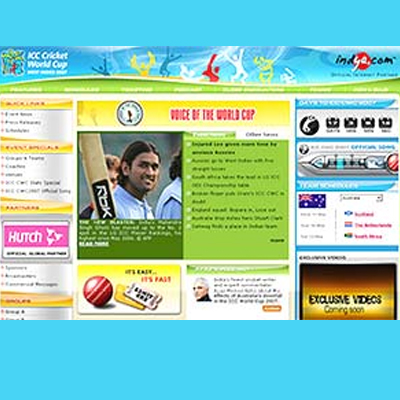
    With the cricket World Cup scheduled to kick off in less than a month’s time indya.com, which is running the official website www.cricketworldcup.com as the International Cricket Council’s (ICC) web partner, is starting to make a push.

    The site officially launches on Monday, 26 February.

    Information available with indiantelevision.com indicates that one presenting sponsor and four associate sponsors have been signed up so far for this year’s highlight cricket event.

    It was last year that Star inked a deal with the ICC to run its sites for the Champions Trophy and next month’s World Cup. Indya.com business head Sumant Kasliwal claims that its Champions Trophy site got three million unique users. In total there were over a billion hits, a lot of which, not surprisingly came from India. One million downloads took place and there were 100,000 registered users.

    For the Champions Trophy the site got 230 million page views. Kasliwal says that for the World Cup the site is expecting a billion page views during the event. “Our application Matchcast (which is a scorecard) has been expanded upon. It will be interactive. The aim is to give the consumer a complete experience. One can get match highlights, fall of wickets package, interactive contests. There will be live chat during the game. Users can comment on the state of the game. Our video content will include highlights from the previous World Cups. Other sites (as per the ICC diktat) are not allowed to show cricket videos.”

    Kasliwal also mentions another application – the Simulator. The visitor can view a graphical representation of what is happening ball by ball. He says that from a technological point of view it is a challenge. For each over two dozen parameters are taken into account. The recording takes place on the fly.

    There will also be expert analysis of each match. Prominent names are in the process of getting signed up. There will also be interviews with players and the captains. For the captains there is a section Captainspeak. Kasliwal says that it is in the process of tying up with speakers.

    It is also doing an interactive Voice Of the World Cup initiative. The contest kicks off next month. Here a clip of India’s match versus Pakistan in the previous World Cup is featured. Sachin basically hammers Shoaib. One can visit the section and provide a commentary recording. The winner who will be chosen by the public and a team of experts gets to do commentary for the semi finals and the final for the site.

    The site will also have a picture gallery courtesy gettyimages. For fun one can participate in games. One game that will shortly be launched is called Pick The Score. This is a prediction game and one has to guess scores. There will also be a fantasy game. Here one chooses a dream team for each match and one scores depending on how well the individual players are faring.

    The site will also have quizzes, an ICC contests suite. There will also be pages dedicated to teams and players, merchandise that can be ordered. In some countries like New Zealand, Hong Kong, Korea, Germany, France the site will offer for a fee live streaming of matches. In India highlights and the other earlier mentioned features will be given for free.

    GroupM COO South Asia Vikram Sakuja says that at first the agency was not sure how the product would turn out. However he is happy that for the Champions Trophy the site got a quarter of a billion page views. “I am glad that GroupM saw this potential and got some of our brands like Lufthansa to work with this exciting media offering.”
     

  • Lakshmi Narasimhan joins TV18; to head new venture

    Lakshmi Narasimhan joins TV18; to head new venture

    MUMBAI: Lakshmi Narasimhan, who recently resigned as national director for GroupM’s Central Trading Group (CTG), which is the centralized buying unit of all the agencies of GroupM, is joining Raghav Bahl’s TV18 as head of a new business venture.

    Narasimhan, who is still serving out his notice at GroupM, takes up his new assignment as of 1 March and will be reporting to TV-18 Media CEO Sai Kumar.

    No details were available about the nature of the new venture.

  • Disney and GroupM present ‘Disney’s KidSense’

    Disney and GroupM present ‘Disney’s KidSense’

    A strategic initiative to bring insights into the world of kids

    Mumbai, June 13, 2006: Disney, the world’s number one media brand and GroupM, the world’s leading full service media investment management company have joined hands to launch ‘Disney’s KidSense’ in India.

    KidSense is a strategic effort by Disney and GroupM to explore the world of kids and share insights with the media and marketing fraternity. This initiative includes annual research and periodic forums for deliberations and creating opportunities to understand the largest kids market in the world – India. This announcement was jointly made today, by Rajat Jain, Managing Director, The Walt Disney Company (India) and Ashutosh Srivastava, CEO, GroupM, South Asia.

    Disney’s KidSense will be the knowledge powerhouse for all stakeholders in the kids segment in the country. Using strategic insights gathered from research, opinions from childhood experts, media professionals, international learning and experience of the two giants, KidSense aims to fill the information need gap in the industry. As part of this initiative, KidSense today released its first two-part Research Study, which will provide a window into kids’ minds, interests, their behaviour, and influence on family purchase decisions.

    Rajat Jain, Managing Director, The Walt Disney Company (India) said “Kids have increasingly emerged as savvy, sensitive and an extremely important consumer segment today. As global leaders in this genre, it is our responsibility to understand kids and provide a knowledge-house for all the stakeholders. We believe that Disney’s KidSense would act as a credible reference-point for the industry, our business partners and help grow the business in this industry as a whole.”

    “This initiative with GroupM is an important step towards addressing the missing links into the external and internal realities of this genre. The four to fourteen age group is definitely one planet with multiple worlds. You can no longer treat them all as a homogenous group. The kids market in India is in a growth phase and marketers are interested in learning about this segment more than ever before. With Disney’s KidSense, we are beginning to equip ourselves to provide answers to most queries on kids”, he added.

    Ashutosh Srivastava, CEO, GroupM, South Asia said, “The association of GroupM with Disney is all about unlocking value in this growing market segment of young consumers. An important learning for all is that kids like to be spoken to in their own environment – their schools, their play areas, their homes and their shows. Disney’s KidSense shows new realities of influence from this genre on purchase decisions in categories ranging from confectionery to cars and insurance companies. The latest mantra for marketers should be – talk the kids language to enter their homes. With this association, we have created a solid information base to address planners’ needs for the genre.”

    The two parts of this elaborate research (quantitative and qualitative) were conducted and collated early this year by leading research firms – Indica Research Practices and Consulting and Third Eye across twelve markets in India. Over 4000 kids across the country were studied over a three month period to delve into their tastes, behaviour and influences on purchase decisions on 15 product categories ranging for confectioneries, commodities, FMCG, white goods, and services.

    KidSense also includes the perspective of caregivers to draw insights on the developmental, social and behavioral reality of Indian kids. For the first time in India, this study provides a detailed analysis of kids between the ages of 4-14 with segmentation that brings out a clear distinction between the 3 main groups – 4 to 5, 6 to 9 and 10 to 14. It offers a full section on kid-power, which covers 15 non traditional product categories and answers a broad spectrum of advertiser’s queries.

    About The Walt Disney Company:

    The Walt Disney Company, together with its subsidiaries and affiliates, is a diversified, international family entertainment and media enterprise which includes Walt Disney Parks and Resorts, The Walt Disney Studios, ABC, Inc., ESPN, Disney Channel, Toon Disney, Disney Consumer Products, television and radio stations and Internet web sites.

    About GroupM:

    GroupM, the world’s leading full service media investment management operation, includes MindShare, Mediaedge:cia, MediaCom and MAXUS. It has pioneered diversified services such as branded entertainment, data analytics, digital media, and brand activation. The focus of GroupM is the intelligent application of volume and scale in trading, innovation and quality of services, in order to bring benefit to clients and the companies it operates. GroupM believes that all communications planning begins with Consumer Insights.

    For Media Enquiries please contact:

    K. Seshasaye / Pooja Verma
    Walt Disney Television International (India)
    Tel: 5651 6630 / 6628
    Mob: 9820715609 / 9820139811
    pooja.verma@disney.com
    seshasaye.kanthamraju@disney.com

    Ameeta Sequeira / Khyati Parekh
    Corporate Voice|Weber Shandwick
    Tel: 2281 2960/ 2281 2957
    ameeta@corvoshandwick.co.in
    khyati@corvoshandwick.co.in