Tag: GroupM

  • Mindshare restructures South Asia leadership

    Mindshare restructures South Asia leadership

    MUMBAI: As part of its ongoing commitment to delivering adaptive planning and thinking, for clients and dynamic markets, Mindshare APAC has realigned its senior leadership in South Asia.


    Mindshare APAC chief client officer MA Parthasarathy has been named chief product officer for South Asia. In his new role, Parthasarathy will lead a community of communications strategy and analytics across ten Mindshare offices in South Asia.


    Ruchir Mathur, currently principal partner on the PepsiCo business has been appointed as leader for client leadership. Mathur will spearhead a range of ground-breaking activity with an experience of over ten years with Mindshare.


    Saket Sinha returns to the Mindshare family as principal partner leading rodeos and the east zone. In his previous role, Sinha was championing business in new geographies for GroupM, creating expansions for the network in several new markets.


    Sinha will report to Mathur and Mindshare South Asia CEO Prasanth Kumar for the east zone. Parthasarathy and Mathur will report into Kumar directly.


    Commenting on the re-alignment, Kumar said, “As pioneers in adaptive marketing, we are focused on creating a team that continues to open up more possibilities and set ourselves apart, with the capability to merge strategy with market intelligence. As we advise our clients to change mindsets that reflect in the communication they partake in, so does our commitment strengthen to ensure our best talent to service the brands we work with. Parthasarathy, Ruchi and Saket have always been an integral part of the Mindshare family. Each one of them brings their expertise to the table and I am confident that they will continue to take Mindshare to greater heights.”

  • Kinetic & GroupM acquire majority stake in French OOH company

    Kinetic & GroupM acquire majority stake in French OOH company

    MUMBAI: WPP’s wholly-owned operating companies, Kinetic and GroupM have agreed to acquire a majority stake in France based out-of-home (OOH) company Financiere Poster (Poster Conseil).

    Poster Conseil manages media planning and buying for agencies and direct clients, and provides planning and measurement technologies to both agencies and vendors.


    It employs 25 people and is based in Paris. 

    Poster Conseil will continue to be led by CEO Xavier Sorato. The agency’s consolidated revenues for the year ended 31 December, 2014 were EUR 9.8 million, with gross assets of EUR 8.5 million. 

    Tenthavenue, Kinetic’s parent company, develops and delivers content that aligns brand objectives with consumer needs in OOH and moving environments. The subsidiary companies of Tenthavenue provide comprehensive branding services in global in-flight entertainment, OOH media advertising, mobile marketing and digital publishing.
     

  • GroupM appoints Filip Jabbour as MENA CEO

    GroupM appoints Filip Jabbour as MENA CEO

    MUMBAI: In order to drive growth in the Middle East and North Africa (MENA), GroupM has appointed Filip Jabbour as CEO for the region.


    Based in Dubai, Jabbour will begin his new role from June and report to GroupM Europe, Middle East & North Africa CEO Dominic Grainger.


    In his new post, Jabbour will be responsible for developing GroupM’s strategy and accelerating the growth of its media agencies Mindshare, MEC, MediaCom, and BPG Maxus across the region.


    Jabbour will launch operations to leverage GroupM’s scale and accelerate development of media agency offerings with focus on developments in digital, technology, and data management, as well as partnerships with media, entertainment and sports rights owners to create additional value and drive advantages for clients.


    Jabbour joins GroupM from the US-based Spark where he was executive vice president and managing director. He was also previously with Starcom MediaVest Group as global business development director, where he spearheaded strategy with clients and drove new business internationally. He held leadership roles at Starcom since 2005, including being MENA CEO where he drove successful business across the region.


    “MENA is a diverse and dynamic region, with fantastic growth opportunities for our clients. Filip’s track record with blue chip clients, developing communications offers for the future and building relationships make him well suited to further develop and lead our regional operations. His experience, along with his strategic thinking and interest in developing an innovative future-facing business, make him an ideal cultural fit for GroupM and just the right leader to collaborate closely with our agencies to drive additional benefits and growth for our clients in the region,” said Grainger.


    Jabbour added, “The opportunity to join the world’s leading media investment management group to lead development in the exciting and fast-growing MENA market is thrilling. GroupM agencies operating in MENA are distinguished by their winning track records, and I am keen to help accelerate their pace by harnessing the absolute best digital, technology, data and content solutions available. I’m looking forward to integrating learning from work in the US and across global markets, with specific experiences developed by being part of the MENA region that has shaped my career for 18 years.” 

  • IPL 8: MSM rakes in Rs 1000+ crore in revenue

    IPL 8: MSM rakes in Rs 1000+ crore in revenue

    MUMBAI: After defeating Chennai Super Kings by a huge margin in the final of the Pepsi Indian Premier League (IPL) 2015, Mumbai Indians emerged as the champion for the second time! However, it’s not only the Reliance owned Mumbai Indians that is celebrating. IPL 2015 was also a champagne opener for Multi Screen Media (MSM), as the official broadcaster is speculated to earn an unprecedented Rs 1200 crore from the tourney.


    IPL 8 came in right after the ICC Cricket World Cup, which started with substantial performances from team India, which made brands go ballistic. Naysayers speculated that IPL might face the plight of brand’s fatigue. Also the Supreme Court intervention raised several questions over the integrity of the tournament.


    The speculations and controversies were anything but a hurdle for the progressive league feels a senior media expert. “This is the best IPL Sony has ever had since inception. They had Rs 1000 crore before the first ball was bowled. More brands associated with them and hence the inventory was packed. Hence the argument of fatigue and integrity was null and void. In fact, in my opinion, they raised more than Rs 1200 crore so IPL is here to stay and will grow bigger and better,” he said.


    However, a senior official from MSM says that the broadcaster fetched around Rs 1000 crore this IPL, which is on a ‘slightly’ conservative side from the speculated Rs 1200 crore figure!


    Not only in terms of brand engagements, IPL 2015 was a pioneer for cricketainment too, GroupM ESP national director Vinit Karnik told Indiantelevision.com, “This year I think we had the most number of last over finishes. In fact, the number of last three balls finishes was relatively high, quality of cricket was great and naturally the positive aspects reflected in the ratings, which were also higher than before. Overall, IPL just exhibited another year of exquisiteness and left a subtle answer who doubted the longevity of the tournament.”


    “IPL 2015 was an enlightening year, which sent a strong message about the coming generation of Indian cricket. Shreyas Iyer, Hardik Pandya, Pawan Negi showed their talent and that’s the beauty of IPL. This year, the experience was even better because five teams had opportunities till the last ball of the final league match was played and only two teams were declared eliminated before the last week of the tournament. So all this signifies that the tournament is becoming more unpredictable and competitive, which is exactly what cricket lovers want. This IPL is a step back for critics and forward for the tournament,” opined former first class cricketer and veteran cricket analyst Hemant Kenkre.


    MSM holds the rights to the IPL till 2017 until it goes under the hammer again. When asked if there are possibilities of an increase in the broadcasting rights of the tourney, when it comes up for bidding again, Karnik said, “I certainly think it will go up and by a significant margin because the ratings are going up and in two years, it will manage to reach more people, which will naturally add to the value.”


    New sporting leagues in the heart of India are establishing the nation’s vision on sports but all the mushrooming leagues are dependent on a solitary revenue source and that is advertising. The first edition of Indian Super League (ISL) succeeded to garner huge publicity and hence will be in the mind of brands and so will the soon to be played Pro Kabaddi League. With this, the revenue pie is no doubt getting distributed among various avenues.


    When queried if this division of pie could impact cricket and whether BCCI’s low revenue generation in the previous financial year was due to that, Karnik informed, “BCCI’s low revenue was due to lack of international cricket in domestic conditions and has nothing to do with emerging leagues. Cricket in the near future is unlikely to get effected by any other sporting event. The new leagues will find a new source and at the same time new brands will associate with cricket. At this point of time, there is no competition to cricket and events like IPL with safely prevail.”


    MSM, in association with BCCI, launched Fan Park initiative to bring IPL action closer to cities not hosting IPL matches and that venture also saw good success. Apart from that, the broadcaster took the multilingual feed route to target regional audiences but did not monetize it separately and went for similar inventory. However, rumours are rife that after garnering good ratings from the regional feeds, MSM may have different inventories for different feeds in the coming year.


    Overall it remains to be seen if this mix of new and old, cricket and entertainment, brands and viewership continues to propel and establish itself as a goose that laid the golden eggs for fans, broadcasters and BCCI. 

  • Splash eyes revenues of Rs 150 crore; plans 21 stores by year-end

    Splash eyes revenues of Rs 150 crore; plans 21 stores by year-end

    BENGALURU: The Landmark Group’s international youth oriented hi-street value fashion brand Splash is eyeing revenues of Rs 150 crore this year. The brand, closed last year with 12 stores across India and is planning to increase the count to 21 by the end of 2015.


    Additionally, company sources told Indiantelevision.com that Splash was also looking at spending more than five per cent of its revenues towards ATL and BTL activities.


    Splash has 200 stores globally, had revenues of Rs 90 crore last year across an average store count of eight in India.


    In 2015, the brand has already launched four new stores including one in Mumbai taking the count to 16. Now, Splash has unveiled its 17th store in the country in Bengaluru’s hi-street – Commercial Street, on 23 May. Next on the cards is a store launch in Noida in the near future.


    At the Bengaluru store opening, Splash also launched its new collection Love Summer.


    “Splash is consistently involved in delivering high fashion season after season. We are delighted to bring out the best of the brand’s personality and sync it with our new collection – #LoveSummer – this season’s key collection, which has an easy tropical vibe to it. Consumers have received the collection very well. It is young, tropical, quirky and conversational – a true reflection of our customer. With Splash’s launch at Commercial Street, we look forward to increase our reach to the fashion enthusiasts of Bangalore,” said Splash COO Kalyan Kumar.


    “Our ATL activities include bursts of radio a week either way of a new store opening or the launch of a new product line, with some print and online campaigns. We also do a number of BTL activities, like in the case of the store launch today, where we have the band ‘Peepal Tree’ performing at the store. A number of models wearing Splash attire that will along a part of Commercial Street before entering the store and walking the ramp set up for the fashion show organized by Sheetal Mehra,” Kumar added.


    “In the middle east, we are present on television and across many locations. In India, presently we are located in 10 cities. Once we reach a reasonably good store count in the country, we will use television as we do in other geographies,” informed Kumar.


    The average Splash store witnesses around 400 customer walk-ins daily, with an average conversion rate of 30 per cent. Some of the stores located in hi-streets and malls have a conversion rate that is as high as 38 per cent, while the laggards report rates of around 24- 26 per cent.


    Splash’s online campaigns cover the usual social sites such as Facebook, Twitter, Instagram and Youtube. Mindshift along with the company manages the online creative duties for the Splash, while media buying is done by the parent group Landmark through GroupM.

  • Melting to a fabulous show

    Melting to a fabulous show

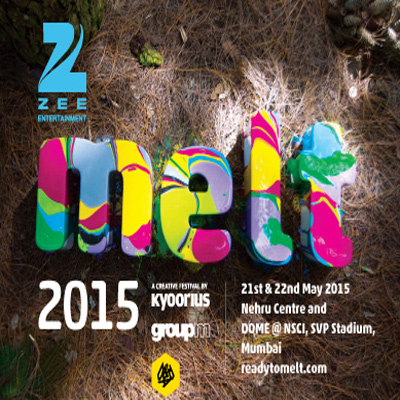
    MUMBAI: After literally ‘Melting’ for two days with sessions going around at all times, Zee Melt 2015 in association with GroupM was a resounding success. Speakers from across the globe flew down to address audiences with their expertise.


    Not only that, the event was trending on Twitter on day one. With agencies having workshops and stalls to showcase their work to the masses, Zee Melt 2015 was possibly one of the most memorable events in town.


    The two day festival of creativity in advertising and marketing created by Kyoorius in partnership with Zee, GroupM and D&AD offered delegates a plethora of choices of events, such as workshops, seminars, showcases and the main conference.


    Kinetic Future Citizens was centred around understanding the consumers of the future – their needs, wants and behaviours. Kinetic Future Citizens engaged the delegates with a different experience. The concept was simple. One had to pedal a cycle and the animation on the TV would start playing. A technology, which understands the future of consumers and the environment. 


    Meanwhile, Happy Finish created a lot of buzz with its augmented reality experience. It made delegates enter the virtual world in their world and do many things like bring a car alive when it is actually not present. 


    Metalworks by Maxus, on one hand, through its Provolv Cricket wearable technology kit gave delegates a player performance cricket match experience, while Mindshare had an interactive marketing Purple Box and Loop Room.


    The industry appreciated the work and initiatives taken at Zee Melt 2015. Here is a look at what some of them had to say:


    Madison World chairman Sam Balsara tells Indiantelevision.com, “I could not attend much of the sessions, but I did attend Martin Sorrell’s and it was a great one. The initiative is a good one and in the near future more and more such events are likely to emerge. It was a fabulous show and I look forward to more years of Melt 2015.”


    Ogilvy & Mather former ECD Abhijit Awasthi summed it up in two words – “It’s fabulous.”
     

    BBDO India chief creative officer Josy Paul said, “I enjoyed the MELT experience. I attended some of the seminars on Day one and the awards night on Day two. I thought the turnout and energy was fantastic. Great idea to have it at the Nehru centre. Never realized the place had so many auditoriums and seminar rooms. This created an integrated well knit feeling. It also helped that the location was close to our office.”

    He adds, “The teams from our office who attended both the days were singing praises of the workshops.They are keen to cascade their learning to the rest of the office. Congratulations to the organizers for bringing together such a diverse set of speakers across so many different disciplines and fields of communication and technology. What’s great is that these new influences are people, ideas and actions that we are not exposed to sitting in our offices. So the interactions were most rewarding.”

    Advertising Club chief operating officer Bipin Pandit said, “We are eventually from the same fraternity and it was a good initiative.”

  • IAA Debate: Will mobile take over TV as primary screen three years from now?

    IAA Debate: Will mobile take over TV as primary screen three years from now?

    MUMBAI: With mobile proliferation in the country and the advent of 4G, the big question remains whether mobile will be the primary screen for news and entertainment in India in three to four years from now?


    At Melt 2015, the Indian Advertising Association (IAA) organised a riveting debate on the same with a panel comprising Times Now editor in chief Arnab Goswami and The Hindu MD and CEO Rajiv Lochan, who teamed up to debate against the motion, whereas Madison Media group CEO Vikram Sakhuja and The Quint.com founder and seasoned entrepreneur Raghav Bahl argued for the motion.


    ET Now journalist Sonali Krishna moderated the debate. The audience, which comprised the who’s who of the media, advertising and marketing industry, was the ultimate judge of the debate.


    All four participating members were given seven minutes to put forth their argument. Sakhuja kick started the debate by basing his argument on the power and features of a smart phone and also the connection that the device has built with consumers in recent years. He was of the opinion that the mobile is something that a person picks up the first thing in the morning and puts down the last at night. The prime connect of Sakhuja’s piece was when he asked people in the audience who had a mobile to raise their hand. Of course, it came as no surprise that the entire hall put their hand up.


    However, that aside, his opponents also made sensible rebuttals to portray counter arguments. The prime base of Sakhuja’s argument was the ability of mobile phones and how it enables consumer to consume content while in motion.


    Goswami, who in his inimitable style kept putting counter facts and figures in between Sakhuja’s speech initially, took to the floor by basing his piece on the reach and accessibility of television as opposed to the limitations of the mobile phone. Goswami said that the hands that went up when asked if they had a mobile phone, do not represent the entire country and there are people beyond them too who have limited access to smartphones and high speed internet.


    Goswami also focused on the affordability quotient and how by paying certain sum of money, an entire house consisting multiple members can enjoy action on television while the investment is way more when it comes to consumption of content on mobile phones, which is less mass and hence gets lesser reach or viewership as compared to television.


    Though Goswami’s opponents made numerous attempts to break him by interrupting and putting forth questions, as always he was least deflected and managed to put way more in justifying his stand.


    Giving a pass to the mumbo jumbo of statistics, Bahl justified his stand by speaking about consumer behavior and how it can change drastically within a short span of time. He stated the example of mobile phone and the high initial rates associated with it, which in turn placed it as a product for the elite class and totally irrelevant to the middleclass or lower middle class. However, in a short span during 2001 to 2005 everything changed drastically and now a vegetable vendor sits with his cart and sends the vegetable price to consumers over mobile phone using Whatsapp. Many in the audience appreciated Bahl’s arguments and examples as the foundation of his argument was that statistics are derived from past occurrences and hence predicting the duration required to bring a change in consumer behavior on the basis of available statistics cannot be justified.


    Not missing the chance even once, Goswami and Lochan interrupted him at numerous occasions. However, one such instance turned into a light banter between Goswami and Bahl, which got the audience on the edge of their seats. Bahl, during his speech, mentioned, “News is consumed in bits and bytes,” to which Goswami countered by saying, “I run a two hour long news show, which cannot be called as bits and bytes and is widely watched.” Bahl immediately launched the direct war by saying, “The show you run is not news but opinion.” Not letting Bahl continue with his point, Goswami retaliated by saying, “Raghav, you launched a news channel, which never managed to get half my ratings.”


    However, before things could go out of control, Krishna interjected and called for the debate to go on smoothly.


    Adding more substance to the few points already made by Goswami, Lochan also touched upon the qualitative aspect and his major issues were poor available infrastructure, which is in a buffering mode. He also made a point on the basis of health issues and stated mobile phones are a hazard to health and hence there are possibilities of people refraining from using the device.


    Once the four speakers had put forth their points, in the concluding statements they acknowledged all the arguments put forward.


    A message that Goswami repeatedly tried to convey through his comments, which were directed towards Sakhuja – a media planning and buying representative, was that Sakhuja was standing on the wrong side and should make a shift. The message was not only directed at Sakhuja but was an indirect attempt to convey that television is still the primary screen and advertisers should rate them undisputedly.


    After rounds of arguments and counter arguments there was no clear winner that was depicted through audience reaction. However, IAA president Srinivasan Swamy declared Goswami and Lochan as the winners of the debate, which was considered as the official verdict.

  • Mindshare to present adaptive marketing at Melt 2015

    Mindshare to present adaptive marketing at Melt 2015

    MUMBAI: This Melt, GroupM’s flagship agency Mindshare will bring alive the concept of real time planning adaptive marketing through The Loop and Purple Box as a part of GroupM FutureReady hall.


    Fitting in perfectly with Melt’s theme – a festival of creativity will take participants through an experience of adaptive marketing with a live campaign and contest. The Mindshare zone revolves around their core philosophy of Original Thinking Framework.


    The experience will be demonstrated in the loop room in the Mindshare zone. The Loop is not just another technological interface but rather a way of life for all at Mindshare. It will effectively break down all silos and bring all key stakeholders into one single room – creative, media, social, digital, content and production.


    Adaptive marketing enables the shift of media spends to leverage opportunities uncovered by real time data and provides actionable insights that can be executed instantly. The Loop is also used to track competitor efforts in paid, owned and earned media, as well as providing intelligence on trending and viral news and content.


    The Loop @Melt – Mindshare will integrate live contests and track real time influencers at Melt 2015. Participants will be engaged through the two days by fuelling creative thinking and conversations around Melt through the Loop.


    On the other hand, the Purple Box is a creative manifestation of adaptive marketing solutions. Created exclusively for Melt, Mindshare Purple Box will demonstrate various consumer archetypes in an interesting visual format. Participants will be able to choose from a consumer ‘avatar’ and look deeper into some of their passion points, while we convert them into communication opportunities.


    Mindshare south Asia CEO Prasanth Kumar said, “Driven with the core values of speed, provocation and teamwork, Mindshare is not only working in an adaptive marketing environment, but also defining this environment. With The Loop philosophy we understand that content and messaging is fluid and continuous, and our frameworks demonstrate the agility and responsiveness of a collaborative decision making process for brands. At Melt, one can see a live demonstration of this framework at the Loop Room, as well as how adaptive marketing looks from a consumer’s perspective with Purple Box.”


    The Mindshare experience will be live from 10 am to 5 pm on 21 and 22 May at Zee Melt 2015 in GroupM FutureReady zone at Nehru Centre in Worli, Mumbai.

  • Broadcasters, cable cos, distributors form new Video Advertising Bureau

    Broadcasters, cable cos, distributors form new Video Advertising Bureau

    MUMBAI: The Cable television Advertising Bureau (CAB) has paved the way for the Video Advertising Bureau (VAB).


    CAB, which was founded in 1980, has dissolved and been replaced by VAB comprising 110 broadcast and cable networks and the 11 multichannel video programming distributors (MVPDs) to form a single voice to promote the power of video advertising.


    The VAB’s goal in uniting nearly all broadcast and cable networks with MVPDs is to raise the bar on research, data and analytics, and expand the market for advertising in professionally produced video content.


    “Our industry is changing rapidly, however one constant is the unquestionable power of television to reach consumers with advertiser messaging. By broadcasters, cable networks and distributors coming together in this unprecedented way, VAB members will share expertise and insights, put forward original research and push toward a common goal of elevating television’s leadership in driving product sales and brand affinity for clients,” said Discovery Communications ad sales president and inaugural VAB co-chair Joe Abruzzese.


    VAB members produce and sell the overwhelming majority of video content, and likewise command the vast majority share of viewer attention. This attention advantage manifests across all screens – TV, desktop, laptop, tablet and smartphone – totaling 80 per cent (140 hours) of the 175 hours/month Americans devote to the universe of ad-supported TV, Google/YouTube, AOL, MSN, Yahoo and Facebook.


    “The time has come for the TV industry to be represented holistically with the power of the content superseding the differences in distribution. This will clearly advance the share of voice for the industry and support the initiatives that will provide incremental value to advertisers as technology, data and consumer choice change the dynamics of the medium,” said Group M chief investment officer Rino Scanzoni.


    The VAB’s top priority is commissioning research on two levels – quantifying the primary role that ad-supported TV plays in generating consumer sales traffic, and clarifying attribution in the modern media mix.


    “We are proud to work alongside our expanded membership of broadcasters and cable networks at the Video Advertising Bureau to expand the thought leadership on best practices and insights for marketers. Our collective goal is to help our clients make stronger connections with consumers where they watch, when they watch, and on any device,” added Time Warner Cable Media EVP and COO and inaugural VAB co-chair Joan Gillman.


    Content over distribution


    VAB members are creating the next ways for advertisers to capitalize on the attention advantage, from data platforms to addressable TV advertising. In unison, the innovations can refine the state of the art of video advertising.


    “There is no substitute for quality content in the presence of valuable data and insights. It only makes sense to expand this organization’s focus to reflect the rapidly changing premium video environment and strengthen the research it can provide to content creators and advertisers regardless of platform — it doesn’t matter where the content is consumed, it only matters that it’s great,” said NBCUniversal chairman, advertising sales and client partnerships Linda Yaccarino.


    The more ways viewers can get video, the more they continue to choose premium TV content. According to researcher GfK’s 2014 UK-US SVOD study, TV content accounts for 88 per cent of all streaming activity in the US.


    “The media landscape is changing rapidly but one thing remains a constant: premium TV content is still the most powerful environment for advertisers. We are committed to helping our clients leverage this content effectively across multiple screens, and are pleased to be joining other broadcast and cable networks in this important initiative” said CBS Television Network president, network sales Jo Ann Ross.


    Cross-screen commitment


    Leading the VAB will be the executive team that has run CAB for the past 12 years, during which time cable ad revenues have grown by 80 per cent. Sean Cunningham will be president & CEO; Chuck Thompson will be EVP, whereas Danielle DeLauro will be SVP strategic sales insights. Together they will give advertisers one source for the best research, insight and perspective on video advertising. Importantly, this will include new primary research on the impact of TV advertising.


    Cunningham said, “More than ever, consumers are tuning in to premium, multiscreen TV content – at a moment’s notice, at arm’s-length, on the best available screen. Advertisers instinctively know this world-class video initiates the sales cycle. The VAB will lead the charge to prove it.”


    “We congratulate the CAB and the broadcast community as they converge to become the VAB. Multi-screen TV content is among marketers’ most important assets. The creation and evolution of the VAB will further marketers’ sophistication, insights and understanding of these assets as they seek to improve their marketing and media management and more successfully build their brands and business results,” said Association of National Advertisers president Bob Liodice.