Tag: GroupM

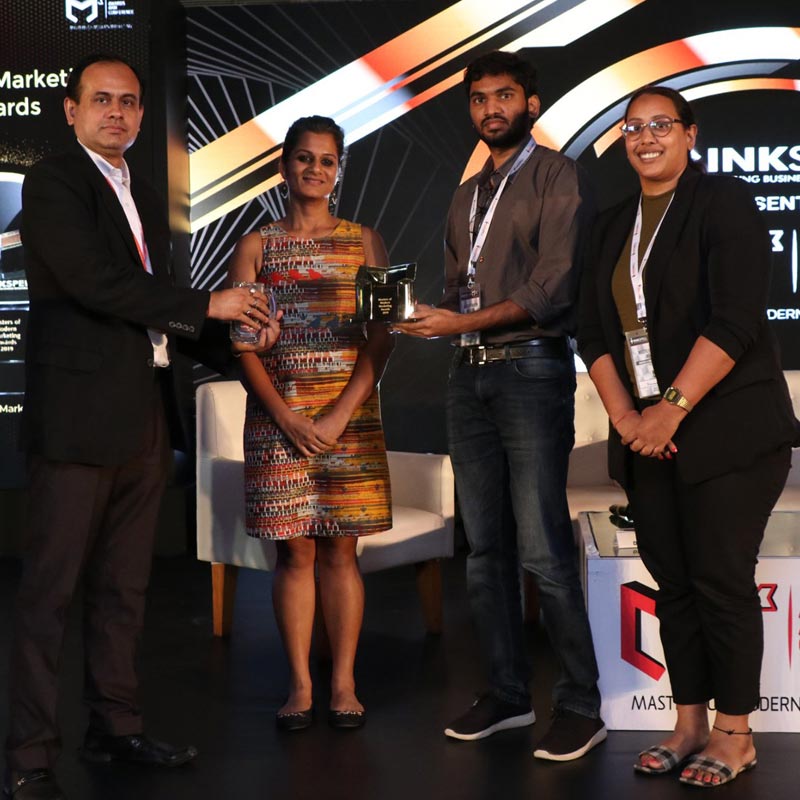
  • Vote the Hell, a collaborative content piece between GroupM’s motion content group and Dish TV wins at mCube media awards

    Vote the Hell, a collaborative content piece between GroupM’s motion content group and Dish TV wins at mCube media awards

    MUMBAI: ‘’Vote the Hell’’, Motion Content Group and Dish TV India’s comedy show, in association with Friday Code Private Limited, won the mCube Media Awards 2019, the premier digital marketing awards in India, in the Best Content in an Influencer Marketing Campaign – (Best Co-created Video Content Series) category.

    The award ceremony took place on July 12 in Mumbai with the who’s who of the marketing world in attendance.

    “Vote the Hell” is India’s one of a kind comedy show on elections showcasing the lighter side of the most heavily discussed topic in India. The series features 7 popular comedians from the country – Ankita Shrivastav, Abijit Ganguly, Jeeveshu Aluwalia, Sundeep Sharma, Ravi Gupta, Bullet Bhaskar and RJ Vignesh. The show is available exclusively on the Dish TV owned Watcho app and can be accessed in 3 languages – Hindi, Tamil and Telugu.

    Sudip Sanyal, Business Head, MCG India says, “Truly, Laughter is the Best Medicine. Through our association with Dish Tv on ‘Vote the Hell’, a step towards being recognized as a credible content provider was taken, and this award is a validation of this effort. We are truly appreciative of this partnership and the trust shown by Dish TV and sincerely hope that this is the start of many more such recognitions. As promised, we at Motion Content Group India will continue to produce and partner with the best in the business, to create quality content and keep the audience hooked onto platforms across genres.”

  • Idea promotes video calling feature in new ad

    Idea promotes video calling feature in new ad

    MUMBAI: Mindshare, India’s largest full-service media agency and part of GroupM, launched a unique interactive campaign with Mallika Dua – a renowned comedian and social media influencer, as part of Idea 4G #IndiaKaLiveNetwork initiative. The campaign is an attempt to bring alive the experience of video calling with a renowned celebrity in real time.

    Building on the brand’s tagline of ‘India Ka Live Network’, Idea 4G Live leveraged the power of video calls in an attempt to create awareness about common misdoings of people and encourage them to change their behaviour.

    Mindshare and Idea 4G unveiled a distinctive voice-enabled AI led interactive video chat bot ad campaign that enabled millions of users to interview Dua.  This has never been attempted before in the digital mobile ad-space and was co-created by mCanvas, the experiential storytelling ad platform for small screens. The tool allows users to interact with Dua, and ask her questions ranging from personal trivia to the benefits of Idea 4G network and the power of live videos by simply tapping on the mic icon. Trending questions are also prompted at the bottom of the screen which the user can scroll through and ask Dua. The innovation is done through live media banners placed on popular websites, which can be accessed through mobile phone browsers.

    The experience is designed to be seamless and resemble a live video call with the user's own face seen on the screen. This experience can last for as long as the user has questions to ask and also allows users to ‘Get Idea’ in just a few clicks.

    The innovation uses Artificial Intelligence (AI) where the ad creative listens to user questions in English & Hindi and uses Machine Learning (ML) to analyse all the questions asked by previous users and increase the accuracy of the responses. For example, if a user asks a question in Hinglish, the AI detects that it contains English and Hindi. Next, the ML helps accurately assign a relevant answer to that question.

    The campaign is live on several media and news websites and has already seen engagement from over 7.2 million users. The campaign is witnessing about eight times higher than the average mobile-banner click-through rate. Interactions with this creative have also been found to last for an average of 22 seconds, with some users spending over 10 minutes.

    Speaking about the launch of the campaign, Mindshare India national head – mobile Niraj Ruparel said, “We at Mindshare always look forward to crafting innovative and effective solutions for brands. Idea, as a brand, does not shy away from taking an unconventional path when it comes to communication. With the video-chat bot ad we have come together to create a first of its kind innovation on an effective platform. By leveraging on Mallika Dua’s popularity, and Idea’s 4G network, we are hopeful of bringing about a change in people’s behaviour, and habits, as well as encourage more people to go Live to highlight societal issues.”

    Vodafone Idea Ltd president marketing Sunita Bangard said, “Over the years, brand Idea has built a strong reputation for creating purposeful, conscientious campaigns that encourage change for the betterment of society. The Idea 4G #IndiaKaLiveNetwork campaign highlighted the power of streaming LIVE videos over Idea’s robust 4G network thereby driving a positive change in behaviour among citizens. In its endeavor to engage with the digital natives, Brand Idea has always tried digital-first initiatives for our ATL campaigns, many of which have been appreciated and rewarded at various digital forums. Our innovative AI-and ML-aided campaign has set new benchmarks in digital advertising.”

  • Pre-school kids content’s monetisation and viewership challenges

    Pre-school kids content’s monetisation and viewership challenges

    MUMBAI: Animators have long contemplated the complexity of producing pre-school content for the ages of two to four years. On the third day of FICCI Frames 2019, executives from the industry spoke about ‘Catching youngest viewers: Powering the kids network and advertisers ecosystem through data’. It had panellists BARC India senior VP business development partnerships Elbert D’silva, Sony Yay head programming Ronojoy Chakraborty, DDB Mudra Group executive director Sathyamurthy Namakkal, GroupM business head entertainment, sports and live events Vinit Karnik, Viacom18 head content kids TV network Anu Sikka and Graphiti multimedia co-founder Mujal Shroff. The session was moderated by Punaryug Artvision founder Ashish Kulkarni.

    Sikka threw the limelight over the issue that the industry had been facing since the start and the reason why the kids genre is under-indexed. She said that at first it was a question of finance and so the industry depended on acquired content and later realised the need to produce home-grown content. Parents also exert some control over what the kid watches. A kid may have no issue with Dora being Indian or not, but it is the parents who demand local content. They would want their kids to watch localised content. “Kids from age five demand local content, but in case of kids from the age group of 0-2, the parents are the gatekeepers,” she concluded.  

    She further added that now is the time that we need to cater to specialised content. “If you look at our Nick Jr. channel, it has grown three to four times this year. But unfortunately, if you look at the overall programming, we don’t get viewership of the two to fourteen years age group. And that is why there is a lack of pre-schooling content,” she said.

    On the other hand, Shroff said that there is also a placement issue. He said, “If you look at the viewing pattern, as the child evolves these days, it is on multiple devices. But some age groups still prefer TV.” Kids aged 5-6 or 9-10 tend to consume content on their parents mobile phones or any other device but a 2-year-old kid still watches TV.

    Chakraborty explained that pre-school programming is only justified if it can be monetised. “If you look at our category, one-fourth share is GECs but the revenue share for kids category is one-tenth. Hence the revenue here is very less and therefore, broadcasters are not creating content,” he said. If BARC were to provide some viewership cuts for the pre-school audience rather than keep it as a part of the entire kids genre, broadcasters will be able to curate better content.

    Agreeing with him, Karnik said that it would be difficult to strategise programming for the pre-schooling kids as the category as a whole is under-indexed in terms of advertising. Despite witnessing a hike in ratings, revenues are increasing at a snail’s pace.

    Namakkal chipped in with a different standpoint. He said that the industry shouldn’t get greedy about data because there is already information overload. “One-third of kids consume one and a half hours of video on TV screens. But while we talk about advertising revenue, it will never be equal to viewership share,” he explained.

  • TRAI tariff order’s impact on advertising expenditure on regional channels

    TRAI tariff order’s impact on advertising expenditure on regional channels

    MUMBAI: While TV still remains the primary avenue for major brands to break their bank on advertising expenditure (adex), digital is slowly but surely capturing a bigger slice of that pie. According to the FICCI KPMG 2018 report, adex on Hindi GECs saw a decline of nine per cent in FY18 while regional channels witnessed an increase of 5.4 per cent. The new tariff order is likely to ensure that trend continues in FY19 as well, industry experts feel.

    Carat India SVP Mayank Bhatnagar said that new tariff regime will not impact the adex on an immediate basis but depending on the viewership patterns, advertising deals or strategy would be recalibrated by brand managers. Likewise, Enterr10 Fakt Marathi MD Shirish Pattanshetty was of the opinion that overall advertising spends are likely to grow this year with general elections, IPL and the cricket World Cup. He stated that the regional language market is likely to grow in double digits.

    As per industry reports, ad spends grew 17-18 per cent on FTA channels in 2018 as compared to 10 per cent in 2017, the lowest in five years. TV is expected to be the lead medium as far as reach is concerned for the next three years, with the FMCG category being the highest contributor when it comes to TV ad spends.

    Dishum Broadcasting COO Partha Dey believes that the consumption pattern of genres won’t change but the new regulatory framework could compel some viewers to opt for free or cheaper channels.

    Stratagem Media founder director Sundeep Nagpal, however, contradicted Dey by stating that this trend had nothing to do with the new tariff order. 

    “The new tariff order would, in a way, be less detrimental for regional channels than for national channels,” he explained. 

    HBC founder Harish Bijoor felt that the decline in the adex will be greater for regional channels post the implementation of the new tariff norms.

    Now that over the top (OTT) platforms have already entered the race, the industry predicts that both TV and OTT will work together in the long run. Ad spends on TV and digital stand at 45 per cent and 15 per cent respectively and the latter is expected to take bigger strides in the near future. Total ad pie for TV and OTT will rise from the current 60 per cent to 80 per cent in the next three to four years.

    The CEO of a major production house pointed out that ad spends on digital media have been growing upwards of 30 per cent in the last five years and that trend is set to continue.

    “Having said so, the traditional media including TV will also continue to grow making India the most distinct big market in the world,” he said.

    “I have been hearing the regional content conversation for the last eight years. There is every proof that the regional market is critical, fast-growing and is getting more and more localised.  The power of regional will only go up,” he highlighted. 

    According to him, this is not a new trend as it is opening up dramatically in the OTT space as well. 

    “Each language will gain maturity from the point of view of revenue catchment because along with creating value, you also need a strategy to capture value,” he added.

    With DPOs trying hard to migrate subscribers to the new system, TRAI has given customers time till 31 March 2019 to make their new channel selections. 

    Even the BARC ratings have not been released to the public till there is some stability in viewership. 

    While the industry remains divided on the impact of the tariff order on adex, a clearer picture will emerge once the dust settles.

  • ESP Properties: Sports and entertainment trends 2019

    ESP Properties: Sports and entertainment trends 2019

    MUMBAI: ESP Properties, GroupM’s sports and entertainment marketing agency announced its Top Sports and Entertainment Trends for 2019 on 26 February 2019.

    ESP Properties India business head Vinit Karnik said, “2019 will be a year for sports and entertainment. With Cricket on our minds for more than half the year, brands would want to revolve their game around the sport and the athletes. While e-sports is also becoming big, it has come a long way, and it is only expected to get bigger. With almost 20 per cent of share of spend expected in digital, ad spends in sports and entertainment marketing is expected to grow and evolve.”

    Cricket to dominate media and mind measures in 2019

    Cricket is in full swing in H1 2019 with Team India moving bases from Australia to New Zealand post the ODI series and following it up with hosting Australia in February to play ODI’s & T20’s. Then comes Vivo IPL and ICC Cricket World Cup, making Virat Kohli and his boys the talk of the town for the first six months in 2019 and literally monopolizing consumer eyeballs and advertising money. 2019 will break all records of cricket consumption on TV and Digital. With the ICC World Cup in England & Wales and considering our love for London, Indians will break all worldwide records of traveling overseas to watch sports and boost the sports tourism economy. With such a start to the year dominated by cricket, emerging leagues may have to reset themselves to make their presence felt and stay relevant.

    Embrace the athlete, embrace their stories

    One of the biggest marketing trends of this year is storytelling and we expect talent to unlock maximum value in 2019. Sporting landscape, led by cricket, will see the true value of talent beyond the top cricketers being unlocked. Audiences not only want to be taken on a journey, but they also want to connect with brands. Brands which can use Athlete and their storytelling power will garner massive interest from fans and advertisers owing to mass media exposure via TV and one-to-one engagement through social communities, rediscovering their true value. Federations and leagues will carefully evaluate talent contracts in terms of talent usage rights for self, sponsor activation and scope of the engagement. With social media becoming the primary engagement platform, the right balance between personal and public imagery will be most talked and debated in 2019. One can’t rule out a policy for talent on national duty for social media engagements and media appearances. This space will be super exciting in 2019, hence watch this space closely…

    Definition of ‘sellable’ content to be rejigged by newer monetization models

    Experimental content is facing challenges to release in large scale formats like cinemas. With newer digital platform and content taking center stage, storing telling will be redefined with a lot of experimentation and fresh feel. For example, content series like Lust Stories and Love, Per Square Foot has managed to harvest a completely new group of audience via digital only release. This trend is expected to continue with many more such content prices seeing a ray of hope to see the light of day.

    Broadcasting platforms to lean on data-driven insights and player access to engage and build fans

    While traditional broadcast passed on Gold Standards of Content from linear to non-linear platforms, best practices in Consumer Engagement will move from non-linear to linear platforms. For example, Watch ‘n’ Play on Hotstar during Vivo IPL 2018 has redefined Consumer Engagement norms for the traditional linear broadcaster(s) to follow. Moreover, increasing insistence on player access as a ‘Sponsorship Right’ in the sporting ecosystem is bound to blur lines of personal endorsements. With professional sporting ecosystem in India being over a decade old, advertisers have started looking at ‘Sponsorship’ as a one-stop solution to media exposure and talent access.

    Mobile Gaming to take center stage in the competitive CPU dominant Professional E-Sports World

    Globally, professional E-sport competitions are primarily held on a computer and consoles and mobiles take a backseat. In India, we’re witnessing a different trend where tournaments being held on the mobile, courtesy – PUBG on mobile with DAU of approx. 10mn+ which is more than any other game in the world across any platform is already giving gamers in India almost half the prize money of an E-Sports League India and this is only going to further grow. There will be so many more mobile E-Sport tournaments which will be seen in the coming future.

  • GroupM consolidates commercial data benchmarking with COMvergence

    GroupM consolidates commercial data benchmarking with COMvergence

    MUMBAI: GroupM, WPP’s global media investment group, has announced that it is consolidating the reporting and analysis of its commercial and business development data with COMvergence. COMvergence is an independent, international research company collecting and analysing data from the global marketing services groups, and the marketplace, to provide quarterly reports and more accurate benchmarks for the scale of media agencies’ client billings.

    GroupM has worked with COMvergence as a data source for more than three years, each year adding additional markets in a progressive push to consolidate its data reporting with the most accurate resource available. Per the terms of the new global agreement, COMvergence will ensure the accuracy of its methodologies and reporting with annual third-party auditing by an accredited auditing firm.

    Global chief growth officer Elizabeth McCune said, “COMvergence has taken an open approach to building its methodology and partnerships for data collection and tabulation, giving us the confidence that when we share data from their benchmark reports to clients and their pitch consultants, it is the most accurate and validated view of the size and scope of our business and competitive set across the globe. Our industry truly needs a focus on accuracy and transparency in this area.

    According to COMvergence’s most recent global billings and market share reports, GroupM is the number one media investment group for 2018, with $45 billion of cumulative billings and 28.8 percent market share (based on the total billings for the big 6 groups). In addition, three of GroupM’s agencies – Mindshare, Wavemaker and MediaCom – are in the top 10 rankings for global media agencies.

    Feeding COMvergence’s analysis and reports are data from independent, third-parties like Kantar and Nielsen, as well as other research firms, agency performance evaluation companies, and financial analysts. COMvergence also tracks and digests information from the most reliable and respected international and local trade press titles, as well as industry associations including the World Federation of Advertisers (WFA) and the American Association of Advertising Agencies (4As). These strategic alliances are critical to deliver unparalleled research products, market analysis and methodologies. COMvergence also conducts face-to-face meetings and proprietary surveys with CMOs and advertising and procurement directors from the top 100 international advertisers.

    COMvergence founder Olivier Gauthier said, “GroupM has been an extraordinary client partner. They, along with the major holding company media groups, have worked with COMvergence since our founding to develop accurate methodologies and a collection of local and global reports that provide true insight into agencies and their performance across the globe. COMvergence stands behind the veracity of our data, and we promise annual audits to provide our clients and the marketplace at-large with utmost confidence in our data and analysis.”

  • GroupM announces new leadership structure for South Asia team and Mindshare

    GroupM announces new leadership structure for South Asia team and Mindshare

    MUMBAI: GroupM South Asia announced a restructuring in its leadership, to continue delivering the advantages of global operations and learnings with local expertise and sharp market insights.                      

    Effective immediately, Prasanth Kumar is named chief operating officer, South Asia, and Tushar Vyas is named president growth and transformation, South Asia, the brand new roles in the organisation.

    In addition, Parthasarathy Mandayam is named Mindshare’s CEO for South Asia and Amin Lakhani is named Mindshare’s chief operating officer in South Asia.

    Prasanth Kumar, who was handling the post of Mindshare CEO till now, will now be responsible for operational excellence of GroupM and will lead the teams across OpCos, trading and specialised units.

    Tushar Vyas, who was responsible for the launch of digital media agency business unit (interaction) for GroupM India, in his new role will drive digital transformation and focus on building GroupM capability focusing on digital, data, analytics and content.  

    Speaking on the new appointments, GroupM South Asia CEO Sam Singh said, “Prasanth and Tushar are passionate leaders with high integrity and proven ability to envision and deliver successful outcomes in a challenging environment. As we become a more data-centric organisation, there is a need to drive transformation and build future capabilities with a focus on digital, data, analytics, and content. We must work across GroupM to drive organisational transformation and operational excellence. The new team structure is another step in this direction.”

    He added, “I am also sad to announce that Lakshmi Narasimhan our chief growth officer for GroupM South Asia has decided to step down from his current role effective 31 January 2019, to pursue personal interests. I thank him for his contributions over the years and wish him all the best. We will miss him as we continue to build upon his hard work and passion. Lakshmi was instrumental in building our strong trading community with solid practices”.

    Parthasarathy Mandayam will take over the role of chief executive officer (CEO) of Mindshare, South Asia from Prasanth, effective 1 February 2019.  He has spent 10+ years with Mindshare in various leadership roles – data, insights, analytics, strategy, client leadership and business unit leadership. He will report into Sam Singh, CEO GroupM, South Asia, Prasanth Kumar – COO – GroupM South Asia and Amrita Randhawa, CEO Mindshare Asia Pacific.

    Going forward, Amin Lakhani will take on the role of chief operating officer (COO) for Mindshare South Asia. Amin has over 20 years’ experience in various roles in Mindshare and GroupM and is currently leading client leadership at Mindshare.

    Talking on the latest developments, the new GroupM COO Prasanth Kumar said, “Our industry is an ever-mutating one, so we have to also continue to evolve and adapt. With Maps and Amin now at the helm of Mindshare, we have leaders with a proven track record of consistently achieving clients’ business goals. They will continue cultivating client relationships at the highest level and delivering great results.”

  • What were the merger trends for marketing in 2018?

    What were the merger trends for marketing in 2018?

    MUMBAI: The year 2018 will be known for a lot of things. It has been one of the most imperative years for the advertising and media industry. This year broke shackles and ideologies of how people traditionally perceived the industry. I think it is safe to say that the marketing books hereon will have a dedicated page for everything that occurred in 2018.

    I am optimistic about 2018 being one of the best years for A&M industry (so far). Why, you ask? Because this has been one of the most momentous year for mergers and acquisitions. While news about mergers came in from all sectors of the media, the A&M world tasted its first big bite of consolidation this year.

    We’ve all read and heard about the four extensive types of mergers, but it was only in 2018 where we witnessed all of them! The traditional case of two big networks (agencies) coming together, big agencies merging their businesses with small agencies, two small agencies coming together to take on big network agencies, and the most recent trend: consultancy firms opening agencies or merging with one.

    Let’s start with the advertising giant WPP, where we saw a lot of action happen this year. One of the bigger mergers this year happened within the WPP group, where Wunderman and J. Walter Thompson were united to form Wunderman Thompson. The merger will help the group as Wunderman and J. Walter Thompson share many core clients, who will now have simpler access to the expertise of both agencies. Additionally, WPP’s GroupM, the leading global media investment group acquired an Indian digital agency, The Glitch. With this acquisition, The Glitch continues to work as an independently positioned brand, while taking advantage of GroupM’s larger infrastructure and ecosystem. 

    With a promise to simplify the business, WPP’s Chief Executive Officer merged one of its largest agencies, Y&R with VML, that left the ad industry gasping for breath. The disappearance of the 95-year-old Y&R brand, which had been part of the WPP empire since 2000, was a moment to pause and reflect on the pressures that the industry in general and ad agencies, in particular, are facing from changing client demands.

    Similarly, international advertising agency M&C Saatchi acquired Manish Bhatt-led Scarecrow Media, where the new entity is called M&C Saatchi Scarecrow. This is M&C Saatchi’s full-fledged attempt to get a stronger foothold in one of the most competitive ad markets in the world, India. Advertising agencies are finding ways to navigate through an increasingly volatile landscape. One of those ways is consolidating the hundreds of agency brands under their roofs and merging the entity with another agency. 

    After years of headlines about consultancy companies eating ad agencies’ lunches, the two groups are increasingly starting to look alike. The consultancies are rising fast by gaining a foothold in the marketing department and wooing chief marketing officers with their vast array of data analytics solutions and strategies to solve big business problems that traditional agencies can no longer solve. Increasingly, we are seeing a lot of consultancies merging their business and resources with agencies to deliver better solutions to clients. The trend of consultancies and agencies coming together is shaking up the marketing industry. In 2018, we saw the likes of Accenture Interactive, PwC Digital Services, IBM iX and Deloitte Digital emerge as winners for brands as they are looking for areas to cut costs and drive better performance.

    Right now, we’re at a point where the industry cares less about agency labels than ever before. This is an industry where so many people worry about whether something is an ad agency, a digital agency, a PR agency, or a consultancy. This may be the first time where the labels of agencies don’t really matter.

    If your merger translates to 1+1=2, the merger makes no sense because there is no added value to it. However, only if your merger translates to 1+1 >2 (greater than 2), the time, effort and money that you put into the merger will be beneficial for both parties involved.

    At the end of the day, I think consolidation is the way to go because it helps in playing on each other’s strength and delivering better results collectively. If agencies find the right partner to complement their existing skill set, it is only beneficial for both the parties. More importantly, the agencies and clients need to evolve with the changing time because their customers are evolving at a faster pace than them.

    (The author is chief executive officer and co-founder, White Rivers Media. The views expressed here are his own and Indiantelevision.com may not subscribe to them)

  • TAM AdEx reveals print, radio reducing spend on TV

    TAM AdEx reveals print, radio reducing spend on TV

    MUMBAI: A recent report created by AdEx, a part of TAM Media Research, has revealed how television medium uses others mediums i.e. print and radio for its own advertising and vice versa.

    As per the report, television has been increasing ad-spends on the print medium for the past three years—it spent 85 per cent of its ad revenue on print in January-September 2016, followed by 94 per cent and 95 per cent during the same period in 2017, and 2018 respectively. The subsequent ad-spends on radio dipped from 15 per cent in 2016 to 6 per cent in 2017, and 5 per cent in the current year.

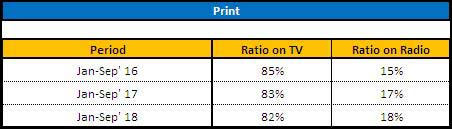
    On the other hand, print has been deducing its ad-spend ratio on TV to radio. In January-September 2016, it spent 85 per cent on TV and 15 per cent on the radio. In the following year, the ratio was 83 per cent and 17 per cent respectively, while it further changed to 82 per cent and 18 per cent in 2018.


    Radio also has been reducing its ad expenditure on TV. As per the report, radio medium spent 91 per cent share of its ad expenditure on TV in January-September 2016 and decreased it to 83 per cent in 2017. There had been a slight increase in the expenditure in 2018 as compared to the previous year, but the share remained much less than 2016, at 85 per cent. The subsequent expenditure on print medium was 9 per cent, 17 per cent, and 15 per cent, respectively.


    On a related note, India is one of the top countries when it comes to investing money in ad-expenditures. As per the latest report revealed by GroupM, the media investment arm of WPP group, India will rank third globally in terms of ad-expenditures in the coming year, contributing $ 1.35 billion to worldwide spends.

    An Indian Brand Equity Foundation (IBEF) report of March 2017 highlighted the market size of various media terming print as the biggest contributor to the sector, accounting for almost 41.2 per cent of the total advertising revenue, followed by TV (38.2 per cent) and other modes including radio, outdoor, and cinema collectively contributing 10 per cent. The share of digital stood at 11 per cent.

  • MMA releases ‘Mobile Ecosystem and ad-Sizing Report’ 2018

    MMA releases ‘Mobile Ecosystem and ad-Sizing Report’ 2018

    MUMBAI: Mobile Marketing Association (MMA) along with media investment group GroupM has released the its ‘Mobile Ecosystem and ad-Sizing Report’ 2018 highlighting an in-depth analysis of India’s mobile reach, smartphone penetration, rural and urban usage pattern, with an emphasis on gaming, and mobile advertising spends. Advocated by GroupM, the report is a collaborative effort by the marketing and mobile industry.

    The report offers an insight into how India is moving towards a new era of mobile marketing, seeing rampant growth in both usages and spends. It explores how programmatic works along with updates on the latest trends in data growth, content play, and device status. The report also reveals that Xiaomi became the most shipped smartphone, the first time any smartphone crossing Samsung in the last five years.

    The report highlights the ‘mammoth growth’ of Jio, which is now 18 per cent of the total market and has added more than 200 million users to the mobile ecosystem. It also states that rural India is bringing online three times more people than urban areas. “India will cross 500 million mobile internet users by the end of 2018, we foresee that this growth will be led by the rural populace,” it adds.

    It mentions that India is in the top three countries in programmatic spends growth with the spends growth of 81 per cent in the past year. Programmatic adoption in the country is growing; standing at 32 per cent right now and poised to grow to 52 per cent in the next 24 months. The propensity for programmatic guaranteed increasing in India – penetration to grow from 6 per cent to 17 per cent by 2020.

    Talking about the key verticals in mobile advertising, the report states that gaming, vernacular, OTT video, and OTT audio are leading the segment. “Mobile gaming in India is dominated by freemium games. 2016 saw a 200 per cent increase in gaming app revenue, which will grow at a CAGR of 87 per cent till 2020, crossing the $1 billion mark,” it reveals.

    The report claims that vernacular language users in India will grow 12 times by 2021. “In the next five years chat application, government sites, and digital payments will lead to more vernacular content consumers online,” it mentions.  

    The report further mentions that on-demand video platforms have crossed 100 million users in India with Hotstar leading the market. The user growth on these platforms has got maximum traction from tier 2 and tier 3 cities.

    MMA Asia Pacific managing director Rohit Dadwal said, “Mobile Marketing is now a main stream advertising and marketing medium and it is imperative that we start to decipher the various parts of this burgeoning media. We hope the ecosystem study would provide insights to marketers and the industry on the whole on the opportunity and will help in making the right investments for its continuing growth.”

    GroupM CEO and Mobile Marketing Association India co-chair Sam Singh noted, “The number of smartphone users is expected to only go up and it just shows how much potential these digital screens have. Hence, we as marketers must understand various facets of mobile marketing. Times are changing fast and we want to enable marketers with the knowledge that can help them in a long run.”