Tag: Greg Peters

  • Netflix CEOs play coy about Warner Bros Discovery acquisition

    Netflix CEOs play coy about Warner Bros Discovery acquisition

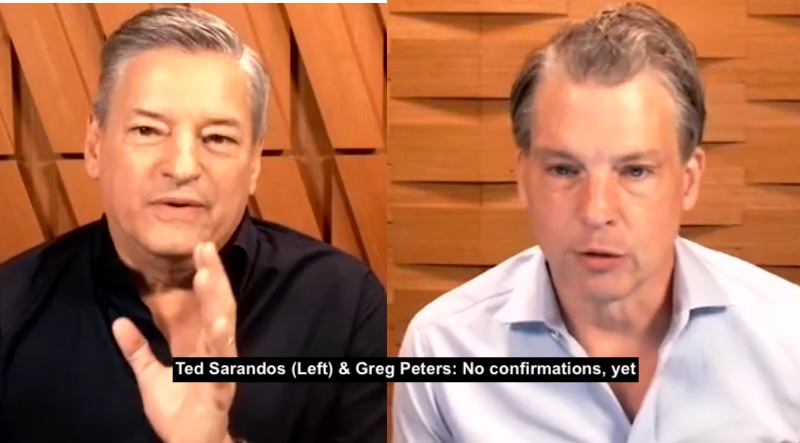
    LOS ANGELES: Netflix is keeping its cards close whilst the rest of Hollywood scrambles for Warner Bros Discovery’s assets. Asked during Tuesday’s third-quarter earnings call whether the streaming giant might join the bidding war, co-chief executives Ted Sarandos and Greg Peters delivered a masterclass in strategic ambiguity: they ruled nothing out, but ruled nothing in either.

    “It’s true that historically, we’ve been more builders than buyers, and we think we have plenty of runway for growth without fundamentally changing that playbook,” said Sarandos. “Nothing is a must-have for us.” 

    Yet he added that Netflix looks at “all” merger opportunities through the same lens—a nod that Warner Bros Discovery’s studio and streaming empire, including HBO, HBO Max and Warner Bros Television, might just pique its interest.

    What Netflix definitely won’t touch are Warner Bros Discovery’s linear networks. “We’ve been very clear in the past that we have no interest in owning legacy media networks, so there is no change there,” Sarandos said. That rules out a bid for the whole company, which Warner Bros Discovery is splitting in two: one entity (Warner Bros) housing the streaming and studio jewels, the other (Discovery Global) lumping together cable channels and Discovery+.

    The carve-up comes after Warner Bros Discovery announced it was reviewing “strategic options” following “unsolicited interest” from “multiple” parties. Paramount is reportedly leading the charge, having offered $20 per share for the lot, then upping its bid to $24—both rejected. CNBC reports that Netflix and Comcast are also circling.

    Peters downplayed the threat of rivals bulking up through deals, pointing to mega-mergers like Disney-Fox, Amazon-MGM and Discovery-WarnerMedia that failed to shake up the landscape. “None of those mergers represented a fundamental shift in the competitive landscape,” he said. “Watching some of our competitors potentially get bigger via M&A does not change our view.”

    The caginess came as Netflix reported third-quarter revenue up 17 per cent year-on-year to $11.5bn, in line with forecasts. Operating income rose 12 per cent to $3.2bn, though it fell short of expectations after a $619m hit from a dispute with Brazilian tax authorities. Shares tumbled 6.5 per cent in after-hours trading, though Netflix insisted the tax spat won’t dent future results.

    By region, revenue in the US and Canada grew 17 per cent to $5.01bn, Europe, Middle East and Africa climbed 18 per cent to $3.7bn, Latin America rose 10 per cent to $1.37bn and Asia Pacific surged 21 per cent to $1.37bn. Netflix now commands 8.6 per cent of US television viewing time, up from 7.5 per cent in late 2022, and 9.4 per cent in Britain, up from 7.7 per cent.

    Hits last quarter included Wednesday season two (114m views), The Thursday Murder Club (61m) and My Oxford Year (81m). The Canelo-Crawford boxing match drew 41m viewers, making it the most-watched men’s championship bout this century, Netflix claimed.

    For now, Sarandos and Peters are content to watch the feeding frenzy from the sidelines. But their refusal to slam the door suggests they might yet crash the party—provided the price is right and the baggage left behind.

  • Netflix inks landmark deal to host TF1 channels in France

    Netflix inks landmark deal to host TF1 channels in France

    MUMBAI: In a groundbreaking move poised to reshape France’s television landscape, Netflix has announced a landmark partnership with major French broadcaster TF1. From the summer of 2026, Netflix subscribers across France will gain direct access to TF1 Group’s live channels and extensive on-demand content, all seamlessly integrated into their existing Netflix subscription. This “first-of-its-kind partnership,” unveiled at the Cannes Lions advertising conference, signals a significant strategic shift for both media giants.

    The deal will see Netflix members in France able to stream TF1’s five free-to-air linear television channels — TF1, TMC, TFX, TF1 Séries Films, and LCI — directly through the Netflix platform. This unprecedented integration also includes access to over 30,000 hours of on-demand content from TF1+, the broadcaster’s own streaming service. Viewers will no longer need to switch between apps to catch popular French dramas like Broceliande and Demain nous appartient,  entertainment staples such as The Voice, or even major live sporting events featuring France’s national football and basketball teams.

    For Netflix, this collaboration is a clear step towards becoming a comprehensive “one-stop-shop” for television audiences globally. Netflix co-chief executive Greg Peters highlighted the synergy, stating the deal “plays to our strengths of giving audiences the best entertainment alongside the best discovery experience.”

    By teaming up with France’s leading broadcaster, Netflix aims to provide “even more reasons to come to Netflix every day and to stay with us for all their entertainment.” The move is particularly astute given France’s stringent regulatory requirements that mandate international streaming platforms invest in and contribute to local content production.

    Conversely, for TF1, whose chief executive Rodolphe Belmer expressed his delight, the alliance represents a crucial opportunity to expand its digital footprint and unlock new avenues for advertisers in an increasingly fragmented viewing market. TF1 currently reaches 58 million monthly viewers via its broadcast channels and serves 35 million users on its TF1+ streaming service. 

    Belmer emphasised that the partnership would allow TF1’s “premium content to reach unparalleled audiences and unlock new reach for advertisers within an ecosystem that perfectly complements our TF1+ platform.” While TF1+ remains central to its strategy, the Netflix integration is seen as “truly complementary,” with internal analyses predicting a “significantly net positive” business effect.

    Peters and Belmer flew into the picturesque French Riviera town of Cannes to make the announcement. 

    The financial terms remain undisclosed, but industry observers suggest it could serve as a global blueprint for similar arrangements as Netflix seeks to deepen its power over traditional broadcasters. This development comes at a pivotal time for Netflix, which in April 2025 saw co-chief executive Ted Sarandos announce an ambitious target of reaching a $1 trillion market capitalisation. 

    However, the company has also faced recent headwinds, including subscriber backlash following price increases in several countries and a slowdown in growth in the Asia-Pacific region. Integrating content from popular free-to-air broadcasters like TF1 could provide a fresh impetus for subscriber acquisition and retention.

    The partnership is not entirely new territory for TF1 and Netflix, who have previously collaborated on successful co-productions such as Les Combattantes, L’Agence, and Tout le bleu du ciel. This deepening of ties underscores a growing trend of convergence between traditional media and streaming giants, as both adapt to evolving consumer habits that increasingly favour on-demand consumption. The ability to watch a diverse range of content, from scripted dramas to live sports, all within a single interface, marks a significant evolution in the streaming warS.

  • Netflix shrugs off downturn fears as ad tech rollout bears fruit

    Netflix shrugs off downturn fears as ad tech rollout bears fruit

    MUMBAI: Netflix executives are feeling rather chirpier about their prospects, even as storm clouds gather over the global economy. During their Q1 2025 earnings call, co-CEOs Ted Sarandos and Greg Peters dismissed concerns about consumer belt-tightening, insisting that home entertainment has historically been “resilient” during lean times.

    “Entertainment historically has been pretty resilient in tougher economic times,” Peters told analysts. “Netflix specifically also has been generally quite resilient, and we haven’t seen any major impacts during those tougher times.”

    The streaming behemoth is ploughing ahead with its advertising ambitions, having just rolled out its proprietary ad tech platform in Canada and the US, with plans to expand to its remaining 10 ad markets in the coming months. Peters confidently predicted the company would “roughly double” its advertising revenue in 2025.
    “We aren’t currently seeing any signs of softness from our direct interactions with buyers,” he said. “Actually, to the opposite, we’re seeing some positive indicators from clients as we approach our upfront event.”

    The firm’s first-party ad tech platform is already yielding dividends, offering “more flexibility for advertisers” and “fewer activation hurdles,” according to Peters. In the US, Netflix has significantly expanded its targeting capabilities based on “life stage, interest, viewing mood” and third-party data.

    Sarandos reiterated that the company’s live strategy extends beyond sports, though he confirmed Netflix will broadcast a second NFL Christmas Day game in December 2025. The company will also stream the Taylor-Serrano boxing rematch in July, following on from the Tyson-Paul fight that generated substantial buzz.

    When questioned about potentially competing head-to-head with YouTube in short-form content, Peters struck a pragmatic tone: “We think the biggest opportunity we’ve got is actually going after the roughly 80% share of TV time that neither Netflix nor YouTube have today.”

    Meanwhile, chief financial officer Spence Neumann assured investors that excess cash flow would predominantly be returned to shareholders through buybacks, absent any “meaningful M&A.” The company maintains its full-year operating margin guidance of 29 per cent.

  • Netflix steams ahead with blockbuster Q1 as profits pop; Reed Hastings moves to non-exec chair

    Netflix steams ahead with blockbuster Q1 as profits pop; Reed Hastings moves to non-exec chair

    MUMBAI: Netflix smashed expectations in its first quarter of 2025, raking in $10.54bn in revenue—up nearly 13 per cent from last year—as the streaming titan shifts the spotlight from subscriber counts to cold, hard cash.
    The platform’s earnings per share soared to $6.61, comfortably beating Wall Street’s forecast of $5.71, while net income hit $2.89bn, up from $2.33bn a year ago. Operating income leapt 27 per cent to $3.35bn, pushing the margin up to 31.7 per cent.

    This was Netflix’s first earnings show without revealing its subscriber count, a move designed to pivot focus onto financial muscle and engagement rather than the once-sacrosanct user numbers. With pricing bumped up in key markets and a small but growing ad business, the company managed to woo both viewers and investors alike.

    Shares gained around three per cent in after-hours trading, closing Thursday at a sizzling $973. Netflix also doubled down on its full-year revenue forecast of $43.5bn–$44.5bn, projecting a 15 per cent year-on-year lift for Q2, with a beefier operating margin of 33 per cent.

    By region, the US and Canada contributed $4.62bn (up 9 per cent), EMEA rose 15 per cent to $3.41bn, Latin America clocked $1.26bn (up 8 per cent), while Asia Pacific surged 23 per cent to hit the same $1.26bn mark.
    On the content front, the UK’s moody miniseries Adolescence got a nod for driving eyeballs, alongside action flicks Back in Action, Ad Vitam and Counterattack. WWE’s Monday Night Raw also proved a global hit, cracking the streamer’s weekly top 10 since its January debut.

    The company launched its in-house ad tech platform in the US in April, touting it as a foundation for “enhanced targeting, snazzier formats and programmatic wizardry” in the quarters ahead.

    While economic clouds hover—thanks to tariff turmoil under President Trump 2.0—co-chief executive Greg Peters struck a bullish tone.

    “Based on what we are seeing by actually operating the business right now, there’s nothing really significant to note. We also take some comfort that entertainment historically has been pretty resilient in tougher economic times. Netflix, specifically, also, has been generally quite resilient. We haven’t seen any major impacts during those tougher times, albeit over a much shorter history,”  he said, adding that Netflix’s cheaper ad tier gives it added economic resilience.

    The earnings bonanza was capped off with a curtain call from co-founder Reed Hastings, who stepped down as executive chairman to become a non-executive chair—marking the end of an era for the man who helped binge-watching go mainstream.

    And just to keep Wall Street happy, Netflix threw in some shareholder candy too—buying back 3.7 million shares for $3.5bn and paying down $800m in debt. Still, with $15.1bn in debt on the books and $7.2bn in the bank, the company isn’t quite ready to roll the end credits.

  • Netflix lends support to those affected by fires in LA

    Netflix lends support to those affected by fires in LA

    MUMBAI: In response to the devastating wildfires that swept across Southern California, Netflix and its co-CEOs, Ted Sarandos and Greg Peters  stepped up to support those affected. At least that’s what Sarandos  assured  in a blog post last week that the company was committed to aiding  employees and the wider community during this difficult time.

    “Many of our employees and creative partners have been directly impacted by this disaster,” Sarandos stated.

    To facilitate recovery efforts, Netflix has pledged a substantial $10 million donation. This funding will be distributed among several organisations, including the Los Angeles Fire Department Foundation, California Community Fund Wildfire Recovery Fund, World Central Kitchen, Motion Picture and Television Fund, and Entertainment Community Fund, aiming to provide immediate relief and ongoing support.

    In addition to financial contributions, Netflix is directly assisting affected employees, including offering temporary housing solutions for those who have lost their homes. The company is also implementing a double-match for all employee charitable contributions through its giving program.

    Sarandos expressed gratitude to the firefighters and first responders tirelessly battling the flames. “These heroes have been saving lives and communities with little rest,” he remarked.

    Reflecting on the spirit of Los Angeles, Sarandos, a long-time resident, noted, “For many, LA is more than just palm trees and movie stars; it’s a family of hardworking individuals from diverse backgrounds.”

    He higlighted the community’s resilience, stating that while many dreams may currently feel distant, the capacity to rebuild is strong.

    “The next few years will pose challenges, but we will come back stronger than before,” he concluded. 

  • Netflix content king Ted Sarandos named co-CEO

    Netflix content king Ted Sarandos named co-CEO

    KOLKATA: The brain behind the content strategy of the undisputed king in streaming service has additional responsibility now. Netflix has named its chief content officer Ted Sarandos as co-CEO of the company. In addition to that, Netflix has also appointed Greg Peters to be its chief operating officer, in addition to his role as chief product officer. 

    “Ted has been my partner for decades. This change makes formal what was already informal — that Ted and I share the leadership of Netflix,” Netflix co-founder and CEO Reed Hastings said while announcing the Q2 result. 

    Sarandos will continue as the company's chief content officer also. “My journey to co-CEO of Netflix has been as a fan of great entertainment. And that's my commitment to Netflix members going forward: to keep pushing the boundaries of what a consumer-first company can achieve for people who love stories,” he said.

    "Ted’s been instrumental to our success as a company. While I saw streaming coming and pushed for it, Ted drove the revolution in our content strategy, which was way ahead of its time and has been key to our continued success. It was typical of his ability to see where the industry – and consumer tastes – are headed. He’s built an extraordinary team, attracting some of the most creative and best entertainment executives from all around the world," said Hastings.

    Sarandos praised Hastings as an unbelievable role model and source of inspiration for him  and stated in an earnings call, “my focus is to continue the successful train we’ve been on for the next 200 million subs around the world.” 

    "Greg’s appointment as COO reflects the strategic and analytical strengths he’s brought to our product team over the past 10 years. As we’ve grown, one of my biggest roles at Netflix has been to be broad across the company, getting to know many different people in every area of our business. This has helped Netflix stay mostly aligned, loosely coupled and very productive. In his new role, I want Greg to take on more of this work so that we continue to improve rapidly. Eventually he needs to know every corner of Netflix better than I do today," added Hastings.

    These changes are part of a long process of succession planning, announced Hastings. "While transitions can be hard, I am optimistic because we have a well established culture that’s built to be flexible and many years to get good at this. I’m committed to Netflix for the long term,” he added.

  • Indians lead amongst 70 mn global OTT account password sharers

    Indians lead amongst 70 mn global OTT account password sharers

    MUMBAI: Indian streaming service subscribers lead the world in lending their accounts to others who don’t have one, says a report by market research firm Ampere Analysis. Next in line are OTT subs in Netherlands and France with the Japanese expectedly being the country where the least number of users borrow OTT accounts. The UK, China and Indonesia are nations where account borrowing is growing the fastest.

    That’s good news and it’s bad news too. It clearly shows how much in demand, the content on streaming services is; it’s bad especially for SVOD platforms as they are losing subscription revenue on account of this tendency.

    Ampere estimates there are 70 million households in 22 countries who are borrowing one or more accounts. It also stated that the trend has picked up in the past 12 months, with the growth in popularity of existing services and the launch of new services from eight per cent of global internet users in Q1 2019  to 11 per cent in Q1 2020.

    The market research firm expects this tendency to increase with the proliferation of OTT services worldwide.

    Ampere further highlighted in the report that  SVOD service providers should see the glass half full not half empty as far as the borrowers are concerned. There’s a possibility to convert some of them into subscribers. Reason: almost three-quarters of them representing 50 million subscribe to at least one OTT service and more than two-thirds of them have pay TV at home. Additionally, half of these borrowers acknowledged that they would not mind paying extra for something that gives them exactly what they want.

    And guess what, a large subset of borrowers are viewing mainly sports and that too for specific periods during the seasons when their favourite games are aired. 

    Netflix has raised concern about shared accounts in the past. In a Q3 2019 financial investor call interview in October 2019, Netflix chief product officer Greg Peters had observed that the streamer was looking at consumer-friendly ways to push back at the edges of password sharing.

    Some surveys have revealed that just under 10 per cent  of Netflix subscribers are not paying for their accounts, even as millennials are rampantly  sharing their passwords around. Estimates are that the loss accruing on account of this, to Netflix, would be in the region of $150 million every month.

    That is not something anyone can sniff at. 

  • Big growth in viewing in India led by originals: Netflix’s Ted Sarandos

    Big growth in viewing in India led by originals: Netflix’s Ted Sarandos

    MUMBAI: Last year, Netflix rolled out a mobile-only plan in India to suit the country's preference for smartphones over laptops. Moreover, it was a way to delve deeper into a market where its basic Rs-500-a-month subscription plan was sharply expensive compared to homegrown OTT giants. The bet got the success it hoped for and Netflix followed the footprint in other markets as well. After nearly a year, the streaming service seems satisfied in the uptake of mobile-only plans as well as its overall growth here.

    “It's a plan (mobile-only plan) that we've tested for a while and we have rolled it out now in a bunch of countries: India, Malaysia, Indonesia, Thailand and the Philippines. And it's consistent with the broad theme and goal that we have which is why we're seeking effective ways to make the Netflix service more accessible to more and more people around the world,” Netflix chief product officer Greg Peters said in an earnings call.

    This strategy has helped Netflix witness a significant increase in acceleration and addition of new members. From a revenue perspective, it's also helping the company go from "neutral to positive", which Peters says will be good in the long term for the business.

    While all streaming players have witnessed magical growth in users during this COVID-19 lockdown, everyone is keen to know about Netflix’s growth in the period. Peters said he would not draw any strong contrast between India and other countries around the world. He mentioned that it is putting high effort to make the offering more competitive and attractive to members.

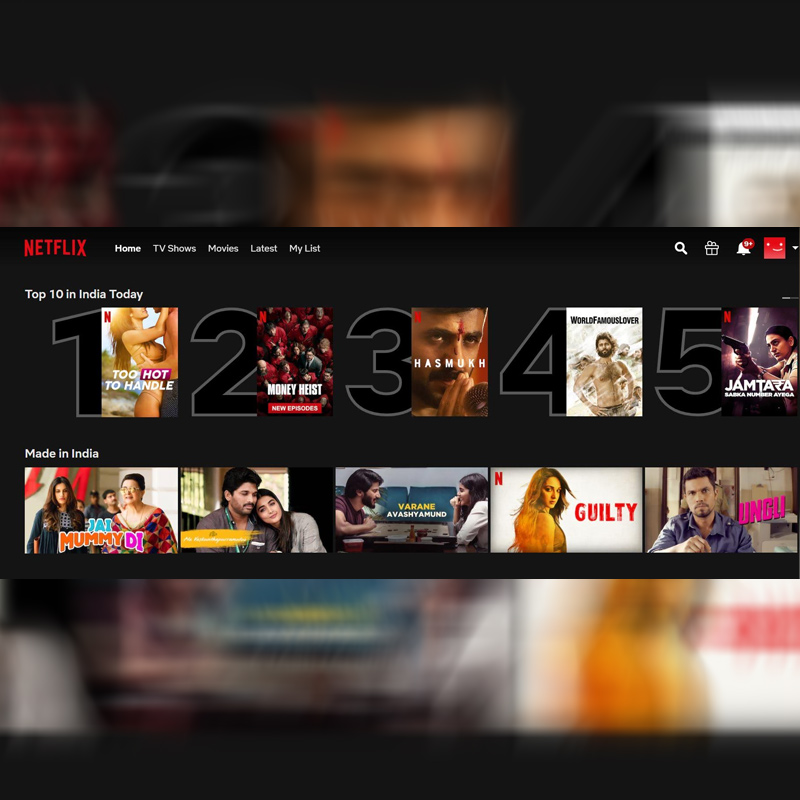
    “We've seen a big growth in viewing in India and have had great success for our local originals. Most recently was She andGuilty and a few others have been driving a lot of engagement in local content on our India service and they also are big fans of our global original content like Lacasa de Papel. So we're growing the business of licensed originals, international and domestic, across the board,” Netflix chief content officer Ted Sarandos said.