Tag: graphics

  • “Indian broadcasters need to look at solutions not just products to get real value” – Ross Video’s David Ross

    “Indian broadcasters need to look at solutions not just products to get real value” – Ross Video’s David Ross

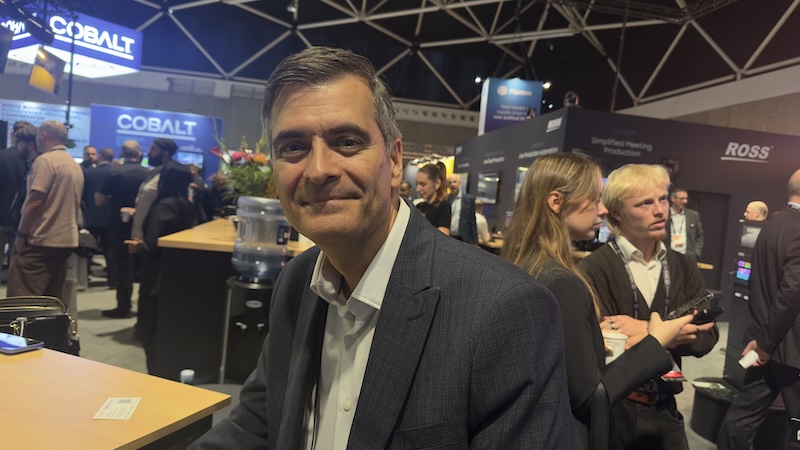
    At around 10 am on 12 September, long before the espresso machines hit their stride, Hall 8 of Amsterdam’s RAI convention centre throbbed with an unexpected chant: “Go Ross Go!” The source was not a marketing stunt but the chairman and chief executive himself. David Ross, head of Ontario-based Ross Video, stood shoulder-to-shoulder with his crew on the IBC show floor,  voice carrying across the cavernous hall. While rival executives do their glad-handing from glassy suites, David prefers to start the day in the trenches, rallying the troops like a regimental captain before battle.
    Engineering and enterprise run in his circuitry. He began programming at the age of nine, scooped up national engineering prizes as a teenager and left university with a computer-engineering degree heavy on business. Before joining the family firm in 1991 he cut his teeth at the CBC and Electrohome, fiddling with projectors and video-effects units. From product manager to head of R&D, then president in 2004 and chief executive two years later, his climb was brisk and unshowy at Ross Video.
    The numbers are anything but modest. Under his watch Ross Video has posted roughly 15 per cent compound growth every year since 1991—without a single downturn, recession or not. He owns more than four-fifths of the company yet has kept it employee-friendly, structuring it as an ESOP and keeping private equity at bay. The mantle of respect is heavy: an honorary doctorate from the University of Ottawa, fellowships from Canada’s Academy of Engineering and from the Society of Motion Picture and Television Engineers, and a trophy cabinet of industry awards.
    For all the laurels, David remains a kinetic learner. He trades ideas with fellow chiefs through TEC (Vistage in America) and gulps down management audiobooks while pounding out marathon miles. It is this mix of technical curiosity, fiscal discipline and boyish gusto that has made Ross Video one of broadcasting’s quiet powerhouses.
    When Indiantelevision.com founder and editor in chief Anil Wanvari caught up with him at IBC, the conversation roamed from the science of sustaining perpetual growth to the sheer pleasure of building kit that makes television sparkle—proof that the man leading the cheer is also the engineer behind the magic. Excerpts from the tete a tete:

    On what’s exciting him about IBC 2025.
    To start off we just bought a company. And we just had some fun with it. We are talking about, you know, peanut butter goes with jelly, movies go with popcorn and you know video goes with audio. So we bought Lama (Lean and Mean Audio) – a company that does audio entirely software-based in the cloud and on-prem. It’s quite a comprehensive feature set. It’s also got automix and things like that. They did 16,000 streams of audio for the Paris Olympics where they needed to match up commentators with crowd noise – and to have it automatically set up. They were doing hundreds and hundreds of them a day.  We are going to sell what we have and over time we are going to do more with it.

    On whether Ross Video’s acquisition streak is going to continue. 
    Lama was our twenty second acquisition. Acquisition number 23 is almost done. We can’t talk about that, But watch this space. We also do organic growth. If all we were going to do is grow through acquisition, we would not have 500 people in R&D like we do today. So that’s a major investment, especially when you consider that Ross Video is only about 1500 people. One in three are designing new products. And also considering we have our own manufacturing in-house. That  is a major commitment to new product development.  But we look at everything that is adjacent to- complimentary to – what we do. Everything has to connect with what we do in multiple ways.

    The first robot I actually bought was in house, and we bought it out. It was the Furio, which is on tracks. I did that around 2011 or so. It was a bit of a shock when I came back and said: “Stop everything. Let’s start building robots.” Then we did Cambotics three months later, and then we did an organic product, which was SkyDolly and and just last year, we launched Artimo, which was an organic product based upon acquisitions. So, how much is acquisition? How much is organic? It kind of gets all blurred after a while, because we’re doing brand new innovations, but because we are already in the market. Now we have that technology that we brought in house. You’re going to see the same sort of thing again, with Lama, you know, bringing in audio in house. Great. What’s next? That’ll be organic,

    On whether Ross Video will consider outsourcing production to cheaper locations such as India or China
    What we make in our industry is generally not interesting to make in India or China. They want to make a million of something. We make hundreds or thousands of something. Very, very complex products at lower volumes than the mass market. There’s a lot of enhancements and back and forth of R&D. It all makes sense to have all of that in-house. It might be more expensive for us to do the manufacturing in China as there’s a lot inefficiencies in working with an outside company and also it’s just not interesting to them. Our factories are designed to make studio robotics or routers or production switchers.
    On the product gaps in the company’s portfolio and how will Ross fill those.
    We’re already in broadcast, we’re in sports and live events, we’re in OB vans, we’re in mega churches, we’re in government, we’re in corporate, high end type production. We’re already in stadiums that’s actually our biggest market. What else can we do? I know there’s there’s other adjacencies. So I can’t quite tell you where our gaps are. You could say that we’ve got a great portfolio, and we can create some really great end-to-end solutions. I can also tell you that there’s 1000 companies that aren’t part of Ross; they do stuff that we don’t do. So you could say that we’ve got a thousand gaps. In other words, lots of opportunity in the future.

    On how long can the motivated and family like culture continue at Ross Video now that it is expanding aggressively.
    I think I enhanced it a little bit coming forward from what my father John had put in place. You know, there was a day when I had to move from the Iroquois in Canada  location, where we really started, and to Ottawa, an hour north. And not being in the factory, things started to go wrong, and culture started to change. And I’d hear stories about people not working well together and so on. That was only when we were around about 75 people, and I thought to myself  how are we going to get to 100 people and keep the culture? It’s already falling apart, so we sat down and wrote up the Ross Video code of ethics. We wrote down the Ross Video culture. We put it in everybody’s, you know, walls or their cubes and their offices, their home offices. We put it on the website. It sits on the doors of our meeting rooms. Here we live it. And when you do that, it’s a culture that can extend potentially indefinitely, because I’m already not in every location, but we’re able to bring people on. They understand what it is. We got a lot of people that live this culture and love it. And people who don’t match that culture, that don’t respect each other, that don’t help each other, that aren’t focused on customers, that sort of thing. They don’t last very long at Ross Video, sometimes they self-select and out they go. They just don’t fit. So how big can we go? I know, as big as you want.

    On how Ross Video deals  with a market like India where price plays a very important role in closing a deal and negotiations can be endless as compared to other countries.

    Well,  the thing is I am unaware of a major manufacturer of routers or production switchers or sports analysis tools or robotics out of India. We’re competing with the same players, for the most part, in India that we do with in the rest of the world. So really, the question is figuring out the right solution for the job and sharpening your pencil for India is but in the end, you know, it’s the same products. So I would love to be able to discount our products to 90 per cent but then it would be cheaper for us to just shovel money and not sell products, because we’d have been losing money on everything we sell.

    So, so from the point of view of price, I think India, like everybody else as well, does have certain minimum requirements for what they want. I mean, I was looking at a bid from Doordarshan just yesterday, actually,  “they didn’t just say we would need a production switcher. We want the lowest price.” They had, you know, a couple of dozen criteria the product. Before you can bid, you must have all of these high end features. And if you qualify for that, then we want to see the best price. So it’s not just a race to the bottom.

    These features are important to our customers in India like everywhere else, because they provide value. And I think what we need to start doing in India as well, like we have been doing everywhere else, that is not just talk about a product, its features and its price, but also the ecosystem and the solution that we provide.

    For example, you know, OverDrive works really well with our Carbonite production switchers. Carbonite production switchers work really well triggering XPression graphics. XPression graphics work really, really well with our with our weather system Raiden. Xpression workflows work really well with Voyager, which ties in sports analysis, which talk  to our instant replay systems and so forth. So you can see there’s a thread that goes through everything that we do that also has value. And I think if one of the things you have to have a conversation with locally is discuss the system that you want, the solution that you want, and not just bid for individual products. Because I think if India continues to just look at one product at a time, some features and a price, they’re missing out on unlocking real value and real savings in workflow and efficiencies.

    On whether Ross Video will consider serving the individual creator community at some stage.
    I’m going to say only at the highest end, yeah, one of the most important things when you have a company of any sort is the path to market. How are you going to be communicating with a market, and how are you going to service that market? Ross Video is very intentionally set up to have a close relationship with its customers. When somebody comes onto our booth in an exhibition, we know who they are, we know what they need. We understand their company, their needs. We often know the person, even have a relationship with that person, maybe over many years.

    When you’re talking about the creator community, and you say there’s a million creators out there, we can’t do that. That is a different type of a sale. It’s a sale where it’s about marketing, it’s about lead generation. It’s about no price negotiation. It’s about clicking and buying it on a website. We’re not set up for that. And also it’s about a larger mass market.

    And in the mass market as well is that’s where you have to build in millions at a very, very low price, very little customisation, if any. That’s not what we do either. We do more expensive products. That’s what our factory is set up to do. And we have, we would say, a more expensive but more intimate connection with our customers. When the creator community, you know, gets to a certain point, if you have one that’s making it, you know, has a lot of eyeballs, therefore making a lot of money, they want to transform from to a more professional look, and they want to create a studio, then we’re there for them. So we don’t need to move into the content creator business to be able to get to the billion dollars in revenue from the 500 million we have now, but to get to $2 billion in revenue, maybe, maybe that’s next. But right now, I think the way we want to leverage our customers and our brand and our go to market and our manufacturing capability and our design expertise, more so to be able to double the size of the company.

    On the role that AI is playing at Ross Video and in its products.
    AI is a really, really big topic. It’s everything like it’s interesting inside the company. You could say there’s inside, there is outside the products, and then there’s many types of AI as well. Inside the company, there’s AI everywhere. Pretty much everybody that wants chatgpt gets an enterprise copy of it inside of Ross video, so we’ve got like, 1000 copies of chatgpt running at any given time. We’re using it, developing our software. We’re using it developing our manuals. We’re using it to drive our website, our manuals. We’re using it writing our specifications, our market research, internal communications. We’re using it everywhere, and that’s on purpose, because I want to make sure that all of our employees, in all ways, become very, very familiar with AI and be able to get more ideas of how can it affect workflows and get that comfort.

    Now, inside of Ross Video, we have something called Ross Research Labs, and that is different and separate. Ross Research Labs is different and separate from all the product groups. So we got, you know, R and D team for production switches, another for routers, another for graphics, another for robots and so forth.

    Ross Research Labs is there for all of the different groups. So for example, recently, they were using AI to do player tracking for our Piero system, our sports analysis system, and be able to make sure that when one player goes through another player and comes out the other side, it doesn’t suddenly get identified as a new player. It can track them properly they had to go through we actually worked with universities to figure out the very best algorithms to be able to make player tracking work.

    We also take a look at the pitch, say for cricket or football or something like that, where we can look at that, and we can now use AI to calculate where the camera is that’s taking that image and what the zoom setting is on the lens and everything else, and understand where it is. The camera is in a three dimensional space, so we can overlay graphics with it. That was another thing that came out of Ross Research Labs.

    Another thing that we’re doing is Ross voice control. So this is speech to text, but we have examples of major broadcasters. I’ll say that that I’ve done hour long productions where the presenter is speaking, controlling the graphics, running maps and creating all these animations behind them. There is no one in the control room following this and pressing any buttons. It is all speech to text. That text goes into an engine that then drives through an API our products to be able to do the production. And when we did it, there was only one time that somebody had to reach in and press a button over a one hour or two hour production, which is just amazing, and it was running faster than  any human operator could could run in real time.

    There’s another thing that we’re just starting to work with as well, which we’re starting to do in stadiums where we’re doing closed captioning, basically, but for the big screen. So people who can’t hear that, or maybe the crowd is too loud they want to hear what a commentator said. We’re actually putting that up on the screen. We can also do it in real time. Translations. We’ve compared that to human translators, and we’re faster by like, five seconds, and more accurate as well. So that’s another use of AI that we’re starting to roll out, and that came out of some of our other R and D teams. There’s more going in that direction. The next side of things as well. Oh, of course, our Artimo, you know, has all sorts of facial tracking and body tracking and things like that for our cameras to be able to keep talent centered in a production quality way, but there’s more

  • News channels focus on graphics on D-day

    News channels focus on graphics on D-day

    MUMBAI: At a time when presentation matters as much as content if not more, news channels are leaving no stone unturned to better package their coverage of the elections, ahead of counting day on 16 May. According to insiders, channels are investing close to Rs 1 crore to Rs 1.5 crore in graphics and technology depending on their own internal resources.


    “There are two parts to it: pre-counting day and counting day. In the former, you have to effectively cover all constituencies and make people understand while in the latter, the emphasis is on graphics as well as synergy between getting the information and putting it out instantly,” says NDTV CTO Dinesh Singh. Simply put, maximum energy goes into ensuring that data is collected from multiple sources and punched in quickly to be flashed on your TV screens. More precisely, revamping studio sets, making graphics more elegant, and inflating backend support in terms of OB vans, cameras and servers are all part of this exercise.


    “Satellites, lease lines or 3G supported systems are used to send pictures and videos from the ground to the studio while historical data is put on air through graphics. This can be done either virtually on a green screen or in a real set with virtual graphics,” says Live India head of technical operations Johnjit Singh Ahluwalia. A case in point is Times Now where one can see editor-in-chief Arnab Goswami, belting out statistics in his swanky new studio with the graphics playing out in front of him. CNN-IBN, on the other hand, has tied up with Microsoft for presenting historical data of more than 60 years.


    Speaking of ABP News, the channel put in six months of effort to hire OB vans and extra manpower along with backpack units for larger coverage. New shows have been set up with multi camera facility, apart from extra microphones, cables, connectors and servers. Various mechanisms such as OB vans, leased lines, FTPS and back pack units like Live U and TVU that work on 2G/3G/4G and are equipped with a variety of data cards are used to receive data at the office. “We also focus on error-free transmission and so far, have achieved it. High end studio cameras are hired with a triax setup for outdoor shoots,” says MCCS marketing manager Vikas Singh.


    Network 18 has roped in AC Nielsen as the agency to handle raw counting day data. Planning was done eight months in advance, keeping in mind the pre-polling stage, the polling period, post-polls, counting day, and the results. “Technology plays a key role in the elections. From programmers to data analysts to statisticians, every specialist plays a key role. But more than playing an individual key role, I think the ability to maximise the relevance of technology and to be able to bring all of them together for a common deliverable is the key for in depth elections coverage,” says CNN-IBN and IBN7 managing editor Vinay Tewari.


    NDTV, with a developer team of 21 engineers and around 40 people in the graphics department, started preparations around three months in advance. “Earlier, counting used to be for three days and now, it starts in the morning and ends in the afternoon so the on-screen graphics need to be attractive and studio swanky,” says Dinesh Singh.


    ABP News has divided itself into teams of eight to 10 for production, camera editing, satcom, working for programmes etc. that report to line managers, who in turn report to the main head. Ahluwalia agrees about the importance of technology in election. “These are crucial five or six hours within which you either swim or sink. Most of the investment goes in the actual coverage from the ground and then on the presentation of that data. With little resource, give high quality,” he says.


    The crux of the election is to ensure that you have a good backup for everything in case anything goes wrong. “At various locations, we have a back up like another OB van or a Live U unit, stand-by cables, camera etc. in case of any equipment failure. We had contemplated each and every aspect of technical failure and have been thus able to avoid that. Equipment redundancies are built at various levels of production and post production, including the programme transmission,” says Vikas Singh. Ahluwalia says that most news broadcasters have seen at least one election that redundancies are built into the system with complimenting hardware, servers and machines to give seamless on-air transmission.


    With less than a day to go for counting, channels are all set to turn up some serious heat with not just the information but also the graphics. So, prepare to sit back and enjoy the game…

  • Fastrack launches helmets; eyes revenue of Rs 500 crore

    Fastrack launches helmets; eyes revenue of Rs 500 crore

    BENGALURU: Titan’s urban youth brand Fastrack announced the launch of a new category – helmets in Bengaluru. The new range will see 24 different variants for ‘guys and girls’ in different colours and graphics, making them a style-essential for its TG. Titan plans to include a range of bicycle headgear and accessories in the near future.

    Fastrack, which was launched in 1998, has seen revenue growth of more than fifty times from Rs 30 crore to Rs 770 crore, hence making it the largest fashion accessories brand in the country, claim Titan officials. By the end of this fiscal in March 2014, the company expects revenue of just Rs 8 to 10 crores from the helmet stream and about Rs 50 crore during FY-2014-15.

    We are looking at revenue of about Rs 500 crore from this stream over the next five years, says Titan managing director Bhaskar Bhatt

    The company says that the present size of the organised helmet market which constitutes about 45 per cent of the overall market is Rs 400 crore in India and is estimated to grow to about Rs 1500 crore over the next five years. “We are looking at revenue of about Rs 500 crore from this stream over the next five years,” reveals Titan managing director Bhaskar Bhatt to www.indiantelevision.com.

    “India has one of the highest numbers of two-wheelers in the world. With unorganised players currently driving the helmet business, the category has a large potential in the market. We are trying to buck the trend – even if a person doesn’t want to buy a helmet, she or he will buy it because it’s from Fastrack, because we believe that it is not the helmet that the person will buy, but brand Fastrack,” Bhatt further adds.

    For the present Fastrack helmets will be sold through the 147 Fastrack stores across the country. Titan plans to increase the number of Fastrack outlets to 200 by 31 March, 2014. The company also plans to sell helmets online through its own portal as well as other fashion online retailers such as Myntra, Jabong, etc., in the near future.

    “We are looking at outdoor promotions over the next few months. We’ll probably launch a multimedia campaign including TVCs sometime in the near future,” informs Titan Vice President and Chief Marketing Officer Ronnie Talati. Lowe Lintas handles the creative duties and Maxus the media buying for Fastrack.

    Company sources peg the outdoor Fastrack helmets campaign at about Rs 2 crores till the end of this fiscal, and then depending upon the response, will chalk out a campaign for the next year.

    “Being in the business of youth fashion accessories, helmets were a natural extension for us after watches, sunglasses and bags. Many of today’s youth use protective gear to make bold fashion statements. The youth being the dominant consumers for the category, launching the helmets range under the Fastrack umbrella would help keep a firm grip on the capricious youth market,” adds Talati.

  • Xbox One becomes an instant hit

    Xbox One becomes an instant hit

    MUMBAI: Microsoft Corp that launched its new gaming console Xbox One on Friday was an instant hit with the gaming fans. One million consoles were picked up within 24 hours of its launch 13 countries.


    Xbox One that is available at $499, offers improved graphics for realistic effects, processors that allow faster game play and a slew of exclusive video games.


    Looking at the instant popularity that it has got, Microsoft has reportedly described it as the biggest launch in Xbox history, setting a new sales record at the company.


    The consoles were sold out at most retail shops, according to reports.

  • Zees Buddha wows buyers

    Zees Buddha wows buyers

    CANNES: Mipcom presents the perfect opportunity to mix business with pleasure. And so it was that the producer of Zee TV’s latest series Buddha, BK Modi, hosted a lavish bash at Cannes’ La Mandala Beach on 8 October to introduce the series to the international market even as his guests partied the night away. 

    The party was organised by Indiantelevision.com’s ITV 2.0 Productions on behalf of Buddha Films.

    One couldn’t have asked for a better setting, what with the glistening waves, cool breeze and interim light showers coupled with scrumptious snacks and drinks that flowed freely.

    While the first episode of Buddha played out on the mammoth screen, the invitees – Indians as well as lovers of all things Indian from across the globe – set the dance floor on fire with some signature Bollywood moves. The party continued till the wee hours of the morning and Buddha surely impressed – with its costumes, sets, graphics and more so, its production quality.

    For those among the industry who’ve been waiting to see the actor who plays Buddha, here’s some dope: “He’s a debutant,” according to Modi and will be announced on 13 October. Apparently, he had to undergo rigorous training to get under the skin of the Buddha.