Tag: Governance

  • New economy & the end of employment

    The internet brought upon us the first instance of a crowd-based economic model in mid-2000s pioneered perhaps by YouTube and followed quickly by eBay with its peer-to-peer facilitation of exchange of second hand goods.

    Full-time employment has come of age — having evolved to today include worker protections, benefits and the works. ‘The other 99%’ happily work for a few others and the model earns respect for and from the constituents in the society.

    Internet and the age of start-ups seem to be posing a challenger however.

    It’s becoming personal Now!

    Today Uber (ride hailing) and Air b-n-b (room sharing) are the poster boys of a glamorous new way of economic modelling popularly called ‘sharing economy’. People don’t shy today on the prospect of the extent of intrusion while willing to ‘share a bedroom’ to make the most of a gig economy.

    The gig economy basically relies on its ability to use resources optimally to give best throughput and is seemingly a more efficient, productive and better system.

    Platform-based disruptions

    Historically, employment as a method has seen unprecedented success as a model to organise labour over the last few hundred years.

    Platform-based disruptions across industries – enabled through an overall robust digital trust network (example – online profiles of hosts and guests, rating systems, etc.) in the ecosystem – is however becoming the order of the day.

    Are we witnessing the transformation of good old capitalism – the defining economic force of the 20th century? Will we see the 21st century lend itself to organising labour in a different fashion ultimately leading to end of full-time employment as a core model as we know it?

    Can ‘new economy’ work for everybody? Will it succeed in universally becoming the new normal? Can it be inclusive as it purportedly seems to be and contentiously fights to project?

    Is the sharing economy a pre-cursor to the beginning of the end of employment?

    Economic might has historically beaten military might across wars and across centuries.

    Is the gig economy Schumpeter’s ‘creative destruction’ in disguise or is this disruption only going to be replacing a rusty nail with a crooked one!  

    Are we fortunate to be living in interesting and exciting times that saw the early days of unravelling of future of work!

    Domino Effect

    For now, it seems ‘sharing’ could be a force for good but may not necessarily replace good old ‘full-time employment’ as a core model anytime soon.  

    When and if it does, will this massive change of democratisation of economic opportunity through crowd-based capitalism even lead to evolution of a better political system of governance?  What is your view?

    public://Untitled-2_13.jpg

    (Piyush Sharma, a global tech, media and entrepreneurial leader, created the successful foray of Zee Entertainment in India and globally under the ‘Living’ brand. The views expressed here are of the writer’s and Indiantelevision.com may not subscribe to them.)


  • There is no foundation funded journalism in India: Shekhar Gupta

    There is no foundation funded journalism in India: Shekhar Gupta

    MUMBAI:  Social media is the new hub for news breaks.  The role that the platform played during the recently concluded ‘election of the century’ set the tone for the future of journalism in the country.  And stressing on the same was India Today group editor in chief of news properties and vice –chairman Shekhar Gupta at a session on ‘Media and Governance’ at Indian Merchants Chamber.


    Gupta said that social media like Twitter will affect governance in India. Calling social media as the new form of journalism that is used to break many stories, he also cautioned that it spreads urban mythologies. He went on to add that  if a war like situation arises, leaders having mass following on Twitter will find it difficult to control a “Twitter storm” from the Twitterati.  Gupta also expects the new government to make phone calls to media owners and it is during this time the media will be tested he said.


    Speaking about the turnover of the Indian media industry he quoted  a press article which mentions that the total turnover of the Indian media industry including entertainment is less than that  of telecom giant Bharti Airtel.


    He pointed out that India’s demographics and an aggressive literate policy were fuelling the growth in Indian media. He compared the outburst of channels and publications in the media to the 1962 war where the Indian army had expanded suddenly. He also lamented about the fact that today’s TV journalist were inadequately trained in classrooms as well as newsrooms and as such the media is going down the value chain.


    At a time when serious discussions are taking place about media ownership with the latest one being Reliance Industries’ acquisition of Network18, Gupta said that the media has always been owned by the corporate and stated, “There is no foundation funded journalism in India”. He also said that large corporate companies are not in the business to milk money out of media organisations as for them the investment is too less.  Gupta said the only worry for him was “funny people” owning the media. He explained how a particular political family at the regional level controls the distribution of media in a north Indian state.


    Speaking about the ad revenue of news channels, he explained that FMCG advertisers like soaps, toothpastes and aerated drinks first go to general entertainment channels (GECs) like Star Plus, Colors or Sony where they get high viewership. The second option is sports channels which again have high viewership and last in line are news channels that have no choice left and have to offer ad slots at cheaper rates.


    Gupta was previously the editor in chief of Indian Express and a well known host on NDTV for his show Walk the Talk. When asked what will be his new role at India Today group, he said that his essential job was still the same although it was a different universe. “It is still what it was, except it is not a broadsheet daily. This group is diverse as it has 36 titles including magazines and channels like Headlines Today and Aaj Tak,” he said.

  • Verizon Identifies Key Enterprise-Technology Trends for 2014

    Verizon Identifies Key Enterprise-Technology Trends for 2014

    MUMBAI: Enterprise users will gain unprecedented control over their technology environment in 2014, according to Verizon Enterprise Solutions’ list of top enterprise technology trends for 2014. The new year will see a sharp focus on how enterprises and governments use technology to enhance the customer’s experience and enable innovation.
    “We are experiencing the democratization of enterprise technology,” said David Small, Verizon Enterprise Solutions’ chief platform officer. “Mirroring what has happened in the consumer technology space, enterprise technology users look for services to be delivered on demand, to a time and place of their choosing, and in the way that they want. In 2014, enterprise success will be measured by how well organizations are able to use technology to meet user expectations and harness individual innovation.”
     

    Here are the key trends Verizon believes will drive change for enterprises and government in 2014:

    1. The Customer of One Comes of Age

    The ability to tailor a customer’s experience to best meet personalized, individual needs will increasingly be a brand differentiator. In 2014, enterprises will refocus on customer touch points, recognizing that integrated omnichannel connections – across online, mobile, broadcast and in-store –can make customers feel valued at every step of the purchase and experience lifecycle. These integrated systems will be the key to opening up new routes to markets by enabling businesses to engage directly with the individual on demand, and build trusted connections to simplify transactions. Insight provided by big data analytics will create new, individualized marketing opportunities that will transform and focus the customer engagement model.

    2. M2M ‘as a Service’ Simplifies Path to the Connected World

    Ubiquitous4G LTE wireless service and the availability of machine-to-machine (M2M) solutions “as a service” – on demand, over the Internet and ready to use –coupled with strong security will overcome the issues that have previously prevented many organizations from fully embracing M2M. By leveraging third-party expertise, organizations will be able to quickly transform the conversations of intelligent endpoints into unprecedented insights – and unprecedented business opportunities. As M2M adoption accelerates, manufacturers, dealers and business partners will be able to realize the full potential of new revenue streams and increased operational efficiencies, while better meeting the needs of their customers.


    3. The Shortage of Security Expertise Forces Changes to Cyber security Management

    Continued targeted attacks and high-profile security breaches impel corporate boards of directors to demand substantial increases in security investments in 2014 – and rethinking of traditional approaches to cyber security management. As enterprises increasingly adopt mobility, big data, cloud and broadcast solutions, the complexity of effective cyber security programs far exceeds both the availability of human capital around the world and the capability of any one enterprise to execute alone. Enterprises will develop and execute hybrid cyber security-management models that combine an agile staff of in-house security-minded business experts with trusted managed security services across a broad range of capabilities such as identity management, security analytics and cyber intelligence, and governance, risk and compliance.

    4. IT Decentralizes

    Organizations embracing the new information technology world of cloud, mobility and M2M will see IT increasingly decentralized. IT will be core to every business function. As a result, IT will work more closely with individual business units and focus on developing tools for seamless process enablement that empowers employees and customers. The C-suite (e.g. CFO, CMO, COO), lines of business and staff functions will increasingly take the lead role in engaging and deploying in the cloud, because of the immediate deployment speed, flexibility, control and cost value they see in cloud, as well as advantages in big data analysis. IT will be integrated into financial performance planning, and the lines between the IT department and finance will continue to blur as technology becomes the valued enabler, rather than the end game.
    5. Providers Add Gravity to the Cloud

    In a world where mobile is the norm, and rich media content is a given, the cloud will come into its own as the only location where growing data volumes can be stored, accessed and analyzed on demand. In 2014, adding software and services to the cloud will be a key focus for cloud providers seeking to attract customers –adding gravity and encouraging user stickiness. 

    Integrated cloud offerings will increasingly enable mashups of fixed and mobile networks; systems, ideas and solutions; people and things; and intelligence and information. Providing systems and tools to transform these data into insights in the cloud and on demand will transform the customer experience.

    Small concluded: “Verizon Enterprise Solutions brings together an unparalleled set of assets with the objective of driving open a connected world of opportunity for our clients. Whatever their industry or sector, in 2014 our clients will look to invest and innovate so they can more rapidly and securely deliver their products and services where, when, and how their users want them. Our focus is on offering powerful answers to business challenges by harnessing the power of our advanced technology platforms to deliver industry-specific solutions that unlock productivity and value for our clients, their customers and society.”

  • Govt. concerned about ongoing impasse between IOC and IOA, wants early solution

    Govt. concerned about ongoing impasse between IOC and IOA, wants early solution

    NEW DELHI: Youth Affairs and Sports Minister Jitendra Singh has said that the government “stands committed to zero tolerance on criminality in sports and adherence to ethics and good governance in sports in the country.”


    Reacting to media reports that the General Body of the Indian Olympics Association has not agreed to carry out some of the amendments to its constitution as required by the International Olympics Committee, he said, “The Government is concerned about the ongoing impasse between the two bodies and is watching the developments closely.”


    He said that the Government had noted that a Special General Body Meeting of the IOA was held on 27 October in pursuance of the directions of the IOC to it.


    He added that the Government felt the deadlock between the IOA and IOC should be resolved at the earliest so that the suspension of the IOA is lifted and Indian sportspersons/teams are able to participate in international sporting events under the Indian National Flag.

  • V Narayansamy and Manish Tewari launch docu films on good governance

    V Narayansamy and Manish Tewari launch docu films on good governance

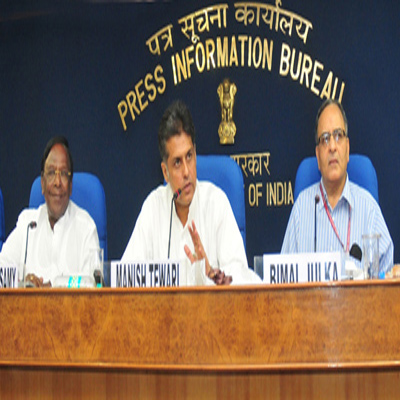
    New Delhi: Documentary films on seven good governance initiatives were launched by minister of state in PMO & ministry of personnel, public grievances & pensions V Narayanasamy and the information and broadcasting minister Manish Tewari.

    The films have been produced by the department of administrative reforms and public grievances (DARPG) and the department of pensions and pensioners’ welfare (DPPW).

    Narayanasamy said these initiatives highlight the innovative efforts of the civil servants who have been instrumental in ensuring that the policies and programmes of the government reach the beneficiaries. He said these initiatives are to be suitably documented and disseminated through all possible channels of communication to enable their adaption, replication and further innovation, for the betterment of the common man.

    DARPG secretary Sanjay Kothari said the Department has been producing the documentary films with the objective of promoting and dissenminating the successful initiatives. He said so far, sixty-one documentary films have been produced including the films being released on the occasion.

    The seven films on the initiatives from different parts of the country in various sectors are (i) e-Sugam, a self policing system for tax compliance, Karnataka; (ii) pensioners, portal, government of India, (iii) electronic service level agreement, government of Delhi, (iv) health management information systems, Tamil Nadu, (v) crop pest surveillance and advisory project, Maharashtra, (vi) Aarogyam, Uttar Pradesh, and (vii) integrated Odisha treasury management system, Odisha. The initiatives demonstrate as to how information and communication technologies can be leveraged to simplify the processes and procedures and deliver various government services to larger population.

    The documentary films are meant for diverse audiences such as probationers & other officers in national academies and State training institutes; delegates in conferences, seminars and meetings at central, state, district, panchayat levels; and for telecast on national network of Doordarshan or other television channels for general public. These films have been produced by the department through the directorate of advertising and visual publicity.

    I&B secretary Bimal Julka was also present on the occasion.