Tag: Got Talent

  • Simon Cowell’s Syco Entertainment inks $125 mn Got Talent securitization deal

    Simon Cowell’s Syco Entertainment inks $125 mn Got Talent securitization deal

    Mumbai: Global media and entertainment investment bank ACF has recently advised Syco Entertainment, which resulted in Simon Cowell securitizing the “Got Talent” franchise by signing a groundbreaking $125 million deal.

    The Got Talent franchise includes America’s Got Talent and Britain’s Got Talent formats that have been commissioned in 72 territories worldwide, including in India on Sony.

    The deal will allow the company to use this war-chest to grow the business through a mixture of strategic acquisitions and organic growth projects.

    As advised by ACF and law firm Memery Crystal throughout the complex investment deal, Syco worked with their team in both the UK and US over a two-year period. The deal is the first of its kind as it includes securitization of various aspects of the Got Talent intellectual property, which comprise production margins and fees, digital income, franchise and original content sales, and sponsorship income. ACF’s innovative approach used a structure for the Got Talent format more commonly applied to the music industry’s royalty income streams.

    ACF founder & CEO Thomas Dey said, “ACF worked with Syco to formulate this financial strategy to support its plans and managed the entire process as the lead bank. Our brief was to create a structure to enable the company to maximise the full potential of its existing passive royalty income stream. ACF has created a winning formula using our extensive experience from across the media and entertainment industries. We are certain that this ground-breaking structure will be one that we will use for many media formats in the future.”

    Syco Entertainment director Ian Rosenblatt OBE said, “ACF’s certainly got talent. Their team, led by the ever-tenacious Thomas Dey, delivered on their promises and introduced the perfect partners to achieve our goals.”

  • Sony Entertainment Television acquires rights of India’s Got Talent

    Mumbai: Sony Entertainment Television has acquired the telecast rights of India’s Got Talent, which is the Indian adaptation of the international format titled ‘Got Talent’. Previously Colors held the sole rights to telecast the show in India. 

    Since the airing of America’s Got Talent in 2006, the format ‘Got Talent’ was successfully adapted in over 70 countries. The show aims to bring pure talent to the fore, and it also reiterates that age is just a number. India’s Got Talent is a popular format where solo or group performance is welcomed, irrespective of social status or gender. 

    With an esteemed panel of jury to shortlist qualifying talent, thousands of hopeful aspirants from across the country are followed by viewers who vote to decide the final winner; the format gives a platform for many to showcase their inherent talent, thereby opening a gateway to worldwide opportunities.

    “India’s Got Talent as a format holds great potential, and Sony Entertainment Television’s stronghold in the non-fiction, talent-led reality show formats gives us yet another opportunity to resonate with the audience. Having acquired the rights from Fremantle, we are gearing up for an exciting new season of India’s Got Talent and we look forward to showcasing the best talent in our country,” said Sony Entertainment Television and digital business head- content Ashish Golwalkar. 

    Fremantle India managing director Aradhana Bhola said, “At Fremantle, we are delighted to be partnering with Sony Entertainment Television on yet another of our successful formats, India’s Got Talent. With its inherent diversity and inclusivity, the show is a true and unique representation of the talent of the people of India. It is our sincere hope that the forthcoming season will continue to offer irresistible entertainment to the audience who have given it so much love through the years.” 

  • Greymatter’s ‘The Remix’ makes it to Fresh TV’s ‘Top 25 Formats’

    Greymatter’s ‘The Remix’ makes it to Fresh TV’s ‘Top 25 Formats’

    MUMBAI: Greymatter Entertainment’s new music reality format The Remix is creating waves. The format, which has been produced by the Vietnam based Cattiensa and is aired at VTV3 in Vietnam, has been garnering not just television ratings, but also generating a lot of social media buzz.


    The ten episode show, in the first two weeks generated close to 43,000 discussions among viewers. Not only that, the live show has generated a 10 plus rating in Vietnam and close to 5.5 million views per episode on YouTube.


    The rising success and the uniqueness of the format has helped it in getting chosen by Fresh TV for the ‘Mip top 25 formats to watch out for.’


    “We had created the format two years ago, and Vietnam showed interest in it and thus got it first,” says Greymatter director Rahul Sarangi.


    Sarangi is overwhelmed as it is the first time an Asian format has made it to the Fresh TV top 25 format list. Talking about the format he says, “It is a music talent show, wherein the winner gets a million dollars and a chance to shoot with a record label. There are two performers in each team, wherein one sings while the other composes the music. There are four judges, who give a song of their choice to the performers, who then have to remake it and perform.”


    Every week sees an elimination, which comprises 50 per cent points from the judges and 50 per cent votes coming in through SMSes.


    “The interesting part of this show, unlike the others like X Factor, Got Talent etc is that it is Live and not deferred even by a second,” informs Sarangi.


    Another differentiator, according to Sarangi is that the entire set is a LED Box, which changes with the mood of the song. “The set is customized and sees a changed setting and graphics along with the songs,” he says.


    This $2 million property airs two hours of programming per episode. “We are the format owners of the show and have done the set designing, the graphics and the whole packaging of the reality programme, the finale of which will be aired on 12 April,” informs Sarangi.


    The format has also been sold to a French production house. “The format has become a big success and we are in talks with production houses from Australia, Philippines, Indonesia and the US who have shown interest in the format,” he adds.


    Sarangi opines that it is time that Indian broadcasters too get into airing live reality shows. “We are always working towards global ideas and would like to bring these ideas to India as well,” concludes Sarangi.  


  • ‘Got Talent’ continues its global domination with ‘Mongolia’s Got Talent’

    ‘Got Talent’ continues its global domination with ‘Mongolia’s Got Talent’

    MUMBAI: The international rollout of the world’s most successful TV format “Got Talent”, took another landmark step today as Syco Entertainment and FremantleMedia announced the commission of Mongolia’s Got Talent by Mongol TV. The news comes after Got Talent creator Simon Cowell’s recent MIPCOM 2014 Keynote session in which he joked about Mongolia being one of the last regions in the world where Got Talent didn’t have a presence. The multi-season deal will see Mongol TV broadcast the first local version of the format in 2015.

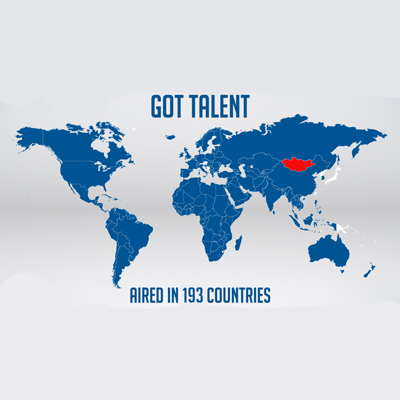
    The Guinness World Record-breaking franchise co-produced by Cowell’s Syco Entertainment and FremantleMedia continues its rein as the Most Successful Reality Television Format in history as it travels further around the world with the new version bringing the total number of local versions across Europe, Asia Pacific, the Middle-East, Africa and the Americas to 67 and the total countries in the world to air a version of the format to 193* (see map).

    As well as creating a local version of the format, Mongol TV will acquire season 8 of the ever successful Britain’s Got Talent. These deals were brokered by Haryaty Rahman, VP Sales and Distribution, Asia, FremantleMedia International. The UK version of the show continues to be the UK’s biggest entertainment show and in 2014 the Britain’s Got Talent finale on ITV exceeded 12 million viewers for 7th year in a row!


    Simon Cowell said “Mongolia is one of the last countries in the world to have Got Talent on air so I’m absolutely delighted Mongol TV will be making the show next year. So thank you and Congratulations Mongolia!”

    Cecile Frot-Coutaz, CEO, FremantleMedia added: “Got Talent has become a World Record breaking format because it combines extraordinary acts with great storytelling, capable of transcending geographic boundaries, language and culture. We’re looking forward to working with Mongol TV next year to create a local version of the show, which will – I’m sure – uncover an array of hidden talents from this part of the globe.”

    Nomin Chinbat, CEO of Mongol TV, said “When I heard Simon Cowell at MIPCOM saying that Got Talent had to be in Mongolia, I immediately decided to rise up to the challenge. Mongolians are great entertainers and this format is a great fit for Mongol TV. I now challenge Simon to join us in Ulaanbaatar in September when we launch the series!”

    Got Talent is watched by an estimated 500 million people worldwide has accumulated over 6 billion lifetime views on YouTube. In 2014, the franchise rolled out in six new markets: Afghanistan, Azerbaijan, Cambodia, Iceland, Mexico and Myanmar.


  • The Content Hub: Talent shows and drama series drive the global format business

    The Content Hub: Talent shows and drama series drive the global format business

    MUMBAI: “Format business is a major industry.  Today, the production value of format business is well over 20 billion euros,” said The Format People CCO & partner Justin Scroggie during his keynote at ‘The Content Hub’ organised by indiantelevision.com.

    It is unquestionable that television formats have indeed become essential components in the international television market. Largely licensed by television networks, TV formats describe the overall concept of a show and its premises. Investors around the world are now looking at television as an attractive business.

     “Over the past nine years, American Idol has generated US $8 billion on its own,” he said.

    Scroggie also discussed about the major global trends and television formats in the international landscape as part of his keynote presentation. According to him, the original drivers for the format business are game shows. “Game shows are flexible, relatively short, scalable in terms of cost and renewable. They are repeatable and above all, they are adaptable in various cultures,” he opined while highlighting that despite all this, game shows are struggling these days.

    So why is this happening? “Everybody is looking for the next big game show breakout and nobody is finding it,”Scroggie explained.  Citing the example of the popular game show Who wants to be a Millionaire, Scroggie said that big money prizes are not delivering the kind of drama as the audience is too familiar with it now.

    In addition, with the advent of reality and talent programmes, game shows are not delivering the same level of drama, strong characters and emotional connect which the audiences are expecting. According to Scroggie, talent and reality shows are driving the international format business.

    “Got Talent entered the Guinness book of world record as the world’s most successful reality television format. It has been adapted in 63 countries,” he informed. There are many successful talent show formats like ‘Strictly Come Dancing’ and ‘Masterchef’ that have been adapted globally.  “However trends don’t happen in every country at the same time,”Scroggie added. While Canada does not have many talent shows, China currently has more than 90 talent shows on air.  

    At this point, Scroggie also said that talent shows are also getting saturated.  “Having learnt the grammar of making international talent programmes, more and more countries are making their own versions so that they don’t need to buy international formats,” he explained.  

    Scroggie believes that the fastest growing area of format business is scripted formats which include drama series that can be adapted and remade in other countries. Homeland, for example, one of the highly successfully television shows in the US, is actually an Israeli format.

     
    “The best dramas are those that travel and have something about them. They can be adapted into the story and emotions of any country,” he said.

    Scroggie also spoke about telenovelas, such as ‘Everest’ on Star Plus that drive scripted formats. He believes that today we can find quality drama content written by top talent starring A-listers.  Serialised dramas like family, crime and politics also work.

    In the last part of his keynote, Scroggie explained how the barriers between viewers and shows are breaking down. “Television is a passive medium and the audience wants to interact with the people they see on screens,” he added.  Scoggie feels that web series is picking up and is easy to watch.  While social experiments are popular, they are also risky as they involve real people in a live and reality drama.

    Scroggie, whose organisation deals in format creation, consultancy on formats, branding and in-house training also delved on why UK is a leader in format sales.

    “UK broadcasters are only allowed to keep 15 per cent of the rights on the show. The creators of the shows retain 85 per cent. This has created a huge incentive for producers to sell their formats to broadcasters,” he stated.   

    While UK, US, Netherlands, Israel and Brazil are doing well in the format business, Scroggie feels that Turkey and China are potential countries to also look out for in the future.

     “With your help, let’s add India to the list,” he concluded.


  • FremantleMedia sees a ground-breaking sale of formats to Asia

    FremantleMedia sees a ground-breaking sale of formats to Asia

    CANNES: FremantleMedia International (FMI) has announced that it has sold a ground-breaking 25 formats to seven different Asian markets within the last year. FMI has closed two deals every month since taking over responsibility for format sales in the territory in 2013.
     
    The breadth of formats represented by the deals range from talent shows to gameshows, dating and fashion formats. The latest deal sees the world record-breaking Got Talent franchise, which is co-owned and produced by Syco Entertainment and FremantleMedia, sold to Laos broadcaster LNTV3. It was concluded by FMI’s VP international distribution & home entertainment Haryaty Rahman.
     
    Since taking over responsibility for local format sales 12 months ago, Rahman has been the architect of a range of deals that has ensured that Got Talent, Idols and The X Factor in Myanmar and Cambodia, became the first ever international talent or singing formats to have entered these markets. She has also successfully worked with broadcasters in the Philippines, Singapore, Malaysia and Taiwan to bring Asian audiences some of the world’s best-loved titles like Hole in the Wall, Family Feud, Total Blackout, Project Runway, The Noise and Take Me Out.
     
    Rahman said, “We’re very proud to have sold the equivalent of two formats every month over the last year. It’s a ground-breaking feat and testament to the quality and desirability of FremantleMedia’s formats. It’s a huge advantage that we are based over here as it means we completely understand the requirements of local audiences and broadcasters, allowing us to match their needs with the breadth of titles we have in our catalogue to create the perfect fit.”

  • “I don’t have many artists on the panel because artists don’t like finding another artist”: Simon Cowell

    “I don’t have many artists on the panel because artists don’t like finding another artist”: Simon Cowell

    CANNES: MIPCOM 2014 has kickstarted with some great content from across the globe and some great sessions. The biggest content market on day one saw an interesting question and answer session between producer and talent scout Simon Cowell, who has been named the ‘personality of the year’ and a former Got Talent judge Piers Morgan.


    Excerpts…


    Was it in your blood to be in the entertainment industry?


    I loved entertainment since childhood. My dad was a very loyal guy, he told me one thing, whatever you do, remember that in every person, there is an invisible sign which says, “make me feel important.” And that’s how I started making my TV shows.


    What was the key moment for you in the business? When you started work and then everything fell, everything you dreamed of, crashed, what did all that tell you?


    If you work in TV, film, music business, only two things matter, stars and hits. I had nothing. When there is no training, you make more mistakes. I owned the bank half a million pounds. But in a way, it was the best thing that ever happened to me. Although I don’t want to do it again!


    You made the genius move of fusing the power of TV to power of music. You did it at a time when no one had thought of it…


     The truth is it was always there. Right from Elvis to Beetles, TV played a massive part in spreading their fame worldwide and for me I was very concerned about the stranglehold that radio companies had on record artists, and then I thought TV was the medium that I could use to connect with music.


    You have been critical of the participants who come on X Factor and Got Talent, will you sober down with age?


    In my business you have to become the audience permanently. So when I am editing and noting one of my shows, it has to be what I like and find emotional or funny. You can’t treat the audience like idiots. If somebody comes on stage and is literally tone-deaf, and if I say take a couple of singing lessons and you’ll be a star, they’ll think I’m mad. I am a perfectionist. The day you just let go without looking at it, that’s the day you lose it.


    What about stars as judge on the show?  


    I never wanted to put too many artists in the panel, because artists don’t want to find another artist.


    About partnership with FremantleMedia…


    Without FremantleMedia, I would not have been sitting here now. What I really liked about Fremantle was that it understood that the combination of a music company making a TV show was better than a TV company making a music show.


    You created One Direction, through your show…


    I don’t like the word ‘create’. I didn’t create them, I gave five people the opportunity to be in a group because I felt as a whole they would have a better chance of being successful because they were so young and inexperienced.


    The groups, I have to admit, were terrible that year, but I felt these guys could work together. What I did was because that’s what I needed to do, I gave them the opportunity and the boys ran with the opportunity. It was a fantastic collaboration.


    What happened to X Factor America?


    I haven’t given up on the format in America. We just gave up on it too early.


    How important are the broadcasters in each territory?


    The broadcaster is one thing; it is the people in the channel who are important. They have trusted us and our partnership has been great.


    What do you look in people when you look for partnerships?


    Trust in both ways. If we didn’t have them trusting us in the first place, I wouldn’t have been here. They look after the shows and make it their own. That’s what I love.


    Are you moving into movies?


    Yes, but slowly. So we will do what we did in TV. My thought process is that with so many artists, I am looking at something like a High School Musical.


    Why have you done so few shows?


    Because it is difficult to come up with hit shows like X Factor or Got Talent. Too many shows will kill the market. The show these days are more about gimmick.


    Do you see a problem with multi-screen viewing?


    I don’t see a problem with it. If there are new ways of watching our shows, it is only to our advantage.


    When you relook, what’s that one moment you look to?


    The second week’s ratings of X Factor UK. The numbers had gone up by millions, as compared to the first week. So I felt really good.

  • Colors takes centre stage with ‘Got Talent’

    Colors takes centre stage with ‘Got Talent’

    MUMBAI: From the time Colors’ biggest reality show, Bigg Boss ended, speculation has been if Salman Khan will return for the eighth season of the show. And when the news of Shah Rukh Khan coming on the channel broke, rumours about SRK hosting the show intensified.   


    However, these rumours have now been put to rest as the channel made formal announcement of its new property ‘Got Talent World Stage Live’ which will be hosted by Shah Rukh Khan.


    The channel is set to present a first-of-its-kind global on ground extension of the ‘Got Talent’ franchise in India. It has associated with RFS Entertainment, an entertainment company that has partnered with Simon Cowell’s Syco Entertainment, to bring the best of acrobats, dancers, stunt artists and many more to the country.


    The live event is an extension of the channel’s marquee talent show, ‘India’s Got Talent’, which is created and owned by Syco Entertainment and is co-produced by FremantleMedia India and is executed by Cineyug.


    A ticketed event will feature performances by 10 Indian and 10 International talents. 


    Colors CEO Raj Nayak asserts, “With every show, we believe we are just reinventing ourselves. As a broadcaster, the property holds immense potential for us because the discerning audience harbours great appreciation for outstanding talent.”


    He further adds that it took them time to put everything into place. “When we were ready with the idea, the artists were not available. So, it took two years for us to get all of them together on-board.”


    According to RFS Entertainment owner Ravinderjit Singh, the promising new talent across genres proving their mettle on every platform makes India the perfect backdrop for a showcase of this magnitude. He believes it will be a delight for Indian audiences when the caliber of national and international talent will join hands.


    Talking about advertisers’ traction, Nayak says it is at a pre mature level. “We have just made an announcement on this. But I am never worried about advertisers,” he laughs.


    The tickets for the event will go on sale next week on www.bookmyshow.com which will be held at Mumbai’s Andheri Sports Complex on 6 December 2014. The channel will air it later for which the date hasn’t been finalised yet.


  • FremantleMedia promotes Chris O’Dell to head of global entertainment production

    FremantleMedia promotes Chris O’Dell to head of global entertainment production

    MUMBAI – FremantleMedia, one of the largest creators, producers and distributors of television brands in the world, today announced the promotion of Executive Producer Chris O’Dell to Head of Global  Entertainment Production.


    Reporting to the Director of Global Entertainment, Rob Clark, Chris will oversee and be the first point of contact for FremantleMedia’s international production teams as they roll out formats such as X Factor, Got Talent, Idols and Farmer Wants a Wife across the world.


    Chris O’Dell says: “FremantleMedia has some of the world’s best-known entertainment brands in its catalogue and a fantastic set of producers in the all the major markets who deliver these formidable shows time and again. I’m really excited to take on this new challenge, work with the team to continue to deliver our global hits and introduce international audiences to some of our exciting new formats.”


    Rob Clark added: “Chris is one of the most experienced producers I know. He has worked with some of the biggest companies and most well-loved names in the entertainment industry, and has a wealth of experience producing FremantleMedia’s hit shows all around the world. I think he’ll be a fantastic Head of Global Entertainment Production and look forward to work with him as we continue to roll out our shows in new markets.”


    Prior to his promotion, Chris was Executive Producer at FremantleMedia for the last seven years, working with executives, producers, territory heads and local broadcasters to produce, refresh and manage FremantleMedia’s key entertainment formats including X Factor, Got Talent, Take Me Out, Hole in the Wall and Idols. An experienced media executive, Chris has held a number of production roles such as Executive Producer, Series Producer and Head of Development with companies which include TWI Entertainment, part of IMG Media, Granada Entertainment and London Weekend Television (LWT) where he had various roles including Head of Entertainment Formats, Executive Producer, Series Producer & Creative Executive. His production credits include Blind Date, Surprise Surprise, An Audience with…, Saturday Night Takeaway and Ant & Dec’s All Star Cup. Chris also created two formats – Chef V and The Better Half – which sold internationally.


    Chris’ promotion follows the departure of Diana Buddingh, who left the business to return to Holland in May.

  • ‘Like Latin America, Indian fiction can be sold around the world’ : The WIT MD Virginia Mouseler

    ‘Like Latin America, Indian fiction can be sold around the world’ : The WIT MD Virginia Mouseler

    As format shows have become globalised, India offers an interesting opportunity. The consumption of reality shows has gone up even as channels like MTV have changed their positioning.

    In fiction, India is also emerging as a powerful production force and has the potential to sell its products around the world.

    The Wit (World Information Tracking), an agency specialised in research and information on TV programmes worldwide, is looking at expanding in India.

    In an interview with Indiantelevision.com’s Ashwin Pinto, The Wit’s managing director Virginia Mouseler talks about the company’s plans and the kind of content that works globally.

    Excerpts:

    When you founded The Wit 15 years ago, what did you set out to achieve?
    We wanted to explore creativity around the world and explore new ideas. We realised that other countries had good ideas and in France nobody knew about it.

    Now formats have become globalised. They travel around the world. Earlier only game shows like Wheel of Fortune travelled. Now it is a world of formats. The same good idea that works in one country can go to another and be adapted to the local culture.

    How have you expanded?
    In the beginning, we started with eight countries like UK, the US and Germany. These are the big markets in the Western world. Now we cover 40 countries, including some smaller countries like Belgium, as they are dynamic and creative. We observe every day the new shows and
    programmes that are being launched.

    We have correspondents around the world that send us a weekly report about the new shows that are launching in that country with ratings. You can track our database if you are a subscriber. Television channels subscribe to us. They get to know about interesting ideas.

    What are the major trends that we are seeing globally?
    The most successful show is the music talent contest. Music is everywhere. You cannot have just a singer in front of an audience. There has to be a competition element. Last year the number of formats adapted globally was 10 times compared to five years back.

    People are buying more and more formats. The top formats adapted globally include Dancing With The Stars, Idol, Got Talent, X-Factor and who Wants to Be A Millionaire. Another trend is reality TV. This is everywhere. Another growing trend is factual entertainment.

    TV channels want to address serious social topics without being boring. They find a way to tackle important social issues like homelessness or being jobless or being overweight in an entertaining way. Instead of doing a documentary, they will create experimental shows where people can change their lives and change another life.

    Could you give me an example of this?
    Teenagers in the UK are difficult to handle. They do what they want. They do not go to school nor do they obey their parents. They are unruly. They are sent to another part of the world. In one example on a show called ‘World’s Strictest Parents’, two UK kids were sent to an Indian family in Rajasthan. They had to adapt to discipline. The father showed them what education means to him.

    Is the kind of content that works here different from what works abroad?
    I don’t think so. Of course, there are cultural differences. At the same time in India Big Boss has been a success as it has been everywhere. A good idea will work anywhere if it is not shocking or provocative. It should have universal and positive values.
    ‘The economic downturn has led to consolidation. Spain launched two new national channels and smaller thematic channels two years back; this year they merged. Consolidation has also taken place on the production front.‘

    How are drama and comedy faring?
    They are popular. The problem is that drama and comedy are more expensive than reality TV. Everywhere local fiction is the most popular. But some channels in the UK wanted to reduce costs due to the financial crisis. They are good at fiction and drama but it is expensive. They did more reality TV. It was not a matter of success but of cost.

    So the economic downturn impacted programme expenditure?
    Yes! The UK was hit. A lot of people lost jobs. Producers made less content due to less ad revenue. Channels decided not to buy big budget fiction. I hope that they will do it again. The crisis impacted budgets of channels. They couldn’t pay for big historical fiction.

    In Germany they decided to buy more American shows rather than produce quality local shows due to costs. Now the situation is getting better. Spain is producing good fiction but with less expensive budgets. We are also seeing more co-productions happen in Europe between countries. This allows for expensive historical series to be made. For one country to do it would be difficult. The budgets are less than what is available in the US. When there are only 50 million viewers, it is difficult to produce an expensive show.

    The other impact of the downturn is that it led to consolidation. Spain launched two new national channels and smaller thematic channels two years back. This year they merged. Economically they could not attract enough ad revenue.

    How has the production sector been affected?
    Consolidation has also taken place on the production front. Earlier there were 10 independent production houses in a country. Now most have been acquired. It is tough for independent producers as there are few independent formats. They cannot buy a format as the big production houses have the major formats. It is difficult for a new
    idea to go on air now if it was not a success elsewhere.

    Channels are afraid of making mistakes. They don’t want to take the risk of buying a new idea from an independent producer.

    Across Asia what has the scene been like?
    Fiction in Korea and Japan is a big success in terms of soaps and dramas. After that, you have music and dance. We cover those two markets in Asia. Now we are focusing on India.

    What are the plans for India?
    Until now we followed formats which were adapted from abroad to see how it was done and if it had different cultural values. We did not follow fiction as there was a lot of it. Now we see channels like MTV have interesting local reality formats developed here like Roadies.

    We will focus on this kind of creativity. We will also cover fiction shows on channels like Colors. We want to touch base with the people in these channels to understand what is important for them and their style of production. India is such a powerful production force in fiction. I think that Indian fiction can be sold around the world as has been the case with Latin America. Their telenovelas are sold globally.

    Are you setting up an office here?
    No! We have one office in Geneva. We have correspondents globally sending us reports. It could be a housewife who loves television and will tell us everyday what is going on. Local correspondents also tell us why a fiction show is successful. It could be that the host is popular or that nobody wanted to see competition. You could have a
    show that runs for three hours and which delivers good ratings.

    Only a local person can tell you why it is a success. You need background and gossip. Someone who loves television and is not judgmental makes for a good correspondent. Correspondents should be able to work with our schedule and way. They have to be people that I can trust. I have to count on them every week. In India at the moment the PR agencies of channels send us data.

    Why didn’t you focus more on India earlier?
    We focus on countries that want to export their formats. Japan and Korea are looking increasingly at exporting formats. India so far has imported formats. They did not export anything. Now local concepts are being created here that are worth exporting. Important people in television and media read the Wit. It is an advertising platform for channels.
    We are seeing many foreign companies like CBS and RTL in Germany coming in now and tying up with Indian media companies. How do you see this impacting the content landscape?
    They will try to widen their own sales catalogue and adapt it to the local market. It is good for viewers as they have more choice. RTL and CBS want to have more space to sell but they have to be an Indian channel first of all if they hope to succeed. RTL has been in Greece recently and they have to adapt to the Greek market. They have to develop local fiction with local producers.
    What challenges are content producers and distributors facing as they try to hold on to audiences?
    The most threatened are the bigger channels. In the US for instance, the big networks have lost their audiences a lot over the past five years due to newer cable channels that drew young viewers. Specialty channels came in that targeted young women.

    What they have to do is create new channels themselves that are niche. The needs of people are becoming more specific. If you like golf, you want a channel for it.
    What impact is new media having on time spent on traditional television?
    Statistics show that people watch more television. New media is another platform. It is a new possibility to watch television. The challenge is to do good stories, ideas. Young people can connect to Twitter and Facebook. This is why the industry is developing connected television. They can attract young viewers on the TV and use what they like on their computer. Channels are working with technology companies.

    Is research more important today in an increasingly fragmented television environment?
    Television is a cultural product. When you see a TV show, you want to see something that reflects your society. You want to find yourself or your neighbour. Television is an image of society. You have to look at social and cultural influences to do a good TV show.
     

    But did the downturn impact channel budgets on research?
    We are a research tool. We did not lose any subscribers. We are a necessary luxury as channels need to know what is happening in other markets. We do social research to watch the social images of other countries through television. Television teaches you about the social worlds in other countries.

    The youth is probably the most difficult demographic to capture. They also migrate across platforms. What can media companies do to hold their attention better?
    Channels spoke about multiplatform formats last year. I think though that just going multiplatform does not make a show. It has to be an interesting story, a good topic something that touches the life of a youth.

    The youth might want to interact with and control content. However this is only an additional tool. The core is to have a show that meets the youth’s issues in an innovative way. It could be in fiction, reality. One show that has worked is Young Dumb and Living Off Mum. It airs in the UK on the BBC and focuses on making youngsters who have been lazy more responsible. But it is done in an entertaining way.

    The series follows a group of youth who‘ve waited on hand and foot their whole lives. The series sees them living together in a house and fending for themselves. Each week they must compete against each other in tough work challenges set by their parents, designed to encourage them to become more independent. After each assignment, their parents meet to watch the footage of the task and decide who, based on behaviour and performance, should be eliminated from the competition.At the end of the series, the winner will receive a round-the-world trip for two people.

    In what way has the youth perception and expectations from television changed over the past five years in India and globally?
    The youth want to watch television everywhere. Earlier the family gathered at a certain time. That has changed. The youth want to watch it anytime and anywhere and enter it anytime. You cannot tell them that a show starts at 8 pm. They want to control television and not be in control of it.

    What are the mistakes that television channels catering to the youth should avoid?
    It should avoid giving them lessons. It should not talk down to them. Television is not a tool of power. Broadcasters should realise this. Television is a consumption good. Television should understand that it has to be attractive and at the same time offer flexibility. It should not be a big brother. The youth want information in an entertaining way.

    What lessons have come from shows that have worked for youth?
    Youth needs guidance and coaching. This is why there are so many coaching shows for the youth. Guidance can be given but not through lessons. It should be done through experiments like involving somebody’s life being changed for the better.

    The youth also want avenues that allow them the possibility show their talents. That is why talent shows are popular. However everything does not have to be about being a star. There are talent shows for ordinary jobs like a butcher, nurse. Television has to offer experiments on different worlds.

    What about content targeted towards women?
    There is an interesting show in the US that has been adapted in many European countries called ‘The Real Housewives of’. They follow real housewives from a neighbourhood. You can enjoy watching the life of a real housewife. It is not necessarily about the successful woman professionally. She can be middle class or upper class. You can see her daily life. The ideas came from the fiction show Desperate Housewives.

    Another interesting thing is that shows that only targeted women earlier are also hooking on men. For instance, cooking shows are very successful. Here you have Masterchef India. This genre also targets men. Men and women compete to cook the best meal and welcome guests. Japan loves this genre. But what is interesting is that countries like France and Italy which are famous for food have less cooking shows.

    In terms of television consumption patterns, what differences are there globally?
    What we have seen is that it is often linked to when people have dinner. So in the UK the news is at 7 pm, in Germany it is at 8 pm and in Spain it is at 10 pm. In the UK the average length of a show is half an hour. In Italy it is three hours.

    In the first 20 minutes, the host is greeting the audience and saying nice things. In the UK it would be over. In Turkey, a fiction show is four hours. Turkish people like watching TV, going to eat and going back to watch the show.

    Are any genres becoming more popular?
    Hidden camera shows are making a comeback on television globally. This would work well in India. These shows have a lot of comedy. Big global events are becoming stronger drivers for channels like a world cup.
     

    In India we are seeing a trend where music channels to capture youth have moved away from music and doing different shows. Is this something being seen globally as well?
    Yes! They realised that they needed an identity. Music video clips can be found in many places. MTV realised that they had to be something else than just a music channel. When MTV started, it was the only place where you could find music clips. That is not the case now. They needed a clear personality. The music channels realised that they need to have a face, a real identity.