Tag: Google

  • Nestle to fund SilverPush & IotPot pilots, ad:tech concludes

    MUMBAI: ad:tech, one of the largest digital marketing event, concluded its 7th edition of Digital Marketing & Advertising Conference & Exhibition in India at Gurgaon.

    ad:tech 2017 had keynotes from industry veterans and enlightening sessions for the adverting marketing community. The event witnessed a large footfall which included exhibitors, marketers, and industry leaders and an Innovation Zone with the latest disruptive technology in digital marketing.

    The second day of the action packed digital marketing event saw keynote from Times Internet’s Gautam Sinha on ‘Re-inventing digital engagement’ followed by GroupM’s Rob Norman who engaged the audience with a dynamic session on ‘Facebook and Google duopoly and the challengers to that’. These introductory keynotes were followed by spotlight sessions on topics like ‘Ecommerce companies as media platforms’, ‘Vernacular on Mobile’ and others.

    The second day concluded with the keynote by Bharat Anand, HBS Professor and author-The Content Trap who shared his insights on ‘Reflection of marketing in a digital age’.

    SilverPush and IotPot walked away with the coveted ‘The Next Big Thing’ title along with a fully-funded pilot with Nestlé. This year ad:tech brought its global initiative ‘The Next Big Thing’ to India in partnership with Nestlé India with the aim to build a platform that brings entrepreneurs and marketing leaders together and kick start collaborations. This proves to be a great platform for start-ups to prove their mettle by showcasing their indigenous ideas in front of Nestlé and digital media professionals and thereby walking away with a fully funded project.

    Comexposium India Country MD Jaswant Singh said, “The 7th edition brought together more than 100 companies from across the globe to exhibit what’s new and what’s next. Over the years ad:tech is developing as a coveted platform for the community to deliver content which is relevant in this fast changing dynamic industry.”

    This year’s event witnessed phenomenal additions of companies like IBM, Accenture, Gameloft, Taboola, GSK, SAP, Yes Bank, Maruti Suzuki and Pepsico India,

  • We-Media: UCWeb enhances focus on content, invests Rs 50 million

    MUMBAI:  Leading the user-generated content ecosystem in India, Alibaba Group’s UCWeb Inc has announced the launch of We-Media Reward Plan 2.0, a self-creating content platform in India with an initial investment of Rs 50 million. The internet major is investing Rs 2 billion for driving content distribution in India over the next two years. UCWeb’s content distribution platform UC News, launched in June 2016, has registered a new milestone by becoming one of the fastest growing apps in the country with a Monthly Active Users (MAUs) of over 80 Million in India (as of February 2017).

    Announcing the initiative on his visit to India, UCWeb co-founder and Alibaba Mobile Business Group president He Xiaopeng said, “Dominance of mobile and digital proliferation is leading to an increased adoption of mobile internet and is making India ‘Digitally Ready’. UCWeb is realising its vision of “Serve half the population of the planet” and we are moving forward to the era of “GUF” (Google, UCWeb and Facebook). The investment falls under Alibaba Digital Media and Entertainment Group’s targeted investment of $7.2 billion in content over the next three years.”

    “Content consumption on mobile is rapidly rising while the We-Media ecosystem is still at a nascent stage. According to our data, there are at least 400,000 self-publishers in India already with a huge scope to grow the market, especially in the niche categories. UC Browser was launched with an aim to solve browsing-related problems while UC News and We-Media program aim to meet the increasing demand of varied content by users and build a well-established ecosystem. With our strengths in technology like Big Data AI and vast experience in markets like China, UCWeb will augment its focus on digital content aggregation and distribution in the world’s second largest internet market, India. We aim for UC We – Media to open a gateway to more opportunities in India’s content industry and emerge as the No. 1 content generation and service platform in 2017,” Xiaopeng added.

    UCWeb is also upgrading its content and services portfolio by adding more short video-related content. Short Videos are fast becoming the most popular form of content consumed in China today and UCWeb sees huge potential for this concept here in India as well. UC News aims to provide upgraded content and services to its users and, going forward, will make significant investment in this category. According to the company’s latest Content Consumption Trends Report, video content has risen 30% in the last quarter alone. The company is in the process of setting up a separate team to handle the Short Videos section and is scouting for relevant partners to support this for UC News India.

    “The latest data on UC News shows that we generated over 3,100 million page views in January, 2017 alone, which translates to 100 million page views daily. Moreover, we are experiencing a fast rise in the average time spent on UC News. As of this quarter, an average user spends over 23 minutes on UC News. Our strong user base number indicates the success of our strategy of moving ‘From Tool to Content’. We had said that content is booming and 80 Million MAUs of UC News is a clear reflection of that. Users are embracing diverse -digital content and their appetite for such content is being met by UC News”, said Alibaba Mobile Business Group GM-Overseas Business Kenny Ye.

    Game-changer in the content ecosystem

    Besides an upgrade in Ad revenue sharing model, We-Media Reward Plan 2.0 will open the door of opportunity to the most talented writers in the country. 1000 We-media writers will be recruited in India and Indonesia who will be able to earn at least INR 50,000 per month through the UC News platform. UCWeb has been setting new trends under the UC We-Media program where people get an opportunity to create, to write, share thoughts and engage with their followers on UC News. The Program saw an increase of 200% and 350% (MoM) in its page views of English and Hindi We-Media content respectively in the past quarter.

    UC News is a big-data powered content distributor, serving as a one-stop source of trending and curated news content covering all popular categories that Indian users can consume on the go, with featured channels including news, cricket, technology, entertainment, movies, lifestyle, health, humor, etc. UCWeb’s strength in technology is helping UC News process millions of data request and content of massive origins everyday with the help of its three big data clusters set-up in India. The cluster combines over 5000 machines handling millions of data-request with a response time of less than 10 milliseconds for each, thereby boosting the content generation and distribution on UC News to meet the demands of 80 Million MAUs.

    Late last year, Alibaba Holdings announced its new digital media arm, Alibaba Digital Media and Entertainment, in a major reorganization of the company’s entertainment assets. The transformation marked a total consolidation of Alibaba’s media businesses, including video website YoukuTudou, UCWeb and Alibaba Pictures Group as well as the company’s sports, games, literature, music and the digital entertainment divisions.

  • Amazon, Tata & Hyundai top India’s most mobile-ready brands, FB in world’s best

    MUMBAI: Ansible, the mobile marketing and technology agency of IPG Mediabrands, in partnership with global market research firm YouGov, and Powered by Google, has launched MDEX, that ranks world’s most “mobile ready” brands.

    The Top 10 Most “Mobile Ready” Brands in India Are:

    Amazon
    Tata Motors
    Hyundai
    Maruti
    Snapdeal
    Horlicks
    Lakme
    Rin
    Iodex
    Bournvita

    In total, more than 2,000 brands were reviewed across 15 countries (Argentina, Australia, Austria, Brazil, Canada, Chile, Germany, India, Malaysia, Mexico, Philippines, Singapore, UK, Uruguay, and the USA) against 60 separate criteria, producing in excess of 240,000 data points.

    The Top 10 Most “Mobile Ready” Brands In The World Are:

    1. Facebook
    2. Amazon
    3. 7-Eleven
    4. Hyundai
    5. Microsoft
    6. Nike
    7. Google
    8. Adidas
    9. OLX
    10.Target

    Ansible India CEO Anjali Hegde said, “India is a mobile first nation and an entire generation has bypassed PC/Desktop to connect digitally. The new consumer is mobile first and uses it as a primary tool for information, entertainment, engagement, communication and commerce. MDEX puts into perspective and benchmarks the mobile readiness of brands to connect with this new consumer. It is an authoritative study which looks at the mobile ecosystem in a holistic way. This is a study is timely and would immensely benefit brands to remain ahead of the curve.”

  • Google, MS agree to crack down on online content piracy site

    NEW DELHI: A global war on content piracy, including in India, just got a leg up. For the first time, global tech giants Google and Microsoft have agreed to tighten up their search engines as part of a crackdown on content piracy websites illegally streaming events and films with the UK regulator Ofcom backing it.

    Google and Microsoft’s search engine Bing have signed up to a voluntary code of practice and will ensure offending websites are demoted in their search results, according to a PTI report from London, which goes on to state that he entertainment industry reached the agreement with the tech giants after talks brokered by the UK government.

    The initiative will run in parallel with existing anti-piracy measures, which includes initiatives by PIPCU or the Police Intellectual Property Crime Unit (PIPCU), which is a specialist national police unit dedicated to protecting the UK industries that produce legitimate, high quality, physical goods and online and digital content from intellectual property crime.

    PIPCU operationally independent and launched in September 2013 with £2.56million funding from the Intellectual Property Office (IPO) of the UK until June 2015, got additional funding from the IPO in October 2014 till 2017. The unit is dedicated to tackling serious and organized intellectual property crime (counterfeit and piracy) affecting physical and digital goods (with the exception of pharmaceutical goods) with a focus on offences committed using an online platform.

    The PTI report, quoting BBC and dwelling on Google and MS moves, stated that the code said to be the first of its kind in the world is expected to be in operation by the middle of this year.

    Jo Johnson, the UK’s minister for universities, science, research and innovation, was quoted in the report as saying that the search engines’ “relationships with our world leading creative industries needs to be collaborative”. He added: “It is essential that (consumers) are presented with links to legitimate websites and services, not provided with links to pirate sites.”

    Google has indicated that the effort would provide a way to check that its existing anti-piracy efforts were effective, rather than committing it to adding new measures. “Google has been an active partner for many years in the fight against piracy online. We remain committed to tackling this issue and look forward to further partnership with rights holders,” a Google spokesperson was quoted by PTI as saying.

    The UK’s Intellectual Property Office (IPO) led the discussions, with the assistance of the Department for Culture, Media and Sport. Britain’s communications watchdog, Ofcom, supported the talks by exploring techniques that could be used to ensure internet users avoid coming across illegal content.

    Trade body Alliance for Intellectual Property director-general Eddy Leviten told the BBC, according to the PTI report, “Sometimes people will search for something and they will end up unwittingly being taken to a pirated piece of content. What we want to ensure is that the results at the top of the search engines are the genuine ones. It is about protecting people who use the internet, but also protecting the creators of that material too.”

    Besides demoting copyright infringing sites, search engine auto-complete functions, a time-saving feature that suggests what users may be looking for, are also expected to remove terms that may lead to pirated websites. Compliance with the code will be monitored by the IPO over the next few months.

  • Google takes down 1.7 bn. ads for violating policies

    Google takes down 1.7 bn. ads for violating policies

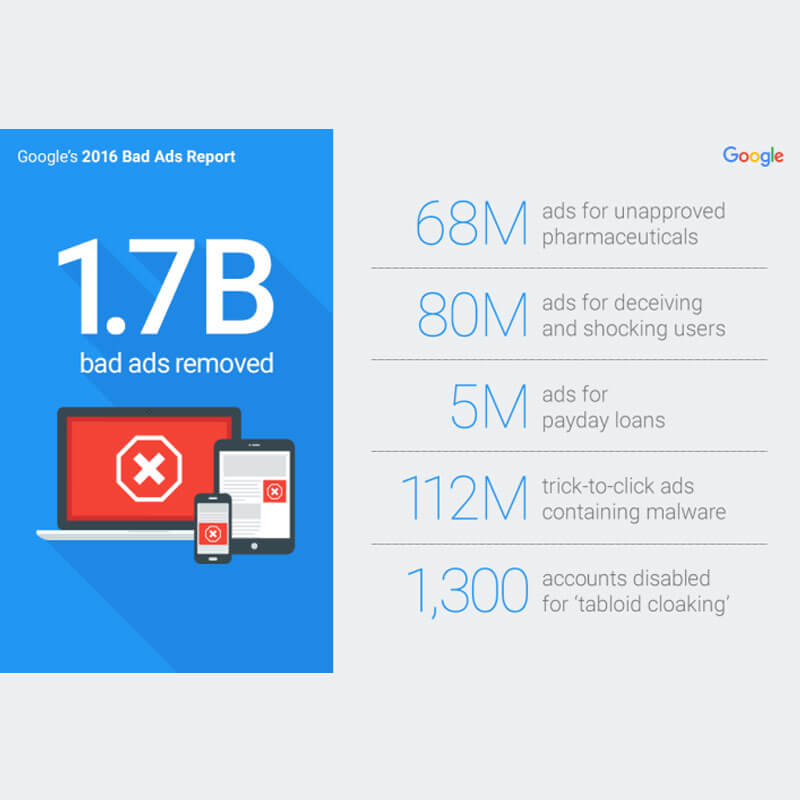
    MUMBAI: In 2016, Google took down 1.7 billion ads that violated its advertising policies, more than double the amount of bad ads it took down in 2015, according to the latest ‘Better Ads Report’ for 2016 released by the company.

    “A free and open web is a vital resource for people and businesses around the world. And ads play a key role in ensuring you have access to accurate, quality information online. But bad ads can ruin the online experience for everyone. They promote illegal products and unrealistic offers. They can trick people into sharing personal information and infect devices with harmful software. Ultimately, bad ads pose a threat to users, Google’s partners, and the sustainability of the open web itself,” said Sustainable Ads Product Management director Scott Spencer.

    Last year, Google did two key things to take down more bad ads. First, it expanded the company’s policies to better protect users from misleading and making predatory offers. For example, in July it introduced a policy to ban ads for payday loans, which often result in unaffordable payments and high default rates for users. In the six months since launching this policy, Google disabled more than five million payday loan ads.

    Second, it beefed up its technology to spot and disable bad ads even faster. For example, “trick to click” ads often appear as system warnings to deceive users into clicking on them, not realizing they are often downloading harmful software or malware. In 2016, Google detected and disabled a total of 112 million ads for “trick to click,” 6X more than in 2015.

    According to the report, most common inappropriate online ads were those for illegal products. Google disabled more than 68 million bad ads for healthcare violations and 17 million ads for illegal gambling violations in 2016.

    Protecting consumers against misleading ads that try to drive clicks and views by intentionally misleading people with false information like asking `Are you at risk for this rare, skin-eating disease?’ or offering miracle cures like a pill that will help people lose 50 pounds in three days without lifting a finger, Google took down nearly 80 million bad ads for deceiving, misleading and shocking users in 2016.

    As for ads developed exclusively for the mobile web, Google’s systems detected and disabled over 23,000 ‘self-clicking ads’ on its platforms as compared to only having to disable a few thousand of these bad ads last year. Similarly, the report highlighted a dramatic increase in scamming activity in 2016 and approximately 7 million bad ads were disabled for intentionally attempting to trick the Google detection systems.

    2016 also saw rise of a new type of scammers called `tabloid cloakers’ that take advantage of current trends and hot topics: a government election or a trending news story or a well-known celebrity. The ads used by these scammers may look like headlines for real articles on a news website but when clicked upon, consumers are redirected to a site selling weight loss products. In 2016, Google suspended over 1,300 accounts for `tabloid cloaking’. In December alone, Google took down 22 `cloakers’ that were responsible for ads seen over 20 million times by people online in a single week.

    Over the years, Google has been working to find ads that violate its policies and blocks the ad or the advertiser, depending on the violation. In 2016, it took action on 47,000 sites for promoting content and products related to weight-loss scams. It also took action on more than 15,000 sites for unwanted software and disabled 900,000 ads for containing malware. Around 6,000 sites and 6,000 accounts were suspended for attempting to advertise counterfeit goods, like imitation designer watches.

    In order to keep Google’s content and search networks safe and clean, Google has introduced stricter policies, including the new AdSense mis-representative content policy. The policy update introduced in November 2016, enables the company to take action against website owners misrepresenting who they were and deceiving users with their content.

  • Google takes down 1.7 bn. ads for violating policies

    Google takes down 1.7 bn. ads for violating policies

    MUMBAI: In 2016, Google took down 1.7 billion ads that violated its advertising policies, more than double the amount of bad ads it took down in 2015, according to the latest ‘Better Ads Report’ for 2016 released by the company.

    “A free and open web is a vital resource for people and businesses around the world. And ads play a key role in ensuring you have access to accurate, quality information online. But bad ads can ruin the online experience for everyone. They promote illegal products and unrealistic offers. They can trick people into sharing personal information and infect devices with harmful software. Ultimately, bad ads pose a threat to users, Google’s partners, and the sustainability of the open web itself,” said Sustainable Ads Product Management director Scott Spencer.

    Last year, Google did two key things to take down more bad ads. First, it expanded the company’s policies to better protect users from misleading and making predatory offers. For example, in July it introduced a policy to ban ads for payday loans, which often result in unaffordable payments and high default rates for users. In the six months since launching this policy, Google disabled more than five million payday loan ads.

    Second, it beefed up its technology to spot and disable bad ads even faster. For example, “trick to click” ads often appear as system warnings to deceive users into clicking on them, not realizing they are often downloading harmful software or malware. In 2016, Google detected and disabled a total of 112 million ads for “trick to click,” 6X more than in 2015.

    According to the report, most common inappropriate online ads were those for illegal products. Google disabled more than 68 million bad ads for healthcare violations and 17 million ads for illegal gambling violations in 2016.

    Protecting consumers against misleading ads that try to drive clicks and views by intentionally misleading people with false information like asking `Are you at risk for this rare, skin-eating disease?’ or offering miracle cures like a pill that will help people lose 50 pounds in three days without lifting a finger, Google took down nearly 80 million bad ads for deceiving, misleading and shocking users in 2016.

    As for ads developed exclusively for the mobile web, Google’s systems detected and disabled over 23,000 ‘self-clicking ads’ on its platforms as compared to only having to disable a few thousand of these bad ads last year. Similarly, the report highlighted a dramatic increase in scamming activity in 2016 and approximately 7 million bad ads were disabled for intentionally attempting to trick the Google detection systems.

    2016 also saw rise of a new type of scammers called `tabloid cloakers’ that take advantage of current trends and hot topics: a government election or a trending news story or a well-known celebrity. The ads used by these scammers may look like headlines for real articles on a news website but when clicked upon, consumers are redirected to a site selling weight loss products. In 2016, Google suspended over 1,300 accounts for `tabloid cloaking’. In December alone, Google took down 22 `cloakers’ that were responsible for ads seen over 20 million times by people online in a single week.

    Over the years, Google has been working to find ads that violate its policies and blocks the ad or the advertiser, depending on the violation. In 2016, it took action on 47,000 sites for promoting content and products related to weight-loss scams. It also took action on more than 15,000 sites for unwanted software and disabled 900,000 ads for containing malware. Around 6,000 sites and 6,000 accounts were suspended for attempting to advertise counterfeit goods, like imitation designer watches.

    In order to keep Google’s content and search networks safe and clean, Google has introduced stricter policies, including the new AdSense mis-representative content policy. The policy update introduced in November 2016, enables the company to take action against website owners misrepresenting who they were and deceiving users with their content.

  • Netflix confirms seven million subs; picks up Amazon gauntlet

    Netflix confirms seven million subs; picks up Amazon gauntlet

    MUMBAI: For all those media watchers who have been writing Netflix’s obituary in India, here’s a note of caution: take a few steps back, hold on to your fingers before banging in any other words on your keyboards. The global streaming services has come back with some smashing numbers in the latest quarter which should make the critics go red in their faces – with embarrassment, of course. And it is quite likely it will go back to the drawing board with a review of its India strategy.

    The company announced over the weekend that it had added 19 million new net subs in the year 2016 as against 17.4 million in 2015, finishing the year with 93.8 million subs. Its global streaming revenue during the period: a mindboggling $8.3 billion, reflecting a 35 per cent year on year growth.

    And its figures for the quarter ended 31 December 2016 are also noteworthy: it notched up its historical best Q4 net adds number at 7.05 million (against 5.20 million forecast and 5.59 million in Q42015). These net adds came both courtesy the US (1.93 million vs forecast 1.54 million) and the 190 countries it is present in (5.12 million Q4 2016 as against the 3.75 million forecast and 4.04 million achieved in the year ago quarter). The company says in a release that the contribution was broad based geographically and the impact of its content slate is likely to be felt even more in Q2 2017 as it rolls out the new shows it has commissioned and libraries it has acquired.

    The Reed Hastings-Ted Sarandos team has upped Netflix’s content budget to $6 billion for 2017 – 20 per cent more than it had laid out for 2016. The company has given a guidance of 5.12 million new net adds for Q1 2017 (3.7 million of these will be from outside the US).

    Estimates are that it has managed to rope in sub-100,000 subscribers in India and renewals have been tough to achieve. In fact, it sent down a team on a fact finding mission to figure out why uptake has not been blazing like in other parts of the world. And how it can appeal better to potential subscribers.

    Analysts expect some pricing corrections going forward, considering the aggressive pricing that streaming services such as Hotstar, Amazon Prime, ErosNow, YuppTV, Hooq are adopting.
    Then it hopes that its offline viewing mode it launched in Q42016 will also help do the trick in India where bandwidth is patchy at best, despite the speedy rollout of 4G services by Jio, Airtel, Idea and the freebie offers they are dishing out.

    The Netflix offline mode allows viewers on iOS and Android devices to download content for viewing later while traveling to work on subways, buses, planes etc. The company hopes that this feature will do well in countries with limited or expensive bandwidth. Says the press release: “We are pleased with the initial results and as expected enjoyment of offline viewing is greatest where the broadband infrastructure is less than robust.”

    Netflix is also banking on the appeal of Shah Rukh Khan to help do the magic in India and south Asia. Speculation is that it has invested hundreds of crores to acquire Red Chilies Entertainment’s forward and back catalogue. Then of course its first series adapted from Vikram Chandra’s Mumbai underworld thriller Sacred Games and produced by the edgy production house Phantom Films should see the light of day by mid to end 2017.

    If it does anywhere as well as Netflix’s first Brazilian original series 3% did, it could catapult the SVOD service to cult status amongst India’s millenials and mobile-toting generation. The Portuguese language scifi post apocalyptic thriller premiered last year as one of the most watched originals in Brazil as well as Latin America and was also watched by millions of subscribers in the US dubbed and subtitled in English.

    Netflix is quite confident that its 2016 global slate – which included award winning shows such as The Crown, Marvel’s Luke Cage, Gilmore Girls: A Year in the Life, The OA, Troll Hunters – will continue to generate traction in India.

    Netflix acknowledges in the investor release that Internet TV is evolving fast and becoming hyper competitive. Says the company: “Internet video is a global phenomenon. Amazon Prime Video expanded recently to match our territory footprint, while YouTube remains far larger than either of us in terms of global video enjoyment minutes. Video consumption is growing on Facebook, and Apple is rumored to be adding video to its music service. Satellite TV operators are moving to become internet MVPDs, such as ViaSat to ViaPlay in the Nordics, DISH to Sling, and DirecTV to DirecTV Now. Insurgent firms such as Molotov.tv in France and Hulu are building native-internet interfaces for TV network bundles. CBS is releasing a major original series ( Star Trek) exclusively on its domestic SVOD service (with us as international partner). Finally, the BBC has become the first major linear network to announce plans to go binge-first with new seasons, favoring internet over linear viewers. We presume HBO is not far behind the BBC. In short, it’s becoming an internet TV world, which presents both challenges and opportunities for Netflix as we strive to earn screen time. “

    It additionally states that Q42016 marked the tenth anniversary of its streaming launch. And the road ahead is quite clearly laid out. “The next decade will be even more amazing and tumultuous as Internet TV supplants linear TV and we strive to remain a leader.”

  • Netflix confirms seven million subs; picks up Amazon gauntlet

    Netflix confirms seven million subs; picks up Amazon gauntlet

    MUMBAI: For all those media watchers who have been writing Netflix’s obituary in India, here’s a note of caution: take a few steps back, hold on to your fingers before banging in any other words on your keyboards. The global streaming services has come back with some smashing numbers in the latest quarter which should make the critics go red in their faces – with embarrassment, of course. And it is quite likely it will go back to the drawing board with a review of its India strategy.

    The company announced over the weekend that it had added 19 million new net subs in the year 2016 as against 17.4 million in 2015, finishing the year with 93.8 million subs. Its global streaming revenue during the period: a mindboggling $8.3 billion, reflecting a 35 per cent year on year growth.

    And its figures for the quarter ended 31 December 2016 are also noteworthy: it notched up its historical best Q4 net adds number at 7.05 million (against 5.20 million forecast and 5.59 million in Q42015). These net adds came both courtesy the US (1.93 million vs forecast 1.54 million) and the 190 countries it is present in (5.12 million Q4 2016 as against the 3.75 million forecast and 4.04 million achieved in the year ago quarter). The company says in a release that the contribution was broad based geographically and the impact of its content slate is likely to be felt even more in Q2 2017 as it rolls out the new shows it has commissioned and libraries it has acquired.

    The Reed Hastings-Ted Sarandos team has upped Netflix’s content budget to $6 billion for 2017 – 20 per cent more than it had laid out for 2016. The company has given a guidance of 5.12 million new net adds for Q1 2017 (3.7 million of these will be from outside the US).

    Estimates are that it has managed to rope in sub-100,000 subscribers in India and renewals have been tough to achieve. In fact, it sent down a team on a fact finding mission to figure out why uptake has not been blazing like in other parts of the world. And how it can appeal better to potential subscribers.

    Analysts expect some pricing corrections going forward, considering the aggressive pricing that streaming services such as Hotstar, Amazon Prime, ErosNow, YuppTV, Hooq are adopting.
    Then it hopes that its offline viewing mode it launched in Q42016 will also help do the trick in India where bandwidth is patchy at best, despite the speedy rollout of 4G services by Jio, Airtel, Idea and the freebie offers they are dishing out.

    The Netflix offline mode allows viewers on iOS and Android devices to download content for viewing later while traveling to work on subways, buses, planes etc. The company hopes that this feature will do well in countries with limited or expensive bandwidth. Says the press release: “We are pleased with the initial results and as expected enjoyment of offline viewing is greatest where the broadband infrastructure is less than robust.”

    Netflix is also banking on the appeal of Shah Rukh Khan to help do the magic in India and south Asia. Speculation is that it has invested hundreds of crores to acquire Red Chilies Entertainment’s forward and back catalogue. Then of course its first series adapted from Vikram Chandra’s Mumbai underworld thriller Sacred Games and produced by the edgy production house Phantom Films should see the light of day by mid to end 2017.

    If it does anywhere as well as Netflix’s first Brazilian original series 3% did, it could catapult the SVOD service to cult status amongst India’s millenials and mobile-toting generation. The Portuguese language scifi post apocalyptic thriller premiered last year as one of the most watched originals in Brazil as well as Latin America and was also watched by millions of subscribers in the US dubbed and subtitled in English.

    Netflix is quite confident that its 2016 global slate – which included award winning shows such as The Crown, Marvel’s Luke Cage, Gilmore Girls: A Year in the Life, The OA, Troll Hunters – will continue to generate traction in India.

    Netflix acknowledges in the investor release that Internet TV is evolving fast and becoming hyper competitive. Says the company: “Internet video is a global phenomenon. Amazon Prime Video expanded recently to match our territory footprint, while YouTube remains far larger than either of us in terms of global video enjoyment minutes. Video consumption is growing on Facebook, and Apple is rumored to be adding video to its music service. Satellite TV operators are moving to become internet MVPDs, such as ViaSat to ViaPlay in the Nordics, DISH to Sling, and DirecTV to DirecTV Now. Insurgent firms such as Molotov.tv in France and Hulu are building native-internet interfaces for TV network bundles. CBS is releasing a major original series ( Star Trek) exclusively on its domestic SVOD service (with us as international partner). Finally, the BBC has become the first major linear network to announce plans to go binge-first with new seasons, favoring internet over linear viewers. We presume HBO is not far behind the BBC. In short, it’s becoming an internet TV world, which presents both challenges and opportunities for Netflix as we strive to earn screen time. “

    It additionally states that Q42016 marked the tenth anniversary of its streaming launch. And the road ahead is quite clearly laid out. “The next decade will be even more amazing and tumultuous as Internet TV supplants linear TV and we strive to remain a leader.”

  • MAM 2016: When marketing, advertising hopped on to Digital India

    MAM 2016: When marketing, advertising hopped on to Digital India

    ‘Live streaming’, ‘Video on demand’, ‘data crunching’, ‘branded content’, ‘geo-targeting’, ‘digital measurement’, ‘native advertising’, ‘programmatic’, ‘digitisation’, ‘demonetisation’….2016 has generated enough buzzwords for the Indian marketer. So much so that it is hard to place one’s finger on that one thing that defined 2016’s marketing trends. Whatever be that theme, 2016 was definitely a year of disruption.

    Certainly it was disruptions galore. Disruption in how the audience consumes content (Hotstar, Netflix anyone?); disruption in how TV is viewed with major push towards digitisation; disruption in what content advertisers pay for (HUL’s Brooke Bond Red Label and the Six Pack Band, Tata Tiago driving TVF’s Tripling); disruption in media planning and buying (Amagi’s Mix); disruption in how we use money (payment banks and e-wallets) and finally disruption in pricing.

    One prime differentiator for brands this year was pricing or even no- pricing! The year started with the popular debate on Net Neutrality sparked by Airtel Zero and Facebook’s internet.org. Both had ambitious plans to provide internet across India at zero cost to preferential consumers. These projects couldn’t take off without blessings from TRAI, but differential pricing was also a major weapon used by OTT players in their race to be India’s primary SVOD service.

    Not to mention Baba Ramdev-pioneered Patanjali Ayurveda that gave global and incumbent Indian FMCG giants sleepless nights with its highly competitive pricing, even taking over other major advertiser by setting aside Rs 300 crore or Rs. 3 billion in ad spends. The nationalistic flavour that dominated the year further added to the brand’s marketing success.

    Patanjali wasn’t the only brand that cashed in on India’s new found nationalism in 2016. Another good example is Bajaj V, Bajaj Automobile’s latest launch in the 150 cc category, a part of steel used in which came from the now-decommissioned Indian navy’s warship INS Vikrant. The long-running and innovative marketing campaign, conceptualised and experimented with long-form content by Leo Burnett, picked up several medals in this year’s awards season.

    Nationalism aside, one of the major disruptors that the Indian marketers had to keep up with in 2016 was the Indian government itself. With some 60-odd policy changes throughout the year across various sectors, with remarkable execution time, the government kept the nation — and the markers — on their toes. Demonetisation of high value currency notes being the latest. While one would expect government and its departments to take several months to act on a single policy change, the PM Modi-led government remained exceptionally pro- active throughout 2016 — some critics dubbed it extremely destructive, but that’s another story — including the Star-Up India initiative that would further pump out a new breed of digital brands by 2017.

    ‘Marketing isn’t magic. There is science to it.’ This famous quote by Hubspot’s social media scientist and award winning marketer Dan Zarrella was felt strongly in 2016. Marketing in India saw a major facelift with increasing stress on technology. Whether it was the rise of messenger apps over social media, FB opening its door to easy and convenient live streaming, chat bots fronting the direct marketing initiatives by new age services, drones becoming the messengers of communication, media agencies putting more emphasis on data procurement and trend mapping through new tools, or AR/VR changing the ball game altogether…. ‘martech’ has taken a leap of faith worth a few decades in just a year. And for once, India wasn’t lagging at the tail end of this disruption. In some cases it was actually in the eye of the storm.

    Social media and technology giant Facebook recently announced India as its second most important market after the US and has in fact invested heavily in several India- only initiatives for both its users and brands. The result is that several brands, which were solely dependent on YouTube for the ‘digital video’ aspect of their marketing mix are now taking Facebook seriously. Although YouTube remains the market leader in digital video ad spends, 2016 Facebook has drawn significant attention from brands thanks to the advanced targeting options and different format options it offers with its video service (360 degree, live video, etc). Given the major setbacks that Facebook faced in this market, first with internet.org and then its mistake with measurement figures, this positive acceptance by brands was a major plus.

    2016 also saw several major Indian brands dabbling in Virtual Reality. Tata Motor’s virtual desk drive through mass distributed Google cardboards is a classic example. While innovations brought freshness in the sector, it has only set the stage for a more substantial use of VR/AR for marketing in 2017.

    When it comes to the start-ups and e-commerce world, the general trend was that of austerity. With cash crunch in the investment world and investors asking to recheck acquisition costs and several start-ups nearing their re-evaluation period, many companies saw themselves moving from GMVs to NPS to measure their value. With their burn rates going down, ecommerce giants couldn’t continue their marketing blitzkrieg as they did in 2015.

    While 2016 remained loyal to the ad spend estimates, third quarter saw a major fall in advertising spends across mediums following marketing budget cuts in major FMCG brands in the aftermath of demonetisation. Advertising was the first sector to be impacted due to this government move. Though the effect was felt across the whole medium, cut in television advertising spends accounted to almost Rs 600 crore (Rs. 6 billion) — some estimates put it as high as 2500 crore or Rs 250 billion. Print and out of home were the second most impacted segments. At the cost of over-generalising, the industry has seen a drop of almost 25 per cent in advertising spends in the current quarter. Advertising is also likely to be the last sector to return to normalcy as long as brands continue to treat it as expenditure and not an investment.

    Though comparatively digital advertising suffered less due to demonetisation, the digital video saw a major setback, while SEO and other forms of digital advertising managed to stay afloat. Nonetheless, it is imperative that most major agencies would revise their advertising forecast for 2016- 2017 estimates factoring in demonetisation.

    It goes without saying that digital became one of the primary mediums of advertising for brands in 2016 with traditional agencies planning major account with the ‘digital first’ as a concept. The rapidly growing digital advertising spends got a major boost as social media planning became a buzzword. Industry experts and senior planners are hopeful that this trend will continue through 2017 with the availability of cheaper and faster data across India. The ongoing dialogue of a cashless economy saw digital brands such as payment banks and e-wallets emerge as a major spender. The government’s push towards cashless transaction of money is most likely to give rise to a new breed of digital brands, which is good news for the digital advertising world.

    However, television continued to be the most preferred medium; especially with brands going after maximum reach and engagement. Television in India proved its efficiency as an advertising medium, thus ruling ad spends. But, major media management agencies such as GroupM and Dentsu Aegis Network are moving towards ‘video planning and buying’. Being platform-agnostic is the way forward.

    Overall, 2016 started with a good pace but slowed down for the advertising world towards the second quarter. The industry took a major hit in the third quarter and is yet to recover from the demon(etisation) bit. While media gurus are bullish on long-term effects of demonetisation, they don’t have high hopes of the industry returning to normalcy anytime before the end of the financial year.

    While the advertising world awaits ‘achhe din’ (a period of prosperity) in 2017, it bid adieu to 2016, the year when marketing and advertising leap-frogged into ‘Digital India’.
  • MAM 2016: When marketing, advertising hopped on to Digital India

    MAM 2016: When marketing, advertising hopped on to Digital India

    ‘Live streaming’, ‘Video on demand’, ‘data crunching’, ‘branded content’, ‘geo-targeting’, ‘digital measurement’, ‘native advertising’, ‘programmatic’, ‘digitisation’, ‘demonetisation’….2016 has generated enough buzzwords for the Indian marketer. So much so that it is hard to place one’s finger on that one thing that defined 2016’s marketing trends. Whatever be that theme, 2016 was definitely a year of disruption.

    Certainly it was disruptions galore. Disruption in how the audience consumes content (Hotstar, Netflix anyone?); disruption in how TV is viewed with major push towards digitisation; disruption in what content advertisers pay for (HUL’s Brooke Bond Red Label and the Six Pack Band, Tata Tiago driving TVF’s Tripling); disruption in media planning and buying (Amagi’s Mix); disruption in how we use money (payment banks and e-wallets) and finally disruption in pricing.

    One prime differentiator for brands this year was pricing or even no- pricing! The year started with the popular debate on Net Neutrality sparked by Airtel Zero and Facebook’s internet.org. Both had ambitious plans to provide internet across India at zero cost to preferential consumers. These projects couldn’t take off without blessings from TRAI, but differential pricing was also a major weapon used by OTT players in their race to be India’s primary SVOD service.

    Not to mention Baba Ramdev-pioneered Patanjali Ayurveda that gave global and incumbent Indian FMCG giants sleepless nights with its highly competitive pricing, even taking over other major advertiser by setting aside Rs 300 crore or Rs. 3 billion in ad spends. The nationalistic flavour that dominated the year further added to the brand’s marketing success.

    Patanjali wasn’t the only brand that cashed in on India’s new found nationalism in 2016. Another good example is Bajaj V, Bajaj Automobile’s latest launch in the 150 cc category, a part of steel used in which came from the now-decommissioned Indian navy’s warship INS Vikrant. The long-running and innovative marketing campaign, conceptualised and experimented with long-form content by Leo Burnett, picked up several medals in this year’s awards season.

    Nationalism aside, one of the major disruptors that the Indian marketers had to keep up with in 2016 was the Indian government itself. With some 60-odd policy changes throughout the year across various sectors, with remarkable execution time, the government kept the nation — and the markers — on their toes. Demonetisation of high value currency notes being the latest. While one would expect government and its departments to take several months to act on a single policy change, the PM Modi-led government remained exceptionally pro- active throughout 2016 — some critics dubbed it extremely destructive, but that’s another story — including the Star-Up India initiative that would further pump out a new breed of digital brands by 2017.

    ‘Marketing isn’t magic. There is science to it.’ This famous quote by Hubspot’s social media scientist and award winning marketer Dan Zarrella was felt strongly in 2016. Marketing in India saw a major facelift with increasing stress on technology. Whether it was the rise of messenger apps over social media, FB opening its door to easy and convenient live streaming, chat bots fronting the direct marketing initiatives by new age services, drones becoming the messengers of communication, media agencies putting more emphasis on data procurement and trend mapping through new tools, or AR/VR changing the ball game altogether…. ‘martech’ has taken a leap of faith worth a few decades in just a year. And for once, India wasn’t lagging at the tail end of this disruption. In some cases it was actually in the eye of the storm.

    Social media and technology giant Facebook recently announced India as its second most important market after the US and has in fact invested heavily in several India- only initiatives for both its users and brands. The result is that several brands, which were solely dependent on YouTube for the ‘digital video’ aspect of their marketing mix are now taking Facebook seriously. Although YouTube remains the market leader in digital video ad spends, 2016 Facebook has drawn significant attention from brands thanks to the advanced targeting options and different format options it offers with its video service (360 degree, live video, etc). Given the major setbacks that Facebook faced in this market, first with internet.org and then its mistake with measurement figures, this positive acceptance by brands was a major plus.

    2016 also saw several major Indian brands dabbling in Virtual Reality. Tata Motor’s virtual desk drive through mass distributed Google cardboards is a classic example. While innovations brought freshness in the sector, it has only set the stage for a more substantial use of VR/AR for marketing in 2017.

    When it comes to the start-ups and e-commerce world, the general trend was that of austerity. With cash crunch in the investment world and investors asking to recheck acquisition costs and several start-ups nearing their re-evaluation period, many companies saw themselves moving from GMVs to NPS to measure their value. With their burn rates going down, ecommerce giants couldn’t continue their marketing blitzkrieg as they did in 2015.

    While 2016 remained loyal to the ad spend estimates, third quarter saw a major fall in advertising spends across mediums following marketing budget cuts in major FMCG brands in the aftermath of demonetisation. Advertising was the first sector to be impacted due to this government move. Though the effect was felt across the whole medium, cut in television advertising spends accounted to almost Rs 600 crore (Rs. 6 billion) — some estimates put it as high as 2500 crore or Rs 250 billion. Print and out of home were the second most impacted segments. At the cost of over-generalising, the industry has seen a drop of almost 25 per cent in advertising spends in the current quarter. Advertising is also likely to be the last sector to return to normalcy as long as brands continue to treat it as expenditure and not an investment.

    Though comparatively digital advertising suffered less due to demonetisation, the digital video saw a major setback, while SEO and other forms of digital advertising managed to stay afloat. Nonetheless, it is imperative that most major agencies would revise their advertising forecast for 2016- 2017 estimates factoring in demonetisation.

    It goes without saying that digital became one of the primary mediums of advertising for brands in 2016 with traditional agencies planning major account with the ‘digital first’ as a concept. The rapidly growing digital advertising spends got a major boost as social media planning became a buzzword. Industry experts and senior planners are hopeful that this trend will continue through 2017 with the availability of cheaper and faster data across India. The ongoing dialogue of a cashless economy saw digital brands such as payment banks and e-wallets emerge as a major spender. The government’s push towards cashless transaction of money is most likely to give rise to a new breed of digital brands, which is good news for the digital advertising world.

    However, television continued to be the most preferred medium; especially with brands going after maximum reach and engagement. Television in India proved its efficiency as an advertising medium, thus ruling ad spends. But, major media management agencies such as GroupM and Dentsu Aegis Network are moving towards ‘video planning and buying’. Being platform-agnostic is the way forward.

    Overall, 2016 started with a good pace but slowed down for the advertising world towards the second quarter. The industry took a major hit in the third quarter and is yet to recover from the demon(etisation) bit. While media gurus are bullish on long-term effects of demonetisation, they don’t have high hopes of the industry returning to normalcy anytime before the end of the financial year.

    While the advertising world awaits ‘achhe din’ (a period of prosperity) in 2017, it bid adieu to 2016, the year when marketing and advertising leap-frogged into ‘Digital India’.