Tag: Google

  • YouTube removed 7.85 mn videos last quarter

    YouTube removed 7.85 mn videos last quarter

    MUMBAI: According to Google’s YouTube community guidelines enforcement report, YouTube removed 7.85 million videos and 1.67 million channels in its last quarter.

    The report wrote, “At YouTube, we work hard to maintain a safe and vibrant community. We have community guidelines that set the rules of the road for what we don’t allow on YouTube. For example, we do not allow pornography, incitement to violence, harassment, or hate speech.”

    In the past year, YouTube faced increased criticism for pushing users towards content which would be misleading and would violate its policies on spam. In order to deal with that, the video sharing website removed videos and channels which violated the policies of the company.

    YouTube explained that it will delete a channel if it receives three strikes in 90 days or if it has a single case of severe abuse like “pornography, incitement to violence, harassment, or hate speech, or violating guidelines (as is often the case with spam accounts).” When a channel is terminated, all of its videos are removed, the report added.

    79.6 per cent of the channels removed were spam, misleading and scams, 12.6 per cent channels because of adult sexual content. “The majority of channel terminations are a result of accounts being dedicated to spam or adult sexual content in violation of our guidelines,” said the report.

    Overall, 74.5 per cent of the videos were removed before any views and the other 25.5 per cent of the videos on the platform were removed after views. In this the majority 72.2 per cent of the videos were removed because they were spam, misleading and scams.

  • YouTube carrying out trials for more pre-video ads

    YouTube carrying out trials for more pre-video ads

    MUMBAI: Video streaming service site YouTube has been carrying out trials to add more ads into videos.

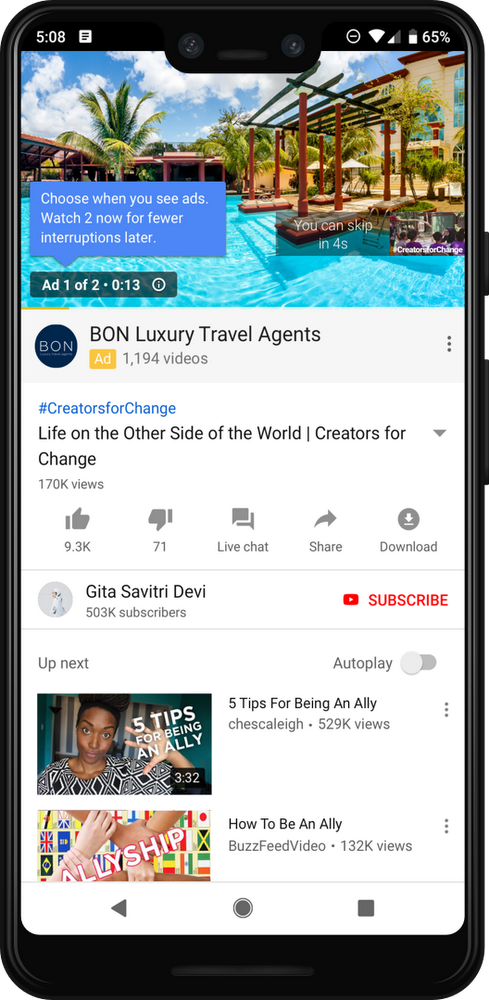
    In Google’s new blog post, it explained that interrupting viewers less often with ads correlates to better user metrics. And that is why; it has been carrying out tests which will show viewers two skippable ads back-to-back at the beginning of a video.

    Google wrote, “Because when users see two ads in a break, they’re less likely to be interrupted by ads later. In fact, those users will experience up to 40 percent fewer interruptions by ads in the session. Early experiment results also show an 8-11 percent increase in unique reach and a 5-10 percent increase in frequency for advertisers, with no impact to brand lift metrics.”

    This new change will first come to YouTube’s desktop experience. Mobile and TV screens will be followed with the new feature in the coming days.

    The update on YouTube will look something like this with a message explaining that you can watch two ads now for fewer interruptions later.

    Concluding the blog post, it wrote, “In the face of these burgeoning user trends — as well as the next wave, and the next — we’ll continue working to build the ideal video viewing experience, and keep thinking up ways to deliver value for our advertiser partners.”

  • ‘Koffee with Karan 6’ takes off with exclusive brand partners

    ‘Koffee with Karan 6’ takes off with exclusive brand partners

    MUMBAI: Indian film director Karan Johar’s crowd-pleasing talk show Koffee with Karan came back with its sixth season earlier this week. The opening episode of the new season featured Alia Bhatt and Deepika Padukone.

    The show airs on Star World, which is a part of Star India. According to Livemint, the broadcaster is anticipated to make around Rs 35-40 crore from sponsorship deals.

    The list of the sponsors includes high profile brand names such as multimedia speaker Google Home which is the presenting sponsor of the show, ‘driven by’ German automobile manufacturer company Audi and ‘powered by’ telecom operator Idea. Jaquar, OPPO F9 Pro and L’Oreal Paris are the lifestyle, special and beauty partners for the show.

    Speaking to Livemint, a Star spokesperson said, “As the longest running chat show on Indian television, Koffee With Karan sets new benchmarks with every new season creating unprecedented buzz and aggregating premium consumers across the television and digital platforms.”

    “As such, brands are more than excited to leverage the show and create unique integrations that would excite their target audiences,” added the spokesperson.

    The spokesperson also explained how they’ll use brand integrations during the show, like; the host Johar could use the Google Home features in between the show or in the rapid fire round, the questions could be read from an OPPO phone or a celebrity who gives the answer of the season in the rapid fire round could be awarded with an Audi.

    Star is also looking to engage with the viewers through social network, as every week, viewers will have a chance to win autographed mugs of their favourite celebrities by participating in the Twitter contest held by Star World. The show will also offer an opportunity to be on the Koffee couch and field rapid fire questions from Johar through a Facebook camera innovation which will be captured on social media.

  • Airtel, Jio turn to AI to improve customer service

    Airtel, Jio turn to AI to improve customer service

    MUMBAI: Every industry and player is adapting to Artificial Intelligence (AI) in today’s time and the Indian telecom industry isn’t far behind. In order to offer better customer service and experience, telcos like Bharti Airtel and Reliance Jio are turning to AI.

    Bharti Airtel has teamed up with technology company Google to remove the complexities from its customer service experience. It has integrated AI-powered Google Assistant which responds to voice commands. This modification is said to cut down costs. Airtel was already using AI and Machine Learning to enhance customer experience through its MyAirtel application and airtel.in

    Reliance Jio introduced the voice command feature on its MyJio application. In a recent report by Bank of America Merrill Lynch, it said that voice AI is a focus area for the Mukesh Ambani-led telco, and the AI-based voice command feature is working well for the telco.

    According to an Economic Times report, Jio is also taking steps to develop AI-based products and solutions in-house. Jio's director and Mukesh Ambani's son, Akash Ambani, is building a team of professionals on AI and its multiple use cases for the telecom firm.

    Speaking to ET, Greyhound Research founder, CEO and chief analyst Sanchit Vir Gogia said, “Efforts to automate customer service is already visible through apps. Airtel has already made sizeable efforts on this front and is seeing a good response on its MyAirtel app. It makes a lot of sense to adopt AI technology to automate given the cost of human interaction has increased 20-30 per cent.”

    He added that Indian telcos need to make their subscribers use these features. “Airtel's app for self-service is well received. Jio's user base is different and they may not use such a feature as aggressively,” he said.

  • Brands, agencies to rewire approaches using data: CVL Srinivas, WPP

    Brands, agencies to rewire approaches using data: CVL Srinivas, WPP

    MUMBAI: Data. A four letter word that has even the senior most executives sweating and scratching their heads. While it is a small little word, understanding how to use it, is actually very complicated. That’s why  all we’ve been hearing about in the last year is how can brands and agencies leverage the most of data and more importantly, understanding the basics of data. 

    Data is not restricted to using it only in advertising (for data-driven advertising), it can essentially be a very function of every brand. With all the buzz around data and using it to reach the consumer effectively and efficiently, marketers and agencies must know how to make the most of data for better ROI and consumer engagement.

    Google Maps, Instagram, Facebook, Twitter, Snapchat, Google, YouTube, Netflix have all changed our world, and for good! Technology has changed the way we connect with brands and things around us. You like something, you hit a ‘heart’, something makes you furious, you reply via an angry emoji on Facebook. All this consumer behaviour is Data for marketers. And with a consumer’s likes, dislikes, hearts, tweets and browsing history available readily, a brand maps the consumer behaviour and reaches to them with targeted advertising and content. That’s why you only get a message or pop up to shop or buy your favourite pair of clothes, lipstick, car or mobile that you’ve been eyeing for long.

    However, with brands being able to map your behaviour by scrutinising you and using your data, it also violates a consumer right to privacy. To address this, the Government of India is currently considering sweeping a data privacy law –  Personal Data Protection Bill of 2018 , which states that privacy is a "fundamental right" under the Indian Constitution. 

    The bill is closely modelled after the European Union's General Data Protection Regulation (GDPR). It broadly applies to all personal data defined as any data of a person which allows direct or indirect identifiability; and envisions a regime where individual consent is the cornerstone of data-sharing. If the bill is passed, it may change the way on when, where and how much data can brands actually use. 

    Maybe eventually brands will have to pay their users in some form to be able to use their data in the new framework of guidelines. It could be in the form of money, virtual money, coupons or discounts.

    To understand the current scenario and future of data driven marketing, in a quick chat with Indiantelevision.com, WPP country manager CVL Srinivas gave us insights about creating the balance between using data and human insights, future of advertising with data, WPP’s plan for 2019 and more. Excerpts: 

    The importance of data in advertising today is more than ever. How do you see the future of advertising along with data?

    Data is a critical part of every business today. We have a lot more data available to us than we ever had before. Today, every business is looking at transforming itself – by smartly leveraging data, businesses can fast track their growth in numerous ways. Advertising is becoming a lot more data-led. Not just in targeting the right audience or deciding the best 

    medium, data is inspiring creative thinking on brands. We saw numerous examples of data-inspired creativity at our summit today. Going forward, we will see brands and agencies adapting to this new data world by rewiring their approaches. This is not to say that all the

    traditional methods will go out of the window. We need as much of the marketing gut as we need data.

    Having too much data can often become complex. What’s the way out?

    A data strategy needs to start with a purpose. The end uses of data need to be defined. Else there is a tendency to try and boil the ocean. Like we heard from a lot of our panellists that day, that the best approach is to start small, test a few hypotheses and then scale up. 

    Somewhere along the way one learns what kind of data is most valuable for a particular business/brand.

    While brands and agencies have a lot of rich data available today, we don’t know what to do with it. Do we still need time to get there where we understand the data and can leverage it to the best?

    Most businesses are on the journey to get better at harnessing the power of data. There is no one defined method. Some of them have made more progress while others are starting off from scratch. While there is an abundance of data, what we really need is a more 

    balanced approach to putting it to good use. By ‘balanced’, I mean combining data points across different sources to paint a broader picture. That’s where we need to see more progress generally speaking. 

    Focus point for agencies and brands in 2019?

    Data-centricity will be a key priority going forward, but it must go hand in hand with creativity. 

    Do you think brands and agencies need to take a step back, pause and say, “I think we are pushing it too much!” How can we as an industry skip being ad-blocked?

    I think we will soon get to a point where most, if not all advertisers will realise the need to move from a completely push-based advertising approach to a more balanced way of engaging with their consumers. Data and technology are making it easier to identify consumer tastes and preferences more sharply. This will reduce the bombardment. On top of that, if one knows what kind of content engages the consumer, it can result in more relevant messaging being served.


  • Apple, Google & Amazon are world’s most valuable brands: Interbrand report

    Apple, Google & Amazon are world’s most valuable brands: Interbrand report

    MUMBAI: Apple, Google, and Amazon are the three most valuable brands of 2018, according to Interbrand's Best 100 Global Brands 2018 report.

    Facebook, mired in data breach controversies, fell to ninth place. 

    For six consecutive years, Apple and Google hold the top positions. Apple’s brand value grew by 16 percent to USD $214,480m, and Google’s by 10 percent to USD $155,506m. Amazon achieved 56 per cent growth and is the third brand to reach a 100-billion-dollar brand valuation (USD $100,764m), and is the top performer among 28 brands with double-digit percent growth. 

    Microsoft valued at $92.7 billion was fourth while Coca Cola valued at $66.3 billion came fifth followed by Samsung on sixth spot. Facebook's brand value has declined 6 per cent this year in the wake of the Cambridge Analytica data scandal.

    Interbrand global chief executive Charles Trevail says, “A decade after the global financial crisis, the brands that are growing fastest are those that intuitively understand their customers and make brave iconic moves that delight and deliver in new ways.”

    Spotify and Subaru made it to the global top 100 brand list for the first time. Elon Musk's Tesla made into the top 100 in 2017 but lost the race this time owing to several controversies around the brand and its future.

    When it comes to Apple, it has proved highly adept at maximising the value from its hero product, the iPhone, exemplified by its recent launches of the iPhone XS, XS Max and XR.

    "At the same time, it is tapping into the desire for useful apps and services, with sales from its services division growing by 23 per cent to $30 billion in the 2017 fiscal year," said Interbrand economics global managing director Mike Rocha.

    The Interbrand report values a company on the basis of the financial performance of the branded products or services, the role the brand plays in purchase decisions, and the brand's competitive strength and its ability to create loyalty.

  • India’s internet market is no longer male, metro, millennial: Rajan Anandan

    India’s internet market is no longer male, metro, millennial: Rajan Anandan

    MUMBAI: Lightning speed – that’s how India’s internet adoption can be described. With an abundance of growth opportunities, India’s rural areas are leading the way for every company wanting to make a mark in the digital space.
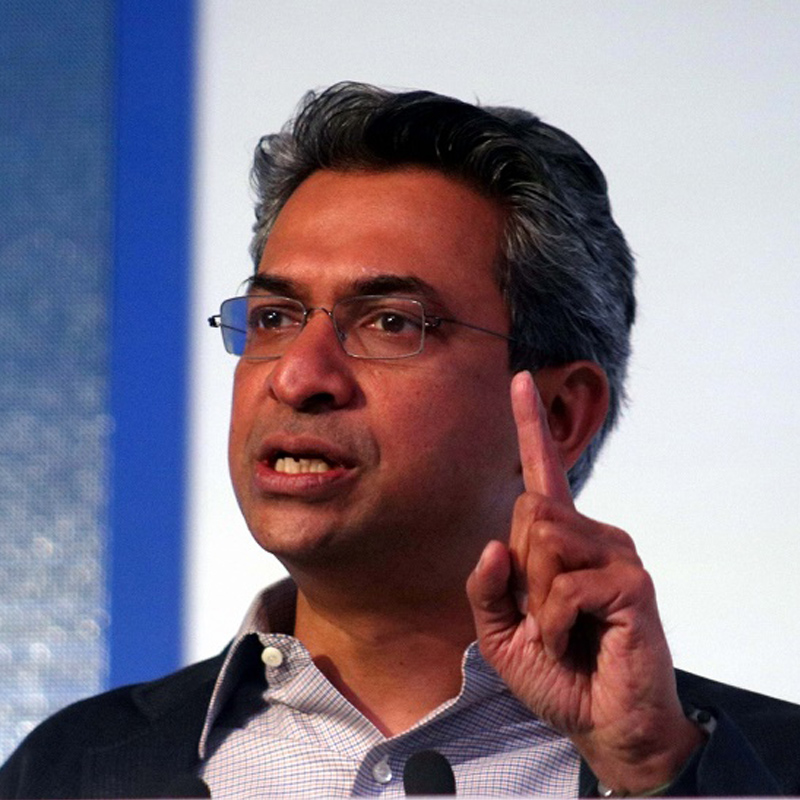
    When the online space is turning into more class agnostic nature, the gender divide is also abolishing. Google (http://www.indiantelevision.com/mam/marketing/brands/how-google-views-indias-internet-landscape-180531) vice president India and South Asia Rajan Anandan was speaking about new age internet users, notable trends and changes at the Subhash Ghosal Memorial Lecture recently. The veteran said that Indian internet users are no longer restricted to the metro, male, millennial phenomenon.
    Rajan highlights a gender disparity in internet usage that was prevalent in India three years ago, which wasn’t the case even in places like Africa or the Middle East. Just one in ten internet users was female. Several factors like lack of awareness and access worked in favour of the divide. Today, 37 per cent of India’s internet users are women which is expected to rise to 45 per cent by 2020.
    “If you go back even 8-10 months, you characterise India’s internet as male, metro and millennial. So millennial males in metro India was really what the internet was about. That has changed pretty dramatically. We see more women coming online. In fact, in terms of new internet users, there are many women than men actually and a lot of them are from rural India, small towns,” he commented.
    Speaking about megatrends in the Indian internet market, he said that voice, video, vernacular are grabbing high attention. Over the last 12-18 months, voice has shown the most surprising growth. There has been a 270 per cent growth in voice searches. “So, they (new users) are more comfortable speaking to internet than typing, tapping. India is going to be the world’s first voice driven internet market,” he said.
    Commenting on the vernacular(http://www.indiantelevision.com/iworld/social-media/google-assistant-becomes-bilingual-180901)growth, he said that almost 100 per cent of new Indian internet users access internet in local languages, not in English. The man with the statistics said over 200 million users access internet in regional languages. Moreover, there has been a 400 per cent growth in Hindi voice searches.

    Indian market went from a messaging first internet market to video first internet market over the time thanks to affordable data prices. “The journey of new age internet users has been pretty straightforward. They started with messaging, generally WhatsApp, then started using social networks, watched a little bit of video because data was expensive. That has actually changed. Almost every new internet user today actually starts his internet journey with video because they all understand video,” Anandan said. He also said 75 per cent of all traffic in mobile data in Indian internet actually comes from video, among which 95 per cent of total video consumption is happening in local languages.
    Indians are consuming higher amount of data, 8 GB per month, compared to developed markets like South Korea, the US and the UK. India is consuming more mobile data than the US and China combined. Even the smartphone quality has improved in India as 70 per cent of phones used here have a 2 GB RAM or more.
    The Google head said that the company is concerned with solving the problems of the common man. He said that the internet can even solve problems related to agriculture, financial institutions and health and education systems.

  • Google’s Sundar Pichai bats for free flow of cross-border data

    Google’s Sundar Pichai bats for free flow of cross-border data

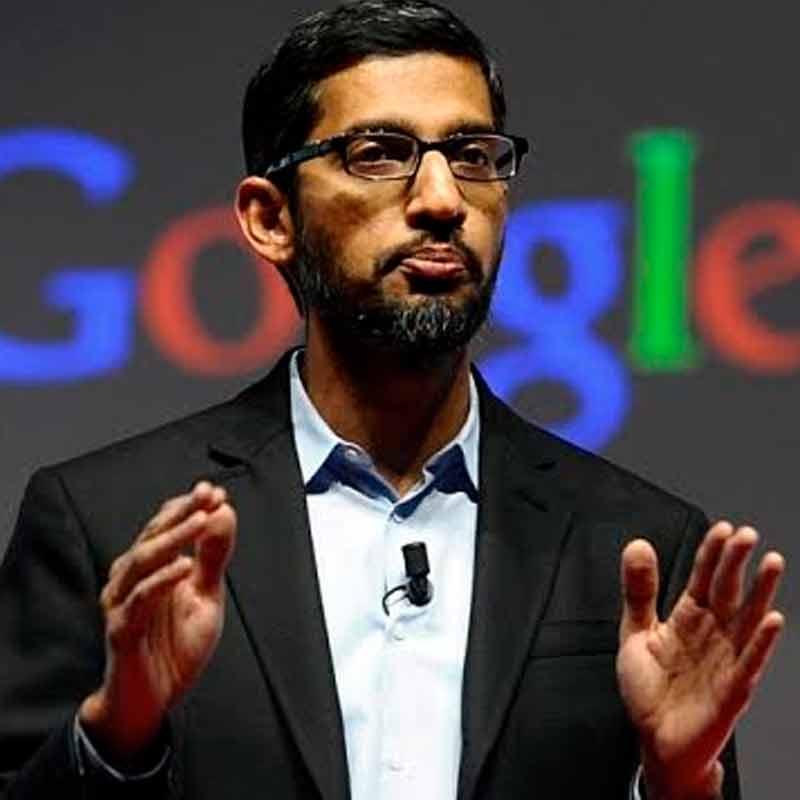
    MUMBAI: At a time when the Indian government is highly focussed on data localisation, Google CEO Sundar Pichai has advocated free flow of cross-border data. The Google exec wrote a letter to Union Minister of Electronics and Information Technology Ravi Shankar Prasad where he said such a step would encourage global companies to contribute to India’s digital economy. However, he also mentioned the importance of data privacy and security.

    “Free flow of data across borders – with a focus on user privacy and security – will encourage startups to innovate and expand globally and encourage global companies to contribute to India’s digital economy,” he said.

    Thanking Prasad for his visit to Google’s Mountain View campus last month Pichai said the company shares the vision of creating a truly ‘Digital India’ and remains firmly committed to being part of the India growth story.

    Recently, the Justice BN Srikrishna Committee recommended in a report that every data fiduciary in India shall ensure the storage of at least one serving copy of personal data on a server or data centre located in India. Along with that, it also stated that the government can notify some categories of personal data as critical personal data that have to be stored in a server or data centre located only in India. The government has extended the date to submit public feedback on the draft bill to 30 September.

  • Google Assistant becomes bilingual

    Google Assistant becomes bilingual

    MUMBAI: Google keeps dominating the tech scene across world with constant upgradation of its features. The tech giant has announced that it will now be able to understand and speak more than one language at a time.

    Users can now speak two languages interchangeably with the Assistant on smart speakers and phones. This move is a part of Google’s multi-year effort to make user-Assistant conversations more natural.

    “Currently, the Assistant can understand any pair of languages within English, German, French, Spanish, Italian, and Japanese. We’ll be expanding to more languages in the coming months,” the company said. It is also aiming to make Assistant trilingual in the future.

    In US market, Google’s Home speakers lag behind Amazon.com’s Echo speakers with roughly 27 percent of the market as compared with Amazon’s 41 percent. But according to analysts, the scene is different internationally as Amazon doesn’t have the same brand recognition outside of the United States.

    “We hope multilingual will encourage more use of the Assistant in bilingual homes, thus helping us continue to improve our training models,” Google  said as quoted by The Washington Post.

  • Google most influential brand: Ipsos study

    Google most influential brand: Ipsos study

    MUMBAI: Ipsos, an independent market research company controlled and managed by research professionals, has released a study on Most Influential Brands (MIB) in India. Affluent Indians have chosen their winners. Google has emerged as the MIB of circa 2017.

    Technology and e-tailing brands have taken up other places in the top five positions, as per Ipsos study. Amazon is at the number two spot, followed by the mobile service provider Jio at the third spot, social engagement site Facebook is ranked fourth, followed by e-marketplace Flipkart, at the fifth position.  

    Ipsos executive director brand health tracking Jyoti Malladi said, “Influential brands provide a sense of purpose by reflecting our personal values. They are an extension of us. They help consumers engage with them long after the purchase. Further, consumers make deep emotional connections with these brands as they are surrounded by them for the most part, occupying a meaningful place in their lives.”

    Barring one FMCG player, the rest are all technology and telecom brands – Samsung (ranked sixth), Patanjali (ranked seventh), Microsoft (ranked eighth), iPhone (ranked ninth) and Apple (ranked tenth).

    The MIB study ranks 100 brands across categories, shortlisted as per advertising spends. The key parameters of evaluation were – trustworthy, engagement, leading edge, corporate citizenship and presence.

    The study was conducted online, among 1000 nationally representative affluent audiences from the top metros.